

Temporomandibular disorder and generalized joint hypermobility: application of diagnostic criteria
Open accessThe DOI matches its Crossref record; 34 of the 35 references it cites were found in a registry or an index.
Abstract
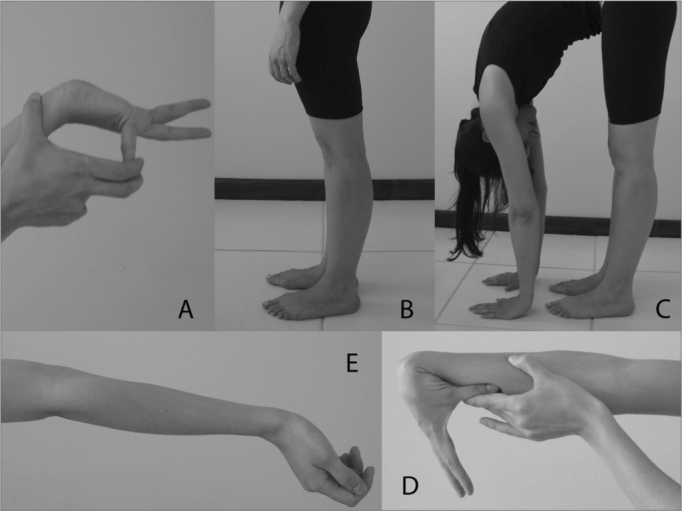
UNLABELLED: Generalized joint hypermobility (GJH) has been considered a predisposing factor for the development of temporomandibular disorder (TMD). AIM: To evaluate clinical and psychosocial aspects in individuals diagnosed with TMD with or without GJH. MATERIALS AND METHODS: Clinical and experimental study, which enrolled 34 women, from 18 to 35 years of age with TMD diagnosed by RDC/TMD. The GJH was assessed by the Beighton score and volunteers were broken down into 2 groups: with GJH (n = 22) and without GJH (n = 12). RESULTS: We found a high percentage of GJH (64. 71%). All participants had myofascial pain; 79. 41% had arthralgia and 41% had disk displacement. There was a correlation between higher GJH scores and higher passive mouth opening amplitude (p = 0.0034), with pain (p = 0.0029) and without pain (p = 0.0081). Greater mandibular range of motion was observed in the group with GJH, except for protrusion. Painful mouth opening was statistically higher in the GJH group (p = 0.0279). CONCLUSIONS: Individuals with TMD associated or not to GJH do not differ significantly regarding clinical and psychosocial aspects, except in the mandibular opening range of motion, which if kept at physiological levels can lead to a late diagnosis of TMD in these individuals.
Overview
The claims and statistics of this paper haven’t been checked yet.
Free: it reads the open-access text and checks the first 5 claims that cite a source we can check. Create a free account to check every claim.
Integrity signals
Registry
Cites
Statistics
Figures
Verification
Claims the paper makes
The claims and statistics of this paper haven’t been checked yet.
Free: it reads the open-access text and checks the first 5 claims that cite a source we can check. Create a free account to check every claim.
Claims other papers make about this one
Each is checked against this paper’s own text: does it say what the citing paper says it does?
The cited source says what the claim attributes to it.
In the citing paper
“However, a conflicting study found a significant positive correlation between mandibular ROM and a positive BS in a study of over 30 women with TMD [36].”
From The Beighton Score as a measure of generalised joint hypermobility (2021) · cites this paper as [36]
Self-check
Percentages, sums and reported differences re-computed from the paper’s own numbers.
The self-check needs the paper’s full text.
Citations
Cites
(1992) · PubMed · Cited by 3,804
Articular mobility in an African population.
Beighton, P., Solomon, L., & Soskolne, C. L. (1973) · Annals of the Rheumatic Diseases · doi:10.1136/ard.32.5.413 · Cited by 1,727
Dworkin, S. F., Huggins, K. H., LeResche, L., Von Korff, M., Howard, J., Truelove, E., & Sommers, E. (1990) · The Journal of the American Dental Association · doi:10.14219/jada.archive.1990.0043 · Cited by 953
Prevalence study of signs and symptoms of temporomandibular disorders in university students
Pedroni, C. R., De Oliveira, A. S., & Guaratini, M. I. (2003) · Journal of Oral Rehabilitation · doi:10.1046/j.1365-2842.2003.01010.x · Cited by 279
Hypermobility and the hypermobility syndrome
Simmonds, J. V., & Keer, R. J. (2007) · Manual Therapy · doi:10.1016/j.math.2007.05.001 · Cited by 263
MANFREDINI, D., CHIAPPE, G., & BOSCO, M. (2006) · Journal of Oral Rehabilitation · doi:10.1111/j.1365-2842.2006.01600.x · Cited by 179
The role of parafunctions, emotions and stress in predicting facial pain
GLAROS, A. G., WILLIAMS, K., & LAUSTEN, L. (2005) · The Journal of the American Dental Association · doi:10.14219/jada.archive.2005.0200 · Cited by 177
Anamnestic Index Severity and Signs and Symptoms of TMD
Bevilaqua-Grossi, D., Chaves, T. C., de Oliveira, A. S., & Monteiro-Pedro, V. (2006) · CRANIO® · doi:10.1179/crn.2006.018 · Cited by 126
Anxiety disorders in the joint hypermobility syndrome
Bulbena, A., Duró, J. C., Porta, M., Martín-Santos, R., Mateo, A., Molina, L., Vallescar, R., & Vallejo, J. (1993) · Psychiatry Research · doi:10.1016/0165-1781(93)90008-5 · Cited by 118
Tartaglia, G. M., da Silva, M. A. M. R., Bottini, S., Sforza, C., & Ferrario, V. F. (2007) · Manual Therapy · doi:10.1016/j.math.2007.05.011 · Cited by 117
Russek, L. N. (1999) · Physical Therapy · doi:10.1093/ptj/79.6.591 · Cited by 115
Etiopathogenesis of disk displacement of the temporomandibular joint: A review of the mechanisms
Manfredini, D. (2009) · Indian Journal of Dental Research · doi:10.4103/0970-9290.51365 · Cited by 100
Coster, P. J. D., den Berghe, L. V., & MARTENS, L. C. (2005) · PubMed · doi:10.11607/jofph.1947 · Cited by 86
Pehling, J., SCHIFFMAN, E. L., Look, J. O., Shaefer, J. R., Lenton, P., & Fricton, J. (2002) · PubMed · Cited by 81
Is Joint Hypermobility Related to Anxiety in a Nonclinical Population Also?
Bulbena, A., Agulló, A., Pailhez, G., Martín-Santos, R., Porta, M., Guitart, J., & Gago, J. (2004) · Psychosomatics · doi:10.1176/appi.psy.45.5.432 · Cited by 76
Hirsch, C., John, M. T., & Stang, A. (2008) · European Journal of Oral Sciences · doi:10.1111/j.1600-0722.2008.00581.x · Cited by 73 · cited 4×
“Hisch et al.(16) decided to analyze whether GJH is a risk factor for TMD in a study involving 895 individuals and noticed an association between GJH, increase in mandibular range of motion and reciprocal click.”
BackgroundInfluentialMaximum jaw opening capacity in adolescents in relation to general joint mobility
WESTLING, L., & HELKIMO, E. (1992) · Journal of Oral Rehabilitation · doi:10.1111/j.1365-2842.1992.tb01112.x · Cited by 62
Kavuncu, V., Sahin, S., Kamanli, A., Karan, A., & Aksoy, C. (2006) · Rheumatology International · doi:10.1007/s00296-005-0620-z · Cited by 60 · cited 4×
“71%), in agreement with Kavuncu et al.(14), who found 79.”
BackgroundResultInfluentialGeneral joint hypermobility and temporomandibular joint derangement in adolescents.
Westling, L., & Mattiasson, A. (1992) · Annals of the Rheumatic Diseases · doi:10.1136/ard.51.1.87 · Cited by 60
Generalized joint laxity and temporomandibular disorders.
Perrini, F., Tallents, R. H., Katzberg, R. W., Ribeiro, R. F., Kyrkanides, S., & Moss, M. E. (1997) · PubMed · Cited by 50
Winocur, E., Gavish, A., Halachmi, M., Bloom, A., & Gazit, E. (2000) · Journal of Oral Rehabilitation · doi:10.1046/j.1365-2842.2000.00546.x · Cited by 40 · cited 4×
“On the other hand, Boering apud Winocur et al.5 stated that hypermobility by itself does not affect the TMJ, unless there is a movement dysfunction such as a click or a joint lock.”
BackgroundInfluentialSuvinen, T. I., Reade, P. C., Könönen, M., & Kemppainen, P. (2003) · Journal of Oral Rehabilitation · doi:10.1046/j.1365-2842.2003.01114.x · Cited by 37 · cited 2×
“Suvinen et al.(33) found similar results, with a prevalence of mixed myogenic and arthrogenic dysfunction in 44% of the individuals.”
ResultMandibular border positions and their relationships with peripheral joint mobility
McCARROLL, R. S., HESSE, J. R., NAEIJE, M., YOON, C. K., & HANSSON, T. L. (1987) · Journal of Oral Rehabilitation · doi:10.1111/j.1365-2842.1987.tb00701.x · Cited by 37
Temporomandibular Joint Osteoarthrosis and Temporomandibular Joint Hypermobility
Dijkstra, P. U., de Bont, L. G. M., de Leeuw, R., Stegenga, B., & Boering, G. (1993) · CRANIO® · doi:10.1080/08869634.1993.11677978 · Cited by 33 · cited 2×
“In a longitudinal study, Dijkstra et al.(32) also did not notice clinical and functional differences between individuals with and without TMD hypermobility, nonetheless, they had higher incidences of radiographic signs of osteoarthrosis.”
BackgroundRelationship Between Systemic Joint Laxity, TMJ Hypertranslation, and Intra-articular Disorders
Conti, P. C. R., Miranda, J. E. S., & Araujo, C. R. P. (2000) · CRANIO® · doi:10.1080/08869634.2000.11746132 · Cited by 33 · cited 2×
“This is in agreement with the findings by Conti et al.4 and Saéz-Yuguero et al.17.”
ResultTemporomandibular joint dysfunction
Westling, L., Holm, S. H., & Wallentin, I. (1992) · Oral Surgery Oral Medicine Oral Pathology · doi:10.1016/0030-4220(92)90395-7 · Cited by 32
WESTLING, L., & MATTIASSON, A. (1991) · European Journal of Oral Sciences · doi:10.1111/j.1600-0722.1991.tb01022.x · Cited by 32
Sáez-Yuguero, M. D. R., Linares-Tovar, E., Calvo-Guirado, J. L., Bermejo-Fenoll, A., & Rodríguez-Lozano, F. J. (2009) · Oral Surgery, Oral Medicine, Oral Pathology, Oral Radiology, and Endodontology · doi:10.1016/j.tripleo.2009.02.021 · Cited by 26
Temporomandibular Joint Osteoarthrosis and Generalized Joint Hypermobility
Dijkstra, P. U., de Bont, L. G. M., Stegenga, B., & Boering, G. (1992) · CRANIO® · doi:10.1080/08869634.1992.11677913 · Cited by 25
Caracterização dos pacientes de um ambulatório de disfunção temporomandibular e dor orofacial
Bove, S. R. K., Guimarães, A. S., & Smith, R. L. (2005) · Revista Latino-Americana de Enfermagem · doi:10.1590/s0104-11692005000500012 · Cited by 22
Incidence of Systemic Joint Hypermobility and Temporomandibular Joint Hypermobility in Pregnancy
Silveira, E. B., Rocabado, M., Russo, A. K., Cogo, J. C., & Osório, R. A. L. (2005) · CRANIO® · doi:10.1179/crn.2005.019 · Cited by 19
Is temporomandibular joint dysfunction associated with generalized joint hypermobility?
Greenwood, L. F. (1987) · Journal of Prosthetic Dentistry · doi:10.1016/0022-3913(87)90423-9 · Cited by 18
Predisposition for Temporomandibular Joint Disorders: Loose Ligaments
Deodato, F., Trusendi, R., Giorgetti, R., & Scalese, M. (2006) · CRANIO® · doi:10.1179/crn.2006.029 · Cited by 16
Russek, L. N. (2012) · Springer eBooks · doi:10.1007/springerreference_109547 · Cited by 15
Cited by
The Beighton Score as a measure of generalised joint hypermobility
Malek, S., Reinhold, E. J., & Pearce, G. S. (2021) · Rheumatology International · doi:10.1007/s00296-021-04832-4 · Cited by 224
Postural tachycardia syndrome and other forms of orthostatic intolerance in Ehlers-Danlos syndrome
Roma, M., Marden, C. L., De Wandele, I., Francomano, C. A., & Rowe, P. C. (2018) · Autonomic Neuroscience · doi:10.1016/j.autneu.2018.02.006 · Cited by 133
TEMPOROMANDIBULAR DYSFUNCTION, STRESS AND COMMON MENTAL DISORDER IN UNIVERSITY STUDENTS
Augusto, V. G., Perina, K. C. B., Penha, D. S. G., dos Santos, D. C. A., & Oliveira, V. A. S. (2016) · Acta Ortopédica Brasileira · doi:10.1590/1413-785220162406162873 · Cited by 91
Oral and mandibular manifestations in the Ehlers–Danlos syndromes
Mitakides, J., & Tinkle, B. T. (2017) · American Journal of Medical Genetics Part C: Seminars in Medical Genetics · doi:10.1002/ajmg.c.31541 · Cited by 66
Connective tissue, Ehlers–Danlos syndrome(s), and head and cervical pain
Castori, M., Morlino, S., Ghibellini, G., Celletti, C., Camerota, F., & Grammatico, P. (2015) · American Journal of Medical Genetics Part C: Seminars in Medical Genetics · doi:10.1002/ajmg.c.31426 · Cited by 67
“The surgical repertoire various approaches, comprising occipi-tovertebral fusion [Garrido and Sasso, 2012], C1-C2 posterior fixation (Jacobson et al., 2012) and subaxial cervical fixation [Pelton et al., 2012].”
Method
Metadata
- Authors
- Pasinato, F., Souza, J. A., Corrêa, E. C. R., & Silva, A. M. T. D.
- Affiliations
- Universidade Federal de Santa Maria (BR)
- Universidade Federal de São Paulo (BR)
- Corresponding author
- Pasinato, Fernanda
- ORCID
- Venue
- Brazilian Journal of Otorhinolaryngology
- Publisher
- FapUNIFESP (SciELO)
- Published
- 2011-08
- Volume
- 77
- Issue
- 4
- Pages
- 418-425
- ISSN
- 1808-8686 (ISSN-L)
- PMC
- PMC9450698
- OpenAlex
- W2113216937
- Cited by
- 50
- References
- 35
- Citations by year
- 2026: 1 · 2025: 1 · 2024: 4 · 2023: 4 · 2022: 2 · 2021: 7 · 2020: 5 · 2019: 2 · 2018: 2 · 2017: 1 · 2016: 6 · 2015: 7 · 2014: 3 · 2013: 4 · 2012: 1
- FWCI
- 4.32
- Type
- journal article
- Language
- en
- Open access
- gold
- doi.org
- Licence
- cc-by-nc-nd
- Locations
- Brazilian Journal of Otorhinolaryngology (publishedVersion, cc-by-nc-nd)
- PubMed Central (publishedVersion, cc-by)
- PubMed (publishedVersion)
- LA Referencia (Red Federada de Repositorios Institucionales de Publicaciones Científicas) (publishedVersion, other-oa)
- Americanae (AECID Library) (submittedVersion, other-oa)
- DOAJ (DOAJ: Directory of Open Access Journals) (submittedVersion, cc-by-sa)
- LA Referencia (Red Federada de Repositorios Institucionales de Publicaciones Científicas) (submittedVersion, other-oa)
- Topics
- Health Sciences › Dentistry › Oral Surgery › Temporomandibular Joint Disorders
- Health Sciences › Medicine › Psychiatry and Mental health › Fibromyalgia and Chronic Fatigue Syndrome Research
- Health Sciences › Dentistry › Periodontics › Oral and gingival health research
- Keywords
- temporomandibular disorders, generalized joint hypermobility, Beighton score, myofascial pain, joint pain, disc displacement, mandibular range of motion, RDC/TMD diagnostic criteria, psychosocial aspects, women
- MeSH terms
- Adolescent, Adult, Chronic Disease, Cross-Sectional Studies, Depression, Facial Pain, Female, Humans, Joint Instability, Severity of Illness Index, Temporomandibular Joint Disorders, Young Adult
About these checks
Registry, retraction, Cites and statistics results are computed, not judged, with one exception: a printed reference that no index lists is read once by a model before it counts as a citation error. Claims are extracted by a model and kept only when their quote appears verbatim in the text; each cited source is then checked, with a model’s help, for whether it says what the claim relies on. Those verdicts can be wrong — read the claim’s quote and the cited source before relying on one.
Statistics and arithmetic are recomputed, not judged.
Confidence bands are shown only for fields calibrated on our annotated test set. None is calibrated yet, so no band is shown.
What counts as a claim ›How we measure confidence ›How we check this ›
Are you an author, or do you see a problem with this page? Request a review
Data sources
Bibliographic data: Semantic Scholar, OpenAlex, Crossref.
Contains information from the Semantic Scholar Academic Graph Datasets, made available under the ODC Attribution License (ODC-BY 1.0).
Semantic Scholar’s data is described in: Kinney, R., et al. (2023). The Semantic Scholar Open Data Platform. arXiv:2301.10140.
