

Role of cognitive reserve in progression from mild cognitive impairment to dementia
Open accessThe DOI matches its Crossref record; 42 of the 42 references it cites were found in a registry or an index.
Abstract
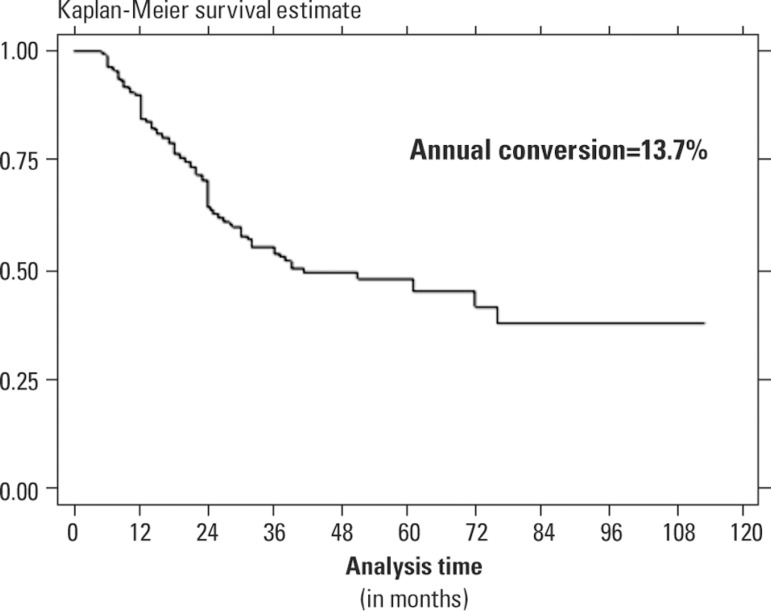
Abstract Cognitive reserve is the ability to optimize performance through differential recruitment of brain networks, which may reflect the use of alternative cognitive strategies. Objectives: To identify factors related to cognitive reserve associated with progression from mild cognitive impairment (MCI) to degenerative dementia. Methods: A cohort of 239 subjects with MCI (age: 72.2±8.1 years, 58% women, education: 12 years) was assessed and followed for five years (2001 to 2006). Results: In the first year, 13.7% of MCI converted to dementia and 34.7% converted within three years (78.3% converted to Alzheimer's dementia). Risk factors for those who converted were education less than 12 years, MMSE score less than 27, Boston naming test score less than 51, IQ (Intelligence Quotient) less than 111, age over 75 years, lack of occupation at retirement, and presence of intrusions in memory recall (all account for 56% of the variability of conversion). Conclusions: MCI patients are a population at high risk for dementia. The study of risk factors (e.g. IQ, education and occupation), particularly those related to cognitive reserve, can contribute important evidence to guide the decision-making process in routine clinical activity and public health policy.
Overview
The claims and statistics of this paper haven’t been checked yet.
Free: it reads the open-access text and checks the first 5 claims that cite a source we can check. Create a free account to check every claim.
Integrity signals
Registry
Cites
Statistics
Figures
Verification
Claims the paper makes
The claims and statistics of this paper haven’t been checked yet.
Free: it reads the open-access text and checks the first 5 claims that cite a source we can check. Create a free account to check every claim.
Claims other papers make about this one
Each is checked against this paper’s own text: does it say what the citing paper says it does?
The source backs part of the claim, not all of it — or backs it for a different population, condition or comparison.
In the citing paper
“Studies show that brain reserve is positively correlated with IQ, educational attainment, and engagement in cognitively stimulating occupational and leisurely activities, and negatively correlated with the transition from MCI to dementia [5,90].”
From Digital dementia in the internet generation: excessive screen time during brain development will increase the risk of Alzheimer's disease and related dementias in adulthood (2022) · cites this paper as [90]
Experimental — accuracy not yet measured
Self-check
Percentages, sums and reported differences re-computed from the paper’s own numbers.
The self-check needs the paper’s full text.
Citations
Cites
Folstein, M. F., Folstein, S. E., & McHugh, P. R. (1975) · Journal of Psychiatric Research · doi:10.1016/0022-3956(75)90026-6 · Cited by 88,282
An inventory for measuring depression
BECK, A. T. (1961) · Archives of General Psychiatry · doi:10.1001/archpsyc.1961.01710120031004 · Cited by 38,032 · cited 2×
“Each subject underwent a uniform structured evaluation , including medical history, complete neurological examination; neuropsychological assessment (see below) and the Beck Depression Inventory.”
McKhann, G., Drachman, D., Folstein, M., Katzman, R., Price, D., & Stadlan, E. M. (1984) · Neurology · doi:10.1212/wnl.34.7.939 · Cited by 27,915
Kok, J. S., Berg, I. J., & Scherder, E. J. A. (2013) · Dementia and Geriatric Cognitive Disorders Extra · doi:10.1159/000353441 · Cited by 20,589
Older Adults' Reasons for Using Technology while Aging in Place
Peek, S. T. M., Luijkx, K. G., Rijnaard, M. D., Nieboer, M. E., van der Voort, C. S., Aarts, S., van Hoof, J., Vrijhoef, H. J. M., & Wouters, E. J. M. (2016) · Gerontology · doi:10.1159/000430949 · Cited by 19,690
Sensitivity and False Alarm Rate of a Fall Sensor in Long-Term Fall Detection in the Elderly
Kangas, M., Korpelainen, R., Vikman, I., Nyberg, L., & Jämsä, T. (2015) · Gerontology · doi:10.1159/000362720 · Cited by 18,909
Mild Cognitive Impairment: Clinical Characterization and Outcome
Petersen, R. C., Smith, G. E., Waring, S. C., Ivnik, R. J., Tangalos, E. G., & Kokmen, E. (1999) · Archives of Neurology · doi:10.1001/archneur.56.3.303 · Cited by 8,980
Diagnostic and Statistical Manual of Mental Disorders
Siegel, L. J., & Fletcher‐Janzem, E. (2008) · Encyclopedia of Special Education · doi:10.1002/9780470373699.speced0655 · Cited by 8,477
Validity of the Trail Making Test as an Indicator of Organic Brain Damage
Reitan, R. M. (1958) · Perceptual and Motor Skills · doi:10.2466/pms.1958.8.3.271 · Cited by 7,928
Winblad, B., Palmer, K., Kivipelto, M., Jelic, V., Fratiglioni, L., Wahlund, L. ‐., Nordberg, A., Bäckman, L., Albert, M., Almkvist, O., et al. (2004) · Journal of Internal Medicine · doi:10.1111/j.1365-2796.2004.01380.x · Cited by 4,946
Research works printed but not linked: 3
- Signoret JL Whiteley A Memory battery scale Intern Neuropsych Soc Bull 1979 9 2 26
- Harris P Drake M Allegri RF Deterioro cognitivo leve: en búsqueda de la predemecia Acta Psiquiátr Psicol Am Lat 2001 47 11 20
- Allegri RF Drake M Harris P Serrano CM Taragano FE Intrusions in Verbal Learning in Mild Cognitive Impairment: Prodromal Alzheimer's Disease? Neurology 2005 65 Suppl 1 A 165
Cited by
Nelson, M. E., Jester, D. J., Petkus, A. J., & Andel, R. (2021) · Neuropsychology Review · doi:10.1007/s11065-021-09478-4 · Cited by 190
“, 2017)); however, some still show reduced risk of progression with high CR and transition from MCI to dementia (Allegri et al., 2010).”
BackgroundManwell, L. A., Tadros, M., Ciccarelli, T. M., & Eikelboom, R. (2022) · Journal of Integrative Neuroscience · doi:10.31083/j.jin2101028 · Cited by 122
Park, H., Park, J., Na, H. R., Shimada, H., Kim, G. M., Jung, M.-K., Kim, W. K., & Park, K. W. (2019) · Journal of Clinical Medicine · doi:10.3390/jcm8070940 · Cited by 140
“In the pre-dementia stage, converted patients showed lower global cognitive function and greater semantic memory impairment (verbal fluency and vocabulary) than non-converted patients [37].”
BackgroundStocker, H., Möllers, T., Perna, L., & Brenner, H. (2018) · Translational Psychiatry · doi:10.1038/s41398-018-0221-8 · Cited by 96
Cognitive Reserve in Dementia: Implications for Cognitive Training
Mondini, S., Madella, I., Zangrossi, A., Bigolin, A., Tomasi, C., Michieletto, M., Villani, D., Giovanni, G. D., & Mapelli, D. (2016) · Frontiers in Aging Neuroscience · doi:10.3389/fnagi.2016.00084 · Cited by 127
“Data from the literature provide evidence of a reduced risk of AD in people with high educational level (Scarmeas et al., 2004; Allegri et al., 2010).”
BackgroundResting-state prefrontal EEG biomarkers in correlation with MMSE scores in elderly individuals
Choi, J.-M., Ku, B. U., You, Y. G., Jo, M., Kwon, M., Choi, Y., Jung, S., Ryu, S., Park, E., Go, H.-Y., et al. (2019) · Scientific Reports · doi:10.1038/s41598-019-46789-2 · Cited by 97
Robitaille, A., van den Hout, A., Machado, R. J. M., Bennett, D. A., Čukić, I., Deary, I. J., Hofer, S. M., Hoogendijk, E. O., Huisman, M., Johansson, B., et al. (2018) · Alzheimer's & Dementia · doi:10.1016/j.jalz.2017.10.003 · Cited by 77
“Several risk factors producing substantial inter-individual differences have been identified for their association with cognitive decline and dementia, including occupational attainment [6-8], education [8-12], and other life experiences [13, 14].”
BackgroundXue, H., Sun, Q., Liu, L., Zhou, L., Liang, R., He, R., & Yu, H. (2017) · Comprehensive Psychiatry · doi:10.1016/j.comppsych.2017.07.003 · Cited by 88
Liu, S., Ando, F., Fujita, Y., Liu, J., Maeda, T., Shen, X., Kikuchi, K., Matsumoto, A., Yokomori, M., Tanabe-Fujimura, C., et al. (2019) · Journal of Biological Chemistry · doi:10.1074/jbc.ra118.006420 · Cited by 57
“Less IQ level has been shown to be a risk factor for progression from mild cognitive impairment to degenerative dementia (36).”
BackgroundAmanollahi, M., Amanollahi, S., Anjomshoa, A., & Dolatshahi, M. (2021) · European Journal of Neuroscience · doi:10.1111/ejn.15183 · Cited by 59
“Many studies have documented that higher levels of CR reduces the risk of the progression of mild cognitive impairment (MCI) to severe dementia (Allegri et al., 2010; Kryscio et al., 2006; Xu et al., 2020).”
BackgroundLee, S. Y., Kang, J. M., Kim, D. J., Woo, S. K., Lee, J., & Cho, S. (2020) · Frontiers in Aging Neuroscience · doi:10.3389/fnagi.2020.590607 · Cited by 48
“Since educational and occupational attainment were found to affect the progression to dementia in patients with mild cognitive impairment (MCI) (Allegri et al., 2010; Myung et al., 2017), CR may play a protective role at the preclinical or prodromal stage of dementia that manifests with subtle decline of cognitive and…”
BackgroundRelationship between Brain Age-Related Reduction in Gray Matter and Educational Attainment
Rzezak, P., Squarzoni, P., Duran, F., Alves, T. C. T. F., Tamashiro-Duran, J. H., Bottino, C. M. C., Ribeiz, S. R. I., Lotufo, P. A., Menezes, P. R., Scazufca, M., et al. (2015) · PLoS ONE · doi:10.1371/journal.pone.0140945 · Cited by 41
“In this scenario, we cannot rule out the possibility that differences in socioeconomic status, occupation, intellectual abilities and physical activities could at least partially interfere in the brain aging processes [60,61].”
BackgroundEffects of Cognitive Reserve in Alzheimer’s Disease and Cognitively Unimpaired Individuals
Lee, D. H., Seo, S. W., Roh, J. H., Oh, M., Oh, J. S., Oh, S. J., Kim, J. S., & Jeong, Y. (2022) · Frontiers in Aging Neuroscience · doi:10.3389/fnagi.2021.784054 · Cited by 39
“The literature has reported CR-related attenuated cognitive decline in early stages of AD and CU groups using education (Allegri et al., 2010; Clouston et al., 2019), occupational complexity (Andel et al., 2005; Smart et al., 2014), composite scores (Pettigrew et al., 2017; Soldan et al., 2017),…”
Lojo‐Seoane, C., Facal-Mayo, D., & Juncos‐Rabadán, O. (2012) · Revista Española de Geriatría y Gerontología · doi:10.1016/j.regg.2012.02.006 · Cited by 59
“…alto (> 12 años) y bajo (< de 12 años) Participantes con menor educación tienen concentraciones de t-tau más altas que los de mayor educación Allegri et al. (2010)16 239 64-81 - MMSE, batería de memoria y cognitiva Nivel educativo: bajo (< 12 años) y alto (> 12 años)- Principales…”
BackgroundFang, M. L., Coatta, K., Badger, M., Wu, S., Easton, M., Nygård, L., Astell, A., & Sixsmith, A. (2017) · Journal of Applied Gerontology · doi:10.1177/0733464815589987 · Cited by 23
“Current projections also suggest that 3% to 15% of those who experience cognitive impairment will eventually progress to full dementia on an annual basis (Allegri et al., 2010; Busse, Angermeyer, & Riedel-Heller, 2006; Farias, Mungas, Reed, Harvey, & DeCarli, 2009; Geda, 2012).”
BackgroundHighly superior autobiographical memory in aging: A single case study
Santangelo, V., Pedale, T., Colucci, P., Giulietti, G., Macrì, S., & Campolongo, P. (2021) · Cortex · doi:10.1016/j.cortex.2021.05.011 · Cited by 28
Myung, W., Lee, C., Park, J. H., Woo, S., Kim, S., Kim, S., Chung, J. W., Kang, H. S., Lim, S., Choi, J., et al. (2016) · Journal of Alzheimer s Disease · doi:10.3233/jad-160257 · Cited by 35
“Allegri et al. reported that lack of occupation is a risk factor for progression from MCI to dementia [21].”
Reserva cognitiva y habilidades lingüísticas en mayores sanos
López-Higes, R., Rubio-Valdehita, S., Prados, J. M., & Fuentes, M. G. (2013) · Revista de Neurología · doi:10.33588/rn.5703.2013120 · Cited by 40
“En el estudio longitudinal de Allegri et al [33], el factor que explicaba el mayor porcentaje de la varianza (26”
BackgroundEducation level predicts retrospective metamemory accuracy in healthy aging and Alzheimer’s disease
Szajer, J., & Murphy, C. A. (2013) · Journal of Clinical and Experimental Neuropsychology · doi:10.1080/13803395.2013.844771 · Cited by 23
“Therefore, when AD is diagnosed in highly educated individuals they may be more advanced in the disease’s pathology, resulting in the more rapid declines reported in individuals with high levels of education (Albert et al., 1995; Allegri et al., 2010; Le Carret et al., 2005; Tucker & Stern, 2011).”
BackgroundAniwattanapong, D., Tangwongchai, S., Supasitthumrong, T., Hemrunroj, S., Tunvirachaisakul, C., Tawankanjanachot, I., Chuchuen, P., Snabboon, T., Carvalho, A. F., & Maes, M. H. J. (2018) · Aging & Mental Health · doi:10.1080/13607863.2018.1501668 · Cited by 24
“Moreover, lower education (<12 years) is an established risk factor increasing the conversion from MCI to dementia (Allegri et al., 2010).”
BackgroundTsormpatzoudi, S.-O., Μoraitou, D., Papaliagkas, V. T., Pezirkianidis, C., & Tsolaki, M. (2023) · Behavioral Sciences · doi:10.3390/bs13100792 · Cited by 16
“At this point, it should be noted that the current study’s late MCI patients had a lower educational level in contrast to early and healthy participants, which has been demonstrated as a risk factor for developing fast and severe types of cognitive impairment [108,109].”
ResultProper name retrieval in cognitive decline: The role of cognitive reserve
Montemurro, S., Mondini, S., Nucci, M., & Semenza, C. (2018) · The Mental Lexicon · doi:10.1075/ml.18004.mon · Cited by 17
Rivera-Fernández, C., Custodio, N., & Soto‐Añari, M. (2021) · Dementia & Neuropsychologia · doi:10.1590/1980-57642021dn15-020006 · Cited by 21
Jia, F., Li, X., Liu, F., Shi, X., Liu, H., & Cao, F. (2020) · Journal of Psychosomatic Research · doi:10.1016/j.jpsychores.2020.110224 · Cited by 16
Feldberg, C., Hermida, P. D., Tartaglini, M. F., Stefani, D., Somale, V., & Allegri, R. (2016) · AIMS Medical Science · doi:10.3934/medsci.2016.1.77 · Cited by 17
“The concept of cognitive reserve posits that individual differences in how tasks are processed might provide differential reserve against brain pathology [13].”
BackgroundBouts, M. J. R. J., van der Grond, J., Vernooij, M. W., Koini, M., Schouten, T. M., de Vos, F., Feis, R. A., Cremers, L. G. M., Lechner, A., Schmidt, R., et al. (2019) · Human Brain Mapping · doi:10.1002/hbm.24554 · Cited by 15
“…PET-derived biomarkers (Dukart et al., 2013; Li et al., 2014), or additional cognitive assessment scores including measures of cognitive reserve (Allegri et al., 2010; Moradi et al., 2015; Vieira, Pinaya, & Mechelli, 2017; Wang et al., 2017) may further augment classification accuracy without…”
BackgroundMougias, M., Beratis, I., Moustaka, K., Alexopoulos, P., & Assimakopoulos, K. (2023) · Geriatrics · doi:10.3390/geriatrics8020038 · Cited by 7
“On the other hand, the presence of greater cognitive reserve, as reflected by relevant indicators such as high educational attainment, language skills, and frequent cognitive or social activities in patients with MCI, appears to be a protective factor against the development of dementia [30,31].”
BackgroundSun, N., Jia, R., Guo, C., Sun, T., Dong, X., Li, L., & Yang, P. (2021) · Nursing Open · doi:10.1002/nop2.801 · Cited by 8
“These include occupational complexity (Karp et al., 2009; Qiu et al., 2003; Wajman & Bertolucci, 2010), educational attainment (Allegri et al., 2010; Robitaille et al., 2018; Terrera et al., 2014), marital status (Håkansson et al., 2009), socioeconomic status (Osler et al., 2013) and social…”
Burgos-Morelos, L. P., Rivera-Sánchez, J. J., Vargas, Á. D. S., Arreola-Mora, C., Chávez-Negrete, A. J., Lugo, J. E., Faubert, J., & Pérez-Pacheco, A. (2023) · Applied Neuropsychology Adult · doi:10.1080/23279095.2023.2169884 · Cited by 4
“Years of education are one of the main factors of cognitive reserve (CR) associated with the protective effect on the progression of MCI to dementia (Allegri et al., 2010; Nelson et al., 2021).”
Sepehry, A. A., Schultz, I. Z., Cohen, D. A., & Greer, S. C. (2022) · Psychological Injury and Law · doi:10.1007/s12207-022-09456-y · Cited by 7
“…reserve capacity [for example, by virtue of low premorbid IQ, learning disability, attention deficit hyperactivity disorder (ADHD), or prior brain injury] are at risk of more rapid and more severe cognitive decline (Allegri et al., 2010; Fraser et al., 2019; Stern, 2012; Steward et al., 2018).”
BackgroundCognitive reserve in young-onset cognitive impairment
Carbone, C., Maramotti, R., Balboni, E., Beltrami, D., Ballotta, D., Bedin, R., Gallingani, C., Tondelli, M., Salemme, S., Gasparini, F., et al. (2025) · Brain and Cognition · doi:10.1016/j.bandc.2025.106297 · Cited by 10
“…works high-lighting associations between CRIq measuring education and better cognitive performances in MCI patients (Berezuk et al., 2021; Feldberg et al., 2016), specifically in naming ability and divided attention (Allegri et al., 2010; Ciccarelli et al., 2018; Rold ´ an-Tapia et al., 2012).”
Sung, J. E., Choi, S., Kim, G. H., & Jeong, J. H. (2023) · International Journal of Speech-Language Pathology · doi:10.1080/17549507.2023.2273771 · Cited by 1
“Allegri et al. (2010) reported that factors such as IQ, educational level, and job complexity were associated with cognitive reserve, accounting for 56% of the variability in the conversion from MCI to dementia.”
La ocupación en la Gerontología: una perspectiva crítica del Modelo de Ocupación Humana
Krzemien, D., Miranda, C., & Martin, N. G. (2020) · Revista Ocupación Humana · doi:10.25214/25907816.268 · Cited by 10
“Con los aportes de las neurociencias acerca de los cambios del cerebro envejecido (Harris y Allegri, 2009; Allegri et al., 2010; Soto y Arcos, 2010; Redolar, 2014) es posible explicar cómo la neuroplasticidad de las redes neuronales, en relación con las capacidades de reserva cognitiva, permiten…”
BackgroundFilipin, F., Feldman, M. L., Taragano, F. E., Martelli, M., Sanchez, V., García, V. A., Tufró, G., Heisecke, S. L., Serrano, C. M., & Dillon, C. (2015) · AIMS Medical Science · doi:10.3934/medsci.2016.1.1 · Cited by 3
“5), since higher IQ is one of the hallmarks of cognitive reserve [15].”
BackgroundSelf-citationDanesin, L., D’Este, G., Barresi, R., Piazzalunga, E., Garbo, A. D., Giustiniani, A., Semenza, C., Bottini, G., Oliveri, M., & Burgio, F. (2025) · Biomedicines · doi:10.3390/biomedicines13102447 · Cited by 1
“Similarly, higher cognitive reserve has been identified as a protective factor against the development of dementia in patients with MCI [60,61].”
Mohammed, A., Ovalle-Eliseo, S., Mohammed, J. M., Islas-Huerta, G., Monserratt, L. H., Andrade, D., Garcia, J., Kaufman, R., Gutierrez, M. R. C., & Díaz‐Santos, M. (2026) · JMIR Formative Research · doi:10.2196/73445 · Cited by 1
“The program implements principles from our model, which integrates 3 evidence-based frameworks of ADRD (cognitive reserve theory [13,48-57], SDOH [7,58-62] in ADRD, and human aging neuroscience), with deep structures (ie, the underlying cultural, social, and systemic factors influencing health…”
Shi, H., Tabata, H., Otsuka, H., Iwashimizu, T., Kaga, H., Someya, Y., Abudurezake, A., Kakehi, S., Naito, H., Yoshizawa, Y., et al. (2024) · Frontiers in Aging Neuroscience · doi:10.3389/fnagi.2024.1456665 · Cited by 1
Reynolds Intellectual Screening Instrument 1st versus 2nd Edition in a Memory Disorder Sample
Ruchinskas, R. A., & Goette, W. F. (2020) · Archives of Clinical Neuropsychology · doi:10.1093/arclin/acaa064 · Cited by 2
Occupational Complexity and Leisure Activities in Cognitive Aging
Feldberg, C., Stefani, D., & Allegri, R. (2014) · Current Psychopharmacologye · doi:10.2174/2211556003666140717183716 · Cited by 1
“The development of the ability of cognitive reserve is associated to genetics’ predisposition and the exposure to enriched environments, where school, occupation and leisure activities lead a major role [11].”
BackgroundSelf-citationBoateng, C., & Duah, I. O. (2026) · PLOS Aging and Health · doi:10.1371/journal.page.0000025
“The burden of dementia is compounded by age-related reduction in cognitive reserve [24,25], increase in physical frailty [26,27], multimorbidity [28–30], and common mental health conditions, such as depression and anxiety, which are associated with cognitive decline and dementia [29–32].”
Danesin, L., Pagnin, G., Maistrello, L., Baron, G., Menardi, A., Piazzalunga, E., Menichelli, A., Cattaruzza, T., Rigon, L., Koutsikos, K., et al. (2026) · Frontiers in Aging Neuroscience · doi:10.3389/fnagi.2026.1746491
“In this view, our findings may suggest a potential role of cognitive reserve in maintaining everyday independence in individuals with PD-MCI, aligning also with prior studies on patients with MCI caused by other underlying conditions (Allegri et al., 2010; Poletti et al., 2011).”
The modulating effect of cognitive reserve on dysfunctional beliefs in aging
Fabio, R. A., & Giordano, A. (2026) · Europe’s Journal of Psychology · doi:10.5964/ejop.17625
“Literature provides evidence of a reduced risk of Alzheimer's in individuals with higher education levels (Allegri et al., 2010; Bernini et al., 2025; Panebianco et al., 2022, 2023; Scarmeas & Stern, 2004).”
Lee, M.-S. (2024) · Journal of the Korea Academia-Industrial cooperation Society · doi:10.5762/kais.2024.25.5.463
“높은 교육연수, 복잡도가 높은 직업 일수록 보존적 효과가 극대화되어 AD의 발병률이 감소 된다는 보고도 있다[8,9].”
Education and marriage synergistically protect oldest old against severe cognitive impairmentPreprint
Sun, N., Jia, R., Guo, C., Sun, T., Dong, X., Li, L., & Yang, P. (2019) · Research Square · doi:10.21203/rs.2.16104/v1
Produções sobre Neuropsicologia e suas contribuições para a (des) patologização da Educação
da Silva, T. C., & Gomes, C. (2021) · Revista Psicopedagogia · doi:10.51207/2179-4057.20210033
Metadata
- Authors
- Allegri, R. F., Taragano, F. E., Krupitzki, H., Serrano, C. M., Dillon, C., Sarasola, D., Feldman, M., Tufró, G., Martelli, M., & Sanchez, V.
- Affiliations
- Centro de Educación Médica e Investigaciones Clínicas Norberto Quirno (AR)
- Corresponding author
- Allegri, Ricardo F.
- Venue
- Dementia & Neuropsychologia
- Publisher
- FapUNIFESP (SciELO)
- Published
- 2010-03
- Volume
- 4
- Issue
- 1
- Pages
- 28-34
- ISSN
- 1980-5764 (ISSN-L)
- PMC
- PMC5619527
- OpenAlex
- W2168534017
- Semantic Scholar
- 13dcc400f3bb5946c25445499a04eba729bf8843
- Cited by
- 53
- References
- 42
- Citations by year
- 2026: 4 · 2025: 3 · 2024: 4 · 2023: 4 · 2022: 3 · 2021: 6 · 2020: 5 · 2019: 6 · 2018: 4 · 2017: 2 · 2016: 4 · 2015: 3 · 2014: 1 · 2013: 2 · 2012: 2
- FWCI
- 0.87
- Type
- journal article
- Language
- en
- Open access
- diamond
- doi.org
- Licence
- cc-by
- Locations
- Dementia & Neuropsychologia (publishedVersion, cc-by)
- Europe PMC (PubMed Central) (publishedVersion, cc-by)
- PubMed Central (publishedVersion, cc-by)
- PubMed (publishedVersion)
- LA Referencia (Red Federada de Repositorios Institucionales de Publicaciones Científicas) (publishedVersion, other-oa)
- Americanae (AECID Library) (submittedVersion, cc-by)
- DOAJ (DOAJ: Directory of Open Access Journals) (submittedVersion, cc-by-sa)
- Redalyc (Universidad Autónoma del Estado de México) (submittedVersion)
- Funders
- Consejo Nacional de Investigaciones Científicas y Técnicas
- Topics
- Health Sciences › Medicine › Psychiatry and Mental health › Dementia and Cognitive Impairment Research
- Social Sciences › Psychology › Experimental and Cognitive Psychology › Cognitive Abilities and Testing
- Social Sciences › Psychology › Clinical Psychology › Historical and Modern Theater Studies
- Keywords
- cognitive reserve, mild cognitive impairment, conversion to dementia, Alzheimer's disease, risk factors, educational attainment, intelligence quotient, Boston Naming Test, occupational status
About these checks
Registry, retraction, Cites and statistics results are computed, not judged, with one exception: a printed reference that no index lists is read once by a model before it counts as a citation error. Claims are extracted by a model and kept only when their quote appears verbatim in the text; each cited source is then checked, with a model’s help, for whether it says what the claim relies on. Those verdicts can be wrong — read the claim’s quote and the cited source before relying on one.
Statistics and arithmetic are recomputed, not judged.
Confidence bands are shown only for fields calibrated on our annotated test set. None is calibrated yet, so no band is shown.
What counts as a claim ›How we measure confidence ›How we check this ›
Are you an author, or do you see a problem with this page? Request a review
Data sources
Bibliographic data: Semantic Scholar, OpenAlex, Crossref.
Contains information from the Semantic Scholar Academic Graph Datasets, made available under the ODC Attribution License (ODC-BY 1.0).
Semantic Scholar’s data is described in: Kinney, R., et al. (2023). The Semantic Scholar Open Data Platform. arXiv:2301.10140.
