

Role of cognitive reserve in progression from mild cognitive impairment to dementia
Open accessThe DOI matches its Crossref record; 42 of the 42 references it cites were found in a registry or an index.
Abstract
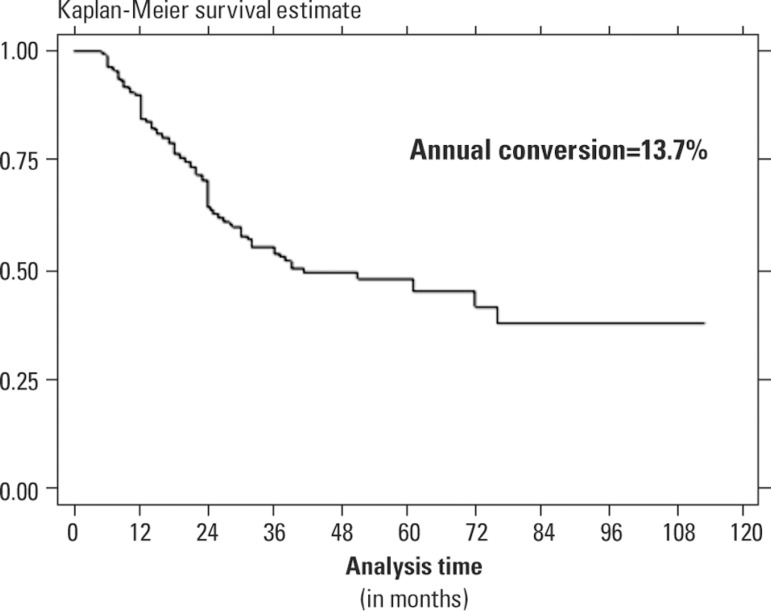
Abstract Cognitive reserve is the ability to optimize performance through differential recruitment of brain networks, which may reflect the use of alternative cognitive strategies. Objectives: To identify factors related to cognitive reserve associated with progression from mild cognitive impairment (MCI) to degenerative dementia. Methods: A cohort of 239 subjects with MCI (age: 72.2±8.1 years, 58% women, education: 12 years) was assessed and followed for five years (2001 to 2006). Results: In the first year, 13.7% of MCI converted to dementia and 34.7% converted within three years (78.3% converted to Alzheimer's dementia). Risk factors for those who converted were education less than 12 years, MMSE score less than 27, Boston naming test score less than 51, IQ (Intelligence Quotient) less than 111, age over 75 years, lack of occupation at retirement, and presence of intrusions in memory recall (all account for 56% of the variability of conversion). Conclusions: MCI patients are a population at high risk for dementia. The study of risk factors (e.g. IQ, education and occupation), particularly those related to cognitive reserve, can contribute important evidence to guide the decision-making process in routine clinical activity and public health policy.
Overview
The claims and statistics of this paper haven’t been checked yet.
Free: it reads the open-access text and checks the first 5 claims that cite a source we can check. Create a free account to check every claim.
Integrity signals
Registry
Cites
Statistics
Figures
Verification
Claims the paper makes
The claims and statistics of this paper haven’t been checked yet.
Free: it reads the open-access text and checks the first 5 claims that cite a source we can check. Create a free account to check every claim.
Claims other papers make about this one
Each is checked against this paper’s own text: does it say what the citing paper says it does?
The source backs part of the claim, not all of it — or backs it for a different population, condition or comparison.
In the citing paper
“Studies show that brain reserve is positively correlated with IQ, educational attainment, and engagement in cognitively stimulating occupational and leisurely activities, and negatively correlated with the transition from MCI to dementia [5,90].”
From Digital dementia in the internet generation: excessive screen time during brain development will increase the risk of Alzheimer's disease and related dementias in adulthood (2022) · cites this paper as [90]
Experimental — accuracy not yet measured
Self-check
Percentages, sums and reported differences re-computed from the paper’s own numbers.
The self-check needs the paper’s full text.
Citations
Cites
Folstein, M. F., Folstein, S. E., & McHugh, P. R. (1975) · Journal of Psychiatric Research · doi:10.1016/0022-3956(75)90026-6 · Cited by 88,282
An inventory for measuring depression
BECK, A. T. (1961) · Archives of General Psychiatry · doi:10.1001/archpsyc.1961.01710120031004 · Cited by 38,032 · cited 2×
“Each subject underwent a uniform structured evaluation , including medical history, complete neurological examination; neuropsychological assessment (see below) and the Beck Depression Inventory.”
McKhann, G., Drachman, D., Folstein, M., Katzman, R., Price, D., & Stadlan, E. M. (1984) · Neurology · doi:10.1212/wnl.34.7.939 · Cited by 27,915
Hirono, N., Mori, E., Ikejiri, Y., Imamura, T., Shimomura, T., Hashimoto, M., Yamashita, H., & Ikeda, M. (1997) · Brain and nerve · Cited by 21,030
Kok, J. S., Berg, I. J., & Scherder, E. J. A. (2013) · Dementia and Geriatric Cognitive Disorders Extra · doi:10.1159/000353441 · Cited by 20,589
Older Adults' Reasons for Using Technology while Aging in Place
Peek, S. T. M., Luijkx, K. G., Rijnaard, M. D., Nieboer, M. E., van der Voort, C. S., Aarts, S., van Hoof, J., Vrijhoef, H. J. M., & Wouters, E. J. M. (2016) · Gerontology · doi:10.1159/000430949 · Cited by 19,690
Sensitivity and False Alarm Rate of a Fall Sensor in Long-Term Fall Detection in the Elderly
Kangas, M., Korpelainen, R., Vikman, I., Nyberg, L., & Jämsä, T. (2015) · Gerontology · doi:10.1159/000362720 · Cited by 18,909
Mild Cognitive Impairment: Clinical Characterization and Outcome
Petersen, R. C., Smith, G. E., Waring, S. C., Ivnik, R. J., Tangalos, E. G., & Kokmen, E. (1999) · Archives of Neurology · doi:10.1001/archneur.56.3.303 · Cited by 8,980
Diagnostic and Statistical Manual of Mental Disorders
Siegel, L. J., & Fletcher‐Janzem, E. (2008) · Encyclopedia of Special Education · doi:10.1002/9780470373699.speced0655 · Cited by 8,477
Validity of the Trail Making Test as an Indicator of Organic Brain Damage
Reitan, R. M. (1958) · Perceptual and Motor Skills · doi:10.2466/pms.1958.8.3.271 · Cited by 7,928
Winblad, B., Palmer, K., Kivipelto, M., Jelic, V., Fratiglioni, L., Wahlund, L. ‐., Nordberg, A., Bäckman, L., Albert, M., Almkvist, O., et al. (2004) · Journal of Internal Medicine · doi:10.1111/j.1365-2796.2004.01380.x · Cited by 4,946
Research criteria for the diagnosis of Alzheimer's disease: revising the NINCDS–ADRDA criteria
Dubois, B., Feldman, H. H., Jacova, C., DeKosky, S. T., Barberger-Gateau, P., Cummings, J., Delacourte, A., Galasko, D., Gauthier, S., Jicha, G., et al. (2007) · The Lancet Neurology · doi:10.1016/s1474-4422(07)70178-3 · Cited by 4,411
What is cognitive reserve? Theory and research application of the reserve concept
STERN, Y. (2002) · Journal of the International Neuropsychological Society · doi:10.1017/s1355617702813248 · Cited by 3,951
McKhann, G., Drachman, D., Folstein, M., Katzman, R., Price, D., & Stadlan, E. M. (2011) · Neurology · doi:10.1212/01.wnl.0000400650.92875.cf · Cited by 1,495 · cited 1×
“Clinical diagnosis Dementia diagnoses were made according to the Diagnostic and Statistical Manual of Mental Disorders, Fourth Edition(21) while AD diagnoses were based on the National Institute of Neurological and Communicative Disorders and Stroke-Alzheimer’s Disease and related Disorders of Association criteria, re…”
Influence of education and occupation on the incidence of Alzheimer's disease
Stern, Y. (1994) · JAMA: The Journal of the American Medical Association · doi:10.1001/jama.1994.03510370056032 · Cited by 1,434 · cited 3×
“Several studies have suggested that differential susceptibility to dementia level is related to variables such as education, literacy, IQ and engagement in leisure activities.(2-7) The concept of cognitive reserve posits that individual differences in how tasks are processed might provide differential reserve against…”
Differential behavioral effects in frontal lobe disease
Benton, A. L. (1968) · Neuropsychologia · doi:10.1016/0028-3932(68)90038-9 · Cited by 1,431
Education and the prevalence of dementia and Alzheimer's disease
Katzman, R. (1993) · Neurology · doi:10.1212/wnl.43.1_part_1.13 · Cited by 1,159 · cited 1×
“Epidemiological studies have established low educational attainment as a significant risk factor for dementia.(36-38) In our study, education level and occupational complexity can be divided into late age as the active factor, and global IQ and old age as the passive factor.”
MULTI-INFARCT DEMENTIA A CAUSE OF MENTAL DETERIORATION IN THE ELDERLY
HACHINSKI, V (1974) · The Lancet · doi:10.1016/s0140-6736(74)91496-2 · Cited by 1,093
Zhang, M., Katzman, R., Salmon, D., Jin, H., Cai, G., Wang, Z., Qu, G., Grant, I., Yu, E., Levy, P., et al. (1990) · Annals of Neurology · doi:10.1002/ana.410270412 · Cited by 1,047 · cited 1×
“36-38 In our study, education level and occupational complexity can be divided into late age as the active factor, and global IQ and old age as the passive factor.”
Crook, T., Bartus, R. T., Ferris, S. H., Whitehouse, P., Cohen, G. D., & Gershon, S. (1986) · Developmental Neuropsychology · doi:10.1080/87565648609540348 · Cited by 938
Mild cognitive impairment in the elderly: Predictors of dementia
Flicker, C., Ferris, S. H., & Reisberg, B. (1991) · Neurology · doi:10.1212/wnl.41.7.1006 · Cited by 838
Classification criteria for mild cognitive impairment: A population-based validation study
Ritchie, K., Artero, S., & Touchon, J. (2001) · Neurology · doi:10.1212/wnl.56.1.37 · Cited by 835 · cited 1×
“36-38 In our study, education level and occupational complexity can be divided into late age as the active factor, and global IQ and old age as the passive factor.”
Influence of leisure activity on the incidence of Alzheimer's disease
Scarmeas, N., Levy, G., Tang, M.-X., Manly, J., & Stern, Y. (2001) · Neurology · doi:10.1212/wnl.57.12.2236 · Cited by 831 · cited 3×
“Several studies have suggested that differential susceptibility to dementia level is related to variables such as education, literacy, IQ and engagement in leisure activities.(2-7) The concept of cognitive reserve posits that individual differences in how tasks are processed might provide differential reserve against…”
MACLENNAN, R., & Jensen, O. M. (1977) · The Lancet · doi:10.1016/s0140-6736(77)92831-8 · Cited by 718
Levy (1994) · doi:10.1017/s1041610294001626 · Cited by 706
MacLennan, R., & Jensen, O. M. (1977) · PubMed · Cited by 685
Senescent forgetfulness: benign and malignant.
Kral, V. A. (1962) · Europe PMC (PubMed Central) · Cited by 575
Amnestic MCI or prodromal Alzheimer's disease?
Dubois, B., & Albert, M. L. (2004) · The Lancet Neurology · doi:10.1016/s1474-4422(04)00710-0 · Cited by 543
Cockrell, J. R., & Folstein, M. F. (2002) · Principles and Practice of Geriatric Psychiatry · doi:10.1002/0470846410.ch27(ii · Cited by 483
Cognitive reserve and the neurobiology of cognitive aging
Whalley, L. J., Deary, I. J., Appleton, C. L., & Starr, J. M. (2004) · Ageing Research Reviews · doi:10.1016/j.arr.2004.05.001 · Cited by 460
Brain networks associated with cognitive reserve in healthy young and old adults
Stern, Y. (2005) · Cerebral Cortex · doi:10.1093/cercor/bhh142 · Cited by 417 · cited 1×
“The concept of cognitive reserve posits that individual differences in how tasks are processed might provide differential reserve against brain pathology.(8)”
Literacy and Memory Decline Among Ethnically Diverse Elders
Manly, J. J., Touradji, P., Tang, M.-X., & Stern, Y. (2003) · Journal of Clinical and Experimental Neuropsychology · doi:10.1076/jcen.25.5.680.14579 · Cited by 329 · cited 2×
“Several studies have suggested that differential susceptibility to dementia level is related to variables such as education, literacy, IQ and engagement in leisure activities.(2-7) The concept of cognitive reserve posits that individual differences in how tasks are processed might provide differential reserve against…”
(1997) · American Journal of Psychiatry · doi:10.1176/ajp.154.2.165 · Cited by 327 · cited 3×
“Several studies have suggested that differential susceptibility to dementia level is related to variables such as education, literacy, IQ and engagement in leisure activities.(2-7) The concept of cognitive reserve posits that individual differences in how tasks are processed might provide differential reserve against…”
Risk factors for transitions from normal to mild cognitive impairment and dementia
Kryscio, R. J., Schmitt, F. A., Salazar, J. C., Mendiondo, M. S., & Markesbery, W. R. (2006) · Neurology · doi:10.1212/01.wnl.0000203264.71880.45 · Cited by 174 · cited 1×
“Low education level in this population increased the risk of progression to dementia in line with results reported by Kryscio et al.(35) Epidemiological studies have established low educational attainment as a significant risk factor for dementia.”
Criteria for diagnosing age‐associated memory impairment: Proposed improvements from the field
Blackford, R. C., & La Rue, A. (1989) · Developmental Neuropsychology · doi:10.1080/87565648909540440 · Cited by 171
Spanish boston naming test norms
Allegri, R. F., Villavicencio, A. F., Taragano, F. E., Rymberg, S., Mangone, C. A., & Baumann, D. (1997) · The Clinical Neuropsychologist · doi:10.1080/13854049708400471 · Cited by 125
Self-citationEl "Mini - Mental State Examination" en español. Normas para Buenos Aires
Butman, J., Harris, P., Drake, M., Baumann, D., & Pascale, A. (2001) · Cited by 107
Premorbid Reading Activity and Patterns of Cognitive Decline in Alzheimer Disease
Wilson, R. S., Bennett, D. A., Gilley, D. W., Beckett, L. A., Barnes, L. L., & Evans, D. A. (2000) · Archives of Neurology · doi:10.1001/archneur.57.12.1718 · Cited by 93 · cited 3×
“Several studies have suggested that differential susceptibility to dementia level is related to variables such as education, literacy, IQ and engagement in leisure activities.(2-7) The concept of cognitive reserve posits that individual differences in how tasks are processed might provide differential reserve against…”
Baldivia, B., Andrade, V. M., & Bueno, O. F. A. (2008) · Dementia & Neuropsychologia · doi:10.1590/s1980-57642009dn20300003 · Cited by 88 · cited 3×
“The development of cognitive reserve is associated with genetic predisposition and exposure to and interaction with favorable environments (education, engagement in cognitively stimulating activities and occupation).(7) However, limited data are available regarding the role of cognitive reserve in conversion from MCI…”
Mild cognitive impairment: Believe it or not?
Allegri, R. F., Glaser, F. B., Taragano, F. E., & Buschke, H. (2008) · International Review of Psychiatry · doi:10.1080/09540260802095099 · Cited by 43
Self-citation[The epidemiology of dementias].
Morales-Virgen, J. J. (1997) · PubMed · Cited by 19
Effects of section of the corpus callosum in rats on performance on the Hebb-Williams maze
Rajalakshmi, R., & Patel, A. J. (1967) · Neuropsychologia · doi:10.1016/0028-3932(67)90049-8 · Cited by 3
Research works printed but not linked: 3
- Signoret JL Whiteley A Memory battery scale Intern Neuropsych Soc Bull 1979 9 2 26
- Harris P Drake M Allegri RF Deterioro cognitivo leve: en búsqueda de la predemecia Acta Psiquiátr Psicol Am Lat 2001 47 11 20
- Allegri RF Drake M Harris P Serrano CM Taragano FE Intrusions in Verbal Learning in Mild Cognitive Impairment: Prodromal Alzheimer's Disease? Neurology 2005 65 Suppl 1 A 165
Cited by
Nelson, M. E., Jester, D. J., Petkus, A. J., & Andel, R. (2021) · Neuropsychology Review · doi:10.1007/s11065-021-09478-4 · Cited by 190
“, 2017)); however, some still show reduced risk of progression with high CR and transition from MCI to dementia (Allegri et al., 2010).”
BackgroundManwell, L. A., Tadros, M., Ciccarelli, T. M., & Eikelboom, R. (2022) · Journal of Integrative Neuroscience · doi:10.31083/j.jin2101028 · Cited by 122
Park, H., Park, J., Na, H. R., Shimada, H., Kim, G. M., Jung, M.-K., Kim, W. K., & Park, K. W. (2019) · Journal of Clinical Medicine · doi:10.3390/jcm8070940 · Cited by 140
“In the pre-dementia stage, converted patients showed lower global cognitive function and greater semantic memory impairment (verbal fluency and vocabulary) than non-converted patients [37].”
BackgroundStocker, H., Möllers, T., Perna, L., & Brenner, H. (2018) · Translational Psychiatry · doi:10.1038/s41398-018-0221-8 · Cited by 96
Cognitive Reserve in Dementia: Implications for Cognitive Training
Mondini, S., Madella, I., Zangrossi, A., Bigolin, A., Tomasi, C., Michieletto, M., Villani, D., Giovanni, G. D., & Mapelli, D. (2016) · Frontiers in Aging Neuroscience · doi:10.3389/fnagi.2016.00084 · Cited by 127
“Data from the literature provide evidence of a reduced risk of AD in people with high educational level (Scarmeas et al., 2004; Allegri et al., 2010).”
Background
Metadata
- Authors
- Allegri, R. F., Taragano, F. E., Krupitzki, H., Serrano, C. M., Dillon, C., Sarasola, D., Feldman, M., Tufró, G., Martelli, M., & Sanchez, V.
- Affiliations
- Centro de Educación Médica e Investigaciones Clínicas Norberto Quirno (AR)
- Corresponding author
- Allegri, Ricardo F.
- Venue
- Dementia & Neuropsychologia
- Publisher
- FapUNIFESP (SciELO)
- Published
- 2010-03
- Volume
- 4
- Issue
- 1
- Pages
- 28-34
- ISSN
- 1980-5764 (ISSN-L)
- PMC
- PMC5619527
- OpenAlex
- W2168534017
- Semantic Scholar
- 13dcc400f3bb5946c25445499a04eba729bf8843
- Cited by
- 53
- References
- 42
- Citations by year
- 2026: 4 · 2025: 3 · 2024: 4 · 2023: 4 · 2022: 3 · 2021: 6 · 2020: 5 · 2019: 6 · 2018: 4 · 2017: 2 · 2016: 4 · 2015: 3 · 2014: 1 · 2013: 2 · 2012: 2
- FWCI
- 0.87
- Type
- journal article
- Language
- en
- Open access
- diamond
- doi.org
- Licence
- cc-by
- Locations
- Dementia & Neuropsychologia (publishedVersion, cc-by)
- Europe PMC (PubMed Central) (publishedVersion, cc-by)
- PubMed Central (publishedVersion, cc-by)
- PubMed (publishedVersion)
- LA Referencia (Red Federada de Repositorios Institucionales de Publicaciones Científicas) (publishedVersion, other-oa)
- Americanae (AECID Library) (submittedVersion, cc-by)
- DOAJ (DOAJ: Directory of Open Access Journals) (submittedVersion, cc-by-sa)
- Redalyc (Universidad Autónoma del Estado de México) (submittedVersion)
- Funders
- Consejo Nacional de Investigaciones Científicas y Técnicas
- Topics
- Health Sciences › Medicine › Psychiatry and Mental health › Dementia and Cognitive Impairment Research
- Social Sciences › Psychology › Experimental and Cognitive Psychology › Cognitive Abilities and Testing
- Social Sciences › Psychology › Clinical Psychology › Historical and Modern Theater Studies
- Keywords
- cognitive reserve, mild cognitive impairment, conversion to dementia, Alzheimer's disease, risk factors, educational attainment, intelligence quotient, Boston Naming Test, occupational status
About these checks
Registry, retraction, Cites and statistics results are computed, not judged, with one exception: a printed reference that no index lists is read once by a model before it counts as a citation error. Claims are extracted by a model and kept only when their quote appears verbatim in the text; each cited source is then checked, with a model’s help, for whether it says what the claim relies on. Those verdicts can be wrong — read the claim’s quote and the cited source before relying on one.
Statistics and arithmetic are recomputed, not judged.
Confidence bands are shown only for fields calibrated on our annotated test set. None is calibrated yet, so no band is shown.
What counts as a claim ›How we measure confidence ›How we check this ›
Are you an author, or do you see a problem with this page? Request a review
Data sources
Bibliographic data: Semantic Scholar, OpenAlex, Crossref.
Contains information from the Semantic Scholar Academic Graph Datasets, made available under the ODC Attribution License (ODC-BY 1.0).
Semantic Scholar’s data is described in: Kinney, R., et al. (2023). The Semantic Scholar Open Data Platform. arXiv:2301.10140.
