

Public Narrative, Collective Action, and Power
Open accessThe DOI matches its Crossref record; 11 of the 12 references it cites were found in a registry or an index.
Abstract
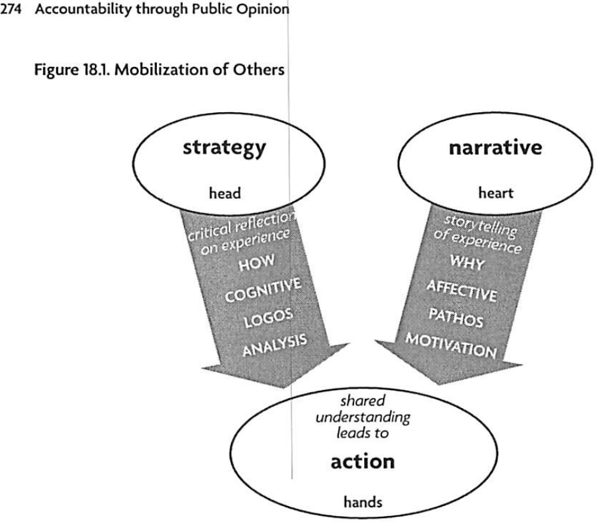
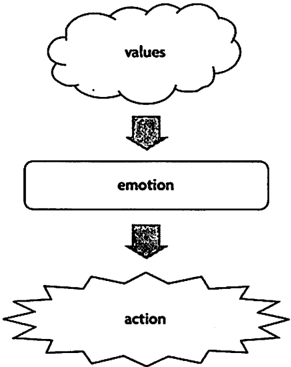
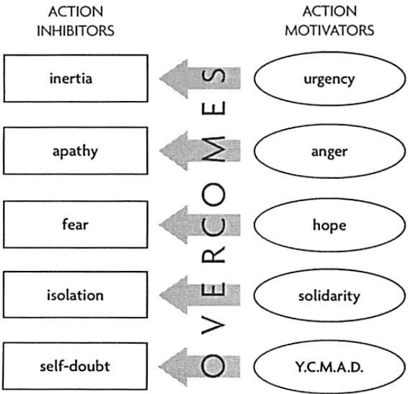
Focuses on public narrative, defined as a leadership practice of translating values into action, based on the fact that values are experienced emotionally. Narrative is the discursive means people use to access values that equip them with the courage to make choices under conditions of uncertainty. Leadership requires understanding that while some emotions can inhibit mindful action, others can facilitate it. Leaders engage others in purposeful action by mobilizing those feelings that facilitate action to trump feelings that inhibit action. Organizations that lack a story lack an identity, a culture, core values thatcan be articulated and drawn on to motivate. Leaders learn to tell the story of their organization by identifying the choice points of the organization's journey, recounting experiences that communicate the values embedded in the work of the organization. Public narrative, understood as a leadership art, is an invaluable resource to stem the tides of apathy, alienation, cynicism, and defeatism.
Overview
The claims and statistics of this paper haven’t been checked yet.
Free: it reads the open-access text and checks the first 5 claims that cite a source we can check. Create a free account to check every claim.
Integrity signals
Registry
Cites
Statistics
Figures
Verification
Claims the paper makes
The claims and statistics of this paper haven’t been checked yet.
Free: it reads the open-access text and checks the first 5 claims that cite a source we can check. Create a free account to check every claim.
Claims other papers make about this one
Each is checked against this paper’s own text: does it say what the citing paper says it does?
The source backs part of the claim, not all of it — or backs it for a different population, condition or comparison.
In the citing paper
“In the case of the outside, more confrontational track, there is a need to build popular interest and support. In this case, stories are an important campaigning tool since they are key in mobilizing large numbers of people behind an issue (Da Costa, 2014) and encouraging them to take action that places pressure on the decisionmakers.”
From Storytelling and evidence-based policy: lessons from the grey literature (2017) · cites this paper as Ganz, 2011
Experimental — accuracy not yet measuredThe cited source says what the claim attributes to it.
In the citing paper
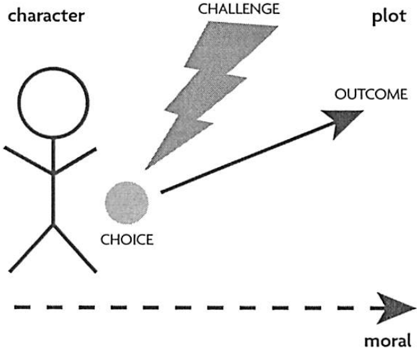
“According to Ganz (2011), the plot of an effective story is structured around the elements of challenge, choice, and outcome: a character is moving towards some sort of goal, but is faced with a challenge. To move forward the character must make a choice, which leads to an outcome.”
From Storytelling and evidence-based policy: lessons from the grey literature (2017) · cites this paper as Ganz, 2011
Self-check
Percentages, sums and reported differences re-computed from the paper’s own numbers.
The self-check needs the paper’s full text.
Citations
Cites
Positive psychology: An introduction.
Seligman, M. E. P., & Csikszentmihalyi, M. (2000) · American Psychologist · doi:10.1037/0003-066x.55.1.5 · Cited by 11,351
Sources of the self: the making of the modern identity
(1990) · Choice Reviews Online · doi:10.5860/choice.27-3278 · Cited by 7,136
Episodic memory: from mind to brain
Tulving, E. (2002) · Annual Review of Psychology · doi:10.1146/annurev.psych.53.100901.135114 · Cited by 4,950
Sources of the Self: The Making of the Modern Identity
Hamlyn, D. W., & Taylor, C. (1991) · British Journal of Educational Studies · doi:10.2307/3120882 · Cited by 3,723
Upheavals of thought: the intelligence of emotions
(2002) · Choice Reviews Online · doi:10.5860/choice.39-4883 · Cited by 3,163
Narrative and the Cultural Psychology of Identity
Hammack, P. L. (2008) · Personality and Social Psychology Review · doi:10.1177/1088868308316892 · Cited by 923
The sentimental citizen: emotion in democratic politics
(2003) · Choice Reviews Online · doi:10.5860/choice.40-3068 · Cited by 503 · cited 1×
“Explainingthis relationship, political scientistGeorgeMarcus points to two neurophysiologic systems—surveillance and disposition (Marcus 2002).”
BackgroundNarrativity, Narrative Identity, and Social Action: Rethinking English Working-Class Formation
Somers, M. R. (1992) · Social Science History · doi:10.1017/s0145553200016679 · Cited by 398 · cited 1×
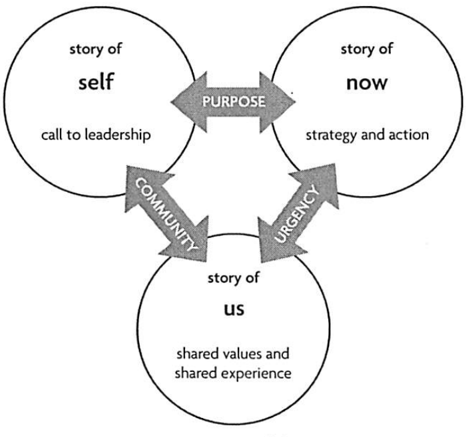
“Socialscientistsoften describe a "story of us"as a collective identity (Somers 1992,1994).”
BackgroundNarrativity, Narrative Identity, and Social Action: Rethinking English Working-Class Formation
Somers, M. R. (1992) · Social Science History · doi:10.2307/1171314 · Cited by 231
The cure at Troy : a version of Sophocles' Philoctetes
Heaney, S., & Sophocles (1991) · Farrar, Straus and Giroux eBooks · Cited by 81
Cited by
Historical Trauma as Public Narrative: A Conceptual Review of How History Impacts Present-Day Health
Mohatt, N. V., Thompson, A. B., Thai, N. D., & Tebes, J. K. (2014) · Social Science & Medicine · doi:10.1016/j.socscimed.2014.01.043 · Cited by 447
“Public narratives differ from personal narratives in as much as they are expressed within public discourse (Ganz, 2011), are indicative of intersubjective understanding (O’Donnell & Tharp, 2012), and are common among a group of people (Rappaport, 2000).”
BackgroundStorytelling and evidence-based policy: lessons from the grey literature
Davidson, B. (2017) · Palgrave Communications · doi:10.1057/palcomms.2017.93 · Cited by 186
Community Power and Empowerment
Christens, B. D. (2019) · doi:10.1093/oso/9780190605582.001.0001 · Cited by 174
Honoring Trans and Gender-Expansive Students in Music Education
Garrett, M. L., & Palkki, J. (2021) · doi:10.1093/oso/9780197506592.001.0001 · Cited by 90
Ganz, M., & McKenna, E. (2018) · Wiley eBooks · doi:10.1002/9781119168577.ch10 · Cited by 75
Self-citation
Metadata
- Authors
- Ganz, M.
- Corresponding author
- Ganz, Marshall
- Venue
- Accountability through Public Opinion
- Publisher
- The World Bank
- Published
- 2011-05-16
- Pages
- 273-289
- OpenAlex
- W2478882249
- Cited by
- 185
- References
- 12
- Citations by year
- 2026: 15 · 2025: 13 · 2024: 16 · 2023: 16 · 2022: 16 · 2021: 28 · 2020: 18 · 2019: 26 · 2018: 9 · 2017: 11 · 2016: 12 · 2015: 1 · 2014: 2 · 2013: 1 · 2012: 1
- FWCI
- 8.11
- Type
- book chapter
- Language
- en
- Open access
- green
- nrs.harvard.edu
- Licence
- cc-by
- Locations
- World Bank, Washington, DC eBooks (publishedVersion)
- Digital Access to Scholarship at Harvard (DASH) (Harvard University) (submittedVersion, cc-by)
- Topics
- Social Sciences › Business, Management and Accounting › Strategy and Management › Leadership and Management in Organizations
- Social Sciences › Business, Management and Accounting › Organizational Behavior and Human Resource Management › Organizational Strategy and Culture
- Social Sciences › Business, Management and Accounting › Organizational Behavior and Human Resource Management › Appreciative Inquiry and Organizational Change
- Keywords
- public narratives, leadership, organizational storytelling, values, emotions, collective action, organizational identity, organizational culture, power, decision making under uncertainty, apathy, cynicism, defeatism
About these checks
Registry, retraction, Cites and statistics results are computed, not judged, with one exception: a printed reference that no index lists is read once by a model before it counts as a citation error. Claims are extracted by a model and kept only when their quote appears verbatim in the text; each cited source is then checked, with a model’s help, for whether it says what the claim relies on. Those verdicts can be wrong — read the claim’s quote and the cited source before relying on one.
Statistics and arithmetic are recomputed, not judged.
Confidence bands are shown only for fields calibrated on our annotated test set. None is calibrated yet, so no band is shown.
What counts as a claim ›How we measure confidence ›How we check this ›
Are you an author, or do you see a problem with this page? Request a review
How to cite
Cite CoChat for the checks on this page, and the paper for its own findings.
- This page
- CoChat. (2026). Citation check: Public Narrative, Collective Action, and Power. https://app.cochat.ai/papers/10.1596/9780821385050_ch18
- The paper
- Ganz, M. (2011). Public Narrative, Collective Action, and Power. Accountability through Public Opinion. https://doi.org/10.1596/9780821385050_ch18
Data sources
Bibliographic data: Semantic Scholar, OpenAlex, Crossref.
Contains information from the Semantic Scholar Academic Graph Datasets, made available under the ODC Attribution License (ODC-BY 1.0).
Semantic Scholar’s data is described in: Kinney, R., et al. (2023). The Semantic Scholar Open Data Platform. arXiv:2301.10140.
