

Public Narrative, Collective Action, and Power
Open accessThe DOI matches its Crossref record; 11 of the 12 references it cites were found in a registry or an index.
Abstract
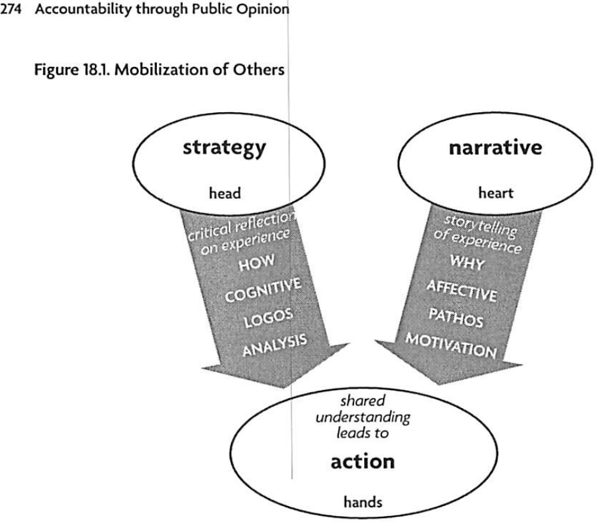
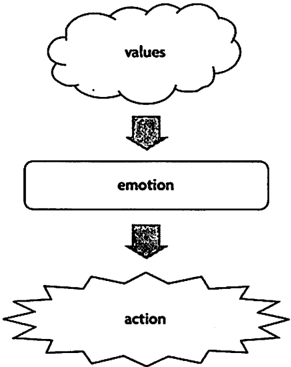
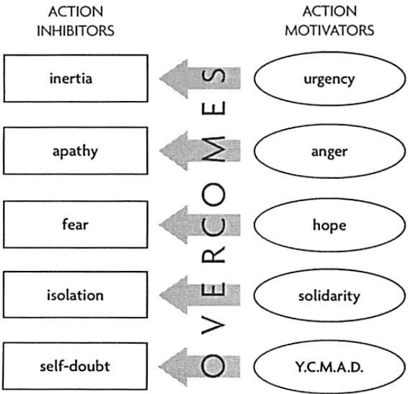
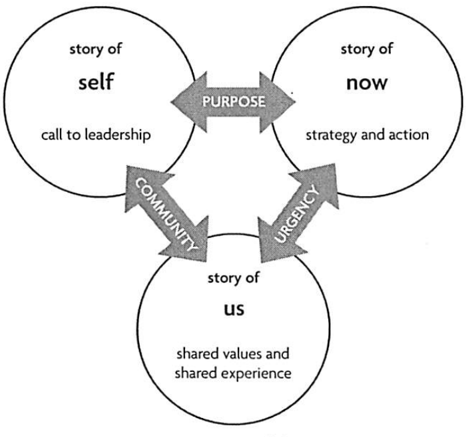
Focuses on public narrative, defined as a leadership practice of translating values into action, based on the fact that values are experienced emotionally. Narrative is the discursive means people use to access values that equip them with the courage to make choices under conditions of uncertainty. Leadership requires understanding that while some emotions can inhibit mindful action, others can facilitate it. Leaders engage others in purposeful action by mobilizing those feelings that facilitate action to trump feelings that inhibit action. Organizations that lack a story lack an identity, a culture, core values thatcan be articulated and drawn on to motivate. Leaders learn to tell the story of their organization by identifying the choice points of the organization's journey, recounting experiences that communicate the values embedded in the work of the organization. Public narrative, understood as a leadership art, is an invaluable resource to stem the tides of apathy, alienation, cynicism, and defeatism.
Overview
The claims and statistics of this paper haven’t been checked yet.
Free: it reads the open-access text and checks the first 5 claims that cite a source we can check. Create a free account to check every claim.
Integrity signals
Registry
Cites
Statistics
Figures
Verification
Claims the paper makes
The claims and statistics of this paper haven’t been checked yet.
Free: it reads the open-access text and checks the first 5 claims that cite a source we can check. Create a free account to check every claim.
Claims other papers make about this one
Each is checked against this paper’s own text: does it say what the citing paper says it does?
The source backs part of the claim, not all of it — or backs it for a different population, condition or comparison.
In the citing paper
“In the case of the outside, more confrontational track, there is a need to build popular interest and support. In this case, stories are an important campaigning tool since they are key in mobilizing large numbers of people behind an issue (Da Costa, 2014) and encouraging them to take action that places pressure on the decisionmakers.”
From Storytelling and evidence-based policy: lessons from the grey literature (2017) · cites this paper as Ganz, 2011
Experimental — accuracy not yet measuredThe cited source says what the claim attributes to it.
In the citing paper
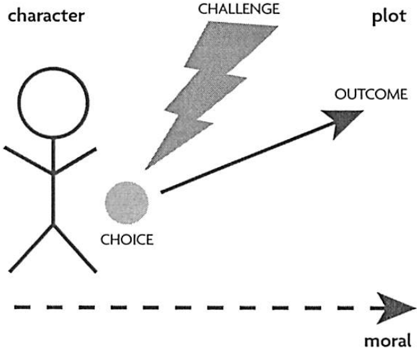
“According to Ganz (2011), the plot of an effective story is structured around the elements of challenge, choice, and outcome: a character is moving towards some sort of goal, but is faced with a challenge. To move forward the character must make a choice, which leads to an outcome.”
From Storytelling and evidence-based policy: lessons from the grey literature (2017) · cites this paper as Ganz, 2011
Self-check
Percentages, sums and reported differences re-computed from the paper’s own numbers.
The self-check needs the paper’s full text.
Citations
Cites
Positive psychology: An introduction.
Seligman, M. E. P., & Csikszentmihalyi, M. (2000) · American Psychologist · doi:10.1037/0003-066x.55.1.5 · Cited by 11,351
Sources of the self: the making of the modern identity
(1990) · Choice Reviews Online · doi:10.5860/choice.27-3278 · Cited by 7,136
Episodic memory: from mind to brain
Tulving, E. (2002) · Annual Review of Psychology · doi:10.1146/annurev.psych.53.100901.135114 · Cited by 4,950
Sources of the Self: The Making of the Modern Identity
Hamlyn, D. W., & Taylor, C. (1991) · British Journal of Educational Studies · doi:10.2307/3120882 · Cited by 3,723
Upheavals of thought: the intelligence of emotions
(2002) · Choice Reviews Online · doi:10.5860/choice.39-4883 · Cited by 3,163
Narrative and the Cultural Psychology of Identity
Hammack, P. L. (2008) · Personality and Social Psychology Review · doi:10.1177/1088868308316892 · Cited by 923
The sentimental citizen: emotion in democratic politics
(2003) · Choice Reviews Online · doi:10.5860/choice.40-3068 · Cited by 503 · cited 1×
“Explainingthis relationship, political scientistGeorgeMarcus points to two neurophysiologic systems—surveillance and disposition (Marcus 2002).”
BackgroundNarrativity, Narrative Identity, and Social Action: Rethinking English Working-Class Formation
Somers, M. R. (1992) · Social Science History · doi:10.1017/s0145553200016679 · Cited by 398 · cited 1×
“Socialscientistsoften describe a "story of us"as a collective identity (Somers 1992,1994).”
BackgroundNarrativity, Narrative Identity, and Social Action: Rethinking English Working-Class Formation
Somers, M. R. (1992) · Social Science History · doi:10.2307/1171314 · Cited by 231
The cure at Troy : a version of Sophocles' Philoctetes
Heaney, S., & Sophocles (1991) · Farrar, Straus and Giroux eBooks · Cited by 81
Cited by
Items 101–186 of 186
Fostering an Inclusive Organization Through the Power of Storytelling
Snow, C. P., Gabay, V., Brownlee, T. D., & Thomas, T. M. (2023) · Building leadership bridges · doi:10.1108/s2058-880120230000009014 · Cited by 1
The Women Who Ruled China: Buddhism, Multiculturalism, and Governance in the Sixth Century
Balkwill, S. (2024) · University of California Press eBooks · doi:10.1525/luminos.192 · Cited by 1
Making Sense: Language, Ethics, and Understanding in Deaf Nepal
Green, E. M. (2024) · University of California Press eBooks · doi:10.1525/luminos.193 · Cited by 2
A Grassroots Initiative to Engage Classroom Teachers in Increasing Physical Activity
Orendorff, K. L., Merica, C. B., & Egan, C. A. (2024) · Journal of Teaching in Physical Education · doi:10.1123/jtpe.2023-0219 · Cited by 1
Training community organizers in the austerity state: lessons from the field
Fisher, R., & Champagne, L. (2024) · Journal of Community Practice · doi:10.1080/10705422.2024.2385622 · Cited by 1
“They have been more focused on and supported by theories and models such as consensus organizing (Eichler, 2007), social capital (Putnam, 2000), Asset-based community development (McKnight & Kretzman, 1999), and public narrative (Ganz, 2011).”
Pobreza y celebridades del espectáculo: un debate del accionar internacional
Aranguren, E. M. M., & Abella, N. N. M. (2017) · OASIS · doi:10.18601/16577558.n26.04 · Cited by 1
“Como señala Marshall Ganz (2011), La narrativa es un medio discursivo que permite acceder a los valores que nos llenan de coraje para tomar decisiones en condiciones de incertidumbre, de ejercer la agencia.”
BackgroundPeirot, N. (2018) · Communication & management · doi:10.3917/comma.142.0081 · Cited by 1
Christens, B. D. (2019) · Oxford University Press eBooks · doi:10.1093/oso/9780190605582.003.0003 · Cited by 1
Social Reality and Narratives Between Interpretations and Metaphors
Мангоне, Э. (2022) · Culture in policy making · doi:10.1007/978-3-030-94565-7_8 · Cited by 1
Christens, B. D. (2019) · Oxford University Press eBooks · doi:10.1093/oso/9780190605582.003.0004 · Cited by 1
The CLIC Project: Language stories matter
García, N. A., Demperio, J., & Kozlowska, M. (2023) · TESOL Journal · doi:10.1002/tesj.751 · Cited by 1
The Narrative Arc Bends toward Justice: Storytelling in Classroom and CommunityPreprint
Syeed, E. (2020) · doi:10.33774/apsa-2020-jcqh6 · Cited by 1
Shenhav, S. R. (2020) · Oxford University Press eBooks · doi:10.1093/obo/9780199756223-0324 · Cited by 1
Christens, B. D. (2019) · Oxford University Press eBooks · doi:10.1093/oso/9780190605582.003.0006 · Cited by 2
Strauser, J., Jordan, N. R., Gratton, C., Lloyd, S. E., Booth, E. G., Wellman, A. A., Steussy-Williams, A., Wepking, C., Martinez-Motta, G., Steele, A. B., et al. (2025) · SSRN Electronic Journal · doi:10.2139/ssrn.5530647 · Cited by 1
Empathy and the Creative University
Dolby, N. (2013) · SensePublishers eBooks · doi:10.1007/978-94-6209-245-7_10 · Cited by 1
Community Organizing and School Transformation
Carter, K. M. (2016) · Digital Access to Scholarship at Harvard (DASH) (Harvard University)
The Socio-Institutional Production of Social Suffering
Miguélez, B. A. (2016) · Dialnet (Universidad de la Rioja)
PERSONAL NARRATIVE DISCLOSURE: COMBATTING METANARRATIVE PERSPECTIVES AND CULTIVATING EMPATHY
Schrock, L. (2016) · OhioLink ETD Center (Ohio Library and Information Network)
Building Healthy Teams: Digital Storytelling in NHS Organisations
Stabler, A. (2018) · Springer eBooks · doi:10.1007/978-3-319-64146-1_15
Christens, B. D. (2019) · Oxford University Press eBooks · doi:10.1093/oso/9780190605582.003.0008
Malena-Chan, R. (2019) · Promotion de la santé et prévention des maladies chroniques au Canada · doi:10.24095/hpcdp.39.4.07f
Learning Healthcare System Principles to Facilitate Spread of DCR
McElvaine, K. K., McCannon, J., & Schwab, C. W. (2019) · Springer eBooks · doi:10.1007/978-3-030-20820-2_19
Jennings, A. T. (2019) · Digital Access to Scholarship at Harvard (DASH) (Harvard University)
Álvarez, X. M. (2020) · Revista de Comunicación Política · doi:10.29105/rcp2-2
Designing Improvement Teams for Success
Leone, N. M., & Subramony, A. (2020) · Springer eBooks · doi:10.1007/978-3-030-55829-1_10
Celebrating TGE Singers in Choral Classrooms
Garrett, M. L., & Palkki, J. (2021) · Oxford University Press eBooks · doi:10.1093/oso/9780197506592.003.0007
Garrett, M. L., & Palkki, J. (2021) · Oxford University Press eBooks · doi:10.1093/oso/9780197506592.003.0008
Honoring Gender Diversity in Music Classrooms
Garrett, M. L., & Palkki, J. (2021) · Oxford University Press eBooks · doi:10.1093/oso/9780197506592.003.0005
Introduction: Teaching People to Learn through the Art of Music
Garrett, M. L., & Palkki, J. (2021) · Oxford University Press eBooks · doi:10.1093/oso/9780197506592.003.0001
Empowering TGE Students with Inclusive Policies
Garrett, M. L., & Palkki, J. (2021) · Oxford University Press eBooks · doi:10.1093/oso/9780197506592.003.0006 · Cited by 1
Understanding School Climate for Trans and Gender-Expansive Persons
Garrett, M. L., & Palkki, J. (2021) · Oxford University Press eBooks · doi:10.1093/oso/9780197506592.003.0003
Starting a Conversation about Trans and Gender-Expansive Persons
Garrett, M. L., & Palkki, J. (2021) · Oxford University Press eBooks · doi:10.1093/oso/9780197506592.003.0002
Safe People Creating Safe Spaces
Garrett, M. L., & Palkki, J. (2021) · Oxford University Press eBooks · doi:10.1093/oso/9780197506592.003.0004
Buntz, L. A. (2022) · Springer eBooks · doi:10.1007/978-3-030-90380-0_9
Ríos, O. (2016) · Masculinities & Social Change · doi:10.17583/mcs.2016.1968
The Practice and Impact of Leadership in a Sub-Saharan Context
Kliewer, B. W., Gott, T., Long, K., & Tolar, M. (2022) · Building Leadership Bridges · doi:10.1108/s2058-88012022011
Redondo-Sama, G. (2017) · International Journal of Educational Leadership and Management · doi:10.17583/ijelm.2017.2868
Christens, B. D. (2019) · Oxford University Press eBooks · doi:10.1093/oso/9780190605582.003.0002 · Cited by 1
Christens, B. D. (2019) · Oxford University Press eBooks · doi:10.1093/oso/9780190605582.003.0009
A COGNITIVE STYLISTIC ANALYSIS OF PERSONAL NARRATIVES ABOUT COVID-19 PANDEMIC
Al-Azzawi, P. D. Q. O., & Rhaif, K. K. (2022) · International Journal of Research in Social Sciences and Humanities · doi:10.37648/ijrssh.v12i04.046
“The cognitive stylistic analysis of narrative 1, as shown in Table (2) below, consists of 879 INTERNATIONAL JOURNAL OF RESEARCH IN SOCIAL SCIENCES AND HUMANITIES three components: world-discourse, textdiscourse, and sub-worlds.”
BackgroundMethodInfluentialTacit knowledge speaks the language of story
Paulson, L., & Fachane, M. (2023) · Routledge eBooks · doi:10.4324/9781003215929-21
Geraty, K. (2023) · The Department Chair · doi:10.1002/dch.30546
Undertaking Systems Transformation Through Ecopolitical Professionalism and Public Pedagogy
Barrett, M. S., & Westerlund, H. M. (2023) · Springer briefs in education · doi:10.1007/978-3-031-45893-4_7
Two tales of one school: competing narratives in a charter school unionization battle in Chicago
Pinkham-Brown, A. (2024) · Globalisation Societies and Education · doi:10.1080/14767724.2024.2305217
“Storytelling is often a powerful tool for activists and organisers (Ganz 2011).”
InfluentialDesigning in Support: Beyond Formal Supervision Arrangements for Research Students
Awwad, R., & Baker, A. T. (2024) · Advances in higher education and professional development book series · doi:10.4018/979-8-3693-5483-4.ch009
Ruggeri, D. (2024) · The Geojournal library · doi:10.1007/978-3-031-41550-0_9 · Cited by 1
Foreword: The Virtues and Vices of Power and Empowerment
Prilleltensky, I. (2019) · Oxford University Press eBooks · doi:10.1093/oso/9780190605582.002.0007
Christens, B. D. (2019) · Oxford University Press eBooks · doi:10.1093/oso/9780190605582.002.0004
Allen, N. E., & Olson, B. D. (2019) · Oxford University Press eBooks · doi:10.1093/oso/9780190605582.002.0006
Christens, B. D. (2019) · Oxford University Press eBooks · doi:10.1093/oso/9780190605582.002.0018
Advance praise for Community Power and Empowerment
Christens, B. D. (2019) · Oxford University Press eBooks · doi:10.1093/oso/9780190605582.002.0001 · Cited by 1
Garrett, M. L., & Palkki, J. (2021) · Oxford University Press eBooks · doi:10.1093/oso/9780197506592.005.0004
Garrett, M. L., & Palkki, J. (2021) · Oxford University Press eBooks · doi:10.1093/oso/9780197506592.005.0002
Garrett, M. L., & Palkki, J. (2021) · Oxford University Press eBooks · doi:10.1093/oso/9780197506592.005.0003
Garrett, M. L., & Palkki, J. (2021) · Oxford University Press eBooks · doi:10.1093/oso/9780197506592.002.0003
Garrett, M. L., & Palkki, J. (2021) · Oxford University Press eBooks · doi:10.1093/oso/9780197506592.002.0007
Garrett, M. L., & Palkki, J. (2021) · Oxford University Press eBooks · doi:10.1093/oso/9780197506592.002.0004
Garrett, M. L., & Palkki, J. (2021) · Oxford University Press eBooks · doi:10.1093/oso/9780197506592.005.0001
Architecture of Integrity, a Culture of Dialogue
Robinson, S. J. (2024) · Springer eBooks · doi:10.1007/978-3-031-65687-3_4
Who works! from fragmentation to coherence through collaborative, constructive communication
Olaitan, P. (2024) · Journal of Integrated Care · doi:10.1108/jica-12-2023-0097
Emery, E., Wiskel, T., Humphrey, K., & Basu, G. (2025) · The Journal of Climate Change and Health · doi:10.1016/j.joclim.2025.100447
“The questions asked the groups to identify available resources they could use to create the power needed to address these large, multifaceted problems [23,24].”
Müller, I. (2025) · European Journal of Mathematics and Science Education · doi:10.12973/ejmse.6.2.113 · Cited by 1
Winett, L. B., Dalingwater, L., & Peru-Pirotte, L. (2025) · Pôle Sud · doi:10.3917/psud.062.0129
Co-Developing Comics to Enhance a Sense of Belonging, Empathy and Agency in the Final Phase of Life
Roberts, A. (2025) · Belonging. · doi:10.1177/30290805251357082
“Using story-telling to support such movements is exempli fi ed in Ganz ’ s (2011) public narrative model, where exploring values and thinking innovatively leads to system level change.”
Critical Approaches to Gender Equity in Leadership Development and Practice
Youngblood, R. J., Hobson, T., & Franzen, R. M. (2022) · doi:10.1108/978-1-64802-790-120251023
Global, N., & Kazanskaia, A. N. (2025) · doi:10.64357/neya-gjnps-ldrmsdrorg-04
Kathy, G., & Jenkins Daniel, M. (2018) · Emerald Group Publishing Limited eBooks · doi:10.1108/978-1-64113-100-120251022
Yates, S. G. (2025) · Journal of Screenwriting · doi:10.1386/josc_00186_1 · Cited by 1
Safe to Speak, Teach, and Research? Experiences of Reprisals in Danish Academia
Bjerre, L., Jensen, A. R., Larsen, S. N., Olsen, F. B. H., Pedersen, J. S., Thorup, M., & Toft, M. (2026) · British Journal of Sociology · doi:10.1111/1468-4446.70096
Cohen, J. E., González, K., Ihenacho, U., Shah, P., McKean‐Cowdin, R., & Bluthenthal, R. N. (2026) · Frontiers in Public Health · doi:10.3389/fpubh.2026.1766034
Peirot, N. (2020) · theses.fr (ABES) · doi:10.70675/d174448bzabcfz4068z8687zdfef2889807f · Cited by 8
Morandi, M. (2026) · Church Communication and Culture · doi:10.1080/23753234.2026.2636857
“This principle underpins the use of public narrative , a framework developed by Marshall Ganz to mobilize volunteers and create a sense of community around a political project (Braga 2024a; Ganz 2011).”
Tomić, S., & Manojlović, S. D. (2026) · Government and Opposition · doi:10.1017/gov.2026.10039
Narrative Plasticity and State Stickiness: Designing Hybrid AI Systems for High-Stakes Communication
Kessler, D. T., Overney, C., Shen, J. J., & Roy, D. K. (2026) · Designing Interactive Systems Conference · doi:10.1145/3800645.3813073 · Cited by 1
“We adapted Public Narrative theory [24, 25]—originally developed for collective mobilization—to structure individual self-advocacy conversations.”
Pinkham-Brown, A. (2026) · Retratos da Escola · doi:10.22420/rde.v20i1.2835
Strategic narratives and the processes of goal achievement in municipal strategic planning
Eymas, F. (2026) · Public Management Review · doi:10.1080/14719037.2026.2703262
Tondreau, A., Kline, S. M., Kang, G., Yang, S., Wall, A., Chen, X., Ikpeze, C. H., Kaosayapandhu, M., Tracy, K. N., Smetana, L. D., et al. (2026) · English Education · doi:10.58680/ee202658284
Marcucci, E., Lozzi, R., & Gatta, V. (2026) · Transportation research procedia · doi:10.1016/j.trpro.2026.04.104
La prossimità relazionale come nuova via per co-costruire visioni future di territorio
Caruso, E. (2026) · U3 iQuaderni · doi:10.3280/u3q30-2025oa21027
Social enterprises in the shadow of the State
Marafioti, E., Sancino, A., Scognamiglio, F., Calò, F., & Sicca, L. M. (2026) · Public Management Review · doi:10.1080/14719037.2026.2700567
Mamdani’s Mending Story: Rescaling Democratic Peoplehood in an Age of Interregnum
Illuzzi, M. J. (2026) · Democratic Theory · doi:10.1017/s233288942600028x
“They help political organizers overcome the collective action problem (Ganz 2011; Mayer 2014).”
Kenworthy, N., & Early, J. O. (2026) · Pedagogy in Health Promotion · doi:10.1177/23733799261480360
Empowering Lived Expertise: The Power-Up Organizing Approach to the Housing Crisis
Lovell, A., Daniels, K., & O’Neal, C. (2026) · Community Organizing Journal · doi:10.71057/s0hcvd83
(2026) · Emerald Group Publishing Limited eBooks · doi:10.1108/978-1-80686-795-020262020
Metadata
- Authors
- Ganz, M.
- Corresponding author
- Ganz, Marshall
- Venue
- Accountability through Public Opinion
- Publisher
- The World Bank
- Published
- 2011-05-16
- Pages
- 273-289
- OpenAlex
- W2478882249
- Cited by
- 185
- References
- 12
- Citations by year
- 2026: 15 · 2025: 13 · 2024: 16 · 2023: 16 · 2022: 16 · 2021: 28 · 2020: 18 · 2019: 26 · 2018: 9 · 2017: 11 · 2016: 12 · 2015: 1 · 2014: 2 · 2013: 1 · 2012: 1
- FWCI
- 8.11
- Type
- book chapter
- Language
- en
- Open access
- green
- nrs.harvard.edu
- Licence
- cc-by
- Locations
- World Bank, Washington, DC eBooks (publishedVersion)
- Digital Access to Scholarship at Harvard (DASH) (Harvard University) (submittedVersion, cc-by)
- Topics
- Social Sciences › Business, Management and Accounting › Strategy and Management › Leadership and Management in Organizations
- Social Sciences › Business, Management and Accounting › Organizational Behavior and Human Resource Management › Organizational Strategy and Culture
- Social Sciences › Business, Management and Accounting › Organizational Behavior and Human Resource Management › Appreciative Inquiry and Organizational Change
- Keywords
- public narratives, leadership, organizational storytelling, values, emotions, collective action, organizational identity, organizational culture, power, decision making under uncertainty, apathy, cynicism, defeatism
About these checks
Registry, retraction, Cites and statistics results are computed, not judged, with one exception: a printed reference that no index lists is read once by a model before it counts as a citation error. Claims are extracted by a model and kept only when their quote appears verbatim in the text; each cited source is then checked, with a model’s help, for whether it says what the claim relies on. Those verdicts can be wrong — read the claim’s quote and the cited source before relying on one.
Statistics and arithmetic are recomputed, not judged.
Confidence bands are shown only for fields calibrated on our annotated test set. None is calibrated yet, so no band is shown.
What counts as a claim ›How we measure confidence ›How we check this ›
Are you an author, or do you see a problem with this page? Request a review
Data sources
Bibliographic data: Semantic Scholar, OpenAlex, Crossref.
Contains information from the Semantic Scholar Academic Graph Datasets, made available under the ODC Attribution License (ODC-BY 1.0).
Semantic Scholar’s data is described in: Kinney, R., et al. (2023). The Semantic Scholar Open Data Platform. arXiv:2301.10140.
