

'Digital authoring support for argumentative writing: what does it change?
The DOI matches its Crossref record; 8 of the 8 references it cites were found in a registry or an index.
Abstract
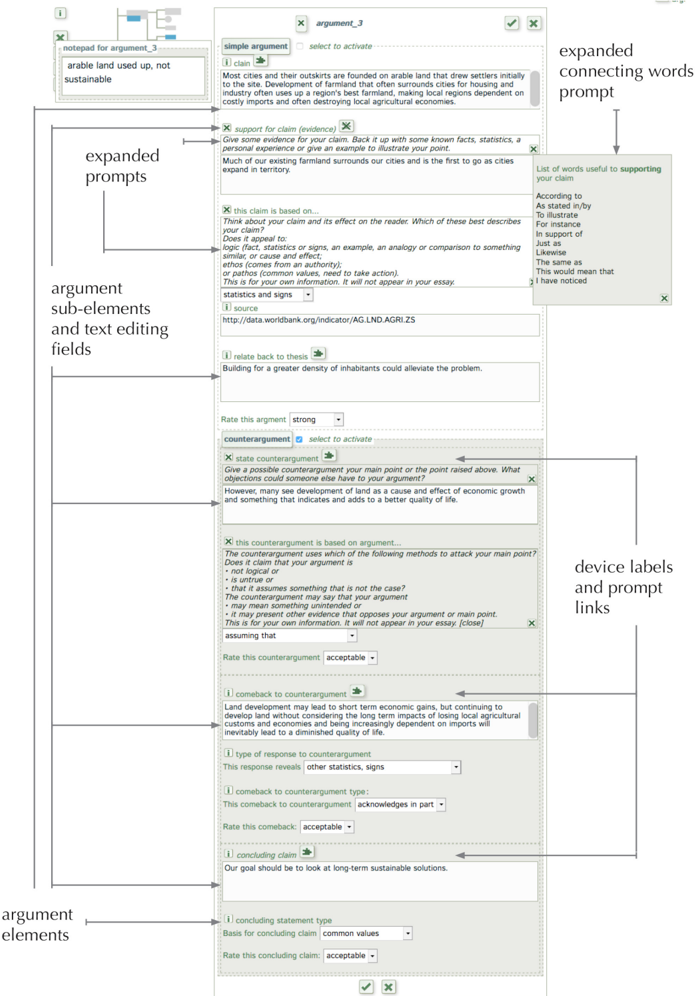
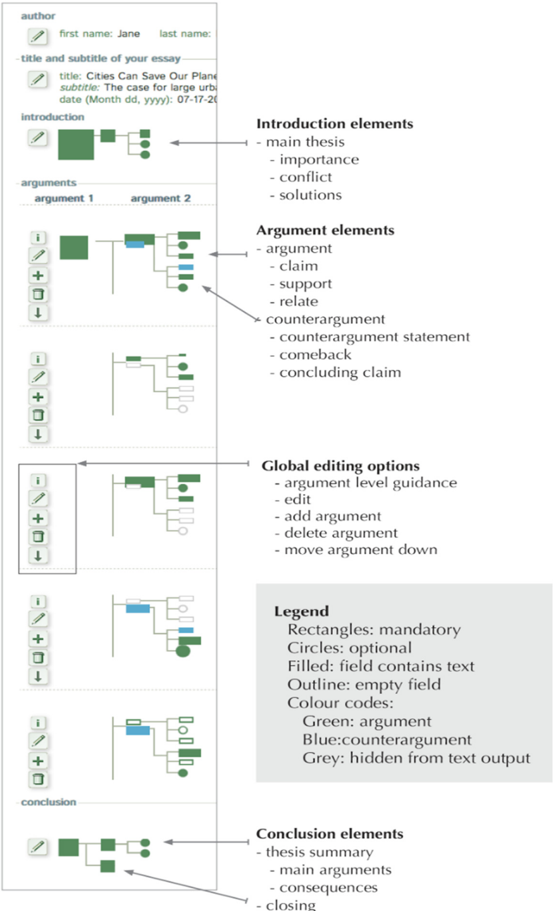
C-SAW (Computer-Supported Argumentative Writer) is an online authoring software embodying design principles derived from theories on written argumentation, self-regulation and conceptual change as well as feedback from practitioners and users, in line with a design-based research approach. Designed to scaffold writing processes, C-SAW is intended as additional support in instructional designs using argumentative writing for learning. This article presents the results of a mixed-method study comparing undergraduate students writing with C-SAW or a text editor. Outcome measures included the number of arguments and the degree of their completion, knowledge of argument components, topic knowledge and changes in epistemic beliefs. Participants writing with C-SAW elaborated arguments to a greater degree, but there were otherwise no significant differences between conditions for other measured outcomes. Furthermore, results were influenced by informal reasoning skills that outweighed the effects of condition. These results are discussed with respect to the difficulties of studying the effects of digital tools on writing and learning in controlled first-use contexts and the importance of developing instructional designs with explicit learning outcomes that are aligned to the instructional principles embedded in digital tools.
Overview
The claims and statistics of this paper haven’t been checked yet.
Free: it reads the open-access text and checks the first 5 claims that cite a source we can check. Create a free account to check every claim.
Integrity signals
Registry
Cites
Statistics
Figures
Verification
Claims the paper makes
The claims and statistics of this paper haven’t been checked yet.
Free: it reads the open-access text and checks the first 5 claims that cite a source we can check. Create a free account to check every claim.
Claims other papers make about this one
Each is checked against this paper’s own text: does it say what the citing paper says it does?
In the citing paper
“Positive results are obtained by several empirically-based tools that provide automated and individual feedback to support students during the writing process.”
From Reporting Writing Process Feedback in the Classroom. Using Keystroke Logging Data to Reflect on Writing Processes (2020) · cites this paper as Benetos & Bétrancourt, 2020
Self-check
Percentages, sums and reported differences re-computed from the paper’s own numbers.
The self-check needs the paper’s full text.
Citations
Cites
Pea, R. D. (2004) · Journal of the Learning Sciences · doi:10.1207/s15327809jls1303_6 · Cited by 1,047
The Psychology of Written Composition
(2013) · doi:10.4324/9780203812310 · Cited by 505
Detection, Diagnosis, and the Strategies of Revision
Flower, L., Hayes, J. R., Carey, L., Schriver, K., & Stratman, J. (1986) · College Composition & Communication · doi:10.2307/357381 · Cited by 450
Digital support for academic writing: A review of technologies and pedagogies
Strobl, C., Ailhaud, E., Benetos, K., Devitt, A., Kruse, O., Proske, A., & Rapp, C. (2019) · Computers & Education · doi:10.1016/j.compedu.2018.12.005 · Cited by 298 · cited 3×
“Since the 1990s, there has been a proliferation of digital tools to support the development of writing skills, most of which aim at assessing the mechanics of writing (spelling, grammar, syntax, language use) (Strobl et al., 2018).”
InfluentialSelf-citationThe Effects of Goal Instructions and Text on the Generation of Counterarguments During Writing.
Nussbaum, E. M., & Kardash, C. M. (2005) · Journal of Educational Psychology · doi:10.1037/0022-0663.97.2.157 · Cited by 279 · cited 1×
“Studies on the effects of instructions have shown that learners interpret learning goals and use them to either include or exclude ideas in their written product (Leitão, 2003; Nussbaum & Kardash, 2005).”
Promoting Argument-Counterargument Integration in Students' Writing
Nussbaum, E. M., & Schraw, G. (2007) · The Journal of Experimental Education · doi:10.3200/jexe.76.1.59-92 · Cited by 279 · cited 6×
“…arising from contradictory information is often cited as the main mechanism leading to deeper learning through argumentative writing (Andriessen et al., 2003; Jonassen & Kim, 2010; Limón, 2001; Nussbaum & Schraw, 2007; Nussbaum & Sinatra, 2003; Wolfe, Britt, Petrovic, Albrecht, & Kopp, 2009).”
InfluentialTrends in Research on Writing as a Learning Activity
Klein, P. D., & Boscolo, P. (2016) · Journal of Writing Research · doi:10.17239/jowr-2016.07.03.01 · Cited by 226 · cited 1×
“Writing instruction can also be more effective when designed to heed discipline-based terms and conventions (Klein & Boscolo, 2015).”
Vandermeulen, N., Leijten, M., & Van Waes, L. (2020) · Journal of Writing Research · doi:10.17239/jowr-2020.12.01.05 · Cited by 87
Research works printed but not linked: 48
- Andriessen, Jerry. (2006). Arguing to learn. In R. K. Sawyer (Ed.), The Cambridge Handbook of the Learning Sciences (pp. 443-459). New York, USA: Cambridge University Press. https://doi.org/10.1017/CBO9780511816833.027 · DOI · Paper page
- Andriessen, Jerry, Baker, M., & Suthers, D. D. (2003). Argumentation, computer support, and the educational context of confronting cognitions. In J. Andriessen, M. Baker, & D. Suthers (Eds.), Arguing to learn: Confronting cognitions in computer-supported collaborative learning environments (Vol. 1, pp. 1-25). Dordrecht, The Netherlands: Kluwer Academic Publishers. https://doi.org/10.1007/978-94-017-0781-7_1 · DOI · Paper page
- Baker, M., Quignard, M., Lund, K., & Séjourné, A. (2003). Computer-supported collaborative learning in the space of debate. In B. Wasson, S. Ludvigsen, & U. Hoppe (Eds.), Designing for Change in Networked Learning Environments : Proceedings of the International Conference on Computer Support for Collaborative Learning 2003, (pp. 11-20). Dordrecht, The Netherlands: Kluwer Academic Publishers. https://doi.org/10.1007/978-94-017-0195-2_4 · DOI
- Bazerman, C., Little, J., Bethel, L., Chavkin, T., Fouquette, D., & Garufis, J. (2005). Writing to Learn. In C. Bazerman (Ed.), Reference Guide to Writing Across the Curriculum (pp. 57- 65). West Lafayette, Indiana, USA: Parlor Press and The WAC Clearinghouse.
- Beguin, P., & Rabardel, P. (2000). Designing for instrument-mediated activity. Scandinavian Journal of Information Systems, 12(1), 173-190.
- Bell, P. (2000). Scientific arguments as learning artifacts: designing for learning from the web with KIE. International Journal of Science Education, 22(8), 797-817. https://doi.org/ 10.1080/095006900412284 · DOI · Paper page
- Bereiter, C., & Scardamalia, M. (1987a). An attainable version of high literacy: Approaches to teaching higher-order skills in reading and writing. Curriculum Inquiry, 17(1), 9-30. https://doi.org/10.1080/03626784.1987.11075275 · DOI
- Bereiter, C., & Scardamalia, M. (1987b). Knowledge telling and knowledge transforming in written composition. In S. Rosenberg (Ed.), Advances in applied psycholinguistics (Vol. 1- 2, pp. 142-175). CUP Archive.
- Breetvelt, I., Bergh, H. Van Den, & Rijlaarsdam, G. (1994). Relations between writing processes and text quality: When and how? Cognition and Instruction, 12(2), 103-123. https://doi.org/10.1207/s1532690xci1202_2 · DOI · Paper page
- Cho, K., & Jonassen, D. H. (2002). The effects of argumentation scaffolds on argumentation and problem solving. Educational Technology Research & Development, 50(3), 5-23. https://doi.org/10.1007/BF02505022 · DOI · Paper page
- Clark, D. B., Stegmann, K., Weinberger, A., Menekse, M., & Erkens, G. (2007). Technology- Enhanced Learning Environments to Support Students' Argumentation. In S. Erduran & M. P. Jiménez-Aleixandre (Eds.), Argumentation in Science Education. Science & Technology Education Library, vol. 35 (pp. 217-243). Dordrecht, The Netherlands: Springer. https://doi.org/10.1007/978-1-4020-6670-2_11 · DOI
- Cohen, J. (1988). Statistical power analysis for the behavioral sciences (2nd ed.). Hillsdale, NJ: Erlbaum Associates.
- Crewe, W. J. (1990). The illogic of logical connectives. ELT Journal, 44(4), 316-325. https://doi.org/10.1093/elt/44.4.316 · DOI · Paper page
- Cotos, E., Huffman, S., & Link, S. (2020). Understanding graduate writers' interaction with and impact of the Research Writing Tutor during revision. Journal of Writing Research 12(1), 187-232. https://doi.org/10.17239/jowr-2020.12.01.07 · DOI · Paper page
- Depover, C. (2014). Les dispositifs de formation médiatisés et leurs effets. In C. Peltier (Ed.), La médiatisation de la formation de de l'apprentissage (pp. 121-133). Louvain-la-Neuve, Belgium: de Boeck. https://doi.org/10.3917/dbu.peter.2014. · doi:10.3917/dbu.peter.2014
- Dolz, J. (1996). Learning argumentative capacities: A study of the effects of a systematic and intensive teaching of argumentative discourse in 11-12 year old children. Argumentation, 10(2), 227-251. https://doi.org/10.1007/BF00180727 · DOI
- Erkens, G., Janssen, J., & Kirschner, P. A. (2010). Visualization of argumentation as shared activity. In J. E. Lieven Verschaffel, Erik de Corte, Ton de Jong (Ed.), Use of Representations in Reasoning and Problem Solving: Analysis and Improvement (p. 242). Taylor & Francis. https://doi.org/10.4324/9780203847824 · DOI
- Felton, M. K., & Herko, S. (2004). From dialogue to two-sided argument; Scaffolding adolescents' persuasive writing. Journal of Adolescent & Adult Literacy, 47(8), 672-683.
- Herrington, J. (2012). Design-based research: Implementation issues in emerging scholar research. In EdMedia: World Conference on Educational Media and Technology (Vol. 1, pp. 1-6). Chesapeake, VA: Association for the Advancement of Computing in Education (AACE).
- Hofer, B. K. (2000). Dimensionality and disciplinary differences in personal epistemology. Contemporary Educational Psychology, 25(4), 378-405. https://doi.org/10.1006/ ceps.1999.1026 · DOI · Paper page
- Janssen, J., Erkens, G., Kirschner, P. A., & Kanselaar, G. (2010). Effects of representational guidance during computer-supported collaborative learning. Instructional Science, 38(1), 59-88. https://doi.org/10.1007/s11251-008-9078-1 · DOI · Paper page
- Jonassen, D. H., & Carr, C. S. (2000). Mindtools: Affording multiple knowledge representations for learning. In S. P. Lajoie (Ed.), Computers as cognitive tools, Volume 2: No more walls (pp. 165-196). Mahwah, NJ, US: Erlbaum. https://doi.org/10.1201/ 9781315045337 · DOI
- Jonassen, D. H., & Kim, B. (2010). Arguing to learn and learning to argue: Design justifications and guidelines. Educational Technology Research and Development, 58(4), 439-457. https://doi.org/10.1007/s11423-009-9143-8 · DOI · Paper page
- Karoly, P. (1993). Mechanisms of self-regulation: a systems view. Annual Review Psychology, 44, 23-52. https://doi.org/10.1146/annurev.ps.44.020193.000323 · DOI · Paper page
- Klein, P. D. (1999). Reopening inquiry into cognitive processes. Educational Psychology, 11(3), 203-270. https://doi.org/10.1023/A:1021913217147 · DOI · Paper page
- Klein, P. D., & Kirkpatrick, L. C. (2010). A Framework for Content Area Writing: Mediators and Moderators. Journal of Writing Research, 2(1), 1-46. https://doi.org/10.17239/jowr- 2010.02.01.1 · DOI
- Kuhn, D. (2001). How do people know? Psychological Science, 12(1), 1-8. https://doi.org/ 10.1111/1467-9280.00302 · DOI · Paper page
- Kuhn, D., Zillmer, N., Crowell, A., & Zavala, J. (2013). Developing norms of argumentation: Metacognitive, epistemological, and social dimensions of developing argumentative competence. Cognition and Instruction, 31(4), 456-496. https://doi.org/10.1080/07370008. 2013.830618 · DOI · Paper page
- Leitão, S. (2003). Evaluating and selecting counterarguments: Studies of children's rhetorical awareness. Written Communication, 20(3), 269-306. https://doi.org/10.1177/ 0741088303257507 · DOI · Paper page
- Leitão, S., Leita, S., & Leitão, S. (2000). The potential of argument in knowledge building. Human Development, 43(6), 332-360. https://doi.org/10.1159/000022695 · DOI · Paper page
- Limón, M. (2001). On the cognitive conflict as an instructional strategy for conceptual change: a critical appraisal. Learning and Instruction, 11(4-5), 357-380. https://doi.org/10.1016/S0959-4752(00)00037-2 · DOI · Paper page
- Luna, M., Villalón, R., Mateos, M., & Martìn, E. (2020). Improving university argumentative writing through online training. Journal of Writing Research 12(1), 233-262. https://doi.org/10.17239/jowr-2020.12.01.08 · DOI
- Mason, L. (2002). Developing epistemological thinking to foster conceptual change in different domains. In M. Limón & L. Mason (Eds.), Reconsidering Conceptual Change: Issues in Theory and Practice (pp. 301-335). Kluwer Academic Publishers. https://doi.org/ 10.1007/0- 306-47637-1_16 · DOI
- Mason, L., Ariasi, N., & Boldrin, A. (2011). Epistemic beliefs in action: Spontaneous reflections about knowledge and knowing during online information searching and their influence on learning. Learning and Instruction, 21(1), 137-151. https://doi.org/10.1016/ j.learninstruc.2010.01.001 · DOI · Paper page
- Mason, L., & Scirica, F. (2006). Prediction of students' argumentation skills about controversial topics by epistemological understanding. Learning and Instruction, 16(5), 492-509. https://doi.org/10.1016/j.learninstruc.2006.09.007 · DOI · Paper page
- Means, M., & Voss, J. (1996). Who reasons well? Two studies of informal reasoning among children of different grade, ability, and knowledge levels. Cognition and Instruction, 14(2), 139-178. https://doi.org/10.1207/s1532690xci1402_1 · DOI · Paper page
- Munneke, L., Andriessen, J., Kanselaar, G., & Kirschner, P. (2007). Supporting interactive argumentation: Influence of representational tools on discussing a wicked problem. Computers in Human Behavior, 23(3), 1072-1088. https://doi.org/10.1016j.chb.2006.10.003
- Neuman, Y. (2003). Go ahead, prove that God does not exist! On high school students' ability to deal with fallacious arguments. Learning and Instruction, 13(4), 367-380. https://doi.org/10.1016/S0959-4752(02)00011-7 · DOI
- Nussbaum, E. M., & Sinatra, G. M. (2003). Argument and conceptual engagement. Contemporary Educational Psychology, 28(3), 384-395. https://doi.org/10.1016/S0361- 476X(02)00038-3 · DOI · Paper page
- Pieschl, S., Bromme, R., Porsch, T., & Stahl, E. (2008). Epistemological sensitisation causes deeper elaboration during self-regulated learning. In Proceedings of the 8th International Conference on International Conference for the Learning Sciences -Volume 2 (pp. 213- 220). Utrecht, The Netherlands: International Society of the Learning Sciences.
- Scheuer, O., Loll, F., Pinkwart, N., & McLaren, B. M. (2010). Computer-supported argumentation: A review of the state of the art. International Journal of Computer- Supported Collaborative Learning, 5(1), 43-102. https://doi.org/10.1007/s11412-009-9080-x · DOI · Paper page
- Schunk, D. H. (1996). Goal and self-evaluative influences during children's cognitive skill learning. American Educational Research Journal, 33(2), 359-382. https://doi.org/ 10.3102/00028312033002359 · DOI · Paper page
- Schwonke, R., Ertelt, A., Otieno, C., Renkl, A., Aleven, V., & Salden, R. J. C. M. (2012). Metacognitive support promotes an effective use of instructional resources in intelligent tutoring. Learning and Instruction, 23, 136-150. https://doi.org/10.1016/ j.learninstruc.2012.08.003 · DOI
- Soller, A., Martínez, A., Jermann, P., & Muehlenbrock, M. (2005). From mirroring to guiding: A review of state of the art technology for supporting collaborative learning. International Journal of Artificial Intelligence in Education, 15(4), 261-290.
- Weinstock, M., Neuman, Y., & Tabak, I. (2004). Missing the point or missing the norms? Epistemological norms as predictors of students' ability to identify fallacious arguments. Contemporary Educational Psychology, 29(1), 77-94. https://doi.org/10.1016/S0361- 476X(03)00024-9 · DOI
- Weinstock, M. P., Neuman, Y., & Glassner, A. (2006). Identification of informal reasoning fallacies as a function of epistemological level, grade level, and cognitive ability. Journal of Educational Psychology, 98(2), 327-341. https://doi.org/10.1037/0022-0663.89.2.327 · DOI · Paper page
- Wolfe, C. R. (2011). Argumentation across the curriculum. Written Communication, 28(2), 193- 219. https://doi.org/10.1177/0741088311399236 · DOI · Paper page
- Wolfe, C. R., Britt, M. A., Petrovic, M., Albrecht, M., & Kopp, K. (2009). The efficacy of a web- based counterargument tutor. Behavior Research Methods, 41(3), 691-698. https://doi.org/10.3758/brm.41.3.691 · DOI
Cited by
Vandermeulen, N., Leijten, M., & Van Waes, L. (2020) · Journal of Writing Research · doi:10.17239/jowr-2020.12.01.05 · Cited by 87
Metadata
- Authors
- Benetos, K., & Betrancourt, M.
- Venue
- Journal of Writing Research
- Published
- 2020-06
- Volume
- 12
- Issue
- vol. 12 issue 1
- Pages
- 263-290
- ISSN
- 2030-1006
- 2294-3307
- Cited by
- 15
- References
- 8
- Language
- en
About these checks
Registry, retraction, Cites and statistics results are computed, not judged, with one exception: a printed reference that no index lists is read once by a model before it counts as a citation error. Claims are extracted by a model and kept only when their quote appears verbatim in the text; each cited source is then checked, with a model’s help, for whether it says what the claim relies on. Those verdicts can be wrong — read the claim’s quote and the cited source before relying on one.
Statistics and arithmetic are recomputed, not judged.
Confidence bands are shown only for fields calibrated on our annotated test set. None is calibrated yet, so no band is shown.
What counts as a claim ›How we measure confidence ›How we check this ›
Are you an author, or do you see a problem with this page? Request a review
How to cite
Cite CoChat for the checks on this page, and the paper for its own findings.
- This page
- CoChat. (2026). Citation check: 'Digital authoring support for argumentative writing: what does it change? https://app.cochat.ai/papers/10.17239/jowr-2020.12.01.09
- The paper
- Benetos, K., & Betrancourt, M. (2020). 'Digital authoring support for argumentative writing: what does it change? Journal of Writing Research. https://doi.org/10.17239/jowr-2020.12.01.09
Data sources
Bibliographic data: Semantic Scholar, OpenAlex, Crossref.
Contains information from the Semantic Scholar Academic Graph Datasets, made available under the ODC Attribution License (ODC-BY 1.0).
Semantic Scholar’s data is described in: Kinney, R., et al. (2023). The Semantic Scholar Open Data Platform. arXiv:2301.10140.
