

Black Students’ Experiences of Anti-Black Racism on Campus
Open accessThe DOI matches its Crossref record; 12 of the 12 references it cites were found in a registry or an index; 3 of the 61 sources its claims cite were checked for support.
Abstract
A two-phase mixed-methods case study at a Canadian university in Alberta. Phase one surveyed 113 self-identified Black students about campus climate, anti-Black racism, effects on well-being, and institutional responses.
Overview
CoChat Summary
TL;DR
This article reports phase one of a mixed-methods case study on Black students’ experiences of anti-Black racism at the University of Calgary, based on an online survey of 113 self-identified Black students. It finds widespread direct and witnessed anti-Black racism, substantial impacts on belonging and well-being, and deep dissatisfaction with institutional reporting and supports.
Key findings
- Half of respondents (n = 35; 50%) reported experiencing anti-Black racism on campus, and over half (n = 35; 50.7%) reported witnessing it; most frequent sites were interactions with peers (34.9%), professors (18.1%), and administrative staff (13.3%).
- Impacts included lost sense of belonging (48%, n = 50), reduced self-confidence (28%), mental health challenges (22%), reduced academic performance (22%), and affected social interactions (4%).
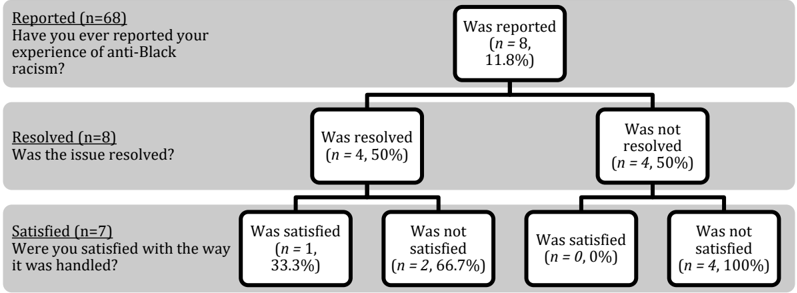
- Only 12% of those responding to the reporting question said they had reported an incident; among reported cases, 50% were resolved, and only one participant was satisfied with how it was handled.
- Most students said the university was not committed to addressing anti-Black racism (57%), that appropriate supports were lacking (73%), and that they were unaware of current anti-racism policies (62%); 79% said such policies were very or extremely important.
Methods
- Two-phase mixed-methods case study; this article presents phase one, an online survey informed by critical race theory and community survey methodology, adapted from Petersen and Alexander’s six-stage assessment protocol.
- Participants were current UCalgary students aged 18+ who self-identified as Black, recruited via purposive and snowball sampling; survey ran December 2020 to March 2022, yielding 304 responses, with 191 removed for incompleteness or non-Black identification, leaving 113 in the final analysis.
- Analysis used descriptive statistics and univariate analysis in Qualtrics, plus thematic analysis of qualitative comments; trustworthiness involved peer debriefing, neutral language, consensus coding, and review of selected quotes.
Limitations
- The authors state the study occurred during COVID-19, which may have shaped participants’ experiences and perspectives, especially virtual education; some students were uncertain about campus safety because they had not been on campus.
- The authors state the survey broadly examined student perspectives and did not explicitly explore intersecting identities, and participation was limited among Black male students and students from Caribbean regions.
- Evident from the text: the single-institution case study and non-probability sampling limit generalizability, and some reporting analyses rely on very small subsamples.
Model-written summary. Check it against the paper before relying on it.
Integrity signals
Registry
Cites
Statistics
Figures
Verification
Claims the paper makes
3 Valid · 2 Not valid · 52 Not checked · 96 Own results and interpretations
The cited sources support only part of this claim — read each source’s verdict below.
In the paper
“Anti-Black racism is prevalent across Canadian university campuses (Moore, 2021;Stirling Cameron & Jefferies, 2021).”
§ Black Students' Experiences of Anti-Black Racism on Campus > Prevalence of Anti-Black Racism in Higher Education in Canada and the United States
What the sources say
- Supportedcites Moore, 2021 matched to “Telling a different story : a counternarrative on Black graduates’ experiences at Canadian post-secondary institutions” (2021) source
Moore's (2021) review section 'Blacks Experience of (Post-Secondary) Education in Canada' documents racism 'on universities campuses all over Canada' (p. ~3, passage 1), including blackface parties, underrepresentation, silencing and microaggressions, and states that racialized/Black students 'are continuing to experience domination and marginalization through both overt and covert racists acts within academia' (passage 2). The 'Adds to' summary (passage 6) records everyday racism at Canadian universities and colleges, and the paper's Summary (passage 8) states the literature shows 'a long history of systemic and antiblack racism within Canadian institutions including post-secondary education.' The paraphrase is a fair, slightly compressed restatement of that point. (LLM, conf=0.90)
- Not matchedcites Stirling Cameron & Jefferies, 2021
An author–year citation the paper’s reference list doesn’t settle. We don’t search these by name.
plain- Asserted: passes — The authors put it forward as true.
- Checkable: passes — It can be checked against evidence.
- Load-bearing: unclear — It is unclear whether the paper’s conclusions depend on it.
- Based: passes — The paper gives a reason why it holds.
- Supported
The cited sources support only part of this claim — read each source’s verdict below.
In the paper
“Further reflecting this distrust, Hussain (2023) found that anti-racism and antidiscrimination frameworks at Canadian universities are frequently implemented in fragmented and inconsistent ways.”
§ Black Students' Experiences of Anti-Black Racism on Campus > Discussion
What the sources say
- Partly supportedcites Hussain (2023) matched to “The Policy Efforts to Address Racism and Discrimination in Higher Education Institutions: The Case of Canada” (2023) sourceExperimental — accuracy not yet measured
The Discussion (page not available) says significant questions remain about implementing anti-racism policies and turning them into services. The Conclusion’s table identifies different policies and challenges at the universities reviewed. These passages support uneven implementation, but the paper does not establish that frameworks across Canadian universities are frequently fragmented and inconsistent. (LLM, conf=0.83)
plain- Asserted: passes — The authors put it forward as true.
- Checkable: passes — It can be checked against evidence.
- Load-bearing: passes — The paper’s conclusions depend on it.
- Based: passes — The paper gives a reason why it holds.
- Partly supported
A result the paper reports from its own data — it cites no other source for it, so there is none to check. The quote shows it is in the paper.
In the paper
“When asked if there were appropriate supports to address discrimination and anti-Black racism on campus, 73% said there were not appropriate supports.”
§ Black Students' Experiences of Anti-Black Racism on Campus > Figure 1. Responses to Anti-Black Racism
plain- Asserted: passes — The authors put it forward as true.
- Checkable: passes — It can be checked against evidence.
- Load-bearing: passes — The paper’s conclusions depend on it.
- Based: passes — The paper gives a reason why it holds.
A result the paper reports from its own data — it cites no other source for it, so there is none to check. The quote shows it is in the paper.
In the paper
“Although the Office of Equity, Diversity and Inclusion, and the Protected Disclosure and Research Integrity Office serve as official channels for reporting incidents, only one student reported accessing these services.”
§ Black Students' Experiences of Anti-Black Racism on Campus > Responses to Anti-Black Racism
plainSingle case- Asserted: passes — The authors put it forward as true.
- Checkable: passes — It can be checked against evidence.
- Load-bearing: unclear — It is unclear whether the paper’s conclusions depend on it.
- Based: passes — The paper gives a reason why it holds.
A result the paper reports from its own data — it cites no other source for it, so there is none to check. The quote shows it is in the paper.
In the paper
“Most students (57%) said no.”
§ Black Students' Experiences of Anti-Black Racism on Campus > Figure 1. Responses to Anti-Black Racism
plain- Asserted: passes — The authors put it forward as true.
- Checkable: passes — It can be checked against evidence.
- Load-bearing: unclear — It is unclear whether the paper’s conclusions depend on it.
- Based: passes — The paper gives a reason why it holds.
51 more claims
Create a free account to see all 153 claims and to verify the 4 references still open.
- Probably not a substantial claim. 45
- It may state two separate claims as one. 69
- The quote only partly states this claim. 6
Self-check
Percentages, sums and reported differences re-computed from the paper’s own numbers.
Each contradiction between two passages listed here was confirmed by an independent check.
Rated minor: it would not touch a result — a value no result rests on, a p-value that stays on the same side of the significance level, or a conflict that is clerical, resolved elsewhere in the paper, or outside its own findings.
In the paper
“| Do you feel safe on campus? (n = 70) | | | | | | Yes | 47 | 67.1% | | | | No | 10 | 15.7% | | |”
§ Black Students' Experiences of Anti-Black Racism on Campus > Conclusion
Reported 15.7 · recomputed 14.285714
Rated minor: it would not touch a result — a value no result rests on, a p-value that stays on the same side of the significance level, or a conflict that is clerical, resolved elsewhere in the paper, or outside its own findings.
In the paper
§ Black Students' Experiences of Anti-Black Racism on Campus > Responses to Anti-Black Racism
“one student who reported an incident of anti-Black racism did not disclose whether the report was resolved or if they were satisfied with the result.”
§ Black Students' Experiences of Anti-Black Racism on Campus > Figure 1. Responses to Anti-Black Racism
“Was reported (n = 8, 11.8%) Was resolved (n = 4, 50%) Was satisfied (n = 1, 33.3%) Was not satisfied (n = 2, 66.7%) Was not resolved (n = 4, 50%)”
Citations
Cites
The publisher hasn’t deposited this paper’s reference list.
Research works printed but not linked: 76
- Ahmed, S. (2012). On being included: Racism and diversity in institutional life. Duke University Press. · DOI · Paper page
- Anderson, M. (2023). The denial of racism is racism itself. Canadian Medical Association Journal, 195(5), E197-E197. · doi:10.1503/cmaj.147823-l
- Arday, J. (2018). Understanding mental health: What are issues for Black and ethnic minority students at university? Social Sciences, 7(10), 196-221. · DOI · Paper page
- Berkowitz, S. (1996). Taking the sample survey approach. In R. Reviere (Ed.), Needs assessment: A creative and practical guide for social scientists (pp. 33-51).
- Taylor & Francis.
- Butts, H. F. (2002). The black mask of humanity: Racial/ethnic discrimination and post- traumatic stress disorder. Journal of the American Academy of Psychiatry and the Law, 30(3), 336-339.
- Cameron, E. S., & Jefferies, K. (2021). Anti-Black racism in Canadian education: A call to action to support the next generation. Healthy Populations Journal, 1(1), 11-15 · DOI
- Caxaj, C. S., Chau, S., & Parkins, I. (2021). How racialized students navigate campus life in a mid-sized Canadian city: 'Thrown against a white background' but 'comfortable enough to laugh'. Race Ethnicity and Education, 24(4), 503-522. · DOI
- Chapman-Hilliard, C., & Beasley, S. T. (2018). "It's like power to move": Black students' psychosocial experiences in Black studies courses at a predominantly white institution. Journal of Multicultural Counseling and Development, 46(2), 129-151. · DOI
- Corbin, N. A., Smith, W. A., & Garcia, J. R. (2018). Trapped between justified anger and being the strong Black woman: Black college women coping with racial battle fatigue at historically and predominantly White institutions. International Journal of Qualitative Studies in Education, 31(7), 626-643. · DOI · Paper page
- Cranston, J., & Bennett, A. (2024). Systemic racism in Canadian higher education: A rapid scoping review of 22 years of literature. Canadian Journal of Higher Education, 54(1), 103-125. · DOI
- Crenshaw, K. W. (1989). Demarginalizing the intersection of race and sex: A Black feminist critique of anti-discrimination doctrine, feminist theory and antiracist politics. University of Chicago Legal Forum, 1989(8), 139-167. · DOI
- Crenshaw, K. W. (2016). Mapping the margins: Intersectionality, identity politics, and violence against women of color. In E. Taylor, D. Gillborn, & G. Ladson-Billings (Eds.), Foundations of critical race theory in education (2nd ed., pp. 223-250). Routledge.
- Creswell, J. W. (2013). Qualitative inquiry & research design: Choosing among five approaches (3rd ed.). Sage.
- Cukier, W., Adamu, P., Wall-Andrews, C., & Elmi, M. (2021). Racialized leaders leading Canadian universities. Educational Management, Administration & Leadership, 49(4), 565-583. · DOI
- Daniel, B.-J. M. (2021). Racial oases as spaces of positive racial identity socialization among African Canadian post-secondary students. International Journal of Qualitative Studies in Education, 36(10), 2177-2195. · DOI
- Diverlus, R., Hudson, S., & Ware, S. M. (2020). Until we are free: Reflections on Black Lives Matter in Canada. University of Regina Press. · DOI
- Douglas, D. D. (2022). Access denied: Safe/guarding the university as white property. In S. Thobani (Ed.), Coloniality and racial (in)justice in the university: Counting for nothing? (pp. 245-265). University of Toronto Press. · doi:10.3138/9781487532048-007
- Duhaney, P., Kusari, K., Morris, E., & Taiwo, A. (2022). Addressing systemic anti-Black racism in social work: A plan of action. Journal of Teaching in Social Work, 42(2-3), 280-302. · DOI
- Duhaney, P., & El-Lahib, Y. (2021). The politics of resistance from within: Dismantling white supremacy in social work classrooms. Advances in Social Work, 21(2/3), 421- 437. · DOI
- Edman, J. L., & Brazil, B. (2009). Perceptions of campus climate, academic efficacy and academic success among community college students: an ethnic comparison. Social Psychology of Education, 12(3), 371-383. · DOI
- Eichstaedt, J. C., Sherman, G. T., Giorgi, S., Roberts, S. O., Reynolds, M. E., Ungar, L. H., & Guntuku, S. C. (2021). The emotional and mental health impact of the murder of George Floyd on the US population. Proceedings of the National Academy of Sciences (PNAS), 118(39), 1-5. · DOI · Paper page
- Essed, P. (1991). Understanding everyday racism: An interdisciplinary theory. Sage. · DOI · Paper page
- Ford, C. L., & Airhihenbuwa, C. O. (2010). Critical race theory, race equity, and public health: Toward antiracism praxis. American Journal of Public Health, 100, S30-S35. · DOI · Paper page
- Gaynor, T. S., & Wilson, M. E. (2020). Social vulnerability and equity: The disproportionate impact of COVID-19. Public Administration Review, 80(5), 832- 838. · DOI · Paper page
- Gershenson, S., Hansen, M., & Lindsay, C. (2021). Teacher diversity and student success: Why racial representation matters in the classroom. Harvard Education Press.
- Gillborn, D. (2006). Critical race theory and education: Racism and anti-racism in educational theory and praxis. Discourse: Studies in the Cultural Politics of Education, 27(1), 11-32. · DOI · Paper page
- Gosine, K. (2007). Navigating the Canadian university system: An exploration of the experiences, motivations, and perceptions of a sample of academically accomplished Black Canadians. Journal of Contemporary Issues in Education, 2(1), 3-21. · DOI
- Graham, L., Brown-Jeffy, S., Aronson, R., & Stephens, C. (2011). Critical race theory as theoretical framework and analysis tool for population health research. Critical Public Health, 21(1), 81-93. · DOI · Paper page
- Guest, G., MacQueen, K., & Namey, E. (2012). Applied thematic analysis. Sage. · DOI · Paper page
- Halvorsen, J., King, R., Lorenzetti, L., Wolfleg, A., & Haile, L. (2022). White entitlement in antiracism and anticolonialism. In A. Gebhard, S. Mclean, & V. St. Denis (Eds.), White benevolence: Racism and colonial violence in the helping professions (pp. 227-243). Fernwood Publishing.
- Hampton, R. (2016). Racialized social relations in higher education: Black student and faculty experiences of a Canadian university (Master's thesis, McGill University). ProQuest Dissertations & Theses.
- Ijoma, J. N., Sahn, M., Mack, K. N., Akam, E., Edwards, K. J., Wang, X., Surpur, A., & Henry, K. E. (2022). Visions by WIMIN: BIPOC representation matters. Molecular Imaging and Biology, 24(3), 353-358. · DOI
- James, C. E., & Asres, M. (2024). Negotiating university, fulfilling the dream: The case of Black students. Genealogy, 8(3), 1-15. · DOI
- Jones, A. M. (2021). Letters to their attackers: Using counterstorytelling to share how Black women respond to racial microaggressions at a historically White institution. International Journal of Qualitative Studies in Education, 36(9), 1825-1837. · DOI
- Joseph, I. (2020). A systemic review of the Black student-athlete experience and the McMaster athletics climate. McMaster University.
- Katchanovski, I., Nevitte, N., & Rothman, S. (2015). Race, gender, and affirmative action attitudes in American and Canadian universities. Canadian Journal of Higher Education, 45(4), 18-41. · DOI
- Koo, K. K. (2021). Am I welcome here? Campus climate and psychological well-being among students of color. Journal of Student Affairs Research and Practice, 58(2), 196-213. · DOI
- Kuechler, M. (1998). The survey method: An indispensable tool for social science research everywhere? American Behavioral Scientist, 42(2), 178-200. · doi:10.1177/0002764298042002005
- Kumsa, M. K., M'Carthy, M. M., Oba, F., & Gaasim, S. (2014). The contours of anti- Black racism: Engaging anti-oppression from embodied spaces. CAOS: The Journal of Critical Anti-Oppressive Social Inquiry, 1, 21-38.
- Leath, S., & Chavous, T. (2018). Black women's experiences of campus racial climate and stigma at predominantly white institutions: Insights from a comparative and within-group approach for STEM and non-STEM majors. Journal of Negro Education, 87(2), 125-139. · DOI
- Lim, J. N. (2021). Racial representation for faculty in higher education (Honors Thesis, Western Michigan University). Scholar Works.
- MacKenzie, M., Sensoy, Ö., Johnson, G. F., Sinclair, N., & Weldon, L. (2023). How universities gaslight EDI&I initiatives: Mapping institutional resistance to structural change. International Journal of Education Policy & Leadership, 19(1), 1-18. · DOI
- Maffini, C. S., & Dillard, K. C. (2022). Safe & sound? Perceptions of campus safety for Black college students. Race Ethnicity and Education, 25(1), 2-17. · DOI
- Malagon, M. C., Huber, L. P., & Velez, V. N. (2009). Our experiences, our methods: Using grounded theory to inform a critical race theory methodology. Seattle Journal for Social Justice, 8(1), 253-272.
- Marks, L. M., Stenersen, M., Adams, K., Lattimore, D., & Lee, B. C. (2021). Racial microaggressions and depression in Black college students: The role of ethnic identity. Journal of College Student Psychotherapy, 37(3), 243-259. · DOI
- Marom, L. (2023). Resistance, performativity, and fragmentation: The relational arena of EDI/D in Canadian higher education. Canadian Journal of Education, 46(4), 1083- 1114. · DOI
- McGill University. (2020). Action plan to address anti-Black racism [Press release].
- Mills, K. J. (2021). Black students' perceptions of campus climates and the effect on academic resilience. Journal of Black Psychology, 47(4-5), 354-383. · DOI
- Mohamed, T., & Beagan, B. L. (2019). 'Strange faces' in the academy: Experiences of racialized and Indigenous faculty in Canadian universities. Race Ethnicity and Education, 22(3), 338-354. · DOI
- Moore, P. J., & Toliver, S. D. (2010). Intraracial dynamics of Black professors' and Black students' communication in traditionally white colleges and universities. Journal of Black Studies, 40(5), 932-945. · doi:10.1177/0021934708321107
- Mullings, D. V., Morgan, A., & Quelleng, H. K. (2016). Canada the great white north where anti-Black racism thrives: Kicking down the doors and exposing the realities. Phylon, 53(1), 20-41.
- Mwangi, C. A. G., Thelamour, B., Ezeofor, I., & Carpenter, A. (2018). "Black elephant in the room": Black students contextualizing campus racial climate within US racial climate. Journal of College Student Development, 59(4), 456-474. · DOI · Paper page
- Ng, E. S., & Lam, A. (2020). Black lives matter: On the denial of systemic racism, white liberals, and polite racism. Equality, Diversity and Inclusion: An International Journal, 39(7), 729-739. · DOI
- Oh, H., Karcher, N. R., Besecker, M., DeVylder, J. E., & Lincoln, K. D. (2025). Perceptions of anti-racism efforts and mental health among students in higher education in the United States. Frontiers in Public Health, 13, 1-9. · DOI
- Parker, L. (2019). Critical race theory and qualitative methodology in education. Oxford Research Encyclopedia of Education. · DOI
- Patton, M. Q. (2002). Qualitative research & evaluation methods (3rd ed.). Sage.
- Petersen, D. J., & Alexander, J. R. (2001). Needs assessment in public health: A practical guide for students and professionals. Kluwer Academic. · doi:10.1007/b112330
- Pittman, E. (1994). Cultural centers on predominantly white campuses: Campus, cultural and social comfort equals retention. Diverse Issues in Higher Education, 11(16), 104.
- Potvin, L. (2020). Black lives matter in Canada too. Canadian Journal of Public Health, 111(5), 633-635. · DOI
- Ransby, B. (2018). Making all Black lives matter: Reimagining freedom in the twenty- first century. University of California Press. · DOI · Paper page
- Ryerson University. (2020). Anti-Black racism campus climate review report. Office of the Vice-President, Equity and Community Inclusion, Ryerson University.
- Sangmen, A. A., Ofori, E., & Botchey, G. (2023). Graduate students' experiences of anti- Black racism in Canadian post-secondary education: A critical exploration. The Canadian Journal for New Scholars in Education, 15(2), 244-257.
- Shadmi, E., Chen, Y., Dourado, I., Faran-Perach, I., Furler, J., Hangoma, P., Hanvoravongchai, P., Obando, C., Petrosyan, V., Rao, K. D., Ruano, A. L., Shi, L., de Souza, E. L., Spitzer-Shohat, S., Sturgiss, E., Suphanchaimat, R., Villar, M. U., & Willems, S. (2020). Health equity and COVID-19: Global perspectives. International Journal Equity Health, 19(104), 1-16. · DOI · Paper page
- Shahin, S., Nakahara, J., & Sánchez, M. (2021). Black Lives Matter goes global: Connective action meets cultural hybridity in Brazil, India, and Japan. New Media & Society, 26(1), 216-235. · DOI
- Smith, W. A. (2004). Black faculty coping with racial battle fatigue: The campus racial climate in a post-civil rights era. In D. Cleveland (Ed.), A long way to go: Conversations about race by African American faculty and graduate students at predominantly White institutions (pp. 171-190).
- Smith, W. A. (2010). Toward an understanding of misandric microaggressions and racial battle fatigue among African Americans in historically white institutions. In E. M. Zamani-Gallaher & V. C. Polite (Eds.), The state of the African American male (pp. 265-277). Michigan State University Press. · doi:10.14321/jj.5501044.18
- Smith, W. A., Mustaffa, J. B., Jones, C. M., Curry, T. J., & Allen, W. R. (2016). 'You make me wanna holler and throw up both my hands!': Campus culture, Black misandric microaggressions, and racial battle fatigue. International Journal of Qualitative Studies in Education, 29(9), 1189-1209. · DOI · Paper page
- Smith, W. A., Yosso, Tara, J., & Solórzano, D. G. (2006). Challenging racial battle fatigue on historically White campuses: A critical race examination of race-related stress. In C. A. Stanley (Ed.), Faculty of color teaching in predominantly White colleges and universities (pp. 299-327).
- Solomon, T. (2023). Up in the air: Ritualized atmospheres and the global Black Lives Matter movement. European Journal of International Relations, 29(3), 576-601. · DOI
- Stirling Cameron, E., & Jefferies, K. (2021). Anti-Black racism in Canadian education: A call to action to support the next generation. Healthy Populations Journal, 1(1), 11-15. · DOI
- Sue, D. W., Capodilupo, C. M., Torino, G. C., Bucceri, J. M., Holder, A. M., Nadal, K. L., & Esquilin, M. (2007). Racial microaggressions in everyday life: Implications for clinical practice. The American Psychologist, 62(4), 271-286. · DOI · Paper page
- Tamtik, M., & Guenter, M. (2019). Policy analysis of equity, diversity and inclusion strategies in Canadian universities -How far have we come? Canadian Journal of Higher Education, 49(3), 41-56. · DOI
- Taylor, E. (1998). A primer on critical race theory: Who are the critical race theorists and what are they saying? The Journal of Blacks in Higher Education, 19, 122-124. · DOI
- Wilcox, M. M. (2023). Oppression is not "culture": The need to center systemic and structural determinants to address anti-Black racism and racial trauma in psychotherapy. Psychotherapy, 60(1), 76-85. · DOI
- Wu, H. H., Gallagher, R. J., Alshaabi, T., Adams, J. L., Minot, J. R., Arnold, M. V., Welles, B. F., Harp, R., Dodds, P. S., & Danforth, C. M. (2023). Say their names: Resurgence in the collective attention toward Black victims of fatal police violence following the death of George Floyd. Plos One, 18(1), 1-26. · DOI
Cited by
The Impact of Anti‐Black Racism on Black Undergraduate Nursing Students in Canada
Luhanga, F. L., Essien, D., Matebekwane, K. A., et al. (2026) · Nursing Inquiry · doi:10.1111/nin.70110
Metadata
- Authors
- Duhaney, P., Lorenzetti, L., Halvorsen, J., & Han, E.
- Affiliations
- University of Calgary (CA)
- Venue
- Advances in Social Work
- Publisher
- IU Indianapolis University Library
- Published
- 2025-07-09
- Volume
- 25
- Issue
- 1
- Pages
- 74-101
- ISSN
- 1527-8565 (ISSN-L)
- 2331-4125
- OpenAlex
- W4412165204
- Cited by
- 1
- References
- 0
- Citations by year
- 2026: 1
- FWCI
- 1.74
- Type
- journal article
- Language
- en
- Open access
- diamond
- doi.org
- Locations
- Advances in Social Work (publishedVersion, cc-by)
- Topics
- Social Sciences › Sociology and Political Science › Critical Race Theory in Education
- Social Sciences › Sociology and Political Science › Racial and Ethnic Identity Research
- Social Sciences › Education › Higher Education Research Studies
- Keywords
- anti-Black racism, Black students, higher education, campus climate, student well-being, institutional responses, racial equity, critical race theory, anti-racism training, curriculum development, representation, Canada, Alberta
About these checks
Registry, retraction, Cites and statistics results are computed, not judged, with one exception: a printed reference that no index lists is read once by a model before it counts as a citation error. Claims are extracted by a model and kept only when their quote appears verbatim in the text; each cited source is then checked, with a model’s help, for whether it says what the claim relies on. Those verdicts can be wrong — read the claim’s quote and the cited source before relying on one.
The claim verdicts this report counts are experimental: their accuracy is not yet measured.
A language model drew the claims from the paper on 2026-10-12, under version 3 of the claim definition (model deepseek-v4.1-flash, prompt extract-v3).
A second model labelled each claim on 2026-10-12 (model jev-1.13-20260917, definition revision gold-guideline-v0.2).
Cited sources are checked with a language model’s help (qwen3.8-omni-flash and gpt-6-sol).
Statistics and arithmetic are recomputed, not judged.
Confidence bands are shown only for fields calibrated on our annotated test set. None is calibrated yet, so no band is shown.
What counts as a claim ›How we measure confidence ›How we check this ›
Are you an author, or do you see a problem with this page? Request a review
Data sources
Bibliographic data: Semantic Scholar, OpenAlex, Crossref.
Contains information from the Semantic Scholar Academic Graph Datasets, made available under the ODC Attribution License (ODC-BY 1.0).
Semantic Scholar’s data is described in: Kinney, R., et al. (2023). The Semantic Scholar Open Data Platform. arXiv:2301.10140.
