

The DOI matches its Crossref record.
Competitive binding of circCCDC6 to microRNA-128-3p activates TXNIP/NLRP3 pathway and promotes cerebral ischemia-reperfusion defects
Abstract
Objective: Circular RNAs (circRNAs) are enriched in the brain and involved in various central nervous system diseases. The potential role of circCCDC6 in cerebral ischemia-reperfusion defects was partly elucidated in the work. Methods: A middle cerebral artery occlusion/reperfusion (MCAO/R) rat model and an oxygen-glucose deprivation and re-oxygenation (OGD/R)-treated SH-SY5Y cell model were constructed. CircCCDC6 expression in the two models was examined, and circCCDC6-involved mechanisms in neuronal pyroptosis and inflammation were analyzed through loss- and gain-of-function assays. Results: MCAO/R rat brain tissues and OGD/R-treated SH-SY5Y cells exhibited upregulated circCCDC6. Silencing circCCDC6 attenuated neuronal pyroptosis and inflammation in the brain tissue of MCAO/R rats. Overexpressing circCCDC6 or inhibiting miR-128-3p stimulated OGD/R-induced pyroptosis and inflammation in SH-SY5Y cells, while upregulating miR-128-3p attenuated OGD/R injury. CircCCDC6 silencing-induced effects on SH-SY5Y cells were antagonized by TXNIP overexpression. Conclusion: Mechanistically, circCCDC6 mediates miR-128-3p and activates TXNIP/NLRP3, thereby promoting OGD/R-induced neuronal pyroptosis and inflammation. CircCCDC6 may provide a new strategy for the treatment of MCAO/R.
Overview
The claims and statistics of this paper haven’t been checked yet.
Run the check — free, no account needed. It reads the open-access text and checks the sources it cites.
Integrity signals
Registry
Cites
Statistics
Figures
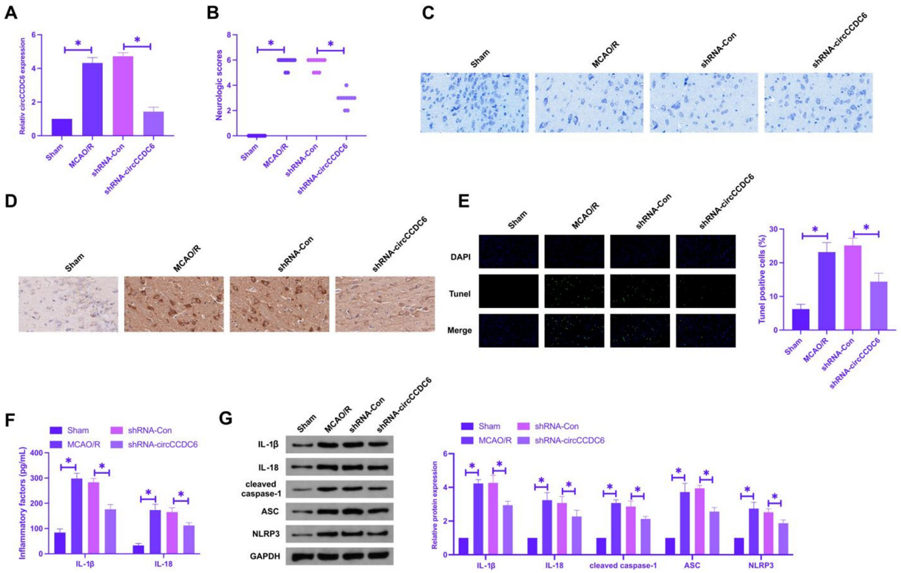
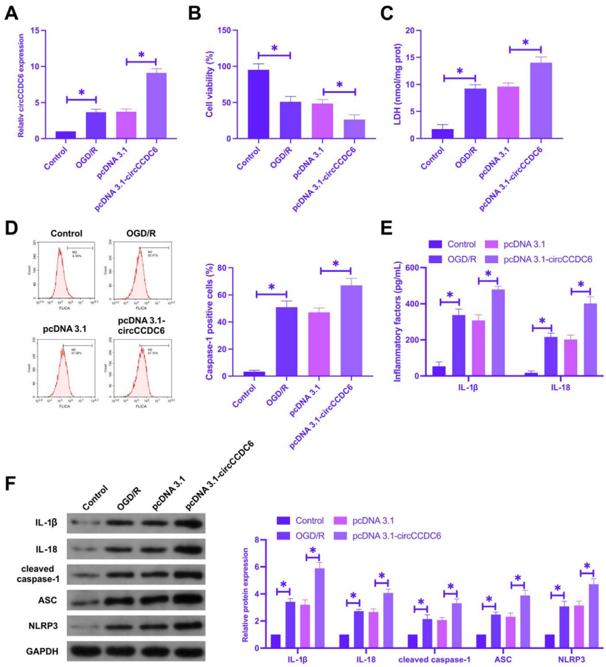
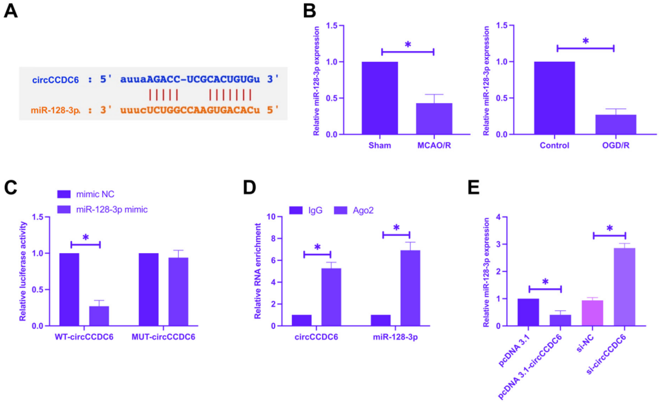
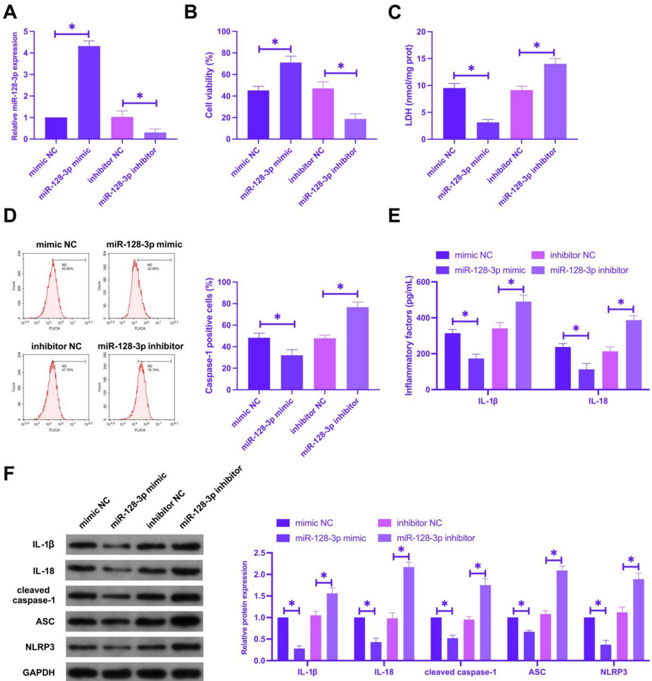
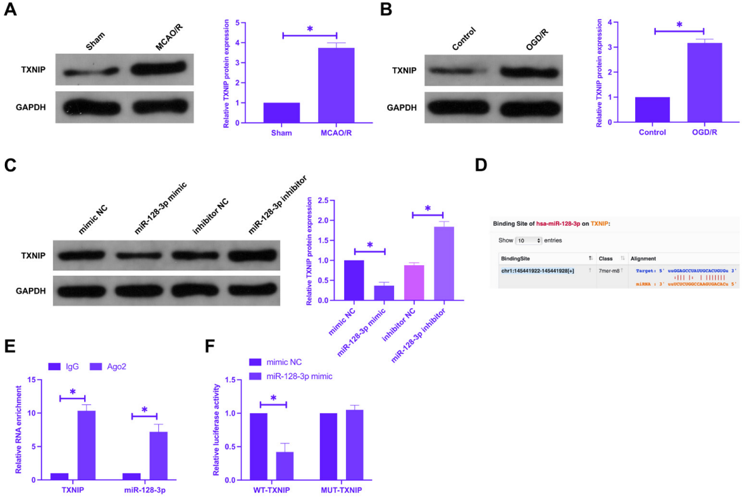
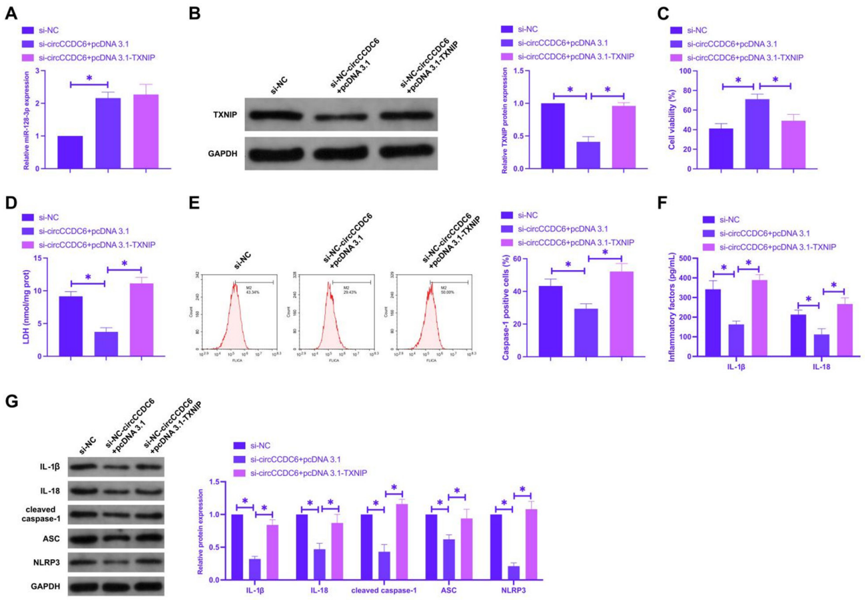
Verification
Claims the paper makes
The claims and statistics of this paper haven’t been checked yet.
Run the check — free, no account needed. It reads the open-access text and checks the sources it cites.
Claims other papers make about this one
Each is checked against this paper’s own text: does it say what the citing paper says it does?
In the citing paper
“Similarly, several circular RNAs have been confirmed to enclose miR-128-3p binding elements, which have functional consequences on neuronal tissue homeostasis.152,153”
From MiR-128-3p – a gray eminence of the human central nervous system (2024) · cites this paper as [153]
Self-check
Percentages, sums and reported differences re-computed from the paper’s own numbers.
The self-check needs the paper’s full text.
Citations
Cites
No references could be resolved yet.
Research works printed but not linked: 38
- Brennan GP, Henshall DC (2020) MicroRNAs as regulators of brain function and targets for treatment of epilepsy. Nat Rev Neurol 16: 506-519. https://doi.org/10.1038/s41582-020-0369-8 · DOI · Paper page
- Chen S, Li B (2020) MiR-128-3p Post-transcriptionally inhibits WISP1 to suppress apoptosis and inflammation in human articular chondro- cytes via the PI3K/AKT/NF-κB signaling pathway. Cell Transplant 29: 963689720939131. https://doi.org/10.1177/0963689720939131 · DOI
- Chen ZQ, Zhou Y, Chen F, Huang JW, Li HL, Li T, Li L (2021) miR- 200a-3p Attenuates coronary microembolization-induced myocardial injury in rats by Inhibiting TXNIP/NLRP3-mediated cardiomyocyte pyroptosis. Front Cardiovasc Med 8: 693257. https://doi.org/10.3389/ fcvm.2021.693257 · DOI
- Dai Q, Ma Y, Xu Z, Zhang L, Yang H, Liu Q, Wang J (2021) Down- regulation of circular RNA HECTD1 induces neuroprotection against ischemic stroke through the microRNA-133b/TRAF3 path- way. Life Sci 264: 118626. https://doi.org/10.1016/j.lfs.2020.118626 · DOI
- Filippenkov IB, Stavchansky VV, Denisova AE, Valieva LV, Remizova JA, Mozgovoy IV, Zaytceva EI, Gubsky LV, Limborska SA, Der- gunova LV (2021) Genome-wide RNA-sequencing reveals massive circular RNA expression changes of the neurotransmission genes in the rat brain after ischemia-reperfusion. Genes (Basel) 12. https://doi. org/10.3390/genes12121870 · DOI
- Jia Y, Cui R, Wang C, Feng Y, Li Z, Tong Y, Qu K, Liu C, Zhang J (2020) Metformin protects against intestinal ischemia-reperfusion injury and cell pyroptosis via TXNIP-NLRP3-GSDMD pathway. Redox Biol 32: 101534. https://doi.org/10.1016/j.redox.2020.101534 · DOI · Paper page
- Kong L, Zhang H, Lu C, Shi K, Huang H, Zheng Y, Wang Y, Wang D, Wang H, Huang W (2021) AICAR, an AMP-activated protein kinase activator, ameliorates acute pancreatitis-associated liver injury partially through Nrf2-mediated antioxidant effects and inhibition of NLRP3 inflammasome activation. Front Pharmacol 12: 724514. htt- ps://doi.org/10.3389/fphar.2021.724514 · DOI
- Lim S, Kim TJ, Kim YJ, Kim C, Ko SB, Kim BS (2021) Senolytic therapy for cerebral ischemia-reperfusion injury. Int J Mol Sci 22. https://doi.org/10.3390/ijms222111967 · DOI
- Liu W, Miao Y, Zhang L, Xu X, Luan Q (2020) MiR-211 protects cerebral ischemia/reperfusion injury by inhibiting cell apoptosis. Bio- engineered 11: 189-200. https://doi.org/10.1080/21655979.2020.1729 322 · DOI
- Liu X, Zhang YR, Cai C, Ni XQ, Zhu Q, Ren JL, Chen Y, Zhang LS, Xue CD, Zhao J, Qi YF, Yu YR (2019) Taurine alleviates schisto- soma-induced liver injury by inhibiting the TXNIP/NLRP3 inflam- masome signal pathway and pyroptosis. Infect Immun 87. https://doi. org/10.1128/iai.00732-19 · DOI
- Liu Y, Li YP, Xiao LM, Chen LK, Zheng SY, Zeng EM, Xu CH (2021) Extracellular vesicles derived from M2 microglia reduce is- chemic brain injury through microRNA-135a-5p/TXNIP/NLRP3 axis. Lab Invest 101: 837-850. https://doi.org/10.1038/s41374-021- 00545-1 · DOI
- Luo L, Liu M, Fan Y, Zhang J, Liu L, Li Y, Zhang Q, Xie H, Jiang C, Wu J, Xiao X, Wu Y (2022) Intermittent theta-burst stimula- tion improves motor function by inhibiting neuronal pyroptosis and regulating microglial polarization via TLR4/NFκB/NLRP3 signal- ing pathway in cerebral ischemic mice. J Neuroinflammation 19: 141. https://doi.org/10.1186/s12974-022-02501-2 · DOI
- Mehta SL, Pandi G, Vemuganti R (2017) Circular RNA expression pro- files alter significantly in mouse brain after transient focal ischemia. Stroke 48: 2541-2548. https://doi.org/10.1161/strokeaha.117.017469 · DOI
- Meng X, Xie W, Xu Q, Liang T, Xu X, Sun G, Sun X (2018) Neu- roprotective effects of radix scrophulariae on cerebral ischemia and reperfusion injury via MAPK pathways. Molecules 23. https://doi. org/10.3390/molecules23092401 · DOI
- tics, and analysis methods. J Cell Physiol 234: 5451-5465. https:// doi.org/10.1002/jcp.27486 · DOI · Paper page
- Tatlisumak T, Takano K, Carano RA, Miller LP, Foster AC, Fisher M (1998) Delayed treatment with an adenosine kinase inhibi- tor, GP683, attenuates infarct size in rats with temporary mid- dle cerebral artery occlusion. Stroke 29: 1952-1958. https://doi. org/10.1161/01.str.29.9.1952 · DOI
- Tu Y, Hu Y (2021) MiRNA-34c-5p protects against cerebral ischemia/ reperfusion injury: involvement of anti-apoptotic and anti-in- flammatory activities. Metab Brain Dis 36: 1341-1351. https://doi. org/10.1007/s11011-021-00724-5 · DOI
- Vo JN, Cieslik M, Zhang Y, Shukla S, Xiao L, Zhang Y, Wu YM, Dha- nasekaran SM, Engelke CG, Cao X, Robinson DR, Nesvizhskii AI, Chinnaiyan AM (2019) The landscape of circular RNA in cancer. Cell 176: 869-881.e813. https://doi.org/10.1016/j.cell.2018.12.021 · DOI
- Wang D, Chen F, Fang B, Zhang Z, Dong Y, Tong X, Ma H (2020) MiR-128-3p Alleviates spinal cord ischemia/reperfusion injury as- sociated neuroinflammation and cellular apoptosis via SP1 sup- pression in rat. Front Neurosci 14: 609613. https://doi.org/10.3389/ fnins.2020.609613 · DOI
- Wang K, Sun Q, Zhong X, Zeng M, Zeng H, Shi X, Li Z, Wang Y, Zhao Q, Shao F, Ding J (2020) Structural mechanism for GS- DMD targeting by autoprocessed caspases in pyroptosis. Cell 180: 941-955.e920. https://doi.org/10.1016/j.cell.2020.02.002 · DOI
- Wang L, Ren W, Wu Q, Liu T, Wei Y, Ding J, Zhou C, Xu H, Yang S (2022) NLRP3 Inflammasome activation: a therapeutic target for cerebral ischemia-reperfusion injury. Front Mol Neurosci 15: 847440. https://doi.org/10.3389/fnmol.2022.847440 · DOI
- Wang Y, Xiao G, He S, Liu X, Zhu L, Yang X, Zhang Y, Orgah J, Feng Y, Wang X, Zhang B, Zhu Y (2020) Protection against acute cerebral ischemia/reperfusion injury by QiShenYiQi via neuroin- flammatory network mobilization. Biomed Pharmacother 125: 109945. https://doi.org/10.1016/j.biopha.2020.109945 · DOI
- Wen M, Jin Y, Zhang H, Sun X, Kuai Y, Tan W (2019) Proteomic analysis of rat cerebral cortex in the subacute to long-term phas- es of focal cerebral ischemia-reperfusion injury. J Proteome Res 18: 3099-3118. https://doi.org/10.1021/acs.jproteome.9b00220 · DOI
- Xin L, Junhua W, Long L, Jun Y and Yang X (2017) Exogenous Hy- drogen Sulfide Protects SH-SY5Y Cells from OGD/RInduced In- jury. Curr Mol Med 17: 563-567. https://doi.org/10.2174/15665240 18666180222121643 · DOI
- Yan Q, Sun SY, Yuan S, Wang XQ, Zhang ZC (2020) Inhibition of microRNA-9-5p and microRNA-128-3p can inhibit ischemic stroke- related cell death in vitro and in vivo. IUBMB Life 72: 2382-2390. https://doi.org/10.1002/iub.2357 · DOI
- Yang B, Zang L, Cui J and Wei L (2021, Feb 12) Circular RNA TTC3 regulates cerebral ischemia-reperfusion injury and neural stem cells by miR-372-3p/TLR4 axis in cerebral infarction. Stem Cell Res Ther 12: 125. https://doi.org/10.1186/s13287-021-02187-y · DOI
- Yang J, Chen M, Cao RY, Li Q, Zhu F (2018) The role of circular RNAs in cerebral ischemic diseases: ischemic stroke and cerebral ischemia/reperfusion injury. Adv Exp Med Biol 1087: 309-325. htt- ps://doi.org/10.1007/978-981-13-1426-1_25 · DOI
- Yang P, Han J, Li S, Luo S, Tu X, Ye Z (2021) miR-128-3p inhib- its apoptosis and inflammation in LPS-induced sepsis by targeting TGFBR2. Open Med (Wars) 16: 274-283. https://doi.org/10.1515/ med-2021-0222 · DOI
- Yang X, Ji H, Yao Y, Lai X, Jiang Y, Wu D, Cai L, Zhu W, Gu X, Hu R, Li L, Xu L, Jiang M (2018) Downregulation of circ_008018 protects against cerebral ischemia-reperfusion injury by targeting miR-99a. Biochem Biophys Res Commun 499: 758-764. https://doi. org/10.1016/j.bbrc.2018.03.218 · DOI
- Yao Y, Hu S, Zhang C, Zhou Q, Wang H, Yang Y, Liu C, Ding H (2022) Ginsenoside Rd attenuates cerebral ischemia/reperfusion injury by exerting an anti-pyroptotic effect via the miR-139-5p/ FoxO1/Keap1/Nrf2 axis. Int Immunopharmacol 105: 108582. https:// doi.org/10.1016/j.intimp.2022.108582 · DOI
- Yu P, Zhang X, Liu N, Tang L, Peng C, Chen X (2021) Pyroptosis: mechanisms and diseases. Signal Transduct Target Ther 6: 128. https:// doi.org/10.1038/s41392-021-00507-5 · DOI · Paper page
- Zhang M, Lu H, Xie X, Shen H, Li X, Zhang Y, Wu J, Ni J, Li H, Chen G (2020) TMEM175 mediates Lysosomal function and partic- ipates in neuronal injury induced by cerebral ischemia-reperfusion. Mol Brain 13: 113. https://doi.org/10.1186/s13041-020-00651-z · DOI
- Zhang Q, Jia M, Wang Y, Wang Q, Wu J (2022) Cell death mecha- nisms in cerebral ischemia-reperfusion injury. Neurochem Res 47: 3525-3542. https://doi.org/10.1007/s11064-022-03697-8 · DOI
- Zhang X, Zhang Y, Cai W, Liu Y, Liu H, Zhang Z, Su Z (2020) MicroRNA-128-3p Alleviates neuropathic pain through targeting ZEB1. Neurosci Lett 729: 134946. https://doi.org/10.1016/j.neu- let.2020.134946 · DOI · Paper page
- Zhang Y, Yao Z, Xiao Y, Zhang X, Liu J (2022) Downregulated XBP- 1 rescues cerebral ischemia/reperfusion injury-induced pyroptosis via the NLRP3/Caspase-1/GSDMD axis. Mediators Inflamm 2022: 8007078. https://doi.org/10.1155/2022/8007078 · DOI
- Zhang ZH, Wang YR, Li F, Liu XL, Zhang H, Zhu ZZ, Huang H, Xu XH (2020) Circ-camk4 involved in cerebral ischemia/reperfusion induced neuronal injury. Sci Rep 10: 7012. https://doi.org/10.1038/ s41598-020-63686-1 · DOI
- Zhu T, Wang L, Tian F, Zhao X, Pu XP, Sun GB, Sun XB (2020) Anti-ischemia/reperfusion injury effects of notoginsenoside R1 on small molecule metabolism in rat brain after ischemic stroke as visualized by MALDI-MS imaging. Biomed Pharmacother 129: 110470. https://doi.org/10.1016/j.biopha.2020.110470 · DOI
- Zuo G, Zhang D, Mu R, Shen H, Li X, Wang Z, Li H, Chen G (2018) Resolvin D2 protects against cerebral ischemia/reperfusion injury in rats. Mol Brain 11: 9. https://doi.org/10.1186/s13041-018-0351-1 · DOI
Cited by
Sorted by citations
MiR-128-3p – a gray eminence of the human central nervous system
Kiel, K., Król, S. K., Bronisz, A., & Godlewski, J. (2024) · Molecular Therapy Nucleic Acids · doi:10.1016/j.omtn.2024.102141 · Cited by 15
Metadata
- Authors
- Wang, C., Dong, M., Zhang, X., Wang, X., Zhao, Y., & Cao, Y.
- ORCID
- Wang, ChongShu
- Venue
- Acta Biochimica Polonica
- Publisher
- Frontiers Media SA
- Published
- 2023-11-07
- ISSN
- 1734-154X
- 0001-527X
- Cited by
- 2
- References
- 0
About these checks
Registry, retraction, Cites and statistics results are computed, not judged, with one exception: a printed reference that no index lists is read once by a model before it counts as a citation error. Claims are extracted by a model and kept only when their quote appears verbatim in the text; each cited source is then checked, with a model’s help, for whether it says what the claim relies on. Those verdicts can be wrong — read the claim’s quote and the cited source before relying on one.
Statistics and arithmetic are recomputed, not judged.
Confidence bands are shown only for fields calibrated on our annotated test set. None is calibrated yet, so no band is shown.
What counts as a claim ›How we measure confidence ›How we check this ›
Are you an author, or do you see a problem with this page? Request a review
