

The DOI matches its Crossref record; 13 of the 13 references it cites were found in a registry or an index.
AmbigQA: Answering Ambiguous Open-domain Questions
Overview
The claims and statistics of this paper haven’t been checked yet.
Run the check — free, no account needed. It reads the open-access text and checks the sources it cites.
Integrity signals
Registry
Cites
Statistics
Figures
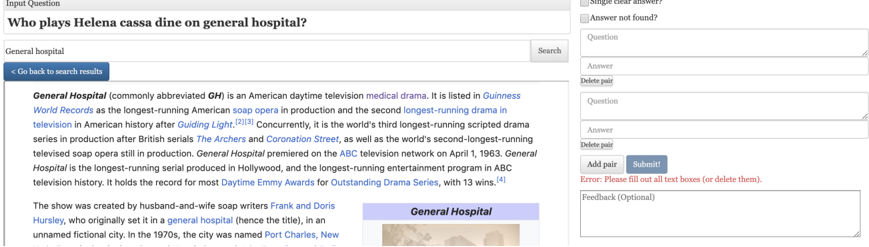
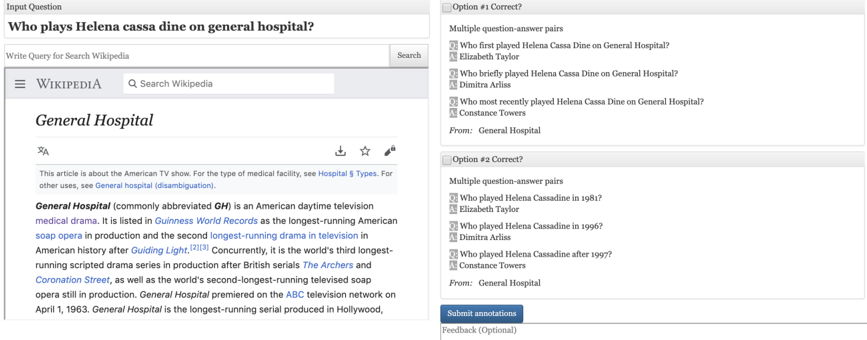
Verification
Claims the paper makes
The claims and statistics of this paper haven’t been checked yet.
Run the check — free, no account needed. It reads the open-access text and checks the sources it cites.
Claims other papers make about this one
Each is checked against this paper’s own text: does it say what the citing paper says it does?
In the citing paper
“A significant challenge in open-domain question answering is the potential temporal mismatch between the Wikipedia dump and the question-answer pairs in the dataset, which can lead to missing answers in the dataset, as highlighted in the AmbigQA study [34].”
From The power of noise: Redefining retrieval for rag systems (2024) · cites this paper as [34]
Self-check
Percentages, sums and reported differences re-computed from the paper’s own numbers.
The self-check needs the paper’s full text.
Citations
Cites
BERT: Pre-training of Deep Bidirectional Transformers for Language Understanding
Devlin, J., Chang, M.-W., Lee, K., & Toutanova, K. (2018) · arXiv · doi:10.48550/arxiv.1810.04805 · Cited by 73,173
BERT: Pre-training of Deep Bidirectional Transformers for Language Understanding
Devlin, J., Chang, M.-W., Lee, K., & Toutanova, K. (2019) · Proceedings of the 2019 Conference of the North American Chapter of the Association for Computational Linguistics: Human Language Technologies, Volume 1 (Long and Short Papers) · doi:10.18653/v1/n19-1423 · Cited by 54,325
BLEU: a method for automatic evaluation of machine translation
Papineni, K., Roukos, S., Ward, T., & Zhu, W.-J. (2001) · Proceedings of the 40th Annual Meeting on Association for Computational Linguistics - ACL '02 · doi:10.3115/1073083.1073135 · Cited by 21,344
Lewis, M., Liu, Y., Goyal, N., Ghazvininejad, M., Mohamed, A., Levy, O., Stoyanov, V., & Zettlemoyer, L. (2020) · Proceedings of the 58th Annual Meeting of the Association for Computational Linguistics · doi:10.18653/v1/2020.acl-main.703 · Cited by 8,821
Self-citationDense passage retrieval for open-domain question answering
Karpukhin, V., Oguz, B., Min, S., Lewis, P., Wu, L., Edunov, S., Chen, D., & Yih, W.-T. (2020) · Proceedings of the 2020 Conference on Empirical Methods in Natural Language Processing (EMNLP) · doi:10.18653/v1/2020.emnlp-main.550 · Cited by 3,575
Self-citationNatural Questions: A benchmark for question answering research
Kwiatkowski, T., Palomaki, J., Redfield, O., Collins, M., Parikh, A., Alberti, C., Epstein, D., Polosukhin, I., Devlin, J., Lee, K., et al. (2019) · Transactions of the Association for Computational Linguistics · doi:10.1162/tacl_a_00276 · Cited by 2,069
TriviaQA: A Large Scale Distantly Supervised Challenge Dataset for Reading Comprehension
Joshi, M., Choi, E., Weld, D., & Zettlemoyer, L. (2017) · Proceedings of the 55th Annual Meeting of the Association for Computational Linguistics (Volume 1: Long Papers) · doi:10.18653/v1/p17-1147 · Cited by 1,690
Self-citationTriviaQA: A Large Scale Distantly Supervised Challenge Dataset for Reading Comprehension
Joshi, M., Choi, E., Weld, D. S., & Zettlemoyer, L. (2017) · arXiv · doi:10.48550/arxiv.1705.03551 · Cited by 1,650
Self-citationReading Wikipedia to answer open-domain questions
Chen, D., Fisch, A., Weston, J., & Bordes, A. (2017) · Proceedings of the 55th Annual Meeting of the Association for Computational Linguistics (Volume 1: Long Papers) · doi:10.18653/v1/p17-1171 · Cited by 1,546
Latent retrieval for weakly supervised open domain question answering
Lee, K., Chang, M.-W., & Toutanova, K. (2019) · Proceedings of the 57th Annual Meeting of the Association for Computational Linguistics · doi:10.18653/v1/p19-1612 · Cited by 771
Research works printed but not linked: 17
- Mohammad Aliannejadi, Hamed Zamani, Fabio Crestani, and W Bruce Croft. 2019. Asking clarify- ing questions in open-domain information-seeking conversations. In SIGIR.
- Jonathan Berant, Andrew Chou, Roy Frostig, and Percy Liang. 2013. Semantic parsing on Freebase from question-answer pairs. In EMNLP.
- Pavel Braslavski, Denis Savenkov, Eugene Agichtein, and Alina Dubatovka. 2017. What do you mean ex- actly? Analyzing clarification questions in CQA. In Proceedings of the 2017 Conference on Conference Human Information Interaction and Retrieval.
- Christopher Clark, Kenton Lee, Ming-Wei Chang, Tom Kwiatkowski, Michael Collins, and Kristina Toutanova. 2019. BoolQ: Exploring the surprising difficulty of natural yes/no questions. In NAACL.
- Ahmed Elgohary, Denis Peskov, and Jordan L. Boyd- Graber. 2019. Can you unpack that? learning to rewrite questions-in-context. In EMNLP.
- Kelvin Guu, Kenton Lee, Zora Tung, Panupong Pa- supat, and Ming-Wei Chang. 2020. REALM: Retrieval-augmented language model pre-training. In ICML.
- Julian Michael, Gabriel Stanovsky, Luheng He, Ido Dagan, and Luke Zettlemoyer. 2018. Crowdsourc- ing question-answer meaning representations. In NAACL.
- Sewon Min, Danqi Chen, Hannaneh Hajishirzi, and Luke Zettlemoyer. 2019a. A discrete hard EM ap- proach for weakly supervised question answering. In EMNLP.
- Sewon Min, Danqi Chen, Luke Zettlemoyer, and Han- naneh Hajishirzi. 2019b. Knowledge guided text re- trieval and reading for open domain question answer- ing. arXiv preprint arXiv:1911.03868. · arXiv
- Myle Ott, Sergey Edunov, Alexei Baevski, Angela Fan, Sam Gross, Nathan Ng, David Grangier, and Michael Auli. 2019. fairseq: A fast, extensi- ble toolkit for sequence modeling. arXiv preprint arXiv:1904.01038. · arXiv
- Sudha Rao and Hal Daumé III. 2018. Learning to ask good questions: Ranking clarification questions us- ing neural expected value of perfect information. In ACL.
- Sudha Rao and Hal Daumé III. 2019. Answer-based adversarial training for generating clarification ques- tions. In NAACL.
- Pavel Sountsov and Sunita Sarawagi. 2016. Length bias in encoder decoder models and a case for global conditioning. In EMNLP.
- Thomas Wolf, Lysandre Debut, Victor Sanh, Julien Chaumond, Clement Delangue, Anthony Moi, Pier- ric Cistac, Tim Rault, R'emi Louf, Morgan Funtow- icz, and Jamie Brew. 2019. HuggingFace's Trans- formers: State-of-the-art natural language process- ing. arXiv preprint arXiv:1910.03771. · arXiv
- Jingjing Xu, Yuechen Wang, Duyu Tang, Nan Duan, Pengcheng Yang, Qi Zeng, Ming Zhou, and SUN Xu. 2019. Asking clarification questions in knowledge-based question answering. In EMNLP.
- Hamed Zamani, Gord Lueck, Everest Chen, Rodolfo Quispe, Flint Luu, and Nick Craswell. 2020. Mim- ics: A large-scale data collection for search clarifica- tion. In ACM International on Conference on Infor- mation and Knowledge Management.
- Y. Zhou and S. Goldman. 2004. Democratic co- learning. In IEEE International Conference on Tools with Artificial Intelligence.
Cited by
Lost in the Middle: How Language Models Use Long Contexts
Liu, N. F., Lin, K., Hewitt, J., Paranjape, A., Bevilacqua, M., Petroni, F., & Liang, P. (2024) · Transactions of the Association for Computational Linguistics · doi:10.1162/tacl_a_00638 · Cited by 1,612
“We use the ambiguity annotations of Min et al. (2020) to create a subset unambiguous questions.”
MethodA Survey on RAG Meeting LLMs: Towards Retrieval-Augmented Large Language Models
Fan, W., Ding, Y., Ning, L., Wang, S., Li, H., Yin, D., Chua, T.-S., & Li, Q. (2024) · Proceedings of the 30th ACM SIGKDD Conference on Knowledge Discovery and Data Mining · doi:10.1145/3637528.3671470 · Cited by 827
UNIFIEDQA: Crossing Format Boundaries with a Single QA System
Khashabi, D., Min, S., Khot, T., Sabharwal, A., Tafjord, O., Clark, P., & Hajishirzi, H. (2020) · Findings of the Association for Computational Linguistics: EMNLP 2020 · doi:10.18653/v1/2020.findings-emnlp.171 · Cited by 514
Self-citationThe power of noise: Redefining retrieval for rag systems
Cuconasu, F., Trappolini, G., Siciliano, F., Filice, S., Campagnano, C., Maarek, Y., Tonellotto, N., & Silvestri, F. (2024) · Proceedings of the 47th International ACM SIGIR Conference on Research and Development in Information Retrieval · doi:10.1145/3626772.3657834 · Cited by 236
Enabling Large Language Models to Generate Text with Citations
Gao, T., Yen, H., Yu, J., & Chen, D. (2023) · Proceedings of the 2023 Conference on Empirical Methods in Natural Language Processing · doi:10.18653/v1/2023.emnlp-main.398 · Cited by 216
The GEM Benchmark: Natural Language Generation, its Evaluation and Metrics
Gehrmann, S., Adewumi, T., Aggarwal, K., Ammanamanchi, P. S., Aremu, A., Bosselut, A., Chandu, K. R., Clinciu, M.-A., Das, D., Dhole, K., et al. (2021) · Proceedings of the 1st Workshop on Natural Language Generation, Evaluation, and Metrics (GEM 2021) · doi:10.18653/v1/2021.gem-1.10 · Cited by 159
Generation-Augmented Retrieval for Open-Domain Question Answering
Mao, Y., He, P., Liu, X., Shen, Y., Gao, J., Han, J., & Chen, W. (2021) · Proceedings of the 59th Annual Meeting of the Association for Computational Linguistics and the 11th International Joint Conference on Natural Language Processing (Volume 1: Long Papers) · doi:10.18653/v1/2021.acl-long.316 · Cited by 146
ClarifyGPT: A Framework for Enhancing LLM-Based Code Generation via Requirements Clarification
Mu, F., Shi, L., Wang, S., Yu, Z., Zhang, B., Wang, C., Liu, S., & Wang, Q. (2024) · Proceedings of the ACM on Software Engineering · doi:10.1145/3660810 · Cited by 74
“The task of generating clarifying questions for ambiguous queries or dialogues has received much attention in information retrieval and dialogue system fields [10, 18, 20, 30, 37, 41].”
CRITIC: Large Language Models Can Self-Correct with Tool-Interactive Critiquing
Gou, Z., Shao, Z., Gong, Y., Shen, Y., Yang, Y., Duan, N., & Chen, W. (2023) · arXiv · doi:10.48550/arxiv.2305.11738 · Cited by 561
“Datasets and Metrics We experiment with three datasets: AmbigNQ (Min et al., 2020), an enhanced version of Natural Question (Kwiatkowski et al., 2019) that employs multi-reference annotations to resolve ambiguity, along with TriviaQA (Joshi et al., 2017) and HotpotQA (Yang et al., 2018).”
BackgroundMethodInfluentialTomayto, Tomahto. Beyond Token-level Answer Equivalence for Question Answering Evaluation
Bulian, J., Buck, C., Gajewski, W., Börschinger, B., & Schuster, T. (2022) · Proceedings of the 2022 Conference on Empirical Methods in Natural Language Processing · doi:10.18653/v1/2022.emnlp-main.20 · Cited by 44
R2-D2: A Modular Baseline for Open-Domain Question Answering
Fajcik, M., Docekal, M., Ondrej, K., & Smrz, P. (2021) · Findings of the Association for Computational Linguistics: EMNLP 2021 · doi:10.18653/v1/2021.findings-emnlp.73 · Cited by 36
Generation-Augmented Retrieval for Open-domain Question Answering
Mao, Y., He, P., Liu, X., Shen, Y., Gao, J., Han, J., & Chen, W. (2020) · arXiv · doi:10.48550/arxiv.2009.08553 · Cited by 31
Chen, H.-T., Zhang, M. J. Q., & Choi, E. (2022) · arXiv · doi:10.48550/arxiv.2210.13701 · Cited by 31
Chen, H.-T., Zhang, M., & Choi, E. (2022) · Proceedings of the 2022 Conference on Empirical Methods in Natural Language Processing · doi:10.18653/v1/2022.emnlp-main.146 · Cited by 31
SciFact-Open: Towards open-domain scientific claim verification
Wadden, D., Lo, K., Kuehl, B., Cohan, A., Beltagy, I., Wang, L. L., & Hajishirzi, H. (2022) · Findings of the Association for Computational Linguistics: EMNLP 2022 · doi:10.18653/v1/2022.findings-emnlp.347 · Cited by 35
Self-citationCan Large Language Models Capture Dissenting Human Voices?
Lee, N., An, N. M., & Thorne, J. (2023) · arXiv · doi:10.48550/arxiv.2305.13788 · Cited by 22
Selectively Answering Ambiguous Questions
Cole, J., Zhang, M., Gillick, D., Eisenschlos, J., Dhingra, B., & Eisenstein, J. (2023) · Proceedings of the 2023 Conference on Empirical Methods in Natural Language Processing · doi:10.18653/v1/2023.emnlp-main.35 · Cited by 19
Query Rewriting for Retrieval-Augmented Large Language Models
Ma, X., Gong, Y., He, P., Zhao, H., & Duan, N. (2023) · arXiv · doi:10.48550/arxiv.2305.14283 · Cited by 14
“For benchmarks that provide official training and test splits (HotpotQA and AmbigNQ), we use the whole training set.”
BackgroundMethodInfluentialAnswering Open-Domain Multi-Answer Questions via a Recall-then-Verify Framework
Shao, Z., & Huang, M. (2022) · Proceedings of the 60th Annual Meeting of the Association for Computational Linguistics (Volume 1: Long Papers) · doi:10.18653/v1/2022.acl-long.128 · Cited by 6
Chiang, C.-H., & Lee, H.-Y. (2024) · Findings of the Association for Computational Linguistics ACL 2024 · doi:10.18653/v1/2024.findings-acl.160 · Cited by 5
Metadata
- Authors
- Min, S., Michael, J., Hajishirzi, H., & Zettlemoyer, L.
- Venue
- Proceedings of the 2020 Conference on Empirical Methods in Natural Language Processing (EMNLP)
- Published
- 2020
- Pages
- 5783-5797
- Cited by
- 87
- References
- 13
About these checks
Registry, retraction, Cites and statistics results are computed, not judged, with one exception: a printed reference that no index lists is read once by a model before it counts as a citation error. Claims are extracted by a model and kept only when their quote appears verbatim in the text; each cited source is then checked, with a model’s help, for whether it says what the claim relies on. Those verdicts can be wrong — read the claim’s quote and the cited source before relying on one.
Statistics and arithmetic are recomputed, not judged.
Confidence bands are shown only for fields calibrated on our annotated test set. None is calibrated yet, so no band is shown.
What counts as a claim ›How we measure confidence ›How we check this ›
Are you an author, or do you see a problem with this page? Request a review
Data sources
Bibliographic data: Semantic Scholar, OpenAlex, Crossref.
Contains information from the Semantic Scholar Academic Graph Datasets, made available under the ODC Attribution License (ODC-BY 1.0).
Semantic Scholar’s data is described in: Kinney, R., et al. (2023). The Semantic Scholar Open Data Platform. arXiv:2301.10140.
