

The DOI matches its Crossref record; 64 of the 69 references it cites were found in a registry or an index, and 1 are not checked yet.
When Do You Need Billions of Words of Pretraining Data?
Open accessAbstract
Yian Zhang, Alex Warstadt, Xiaocheng Li, Samuel R. Bowman. Proceedings of the 59th Annual Meeting of the Association for Computational Linguistics and the 11th International Joint Conference on Natural Language Processing (Volume 1: Long Papers). 2021.
Overview
The claims and statistics of this paper haven’t been checked yet.
Run the check — free, no account needed. It reads the open-access text and checks the sources it cites.
Integrity signals
Registry
Cites
Statistics
Figures
Verification
Claims the paper makes
The claims and statistics of this paper haven’t been checked yet.
Run the check — free, no account needed. It reads the open-access text and checks the sources it cites.
Claims other papers make about this one
Each is checked against this paper’s own text: does it say what the citing paper says it does?
The cited source doesn’t support the claim as written.
In the citing paper
“When restricted to developmentally plausible data volumes, language models no longer perform well on benchmarks for human-like syntactic and semantic behavior (van Schijndel et al., 2019;Zhang et al., 2021).”
From Findings of the BabyLM Challenge: Sample-Efficient Pretraining on Developmentally Plausible Corpora (2023) · cites this paper as Zhang et al., 2021
Checked by a reasoning model — may be wrong.
Experimental — accuracy not yet measuredThe source backs part of the claim, not all of it — or backs it for a different population, condition or comparison.
In the citing paper
“Training long enough on a large-enough dataset has been shown to be key for the ability of language models to acquire syntactic, semantic, and other world knowledge (Zhang et al., 2021; Wei et al., 2021b; Razeghi et al., 2022).”
From Emergent Abilities of Large Language Models (2022) · cites this paper as Zhang et al., 2021
Experimental — accuracy not yet measured
Self-check
Percentages, sums and reported differences re-computed from the paper’s own numbers.
The self-check needs the paper’s full text.
Citations
Cites
BERT: Pre-training of Deep Bidirectional Transformers for Language Understanding
Devlin, J., Chang, M.-W., Lee, K., & Toutanova, K. (2018) · arXiv · doi:10.48550/arxiv.1810.04805 · Cited by 73,173
BERT: Pre-training of Deep Bidirectional Transformers for Language Understanding
Devlin, J., Chang, M.-W., Lee, K., & Toutanova, K. (2019) · Proceedings of the 2019 Conference of the North American Chapter of the Association for Computational Linguistics: Human Language Technologies, Volume 1 (Long and Short Papers) · doi:10.18653/v1/n19-1423 · Cited by 54,325
Language Models are Few-Shot Learners
Brown, T. B., Mann, B., Ryder, N., Subbiah, M., Kaplan, J., Dhariwal, P., Neelakantan, A., Shyam, P., Sastry, G., Askell, A., et al. (2020) · arXiv · doi:10.48550/arxiv.2005.14165 · Cited by 23,372
RoBERTa: A Robustly Optimized BERT Pretraining Approach
Liu, Y., Ott, M., Goyal, N., Du, J., Joshi, M., Chen, D., Levy, O., Lewis, M., Zettlemoyer, L., & Stoyanov, V. (2019) · arXiv · doi:10.48550/arxiv.1907.11692 · Cited by 16,515
WordNet: a lexical database for English
Miller, G. A. (1995) · Communications of the ACM · doi:10.1145/219717.219748 · Cited by 14,015 · cited 1×
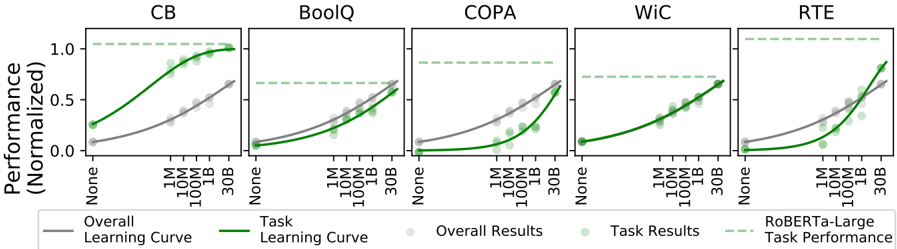
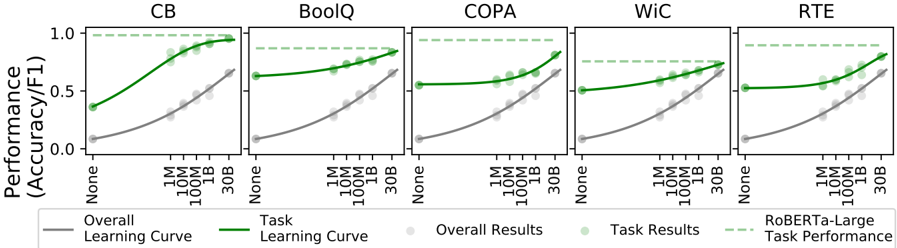
“Miller (1995); Schuler (2005), RTE from Dagan et al. (2006); Bar Haim et al. (2006); Giampiccolo et al. (2007); Bentivogli et al. (2009) Results We plot the results on SuperGLUE in Figure 6.”
BackgroundOn the Dangers of Stochastic Parrots: Can Language Models Be Too Big? 🦜
Bender, E. M., Gebru, T., McMillan-Major, A., & Shmitchell, S. (2021) · Proceedings of the 2021 ACM Conference on Fairness, Accountability, and Transparency · doi:10.1145/3442188.3445922 · Cited by 6,988
SQuAD: 100,000+ Questions for Machine Comprehension of Text
Rajpurkar, P., Zhang, J., Lopyrev, K., & Liang, P. (2016) · Proceedings of the 2016 Conference on Empirical Methods in Natural Language Processing · doi:10.18653/v1/d16-1264 · Cited by 6,208
GLUE: A Multi-Task Benchmark and Analysis Platform for Natural Language Understanding
Wang, A., Singh, A., Michael, J., Hill, F., Levy, O., & Bowman, S. (2018) · Proceedings of the 2018 EMNLP Workshop BlackboxNLP: Analyzing and Interpreting Neural Networks for NLP · doi:10.18653/v1/w18-5446 · Cited by 4,222
Self-citationEnergy and Policy Considerations for Deep Learning in NLP
Strubell, E., Ganesh, A., & McCallum, A. (2019) · Proceedings of the 57th Annual Meeting of the Association for Computational Linguistics · doi:10.18653/v1/p19-1355 · Cited by 3,684
Geurts, B. (1999) · Language · doi:10.2307/417746 · Cited by 2,848
5.7 The WORDNET lexical database of English
Ooi, V. B. Y. (2019) · Edinburgh University Press eBooks · doi:10.1515/9781474471459-050 · Cited by 2,035
Semantics in generative grammar
Heim, I., & Kratzer, A. (1998) · Cited by 1,905
Language Models as Knowledge Bases?
Petroni, F., Rocktäschel, T., Riedel, S., Lewis, P., Bakhtin, A., Wu, Y., & Miller, A. (2019) · Proceedings of the 2019 Conference on Empirical Methods in Natural Language Processing and the 9th International Joint Conference on Natural Language Processing (EMNLP-IJCNLP) · doi:10.18653/v1/d19-1250 · Cited by 1,834
The PASCAL Recognising Textual Entailment Challenge
Dagan, I., Glickman, O., & Magnini, B. (2006) · Lecture notes in computer science · doi:10.1007/11736790_9 · Cited by 1,674
(2018) · International Conference on Learning Representations · Cited by 1,621
Self-citationA primer in BERTology: What we know about how BERT works
Rogers, A., Kovaleva, O., & Rumshisky, A. (2020) · Transactions of the Association for Computational Linguistics · doi:10.1162/tacl_a_00349 · Cited by 1,552
BERT Rediscovers the Classical NLP Pipeline
Tenney, I., Das, D., & Pavlick, E. (2019) · Proceedings of the 57th Annual Meeting of the Association for Computational Linguistics · doi:10.18653/v1/p19-1452 · Cited by 1,307
CamemBERT: a Tasty French Language Model
Martin, L., Müller, B., Suárez, P. O., Dupont, Y., Romary, L., de la Clergerie, É. V., Seddah, D., & Sagot, B. (2020) · Proceedings of the conference - Association for Computational Linguistics. Meeting · doi:10.18653/v1/2020.acl-main.645 · Cited by 1,191
BoolQ: Exploring the Surprising Difficulty of Natural Yes/No QuestionsPreprint
Clark, C., Lee, K., Chang, M.-W., Kwiatkowski, T., Collins, M., & Toutanova, K. (2019) · arXiv (Cornell University) · doi:10.48550/arxiv.1905.10044 · Cited by 1,070
SuperGLUE: A Stickier Benchmark for General-Purpose Language Understanding Systems
Wang, A., Pruksachatkun, Y., Nangia, N., Singh, A., Michael, J., Hill, F., Levy, O., & Bowman, S. R. (2019) · arXiv · doi:10.48550/arxiv.1905.00537 · Cited by 1,051
Self-citationVerbNet: A broad-coverage, comprehensive verb lexicon
Schuler, K. K. (2005) · Scholarly Commons (University of Pennsylvania) · doi:10.5281/zenodo.8100881 · Cited by 842
The Third PASCAL Recognizing Textual Entailment Challenge
Giampiccolo, D., Magnini, B., Dagan, I., & Dolan, B. (2007) · ACL-PASCAL@ACL · doi:10.3115/1654536.1654538 · Cited by 801
The power law repealed: The case for an exponential law of practice
Heathcote, A., Brown, S. D., & Mewhort, D. J. K. (2000) · Psychonomic Bulletin & Review · doi:10.3758/bf03212979 · Cited by 735
Tenney, I., Xia, P., Chen, B., Wang, A., Poliak, A., McCoy, R. T., Kim, N., Van Durme, B., Bowman, S. R., Das, D., et al. (2019) · arXiv · doi:10.48550/arxiv.1905.06316 · Cited by 698
Self-citation(2019) · doi:10.18653/v1/n19-1419 · Cited by 601
Hart, B. M., & Risley, T. (1992) · Developmental Psychology · doi:10.1037/0012-1649.28.6.1096 · Cited by 595
The Seventh PASCAL Recognizing Textual Entailment Challenge.
Bentivogli, L., Clark, P. E., Dagan, I., & Giampiccolo, D. (2008) · Cited by 533
Analysis Methods in Neural Language Processing: A Survey
Belinkov, Y., & Glass, J. R. (2019) · Transactions of the Association for Computational Linguistics · doi:10.1162/tacl_a_00254 · Cited by 522
What BERT Is Not: Lessons from a New Suite of Psycholinguistic Diagnostics for Language Models
Ettinger, A. (2020) · Transactions of the Association for Computational Linguistics · doi:10.1162/tacl_a_00298 · Cited by 511
Salazar, J., Liang, D., Nguyen, T. Q., & Kirchhoff, K. (2020) · Proceedings of the conference - Association for Computational Linguistics. Meeting · doi:10.18653/v1/2020.acl-main.240 · Cited by 510
The CommitmentBank: Investigating projection in naturally occurring discourse
de Marneffe, M.-C., Simons, M., & Tonhauser, J. (2019) · Digital Access to Libraries · doi:10.18148/sub/2019.v23i2.601 · Cited by 471
CrowS-Pairs: A Challenge Dataset for Measuring Social Biases in Masked Language Models
Nangia, N., Vania, C., Bhalerao, R., & Bowman, S. R. (2020) · Proceedings of the 2020 Conference on Empirical Methods in Natural Language Processing (EMNLP) · doi:10.18653/v1/2020.emnlp-main.154 · Cited by 446
Self-citationFine-grained Analysis of Sentence Embeddings Using Auxiliary Prediction TasksPreprint
Adi, Y., Kermany, E., Belinkov, Y., Lavi, O., & Goldberg, Y. (2016) · arXiv (Cornell University) · doi:10.48550/arxiv.1608.04207 · Cited by 446
Representing General Relational Knowledge in ConceptNet 5
Speer, R., & Havasi, C. (2012) · Language Resources and Evaluation Conference (LREC) · doi:10.63317/3zycidvg6dgg · Cited by 412
WiC: the Word-in-Context Dataset for Evaluating Context-Sensitive Meaning Representations
Pilehvar, M. T., & Camacho-Collados, J. (2019) · Conference of the North American Chapter of the Association for Computational Linguistics: Human Language Technologies (NAACL-HLT) · doi:10.18653/v1/n19-1128 · Cited by 406
Designing and Interpreting Probes with Control Tasks
Hewitt, J., & Liang, P. (2019) · Proceedings of the 2019 Conference on Empirical Methods in Natural Language Processing and the 9th International Joint Conference on Natural Language Processing (EMNLP-IJCNLP) · doi:10.18653/v1/d19-1275 · Cited by 393
SemEval-2010 Task 8: Multi-Way Classification of Semantic Relations between Pairs of NominalsPreprint
Hendrickx, I., Kim, S., Kozareva, Z., Nakov, P., Séaghdha, D. Ó., Padó, S., Pennacchiotti, M., Romano, L., & Szpakowicz, S. (2010) · International Workshop on Semantic Evaluation · doi:10.48550/arxiv.1911.10422 · Cited by 367
Choice of Plausible Alternatives: An Evaluation of Commonsense Causal Reasoning
Roemmele, M., Bejan, C. A., & Gordon, A. S. (2011) · Cited by 334
Intermediate-Task Transfer Learning with Pretrained Language Models: When and Why Does It Work?
Pruksachatkun, Y., Phang, J., Liu, H., Htut, P. M., Zhang, X., Pang, R. Y., Vania, C., Kann, K., & Bowman, S. R. (2020) · Proceedings of the conference - Association for Computational Linguistics. Meeting · doi:10.18653/v1/2020.acl-main.467 · Cited by 259
Self-citationInformation-Theoretic Probing with Minimum Description Length
Voita, E., & Titov, I. (2020) · Proceedings of the 2020 Conference on Empirical Methods in Natural Language Processing (EMNLP) · doi:10.18653/v1/2020.emnlp-main.14 · Cited by 251
A Gold Standard Dependency Corpus for English
Silveira, N., Dozat, T., de Marneffe, M.-C., Bowman, S. R., Connor, M. K., Bauer, J., & Manning, C. D. (2014) · Language Resources and Evaluation Conference (LREC) · doi:10.63317/4esbhdz7y5u5 · Cited by 237
Self-citationFine-grained Analysis of Sentence Embeddings Using Auxiliary Prediction TasksPreprint
Adi, Y. (2024) · arXiv (Cornell University) · doi:10.57702/tcr06vve · Cited by 228
(2018) · doi:10.63317/2yu5nu76n7bu · Cited by 189
Resolving Complex Cases of Definite Pronouns: The Winograd Schema Challenge
Rahman, A., & Ng, V. (2012) · Cited by 141
A Systematic Assessment of Syntactic Generalization in Neural Language Models
Hu, J., Gauthier, J., Qian, P., Wilcox, E., & Levy, R. (2020) · Proceedings of the 58th Annual Meeting of the Association for Computational Linguistics · doi:10.18653/v1/2020.acl-main.158 · Cited by 134
Probing for semantic evidence of composition by means of simple classification tasks
Ettinger, A., Elgohary, A., & Resnik, P. (2016) · Workshop on Evaluating Vector-Space Representations for NLP · doi:10.18653/v1/w16-2524 · Cited by 131
The exponential learning equation as a function of successful trials results in sigmoid performance
Leibowitz, N., Baum, B., Enden, G., & Karniel, A. (2010) · Journal of Mathematical Psychology · doi:10.1016/j.jmp.2010.01.006 · Cited by 128
Amnesic Probing: Behavioral Explanation with Amnesic Counterfactuals
Elazar, Y., Ravfogel, S., Jacovi, A., & Goldberg, Y. (2021) · Transactions of the Association for Computational Linguistics · doi:10.1162/tacl_a_00359 · Cited by 126
Superlative quantifiers and meta-speech acts
Cohen, A., & Krifka, M. (2014) · Linguistics and Philosophy · doi:10.1007/s10988-014-9144-x · Cited by 120
Warstadt, A., Zhang, Y., Li, H.-S., Liu, H., & Bowman, S. R. (2020) · Conference on Empirical Methods in Natural Language Processing (EMNLP) · doi:10.18653/v1/2020.emnlp-main.16 · Cited by 115
Self-citationInvestigating BERT’s Knowledge of Language: Five Analysis Methods with NPIs
Warstadt, A., Cao, Y. H., Grosu, I., Peng, W., Blix, H., Nie, Y., Alsop, A., Bordia, S., Liu, H., Parrish, A., et al. (2019) · Conference on Empirical Methods in Natural Language Processing (EMNLP) · doi:10.18653/v1/d19-1286 · Cited by 105
Self-citationInference is Everything: Recasting Semantic Resources into a Unified Evaluation Framework
White, A. S., Rastogi, P., Duh, K., & Durme, B. V. (2017) · International Joint Conference on Natural Language Processing · Cited by 72
Quantity doesn’t buy quality syntax with neural language models
van Schijndel, M., Mueller, A., & Linzen, T. (2019) · Proceedings of the 2019 Conference on Empirical Methods in Natural Language Processing and the 9th International Joint Conference on Natural Language Processing (EMNLP-IJCNLP) · doi:10.18653/v1/d19-1592 · Cited by 65
Probing Across Time: What Does RoBERTa Know and When?
Liu, Z., Wang, Y., Kasai, J., Hajishirzi, H., & Smith, N. A. (2021) · Findings of the Association for Computational Linguistics: EMNLP (Findings of EMNLP) · doi:10.18653/v1/2021.findings-emnlp.71 · Cited by 59
WiC: 10, 000 Example Pairs for Evaluating Context-Sensitive RepresentationsPreprint
Pilehvar, M. T., & Camacho-Collados, J. (2018) · North American Chapter of the Association for Computational Linguistics · doi:10.48550/arxiv.1808.09121 · Cited by 50
Pretrained Language Model Embryology: The Birth of ALBERT
Chiang, C.-H., Huang, S.-F., & Lee, H.-Y. (2020) · Conference on Empirical Methods in Natural Language Processing (EMNLP) · doi:10.18653/v1/2020.emnlp-main.553 · Cited by 42
Information-Theoretic Probing for Linguistic Structure
Pimentel, T., Valvoda, J., Hall Maudslay, R., Zmigrod, R., Williams, A., & Cotterell, R. (2020) · Proceedings of the 58th Annual Meeting of the Association for Computational Linguistics · doi:10.18653/v1/2020.acl-main.420 · Cited by 41
On the importance of pre-training data volume for compact language models
Micheli, V., d’Hoffschmidt, M., & Fleuret, F. (2020) · Conference on Empirical Methods in Natural Language Processing (EMNLP) · doi:10.18653/v1/2020.emnlp-main.632 · Cited by 40
Understanding Learning Dynamics Of Language Models with SVCCA
Saphra, N., & Lopez, A. (2019) · Proceedings of the 2019 Conference of the North American Chapter of the Association for Computational Linguistics: Human Language Technologies, Volume 1 (Long and Short Papers) · doi:10.18653/v1/n19-1329 · Cited by 31
BLiMP: the benchmark of linguistic minimal pairs for English
Warstadt, A., Parrish, A., Liu, H., Mohananey, A., Peng, W., Wang, S.-F., & Bowman, S. R. (2020) · Transactions of the Association for Computational Linguistics · doi:10.1162/tacl_a_00321 · Cited by 28
Self-citationWhen Bert Forgets How To POS: Amnesic Probing of Linguistic Properties and MLM PredictionsPreprint
Elazar, Y., Ravfogel, S., Jacovi, A., & Goldberg, Y. (2020) · arXiv (Cornell University) · Cited by 22
Teichert, A. R., Poliak, A., Durme, B. V., & Gormley, M. R. (2017) · Proceedings of the AAAI Conference on Artificial Intelligence · doi:10.1609/aaai.v31i1.11165 · Cited by 20
Evaluating representations by the complexity of learning low-loss predictorsPreprint
Whitney, W. F., Song, M. J., Brandfonbrener, D., Altosaar, J., & Cho, K. (2020) · arXiv (Cornell University) · doi:10.48550/arxiv.2009.07368 · Cited by 20
Neural-Davidsonian Semantic Proto-role Labeling
Rudinger, R., Teichert, A. R., Culkin, R., Zhang, S., & Durme, B. V. (2018) · Conference on Empirical Methods in Natural Language Processing (EMNLP) · doi:10.18653/v1/d18-1114 · Cited by 14
Precise Task Formalization Matters in Winograd Schema Evaluations
Liu, H., Huang, W., Mungra, D., & Bowman, S. R. (2020) · Conference on Empirical Methods in Natural Language Processing (EMNLP) · doi:10.18653/v1/2020.emnlp-main.664 · Cited by 10
Self-citation
Research works printed but not linked: 7
- Roy Bar Haim, Ido Dagan, Bill Dolan, Lisa Ferro, Danilo Giampiccolo, Bernardo Magnini, and Idan Szpektor. 2006. The second PASCAL recognising textual entailment challenge. In Proceedings of the Second PASCAL Challenges Workshop on Recognis- ing Textual Entailment.
- Luisa Bentivogli, Ido Dagan, Hoa Trang Dang, Danilo Giampiccolo, and Bernardo Magnini. 2009. The fifth PASCAL recognizing textual entailment chal- lenge. In Textual Analysis Conference (TAC).
- Hady Elsahar, Pavlos Vougiouklis, Arslen Remaci, Christophe Gravier, Jonathon Hare, Frederique Laforest, and Elena Simperl. 2018. T-rex: A large scale alignment of natural language with knowledge base triples. In Proceedings of the Eleventh Interna- tional Conference on Language Resources and Eval- uation (LREC-2018).
- Charles Lovering, Rohan Jha, Tal Linzen, and El- lie Pavlick. 2021. Predicting inductive biases of fine-tuned models. In International Conference on Learning Representations.
- Colin Raffel, Noam Shazeer, Adam Roberts, Kather- ine Lee, Sharan Narang, Michael Matena, Yanqi Zhou, Wei Li, and Peter J. Liu. 2020. Exploring the limits of transfer learning with a unified text-to- text transformer. Journal of Machine Learning Re- search, 21(140):1-67.
- Melissa Roemmele, Cosmin Adrian Bejan, and An- drew S. Gordon. 2011. Choice of plausible alterna- tives: An evaluation of commonsense causal reason- ing. In 2011 AAAI Spring Symposium Series.
- Alex Wang and Kyunghyun Cho. 2019. BERT has a mouth, and it must speak: BERT as a Markov random field language model. In Proceedings of the Workshop on Methods for Optimizing and Eval- uating Neural Language Generation, pages 30-36, Minneapolis, Minnesota. Association for Computa- tional Linguistics. · DOI
Cited by
Sorted by citations
On the Opportunities and Risks of Foundation Models
Bommasani, R., Hudson, D. A., Adeli, E., Altman, R., Arora, S., von Arx, S., Bernstein, M. S., Bohg, J., Bosselut, A., Brunskill, E., et al. (2021) · arXiv · doi:10.48550/arxiv.2108.07258 · Cited by 2,676
Self-citationRecent Advances in Natural Language Processing via Large Pre-trained Language Models: A Survey
Min, B., Ross, H., Sulem, E., Veyseh, A. P. B., Nguyen, T. H., Sainz, O., Agirre, E., Heintz, I., & Roth, D. (2024) · ACM Computing Surveys · doi:10.1145/3605943 · Cited by 1,387
Emergent Abilities of Large Language Models
Wei, J., Tay, Y., Bommasani, R., Raffel, C., Zoph, B., Borgeaud, S., Yogatama, D., Bosma, M., Zhou, D., Metzler, D., et al. (2022) · arXiv · doi:10.48550/arxiv.2206.07682 · Cited by 1,264
Probing Classifiers: Promises, Shortcomings, and Advances
Belinkov, Y. (2021) · Computational Linguistics · doi:10.1162/coli_a_00422 · Cited by 491
RESDSQL: Decoupling Schema Linking and Skeleton Parsing for Text-to-SQL
Li, H., Zhang, J., Li, C., & Chen, H. (2023) · Proceedings of the AAAI Conference on Artificial Intelligence · doi:10.1609/aaai.v37i11.26535 · Cited by 279
Metadata
- Authors
- Zhang, Y., Warstadt, A., Li, X., & Bowman, S. R.
- Affiliations
- New York University (US)
- Venue
- Proceedings of the 59th Annual Meeting of the Association for Computational Linguistics and the 11th International Joint Conference on Natural Language Processing (Volume 1: Long Papers)
- Published
- 2021
- Pages
- 1112-1125
- OpenAlex
- W3176198948
- Cited by
- 85
- References
- 69
- Citations by year
- 2026: 3 · 2025: 7 · 2024: 9 · 2023: 40 · 2022: 16 · 2021: 10
- FWCI
- 8.66
- Type
- conference paper
- Language
- en
- Open access
- gold
- doi.org
- Licence
- cc-by
- Funders
- National Science Foundation (1850208)
- Topics
- Physical Sciences › Computer Science › Artificial Intelligence › Topic Modeling
- Physical Sciences › Computer Science › Artificial Intelligence › Natural Language Processing Techniques
- Physical Sciences › Computer Science › Artificial Intelligence › Domain Adaptation and Few-Shot Learning
- Keywords
- pre-training, language models, training data requirements
About these checks
Registry, retraction, Cites and statistics results are computed, not judged, with one exception: a printed reference that no index lists is read once by a model before it counts as a citation error. Claims are extracted by a model and kept only when their quote appears verbatim in the text; each cited source is then checked, with a model’s help, for whether it says what the claim relies on. Those verdicts can be wrong — read the claim’s quote and the cited source before relying on one.
Statistics and arithmetic are recomputed, not judged.
Confidence bands are shown only for fields calibrated on our annotated test set. None is calibrated yet, so no band is shown.
What counts as a claim ›How we measure confidence ›How we check this ›
Are you an author, or do you see a problem with this page? Request a review
