

The DOI matches its Crossref record; 64 of the 69 references it cites were found in a registry or an index, and 1 are not checked yet.
When Do You Need Billions of Words of Pretraining Data?
Open accessAbstract
Yian Zhang, Alex Warstadt, Xiaocheng Li, Samuel R. Bowman. Proceedings of the 59th Annual Meeting of the Association for Computational Linguistics and the 11th International Joint Conference on Natural Language Processing (Volume 1: Long Papers). 2021.
Overview
The claims and statistics of this paper haven’t been checked yet.
Run the check — free, no account needed. It reads the open-access text and checks the sources it cites.
Integrity signals
Registry
Cites
Statistics
Figures
Verification
Claims the paper makes
The claims and statistics of this paper haven’t been checked yet.
Run the check — free, no account needed. It reads the open-access text and checks the sources it cites.
Claims other papers make about this one
Each is checked against this paper’s own text: does it say what the citing paper says it does?
The cited source doesn’t support the claim as written.
In the citing paper
“When restricted to developmentally plausible data volumes, language models no longer perform well on benchmarks for human-like syntactic and semantic behavior (van Schijndel et al., 2019;Zhang et al., 2021).”
From Findings of the BabyLM Challenge: Sample-Efficient Pretraining on Developmentally Plausible Corpora (2023) · cites this paper as Zhang et al., 2021
Checked by a reasoning model — may be wrong.
Experimental — accuracy not yet measuredThe source backs part of the claim, not all of it — or backs it for a different population, condition or comparison.
In the citing paper
“Training long enough on a large-enough dataset has been shown to be key for the ability of language models to acquire syntactic, semantic, and other world knowledge (Zhang et al., 2021; Wei et al., 2021b; Razeghi et al., 2022).”
From Emergent Abilities of Large Language Models (2022) · cites this paper as Zhang et al., 2021
Experimental — accuracy not yet measured
Self-check
Percentages, sums and reported differences re-computed from the paper’s own numbers.
The self-check needs the paper’s full text.
Citations
Cites
BERT: Pre-training of Deep Bidirectional Transformers for Language Understanding
Devlin, J., Chang, M.-W., Lee, K., & Toutanova, K. (2018) · arXiv · doi:10.48550/arxiv.1810.04805 · Cited by 73,173
BERT: Pre-training of Deep Bidirectional Transformers for Language Understanding
Devlin, J., Chang, M.-W., Lee, K., & Toutanova, K. (2019) · Proceedings of the 2019 Conference of the North American Chapter of the Association for Computational Linguistics: Human Language Technologies, Volume 1 (Long and Short Papers) · doi:10.18653/v1/n19-1423 · Cited by 54,325
Language Models are Few-Shot Learners
Brown, T. B., Mann, B., Ryder, N., Subbiah, M., Kaplan, J., Dhariwal, P., Neelakantan, A., Shyam, P., Sastry, G., Askell, A., et al. (2020) · arXiv · doi:10.48550/arxiv.2005.14165 · Cited by 23,372
RoBERTa: A Robustly Optimized BERT Pretraining Approach
Liu, Y., Ott, M., Goyal, N., Du, J., Joshi, M., Chen, D., Levy, O., Lewis, M., Zettlemoyer, L., & Stoyanov, V. (2019) · arXiv · doi:10.48550/arxiv.1907.11692 · Cited by 16,515
WordNet: a lexical database for English
Miller, G. A. (1995) · Communications of the ACM · doi:10.1145/219717.219748 · Cited by 14,015 · cited 1×
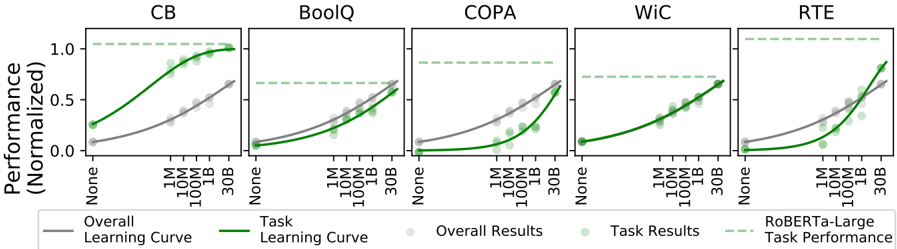
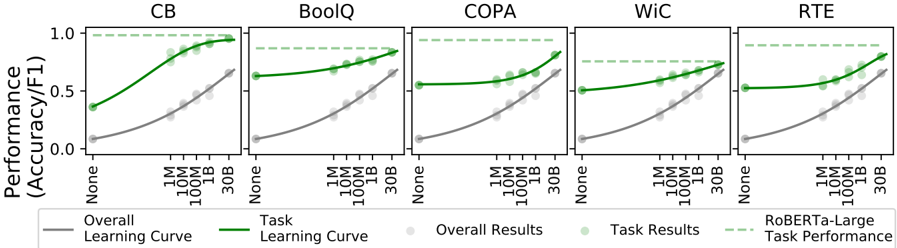
“Miller (1995); Schuler (2005), RTE from Dagan et al. (2006); Bar Haim et al. (2006); Giampiccolo et al. (2007); Bentivogli et al. (2009) Results We plot the results on SuperGLUE in Figure 6.”
BackgroundOn the Dangers of Stochastic Parrots: Can Language Models Be Too Big? 🦜
Bender, E. M., Gebru, T., McMillan-Major, A., & Shmitchell, S. (2021) · Proceedings of the 2021 ACM Conference on Fairness, Accountability, and Transparency · doi:10.1145/3442188.3445922 · Cited by 6,988
SQuAD: 100,000+ Questions for Machine Comprehension of Text
Rajpurkar, P., Zhang, J., Lopyrev, K., & Liang, P. (2016) · Proceedings of the 2016 Conference on Empirical Methods in Natural Language Processing · doi:10.18653/v1/d16-1264 · Cited by 6,208
GLUE: A Multi-Task Benchmark and Analysis Platform for Natural Language Understanding
Wang, A., Singh, A., Michael, J., Hill, F., Levy, O., & Bowman, S. (2018) · Proceedings of the 2018 EMNLP Workshop BlackboxNLP: Analyzing and Interpreting Neural Networks for NLP · doi:10.18653/v1/w18-5446 · Cited by 4,222
Self-citationEnergy and Policy Considerations for Deep Learning in NLP
Strubell, E., Ganesh, A., & McCallum, A. (2019) · Proceedings of the 57th Annual Meeting of the Association for Computational Linguistics · doi:10.18653/v1/p19-1355 · Cited by 3,684
Geurts, B. (1999) · Language · doi:10.2307/417746 · Cited by 2,848
Research works printed but not linked: 7
- Roy Bar Haim, Ido Dagan, Bill Dolan, Lisa Ferro, Danilo Giampiccolo, Bernardo Magnini, and Idan Szpektor. 2006. The second PASCAL recognising textual entailment challenge. In Proceedings of the Second PASCAL Challenges Workshop on Recognis- ing Textual Entailment.
- Luisa Bentivogli, Ido Dagan, Hoa Trang Dang, Danilo Giampiccolo, and Bernardo Magnini. 2009. The fifth PASCAL recognizing textual entailment chal- lenge. In Textual Analysis Conference (TAC).
- Hady Elsahar, Pavlos Vougiouklis, Arslen Remaci, Christophe Gravier, Jonathon Hare, Frederique Laforest, and Elena Simperl. 2018. T-rex: A large scale alignment of natural language with knowledge base triples. In Proceedings of the Eleventh Interna- tional Conference on Language Resources and Eval- uation (LREC-2018).
- Charles Lovering, Rohan Jha, Tal Linzen, and El- lie Pavlick. 2021. Predicting inductive biases of fine-tuned models. In International Conference on Learning Representations.
- Colin Raffel, Noam Shazeer, Adam Roberts, Kather- ine Lee, Sharan Narang, Michael Matena, Yanqi Zhou, Wei Li, and Peter J. Liu. 2020. Exploring the limits of transfer learning with a unified text-to- text transformer. Journal of Machine Learning Re- search, 21(140):1-67.
- Melissa Roemmele, Cosmin Adrian Bejan, and An- drew S. Gordon. 2011. Choice of plausible alterna- tives: An evaluation of commonsense causal reason- ing. In 2011 AAAI Spring Symposium Series.
- Alex Wang and Kyunghyun Cho. 2019. BERT has a mouth, and it must speak: BERT as a Markov random field language model. In Proceedings of the Workshop on Methods for Optimizing and Eval- uating Neural Language Generation, pages 30-36, Minneapolis, Minnesota. Association for Computa- tional Linguistics. · DOI
Cited by
Sorted by citations
On the Opportunities and Risks of Foundation Models
Bommasani, R., Hudson, D. A., Adeli, E., Altman, R., Arora, S., von Arx, S., Bernstein, M. S., Bohg, J., Bosselut, A., Brunskill, E., et al. (2021) · arXiv · doi:10.48550/arxiv.2108.07258 · Cited by 2,676
Self-citationRecent Advances in Natural Language Processing via Large Pre-trained Language Models: A Survey
Min, B., Ross, H., Sulem, E., Veyseh, A. P. B., Nguyen, T. H., Sainz, O., Agirre, E., Heintz, I., & Roth, D. (2024) · ACM Computing Surveys · doi:10.1145/3605943 · Cited by 1,387
Emergent Abilities of Large Language Models
Wei, J., Tay, Y., Bommasani, R., Raffel, C., Zoph, B., Borgeaud, S., Yogatama, D., Bosma, M., Zhou, D., Metzler, D., et al. (2022) · arXiv · doi:10.48550/arxiv.2206.07682 · Cited by 1,264
Probing Classifiers: Promises, Shortcomings, and Advances
Belinkov, Y. (2021) · Computational Linguistics · doi:10.1162/coli_a_00422 · Cited by 491
RESDSQL: Decoupling Schema Linking and Skeleton Parsing for Text-to-SQL
Li, H., Zhang, J., Li, C., & Chen, H. (2023) · Proceedings of the AAAI Conference on Artificial Intelligence · doi:10.1609/aaai.v37i11.26535 · Cited by 279
The Interplay of Variant, Size, and Task Type in Arabic Pre-trained Language ModelsPreprint
Inoue, G., Alhafni, B., Baimukan, N., Bouamor, H., & Habash, N. Y. (2021) · arXiv (Cornell University) · doi:10.48550/arxiv.2103.06678 · Cited by 224
QA Dataset Explosion: A Taxonomy of NLP Resources for Question Answering and Reading Comprehension
Rogers, A., Gardner, M., & Augenstein, I. (2022) · ACM Computing Surveys · doi:10.1145/3560260 · Cited by 213
Ogueji, K., Zhu, Y., & Lin, J. (2021) · Workshop on Multilingual Representation Learning (MRL) · doi:10.18653/v1/2021.mrl-1.11 · Cited by 141
The limitations and ethical considerations of ChatGPT
Hua, S., Jin, S., & Jiang, S. (2024) · Data Intelligence · doi:10.1162/dint_a_00243 · Cited by 120
What Artificial Neural Networks Can Tell Us about Human Language Acquisition
Warstadt, A., & Bowman, S. R. (2022) · Algebraic Structures in Natural Language · doi:10.1201/9781003205388-2 · Cited by 111
Self-citationLanguage Model Behavior: A Comprehensive Survey
Chang, T. A., & Bergen, B. K. (2024) · Computational Linguistics · doi:10.1162/coli_a_00492 · Cited by 105
ExT5: Towards Extreme Multi-Task Scaling for Transfer LearningPreprint
Aribandi, V., Tay, Y., Schuster, T., Rao, J., Zheng, H., Mehta, S. V., Zhuang, H., Tran, V. Q., Bahri, D., Ni, J., et al. (2021) · arXiv (Cornell University) · doi:10.48550/arxiv.2111.10952 · Cited by 132
Testing the Predictions of Surprisal Theory in 11 Languages
Wilcox, E., Pimentel, T., Meister, C., Cotterell, R., & Lévy, R. (2023) · Transactions of the Association for Computational Linguistics · doi:10.1162/tacl_a_00612 · Cited by 87
Semantic Structure in Deep Learning
Pavlick, E. (2021) · Annual Review of Linguistics · doi:10.1146/annurev-linguistics-031120-122924 · Cited by 82
Findings of the BabyLM Challenge: Sample-Efficient Pretraining on Developmentally Plausible Corpora
Warstadt, A., Mueller, A., Choshen, L., Wilcox, E., Zhuang, C., Ciro, J., Mosquera, R., Paranjabe, B., Williams, A., Linzen, T., et al. (2023) · Proceedings of the BabyLM Challenge at the 27th Conference on Computational Natural Language Learning · doi:10.18653/v1/2023.conll-babylm.1 · Cited by 74
“When restricted to developmentally plausible data volumes, language models no longer perform well on benchmarks for human-like syntactic and semantic behavior (van Schijndel et al., 2019; Zhang et al., 2021).”
Self-citationMcCoy, R. T., Smolensky, P., Linzen, T., Gao, J., & Celikyilmaz, A. (2023) · Transactions of the Association for Computational Linguistics · doi:10.1162/tacl_a_00567 · Cited by 70
McCoy, R. T., Smolensky, P., Linzen, T., Gao, J., & Celikyilmaz, A. (2021) · arXiv · doi:10.48550/arxiv.2111.09509 · Cited by 70
An Overview of Language Models: Recent Developments and Outlook
Wei, C., Wang, Y.-C., Wang, B., & Kuo, C. ‐. J. (2024) · APSIPA Transactions on Signal and Information Processing · doi:10.1561/116.00000010 · Cited by 74
Changing the World by Changing the Data
Rogers, A. (2021) · Proceedings of the 59th Annual Meeting of the Association for Computational Linguistics and the 11th International Joint Conference on Natural Language Processing (Volume 1: Long Papers) · doi:10.18653/v1/2021.acl-long.170 · Cited by 51
The Dangers of Underclaiming: Reasons for Caution When Reporting How NLP Systems Fail
Bowman, S. R. (2022) · Proceedings of the conference - Association for Computational Linguistics. Meeting · doi:10.18653/v1/2022.acl-long.516 · Cited by 60
Self-citationProbing Across Time: What Does RoBERTa Know and When?
Liu, Z., Wang, Y., Kasai, J., Hajishirzi, H., & Smith, N. A. (2021) · Findings of the Association for Computational Linguistics: EMNLP (Findings of EMNLP) · doi:10.18653/v1/2021.findings-emnlp.71 · Cited by 59
Applying large language models for automated essay scoring for non-native Japanese
Li, W., & Liu, H. (2024) · Humanities and Social Sciences Communications · doi:10.1057/s41599-024-03209-9 · Cited by 36
Ding, Y., Li, H., Zhu, F., Wang, Z., Peng, W., & Xie, M. (2023) · IEEE Transactions on Industrial Informatics · doi:10.1109/tii.2023.3299078 · Cited by 31
How much pretraining data do language models need to learn syntax?
Pérez-Mayos, L., Ballesteros, M., & Wanner, L. (2021) · Conference on Empirical Methods in Natural Language Processing (EMNLP) · doi:10.18653/v1/2021.emnlp-main.118 · Cited by 26
An Adaptive Graph Pre-training Framework for Localized Collaborative Filtering
Wang, Y., Li, C., Liu, Z., Li, M., Tang, J., Xie, X., Chen, L., & Yu, P. S. (2022) · ACM Transactions on Information Systems · doi:10.1145/3555372 · Cited by 27
DrBERT: A Robust Pre-trained Model in French for Biomedical and Clinical domains
Labrak, Y., Bazoge, A., Dufour, R., Rouvier, M., Morin, E., Daille, B., & Gourraud, P. (2023) · Proceedings of the conference - Association for Computational Linguistics. Meeting · doi:10.18653/v1/2023.acl-long.896 · Cited by 29
Nangia, N., Sugawara, S., Trivedi, H. K., Warstadt, A., Vania, C., & Bowman, S. R. (2021) · doi:10.18653/v1/2021.acl-long.98 · Cited by 29
Self-citationMVP: Multi-task Supervised Pre-training for Natural Language Generation
Tang, T., Li, J., Zhao, W. X., & Wen, J.-R. (2023) · Findings of the Association for Computational Linguistics: ACL (Findings of ACL) · doi:10.18653/v1/2023.findings-acl.558 · Cited by 24
A Better Way to Do Masked Language Model Scoring
Kauf, C., & Ivanova, A. A. (2023) · Proceedings of the conference - Association for Computational Linguistics. Meeting · doi:10.18653/v1/2023.acl-short.80 · Cited by 25
Misra, K., Rayz, J. T., & Ettinger, A. (2023) · Conference of the European Chapter of the Association for Computational Linguistics · doi:10.18653/v1/2023.eacl-main.213 · Cited by 32
RuCoLA: Russian Corpus of Linguistic Acceptability
Mikhailov, V., Shamardina, T., Ryabinin, M., Pestova, A., Smurov, I., & Artemova, E. (2022) · Conference on Empirical Methods in Natural Language Processing (EMNLP) · doi:10.18653/v1/2022.emnlp-main.348 · Cited by 22
Neural reality of argument structure constructions
Li, B., Zhu, Z., Thomas, G., Rudzicz, F., & Xu, Y. (2022) · Proceedings of the conference - Association for Computational Linguistics. Meeting · doi:10.18653/v1/2022.acl-long.512 · Cited by 24
Context Matters: A Pragmatic Study of PLMs’ Negation Understanding
Gubelmann, R., & Handschuh, S. (2022) · Proceedings of the conference - Association for Computational Linguistics. Meeting · doi:10.18653/v1/2022.acl-long.315 · Cited by 21
Comparing Test Sets with Item Response Theory
Vania, C., Htut, P. M., Huang, W., Mungra, D., Pang, R. Y., Phang, J., Liu, H., Cho, K., & Bowman, S. R. (2021) · Proceedings of the 59th Annual Meeting of the Association for Computational Linguistics and the 11th International Joint Conference on Natural Language Processing (Volume 1: Long Papers) · doi:10.18653/v1/2021.acl-long.92 · Cited by 18
Self-citationOpenly accessible LLMs can help us to understand human cognition
Frank, M. C. (2023) · Nature Human Behaviour · doi:10.1038/s41562-023-01732-4 · Cited by 18
Acceptability Judgements via Examining the Topology of Attention Maps
Cherniavskii, D., Tulchinskii, E., Mikhailov, V., Proskurina, I., Kushnareva, L., Artemova, E., Barannikov, S., Piontkovskaya, I., Piontkovski, D., & Burnaev, E. V. (2022) · Findings of the Association for Computational Linguistics: EMNLP (Findings of EMNLP) · doi:10.18653/v1/2022.findings-emnlp.7 · Cited by 21
Construction Grammar and Language Models
Madabushi, H. T., Romain, L., Milin, P., & Divjak, D. (2025) · Cambridge University Press eBooks · doi:10.1017/9781009049139.023 · Cited by 16
Rasmussen, S. H. R., Bor, A., Osmundsen, M., & Petersen, M. B. (2023) · British Journal of Political Science · doi:10.1017/s0007123423000042 · Cited by 17
Trained on 100 million words and still in shape: BERT meets British National Corpus
Samuel, D., Kutuzov, A., Øvrelid, L., & Velldal, E. (2023) · Findings of the Association for Computational Linguistics: EACL 2023 · doi:10.18653/v1/2023.findings-eacl.146 · Cited by 14
Give Me the Facts! A Survey on Factual Knowledge Probing in Pre-trained Language Models
Youssef, P., Koraş, O. A., Li, M., Schlötterer, J., & Seifert, C. (2023) · Findings of the Association for Computational Linguistics: EMNLP (Findings of EMNLP) · doi:10.18653/v1/2023.findings-emnlp.1043 · Cited by 18
Static Embeddings as Efficient Knowledge Bases?
Dufter, P., Kassner, N., & Schütze, H. (2021) · Conference of the North American Chapter of the Association for Computational Linguistics: Human Language Technologies (NAACL-HLT) · doi:10.18653/v1/2021.naacl-main.186 · Cited by 15
Bridging Fairness and Environmental Sustainability in Natural Language Processing
Hessenthaler, M., Strubell, E., Hovy, D., & Lauscher, A. (2022) · Conference on Empirical Methods in Natural Language Processing (EMNLP) · doi:10.18653/v1/2022.emnlp-main.533 · Cited by 16
Should We Be Pre-training? An Argument for End-task Aware Training as an AlternativePreprint
Dery, L. M., Michel, P., Talwalkar, A., & Neubig, G. (2021) · arXiv (Cornell University) · doi:10.48550/arxiv.2109.07437 · Cited by 19
From Form(s) to Meaning: Probing the Semantic Depths of Language Models Using Multisense Consistency
Ohmer, X. I., Bruni, E., & Hupkes, D. (2024) · Computational Linguistics · doi:10.1162/coli_a_00529 · Cited by 18
Modeling Brain Representations of Words' Concreteness in Context Using GPT‐2 and Human Ratings
Bruera, A., Tao, Y., Anderson, A. J., Çokal, D., Haber, J., & Poesio, M. (2023) · Cognitive Science · doi:10.1111/cogs.13388 · Cited by 10
Holmes ⌕ A Benchmark to Assess the Linguistic Competence of Language Models
Waldis, A., Waldis, A., Perlitz, Y., Choshen, L., Choshen, L., Hou, Y., & Gurevych, I. (2024) · Transactions of the Association for Computational Linguistics · doi:10.1162/tacl_a_00718 · Cited by 23
Cross-lingual Transfer of Monolingual Models
Gogoulou, E., Ekgren, A., Isbister, T., & Sahlgren, M. (2022) · Language Resources and Evaluation Conference (LREC) · doi:10.63317/5635surro6fy · Cited by 11
Pre-Training a Language Model Without Human LanguagePreprint
Chiang, C.-H., & Lee, H.-Y. (2020) · arXiv (Cornell University) · doi:10.48550/arxiv.2012.11995 · Cited by 15
Influence of LLMs on Learning and Teaching in Higher EducationPreprint
Upadhyay, A., Farahmand, E., Muñoz, I., Khan, M. A., & Witte, N. (2024) · SSRN Electronic Journal · doi:10.2139/ssrn.4716855 · Cited by 9
Adversarially Constructed Evaluation Sets Are More Challenging, but May Not Be Fair
Phang, J., Chen, A., Huang, W., & Bowman, S. R. (2022) · doi:10.18653/v1/2022.dadc-1.8 · Cited by 9
Self-citationInvestigating Critical Period Effects in Language Acquisition through Neural Language Models
Constantinescu, I., Pimentel, T., Cotterell, R., & Warstadt, A. (2025) · Transactions of the Association for Computational Linguistics · doi:10.1162/tacl_a_00725 · Cited by 7
Self-citationA Systematic Assessment of Language Models with Linguistic Minimal Pairs in Chinese
Liu, Y., Shen, Y., Zhu, H., Xu, L., Qian, Z., Song, S., Zhang, K., Tang, J., Zhang, P., Yang, B., et al. (2026) · Transactions of the Association for Computational Linguistics · doi:10.1162/tacl.a.648 · Cited by 24
On the Role of Corpus Ordering in Language Modeling
Agrawal, A., Singh, S., Schneider, L. R., & Samuels, M. (2021) · Workshop on Simple and Efficient Natural Language Processing (SustaiNLP) · doi:10.18653/v1/2021.sustainlp-1.15 · Cited by 7
Are Sample-Efficient NLP Models More Robust?
Liu, N. F., Kumar, A., Liang, P., & Jia, R. (2023) · Proceedings of the conference - Association for Computational Linguistics. Meeting · doi:10.18653/v1/2023.acl-short.144 · Cited by 10
DrBERT: A Robust Pre-trained Model in French for Biomedical and Clinical domainsPreprint
Labrak, Y., Bazoge, A., Dufour, R., Rouvier, M., Morin, E., Daille, B., & Gourraud, P. (2023) · bioRxiv (Cold Spring Harbor Laboratory) · doi:10.1101/2023.04.03.535368 · Cited by 10
The Effect of Scaling, Retrieval Augmentation and Form on the Factual Consistency of Language Models
Hagström, L., Saynova, D., Norlund, T., Johansson, M., & Johansson, R. (2023) · Proceedings of the 2023 Conference on Empirical Methods in Natural Language Processing · doi:10.18653/v1/2023.emnlp-main.332 · Cited by 6
Decoupling SQL query hardness parsing for text-to-SQL
Yi, J., Chen, G., & Zhou, X. (2024) · Neurocomputing · doi:10.1016/j.neucom.2024.129293 · Cited by 6
Ethics consideration sections in natural language processing papers
Benotti, L., & Blackburn, P. R. (2022) · Conference on Empirical Methods in Natural Language Processing (EMNLP) · doi:10.18653/v1/2022.emnlp-main.299 · Cited by 6
Natural syntax, artificial intelligence and language acquisition
O’Grady, W., & Lee, M. (2023) · Information · doi:10.3390/info14070418 · Cited by 5
Exploring Jiu-Jitsu Argumentation for Writing Peer Review Rebuttals
Purkayastha, S., Lauscher, A., & Gurevych, I. (2023) · Conference on Empirical Methods in Natural Language Processing (EMNLP) · doi:10.18653/v1/2023.emnlp-main.894 · Cited by 13
Shades of zero: Distinguishing impossibility from inconceivability
Hu, J., Sosa, F., & Ullman, T. D. (2025) · Journal of Memory and Language · doi:10.1016/j.jml.2025.104640 · Cited by 8
Exploring Transformers as Compact, Data-efficient Language Models
Fields, C., & Kennington, C. (2023) · Conference on Computational Natural Language Learning · doi:10.18653/v1/2023.conll-1.35 · Cited by 6
Visual Grounding Helps Learn Word Meanings in Low-Data Regimes
Zhuang, C., Fedorenko, E. G., & Andreas, J. (2024) · Conference of the North American Chapter of the Association for Computational Linguistics: Human Language Technologies (NAACL-HLT) · doi:10.18653/v1/2024.naacl-long.71 · Cited by 8
EMTeC: A corpus of eye movements on machine-generated texts
Bolliger, L. S., Haller, P., Cretton, I. C. R., Reich, D. R., Kew, T., & Jäger, L. A. (2025) · Behavior Research Methods · doi:10.3758/s13428-025-02677-4 · Cited by 8
Honey, I Shrunk the Language: Language Model Behavior at Reduced Scale.
Deshpande, V., Pechi, D., Thatte, S., Lialin, V., & Rumshisky, A. (2023) · Findings of the Association for Computational Linguistics: ACL (Findings of ACL) · doi:10.18653/v1/2023.findings-acl.326 · Cited by 7
A Proposal of Post-OCR Spelling Correction Using Monolingual Byte-level Language Models
de Araújo, S. S., Bezerra, B. L. D., & Neto, A. F. D. S. (2025) · ACM Symposium on Document Engineering (DocEng) · doi:10.1145/3704268.3748673 · Cited by 4
Not Enough Data to Pre-train Your Language Model? MT to the Rescue!
Urbizu, G., Vicente, I. S., Saralegi, X., & Corral, A. (2023) · Findings of the Association for Computational Linguistics: ACL (Findings of ACL) · doi:10.18653/v1/2023.findings-acl.235 · Cited by 4
Frequency Balanced Datasets Lead to Better Language Models
Zevallos, R., Farrús, M., & Bel, N. (2023) · Findings of the Association for Computational Linguistics: EMNLP (Findings of EMNLP) · doi:10.18653/v1/2023.findings-emnlp.527 · Cited by 4
Tiny Language Models Enriched with Multimodal Knowledge from Multiplex Networks
Fields, C., Natouf, O., McMains, A., Henry, C., & Kennington, C. (2023) · BabyLM Challenge · doi:10.18653/v1/2023.conll-babylm.3 · Cited by 4
Explicitly Representing Syntax Improves Sentence-to-Layout Prediction of Unexpected Situations
Nuyts, W., Cartuyvels, R., & Moens, M. (2024) · Transactions of the Association for Computational Linguistics · doi:10.1162/tacl_a_00643 · Cited by 5
The Rediscovery Hypothesis: Language Models Need to Meet Linguistics
Nikoulina, V., Tezekbayev, M., Kozhakhmet, N., Babazhanova, M., Gallé, M., & Assylbekov, Z. (2021) · Journal of Artificial Intelligence Research · doi:10.1613/jair.1.12788 · Cited by 4
Ad astra or astray: Exploring linguistic knowledge of multilingual BERT through NLI task
Tikhonova, M., Mikhailov, V., Pisarevskaya, D., Malykh, V., & Shavrina, T. (2022) · Natural Language Engineering · doi:10.1017/s1351324922000225 · Cited by 4
Automatic Document Selection for Efficient Encoder Pretraining
Feng, Y., Xia, P., Durme, B. V., & Sedoc, J. (2022) · Conference on Empirical Methods in Natural Language Processing (EMNLP) · doi:10.18653/v1/2022.emnlp-main.647 · Cited by 4
Hints on the data for language modeling of synthetic languages with transformers
Zevallos, R., & Bel, N. (2023) · Proceedings of the conference - Association for Computational Linguistics. Meeting · doi:10.18653/v1/2023.acl-long.699 · Cited by 4
Language-Agnostic Bias Detection in Language Models with Bias Probing
Köksal, A., Yalcin, O. F., Akbiyik, A., Kılavuz, M. T., Korhonen, A., & Schuetze, H. (2023) · Findings of the Association for Computational Linguistics: EMNLP (Findings of EMNLP) · doi:10.18653/v1/2023.findings-emnlp.848 · Cited by 8
Identifying task groupings for multi-task learning using pointwise V-usable information
Li, Y., Miller, T., Bethard, S. J., & Savova, G. (2025) · Journal of Biomedical Informatics · doi:10.1016/j.jbi.2025.104881 · Cited by 3
Can BERT eat RuCoLA? Topological Data Analysis to Explain
Proskurina, I., Artemova, E., & Piontkovskaya, I. (2023) · Workshop on Slavic Natural Language Processing (SlavicNLP) · doi:10.18653/v1/2023.bsnlp-1.15 · Cited by 3
Scaling Laws for BERT in Low-Resource Settings
Urbizu, G., Vicente, I. S., Saralegi, X., Agerri, R., & Soroa, A. (2023) · Findings of the Association for Computational Linguistics: ACL (Findings of ACL) · doi:10.18653/v1/2023.findings-acl.492 · Cited by 4
LLMs model how humans induce logically structured rules
Loo, A. M., Pavlick, E., & Feiman, R. (2025) · Journal of Memory and Language · doi:10.1016/j.jml.2025.104675 · Cited by 5
When Combating Hype, Proceed with Caution.Preprint
Bowman, S. R. (2021) · arXiv (Cornell University) · Cited by 3
Self-citationCLIMB – Curriculum Learning for Infant-inspired Model Building
Martinez, R. D., McGovern, H., Goriely, Z., Davis, C., Caines, A., Buttery, P., & Beinborn, L. (2023) · Proceedings of the BabyLM Challenge at the 27th Conference on Computational Natural Language Learning · doi:10.18653/v1/2023.conll-babylm.10 · Cited by 2
Steuer, J., Mosbach, M., & Klakow, D. (2023) · Proceedings of the BabyLM Challenge at the 27th Conference on Computational Natural Language Learning · doi:10.18653/v1/2023.conll-babylm.12 · Cited by 14
Assessing Logical Reasoning Capabilities of Encoder-Only Transformer Models
Pirozelli, P., José, M. M., Filho, P. D. T. P. D. C., Brandão, A. A. F., & Cozman, F. G. (2024) · Lecture notes in computer science · doi:10.1007/978-3-031-71167-1_2 · Cited by 5
Zhu, M., Liu, Y., Luo, Z., & Zhu, T. (2026) · npj Digital Medicine · doi:10.1038/s41746-025-02176-y · Cited by 5
AI-Driven Conservation of the Endangered Twisted Yew (Taxus contorta Griff.) in the Western Himalaya
Din, S., Ali, H., Panagopoulos, Τ., Alam, J., Malik, S., & Sher, H. (2025) · Sustainability · doi:10.3390/su17198541 · Cited by 2
Larger Probes Tell a Different Story: Extending Psycholinguistic Datasets Via In-Context Learning
Shivagunde, N., Lialin, V., & Rumshisky, A. (2023) · Conference on Empirical Methods in Natural Language Processing (EMNLP) · doi:10.18653/v1/2023.emnlp-main.130 · Cited by 4
What do Models Learn From Training on More Than Text? Measuring Visual Commonsense Knowledge
Hagström, L., & Johansson, R. (2022) · Annual Meeting of the Association for Computational Linguistics: Student Research Workshop (ACL SRW) · doi:10.18653/v1/2022.acl-srw.19 · Cited by 2
Lil-Bevo: Explorations of Strategies for Training Language Models in More Humanlike Ways
Govindarajan, V. S., Rodriguez, J. D., Bostrom, K., & Mahowald, K. (2023) · Proceedings of the BabyLM Challenge at the 27th Conference on Computational Natural Language Learning · doi:10.18653/v1/2023.conll-babylm.27 · Cited by 1
Training compute-optimal transformer encoder models
Dervishi, M., Allauzen, A., Synnaeve, G., & LeCun, Y. (2025) · Conference on Empirical Methods in Natural Language Processing (EMNLP) · doi:10.18653/v1/2025.emnlp-main.1804 · Cited by 2
Generative Data Augmentation via Wasserstein Autoencoder for Text Classification
Jin, K., Lee, J., Choi, J., Jang, S., & Kim, Y. (2022) · International Conference on Information and Communication Technology Convergence (ICTC) · doi:10.1109/ictc55196.2022.9952762 · Cited by 1
Acquiring Linguistic Knowledge from Multimodal Input
Amariucai, T., & Warstadt, A. S. (2023) · BabyLM Challenge · doi:10.18653/v1/2023.conll-babylm.11 · Cited by 1
Self-citationEdge-Deployed Context-Aware LLM Framework for Low-Latency Bi-Directional Gaze-Speech HRIPreprint
Zhai, Y., & Chian, Y.-T. (2026) · Preprints.org · doi:10.20944/preprints202602.0308.v1 · Cited by 1
Sun, S., Dillon, B., & Iyyer, M. (2022) · Workshop on Insights from Negative Results in NLP (Insights) · doi:10.18653/v1/2022.insights-1.6
Tran, S. Q., Nguyen-Thuan, P., Nguyen, K. V., & Nguyen, N. L.-T. (2023) · Conference of the European Chapter of the Association for Computational Linguistics: Student Research Workshop (EACL SRW) · doi:10.18653/v1/2023.eacl-srw.1
Explorando Redes Neurais Profundas para Tarefa de Aceitabilidade Linguística
Santos, H., Alencar, K. P., de Sousa, R. F., & Anchiêta, R. T. (2023) · Simpósio Brasileiro de Tecnologia da Informação e da Linguagem Humana (STIL) · doi:10.5753/stil.2023.234644
Foundations of Language Modeling
Beinborn, L., & Hollenstein, N. (2023) · Synthesis lectures on human language technologies · doi:10.1007/978-3-031-43260-6_2
NPIs Aren’t Exactly Easy: Variation in Licensing across Large Language Models
DeCarlo, D., Palmer, W., Wilson, M., & Frank, B. (2023) · BlackboxNLP Workshop on Analyzing and Interpreting Neural Networks for NLP (BlackboxNLP) · doi:10.18653/v1/2023.blackboxnlp-1.25
Bootstrapping Small & High Performance Language Models with Unmasking-Removal Training Policy
Yang, Y., Sulem, E., Lee, I., & Roth, D. (2023) · Conference on Empirical Methods in Natural Language Processing (EMNLP) · doi:10.18653/v1/2023.emnlp-main.30 · Cited by 1
Lexicon-Level Contrastive Visual-Grounding Improves Language Modeling
Zhuang, C., Fedorenko, E. G., & Andreas, J. (2024) · Findings of the Association for Computational Linguistics: ACL (Findings of ACL) · doi:10.18653/v1/2024.findings-acl.15 · Cited by 2
Word Vector Representation of Latin Cuengh Based on Root Feature Enhancement
Lyu, W., Chen, J., Qin, X., & Li, J. (2024) · Applied Sciences · doi:10.3390/app15010211
Metadata
- Authors
- Zhang, Y., Warstadt, A., Li, X., & Bowman, S. R.
- Affiliations
- New York University (US)
- Venue
- Proceedings of the 59th Annual Meeting of the Association for Computational Linguistics and the 11th International Joint Conference on Natural Language Processing (Volume 1: Long Papers)
- Published
- 2021
- Pages
- 1112-1125
- OpenAlex
- W3176198948
- Cited by
- 85
- References
- 69
- Citations by year
- 2026: 3 · 2025: 7 · 2024: 9 · 2023: 40 · 2022: 16 · 2021: 10
- FWCI
- 8.66
- Type
- conference paper
- Language
- en
- Open access
- gold
- doi.org
- Licence
- cc-by
- Funders
- National Science Foundation (1850208)
- Topics
- Physical Sciences › Computer Science › Artificial Intelligence › Topic Modeling
- Physical Sciences › Computer Science › Artificial Intelligence › Natural Language Processing Techniques
- Physical Sciences › Computer Science › Artificial Intelligence › Domain Adaptation and Few-Shot Learning
- Keywords
- pre-training, language models, training data requirements
About these checks
Registry, retraction, Cites and statistics results are computed, not judged, with one exception: a printed reference that no index lists is read once by a model before it counts as a citation error. Claims are extracted by a model and kept only when their quote appears verbatim in the text; each cited source is then checked, with a model’s help, for whether it says what the claim relies on. Those verdicts can be wrong — read the claim’s quote and the cited source before relying on one.
Statistics and arithmetic are recomputed, not judged.
Confidence bands are shown only for fields calibrated on our annotated test set. None is calibrated yet, so no band is shown.
What counts as a claim ›How we measure confidence ›How we check this ›
Are you an author, or do you see a problem with this page? Request a review
