

Is ChatGPT a General-Purpose Natural Language Processing Task Solver?
Open accessThe DOI matches its Crossref record; 42 of the 44 references it cites were found in a registry or an index, and 2 are not checked yet.
Abstract
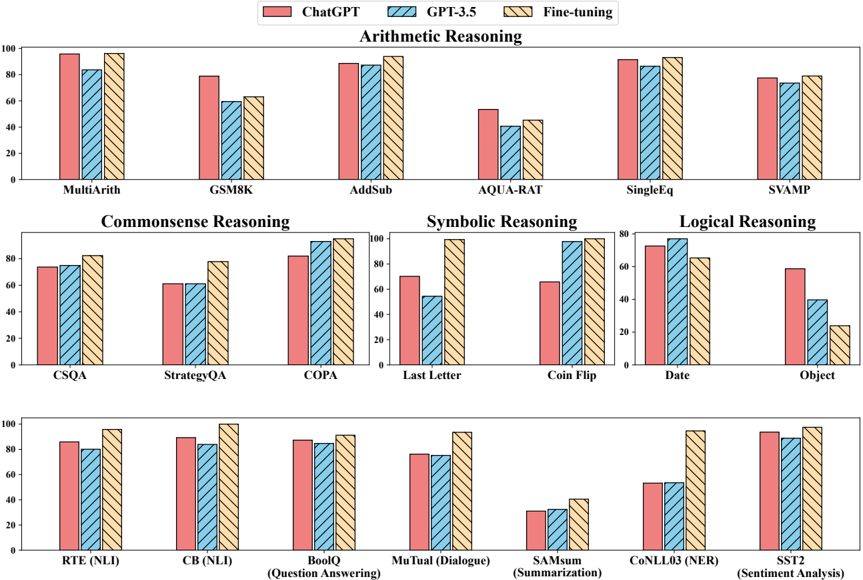
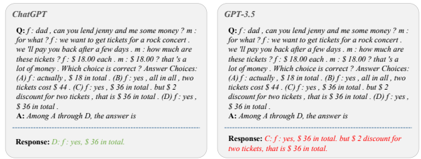
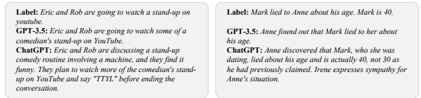
Spurred by advancements in scale, large language models (LLMs) have demonstrated the ability to perform a variety of natural language processing (NLP) tasks zero-shot-i.e., without adaptation on downstream data.Recently, the debut of ChatGPT 1 has drawn a great deal of attention from the natural language processing (NLP) community due to the fact that it can generate high-quality responses to human input and self-correct previous mistakes based on subsequent conversations.However, it is not yet known whether ChatGPT can serve as a generalist model that can perform many NLP tasks zero-shot.In this work, we empirically analyze the zero-shot learning ability of ChatGPT by evaluating it on 20 popular NLP datasets covering 7 representative task categories.With extensive empirical studies, we demonstrate both the effectiveness and limitations of the current version of ChatGPT.We find that ChatGPT performs well on many tasks favoring reasoning capabilities (e.g., arithmetic reasoning) while it still faces challenges when solving specific tasks such as sequence tagging.We additionally provide in-depth analysis through qualitative case studies.
Overview
The claims and statistics of this paper haven’t been checked yet.
Free: it reads the open-access text and checks the first 5 claims that cite a source we can check. Create a free account to check every claim.
Integrity signals
Registry
Cites
Statistics
Figures

Verification
Claims the paper makes
The claims and statistics of this paper haven’t been checked yet.
Free: it reads the open-access text and checks the first 5 claims that cite a source we can check. Create a free account to check every claim.
Claims other papers make about this one
Each is checked against this paper’s own text: does it say what the citing paper says it does?
In the citing paper
“Large Language Models (LLMs) are capable of successfully performing many language processing tasks zero-shot (without training data).”
From Can Large Language Models Transform Computational Social Science? (2024) · cites this paper as Qin et al. 2023
Self-check
Percentages, sums and reported differences re-computed from the paper’s own numbers.
The self-check needs the paper’s full text.
Citations
Cites
BERT: Pre-training of Deep Bidirectional Transformers for Language Understanding
Devlin, J., Chang, M.-W., Lee, K., & Toutanova, K. (2019) · Proceedings of the 2019 Conference of the North American Chapter of the Association for Computational Linguistics: Human Language Technologies, Volume 1 (Long and Short Papers) · doi:10.18653/v1/n19-1423 · Cited by 54,325
Deep reinforcement learning from human preferences
Christiano, P., Leike, J., Brown, T. B., Martic, M., Legg, S., & Amodei, D. (2017) · arXiv · doi:10.48550/arxiv.1706.03741 · Cited by 7,379
Recursive Deep Models for Semantic Compositionality Over a Sentiment Treebank
Socher, R., Perelygin, A., Wu, J., Chuang, J., Manning, C. D., Ng, A., & Potts, C. (2013) · Proceedings of the 2013 Conference on Empirical Methods in Natural Language Processing · doi:10.18653/v1/d13-1170 · Cited by 6,878
Chain-Of-Thought Prompting Elicits Reasoning in Large Language Models
Wei, J., Wang, X., Schuurmans, D., Bosma, M., Ichter, B., Xia, F., Chi, E., Le, Q. V., & Zhou, D. (2022) · Advances in Neural Information Processing Systems 35 · doi:10.52202/068431-1800 · Cited by 4,505
Chain-of-Thought Prompting Elicits Reasoning in Large Language Models
Wei, J., Wang, X., Schuurmans, D., Bosma, M., Ichter, B., Xia, F., Chi, E., Le, Q., & Zhou, D. (2022) · arXiv · doi:10.48550/arxiv.2201.11903 · Cited by 4,263
BoolQ: Exploring the Surprising Difficulty of Natural Yes/No Questions
Clark, C., Lee, K., Chang, M.-W., Kwiatkowski, T., Collins, M., & Toutanova, K. (2019) · North American Chapter of the Association for Computational Linguistics · doi:10.18653/v1/n19-1300 · Cited by 2,998
CommonsenseQA: A Question Answering Challenge Targeting Commonsense Knowledge
Talmor, A., Herzig, J., Lourie, N., & Berant, J. (2019) · North American Chapter of the Association for Computational Linguistics · doi:10.18653/v1/n19-1421 · Cited by 2,836
PaLM: Scaling Language Modeling with Pathways
Chowdhery, A., Narang, S., Devlin, J., Bosma, M., Mishra, G., Roberts, A., Barham, P., Chung, H. W., Sutton, C., Gehrmann, S., et al. (2022) · arXiv · doi:10.48550/arxiv.2204.02311 · Cited by 2,590
Contextual String Embeddings for Sequence Labeling
Akbik, A., Blythe, D. A. J., & Vollgraf, R. (2018) · International Conference on Computational Linguistics · Cited by 1,755
The PASCAL Recognising Textual Entailment Challenge
Dagan, I., Glickman, O., & Magnini, B. (2006) · Lecture Notes in Computer Science · doi:10.1007/11736790_9 · Cited by 1,628
Cited by
A Survey on Evaluation of Large Language Models
Chang, Y., Wang, X., Wang, J., Wu, Y., Yang, L., Zhu, K., Chen, H., Yi, X., Wang, C., Wang, Y., et al. (2024) · ACM Transactions on Intelligent Systems and Technology · doi:10.1145/3641289 · Cited by 4,254
A Survey on Evaluation of Large Language Models
Chang, Y., Wang, X., Wang, J., Wu, Y., Yang, L., Zhu, K., Chen, H., Yi, X., Wang, C., Wang, Y., et al. (2023) · arXiv · doi:10.48550/arxiv.2307.03109 · Cited by 3,159
Ray, P. P. (2023) · Internet of Things and Cyber-Physical Systems · doi:10.1016/j.iotcps.2023.04.003 · Cited by 2,463
A Brief Overview of ChatGPT: The History, Status Quo and Potential Future Development
Wu, T., He, S., Liu, J., Sun, S., Liu, K., Han, Q.-L., & Tang, Y. (2023) · IEEE/CAA Journal of Automatica Sinica · doi:10.1109/jas.2023.123618 · Cited by 1,452
A Comprehensive Overview of Large Language Models
Naveed, H., Khan, A. U., Qiu, S., Saqib, M., Anwar, S., Usman, M., Akhtar, N., Barnes, N., & Mian, A. (2025) · ACM Transactions on Intelligent Systems and Technology · doi:10.1145/3744746 · Cited by 1,257
Metadata
- Authors
- Qin, C., Zhang, A., Zhang, Z., Chen, J., Yasunaga, M., & Yang, D.
- Venue
- Proceedings of the 2023 Conference on Empirical Methods in Natural Language Processing
- Published
- 2023
- Pages
- 1339-1384
- OpenAlex
- W4389523957
- Cited by
- 504
- References
- 38
- FWCI
- 95.27
- Type
- conference paper
- Language
- en
- Open access
- hybrid
About these checks
Registry, retraction, Cites and statistics results are computed, not judged, with one exception: a printed reference that no index lists is read once by a model before it counts as a citation error. Claims are extracted by a model and kept only when their quote appears verbatim in the text; each cited source is then checked, with a model’s help, for whether it says what the claim relies on. Those verdicts can be wrong — read the claim’s quote and the cited source before relying on one.
Statistics and arithmetic are recomputed, not judged.
Confidence bands are shown only for fields calibrated on our annotated test set. None is calibrated yet, so no band is shown.
What counts as a claim ›How we measure confidence ›How we check this ›
Are you an author, or do you see a problem with this page? Request a review
Data sources
Bibliographic data: Semantic Scholar, OpenAlex, Crossref.
Contains information from the Semantic Scholar Academic Graph Datasets, made available under the ODC Attribution License (ODC-BY 1.0).
Semantic Scholar’s data is described in: Kinney, R., et al. (2023). The Semantic Scholar Open Data Platform. arXiv:2301.10140.
