

Is ChatGPT a General-Purpose Natural Language Processing Task Solver?
Open accessThe DOI matches its Crossref record; 42 of the 44 references it cites were found in a registry or an index, and 2 are not checked yet.
Abstract
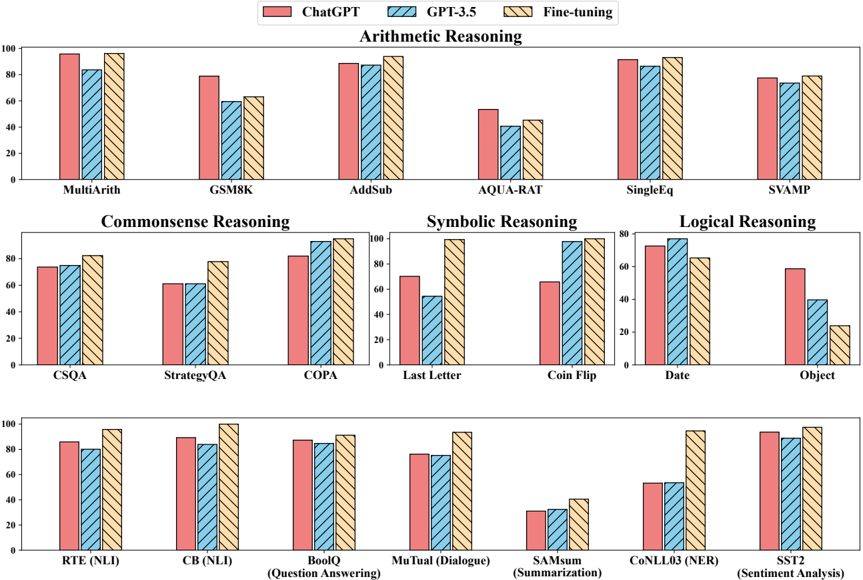
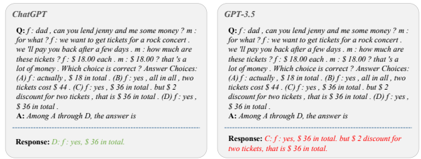
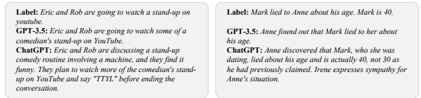
Spurred by advancements in scale, large language models (LLMs) have demonstrated the ability to perform a variety of natural language processing (NLP) tasks zero-shot-i.e., without adaptation on downstream data.Recently, the debut of ChatGPT 1 has drawn a great deal of attention from the natural language processing (NLP) community due to the fact that it can generate high-quality responses to human input and self-correct previous mistakes based on subsequent conversations.However, it is not yet known whether ChatGPT can serve as a generalist model that can perform many NLP tasks zero-shot.In this work, we empirically analyze the zero-shot learning ability of ChatGPT by evaluating it on 20 popular NLP datasets covering 7 representative task categories.With extensive empirical studies, we demonstrate both the effectiveness and limitations of the current version of ChatGPT.We find that ChatGPT performs well on many tasks favoring reasoning capabilities (e.g., arithmetic reasoning) while it still faces challenges when solving specific tasks such as sequence tagging.We additionally provide in-depth analysis through qualitative case studies.
Overview
The claims and statistics of this paper haven’t been checked yet.
Free: it reads the open-access text and checks the first 5 claims that cite a source we can check. Create a free account to check every claim.
Integrity signals
Registry
Cites
Statistics
Figures

Verification
Claims the paper makes
The claims and statistics of this paper haven’t been checked yet.
Free: it reads the open-access text and checks the first 5 claims that cite a source we can check. Create a free account to check every claim.
Claims other papers make about this one
Each is checked against this paper’s own text: does it say what the citing paper says it does?
In the citing paper
“Large Language Models (LLMs) are capable of successfully performing many language processing tasks zero-shot (without training data).”
From Can Large Language Models Transform Computational Social Science? (2024) · cites this paper as Qin et al. 2023
Self-check
Percentages, sums and reported differences re-computed from the paper’s own numbers.
The self-check needs the paper’s full text.
Citations
Cites
BERT: Pre-training of Deep Bidirectional Transformers for Language Understanding
Devlin, J., Chang, M.-W., Lee, K., & Toutanova, K. (2019) · Proceedings of the 2019 Conference of the North American Chapter of the Association for Computational Linguistics: Human Language Technologies, Volume 1 (Long and Short Papers) · doi:10.18653/v1/n19-1423 · Cited by 54,325
Deep reinforcement learning from human preferences
Christiano, P., Leike, J., Brown, T. B., Martic, M., Legg, S., & Amodei, D. (2017) · arXiv · doi:10.48550/arxiv.1706.03741 · Cited by 7,379
Recursive Deep Models for Semantic Compositionality Over a Sentiment Treebank
Socher, R., Perelygin, A., Wu, J., Chuang, J., Manning, C. D., Ng, A., & Potts, C. (2013) · Proceedings of the 2013 Conference on Empirical Methods in Natural Language Processing · doi:10.18653/v1/d13-1170 · Cited by 6,878
Chain-Of-Thought Prompting Elicits Reasoning in Large Language Models
Wei, J., Wang, X., Schuurmans, D., Bosma, M., Ichter, B., Xia, F., Chi, E., Le, Q. V., & Zhou, D. (2022) · Advances in Neural Information Processing Systems 35 · doi:10.52202/068431-1800 · Cited by 4,505
Chain-of-Thought Prompting Elicits Reasoning in Large Language Models
Wei, J., Wang, X., Schuurmans, D., Bosma, M., Ichter, B., Xia, F., Chi, E., Le, Q., & Zhou, D. (2022) · arXiv · doi:10.48550/arxiv.2201.11903 · Cited by 4,263
BoolQ: Exploring the Surprising Difficulty of Natural Yes/No Questions
Clark, C., Lee, K., Chang, M.-W., Kwiatkowski, T., Collins, M., & Toutanova, K. (2019) · North American Chapter of the Association for Computational Linguistics · doi:10.18653/v1/n19-1300 · Cited by 2,998
CommonsenseQA: A Question Answering Challenge Targeting Commonsense Knowledge
Talmor, A., Herzig, J., Lourie, N., & Berant, J. (2019) · North American Chapter of the Association for Computational Linguistics · doi:10.18653/v1/n19-1421 · Cited by 2,836
PaLM: Scaling Language Modeling with Pathways
Chowdhery, A., Narang, S., Devlin, J., Bosma, M., Mishra, G., Roberts, A., Barham, P., Chung, H. W., Sutton, C., Gehrmann, S., et al. (2022) · arXiv · doi:10.48550/arxiv.2204.02311 · Cited by 2,590
Contextual String Embeddings for Sequence Labeling
Akbik, A., Blythe, D. A. J., & Vollgraf, R. (2018) · International Conference on Computational Linguistics · Cited by 1,755
The PASCAL Recognising Textual Entailment Challenge
Dagan, I., Glickman, O., & Magnini, B. (2006) · Lecture Notes in Computer Science · doi:10.1007/11736790_9 · Cited by 1,628
Cited by
A Survey on Evaluation of Large Language Models
Chang, Y., Wang, X., Wang, J., Wu, Y., Yang, L., Zhu, K., Chen, H., Yi, X., Wang, C., Wang, Y., et al. (2024) · ACM Transactions on Intelligent Systems and Technology · doi:10.1145/3641289 · Cited by 4,254
A Survey on Evaluation of Large Language Models
Chang, Y., Wang, X., Wang, J., Wu, Y., Yang, L., Zhu, K., Chen, H., Yi, X., Wang, C., Wang, Y., et al. (2023) · arXiv · doi:10.48550/arxiv.2307.03109 · Cited by 3,159
Ray, P. P. (2023) · Internet of Things and Cyber-Physical Systems · doi:10.1016/j.iotcps.2023.04.003 · Cited by 2,463
A Brief Overview of ChatGPT: The History, Status Quo and Potential Future Development
Wu, T., He, S., Liu, J., Sun, S., Liu, K., Han, Q.-L., & Tang, Y. (2023) · IEEE/CAA Journal of Automatica Sinica · doi:10.1109/jas.2023.123618 · Cited by 1,452
A Comprehensive Overview of Large Language Models
Naveed, H., Khan, A. U., Qiu, S., Saqib, M., Anwar, S., Usman, M., Akhtar, N., Barnes, N., & Mian, A. (2025) · ACM Transactions on Intelligent Systems and Technology · doi:10.1145/3744746 · Cited by 1,257
Summary of ChatGPT-Related Research and Perspective Towards the Future of Large Language Models
Liu, Y., Han, T., Ma, S., Zhang, J., Yang, Y., Tian, J., He, H., Li, A., He, M., Liu, Z., et al. (2023) · arXiv · doi:10.48550/arxiv.2304.01852 · Cited by 1,172
Summary of ChatGPT-Related research and perspective towards the future of large language models
Liu, Y., Han, T., Ma, S., Zhang, J., Yang, Y., Tian, J., He, H., Li, A., He, M., Liu, Z., et al. (2023) · Meta-Radiology · doi:10.1016/j.metrad.2023.100017 · Cited by 855
“5 and bert-style models [78; 110].”
BackgroundMethodResultInfluentialCan Large Language Models Transform Computational Social Science?
Ziems, C., Held, W., Shaikh, O., Chen, J., Zhang, Z., & Yang, D. (2023) · arXiv · doi:10.48550/arxiv.2305.03514 · Cited by 839
Self-citationChatGPT and Open-AI Models: A Preliminary Review
Roumeliotis, K. I., & Tselikas, N. D. (2023) · Future Internet · doi:10.3390/fi15060192 · Cited by 706
Bang, Y., Cahyawijaya, S., Lee, N., Dai, W., Su, D., Wilie, B., Lovenia, H., Ji, Z., Yu, T., Chung, W., et al. (2023) · Proceedings of the 13th International Joint Conference on Natural Language Processing and the 3rd Conference of the Asia-Pacific Chapter of the Association for Computational Linguistics (Volume 1: Long Papers) · doi:10.18653/v1/2023.ijcnlp-main.45 · Cited by 682
“…robust complex reasoning capabilities, which should also be facilitated by the creation of more comprehensive benchmarks for assessing these abilities, such as works by Laskar et al. (2023b); Qin et al. (2023); Davis (2023a), particularly when multiple abilities are required to complete the tasks.”
BackgroundHarnessing the power of llms in practice: a survey on chatGPT and beyond
Yang, J., Jin, H., Tang, R., Han, X., Feng, Q., Jiang, H., Zhong, S., Yin, B., & Hu, X. (2024) · ACM Transactions on Knowledge Discovery from Data · doi:10.1145/3649506 · Cited by 644
Can Large Language Models Transform Computational Social Science?
Ziems, C., Held, W., Shaikh, O., Chen, J., Zhang, Z., & Yang, D. (2024) · Computational Linguistics · doi:10.1162/coli_a_00502 · Cited by 585
“, 2017) series, and ChatGPT (Qin et al., 2023; Gilardi et al., 2023) which is the conversation-based LLM trained through RLHF (Christiano et al.”
BackgroundMethodInfluentialSelf-citationThe impact of ChatGPT on higher education
Dempere, J., Modugu, K., Hesham, A., & Ramasamy, L. K. (2023) · Frontiers in Education · doi:10.3389/feduc.2023.1206936 · Cited by 519
A Categorical Archive of ChatGPT Failures
Borji, A. (2023) · doi:10.21203/rs.3.rs-2895792/v1 · Cited by 514
A Categorical Archive of ChatGPT Failures
Borji, A. (2023) · arXiv · doi:10.48550/arxiv.2302.03494 · Cited by 514
Ghafouri, V., Agarwal, V., Zhang, Y., Sastry, N. R., Such, J., & Suárez‐Tangil, G. (2023) · ACM International Conference on Information and Knowledge Management (CIKM) · doi:10.1145/3583780.3614777 · Cited by 485
Multilingual Jailbreak Challenges in Large Language Models
Deng, Y., Zhang, W.-X., Pan, S. J., & Bing, L. (2023) · International Conference on Learning Representations · doi:10.48550/arxiv.2310.06474 · Cited by 317
A Comprehensive Study of Knowledge Editing for Large Language ModelsPreprint
Zhang, N., Yao, Y., Tian, B., Wang, P., Deng, S.-M., Wang, M.-R., Xi, Z.-K., Mao, S., Zhang, J., Ni, Y., et al. (2024) · arXiv.org · doi:10.48550/arxiv.2401.01286 · Cited by 197
Self-citationAutoAgents: A Framework for Automatic Agent Generation
Chen, G., Dong, S., Shu, Y., Zhang, G., Sesay, J., Karlsson, B. F., Fu, J., & Shi, Y. (2024) · International Joint Conference on Artificial Intelligence · doi:10.24963/ijcai.2024/3 · Cited by 382
Bang, Y., Cahyawijaya, S., Lee, N., Dai, W., Su, D., Wilie, B., Lovenia, H., Ji, Z., Yu, T., Chung, W., et al. (2023) · arXiv · doi:10.48550/arxiv.2302.04023 · Cited by 337
“…robust complex reasoning capabilities, which should also be facilitated by the creation of more comprehensive benchmarks for assessing these abilities, such as works by Laskar et al. (2023b); Qin et al. (2023); Davis (2023a), particularly when multiple abilities are required to complete the tasks.”
BackgroundA Survey of GPT-3 Family Large Language Models Including ChatGPT and GPT-4
Kalyan, K. S. (2024) · Natural Language Processing Journal · doi:10.1016/j.nlp.2023.100048 · Cited by 335
ChatGPT: Empowering lifelong learning in the digital age of higher education
Rawas, S. (2024) · Education and Information Technologies · doi:10.1007/s10639-023-12114-8 · Cited by 310
Personalization of Large Language Models: A Survey
Zhang, Z., Rossi, R. A., Kveton, B., Shao, Y., Yang, D., Zamani, H., Dernoncourt, F., Barrow, J., Yu, T., Kim, S., et al. (2025) · Transactions on machine learning research · doi:10.48550/arxiv.2411.00027 · Cited by 300
Self-citationLLMs for knowledge graph construction and reasoning: recent capabilities and future opportunities
Zhu, Y., Wang, X., Chen, J., Qiao, S., Ou, Y., Yao, Y., Deng, S., Chen, H., & Zhang, N. (2024) · World Wide Web · doi:10.1007/s11280-024-01297-w · Cited by 294
Self-citationLiu, Y., Yang, Z., Yu, Z., Liu, Z., Liu, D., Lin, H., Li, M., Ma, S., Avdeev, M., & Shi, S. (2023) · Journal of Materiomics · doi:10.1016/j.jmat.2023.05.001 · Cited by 294
Tan, Y., Min, D., Li, Y., Li, W., Hu, N., Chen, Y., & Qi, G. (2023) · Lecture notes in computer science · doi:10.1007/978-3-031-47240-4_19 · Cited by 283
UniChart: A Universal Vision-language Pretrained Model for Chart Comprehension and Reasoning
Masry, A., Kavehzadeh, P., Long, X., Hoque, E., & Joty, S. (2023) · Conference on Empirical Methods in Natural Language Processing (EMNLP) · doi:10.18653/v1/2023.emnlp-main.906 · Cited by 280
Holistic Evaluation of Text-to-Image Models
Lee, T., Yasunaga, M., Meng, C., Mai, Y., Park, J.-S., Gupta, A., Zhang, Y., Narayanan, D., Teufel, H., Bellagente, M., et al. (2023) · neural information processing systems · doi:10.52202/075280-3067 · Cited by 279
Self-citationMental-LLM: Leveraging Large Language Models for Mental Health Prediction via Online Text Data
Xu, X., Yao, B., Dong, Y., Gabriel, S., Yu, H., Hendler, J., Ghassemi, M., Dey, A. K., & Wang, D. (2024) · Proceedings of the ACM on Interactive, Mobile, Wearable and Ubiquitous Technologies · doi:10.1145/3643540 · Cited by 278
Are Large Language Models Really Good Logical Reasoners? A Comprehensive Evaluation and Beyond
Xu, F., Lin, Q., Han, J., Zhao, T., Liu, J., & Cambria, E. (2025) · IEEE Transactions on Knowledge and Data Engineering · doi:10.1109/tkde.2025.3536008 · Cited by 242
Li, X., Chan, S., Zhu, X., Pei, Y., Ma, Z., Liu, X., & Shah, S. (2023) · Conference on Empirical Methods in Natural Language Processing (EMNLP) · doi:10.18653/v1/2023.emnlp-industry.39 · Cited by 240
Model Editing Harms General Abilities of Large Language Models: Regularization to the Rescue
Gu, J.-C., Xu, H.-X., Ma, J.-Y., Lu, P., Ling, Z.-H., Chang, K.-W., & Peng, N. (2024) · Conference on Empirical Methods in Natural Language Processing (EMNLP) · doi:10.18653/v1/2024.emnlp-main.934 · Cited by 239
LLM-Adapters: An Adapter Family for Parameter-Efficient Fine-Tuning of Large Language Models
Hu, Z., Wang, L., Lan, Y., Xu, W., Lim, E.-P., Bing, L., Xu, X., Poria, S., & Lee, R. (2023) · Proceedings of the 2023 Conference on Empirical Methods in Natural Language Processing · doi:10.18653/v1/2023.emnlp-main.319 · Cited by 238
Hariri, W. (2023) · arXiv (Cornell University) · doi:10.48550/arxiv.2304.02017 · Cited by 237
Is chatGPT a good nlg evaluator? A preliminary study
Wang, J., Liang, Y., Meng, F., Sun, Z., Shi, H., Li, Z., Xu, J., Qu, J., & Zhou, J. (2023) · Proceedings of the 4th New Frontiers in Summarization Workshop · doi:10.18653/v1/2023.newsum-1.1 · Cited by 235
Laskar, M. T. R., Alqahtani, S., Bari, M. S., Rahman, M., Khan, M. A. M., Khan, H., Jahan, I., Bhuiyan, A., Tan, C. W., Parvez, M. R., et al. (2024) · Conference on Empirical Methods in Natural Language Processing (EMNLP) · doi:10.18653/v1/2024.emnlp-main.764 · Cited by 234
Lai, V. D., Ngo, N. T., Veyseh, A. P. B., Man, H., Dernoncourt, F., Bui, T., & Nguyen, T. H. (2023) · arXiv · doi:10.48550/arxiv.2304.05613 · Cited by 233
“Different from some previous work that exploits two-stage prompting to adopt a zero-shot chain of thoughts (Kojima et al., 2022; Qin et al., 2023), we directly utilize single-stage prompting that only adds the task description D into each input X to simulate the common approach of general users for…”
BackgroundLai, V., Ngo, N., Pouran Ben Veyseh, A., Man, H., Dernoncourt, F., Bui, T., & Nguyen, T. (2023) · Findings of the Association for Computational Linguistics: EMNLP 2023 · doi:10.18653/v1/2023.findings-emnlp.878 · Cited by 233
Towards Safer Large Language Models through Machine Unlearning
Liu, Z., Dou, G., Tan, Z., Tian, Y., & Jiang, M. (2024) · Findings of the Association for Computational Linguistics: ACL (Findings of ACL) · doi:10.18653/v1/2024.findings-acl.107 · Cited by 201
Empirical Study of Zero-Shot NER with ChatGPT
Xie, T., Li, Q., Zhang, J., Zhang, Y., Liu, Z., & Wang, H. (2023) · Conference on Empirical Methods in Natural Language Processing (EMNLP) · doi:10.18653/v1/2023.emnlp-main.493 · Cited by 197
Where Would I Go Next? Large Language Models as Human Mobility PredictorsPreprint
Wang, X., Fang, M., Zeng, Z., & Cheng, T. (2023) · arXiv (Cornell University) · doi:10.48550/arxiv.2308.15197 · Cited by 194
Sohail, S. S., Farhat, F., Himeur, Y., Nadeem, M., Madsen, D. Ø., Singh, Y., Atalla, S., & Mansoor, W. (2023) · Journal of King Saud University - Computer and Information Sciences · doi:10.1016/j.jksuci.2023.101675 · Cited by 192
“In particular, Qin et al. (2023) argued that larger models like ChatGPT can perform NLP tasks without the need for specific data adaptation.”
Bias Runs Deep: Implicit Reasoning Biases in Persona-Assigned LLMs
Gupta, S., Shrivastava, V., Deshpande, A., Kalyan, A., Clark, P., Sabharwal, A., & Khot, T. (2023) · International Conference on Learning Representations · doi:10.48550/arxiv.2311.04892 · Cited by 308
Evaluating Large Language Models on a Highly-specialized Topic, Radiation Oncology Physics
Holmes, J., Liu, Z., Zhang, L., Ding, Y., Sio, T. T., McGee, L. A., Ashman, J. B., Li, X., Liu, T., Shen, J., et al. (2023) · arXiv · doi:10.48550/arxiv.2304.01938 · Cited by 190
Cross-lingual Prompting: Improving Zero-shot Chain-of-Thought Reasoning across Languages
Qin, L., Chen, Q., Wei, F., Huang, S., & Che, W. (2023) · Conference on Empirical Methods in Natural Language Processing (EMNLP) · doi:10.18653/v1/2023.emnlp-main.163 · Cited by 190
AugGPT: Leveraging ChatGPT for Text Data Augmentation
Dai, H., Liu, Z., Liao, W., Huang, X., Cao, Y., Wu, Z., Zhao, L., Xu, S., Zeng, F., Liu, W., et al. (2025) · IEEE Transactions on Big Data · doi:10.1109/tbdata.2025.3536934 · Cited by 189
“Qin et al. [26] evaluated ChatGPT on a comprehensive set of NLP tasks, including common benchmarks in natural language inference, arithmetic reasoning, named entity recognition, sentiment analysis, question answering, dialogue, and summarization.”
Towards Making the Most of ChatGPT for Machine Translation
Peng, K., Ding, L., Zhong, Q., Shen, L., Liu, X., Zhang, M., Ouyang, Y., & Tao, D. (2023) · Findings of the Association for Computational Linguistics: EMNLP (Findings of EMNLP) · doi:10.18653/v1/2023.findings-emnlp.373 · Cited by 188
Platypus: Quick, Cheap, and Powerful Refinement of LLMsPreprint
Lee, A. N., Hunter, C. J., & Ruiz, N. (2023) · arXiv (Cornell University) · doi:10.48550/arxiv.2308.07317 · Cited by 184
Corrective Retrieval Augmented Generation
Yan, S.-Q., Gu, J.-C., Zhu, Y., & Ling, Z.-H. (2024) · arXiv · doi:10.48550/arxiv.2401.15884 · Cited by 182
“Hallucinations of LLMs Although LLMs have exhibited impressive abilities to understand instructions and generate fluent language texts (Bang et al., 2023; Qin et al., 2023; Zhong et al., 2023), one of the most severe issues that LLMs have still been struggling with is hallucinations.”
BackgroundKuzman, T., Mozetič, I., & Ljubešić, N. (2023) · arXiv (Cornell University) · doi:10.48550/arxiv.2303.03953 · Cited by 181
A Comprehensive Capability Analysis of GPT-3 and GPT-3.5 Series Models
Ye, J., Chen, X., Xu, N., Zu, C., Shao, Z., Liu, S., Cui, Y., Zhou, Z., Gong, C., Shen, Y., et al. (2023) · arXiv (Cornell University) · doi:10.48550/arxiv.2303.10420 · Cited by 180
Let the LLMs Talk: Simulating Human-to-Human Conversational QA via Zero-Shot LLM-to-LLM Interactions
Abbasiantaeb, Z., Yuan, Y., Kanoulas, E., & Aliannejadi, M. (2024) · ACM International Conference on Web Search and Data Mining (WSDM) · doi:10.1145/3616855.3635856 · Cited by 179
Role of activity-based learning and ChatGPT on students' performance in education
Al Shloul, T., Mazhar, T., Abbas, Q., Iqbal, M., Ghadi, Y. Y., Shahzad, T., Mallek, F., & Hamam, H. (2024) · Computers and Education: Artificial Intelligence · doi:10.1016/j.caeai.2024.100219 · Cited by 173
Knowledge Graph Prompting for Multi-Document Question Answering
Wang, Y., Lipka, N., Rossi, R. A., Siu, A., Zhang, R., & Derr, T. (2023) · arXiv · doi:10.48550/arxiv.2308.11730 · Cited by 170
The Parrot Dilemma: Human-Labeled vs. LLM-augmented Data in Classification Tasks
Møller, A. G., Pera, A., Dalsgaard, J. A., & Aiello, L. M. (2024) · Conference of the European Chapter of the Association for Computational Linguistics · doi:10.18653/v1/2024.eacl-short.17 · Cited by 165
Li, M., Shi, T., Ziems, C., Kan, M., Chen, N. F., Liu, Z., & Yang, D. (2023) · Conference on Empirical Methods in Natural Language Processing (EMNLP) · doi:10.18653/v1/2023.emnlp-main.92 · Cited by 164
Self-citationKnowledge Graph Prompting for Multi-Document Question Answering
Wang, Y., Lipka, N., Rossi, R. A., Siu, A., Zhang, R., & Derr, T. (2024) · Proceedings of the AAAI Conference on Artificial Intelligence · doi:10.1609/aaai.v38i17.29889 · Cited by 164
Assessing Cross-Cultural Alignment between ChatGPT and Human Societies: An Empirical Study
Cao, Y., Zhou, L., Lee, S., Cabello, L., Chen, M., & Hershcovich, D. (2023) · Proceedings of the First Workshop on Cross-Cultural Considerations in NLP (C3NLP) · doi:10.18653/v1/2023.c3nlp-1.7 · Cited by 163
Amin, M. M., Cambria, E., & Schuller, B. W. (2023) · IEEE Intelligent Systems · doi:10.1109/mis.2023.3254179 · Cited by 162
Evaluating large language models on a highly-specialized topic, radiation oncology physics
Holmes, J., Liu, Z., Zhang, L., Ding, Y., Sio, T. T., McGee, L. A., Ashman, J. B., Li, X., Liu, T., Shen, J., et al. (2023) · Frontiers in Oncology · doi:10.3389/fonc.2023.1219326 · Cited by 162
“The capabilities of ChatGPT empowers diverse practical applications ranging from essay writing to code generation [13].”
BackgroundLarge Language Models as Analogical Reasoners
Yasunaga, M., Chen, X., Li, Y., Pasupat, P., Leskovec, J., Liang, P., Ed, H., & Zhou, D. (2024) · International Conference on Learning Representations · doi:10.48550/arxiv.2310.01714 · Cited by 164
Self-citationOpenAI ChatGPT-Generated Results: Similarity Index of Artificial Intelligence-Based Contents
Ventayen, R. J. M. (2023) · Advances in intelligent systems and computing · doi:10.1007/978-981-99-3608-3_15 · Cited by 161
Towards Interpretable Mental Health Analysis with Large Language Models
Yang, K., Ji, S., Zhang, T., Xie, Q., Kuang, Z., & Ananiadou, S. (2023) · Proceedings of the 2023 Conference on Empirical Methods in Natural Language Processing · doi:10.18653/v1/2023.emnlp-main.370 · Cited by 155
“There are also works on analyzing the emotional reasoning ability of ChatGPT including (Qin et al., 2023; Zhong et al., 2023; Kocoń et al., 2023; Chen et al., 2023) on the sentiment classification task, where ChatGPT achieves comparable or worse performance compared with fine-tuning based methods based on PLMs.”
BackgroundResultIs ChatGPT a Good Causal Reasoner? A Comprehensive Evaluation
Gao, J., Ding, X. H., Qin, B., & Liu, T. (2023) · Findings of the Association for Computational Linguistics: EMNLP (Findings of EMNLP) · doi:10.18653/v1/2023.findings-emnlp.743 · Cited by 154
Usable XAI: 10 Strategies Towards Exploiting Explainability in the LLM Era
Wu, X., Zhao, H., Zhu, Y., Shi, Y., Yang, F., Hu, L., Liu, T., Zhaı, X., Yao, W., Li, J., et al. (2026) · ACM Transactions on Knowledge Discovery from Data · doi:10.1145/3816150 · Cited by 150
Is GPT-3 a Good Data Annotator?
Ding, B., Qin, C., Liu, L., Chia, Y. K., Li, B., Joty, S., & Bing, L. (2023) · Proceedings of the 61st Annual Meeting of the Association for Computational Linguistics (Volume 1: Long Papers) · doi:10.18653/v1/2023.acl-long.626 · Cited by 149
Self-citationAI literacy for ethical use of chatbot: Will students accept AI ethics?
Kajiwara, Y., & Kawabata, K. (2024) · Computers and Education Artificial Intelligence · doi:10.1016/j.caeai.2024.100251 · Cited by 149
Fact-checking information from large language models can decrease headline discernment
DeVerna, M., Yan, H. Y., Yang, K.-C., & Menczer, F. (2024) · Proceedings of the National Academy of Sciences · doi:10.1073/pnas.2322823121 · Cited by 146
Lu, J., Zheng, R., Gong, Z., & Xu, H. (2024) · IEEE Transactions on Learning Technologies · doi:10.1109/tlt.2024.3369690 · Cited by 144
“ChatGPT cannot only complete text generation tasks [19] but also solve various problems with its good reasoning ability [20].”
BackgroundMedChatZH: A tuning LLM for traditional Chinese medicine consultations
Tan, Y., Zhang, Z., Li, M., Pan, F., Duan, H., Huang, Z., Deng, H., Yu, Z., Yang, C., Shen, G., et al. (2024) · Computers in Biology and Medicine · doi:10.1016/j.compbiomed.2024.108290 · Cited by 141
Self-citationExploring the Potential of ChatGPT in Automated Code Refinement: An Empirical Study
Guo, Q., Cao, J., Xie, X., Liu, S., Li, X., Chen, B., & Peng, X. (2024) · Proceedings of the IEEE/ACM 46th International Conference on Software Engineering · doi:10.1145/3597503.3623306 · Cited by 136
Graphologue: Exploring Large Language Model Responses with Interactive Diagrams
Jiang, P., Rayan, J., Dow, S. P., & Xia, H. (2023) · Proceedings of the 36th Annual ACM Symposium on User Interface Software and Technology · doi:10.1145/3586183.3606737 · Cited by 135
Ji, Y., Deng, Y., Gong, Y., Peng, Y.-P., Niu, Q., Zhang, L., Ma, B., & Li, X.-G. (2023) · arXiv.org · doi:10.48550/arxiv.2303.14742 · Cited by 123
GPTAraEval: A Comprehensive Evaluation of ChatGPT on Arabic NLP
Khondaker, M. T. I., Waheed, A., Nagoudi, E. M. B., & Abdul-Mageed, M. (2023) · Conference on Empirical Methods in Natural Language Processing (EMNLP) · doi:10.18653/v1/2023.emnlp-main.16 · Cited by 131
Faith and Fate: Limits of Transformers on Compositionality
Dziri, N., Lu, X., Sclar, M., Li, X. (., Jiang, L., Lin, B. Y., Welleck, S., West, P., Bhagavatula, C., Bras, R. L., et al. (2023) · Advances in Neural Information Processing Systems 36 · doi:10.52202/075280-3081 · Cited by 335
The Generative AI Paradox: "What It Can Create, It May Not Understand"
West, P., Lu, X., Dziri, N., Brahman, F., Li, L.-J., Hwang, J. D., Jiang, L., Fisher, J. R., Ravichander, A., Chandu, K. R., et al. (2023) · International Conference on Learning Representations · doi:10.48550/arxiv.2311.00059 · Cited by 143
Faith and Fate: Limits of Transformers on Compositionality
Dziri, N., Lu, X., Sclar, M., Li, X. L., Jiang, L., Lin, B. Y., West, P., Bhagavatula, C., Bras, R. L., Hwang, J. D., et al. (2023) · arXiv · Cited by 124
Huang, J.-T., Li, E. J., Lam, M. H., Liang, T., Wang, W., Yuan, Y., Jiao, W., Wang, X., Tu, Z., & Lyu, M. R.-T. (2025) · International Conference on Learning Representations · doi:10.48550/arxiv.2403.11807 · Cited by 122
GTA1: GUI Test-time Scaling Agent
Yang, Y., Li, D., Dai, Y., Yang, Y., Luo, Z., Zhao, Z., Hu, Z., Huang, J., Saha, A., Chen, Z., et al. (2026) · International Conference on Learning Representations · doi:10.48550/arxiv.2507.05791 · Cited by 120
A Wide Evaluation of ChatGPT on Affective Computing Tasks
Amin, M. M., Mao, R., Cambria, E., & Schuller, B. W. (2024) · IEEE Transactions on Affective Computing · doi:10.1109/taffc.2024.3419593 · Cited by 119
Zero-Shot Cross-Lingual Summarization via Large Language Models
Wang, J., Liang, Y.-L., Meng, F.-D., Zou, B., Li, Z.-X., Qu, J.-F., & Zhou, J. (2023) · NEWSUM · doi:10.18653/v1/2023.newsum-1.2 · Cited by 43
Evaluation of LLM-based chatbots for OSINT-based Cyber Threat Awareness
Shafee, S., Bessani, A., & Ferreira, P. (2024) · Expert Systems with Applications · doi:10.1016/j.eswa.2024.125509 · Cited by 114
Ma, Y., Cao, Y., Hong, Y., & Sun, A. (2023) · Findings of the Association for Computational Linguistics: EMNLP 2023 · doi:10.18653/v1/2023.findings-emnlp.710 · Cited by 113
The Next Chapter: A Study of Large Language Models in Storytelling
Xie, Z., Cohn, T., & Lau, J. H. (2023) · International Conference on Natural Language Generation · doi:10.18653/v1/2023.inlg-main.23 · Cited by 113
RewriteLM: An Instruction-Tuned Large Language Model for Text Rewriting
Shu, L., Luo, L., Hoskere, J., Zhu, Y., Liu, Y., Tong, S., Chen, J., & Meng, L. (2024) · Proceedings of the AAAI Conference on Artificial Intelligence · doi:10.1609/aaai.v38i17.29863 · Cited by 112
Self-citationLLMArena: Assessing Capabilities of Large Language Models in Dynamic Multi-Agent Environments
Chen, J., Hu, X., Liu, S., Huang, S., Tu, W.-W., He, Z., & Wen, L. (2024) · Proceedings of the conference - Association for Computational Linguistics. Meeting · doi:10.18653/v1/2024.acl-long.705 · Cited by 111
Self-citationEnglhardt, Z., Ma, C., Morris, M. E., Chang, C.-C., Xu, X., Qin, L., McDuff, D., Liu, X., Patel, S., & Iyer, V. (2024) · Proceedings of the ACM on Interactive Mobile Wearable and Ubiquitous Technologies · doi:10.1145/3659604 · Cited by 110
Wang, C., Cheng, S., Guo, Q., Yue, Y., Ding, B., Xu, Z., Wang, Y., Hu, X., Zhang, Z., & Zhang, Y. (2023) · neural information processing systems · doi:10.52202/075280-3367 · Cited by 109
Self-citationA Survey on Detection of LLMs-Generated Content
Yang, X., Pan, L., Zhao, X., Chen, H., Petzold, L. R., Wang, W. Y., & Cheng, W. (2024) · Findings of the Association for Computational Linguistics: EMNLP 2024 · doi:10.18653/v1/2024.findings-emnlp.572 · Cited by 22
Is a Large Language Model a Good Annotator for Event Extraction?
Chen, R., Qin, C., Jiang, W., & Choi, D. (2024) · Proceedings of the AAAI Conference on Artificial Intelligence · doi:10.1609/aaai.v38i16.29730 · Cited by 108
Self-citationKosar, T., Ostojić, D., Liu, Y. D., & Mernik, M. (2024) · Mathematics · doi:10.3390/math12050629 · Cited by 107
Disinformation Detection: An Evolving Challenge in the Age of LLMs
Jiang, B., Tan, Z., Nirmal, A., & Liu, H. (2024) · Society for Industrial and Applied Mathematics eBooks · doi:10.1137/1.9781611978032.50 · Cited by 107
A comprehensive evaluation of large Language models on benchmark biomedical text processing tasks
Jahan, I., Laskar, M. T. R., Peng, C., & Huang, J. X. (2024) · Computers in Biology and Medicine · doi:10.1016/j.compbiomed.2024.108189 · Cited by 106
Wang, L., He, J., Li, S., Liu, N., & Lim, E. (2024) · Lecture notes in computer science · doi:10.1007/978-3-031-53302-0_3 · Cited by 106
ALoRA: Allocating Low-Rank Adaptation for Fine-tuning Large Language Models
Liu, Z., Lyn, J., Zhu, W., & Tian, X. (2024) · Conference of the North American Chapter of the Association for Computational Linguistics: Human Language Technologies (NAACL-HLT) · doi:10.18653/v1/2024.naacl-long.35 · Cited by 106
A Survey of Neural Code Intelligence: Paradigms, Advances and BeyondPreprint
Sun, Q., Chen, Z., Xu, F., Cheng, K., Ma, C., Yin, Z., Wang, J., Han, C., Zhu, R., Yuan, S., et al. (2024) · arXiv (Cornell University) · doi:10.48550/arxiv.2403.14734 · Cited by 106
Can Small Language Models be Good Reasoners for Sequential Recommendation?
Wang, Y., Tian, C., Hu, B., Yu, Y., Liu, Z., Zhang, Z., Zhou, J., Pang, L., & Wang, X. (2024) · International World Wide Web Conference (WWW) · doi:10.1145/3589334.3645671 · Cited by 105
Self-citationIs Translation All You Need? A Study on Solving Multilingual Tasks with Large Language Models
Liu, C., Zhang, W., Zhao, Y., Luu, A. T., & Bing, L. (2025) · Conference of the North American Chapter of the Association for Computational Linguistics: Human Language Technologies (NAACL-HLT) · doi:10.18653/v1/2025.naacl-long.485 · Cited by 104
Large language models: a new approach for privacy policy analysis at scale
Rodríguez, D., Yang, I., Álamo, J. M. D., & Sadeh, N. (2024) · Computing · doi:10.1007/s00607-024-01331-9 · Cited by 104
Mooney, P., Cui, W., Guan, B., & Juhász, L. (2023) · ACM SIGSPATIAL International Workshop on AI for Geographic Knowledge Discovery (GeoAI) · doi:10.1145/3615886.3627745 · Cited by 102
Metadata
- Authors
- Qin, C., Zhang, A., Zhang, Z., Chen, J., Yasunaga, M., & Yang, D.
- Venue
- Proceedings of the 2023 Conference on Empirical Methods in Natural Language Processing
- Published
- 2023
- Pages
- 1339-1384
- OpenAlex
- W4389523957
- Cited by
- 504
- References
- 38
- FWCI
- 95.27
- Type
- conference paper
- Language
- en
- Open access
- hybrid
About these checks
Registry, retraction, Cites and statistics results are computed, not judged, with one exception: a printed reference that no index lists is read once by a model before it counts as a citation error. Claims are extracted by a model and kept only when their quote appears verbatim in the text; each cited source is then checked, with a model’s help, for whether it says what the claim relies on. Those verdicts can be wrong — read the claim’s quote and the cited source before relying on one.
Statistics and arithmetic are recomputed, not judged.
Confidence bands are shown only for fields calibrated on our annotated test set. None is calibrated yet, so no band is shown.
What counts as a claim ›How we measure confidence ›How we check this ›
Are you an author, or do you see a problem with this page? Request a review
Data sources
Bibliographic data: Semantic Scholar, OpenAlex, Crossref.
Contains information from the Semantic Scholar Academic Graph Datasets, made available under the ODC Attribution License (ODC-BY 1.0).
Semantic Scholar’s data is described in: Kinney, R., et al. (2023). The Semantic Scholar Open Data Platform. arXiv:2301.10140.
