

Threads of Subtlety: Detecting Machine-Generated Texts Through Discourse Motifs
Open accessThe DOI matches its Crossref record; 64 of the 64 references it cites were found in a registry or an index; none of the 15 sources its claims cite is checked for support yet.
Abstract
With the advent of large language models (LLM), the line between human-crafted and machine-generated texts has become increasingly blurred. This paper delves into the inquiry of identifying discernible and unique linguistic properties in texts that were written by humans, particularly uncovering the underlying discourse structures of texts beyond their surface structures. Introducing a novel methodology, we leverage hierarchical parse trees and recursive hypergraphs to unveil distinctive discourse patterns in texts produced by both LLMs and humans. Empirical findings demonstrate that, although both LLMs and humans generate distinct discourse patterns influenced by specific domains, human-written texts exhibit more structural variability, reflecting the nuanced nature of human writing in different domains. Notably, incorporating hierarchical discourse features enhances binary classifiers’ overall performance in distinguishing between human-written and machine-generated texts, even on out-of-distribution and paraphrased samples. This underscores the significance of incorporating hierarchical discourse features in the analysis of text patterns. The code and dataset will be available at [TBA].
Overview
CoChat Summary
TL;DR
The paper proposes using hierarchical discourse structures—RST parse trees converted to recursive hypergraphs—and discourse motif analysis to distinguish human-written from machine-generated texts. It reports that adding motif features improves binary detectors, including on out-of-distribution and paraphrased samples, and that human texts show greater structural variability.
Key findings
- Discourse motifs improve detection: GAT improved 0.67→0.73 on HC3; LF improved 0.97→0.98 on HC3, 0.90→0.93 on DeepfakeTextDetect, 0.74→0.82 on OOD, and 0.60→0.62 on OOD-Para (Table 3). On TenPageStories, LF+Motifs improved over LF across settings (e.g., FIG 1: 0.30→0.43; FIG 3: 0.40→0.65; FIG 5: 0.45→0.71; constrained FIG 1: 0.59→0.71; 3: 0.50→0.69; 5: 0.55→0.70).
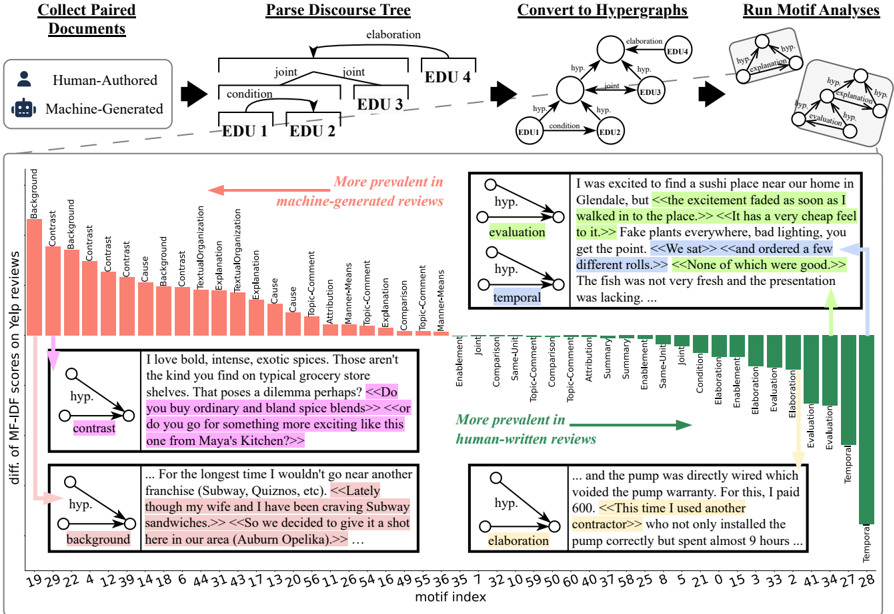
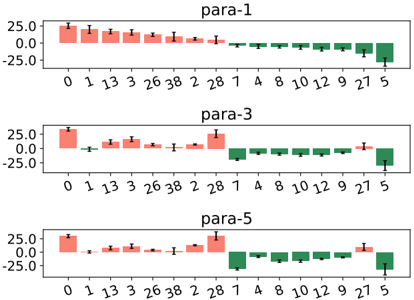
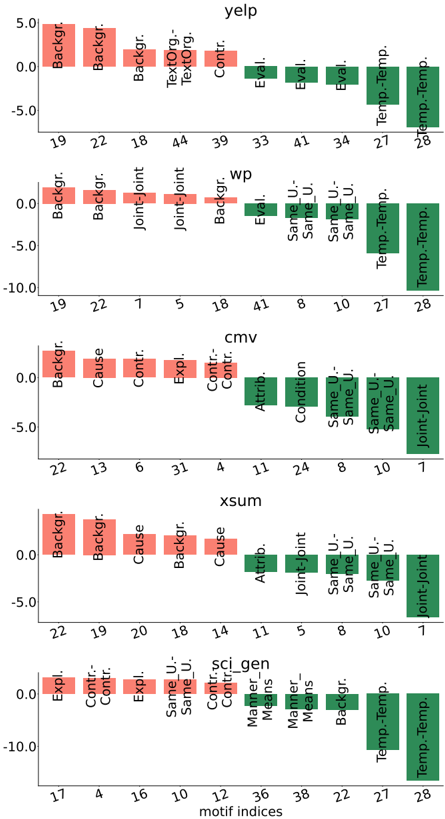
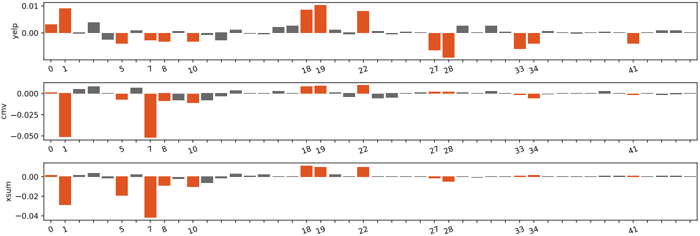
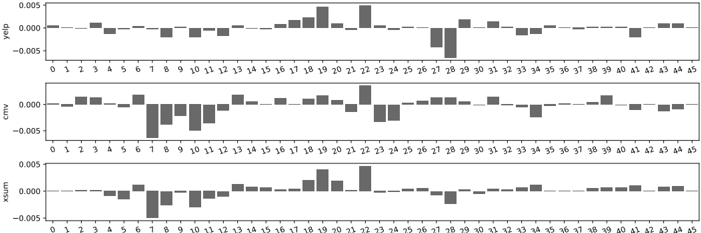
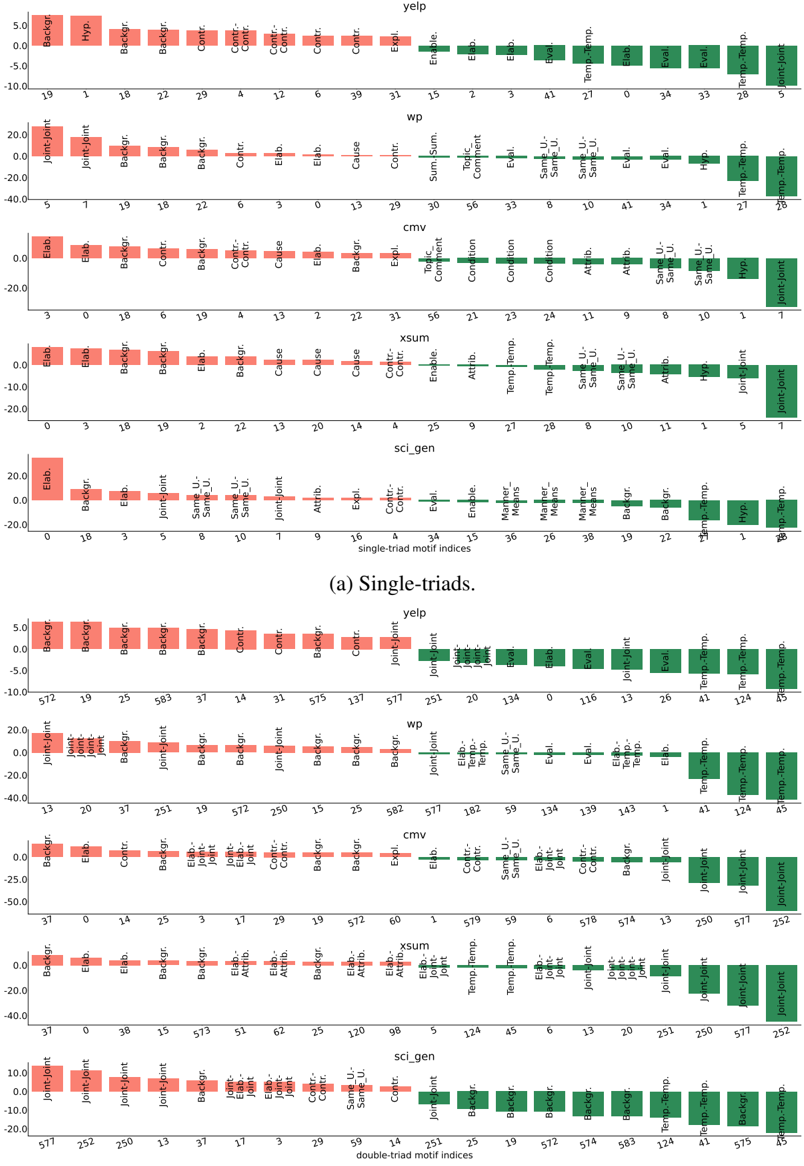
- Motif distributions differ: in TenPageStories, as generation length increases, motifs indexed 0 (Elaboration) and 28 (Temporal) become more prevalent in machine-generated texts, while motifs 7 (Joint) and 5 (Joint) appear more in human-authored texts. Across domains, machine-generated texts tend to feature more Background relations; human-written texts show more Temporal in YELP/WP and more Joint in CMV/XSUM.
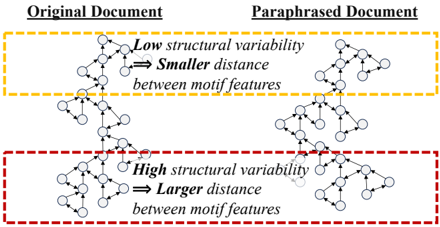
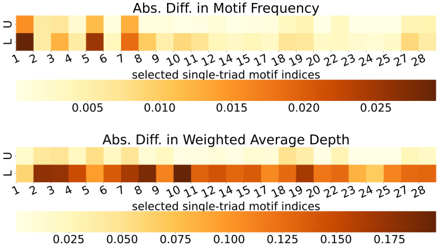
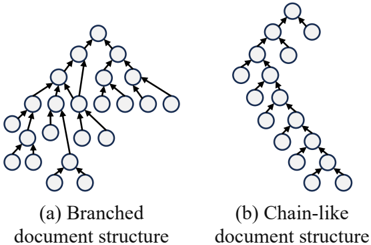
- Structural variability and formality: after paraphrasing, lower segments of discourse graphs show greater absolute distance than upper segments, supporting the hypothesis that higher-level structure is preserved. Human-written texts show weak-to-moderate correlation between formality scores and hyperedge frequency (Pearson R=0.39), while machine-generated texts show no correlation (0.08).
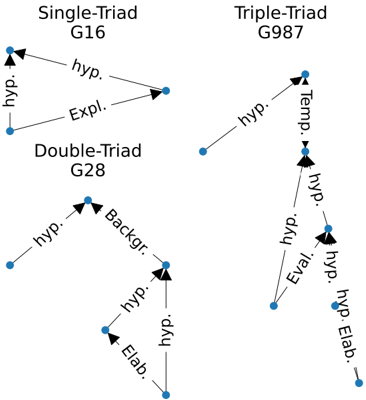
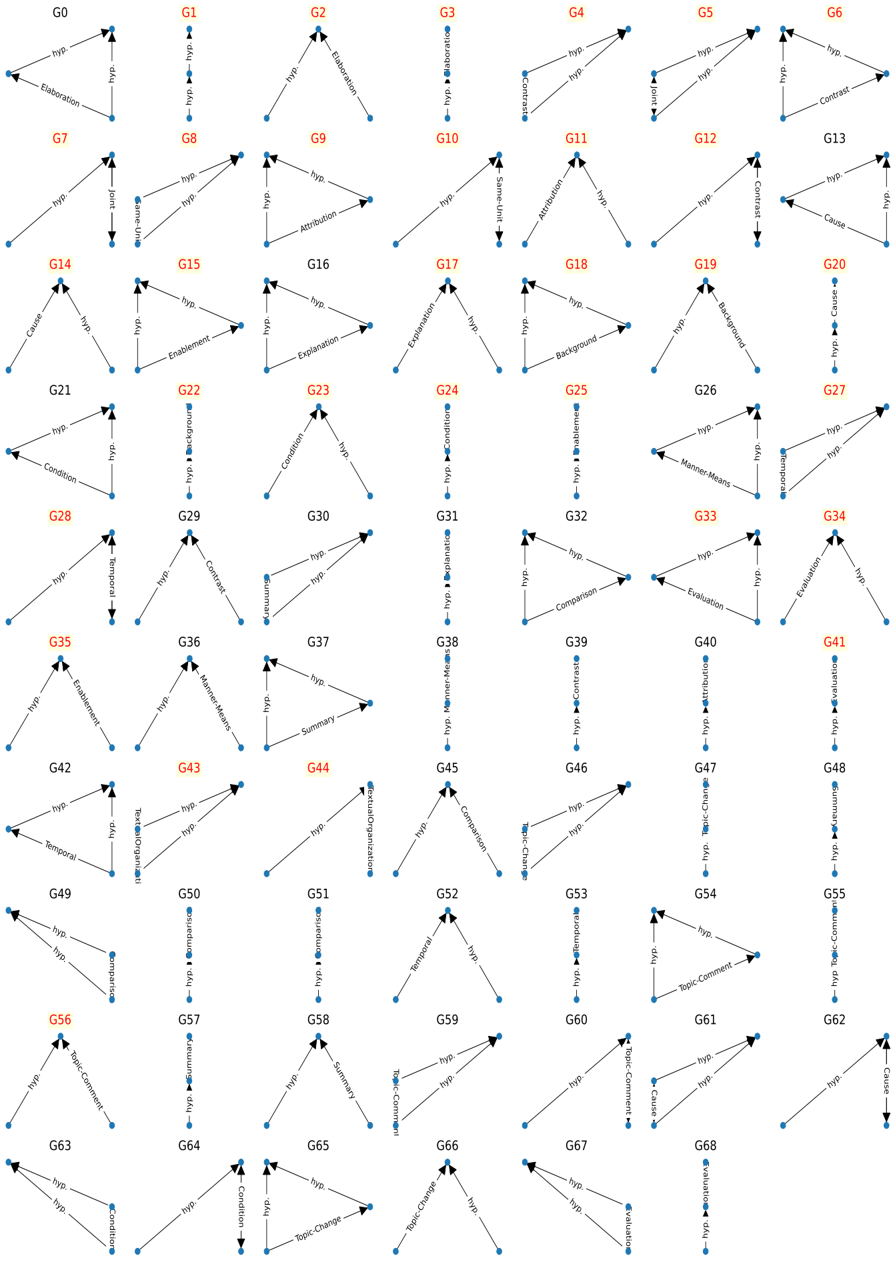
- Motif inventory: 69 single-triads, 592 double-triads, 2,394 triple-triads; 207 motifs selected by MF-IDF >1 SD (31 single, 96 double, 80 triple).
Methods
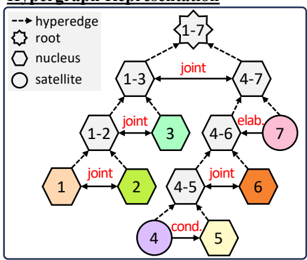
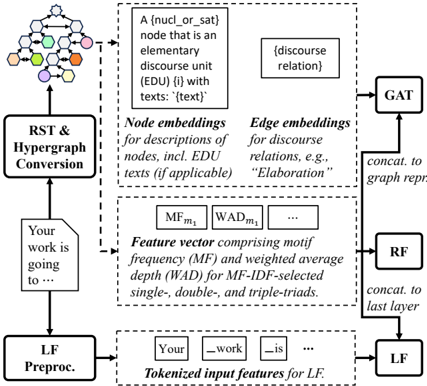
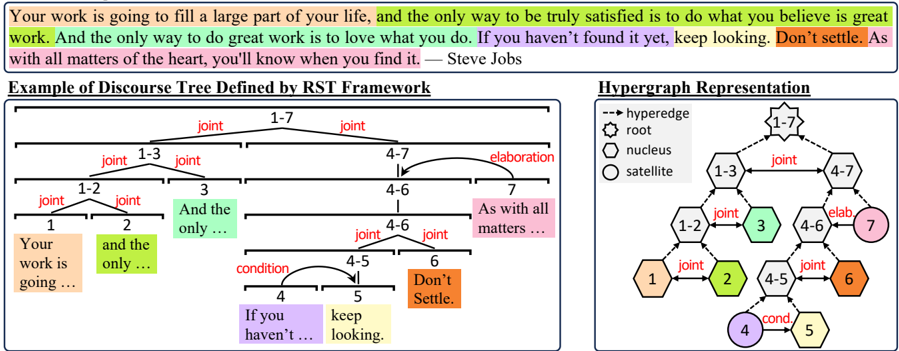
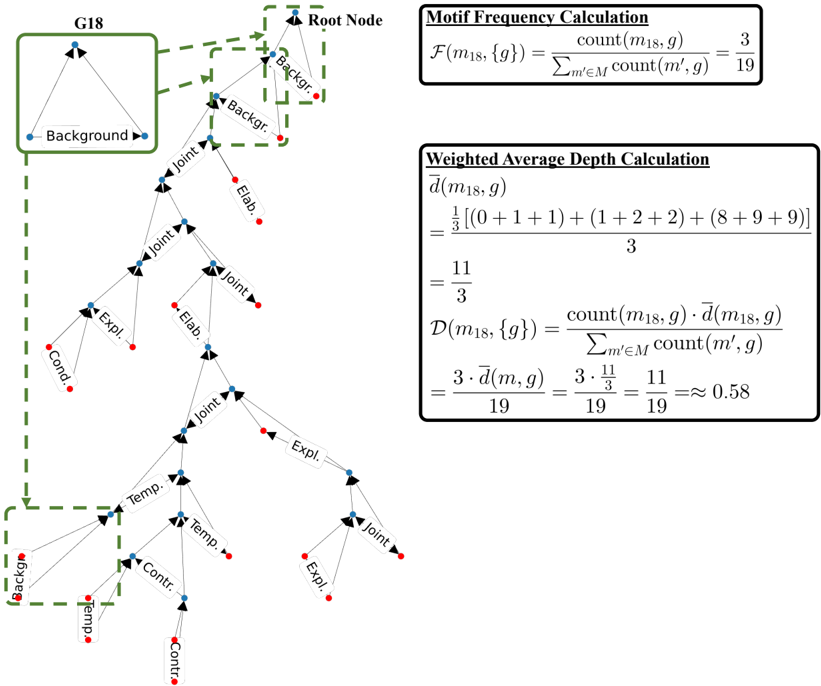
- Documents parsed with RST using the DMRST parser; RST trees converted to recursive hypergraphs and isomorphic Levi graphs; motifs generated as unions of triads (single-, double-, triple-triads); features include motif frequency, weighted average depth, and MF-IDF.
- Evaluated with Random Forest, Graph Attention Network, and Longformer on HC3-English, DeepfakeTextDetect (five domains: YELP, WP, CMV, XSUM, SCI_GEN), and new TenPageStories dataset (20 fictional stories up to 8K tokens, generated with GPT-4-1106-preview in unconstrained, fill-in-the-gap, and constrained fill-in-the-gap settings; 552 request calls, $55).
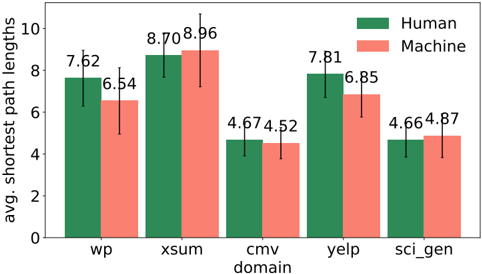
- Binary classification F1; analyses of OOD and paraphrased OOD samples, structural variation after paraphrasing, formality score vs hyperedge frequency, and average shortest path length.
Limitations
- Paper states: findings rely on parsed discourse trees from an existing parser; parsed results may be suboptimal due to difficulty of hierarchical discourse parsing, limited training data, and discourse relation ambiguities; alternative frameworks like SDRT not used. Motif analyses limited to single-, double-, and triple-triads; longer patterns may exist but expanding is not feasible. Formality scorer was trained on short sentence-level inputs and may not suit longer documents. More comprehensive analysis of TenPageStories is needed.
- Evident from text: unconstrained TenPageStories generations were not used in experiments due to limited input length of the discourse parser; TenPageStories is small (20 stories); detection F1 scores on TenPageStories are low due to many false negatives; DeepfakeTextDetect results cover only five of ten domains; ~56% of original dataset used to mitigate imbalance; single classifier across ten domains and no decision boundary adjustment.
Model-written summary. Check it against the paper before relying on it.
Integrity signals
Registry
Cites
Statistics
Figures
Verification
Claims the paper makes
0 Valid · 2 Not valid · 10 Not checked · 54 Own results and interpretations
A result the paper reports from its own data — it cites no other source for it, so there is none to check. The quote shows it is in the paper.
In the paper
“Notably, incorporating hierarchical discourse features enhances binary classifiers' overall performance in distinguishing between human-written and machine-generated texts, even on out-of-distribution and paraphrased samples.”
- Also stated in: § More prevalent in machine-generated reviews More prevalent in human-written reviews · hedged
“To the best of our knowledge, we are the first to demonstrate that integrating hierarchical discourse-level features into the authorship detection task results in enhanced and more robust performance.”
- Also stated in: § 5.1 Human vs. Machine Authorship Detection · boosted
“From Table 3, we can see that incorporating motif information consistently enhances classification performance across various base encoders, underscoring the effectiveness of discourse motifs as auxiliary information for capturing deeper linguistic structures beyond surface lexicons.”
§ Threads of Subtlety: Detecting Machine-Generated Texts Through Discourse Motifs > Abstract
boostedstates a cause- Asserted: passes — The authors put it forward as true.
- Checkable: passes — It can be checked against evidence.
- Load-bearing: passes — The paper’s conclusions depend on it.
- Based: passes — The paper gives a reason why it holds.
- Also stated in: § More prevalent in machine-generated reviews More prevalent in human-written reviews · hedged
A result the paper reports from its own data — it cites no other source for it, so there is none to check. The quote shows it is in the paper.
In the paper
“This dataset features 20 stories with lengths of up to 8K tokens, providing a more comprehensive perspective on longerform machine-generated content.”
- Also stated in: § TENPAGESTORIES (Ours). · plain
“We generate content up to 8K tokens (≈10 A4 pages) in an iterative manner, continuing from the previously generated texts.”
§ Threads of Subtlety: Detecting Machine-Generated Texts Through Discourse Motifs > More prevalent in machine-generated reviews More prevalent in human-written reviews
plain- Asserted: passes — The authors put it forward as true.
- Checkable: passes — It can be checked against evidence.
- Load-bearing: passes — The paper’s conclusions depend on it.
- Based: passes — The paper gives a reason why it holds.
- Also stated in: § TENPAGESTORIES (Ours). · plain
A result the paper states — it cites no source for it, so there is none to check. The quote shows it is in the paper.
In the paper
“We select the triads to be the basis motifs as we find that when converting a recursive RST tree into a standard graph, it always forms the union of subgraphs with 3 vertices.”
§ Threads of Subtlety: Detecting Machine-Generated Texts Through Discourse Motifs > 3.1 Discourse Motifs as Unions of Triads
plainstates a cause- Asserted: passes — The authors put it forward as true.
- Checkable: passes — It can be checked against evidence.
- Load-bearing: passes — The paper’s conclusions depend on it.
- Based: passes — The paper gives a reason why it holds.
A result the paper reports from its own data — it cites no other source for it, so there is none to check. The quote shows it is in the paper.
In the paper
“Conversely, motifs indexed at 7 (Joint) and 5 (Joint) appear more frequently in texts authored by humans.”
§ Threads of Subtlety: Detecting Machine-Generated Texts Through Discourse Motifs > TENPAGESTORIES.
plainstates an association- Asserted: passes — The authors put it forward as true.
- Checkable: passes — It can be checked against evidence.
- Load-bearing: passes — The paper’s conclusions depend on it.
- Based: passes — The paper gives a reason why it holds.
A result the paper reports from its own data — it cites no other source for it, so there is none to check. The quote shows it is in the paper.
In the paper
“It shows that as the generation length increases, motifs indexed at 0 (Elaboration) and 28 (Temporal) become increasingly prevalent in machine-generated texts.”
§ Threads of Subtlety: Detecting Machine-Generated Texts Through Discourse Motifs > TENPAGESTORIES.
plainstates an association- Asserted: passes — The authors put it forward as true.
- Checkable: passes — It can be checked against evidence.
- Load-bearing: unclear — It is unclear whether the paper’s conclusions depend on it.
- Based: passes — The paper gives a reason why it holds.
36 more claims
Create a free account to see all 66 claims and to verify the 9 references still open.
- It may state two separate claims as one. 6
- Probably not a substantial claim. 21
- The quote only partly states this claim. 1
Self-check
Percentages, sums and reported differences re-computed from the paper’s own numbers.
Each contradiction between two passages listed here was confirmed by an independent check.
Rated minor: it would not touch a result — a value no result rests on, a p-value that stays on the same side of the significance level, or a conflict that is clerical, resolved elsewhere in the paper, or outside its own findings.
In the paper
§ Threads of Subtlety: Detecting Machine-Generated Texts Through Discourse Motifs > TENPAGESTORIES.
“As expected the detection model performs better with longer generated texts (i.e., 1, 3, and 5 paragraphs).”
§ Threads of Subtlety: Detecting Machine-Generated Texts Through Discourse Motifs > G68
“Figure: FIGConstrained FIG 1 3 5 1 3 5 LF 0.30 0.40 0.45 0.59 0.50 0.55 LF+Motifs 0.43 0.65 0.71 0.71 0.69 0.70Table 4:”
Citations
Cites
Breiman, L. (2001) · Machine Learning · doi:10.1023/a:1010933404324 · Cited by 133,538
Sentence-BERT: Sentence Embeddings using Siamese BERT-Networks
Reimers, N., & Gurevych, I. (2019) · Proceedings of the 2019 Conference on Empirical Methods in Natural Language Processing and the 9th International Joint Conference on Natural Language Processing (EMNLP-IJCNLP) · doi:10.18653/v1/d19-1410 · Cited by 12,778
Network motifs: simple building blocks of complex networks.
Milo, R., Shen-Orr, S., Itzkovitz, S., Kashtan, N., Chklovskii, D., & Alon, U. (2002) · Science · doi:10.1126/science.298.5594.824 · Cited by 7,368
A STATISTICAL INTERPRETATION OF TERM SPECIFICITY AND ITS APPLICATION IN RETRIEVAL
SPARCK JONES, K. (1972) · Journal of Documentation · doi:10.1108/eb026526 · Cited by 4,505
Training Language Models to Follow Instructions with Human Feedback
Ouyang, L., Wu, J., Jiang, X., Almeida, D., Wainwright, C., Mishkin, P., Zhang, C., Agarwal, S., Slama, K., Ray, A., et al. (2022) · Advances in Neural Information Processing Systems 35 · doi:10.52202/068431-2011 · Cited by 3,117
Longformer: The Long-Document Transformer
Beltagy, I., Peters, M. E., & Cohan, A. (2020) · arXiv · doi:10.48550/arxiv.2004.05150 · Cited by 2,281
Weisfeiler-Lehman Graph Kernels
Shervashidze, N., Schweitzer, P., van Leeuwen, E. J., Mehlhorn, K., & Borgwardt, K. M. (2010) · Max Planck Digital Library · Cited by 1,644
GNNExplainer: Generating Explanations for Graph Neural Networks.
Ying, R., Bourgeois, D., You, J., Žitnik, M., & Leskovec, J. (2019) · PubMed · Cited by 1,499
Can AI-Generated Text be Reliably Detected?
Sadasivan, V. S., Kumar, A., Balasubramanian, S., Wang, W., & Feizi, S. (2023) · arXiv · doi:10.48550/arxiv.2303.11156 · Cited by 810
Defending Against Neural Fake News
Zellers, R., Holtzman, A., Rashkin, H., Bisk, Y., Farhadi, A., Roesner, F., & Choi, Y. (2019) · arXiv · doi:10.48550/arxiv.1905.12616 · Cited by 569
Crosslingual Generalization through Multitask Finetuning
Muennighoff, N., Wang, T., Sutawika, L., Roberts, A., Biderman, S., Le Scao, T., Bari, M. S., Shen, S., Yong, Z. X., Schoelkopf, H., et al. (2023) · Proceedings of the 61st Annual Meeting of the Association for Computational Linguistics (Volume 1: Long Papers) · doi:10.18653/v1/2023.acl-long.891 · Cited by 361
PEGASUS: Pre-training with Extracted Gap-sentences for Abstractive Summarization
Zhang, J., Zhao, Y., Saleh, M., & Liu, P. X. (2020) · International Conference on Machine Learning · Cited by 325
Rao, S., & Tetreault, J. (2018) · Proceedings of the 2018 Conference of the North American Chapter of the Association for Computational Linguistics: Human Language Technologies, Volume 1 (Long Papers) · doi:10.18653/v1/n18-1012 · Cited by 321
How Close is ChatGPT to Human Experts? Comparison Corpus, Evaluation, and Detection
Guo, B., Zhang, X., Wang, Z., Jiang, M., Nie, J., Ding, Y., Yue, J., & Wu, Y. (2023) · arXiv · doi:10.48550/arxiv.2301.07597 · Cited by 318
OpenAssistant Conversations - Democratizing Large Language Model Alignment
Köpf, A., Kilcher, Y., von Rütte, D., Anagnostidis, S., Tam, Z.-R., Stevens, K., Barhoum, A., Duc, N. M., Stanley, O., Nagyfi, R., et al. (2023) · arXiv · doi:10.48550/arxiv.2304.07327 · Cited by 218
Dalalah, D., & Dalalah, O. M. A. (2023) · The International Journal of Management Education · doi:10.1016/j.ijme.2023.100822 · Cited by 218
A Survey on LLM-Generated Text Detection: Necessity, Methods, and Future Directions
Wu, J., Yang, S., Zhan, R., Yuan, Y., Wong, D. F., & Chao, L. S. (2023) · arXiv · doi:10.48550/arxiv.2310.14724 · Cited by 212
A Survey on LLM-Generated Text Detection: Necessity, Methods, and Future Directions
Wu, J., Yang, S., Zhan, R., Yuan, Y., Chao, L. S., & Wong, D. F. (2025) · Computational Linguistics · doi:10.1162/coli_a_00549 · Cited by 212
Segmented Discourse Representation Theory: Dynamic Semantics With Discourse Structure
Lascarides, A., & Asher, N. M. (2007) · Springer eBooks · doi:10.1007/978-1-4020-5958-2_5 · Cited by 190
ChatGPT has entered the classroom: how LLMs could transform education
Extance, A. (2023) · Nature · doi:10.1038/d41586-023-03507-3 · Cited by 175
Koike, R., Kaneko, M., & Okazaki, N. (2023) · AAAI Conference on Artificial Intelligence · doi:10.48550/arxiv.2307.11729 · Cited by 175
Paraphrasing evades detectors of AI-generated text, but retrieval is an effective defense
Krishna, K., Song, Y., Karpinska, M., Wieting, J., & Iyyer, M. (2023) · Advances in Neural Information Processing Systems 36 · doi:10.52202/075280-1195 · Cited by 150
GraphFramEx: Towards Systematic Evaluation of Explainability Methods for Graph Neural Networks
Amara, K., Ying, R., Zhang, Z., Han, Z., Shan, Y., Brandes, U., Schemm, S., & Zhang, C. (2022) · Repository for Publications and Research Data (ETH Zurich) · doi:10.3929/ethz-b-000637559 · Cited by 144
Dou, Y., Forbes, M., Koncel-Kedziorski, R., Smith, N., & Choi, Y. (2022) · Proceedings of the 60th Annual Meeting of the Association for Computational Linguistics (Volume 1: Long Papers) · doi:10.18653/v1/2022.acl-long.501 · Cited by 118
Liu, X., Zhang, Z., Wang, Y., Pu, H., Lan, Y., & Shen, C. (2023) · Conference on Empirical Methods in Natural Language Processing (EMNLP) · doi:10.18653/v1/2023.emnlp-main.1005 · Cited by 114
Liu, Z. Q., Yao, Z., Li, F., & Luo, B. (2024) · ACM SIGSAC Conference on Computer and Communications Security (CCS) · doi:10.1145/3658644.3670392 · Cited by 110
A machine learning approach to the automatic evaluation of machine translation
Corston-Oliver, S., Gamon, M., & Brockett, C. (2001) · Proceedings of the 39th Annual Meeting on Association for Computational Linguistics - ACL '01 · doi:10.3115/1073012.1073032 · Cited by 85
Red Teaming Language Model Detectors with Language Models
Shi, Z., Wang, Y., Yin, F., Chen, X., Chang, K.-W., & Hsieh, C.-J. (2023) · Transactions of the Association for Computational Linguistics · doi:10.1162/tacl_a_00639 · Cited by 83
MAGE: Machine-generated Text Detection in the Wild
Li, Y., Li, Q., Cui, L., Bi, W., Wang, Z., Wang, L., Yang, L., Shi, S., & Zhang, Y. (2024) · Proceedings of the 62nd Annual Meeting of the Association for Computational Linguistics (Volume 1: Long Papers) · doi:10.18653/v1/2024.acl-long.3 · Cited by 79
DetectLLM: Leveraging Log Rank Information for Zero-Shot Detection of Machine-Generated Text
Su, J., Zhuo, T., Wang, D., & Nakov, P. (2023) · Findings of the Association for Computational Linguistics: EMNLP 2023 · doi:10.18653/v1/2023.findings-emnlp.827 · Cited by 75
Neural Message Passing for Multi-Relational Ordered and Recursive Hypergraphs
Yadati, N. (2020) · neural information processing systems · Cited by 73
DMRST: A Joint Framework for Document-Level Multilingual RST Discourse Segmentation and Parsing
Liu, Z., Shi, K., & Chen, N. F. (2021) · Workshop on Computational Approaches to Discourse (CODI) · doi:10.18653/v1/2021.codi-main.15 · Cited by 66
Fighting Fire with Fire: Can ChatGPT Detect AI-generated Text?
Bhattacharjee, A., & Liu, H. (2024) · ACM SIGKDD Explorations Newsletter · doi:10.1145/3655103.3655106 · Cited by 65
The Impact of Generative AI and ChatGPT on Creating Digital Advertising Campaigns
Gołąb-Andrzejak, E. (2023) · Cybernetics & Systems · doi:10.1080/01969722.2023.2296253 · Cited by 60
Liu, X.-M., Zhang, Z.-H., Wang, Y., Pu, H., Lan, Y., & Shen, C. (2022) · arXiv.org · doi:10.48550/arxiv.2212.10341 · Cited by 58
Ghostbuster: Detecting Text Ghostwritten by Large Language Models
Verma, V., Fleisig, E., Tomlin, N., & Klein, D. (2024) · Proceedings of the 2024 Conference of the North American Chapter of the Association for Computational Linguistics: Human Language Technologies (Volume 1: Long Papers) · doi:10.18653/v1/2024.naacl-long.95 · Cited by 56
Dugan, L., Ippolito, D., Kirubarajan, A., Shi, S., & Callison-Burch, C. (2023) · Proceedings of the AAAI Conference on Artificial Intelligence · doi:10.1609/aaai.v37i11.26501 · Cited by 54
ConDA: Contrastive Domain Adaptation for AI-generated Text Detection
Bhattacharjee, A., Kumarage, T., Moraffah, R., & Liu, H. (2023) · Proceedings of the 13th International Joint Conference on Natural Language Processing and the 3rd Conference of the Asia-Pacific Chapter of the Association for Computational Linguistics (Volume 1: Long Papers) · doi:10.18653/v1/2023.ijcnlp-main.40 · Cited by 43
MGTBench: Benchmarking Machine-Generated Text Detection
He, X., Shen, X., Chen, Z., Backes, M., & Zhang, Y. (2024) · Proceedings of the 2024 on ACM SIGSAC Conference on Computer and Communications Security · doi:10.1145/3658644.3670344 · Cited by 43
Distillation-Resistant Watermarking for Model Protection in NLP
Zhao, X., Li, L., & Wang, Y. (2022) · Findings of the Association for Computational Linguistics: EMNLP (Findings of EMNLP) · doi:10.18653/v1/2022.findings-emnlp.370 · Cited by 43
Don’t Lose the Message While Paraphrasing: A Study on Content Preserving Style Transfer
Babakov, N., Dale, D., Gusev, I., Krotova, I., & Panchenko, A. (2023) · Lecture notes in computer science · doi:10.1007/978-3-031-35320-8_4 · Cited by 41
Multiplex network motifs as building blocks of corporate networks
Takes, F. W., Kosters, W. A., Witte, B., & Heemskerk, E. M. (2018) · Applied Network Science · doi:10.1007/s41109-018-0094-z · Cited by 38
Vasilatos, C., Alam, M., Rahwan, T., Zaki, Y., & Maniatakos, M. (2023) · arXiv · doi:10.48550/arxiv.2305.18226 · Cited by 34
ArguGPT: evaluating, understanding and identifying argumentative essays generated by GPT models
Liu, Y., Zhang, Z., Zhang, W., Yue, S., Zhao, X., Cheng, X., Zhang, Y., & Hu, H. (2023) · arXiv · doi:10.48550/arxiv.2304.07666 · Cited by 32
Red Teaming Language Model Detectors with Language Models
Shi, Z., Wang, Y., Yin, F., Chen, X., Chang, K.-W., & Hsieh, C.-J. (2023) · arXiv · doi:10.48550/arxiv.2305.19713 · Cited by 30
Does Human Collaboration Enhance the Accuracy of Identifying LLM-Generated Deepfake Texts?
Uchendu, A., Lee, J., Shen, H., Le, T., Huang, T.-H. '., & Lee, D. (2023) · Proceedings of the AAAI Conference on Human Computation and Crowdsourcing · doi:10.1609/hcomp.v11i1.27557 · Cited by 30
Crosslingual Generalization through Multitask Finetuning
Muennighoff, N., Wang, T., Sutawika, L., Roberts, A., Biderman, S., Scao, T. L., Bari, M. S., Shen, S., Yong, Z.-X., Schoelkopf, H., et al. (2022) · arXiv · doi:10.48550/arxiv.2211.01786 · Cited by 29
MGTBench: Benchmarking Machine-Generated Text Detection
He, X., Shen, X., Chen, Z., Michael Backes, A., & Zhang, Y. (2023) · arXiv (Cornell University) · doi:10.48550/arxiv.2303.14822 · Cited by 29
Computer-Generated Text Detection Using Machine Learning: A Systematic Review
Beresneva, D. (2016) · Lecture Notes in Computer Science · doi:10.1007/978-3-319-41754-7_43 · Cited by 27
GraphFramEx: Towards Systematic Evaluation of Explainability Methods for Graph Neural NetworksPreprint
Amara, K., Ying, R., Zhang, Z., et al. (2022) · arXiv (Cornell University) · doi:10.48550/arxiv.2206.09677 · Cited by 25
Is ChatGPT Involved in Texts? Measure the Polish Ratio to Detect ChatGPT-Generated Text
Yang, L., Jiang, F., & Li, H. (2023) · arXiv · doi:10.48550/arxiv.2307.11380 · Cited by 16
Ghostbuster: Detecting Text Ghostwritten by Large Language Models
Verma, V., Fleisig, E., Tomlin, N., & Klein, D. (2023) · arXiv · doi:10.48550/arxiv.2305.15047 · Cited by 16
Liu, Z., Yao, Z., Li, F., & Luo, B. (2023) · arXiv · doi:10.48550/arxiv.2306.05524 · Cited by 16
Is ChatGPT Involved in Texts? Measure the Polish Ratio to Detect ChatGPT-Generated Text
Yang, L., Jiang, F., & Li, H. (2024) · APSIPA Transactions on Signal and Information Processing · doi:10.1561/116.00000250 · Cited by 16
Chakraborty, M., Tonmoy, S. M. T. I., Zaman, S. M. M., Gautam, S., Kumar, T., Sharma, K., Barman, N., Gupta, C., Jain, V., Chadha, A., et al. (2023) · Proceedings of the 2023 Conference on Empirical Methods in Natural Language Processing · doi:10.18653/v1/2023.emnlp-main.136 · Cited by 13
DPIC: Decoupling Prompt and Intrinsic Characteristics for LLM Generated Text DetectionPreprint
Yu, X., Qi, Y., Chen, K., et al. (2023) · arXiv (Cornell University) · doi:10.48550/arxiv.2305.12519 · Cited by 12
MAGE: Machine-generated Text Detection in the Wild
Li, Y., Li, Q., Cui, L., Bi, W., Wang, Z., Wang, L., Yang, L., Shi, S., & Zhang, Y. (2023) · arXiv · doi:10.48550/arxiv.2305.13242 · Cited by 10
Towards a Robust Detection of Language Model-Generated Text: Is ChatGPT that easy to detect?
Antoun, W., Mouilleron, V., Sagot, B., & Seddah, D. (2023) · arXiv · doi:10.48550/arxiv.2306.05871 · Cited by 9
Predicting Discourse Trees from Transformer-based Neural Summarizers
Xiao, W., Huber, P., & Carenini, G. (2021) · Proceedings of the 2021 Conference of the North American Chapter of the Association for Computational Linguistics: Human Language Technologies · doi:10.18653/v1/2021.naacl-main.326 · Cited by 6
ConDA: Contrastive Domain Adaptation for AI-generated Text Detection
Bhattacharjee, A., Kumarage, T., Moraffah, R., & Liu, H. (2023) · arXiv · doi:10.48550/arxiv.2309.03992 · Cited by 3
Towards Understanding Large-Scale Discourse Structures in Pre-Trained and Fine-Tuned Language Models
Huber, P., & Carenini, G. (2022) · Proceedings of the 2022 Conference of the North American Chapter of the Association for Computational Linguistics: Human Language Technologies · doi:10.18653/v1/2022.naacl-main.170 · Cited by 3
Ubergraphs: A Definition of a Recursive Hypergraph Structure
Joslyn, C., & Nowak, K. (2017) · arXiv · doi:10.48550/arxiv.1704.05547
Fighting Fire with Fire: Can ChatGPT Detect AI-generated Text?
Bhattacharjee, A., & Liu, H. (2023) · arXiv · doi:10.48550/arxiv.2308.01284
Does Human Collaboration Enhance the Accuracy of Identifying LLM-Generated Deepfake Texts?
Uchendu, A., Lee, J., Shen, H., et al. (2023) · arXiv · doi:10.48550/arxiv.2304.01002
Research works printed but not linked: 3
- John Kirchenbauer, Jonas Geiping, Yuxin Wen, Jonathan Katz, Ian Miers, and Tom Goldstein. 2023. A watermark for large language models. In Proceed- ings of the 40th International Conference on Machine Learning, volume 202 of Proceedings of Machine Learning Research, pages 17061-17084.
- PMLR.
- Eleni Miltsakaki, Rashmi Prasad, Aravind Joshi, and Bonnie Webber. 2004. The Penn Discourse Tree- bank. In Proceedings of the Fourth International Conference on Language Resources and Evaluation (LREC'04), Lisbon, Portugal. European Language Resources Association (ELRA).
Cited by
A Survey on LLM-Generated Text Detection: Necessity, Methods, and Future Directions
Wu, J., Yang, S., Zhan, R., Yuan, Y., Chao, L. S., & Wong, D. F. (2025) · Computational Linguistics · doi:10.1162/coli_a_00549 · Cited by 212
A Survey on LLM-Generated Text Detection: Necessity, Methods, and Future Directions
Wu, J., Yang, S., Zhan, R., Yuan, Y., Wong, D. F., & Chao, L. S. (2023) · arXiv · doi:10.48550/arxiv.2310.14724 · Cited by 212
Linguistic and Embedding-Based Profiling of Texts Generated by Humans and Large Language Models
Zanotto, S. E., & Aroyehun, S. (2025) · Conference on Empirical Methods in Natural Language Processing (EMNLP) · doi:10.18653/v1/2025.emnlp-main.1163 · Cited by 37
Cava, L. L., Costa, D., & Tagarelli, A. (2024) · Frontiers in artificial intelligence and applications · doi:10.3233/faia240862 · Cited by 19
Discourse-Driven Evaluation: Unveiling Factual Inconsistency in Long Document Summarization
Zhong, Y., & Litman, D. J. (2025) · Conference of the North American Chapter of the Association for Computational Linguistics: Human Language Technologies (NAACL-HLT) · doi:10.18653/v1/2025.naacl-long.103 · Cited by 16
Metadata
- Authors
- Kim, Z. M., Lee, K., Zhu, P., Raheja, V., & Kang, D.
- Affiliations
- Kumoh National Institute of Technology (KR)
- Venue
- Proceedings of the 62nd Annual Meeting of the Association for Computational Linguistics (Volume 1: Long Papers)
- Published
- 2024
- Pages
- 5449-5474
- ISSN
- 0736-587X (ISSN-L)
- OpenAlex
- W4402671728
- Cited by
- 31
- References
- 48
- Citations by year
- 2026: 17 · 2025: 13 · 2024: 1
- FWCI
- 2.26
- Type
- conference paper
- Language
- en
- Open access
- hybrid
- doi.org
- Licence
- cc-by
- Locations
- Proceedings of the conference - Association for Computational Linguistics. Meeting (publishedVersion, cc-by)
- arXiv (Cornell University) (submittedVersion, cc-by-nc-nd)
- Funders
- National Research Foundation
- National Research Foundation of Korea
- Korea Advanced Institute of Science and Technology
- Ministry of Science and ICT, South Korea (RS-2024-00345567)
- Topics
- Physical Sciences › Computer Science › Artificial Intelligence › Authorship Attribution and Profiling
- Physical Sciences › Computer Science › Artificial Intelligence › Natural Language Processing Techniques
- Physical Sciences › Computer Science › Artificial Intelligence › Topic Modeling
- Keywords
- AI-generated text detection, large language models, human-written vs machine-generated text, discourse structure, binary classification, out-of-distribution generalization
About these checks
Registry, retraction, Cites and statistics results are computed, not judged, with one exception: a printed reference that no index lists is read once by a model before it counts as a citation error. Claims are extracted by a model and kept only when their quote appears verbatim in the text; each cited source is then checked, with a model’s help, for whether it says what the claim relies on. Those verdicts can be wrong — read the claim’s quote and the cited source before relying on one.
A language model drew the claims from the paper on 2026-11-24, under version 3 of the claim definition (model deepseek-v4.1-flash, prompt extract-v3).
A second model labelled each claim on 2026-11-24 (model jev-1.13-20260917, definition revision gold-guideline-v0.2).
Statistics and arithmetic are recomputed, not judged.
Confidence bands are shown only for fields calibrated on our annotated test set. None is calibrated yet, so no band is shown.
What counts as a claim ›How we measure confidence ›How we check this ›
Are you an author, or do you see a problem with this page? Request a review
Data sources
Bibliographic data: Semantic Scholar, OpenAlex, Crossref.
Contains information from the Semantic Scholar Academic Graph Datasets, made available under the ODC Attribution License (ODC-BY 1.0).
Semantic Scholar’s data is described in: Kinney, R., et al. (2023). The Semantic Scholar Open Data Platform. arXiv:2301.10140.
