

The DOI matches its Crossref record; 54 of the 57 references it cites were found in a registry or an index.
Dissecting Contextual Word Embeddings: Architecture and Representation
Open accessAbstract
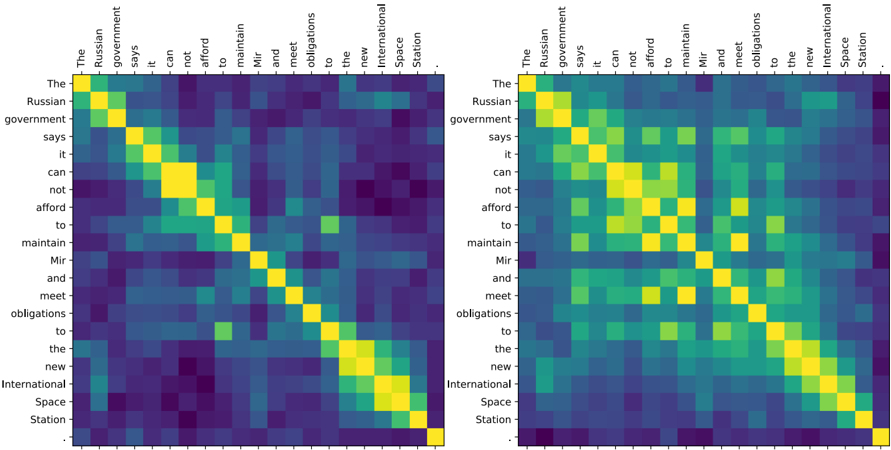
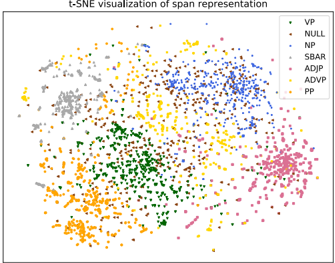
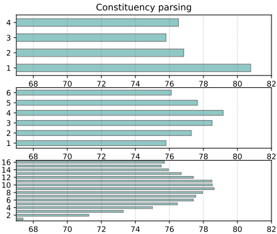
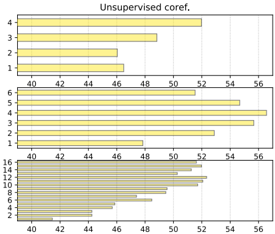
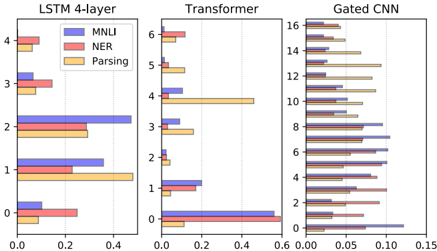
Contextual word representations derived from pre-trained bidirectional language models (biLMs) have recently been shown to provide significant improvements to the state of the art for a wide range of NLP tasks.However, many questions remain as to how and why these models are so effective.In this paper, we present a detailed empirical study of how the choice of neural architecture (e.g.LSTM, CNN, or self attention) influences both end task accuracy and qualitative properties of the representations that are learned.We show there is a tradeoff between speed and accuracy, but all architectures learn high quality contextual representations that outperform word embeddings for four challenging NLP tasks.Additionally, all architectures learn representations that vary with network depth, from exclusively morphological based at the word embedding layer through local syntax based in the lower contextual layers to longer range semantics such coreference at the upper layers.Together, these results suggest that unsupervised biLMs, independent of architecture, are learning much more about the structure of language than previously appreciated.
Overview
The claims and statistics of this paper haven’t been checked yet.
Run the check — free, no account needed. It reads the open-access text and checks the sources it cites.
Integrity signals
Registry
Cites
Statistics
Figures
Verification
Claims the paper makes
The claims and statistics of this paper haven’t been checked yet.
Run the check — free, no account needed. It reads the open-access text and checks the sources it cites.
Claims other papers make about this one
Each is checked against this paper’s own text: does it say what the citing paper says it does?
The source backs part of the claim, not all of it — or backs it for a different population, condition or comparison.
In the citing paper
“Following Peters et al. (2018b); Liu et al. (2019a), we observe that the final 2-3 BERT layers provide embeddings that excel at predictive language modeling; as such, Figure 4 uses embeddings from layer 9 of S2ORC-SCIBERT.”
From S2ORC: The Semantic Scholar Open Research Corpus (2020) · cites this paper as Peters et al. (2018b)
Experimental — accuracy not yet measuredThe cited source says what the claim attributes to it.
In the citing paper
“The study by Peters et al. (2018) suggests that the context vectors of bi-directional language models undergo abrupt changes at syntactic boundaries, allowing them to be utilized for constructing representations of spans or consecutive token sequences.”
From Can "consciousness" be observed from large language model (LLM) internal states? Dissecting LLM representations obtained from Theory of Mind test with Integrated Information Theory and Span Representation analysis (2025) · cites this paper as Peters et al., 2018
Self-check
Percentages, sums and reported differences re-computed from the paper’s own numbers.
The self-check needs the paper’s full text.
Citations
Cites
Deep Residual Learning for Image Recognition
He, K., Zhang, X., Ren, S., & Sun, J. (2016) · 2016 IEEE Conference on Computer Vision and Pattern Recognition (CVPR) · doi:10.1109/cvpr.2016.90 · Cited by 235,474
Vaswani, A., Shazeer, N., Parmar, N., Uszkoreit, J., Jones, L., Gomez, A. N., Kaiser, L., & Polosukhin, I. (2017) · arXiv · doi:10.48550/arxiv.1706.03762 · Cited by 120,404
Glove: Global Vectors for Word Representation
Pennington, J., Socher, R., & Manning, C. (2014) · Proceedings of the 2014 Conference on Empirical Methods in Natural Language Processing (EMNLP) · doi:10.3115/v1/d14-1162 · Cited by 34,071
(2008) · Journal of Machine Learning Research · Cited by 33,051
Efficient Estimation of Word Representations in Vector Space
Mikolov, T., Chen, K., Corrado, G., & Dean, J. (2013) · arXiv · doi:10.48550/arxiv.1301.3781 · Cited by 26,568
Visualizing and understanding convolutional networks
Zeiler, M. D., & Fergus, R. (2014) · Lecture Notes in Computer Science · doi:10.1007/978-3-319-10590-1_53 · Cited by 15,839
Conditional Random Fields: Probabilistic Models for Segmenting and Labeling Sequence Data
Lafferty, J., McCallum, A., & Pereira, F. C. N. (2001) · ScholarlyCommons (University of Pennsylvania) · Cited by 12,935
Deep Contextualized Word Representations
Peters, M., Neumann, M., Iyyer, M., Gardner, M., Clark, C., Lee, K., & Zettlemoyer, L. (2018) · Proceedings of the 2018 Conference of the North American Chapter of the Association for Computational Linguistics: Human Language Technologies, Volume 1 (Long Papers) · doi:10.18653/v1/n18-1202 · Cited by 11,983
Self-citationBuilding a Large Annotated Corpus of English: The Penn Treebank
Marcus, M. (1993) · doi:10.21236/ada273556 · Cited by 7,405
ADADELTA: An Adaptive Learning Rate Method
Zeiler, M. D. (2012) · arXiv · doi:10.48550/arxiv.1212.5701 · Cited by 5,322
Research works printed but not linked: 4
- Yonatan Belinkov, Nadir Durrani, Fahim Dalvi, Has- san Sajjad, and James R. Glass. 2017. What do neu- ral machine translation models learn about morphol- ogy? In ACL.
- Guillaume Klein, Yoon Kim, Yuntian Deng, Jean Senellart, and Alexander M. Rush. 2017. Open- NMT: Open-source toolkit for neural machine trans- lation. In ACL.
- Liyuan Liu, Xiang Ren, Jingbo Shang, Jian Peng, and Jiawei Han. 2018. Efficient contextualized represen- tation: Language model pruning for sequence label- ing. In EMNLP.
- Matthew E. Peters, Mark Neumann, Mohit Iyyer, Matt Gardner, Christopher Clark, Kenton Lee, and Luke Zettlemoyer. 2018. Deep contextualized word rep- resentations. In NAACL.
Cited by
Sorted by citations
Items 301–400 of 436
Design Neural Database to identify the problem of the conditions in Dental Clinics
Talib, R., Rashid, S. T., Jumaah, N. S., & Sabah, R. (2022) · Al-Salam Journal for Engineering and Technology · doi:10.55145/ajest.2022.01.02.001 · Cited by 3
EliCoDe at MultiGED2023: fine-tuning XLM-RoBERTa for multilingual grammatical error detection
Colla, D., Delsanto, M., & Nuovo, E. D. (2023) · Linköping electronic conference proceedings · doi:10.3384/ecp197003 · Cited by 3
Probing with Noise: Unpicking the Warp and Weft of Embeddings
Klubička, F., & Kelleher, J. D. (2022) · BlackboxNLP Workshop on Analyzing and Interpreting Neural Networks for NLP (BlackboxNLP) · doi:10.18653/v1/2022.blackboxnlp-1.34 · Cited by 3
Gupta, A., Smith, A., Vandenberg, J. L., Elsayed, R., Fox, K., Minogue, J., Cheuoua, A. H., Oliver, K. M., Ringstaff, C., & Mott, B. (2023) · Lecture notes in computer science · doi:10.1007/978-3-031-47658-7_5 · Cited by 3
Ibiyev, K., & Novák, A. (2021) · Lecture notes in computer science · doi:10.1007/978-3-030-83527-9_26 · Cited by 3
Densely-connected neural networks for aspect term extraction
Chen, C., Wang, H., Zhu, Q., & Liu, J. (2021) · Science China Information Sciences · doi:10.1007/s11432-019-2775-9 · Cited by 3
Sentiment Analysis Using Bi-CARU with Recurrent CNN Models
Chan, K., & Im, S. (2023) · International Conference on Smart and Sustainable Technologies (SpliTech) · doi:10.23919/splitech58164.2023.10193062 · Cited by 3
SPSD: Similarity-preserving self-distillation for video–text retrieval
Wang, J., Yan, H., Yang, Y., & Kou, H. (2023) · International Journal of Multimedia Information Retrieval · doi:10.1007/s13735-023-00298-1 · Cited by 3
Dasgupta, T., Mondal, I., Naskar, A., & Dey, L. (2020) · Studies in computational intelligence · doi:10.1007/978-3-030-53352-6_27 · Cited by 3
Şenel, L. K., & Schütze, H. (2021) · Conference of the European Chapter of the Association for Computational Linguistics · doi:10.18653/v1/2021.eacl-main.42 · Cited by 3
Evaluation Benchmarks and Learning Criteria for Discourse-Aware Sentence RepresentationsPreprint
Chen, M., Chu, Z., & Gimpel, K. (2019) · arXiv (Cornell University) · doi:10.48550/arxiv.1909.00142 · Cited by 5
Incentive Instruction for Event Relation Extraction in Low-Resource
Wu, X.-P., Hu, J., Wan, W., Zhang, B., & Li, C. (2024) · IEEE Access · doi:10.1109/access.2024.3415426 · Cited by 2
Ma, L., Zhou, W., Bai, Y., Fang, M., Xiao, M., & Li, J. (2025) · IEEE Transactions on Computational Biology and Bioinformatics · doi:10.1109/tcbbio.2025.3559571 · Cited by 2
A Multi-Layer Attention Knowledge Tracking Method with Self-Supervised Noise Tolerance
Wang, H., Liu, H., Ge, Y., & Yu, Z. (2025) · Applied Sciences · doi:10.3390/app15158717 · Cited by 2
Radaković, J., Batalović, K., & Novaković, N. (2026) · Journal of Cheminformatics · doi:10.1186/s13321-025-01149-3 · Cited by 2
Computational Text Analysis for Building and Testing Social Theory
Bodell, M. H., Keuschnigg, M., Macanovic, A., & Menshikova, A. (2026) · KZfSS Kölner Zeitschrift für Soziologie und Sozialpsychologie · doi:10.1007/s11577-026-01065-w · Cited by 2
FiNE: Fine-Grained Neuron-Level Model Editing for Reliable and Safe LLMs
Yang, X., Pan, H., Wang, X., Cao, Y., Li, J., & Wang, M. (2026) · IEEE Transactions on Pattern Analysis and Machine Intelligence · doi:10.1109/tpami.2026.3697976 · Cited by 2
Kertész, G., Czere, J. T., Zrubka, Z., Gulàcsi, L., & Péntek, M. (2026) · JMIR Formative Research · doi:10.2196/86647 · Cited by 4
Specializing Word Embeddings (for Parsing) by Information Bottleneck (Extended Abstract)
Li, X. L., & Eisner, J. M. (2020) · International Joint Conference on Artificial Intelligence · doi:10.24963/ijcai.2020/658 · Cited by 2
Nonlinear ISA with Auxiliary Variables for Learning Speech Representations
Setlur, A., Póczos, B., & Black, A. W. (2020) · Interspeech (USB) · doi:10.21437/interspeech.2020-3050 · Cited by 2
Merlo (Ed.), P., Tiedemann (Ed.), J., & Tsarfaty, R. (2021) · Open access LMU (Ludwid Maxmilian's Universitat Munchen) · doi:10.48550/arxiv.2102.03596 · Cited by 5
Representing ELMo embeddings as two-dimensional text online
Kutuzov, A., & Kuzmenko, E. (2021) · Conference of the European Chapter of the Association for Computational Linguistics · doi:10.18653/v1/2021.eacl-demos.18 · Cited by 2
Character-Level Syntax Infusion in Pre-Trained Models for Chinese Semantic Role Labeling
Wang, Y., Lei, Z., & Che, W. (2021) · International Journal of Machine Learning and Cybernetics · doi:10.1007/s13042-021-01397-3 · Cited by 2
Building a Discourse‐Argument Hybrid System for Vietnamese Why‐Question Answering
Nguyen, C. T., & Nguyen, D. T. (2021) · Computational Intelligence and Neuroscience · doi:10.1155/2021/6550871 · Cited by 2
Query-specific subtopic clustering
Kashyapi, S., & Dietz, L. (2022) · ACM/IEEE Joint Conference on Digital Libraries · doi:10.1145/3529372.3530923 · Cited by 2
Soldevilla, I., Flores, N., & Tuesta, S. (2022) · International Conference on Artificial Intelligence and Big Data (ICAIBD) · doi:10.1109/icaibd55127.2022.9820047 · Cited by 2
Sequential Path Signature Networks for Personalised Longitudinal Language Modeling
Tseriotou, T., Tsakalidis, A., Foster, P., Lyons, T., & Liakata, M. (2023) · Findings of the Association for Computational Linguistics: ACL (Findings of ACL) · doi:10.18653/v1/2023.findings-acl.310 · Cited by 2
An Eclectic Approach for Enhancing Language Models Through Rich Embedding Features
Aldana-Bobadilla, E., Sosa‐Sosa, V. J., Molina-Villegas, A., Gazca-Hernandez, K., & Olivas, J. Á. (2024) · IEEE Access · doi:10.1109/access.2024.3422971 · Cited by 2
Espín-Riofrio, C., Ramos-Ramírez, L., Camacho-Villalva, H., Preciado-Maila, D. K., Charco, J. L., & Montejo‐Ráez, A. (2024) · LACCEI International Multi-Conference for Engineering, Education and Technology (LACCEI) · doi:10.18687/laccei2024.1.1.108 · Cited by 2
Snippet generation using textbook corpus - an NLP approach based on BERT
Moses, A., & Kumar, G. B. (2020) · Journal of Physics Conference Series · doi:10.1088/1742-6596/1716/1/012061 · Cited by 2
Exploring terminological relations between multi-word terms in distributional semantic models
Wang, Y., Daille, B., & Hathout, N. (2023) · Terminology International Journal of Theoretical and Applied Issues in Specialized Communication · doi:10.1075/term.21053.wan · Cited by 2
Christodoulou, C. (2023) · International Workshop on Semantic Evaluation (SemEval) · doi:10.18653/v1/2023.semeval-1.81 · Cited by 2
Relevance-based Infilling for Natural Language Counterfactuals
Betti, L., Abrate, C., Bonchi, F., & Kaltenbrunner, A. (2023) · ACM International Conference on Information and Knowledge Management (CIKM) · doi:10.1145/3583780.3615029 · Cited by 2
A Hybrid Model for Community-Oriented Lexical Simplification
Song, J., Shen, Y., Lee, J. S. Y., & Hao, T. (2020) · Lecture notes in computer science · doi:10.1007/978-3-030-60450-9_11 · Cited by 2
Test Harder than You Train: Probing with Extrapolation Splits
Kunz, J., & Kuhlmann, M. (2021) · BlackboxNLP Workshop on Analyzing and Interpreting Neural Networks for NLP (BlackboxNLP) · doi:10.18653/v1/2021.blackboxnlp-1.2 · Cited by 3
Do pretrained transformers infer telicity like humans?
Zhao, Y., Ngui, J. G., Hartley, L. H., & Bethard, S. J. (2021) · Conference on Computational Natural Language Learning · doi:10.18653/v1/2021.conll-1.6 · Cited by 3
PAC-Bayes Analysis of Sentence RepresentationPreprint
Nozawa, K., & Sato, I. (2019) · arXiv (Cornell University) · doi:10.48550/arxiv.1902.04247 · Cited by 3
Mischief: A Simple Black-Box Attack Against Transformer ArchitecturesPreprint
de Wynter, A. (2020) · arXiv (Cornell University) · doi:10.48550/arxiv.2010.08542 · Cited by 2
Boukkouri, H. E. (2021) · theses.fr (ABES) · doi:10.70675/4c63eb46zd8cfz4a5dz80e9z666563e756d8 · Cited by 2
Enhancing use of BERT information in neural machine translation with masking-BERT attention
Chen, X., Wu, L., & Zhang, Y. (2023) · International Conference on Artificial Intelligence, Automation and High Performance Computing (AIAHPC) · doi:10.1117/12.2684653 · Cited by 1
Biomedical Relation Extraction Using LLMs and Knowledge Graphs
Chellagurki, P., Kumaru, S. P. K., Peela, R. R., Yeluri, N., Rojas, C., & Jetcheva, J. G. (2024) · IEEE International Conference on Big Data Computing Service and Applications (BigDataService) · doi:10.1109/bigdataservice62917.2024.00015 · Cited by 2
Learning Dynamic Representations in Large Language Models for Evolving Data Streams
Srivastava, A., Bhatnagar, S., Murty, M. N., & Raman, J. (2024) · Lecture notes in computer science · doi:10.1007/978-3-031-78169-8_16 · Cited by 1
Multilingual speech representation for the Manipuri automatic speech recognition system
Devi, T. C., Thaoroijam, K., & Nongmeikapam, K. (2026) · Language Resources and Evaluation · doi:10.1007/s10579-026-09908-w · Cited by 1
Li, X., Lao, M., Du, C., Feng, Y., Du, X., Bai, L., & Guo, Y. (2026) · Neurocomputing · doi:10.1016/j.neucom.2026.135010 · Cited by 1
Kong, L., & Shin, J. (2026) · Research Methods in Applied Linguistics · doi:10.1016/j.rmal.2026.100350 · Cited by 1
Hila, A. A. (2026) · Philosophy & Technology · doi:10.1007/s13347-026-01168-4 · Cited by 1
One Step Beyond: Keyword Extraction in German Utilising Surprisal from Topic Contexts
Philipp, J. N., Kölbl, M., Kyogoku, Y., Yousef, T., & Richter, M. (2022) · Lecture notes in networks and systems · doi:10.1007/978-3-031-10464-0_53 · Cited by 1
Anderson, M., & Camacho-Collados, J. (2022) · Joint Conference on Lexical and Computational Semantics · doi:10.18653/v1/2022.starsem-1.15 · Cited by 1
Specializing Pre-trained Language Models for Better Relational Reasoning via Network Pruning
Ren, S., & Zhu, K. Q. (2022) · Findings of the Association for Computational Linguistics: NAACL · doi:10.18653/v1/2022.findings-naacl.169 · Cited by 1
UsingWikidata for Enhancing Compositionality in Pre-trained Language Models
Beloucif, M., Bansal, M., Biemann, C., & Universität Hamburg, G. (2023) · International conference Recent advances in natural language processing · doi:10.26615/978-954-452-092-2_019 · Cited by 1
Zhang, Z., Storks, S., Hu, F., Sohn, S., Lee, M., Lee, H., & Chai, J. Y. (2023) · Conference on Empirical Methods in Natural Language Processing (EMNLP) · doi:10.18653/v1/2023.emnlp-main.456 · Cited by 3
Zurlo, G., & Ronchieri, E. (2024) · Lecture notes in computer science · doi:10.1007/978-3-031-51023-6_18 · Cited by 1
Assessing a BERT-based model for analyzing subjectivity and classifying academic articles
Mehmood, A., Shahid, F., Khan, R., Ahmed, S., Ibrahim, M. M., & Zheng, Z. (2024) · Multimedia Tools and Applications · doi:10.1007/s11042-024-19206-8 · Cited by 1
Conflict-RAG: Understanding Evolving Conflicts Using Large Language Models
Wood, J., & Joshi, D. (2024) · IEEE International Conference on Big Data (BigData) · doi:10.1109/bigdata62323.2024.10825676 · Cited by 1
A Review: How Employed Word Embeddings in Paraphrase Detection?
Debnath, B., & Mondal, A. (2025) · International Conference on Electronics, Materials Engineering & Nano-Technology (IEMENTech) · doi:10.1109/iementech65115.2025.10959683 · Cited by 1
Alshamrani, S. (2025) · Electronics · doi:10.3390/electronics14101919 · Cited by 1
Transfer learning meets sales engagement email classification: Evaluation, analysis, and strategies
Liu, Y., Dmitriev, P., Huang, Y., Brooks, A., Li, D., Liang, M., Boshernitzan, Z., Cao, J., & Nguy, B. (2020) · Concurrency and Computation Practice and Experience · doi:10.1002/cpe.5759 · Cited by 1
Exploring Span Representations in Neural Coreference Resolution
Kahardipraja, P., Vyshnevska, O., & Loáiciga, S. (2020) · Workshop on Computational Approaches to Discourse (CODI) · doi:10.18653/v1/2020.codi-1.4 · Cited by 1
Augmentation of Local Government FAQs using Community-based Question-answering Data
Seki, Y., Oguni, M., & Fujita, S. (2020) · International Conference on Information Integration and Web-based Applications & Services (iiWAS) · doi:10.1145/3428757.3429137 · Cited by 1
Dynamic Ensembles in Named Entity Recognition for Historical Arabic Texts
Majadly, M., & Sagi, T. (2021) · Cited by 1
Early Detection of Depression Indication from Social Media Analysis
Syed, M., & Narvekar, M. (2021) · ITM Web of Conferences · doi:10.1051/itmconf/20214003029 · Cited by 1
How can BERT Understand High-level Semantics?
Beloucif, M., & Biemann, C. (2021) · Cited by 1
Building a Vietnamese Dataset for Natural Language Inference Models
Nguyen, C. T., & Nguyen, D. T. (2021) · Communications in computer and information science · doi:10.1007/978-981-16-8062-5_12 · Cited by 1
A Context-Driven Merge-Sort Model for Community-Oriented Lexical Simplification
Li, R., Xie, W., Song, J., Wong, L. P., Wang, F. L., & Hao, T. (2022) · IEEE International Symposium on Product Compliance Engineering - Asia (ISPCE-ASIA) · doi:10.1109/ispce-asia57917.2022.9971098 · Cited by 1
EpiK-Eval: Evaluation for Language Models as Epistemic Models
Prato, G., Huang, J., Parthasarathi, P., Sodhani, S., & Chandar, S. (2023) · Conference on Empirical Methods in Natural Language Processing (EMNLP) · doi:10.18653/v1/2023.emnlp-main.593 · Cited by 3
CompGuessWhat?!: A Multi-task Evaluation Framework for Grounded Language LearningPreprint
Suglia, A., Konstas, I., Vanzo, A., Bastianelli, E., Elliott, D., Frank, S., & Lemon, O. (2020) · arXiv (Cornell University) · doi:10.48550/arxiv.2006.02174 · Cited by 2
Conditional probing: measuring usable information beyond a baselinePreprint
Hewitt, J., Ethayarajh, K., Liang, P., & Manning, C. D. (2021) · arXiv (Cornell University) · doi:10.48550/arxiv.2109.09234 · Cited by 8
Recent Advances in Automated Question Answering In Biomedical DomainPreprint
Baksi, K. D. (2021) · arXiv (Cornell University) · doi:10.48550/arxiv.2111.05937 · Cited by 1
Building generalizable models for discourse phenomena evaluation and machine translation
Jwalapuram, P. (2022) · doi:10.32657/10356/165027 · Cited by 1
Custom Named Construct Recognition in the Business and Management Literature
Bhattacharya, A. (2023) · Carleton University's Institutional Repository (MacOdrum Library, Carleton University) · doi:10.22215/etd/2023-15467 · Cited by 1
Bi-LSTM-Based Model for Classifying Software RequirementsPreprint
Abbas, J., Hu, Z., Kanwal, S., Ahmad, A., Almogren, A., & Altameem, A. (2024) · Preprints.org · doi:10.20944/preprints202410.2129.v1 · Cited by 1
EntEval: A Holistic Evaluation Benchmark for Entity RepresentationsPreprint
Chen, M., Chu, Z., Chen, Y., Stratos, K., & Gimpel, K. (2019) · arXiv (Cornell University) · doi:10.48550/arxiv.1909.00137
Evaluating Pronominal Anaphora in Machine Translation: An Evaluation Measure and a Test SuitePreprint
Jwalapuram, P., Joty, S., Temnikova, I., & Nakov, P. (2019) · arXiv (Cornell University) · doi:10.48550/arxiv.1909.00131 · Cited by 1
Shareable Representations for Search Query UnderstandingPreprint
Kumar, M., Hu, Y., Headden, W. P., Goutam, R., Lin, H., & Yin, B. (2019) · arXiv (Cornell University) · doi:10.48550/arxiv.2001.04345 · Cited by 1
Feasibility of Improving BERT for Linguistic Prediction on Ukrainian Сorpus.
Livinska, H., & Makarevych, O. (2020) · COLINS
On the Hierarchical Information in a Single Contextualised Word Representation (Student Abstract)
Slack, D. L., Hardey, M., & Moubayed, N. A. (2020) · Proceedings of the AAAI Conference on Artificial Intelligence · doi:10.1609/aaai.v34i10.7231
Automating Template Creation for Ranking-Based Dialogue Models
Chen, J., Elfardy, H., Wang, S., Kahn, A., & Kramer, J. (2020) · Workshop on NLP for Conversational AI (NLP4ConvAI) · doi:10.18653/v1/2020.nlp4convai-1.9
Opinion Analysis Corpora Across Languages
Seki, Y. (2020) · The information retrieval series · doi:10.1007/978-981-15-5554-1_6
Deep Learning With Sentiment Inference For Discourse-Oriented Opinion Analysis
Marasović, A. (2020) · heiDOK (Heidelberg University) · doi:10.11588/heidok.00027699
Language Modelling as a Multi-Task Problem
Weber, L., Jumelet, J., Bruni, E., & Hupkes, D. (2021) · Conference of the European Chapter of the Association for Computational Linguistics · doi:10.18653/v1/2021.eacl-main.176 · Cited by 8
Structured pointing networks for natural language understanding
Nguyen, T. T. (2021) · DR-NTU (Nanyang Technological University) · doi:10.32657/10356/152207
Recognizing modern Japanese magazines by combining Deep Learning with language models
Nguyen, N. T., Nguyen, D. M., Le, A. D., & Quan, T. (2021) · International Conference on Knowledge and Systems Engineering/Proceedings · doi:10.1109/kse53942.2021.9648643
Heryawan, L., & Febriansyah, F. (2021) · International Conference on Computer, Control, Informatics and its Applications · doi:10.1145/3489088.3489097
Enhancing use of BERT information in neural machine translationPreprint
Chen, X., & Zhang, Y. (2022) · doi:10.22541/au.166922867.70594067/v1
Enhancing use of BERT information in neural machine translationPreprint
Chen, X., & Zhang, Y. (2022) · doi:10.22541/au.166922867.70594067/v2
Popularity-Based BERT for Product Recommendation
Gajjar, S., & Rahevar, M. L. (2023) · Lecture notes in electrical engineering · doi:10.1007/978-981-19-7346-8_54
Dreßler, D., Schacht, S., & Lanquillon, C. (2023) · Springer eBooks · doi:10.1007/978-3-658-41155-8_5
Assessing Word Importance Using Models Trained for Semantic Tasks
Javorský, D., Bojar, O., & Yvon, F. (2023) · Findings of the Association for Computational Linguistics: ACL (Findings of ACL) · doi:10.18653/v1/2023.findings-acl.563
Zheng, C., Guo, S., & Xia, W. (2023) · Chinese/English Journal of Educational Measurement and Evaluation · doi:10.59863/wnpu9372
An Insight into Neural Machine Translation
Goswami, S., Vadivu, G., Ram, A. S. S., Milios, E., & Jeba Sonia, J. (2023) · International Conference on Recent Trends in Data Science and its Applications · doi:10.13052/rp-9788770040723.010
ELMo Layer Embedding Comparision with Short Text Classification
Jayakody, J., Vidanagama, V. G. T. N., Perera, I., & Herath, H. M. L. K. (2023) · Asian Conference on Innovation in Technology (ASIANCON) · doi:10.1109/asiancon58793.2023.10270646
Metadata
- Authors
- Peters, M., Neumann, M., Zettlemoyer, L., & Yih, W.-T.
- Affiliations
- Allen Institute for Artificial Intelligence (US)
- University of Washington (US)
- Venue
- Proceedings of the 2018 Conference on Empirical Methods in Natural Language Processing
- Published
- 2018
- Pages
- 1499-1509
- OpenAlex
- W2888329843
- Cited by
- 434
- References
- 57
- Citations by year
- 2026: 23 · 2025: 27 · 2024: 37 · 2023: 53 · 2022: 55 · 2021: 75 · 2020: 83 · 2019: 77 · 2018: 4
- FWCI
- 24.08
- Type
- conference paper
- Language
- en
- Open access
- hybrid
- doi.org
- Licence
- cc-by
- Locations
- Conference on Empirical Methods in Natural Language Processing (EMNLP) (publishedVersion, cc-by)
- Topics
- Physical Sciences › Computer Science › Artificial Intelligence › Topic Modeling
- Physical Sciences › Computer Science › Artificial Intelligence › Natural Language Processing Techniques
- Physical Sciences › Computer Science › Artificial Intelligence › Sentiment Analysis and Opinion Mining
- Keywords
- contextual word embeddings, bidirectional language models, LSTM, convolutional neural networks, self-attention, representation learning, network depth, morphological representation, syntactic representation, coreference, word embeddings, speed-accuracy trade-off
About these checks
Registry, retraction, Cites and statistics results are computed, not judged, with one exception: a printed reference that no index lists is read once by a model before it counts as a citation error. Claims are extracted by a model and kept only when their quote appears verbatim in the text; each cited source is then checked, with a model’s help, for whether it says what the claim relies on. Those verdicts can be wrong — read the claim’s quote and the cited source before relying on one.
Statistics and arithmetic are recomputed, not judged.
Confidence bands are shown only for fields calibrated on our annotated test set. None is calibrated yet, so no band is shown.
What counts as a claim ›How we measure confidence ›How we check this ›
Are you an author, or do you see a problem with this page? Request a review
