

Deep Contextualized Word Representations
Open accessThe DOI matches its Crossref record; 71 of the 71 references it cites were found in a registry or an index; 10 of the 21 sources its claims cite were checked for support.
Abstract
Matthew E. Peters, Mark Neumann, Mohit Iyyer, Matt Gardner, Christopher Clark, Kenton Lee, Luke Zettlemoyer. Proceedings of the 2018 Conference of the North American Chapter of the Association for Computational Linguistics: Human Language Technologies, Volume 1 (Long Papers). 2018.
Overview
CoChat Summary
TL;DR
ELMo introduces deep contextualized word representations computed as task-specific linear combinations of internal states from a pretrained two-layer bidirectional LSTM language model. Adding ELMo to existing models improves the state of the art across six NLP benchmarks, with relative error reductions up to 20%.
Key findings
- ELMo improved every considered task: SQuAD F1 81.1→85.8 (4.7 absolute, 24.9% relative), SNLI 88.0→88.7 ± 0.17 (0.7 / 5.8%), SRL 81.4→84.6 (3.2 / 17.2%), Coref 67.2→70.4 (3.2 / 9.8%), NER 90.15→92.22 ± 0.10 (2.06 / 21%), and SST-5 51.4→54.7 ± 0.5 (3.3 / 6.8%).
- Using all biLM layers outperforms using only the top layer: for SQuAD, the last biLM layer improves development F1 by 3.9% over baseline, averaging all layers adds another 0.3%, and learned layer weights add another 0.2%.
- Intrinsic evaluations show layer-specific information: biLM top-layer WSD F1 is 69.0 versus 67.4 for the first layer, while POS tagging accuracy is higher at the first layer (97.3) than the top layer (96.8).
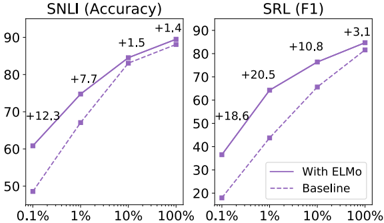
- ELMo increases sample efficiency: the SRL model reaches maximum development F1 after 486 epochs without ELMo, but with ELMo exceeds the baseline maximum at epoch 10, a 98% relative decrease in updates; ELMo with 1% of the training set performs about the same as the baseline with 10%.
Methods
- ELMo is built on a pretrained biLM with two biLSTM layers, 4096 units, 512-dimensional projections, and a residual connection; the context-insensitive type representation uses 2048 character n-gram convolutional filters, two highway layers, and a linear projection to 512 dimensions. The biLM was trained for 10 epochs on the 1B Word Benchmark (approximately 30 million sentences), with average forward/backward perplexity 39.7.
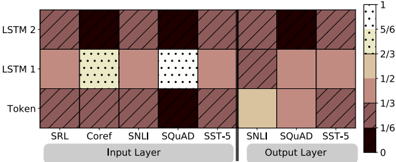
- For downstream tasks, the biLM weights are frozen; all layer representations are recorded, and the task model learns a softmax-normalized linear combination of them. ELMo is concatenated with token embeddings and sometimes also added at the output of the task biRNN, with dropout and sometimes L2 regularization on ELMo weights.
- Evaluation covers six benchmarks—SQuAD, SNLI, SRL, coreference resolution, NER, and SST-5—plus intrinsic WSD on SemCor and POS tagging on PTB.
Limitations
- The paper states no limitations section; no limitations are stated in the paper.
- Evident from the text: evaluation is limited to six benchmark NLP tasks and intrinsic WSD/POS tagging; no other languages or domains are tested.
- Evident from the text: the method depends on a large-scale pretrained biLM and task-specific layer weighting; the paper notes balancing language model perplexity with model size and computational requirements for downstream tasks.
Model-written summary. Check it against the paper before relying on it.
Integrity signals
Registry
Cites
Statistics
Figures
Verification
Claims the paper makes
8 Valid · 3 Not valid · 6 Not checked · 73 Own results and interpretations
Every source the paper cites for this claim was checked and supports it.
In the paper
“For tasks where direct comparisons are possible, ELMo outperforms CoVe (McCann et al., 2017), which computes contextualized representations using a neural machine translation encoder.”
§ Deep contextualized word representations > 1 Introduction
What the sources say
- Supportedcites McCann et al., 2017 matched to “Learned in Translation: Contextualized Word Vectors” (2017) source
The citation identifies CoVe and its method, not the citing authors’ comparison with ELMo. The Abstract (p. 1) describes CoVe as contextualized word vectors produced using an encoder trained for machine translation; Section 4 (p. 4) identifies the encoder’s outputs as context vectors. (LLM, conf=0.90)
plainstates a cause- Asserted: passes — The authors put it forward as true.
- Checkable: passes — It can be checked against evidence.
- Load-bearing: unclear — It is unclear whether the paper’s conclusions depend on it.
- Based: passes — The paper gives a reason why it holds.
- Supported
Every source the paper cites for this claim was checked and supports it.
In the paper
“Unlike most widely used word embeddings (Pennington et al., 2014), ELMo word representations are functions of the entire input sentence, as described in this section.”
§ Deep contextualized word representations > 3 ELMo: Embeddings from Language Models
What the sources say
- Supportedcites Pennington et al., 2014 matched to “Glove: Global Vectors for Word Representation” (2014) source
The citation is offered as an example of the static word embeddings contrasted with ELMo, and our copy of GloVe fits that identification: the Introduction (p. 1) states that semantic vector space models 'represent each word with a real-valued vector' used as features across applications, and the abstract/Introduction describe GloVe as a model that 'trains on global word-word co-occurrence counts' to produce a fixed word vector space (with released trained vectors), i.e. one context-independent vector per word rather than a function of the input sentence. Nothing in our copy makes GloVe representations sentence-dependent, so the contrast the citing sentence draws holds for this source. (LLM, conf=0.85)
plainstates a cause- Asserted: passes — The authors put it forward as true.
- Checkable: passes — It can be checked against evidence.
- Load-bearing: passes — The paper’s conclusions depend on it.
- Based: passes — The paper gives a reason why it holds.
- Supported
The cited sources support only part of this claim — read each source’s verdict below.
In the paper
“However, unlike WSD, accuracies using the first biLM layer are higher than the top layer, consistent with results from deep biL-STMs in multi-task training (Søgaard and Goldberg, 2016;Hashimoto et al., 2017) and MT (Belinkov et al., 2017).”
§ Deep contextualized word representations > POS tagging
What the sources say
- Partly supportedcites Søgaard and Goldberg, 2016 matched to “Deep multi-task learning with low level tasks supervised at lower layers” (2016) sourceExperimental — accuracy not yet measured
Our copy of Søgaard & Goldberg (2016) supports the general direction of the claim: the Experiments and Results section states that 'POS supervision at the lower layer is consistently better than standard MTL' (POS feeding off the inner/1st layer, higher-level task off the outer/3rd), and the Introduction frames the main contribution as 'better performance by having POS task supervision at a lower layer' with supervision of all tasks at the outermost level being 'often suboptimal'. But the accuracy gain the paper reports and quantifies is for the higher-level tasks (CHUNKS F1, CCG supertagging) plus a Rademacher-complexity analysis; no passage in our copy states that POS tagging accuracy itself is higher from the first layer than from the top layer. So the 'lower layer beats top layer' part is supported while the specific attribution to POS-tagging accuracy is not stated in the text we hold. (LLM, conf=0.68)
- Partly supportedcites Hashimoto et al., 2017 matched to “A Joint Many-Task Model: Growing a Neural Network for Multiple NLP Tasks” (2017) sourceExperimental — accuracy not yet measured
Section 2.2 assigns POS tagging to the first bi-LSTM layer, and Section 6 says the model can be used as a POS tagger with only that layer. The paper does not compare POS accuracies from its first and top layers, so it supports the lower-layer connection but not the claimed accuracy advantage. (LLM, conf=0.82)
- Supportedcites Belinkov et al., 2017 matched to “What do Neural Machine Translation Models Learn about Morphology?” (2017) source
The citation is offered for the MT comparison, not as evidence that Belinkov et al. studied biLMs. Section 4.2 reports that first-layer NMT encoder representations outperform second-layer representations on POS tagging, matching the cited comparison. (LLM, conf=0.92)
plainstates an association- Asserted: passes — The authors put it forward as true.
- Checkable: passes — It can be checked against evidence.
- Load-bearing: passes — The paper’s conclusions depend on it.
- Based: passes — The paper gives a reason why it holds.
- Partly supported
The cited sources support only part of this claim — read each source’s verdict below.
In the paper
“The increase of 4.7% with ELMo is also significantly larger then the 1.8% improvement from adding CoVe to a baseline model (McCann et al., 2017).”
§ Deep contextualized word representations > 4 Evaluation
What the sources say
- Partly supportedcites McCann et al., 2017 matched to “Learned in Translation: Contextualized Word Vectors” (2017) sourceExperimental — accuracy not yet measured
The SQuAD results (p. 8, Table 3) support that adding CoVe improved validation performance, but they do not show a 1.8% gain: the listed scores differ by 5.9 points in exact match and 4.3 points in F1. The paper does not compare that gain with ELMo or establish that the difference is significant. (LLM, conf=0.84)
plain- Asserted: passes — The authors put it forward as true.
- Checkable: passes — It can be checked against evidence.
- Load-bearing: passes — The paper’s conclusions depend on it.
- Based: passes — The paper gives a reason why it holds.
- Partly supported
The cited sources support only part of this claim — read each source’s verdict below.
In the paper
“This is competitive with a state-of-the-art WSD-specific supervised model using hand crafted features (Iacobacci et al., 2016) and a task specific biLSTM that is also trained with auxiliary coarse-grained semantic labels and POS tags (Raganato et al., 2017a).”
§ Deep contextualized word representations > 5.3 What information is captured by the biLM's representations?
What the sources say
- Supportedcites Iacobacci et al., 2016 matched to “Embeddings for Word Sense Disambiguation: An Evaluation Study” (2016) source
The Iacobacci et al. citation attaches to the supervised WSD model using hand-crafted features, not to the biLSTM attributed to Raganato et al. Section 4.1 describes the supervised IMS system and its standard POS, context-word, and collocation features; the Conclusions call the standard-feature system state-of-the-art. Page numbers are not supplied in our copy's passages. (LLM, conf=0.92)
- Not matchedcites Raganato et al., 2017a
More than one paper fits this citation.
plain- Asserted: passes — The authors put it forward as true.
- Checkable: passes — It can be checked against evidence.
- Load-bearing: passes — The paper’s conclusions depend on it.
- Based: passes — The paper gives a reason why it holds.
- Supported
51 more claims
Create a free account to see all 90 claims and to verify the 6 references still open.
- It may state two separate claims as one. 23
- Probably not a substantial claim. 13
Claims other papers make about this one
Each is checked against this paper’s own text: does it say what the citing paper says it does?
The source backs part of the claim, not all of it — or backs it for a different population, condition or comparison.
In the citing paper
“In stark contrast, our approach harnesses the potential of Large Language Models (LLMs), particularly their underlying transformer architecture. This modern method enables a more nuanced and contextually aware extraction of meanings at both the word and sentence levels”
From ChatGPT and Deepseek: Can They Predict the Stock Market and Macroeconomy? (2025) · cites this paper as Peters et al., 2018
Experimental — accuracy not yet measuredThe source backs part of the claim, not all of it — or backs it for a different population, condition or comparison.
In the citing paper
“This structure can capture intricate word features, such as synonyms and polysemy, across different linguistic contexts.”
From A Survey of Deep Learning-Based Multimodal Emotion Recognition: Speech, Text, and Face (2023) · cites this paper as [62]
Experimental — accuracy not yet measuredThe source backs part of the claim, not all of it — or backs it for a different population, condition or comparison.
In the citing paper
“we can utilize the technique of fine-tuning pre-trained language models32–35 with family-specific sequences to further improve ProGen’s ability to capture the distribution of local sequence neighborhoods corresponding to the protein family.”
From Large language models generate functional protein sequences across diverse families (2023) · cites this paper as [32]
Experimental — accuracy not yet measuredThe source backs part of the claim, not all of it — or backs it for a different population, condition or comparison.
In the citing paper
“These practical applications of language technology are increasingly reliant on approaches based on trained Large Language Models (LLMs) [23, 41, 104, 111], whereby models are first exposed to as large and varied a collection of language data as possible with the aim of extracting 'general' properties of a language of interest.”
From Data Governance in the Age of Large-Scale Data-Driven Language Technology (2022) · cites this paper as [104]
Experimental — accuracy not yet measuredThe source backs part of the claim, not all of it — or backs it for a different population, condition or comparison.
In the citing paper
“Preliminary work that applied the transfer learning paradigm of pre-training and fine-tuning all of the model's parameters to NLP problems used a causal language modeling objective for pre-training (Dai and Le, 2015; Peters et al., 2018; Radford et al., 2018; Howard and Ruder, 2018).”
From Exploring the Limits of Transfer Learning with a Unified Text-to-Text Transformer (2019) · cites this paper as Peters et al., 2018
Experimental — accuracy not yet measured
17 more claims about this paper
Create a free account to see every claim other papers make about this one.
Self-check
Percentages, sums and reported differences re-computed from the paper’s own numbers.
Each contradiction between two passages listed here was confirmed by an independent check.
Rated minor: it would not touch a result — a value no result rests on, a p-value that stays on the same side of the significance level, or a conflict that is clerical, resolved elsewhere in the paper, or outside its own findings.
In the paper
§ Deep contextualized word representations > 5.6 Contextual vs. sub-word information
“Table 7 summarizes the results for SQuAD, SNLI and SNLI.”
§ Deep contextualized word representations > 6 Conclusion
“Table: 7 Table 7 : Development set ablation analysis for SQuAD, SNLI and SRL comparing different choices for the context-independent type representation and contextual representation.”
Rated minor: it would not touch a result — a value no result rests on, a p-value that stays on the same side of the significance level, or a conflict that is clerical, resolved elsewhere in the paper, or outside its own findings.
In the paper
§ Deep contextualized word representations > 4 Evaluation
“with relative error reductions ranging from 6 -20% over strong base models.”
§ Deep contextualized word representations > 4 Evaluation
“After adding ELMo to the baseline model, test set F 1 improved by 4.7% from 81.1% to 85.8%, a 24.9% relative error reduction over the baseline”
Citations
Cites
Hochreiter, S., & Schmidhuber, J. (1997) · Neural Computation · doi:10.1162/neco.1997.9.8.1735 · Cited by 102,318 · cited 2×
“, 2016) uses a bidirectional Long Short Term Memory (LSTM; Hochreiter and Schmidhuber, 1997) to encode the context around a pivot word.”
MethodAdam: A Method for Stochastic Optimization
Kingma, D. P., & Ba, J. (2014) · arXiv · doi:10.48550/arxiv.1412.6980 · Cited by 98,946
Glove: Global Vectors for Word Representation
Pennington, J., Socher, R., & Manning, C. (2014) · Proceedings of the 2014 Conference on Empirical Methods in Natural Language Processing (EMNLP) · doi:10.3115/v1/d14-1162 · Cited by 34,071
(2014) · Cited by 33,419
Distributed Representations of Words and Phrases and their Compositionality
Mikolov, T., Sutskever, I., Chen, K., Corrado, G., & Dean, J. (2013) · arXiv · doi:10.48550/arxiv.1310.4546 · Cited by 24,533 · cited 3×
“Due to their ability to capture syntactic and semantic information of words from large scale unlabeled text, pretrained word vectors (Turian et al., 2010; Mikolov et al., 2013; Pennington et al., 2014) are a standard component of most state-ofthe-art NLP architectures, including for question answering (Liu et al.”
BackgroundEnriching Word Vectors with Subword Information
Bojanowski, P., Grave, E., Joulin, A., & Mikolov, T. (2017) · Transactions of the Association for Computational Linguistics · doi:10.1162/tacl_a_00051 · Cited by 9,645 · cited 2×
“Previously proposed methods overcome some of the shortcomings of traditional word vectors by either enriching them with subword information (e.g., Wieting et al., 2016; Bojanowski et al., 2017) or learning separate vectors for each word sense (e.”
MethodBuilding a Large Annotated Corpus of English: The Penn Treebank
Marcus, M. (1993) · doi:10.21236/ada273556 · Cited by 7,405
On the Properties of Neural Machine Translation: Encoder–Decoder Approaches
Cho, K., van Merrienboer, B., Bahdanau, D., & Bengio, Y. (2014) · Proceedings of SSST-8, Eighth Workshop on Syntax, Semantics and Structure in Statistical Translation · doi:10.3115/v1/w14-4012 · Cited by 7,099
Recursive Deep Models for Semantic Compositionality Over a Sentiment Treebank
Socher, R., Perelygin, A., Wu, J., Chuang, J., Manning, C. D., Ng, A., & Potts, C. (2013) · Proceedings of the 2013 Conference on Empirical Methods in Natural Language Processing · doi:10.18653/v1/d13-1170 · Cited by 6,878
SQuAD: 100,000+ Questions for Machine Comprehension of Text
Rajpurkar, P., Zhang, J., Lopyrev, K., & Liang, P. (2016) · Proceedings of the 2016 Conference on Empirical Methods in Natural Language Processing · doi:10.18653/v1/d16-1264 · Cited by 6,208 · cited 2×
“Question answering The Stanford Question Answering Dataset (SQuAD) (Rajpurkar et al., 2016) contains 100K+ crowd sourced question-answer pairs where the answer is a span in a given Wikipedia paragraph.”
Background
Research works printed but not linked: 4
- [2]2. Yonatan Belinkov, Nadir Durrani, Fahim Dalvi, Has- san Sajjad, and James R. Glass. 2017. What do neu- ral machine translation models learn about morphol- ogy? In ACL.
- [4]4. Samuel R. Bowman, Gabor Angeli, Christopher Potts, and Christopher D. Manning. 2015. A large an- notated corpus for learning natural language infer- ence. In Proceedings of the 2015 Conference on Empirical Methods in Natural Language Processing (EMNLP). Association for Computational Linguis- tics.
- [36]36. Tomas Mikolov, Ilya Sutskever, Kai Chen, Greg S Cor- rado, and Jeff Dean. 2013. Distributed representa- tions of words and phrases and their compositional- ity. In NIPS.
- [48]48. Prajit Ramachandran, Peter Liu, and Quoc Le. 2017. Improving sequence to sequence learning with unla- beled data. In EMNLP.
Cited by
Items 201–300 of 12,015
VideoCLIP: Contrastive Pre-training for Zero-shot Video-Text Understanding
Xu, H., Ghosh, G., Huang, P.-Y., Okhonko, D., Aghajanyan, A., Metze, F., Zettlemoyer, L., & Feichtenhofer, C. (2021) · Proceedings of the 2021 Conference on Empirical Methods in Natural Language Processing · doi:10.18653/v1/2021.emnlp-main.544 · Cited by 450
Self-citationGLTR: Statistical Detection and Visualization of Generated Text
Gehrmann, S., Strobelt, H., & Rush, A. M. (2019) · arXiv · doi:10.48550/arxiv.1906.04043 · Cited by 460
S2ORC: The Semantic Scholar Open Research Corpus
Lo, K., Wang, L. L., Neumann, M., Kinney, R., & Weld, D. (2020) · Proceedings of the 58th Annual Meeting of the Association for Computational Linguistics · doi:10.18653/v1/2020.acl-main.447 · Cited by 457
“Language model Training data ELM O (Peters et al., 2018a) 1BW (800M) Wikipedia (1.9B) WMT 2008-2012 (3.6B) BERT(Devlin et al., 2019) BooksCorpus (800M) Wikipedia (2.5B) R O BERT A (Liu et al., 2019b) BooksCorpus (800M) CC-News (~3.8B) OpenWebText (~1.9B) Stories (~1.6B) GPT2(Radford et al., 2019)…”
BackgroundSelf-citationThe Natural Language Decathlon: Multitask Learning as Question Answering
McCann, B., Keskar, N. S., Xiong, C., & Socher, R. (2018) · arXiv · doi:10.48550/arxiv.1806.08730 · Cited by 448
“The most successful approaches make use of attentional models that match and align words in the premise to those in the hypothesis [Tay et al., 2017, Peters et al., 2018, Ghaeini et al., 2018, Chen et al., 2017, Wang et al., 2017b, McCann et al., 2017], but recent non-attentional models designed to…”
BackgroundMethodCrowS-Pairs: A Challenge Dataset for Measuring Social Biases in Masked Language Models
Nangia, N., Vania, C., Bhalerao, R., & Bowman, S. R. (2020) · Proceedings of the 2020 Conference on Empirical Methods in Natural Language Processing (EMNLP) · doi:10.18653/v1/2020.emnlp-main.154 · Cited by 446
Dissecting Contextual Word Embeddings: Architecture and Representation
Peters, M., Neumann, M., Zettlemoyer, L., & Yih, W.-T. (2018) · Proceedings of the 2018 Conference on Empirical Methods in Natural Language Processing · doi:10.18653/v1/d18-1179 · Cited by 434
“With the 2-layer LSTM ELMo representations, it is state-of-the-art for SNLI (Peters et al., 2018).”
BackgroundMethodInfluentialSelf-citationSelf-Supervised Representation Learning: Introduction, advances, and challenges
Ericsson, L., Gouk, H., Loy, C. C., & Hospedales, T. M. (2022) · IEEE Signal Processing Magazine · doi:10.1109/msp.2021.3134634 · Cited by 433
“A final trend is that new models are becoming bigger, counting ELMo [56] at 94 M, BERT [12] at 340 M, GPT-2 [13] at 1.5 billion and GPT-3 [32] at 175 billion parameters.”
InfluentialTo Tune or Not to Tune? Adapting Pretrained Representations to Diverse Tasks
Peters, M. E., Ruder, S., & Smith, N. A. (2019) · Proceedings of the 4th Workshop on Representation Learning for NLP (RepL4NLP-2019) · doi:10.18653/v1/w19-4302 · Cited by 432
“To this end, we compare two state-of-the-art pretrained models, ELMo (Peters et al., 2018) and BERT (Devlin et al., 2018) using both and across seven diverse tasks including named entity recognition, natural language inference (NLI), and paraphrase detection.”
BackgroundMethodInfluentialSelf-citationGLTR: Statistical Detection and Visualization of Generated Text
Gehrmann, S., Strobelt, H., & Rush, A. (2019) · Proceedings of the 57th Annual Meeting of the Association for Computational Linguistics: System Demonstrations · doi:10.18653/v1/p19-3019 · Cited by 470
“The success of pretrained language models for natural language understanding (McCann et al., 2017; Devlin et al., 2018; Peters et al., 2018) has led to a race to train unprecedentedly large language models (Radford et al.”
BackgroundEvent Extraction by Answering (Almost) Natural Questions
Du, X., & Cardie, C. (2020) · Proceedings of the 2020 Conference on Empirical Methods in Natural Language Processing (EMNLP) · doi:10.18653/v1/2020.emnlp-main.49 · Cited by 406
Target-Dependent Sentiment Classification With BERT
Gao, Z., Feng, A., Song, X., & Wu, X. (2019) · IEEE Access · doi:10.1109/access.2019.2946594 · Cited by 425
A Robustly Optimized BERT Pre-training Approach with Post-training
Liu, Z., Lin, W., Shi, Y., & Zhao, J. (2021) · Lecture Notes in Computer Science · doi:10.1007/978-3-030-84186-7_31 · Cited by 403
Utilizing BERT for Aspect-Based Sentiment Analysis via Constructing Auxiliary Sentence
Sun, C. C., Huang, L., & Qiu, X. (2019) · arXiv (Cornell University) · doi:10.48550/arxiv.1903.09588 · Cited by 340
BERT Post-Training for Review Reading Comprehension and Aspect-based Sentiment Analysis
Xu, H., Liu, B., Shu, L., & Yu, P. S. (2019) · arXiv (Cornell University) · doi:10.48550/arxiv.1904.02232 · Cited by 354
Katz, D. M., Bommarito, M. J., Gao, S., & Arredondo, P. (2023) · doi:10.2139/ssrn.4389233 · Cited by 422
Katz, D. M., Bommarito, M. J., Gao, S., & Arredondo, P. (2024) · Philosophical Transactions of the Royal Society A: Mathematical, Physical and Engineering Sciences · doi:10.1098/rsta.2023.0254 · Cited by 420
Shifting machine learning for healthcare from development to deployment and from models to data
Zhang, A., Xing, L., Zou, J., & Wu, J. C. (2022) · Nature Biomedical Engineering · doi:10.1038/s41551-022-00898-y · Cited by 420
Deeper Text Understanding for IR with Contextual Neural Language Modeling
Dai, Z., & Callan, J. (2019) · Proceedings of the 42nd International ACM SIGIR Conference on Research and Development in Information Retrieval · doi:10.1145/3331184.3331303 · Cited by 402
Linguistically-Informed Self-Attention for Semantic Role Labeling
Strubell, E., Verga, P., Andor, D., Weiss, D., & McCallum, A. (2018) · Proceedings of the 2018 Conference on Empirical Methods in Natural Language Processing · doi:10.18653/v1/d18-1548 · Cited by 406
Well-Read Students Learn Better: On the Importance of Pre-training Compact Models
Turc, I., Chang, M.-W., Lee, K., & Toutanova, K. (2019) · arXiv (Cornell University) · doi:10.48550/arxiv.1908.08962 · Cited by 398
Self-citationA Survey on Large Language Models: Applications, Challenges, Limitations, and Practical Usage
Hadi, M. U., tashi, Q. A., Qureshi, R., Shah, A., muneer, A., Irfan, M., Zafar, A., Shaikh, M. B., Akhtar, N., Wu, J., et al. (2023) · doi:10.36227/techrxiv.23589741.v1 · Cited by 370
Adversarial Attacks on Deep-learning Models in Natural Language Processing: A Survey
Zhang, W. E., Sheng, Q. Z., Alhazmi, A., & Li, C. (2020) · ACM Transactions on Intelligent Systems and Technology · doi:10.1145/3374217 · Cited by 407
BERT for Joint Intent Classification and Slot Filling
Lew, M., Obuchowski, A., & Kutyła, M. (2019) · arXiv (Cornell University) · doi:10.4230/oasics.ldk.2021.30 · Cited by 389
Multimodal data fusion for cancer biomarker discovery with deep learning
Steyaert, S., Pizurica, M., Nagaraj, D., Khandelwal, P., Hernandez-Boussard, T., Gentles, A. J., & Gevaert, O. (2023) · Nature Machine Intelligence · doi:10.1038/s42256-023-00633-5 · Cited by 402
“Older methods such as Word2Vec 67 and global vectors for word representations (GloVe) 68 have almost been overtaken by ‘contextualized embeddings’ such as embeddings from language models (ELMo) 69 and bidirectional encoder representations from transformers (BERT) 70–72 .”
MethodNeural Machine Translation: A Review
Stahlberg, F. (2020) · Journal of Artificial Intelligence Research · doi:10.1613/jair.1.12007 · Cited by 397
XNLI: Evaluating Cross-lingual Sentence Representations
Conneau, A., Lample, G., Rinott, R., Williams, A., Bowman, S. R., Schwenk, H., & Stoyanov, V. (2018) · arXiv · doi:10.48550/arxiv.1809.05053 · Cited by 399
Neo: a learned query optimizer
Marcus, R., Negi, P., Mao, H., Zhang, C., Alizadeh, M., Kraska, T., Papaemmanouil, O., & Tatbul, N. (2019) · Proceedings of the VLDB Endowment · doi:10.14778/3342263.3342644 · Cited by 389
A BERT-Based Transfer Learning Approach for Hate Speech Detection in Online Social Media
Mozafari, M., Farahbakhsh, R., & Crespi, N. (2020) · Studies in Computational Intelligence · doi:10.1007/978-3-030-36687-2_77 · Cited by 396
Leveraging Pre-trained Checkpoints for Sequence Generation Tasks
Rothe, S., Narayan, S., & Severyn, A. (2020) · Transactions of the Association for Computational Linguistics · doi:10.1162/tacl_a_00313 · Cited by 391
DROP: A Reading Comprehension Benchmark Requiring Discrete Reasoning Over Paragraphs
Dua, D., Wang, Y., Dasigi, P., Stanovsky, G., Singh, S., & Gardner, M. (2019) · Proceedings of the 2019 Conference of the North American Chapter of the Association for Computational Linguistics: Human Language Technologies, Volume 1 (Long and Short Papers) · doi:10.18653/v1/n19-1246 · Cited by 393
“We test four different SQuAD-style reading comprehension models on DROP: (1 (Peters et al., 2018) to the original embeddings (78.7% EM); (4) BERT (Devlin et al., 2018), which recently achieved improvements on many NLP tasks with a novel pre-training technique (84.7% EM).”
MethodInfluentialSelf-citationDesigning and Interpreting Probes with Control Tasks
Hewitt, J., & Liang, P. (2019) · Proceedings of the 2019 Conference on Empirical Methods in Natural Language Processing and the 9th International Joint Conference on Natural Language Processing (EMNLP-IJCNLP) · doi:10.18653/v1/d19-1275 · Cited by 393
“…obtained high accuracy on tasks requiring part-of-speech and morphological information (Belinkov et al., 2017), syntactic and semantic information (Peters et al., 2018b; Tenney et al., 2019), among other properties (Conneau et al., 2018), providing evidence that deep representations trained on…”
BackgroundMethodInfluentialExplain Yourself! Leveraging Language Models for Commonsense Reasoning
Rajani, N. F., McCann, B., Xiong, C., & Socher, R. (2019) · Proceedings of the 57th Annual Meeting of the Association for Computational Linguistics · doi:10.18653/v1/p19-1487 · Cited by 385
Evolution of Semantic Similarity—A Survey
Chandrasekaran, D., & Mago, V. (2022) · ACM Computing Surveys · doi:10.1145/3440755 · Cited by 303
Emotion Recognition from Speech Using wav2vec 2.0 Embeddings
Pepino, L., Riera, P., & Ferrer, L. (2021) · Interspeech 2021 · doi:10.21437/interspeech.2021-703 · Cited by 389
Higher-Order Coreference Resolution with Coarse-to-Fine Inference
Lee, K., He, L., & Zettlemoyer, L. (2018) · Proceedings of the 2018 Conference of the North American Chapter of the Association for Computational Linguistics: Human Language Technologies, Volume 2 (Short Papers) · doi:10.18653/v1/n18-2108 · Cited by 371
Self-citationZhang, X., Wei, F., & Zhou, M. (2019) · Proceedings of the 57th Annual Meeting of the Association for Computational Linguistics · doi:10.18653/v1/p19-1499 · Cited by 377
vq-wav2vec: Self-Supervised Learning of Discrete Speech Representations
Baevski, A., Schneider, S., & Auli, M. (2019) · arXiv (Cornell University) · doi:10.48550/arxiv.1910.05453 · Cited by 388
Program Synthesis with Large Language Models
Austin, J., Odena, A., Nye, M., Bosma, M., Michalewski, H., Dohan, D., Jiang, E., Cai, C., Terry, M., Le, Q., et al. (2021) · arXiv · doi:10.48550/arxiv.2108.07732 · Cited by 388
“…line of previous work on neural language models of natural language text [Mikolov et al., 2010, Sutskever et al., 2011, Józefowicz et al., 2016, Dai and Le, 2015, Peters et al., 2018, Howard and Ruder, 2018], especially recent large Transformer models [Radford et al., 2018, Brown et al., 2020].”
BackgroundPre-Trained Language Models and Their Applications
Wang, H., Li, J., Wu, H., Hovy, E., & Sun, Y. (2023) · Engineering · doi:10.1016/j.eng.2022.04.024 · Cited by 385
ProphetNet: Predicting Future N-gram for Sequence-to-SequencePre-training
Qi, W., Yan, Y., Gong, Y., Liu, D., Duan, N., Chen, J., Zhang, R., & Zhou, M. (2020) · Findings of the Association for Computational Linguistics: EMNLP 2020 · doi:10.18653/v1/2020.findings-emnlp.217 · Cited by 374
Deep Learning Based Text Classification: A Comprehensive Review
Minaee, S., Kalchbrenner, N., Cambria, E., Nikzad, N., Asgari-Chenaghlu, M., & Gao, J. (2020) · arXiv (Cornell University) · doi:10.48550/arxiv.2004.03705 · Cited by 381
nocaps: novel object captioning at scale
Agrawal, H., Desai, K., Wang, Y., Chen, X., Jain, R., Johnson, M., Batra, D., Parikh, D., Lee, S., & Anderson, P. (2019) · 2019 IEEE/CVF International Conference on Computer Vision (ICCV) · doi:10.1109/iccv.2019.00904 · Cited by 312
Fine-Tuning Language Models from Human Preferences
Ziegler, D. M., Stiennon, N., Wu, J., Brown, T. B., Radford, A., Amodei, D., Christiano, P., & Irving, G. (2019) · arXiv · doi:10.48550/arxiv.1909.08593 · Cited by 413
Zampieri, M., Nakov, P., Rosenthal, S., Atanasova, P., Karadzhov, G., Mubarak, H., Derczynski, L., Pitenis, Z., & Çöltekin, Ç. (2020) · Proceedings of the Fourteenth Workshop on Semantic Evaluation · doi:10.18653/v1/2020.semeval-1.188 · Cited by 378
Towards a Unified View of Parameter-Efficient Transfer Learning
He, J., Zhou, C., Ma, X., Berg-Kirkpatrick, T., & Neubig, G. (2021) · arXiv (Cornell University) · doi:10.48550/arxiv.2110.04366 · Cited by 268
How Does NLP Benefit Legal System: A Summary of Legal Artificial Intelligence
Zhong, H., Xiao, C., Tu, C., Zhang, T., Liu, Z., & Sun, M. (2020) · Proceedings of the 58th Annual Meeting of the Association for Computational Linguistics · doi:10.18653/v1/2020.acl-main.466 · Cited by 367
BoolQ: Exploring the Surprising Difficulty of Natural Yes/No Questions
Clark, C., Lee, K., Chang, M.-W., Kwiatkowski, T., Collins, M., & Toutanova, K. (2019) · North American Chapter of the Association for Computational Linguistics · doi:10.18653/v1/n19-1300 · Cited by 2,998
Self-citationNyströmformer: A Nyström-based Algorithm for Approximating Self-Attention
Xiong, Y., Zeng, Z., Chakraborty, R., Tan, M., Fung, G., Li, Y., & Singh, V. (2021) · Proceedings of the AAAI Conference on Artificial Intelligence · doi:10.1609/aaai.v35i16.17664 · Cited by 376
Semi-Supervised Sequence Modeling with Cross-View Training
Clark, K., Luong, M.-T., Manning, C. D., & Le, Q. (2018) · Proceedings of the 2018 Conference on Empirical Methods in Natural Language Processing · doi:10.18653/v1/d18-1217 · Cited by 366
Issues and Challenges of Aspect-based Sentiment Analysis: A Comprehensive Survey
Nazir, A., Rao, Y., Wu, L., & Sun, L. (2022) · IEEE Transactions on Affective Computing · doi:10.1109/taffc.2020.2970399 · Cited by 370
Self-supervised speech representation learning: A review
Mohamed, A., Lee, H.-Y., Borgholt, L., Havtorn, J. D., Edin, J., Igel, C., Kirchhoff, K., Li, S.-W., Livescu, K., Maaløe, L., et al. (2022) · IEEE Journal of Selected Topics in Signal Processing · doi:10.1109/jstsp.2022.3207050 · Cited by 372
“DeCoAR [99] combines the bidirectionality of the popular NLP model ELMo [51] and the reconstruction objective of APC to alleviate this issue”
BackgroundMethodInfluentialCross-modal Memory Networks for Radiology Report Generation
Chen, Z., Shen, Y., Song, Y., & Wan, X. (2021) · Proceedings of the 59th Annual Meeting of the Association for Computational Linguistics and the 11th International Joint Conference on Natural Language Processing (Volume 1: Long Papers) · doi:10.18653/v1/2021.acl-long.459 · Cited by 369
“Since the quality of input representation plays an important role in model performance (Pennington et al., 2014; Song et al., 2017, 2018; Peters et al., 2018; Song and Shi, 2018; Devlin et al., 2019; Song et al., 2021), the encoder-decoder in our model is built upon standard Transformer (which is a…”
MethodMultimodal Sentiment Analysis: A Survey of Methods, Trends, and Challenges
Das, R., & Singh, T. D. (2023) · ACM Computing Surveys · doi:10.1145/3586075 · Cited by 363
KG-BERT: BERT for Knowledge Graph Completion
Yao, L., Mao, C., & Luo, Y. (2019) · arXiv (Cornell University) · doi:10.48550/arxiv.1909.03193 · Cited by 366
Entity-Relation Extraction as Multi-Turn Question Answering
Li, X., Yin, F., Sun, Z., Li, X., Yuan, A., Chai, D., Zhou, M., & Li, J. (2019) · Proceedings of the 57th Annual Meeting of the Association for Computational Linguistics · doi:10.18653/v1/p19-1129 · Cited by 336
Exploring Pre-trained Language Models for Event Extraction and Generation
Yang, S., Feng, D., Qiao, L., Kan, Z., & Li, D. (2019) · Proceedings of the 57th Annual Meeting of the Association for Computational Linguistics · doi:10.18653/v1/p19-1522 · Cited by 348
An Unsupervised Autoregressive Model for Speech Representation Learning
Chung, Y.-A., Hsu, W.-N., Tang, H., & Glass, J. (2019) · Interspeech 2019 · doi:10.21437/interspeech.2019-1473 · Cited by 357
From Word To Sense Embeddings: A Survey on Vector Representations of Meaning
Camacho-Collados, J., & Pilehvar, M. T. (2018) · Journal of Artificial Intelligence Research · doi:10.1613/jair.1.11259 · Cited by 363
Semantics-Aware BERT for Language Understanding
Zhang, Z., Wu, Y., Zhao, H., Li, Z., Zhang, S., Zhou, X., & Zhou, X. (2020) · Proceedings of the AAAI Conference on Artificial Intelligence · doi:10.1609/aaai.v34i05.6510 · Cited by 364
Sentence Encoders on STILTs: Supplementary Training on Intermediate Labeled-data Tasks
Phang, J., Févry, T., & Bowman, S. R. (2018) · arXiv · doi:10.48550/arxiv.1811.01088
Learning the language of viral evolution and escape
Hie, B., Zhong, E. D., Berger, B., & Bryson, B. (2021) · Science · doi:10.1126/science.abd7331 · Cited by 361
“As done in natural language tasks, we can use a hidden layer output within a neural language model as a semantic embedding (Peters et al., 2018) and the language model output to quantify mutational grammaticality ( Figure 1B ); moreover, the same principles used to train a language model on a…”
InfluentialExploiting BERT for End-to-End Aspect-based Sentiment Analysis
Li, X., Bing, L., Zhang, W., & Lam, W. (2019) · Proceedings of the 5th Workshop on Noisy User-generated Text (W-NUT 2019) · doi:10.18653/v1/d19-5505 · Cited by 348
Large language models are few-shot clinical information extractors
Agrawal, M., Hegselmann, S., Lang, H., Kim, Y., & Sontag, D. (2022) · Proceedings of the 2022 Conference on Empirical Methods in Natural Language Processing · doi:10.18653/v1/2022.emnlp-main.130 · Cited by 358
“…zero-shot language modeling meth-ods: (i) Latent Meaning Cells (LMC), a deep latent variable model from Adams et al. (2020) which is pre-trained on millions of notes from MIMIC, (ii) ELMo pre-trained on the same dataset (Peters et al., 2018), and (iii) Clinical BioBERT (Alsentzer et al., 2019).”
MethodLearning Gender-Neutral Word Embeddings
Zhao, J., Zhou, Y., Li, Z., Wang, W., & Chang, K.-W. (2018) · Proceedings of the 2018 Conference on Empirical Methods in Natural Language Processing · doi:10.18653/v1/d18-1521 · Cited by 345
Weight Poisoning Attacks on Pretrained Models
Kurita, K., Michel, P., & Neubig, G. (2020) · Proceedings of the 58th Annual Meeting of the Association for Computational Linguistics · doi:10.18653/v1/2020.acl-main.249 · Cited by 354
Chen, J., Yang, Z., & Yang, D. (2020) · Proceedings of the 58th Annual Meeting of the Association for Computational Linguistics · doi:10.18653/v1/2020.acl-main.194 · Cited by 347
ProtTrans: Towards Cracking the Language of Life’s Code Through Self-Supervised Learning
Elnaggar, A., Heinzinger, M., Dallago, C., Rehawi, G., Wang, Y., Jones, L., Gibbs, T., Feher, T., Angerer, C., Steinegger, M., et al. (2020) · bioRxiv (Cold Spring Harbor Laboratory) · doi:10.1101/2020.07.12.199554 · Cited by 354
Transformer Feed-Forward Layers Are Key-Value Memories
Geva, M., Schuster, R., Berant, J., & Levy, O. (2021) · Proceedings of the 2021 Conference on Empirical Methods in Natural Language Processing · doi:10.18653/v1/2021.emnlp-main.446 · Cited by 353
Transformer Feed-Forward Layers Are Key-Value Memories
Geva, M., Schuster, R., Berant, J., & Levy, O. (2020) · arXiv · doi:10.48550/arxiv.2012.14913 · Cited by 353
VirTex: Learning Visual Representations from Textual Annotations
Desai, K., & Johnson, J. (2021) · 2021 IEEE/CVF Conference on Computer Vision and Pattern Recognition (CVPR) · doi:10.1109/cvpr46437.2021.01101 · Cited by 342
Mockingjay: Unsupervised Speech Representation Learning with Deep Bidirectional Transformer Encoders
Liu, A. T., Yang, S.-W., Chi, P.-H., Hsu, P.-C., & Lee, H.-Y. (2020) · ICASSP 2020 - 2020 IEEE International Conference on Acoustics, Speech and Signal Processing (ICASSP) · doi:10.1109/icassp40776.2020.9054458 · Cited by 337
Measuring Bias in Contextualized Word Representations
Kurita, K., Vyas, N., Pareek, A., Black, A. W., & Tsvetkov, Y. (2019) · Proceedings of the First Workshop on Gender Bias in Natural Language Processing · doi:10.18653/v1/w19-3823 · Cited by 348
“Contextual word embedding models, such as ELMo and BERT (Peters et al., 2018; Devlin et al., 2019) have become increasingly common, replacing traditional type-level embeddings and attaining new state of the art results in the majority of NLP tasks.”
BackgroundMethodInfluentialEfficient Intent Detection with Dual Sentence Encoders
Casanueva, I., Temčinas, T., Gerz, D., Henderson, M., & Vulić, I. (2020) · Proceedings of the 2nd Workshop on Natural Language Processing for Conversational AI · doi:10.18653/v1/2020.nlp4convai-1.5 · Cited by 336
Evaluation of Sentiment Analysis in Finance: From Lexicons to Transformers
Mishev, K., Gjorgjevikj, A., Vodenska, I., Chitkushev, L. T., & Trajanov, D. (2020) · IEEE Access · doi:10.1109/access.2020.3009626 · Cited by 345
FLAIR: An Easy-to-Use Framework for State-of-the-Art NLP
Akbik, A., Bergmann, T., Blythe, D. A. J., Rasul, K., Schweter, S., & Vollgraf, R. (2019) · North American Chapter of the Association for Computational Linguistics · doi:10.18653/v1/n19-4010 · Cited by 977
Can large language models reason about medical questions?
Liévin, V., Hother, C. E., Motzfeldt, A. G., & Winther, O. (2022) · arXiv · doi:10.48550/arxiv.2207.08143 · Cited by 343
Learning How to Ask: Querying LMs with Mixtures of Soft Prompts
Qin, G., & Eisner, J. (2021) · Proceedings of the 2021 Conference of the North American Chapter of the Association for Computational Linguistics: Human Language Technologies · doi:10.18653/v1/2021.naacl-main.410 · Cited by 342
“Pretrained language models, such as ELMo (Peters et al., 2018), BERT (Devlin et al., 2019), and BART (Lewis et al., 2020a), have proved to provide useful representations for other NLP tasks.”
MethodThe language of proteins: NLP, machine learning & protein sequences
Ofer, D., Brandes, N., & Linial, M. (2021) · Computational and Structural Biotechnology Journal · doi:10.1016/j.csbj.2021.03.022 · Cited by 339
A Simple Language Model for Task-Oriented Dialogue
Hosseini-Asl, E., McCann, B., Wu, C.-S., Yavuz, S., & Socher, R. (2020) · arXiv · doi:10.48550/arxiv.2005.00796
Emergent linguistic structure in artificial neural networks trained by self-supervision
Manning, C. D., Clark, K., Hewitt, J., Khandelwal, U., & Levy, O. (2020) · Proceedings of the National Academy of Sciences · doi:10.1073/pnas.1907367117 · Cited by 339
A general framework for information extraction using dynamic span graphs
Luan, Y., Wadden, D., He, L., Shah, A., Ostendorf, M., & Hajishirzi, H. (2019) · Proceedings of the 2019 Conference of the North · doi:10.18653/v1/n19-1308 · Cited by 311
Pre-training Enhanced Spatial-temporal Graph Neural Network for Multivariate Time Series Forecasting
Shao, Z., Zhang, Z., Wang, F., & Xu, Y. (2022) · Proceedings of the 28th ACM SIGKDD Conference on Knowledge Discovery and Data Mining · doi:10.1145/3534678.3539396 · Cited by 338
Detecting formal thought disorder by deep contextualized word representations
Sarzynska-Wawer, J., Wawer, A., Pawlak, A., Szymanowska, J., Stefaniak, I., Jarkiewicz, M., & Okruszek, L. (2021) · Psychiatry Research · doi:10.1016/j.psychres.2021.114135 · Cited by 335
A Survey of GPT-3 Family Large Language Models Including ChatGPT and GPT-4
Kalyan, K. S. (2024) · Natural Language Processing Journal · doi:10.1016/j.nlp.2023.100048 · Cited by 335
Gender Bias in Contextualized Word Embeddings
Zhao, J., Wang, T., Yatskar, M., Cotterell, R., Ordonez, V., & Chang, K.-W. (2019) · Proceedings of the 2019 Conference of the North · doi:10.18653/v1/n19-1064 · Cited by 319
DeeBERT: Dynamic Early Exiting for Accelerating BERT Inference
Xin, J., Tang, R., Lee, J., Yu, Y., & Lin, J. (2020) · Proceedings of the 58th Annual Meeting of the Association for Computational Linguistics · doi:10.18653/v1/2020.acl-main.204 · Cited by 329
Datasets: A Community Library for Natural Language Processing
Lhoest, Q., Villanova del Moral, A., Jernite, Y., Thakur, A., von Platen, P., Patil, S., Chaumond, J., Drame, M., Plu, J., Tunstall, L., et al. (2021) · Proceedings of the 2021 Conference on Empirical Methods in Natural Language Processing: System Demonstrations · doi:10.18653/v1/2021.emnlp-demo.21 · Cited by 343
“Contemporary NLP systems are now developed with a pipeline that utilizes many different datasets at significantly varying scale and level of annotation (Peters et al., 2018).”
BackgroundByT5: Towards a Token-Free Future with Pre-trained Byte-to-Byte Models
Xue, L., Barua, A., Constant, N., Al-Rfou, R., Narang, S., Kale, M., Roberts, A., & Raffel, C. (2022) · Transactions of the Association for Computational Linguistics · doi:10.1162/tacl_a_00461 · Cited by 330
“These approaches include ELMo (Peters et al., 2018), CharacterBERT (El Boukkouri et al., 2020) and many others (Ling et al., 2015; Chung et al., 2016; Kim et al., 2016; Józefowicz et al., 2016; Wang et al., 2020; Wei et al., 2021).”
MethodVL-ADAPTER: Parameter-Efficient Transfer Learning for Vision-and-Language Tasks
Sung, Y.-L., Cho, J., & Bansal, M. (2022) · 2022 IEEE/CVF Conference on Computer Vision and Pattern Recognition (CVPR) · doi:10.1109/cvpr52688.2022.00516 · Cited by 329
“Several papers accordingly propose new architectures and objectives to model language, such as ELMo [35], BERT [8], RoBERTa [31], GPT series [4,38,39], and encoder-decoder versions such as BART [25] and T5 [40].”
BackgroundEvaluating word embedding models: methods and experimental results
Wang, B., Wang, A., Chen, F., Wang, Y., & Kuo, C.-C. J. (2019) · APSIPA Transactions on Signal and Information Processing · doi:10.1017/atsip.2019.12 · Cited by 323
Beneath the Tip of the Iceberg: Current Challenges and New Directions in Sentiment Analysis Research
Poria, S., Hazarika, D., Majumder, N., & Mihalcea, R. (2023) · IEEE Transactions on Affective Computing · doi:10.1109/taffc.2020.3038167 · Cited by 321
A Unified Generative Framework for Aspect-based Sentiment Analysis
Yan, H., Dai, J., Ji, T., Qiu, X., & Zhang, Z. (2021) · Proceedings of the 59th Annual Meeting of the Association for Computational Linguistics and the 11th International Joint Conference on Natural Language Processing (Volume 1: Long Papers) · doi:10.18653/v1/2021.acl-long.188 · Cited by 298
Fine-tuned Language Models for Text Classification.Preprint
Howard, J., & Ruder, S. (2018) · arXiv (Cornell University) · Cited by 357
Enhancing clinical concept extraction with contextual embeddings
Si, Y., Wang, J., Xu, H., & Roberts, K. (2019) · Journal of the American Medical Informatics Association · doi:10.1093/jamia/ocz096 · Cited by 322
SciRepEval: A Multi-Format Benchmark for Scientific Document Representations
Singh, A., D’Arcy, M., Cohan, A., Downey, D., & Feldman, S. (2023) · Proceedings of the 2023 Conference on Empirical Methods in Natural Language Processing · doi:10.18653/v1/2023.emnlp-main.338 · Cited by 321
A Survey of Controllable Text Generation Using Transformer-based Pre-trained Language Models
Zhang, H., Song, H., Li, S., Zhou, M., & Song, D. (2024) · ACM Computing Surveys · doi:10.1145/3617680 · Cited by 317
Analyzing the Structure of Attention in a Transformer Language Model
Vig, J., & Belinkov, Y. (2019) · Proceedings of the 2019 ACL Workshop BlackboxNLP: Analyzing and Interpreting Neural Networks for NLP · doi:10.18653/v1/w19-4808 · Cited by 301
“Contextual word representations have recently been used to achieve state-of-the-art performance across a range of language understanding tasks (Peters et al., 2018; Radford et al., 2018; Devlin et al., 2018).”
BackgroundMethodFinBERT: A Pre-trained Financial Language Representation Model for Financial Text Mining
Liu, Z., Huang, D., Huang, K., Li, Z., & Zhao, J. (2020) · Proceedings of the Twenty-Ninth International Joint Conference on Artificial Intelligence · doi:10.24963/ijcai.2020/622 · Cited by 288
TERA: Self-Supervised Learning of Transformer Encoder Representation for Speech
Liu, A. T., Li, S.-W., & Lee, H.-Y. (2021) · IEEE/ACM Transactions on Audio, Speech, and Language Processing · doi:10.1109/taslp.2021.3095662 · Cited by 312
Semantic memory: A review of methods, models, and current challenges
Kumar, A. A. (2021) · Psychonomic Bulletin & Review · doi:10.3758/s13423-020-01792-x · Cited by 314
Metadata
- Authors
- Peters, M., Neumann, M., Iyyer, M., Gardner, M., Clark, C., Lee, K., & Zettlemoyer, L.
- Affiliations
- Allen Institute for Artificial Intelligence (US)
- University of Washington (US)
- Venue
- Proceedings of the 2018 Conference of the North American Chapter of the Association for Computational Linguistics: Human Language Technologies, Volume 1 (Long Papers)
- Published
- 2018
- Pages
- 2227-2237
- OpenAlex
- W2787560479
- Semantic Scholar
- 3febb2bed8865945e7fddc99efd791887bb7e14f
- Cited by
- 11,983
- References
- 53
- Citations by year
- 2026: 193 · 2025: 554 · 2024: 783 · 2023: 1395 · 2022: 1667 · 2021: 2573 · 2020: 2552 · 2019: 1977 · 2018: 284
- FWCI
- 754.67
- Type
- conference paper
- Language
- en
- Open access
- hybrid
- doi.org
- Licence
- cc-by
- Locations
- Conference of the North American Chapter of the Association for Computational Linguistics: Human Language Technologies (NAACL-HLT) (publishedVersion, cc-by)
- arXiv (Cornell University) (submittedVersion)
- arXiv (Cornell University)
- Topics
- Physical Sciences › Computer Science › Artificial Intelligence › Topic Modeling
- Physical Sciences › Computer Science › Artificial Intelligence › Natural Language Processing Techniques
- Physical Sciences › Computer Science › Artificial Intelligence › Sentiment Analysis and Opinion Mining
- Keywords
- contextualized word representations, word embeddings, word sense disambiguation
About these checks
Registry, retraction, Cites and statistics results are computed, not judged, with one exception: a printed reference that no index lists is read once by a model before it counts as a citation error. Claims are extracted by a model and kept only when their quote appears verbatim in the text; each cited source is then checked, with a model’s help, for whether it says what the claim relies on. Those verdicts can be wrong — read the claim’s quote and the cited source before relying on one.
The claim verdicts this report counts are experimental: their accuracy is not yet measured.
A language model drew the claims from the paper on 2026-10-23, under version 3 of the claim definition (model deepseek-v4.1-flash, prompt extract-v3).
A second model labelled each claim on 2026-10-23 (model jev-1.13-20260917, definition revision gold-guideline-v0.2).
Cited sources are checked with a language model’s help (gpt-6-sol and qwen3.8-omni-flash).
Statistics and arithmetic are recomputed, not judged.
Confidence bands are shown only for fields calibrated on our annotated test set. None is calibrated yet, so no band is shown.
What counts as a claim ›How we measure confidence ›How we check this ›
Are you an author, or do you see a problem with this page? Request a review
Data sources
Bibliographic data: Semantic Scholar, OpenAlex, Crossref.
Contains information from the Semantic Scholar Academic Graph Datasets, made available under the ODC Attribution License (ODC-BY 1.0).
Semantic Scholar’s data is described in: Kinney, R., et al. (2023). The Semantic Scholar Open Data Platform. arXiv:2301.10140.
