

Naturalizing a Programming Language via Interactive Learning
Open accessThe DOI matches its Crossref record; 17 of the 17 references it cites were found in a registry or an index.
Abstract
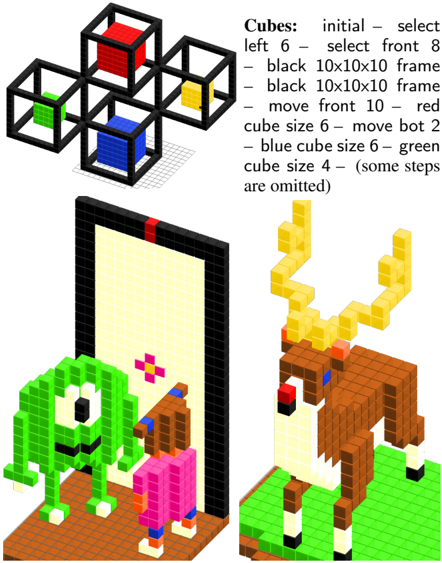
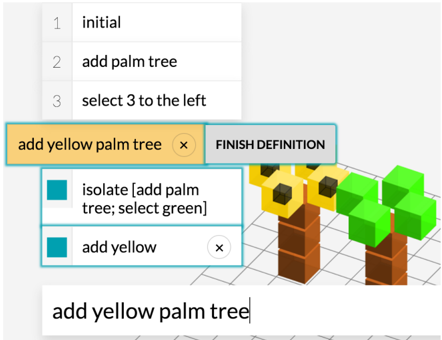
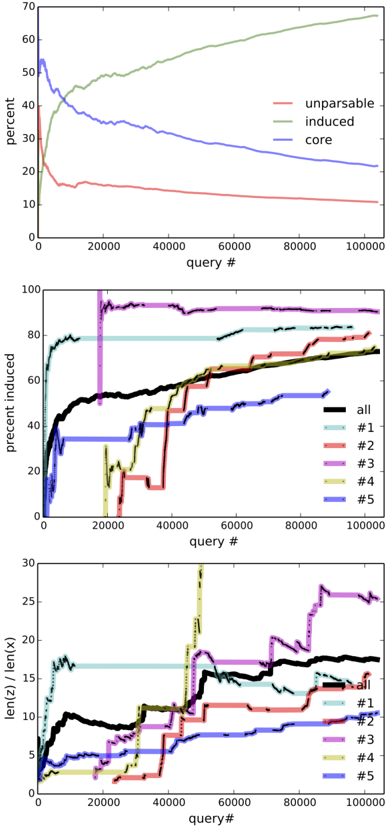
Our goal is to create a convenient natural language interface for performing wellspecified but complex actions such as analyzing data, manipulating text, and querying databases.However, existing natural language interfaces for such tasks are quite primitive compared to the power one wields with a programming language.To bridge this gap, we start with a core programming language and allow users to "naturalize" the core language incrementally by defining alternative, more natural syntax and increasingly complex concepts in terms of compositions of simpler ones.In a voxel world, we show that a community of users can simultaneously teach a common system a diverse language and use it to build hundreds of complex voxel structures.Over the course of three days, these users went from using only the core language to using the naturalized language in 85.9% of the last 10K utterances.
Overview
The claims and statistics of this paper haven’t been checked yet.
Free: it reads the open-access text and checks the first 5 claims that cite a source we can check. Create a free account to check every claim.
Integrity signals
Registry
Cites
Statistics
Figures

Verification
Claims the paper makes
The claims and statistics of this paper haven’t been checked yet.
Free: it reads the open-access text and checks the first 5 claims that cite a source we can check. Create a free account to check every claim.
Claims other papers make about this one
Each is checked against this paper’s own text: does it say what the citing paper says it does?
The source backs part of the claim, not all of it — or backs it for a different population, condition or comparison.
In the citing paper
“How users adapt to systems over time is of interest for not only HCI researchers but also NLP researchers [59,60].”
From CoAuthor: Designing a Human-AI Collaborative Writing Dataset for Exploring Language Model Capabilities (2022) · cites this paper as [59]
Experimental — accuracy not yet measured
Self-check
Percentages, sums and reported differences re-computed from the paper’s own numbers.
The self-check needs the paper’s full text.
Citations
Cites
Semantic Parsing on Freebase from Question-Answer Pairs
Berant, J., Chou, A., Frostig, R., & Liang, P. (2013) · Proceedings of the 2013 Conference on Empirical Methods in Natural Language Processing · doi:10.18653/v1/d13-1160 · Cited by 1,517
Self-citationZettlemoyer, L., & Collins, M. (2012) · arXiv (Cornell University) · doi:10.48550/arxiv.1207.1420 · Cited by 728 · cited 3×
“guage, which has been the subject of work in semantic parsing (Zettlemoyer and Collins, 2005; Artzi and Zettlemoyer, 2011, 2013; Pasupat and Liang, 2015).”
BackgroundUnderstanding Natural Language Commands for Robotic Navigation and Mobile Manipulation
Tellex, S., Kollar, T., Dickerson, S., Walter, M., Banerjee, A., Teller, S., & Roy, N. (2011) · Proceedings of the AAAI Conference on Artificial Intelligence · doi:10.1609/aaai.v25i1.7979 · Cited by 650
Learning to parse database queries using inductive logic programming
Zelle, J. M., & Mooney, R. J. (1996) · Cited by 642
Learning Dependency-Based Compositional Semantics
Liang, P., Jordan, M. I., & Klein, D. (2013) · Computational Linguistics · doi:10.1162/coli_a_00127 · Cited by 546 · cited 1×
“In this work, we use semantic parsing techniques that can handle ambiguity (Zettlemoyer and Collins, 2005, 2007; Kwiatkowski et al., 2010; Liang et al., 2011; Pasupat and Liang, 2015).”
MethodSelf-citationWeakly Supervised Learning of Semantic Parsers for Mapping Instructions to Actions
Artzi, Y., & Zettlemoyer, L. (2013) · Transactions of the Association for Computational Linguistics · doi:10.1162/tacl_a_00209 · Cited by 406
Online Learning of Relaxed CCG Grammars for Parsing to Logical Form
Zettlemoyer, L., & Collins, M. (2007) · Cited by 387
Learning Language Games through Interaction
Wang, S. I., Liang, P., & Manning, C. D. (2016) · Proceedings of the 54th Annual Meeting of the Association for Computational Linguistics (Volume 1: Long Papers) · doi:10.18653/v1/p16-1224 · Cited by 132 · cited 4×
“Compared to interactive language learning with weak denotational supervision (Wang et al., 2016), definitions are critical for learning complex ac-”
BackgroundMethodInfluentialSelf-citationBootstrapping Semantic Parsers from Conversations
Artzi, Y., & Zettlemoyer, L. (2011) · Cited by 120
Learning executable semantic parsers for natural language understanding
Liang, P. (2016) · Communications of the ACM · doi:10.1145/2866568 · Cited by 113
Self-citation
Research works printed but not linked: 3
- J. Duchi, E. Hazan, and Y. Singer. 2010. Adaptive sub- gradient methods for online learning and stochastic optimization. In Conference on Learning Theory (COLT).
- N. Kushman and R. Barzilay. 2013. Using semantic unification to generate regular expressions from nat- ural language. In Human Language Technology and North American Association for Computational Lin- guistics (HLT/NAACL). pages 826-836.
- T. Kwiatkowski, L. Zettlemoyer, S. Goldwater, and M. Steedman. 2010. Inducing probabilistic CCG grammars from logical form with higher-order unifi- cation. In Empirical Methods in Natural Language Processing (EMNLP). pages 1223-1233.
Cited by
Lee, M., Liang, P., & Yang, Q. (2022) · CHI Conference on Human Factors in Computing Systems · doi:10.1145/3491102.3502030 · Cited by 345
Self-citationLearning to Speak and Act in a Fantasy Text Adventure Game
Urbanek, J., Fan, A., Karamcheti, S., Jain, S., Humeau, S., Dinan, E., Rocktäschel, T., Kiela, D., Szlam, A. D., & Weston, J. (2019) · Conference on Empirical Methods in Natural Language Processing (EMNLP) · doi:10.18653/v1/d19-1062 · Cited by 266
“, 2016) and a more open ended building task using a grid of voxels (Wang et al., 2017).”
BackgroundMethodInfluentialLiu, M. X., Sarkar, A., Negreanu, C., Zorn, B., Williams, J., Toronto, N., & Gordon, A. D. (2023) · Proceedings of the 2023 CHI Conference on Human Factors in Computing Systems · doi:10.1145/3544548.3580817 · Cited by 119
Training Classifiers with Natural Language Explanations
Hancock, B., Varma, P., Wang, S., Bringmann, M., Liang, P., & Ré, C. (2018) · Proceedings of the 56th Annual Meeting of the Association for Computational Linguistics (Volume 1: Long Papers) · doi:10.18653/v1/p18-1175 · Cited by 109
“Wang et al. (2017) convert natural language definitions to rules in a semantic parser to build up progressively higher-level concepts.”
BackgroundSelf-citation
Metadata
- Authors
- Wang, S. I., Ginn, S., Liang, P., & Manning, C. D.
- Affiliations
- Stanford University (US)
- Venue
- Proceedings of the 55th Annual Meeting of the Association for Computational Linguistics (Volume 1: Long Papers)
- Published
- 2017
- ISSN
- 0736-587X (ISSN-L)
- OpenAlex
- W2609753328
- Cited by
- 59
- References
- 17
- Citations by year
- 2025: 3 · 2024: 2 · 2023: 5 · 2022: 6 · 2021: 9 · 2020: 15 · 2019: 10 · 2018: 7 · 2017: 2
- FWCI
- 4.24
- Type
- conference paper
- Language
- en
- Open access
- hybrid
- doi.org
- Licence
- cc-by
- Locations
- Proceedings of the conference - Association for Computational Linguistics. Meeting (publishedVersion, cc-by)
- arXiv (Cornell University) (submittedVersion)
- arXiv (Cornell University)
- Funders
- National Science Foundation (1552635, CAREER)
- Defense Advanced Research Projects Agency
- Army Research Office (W911NF-15-1-, W911NF)
- Topics
- Physical Sciences › Computer Science › Artificial Intelligence › Natural Language Processing Techniques
- Physical Sciences › Computer Science › Artificial Intelligence › Speech and dialogue systems
- Physical Sciences › Computer Science › Software › Logic, programming, and type systems
- Keywords
- interactive learning, natural language interfaces, natural language programming, language acquisition, language composition
About these checks
Registry, retraction, Cites and statistics results are computed, not judged, with one exception: a printed reference that no index lists is read once by a model before it counts as a citation error. Claims are extracted by a model and kept only when their quote appears verbatim in the text; each cited source is then checked, with a model’s help, for whether it says what the claim relies on. Those verdicts can be wrong — read the claim’s quote and the cited source before relying on one.
Statistics and arithmetic are recomputed, not judged.
Confidence bands are shown only for fields calibrated on our annotated test set. None is calibrated yet, so no band is shown.
What counts as a claim ›How we measure confidence ›How we check this ›
Are you an author, or do you see a problem with this page? Request a review
How to cite
Cite CoChat for the checks on this page, and the paper for its own findings.
- This page
- CoChat. (2026). Citation check: Naturalizing a Programming Language via Interactive Learning. https://app.cochat.ai/papers/10.18653/v1/p17-1086
- The paper
- Wang, S. I., Ginn, S., Liang, P., & Manning, C. D. (2017). Naturalizing a Programming Language via Interactive Learning. Proceedings of the 55th Annual Meeting of the Association for Computational Linguistics (Volume 1: Long Papers). https://doi.org/10.18653/v1/p17-1086
Data sources
Bibliographic data: Semantic Scholar, OpenAlex, Crossref.
Contains information from the Semantic Scholar Academic Graph Datasets, made available under the ODC Attribution License (ODC-BY 1.0).
Semantic Scholar’s data is described in: Kinney, R., et al. (2023). The Semantic Scholar Open Data Platform. arXiv:2301.10140.
