

An Empirical Comparison of Domain Adaptation Methods for Neural Machine Translation
Open accessThe DOI matches its Crossref record; 25 of the 28 references it cites were found in a registry or an index.
Abstract
In this paper, we propose a novel domain adaptation method named "mixed fine tuning" for neural machine translation (NMT).We combine two existing approaches namely fine tuning and multi domain NMT.We first train an NMT model on an out-of-domain parallel corpus, and then fine tune it on a parallel corpus which is a mix of the in-domain and out-ofdomain corpora.All corpora are augmented with artificial tags to indicate specific domains.We empirically compare our proposed method against fine tuning and multi domain methods and discuss its benefits and shortcomings.
Overview
The claims and statistics of this paper haven’t been checked yet.
Free: it reads the open-access text and checks the first 5 claims that cite a source we can check. Create a free account to check every claim.
Integrity signals
Registry
Cites
Statistics
Figures
Verification
Claims the paper makes
The claims and statistics of this paper haven’t been checked yet.
Free: it reads the open-access text and checks the first 5 claims that cite a source we can check. Create a free account to check every claim.
Claims other papers make about this one
Each is checked against this paper’s own text: does it say what the citing paper says it does?
The cited source says what the claim attributes to it.
In the citing paper
“Specifically, the guidance signals could be style tokens [27,123], length specifications [56], domain tags [14], or any variety of other pieces of information used to control of the generated text.”
From Pre-train, Prompt, and Predict: A Systematic Survey of Prompting Methods in Natural Language Processing (2023) · cites this paper as [14]
Self-check
Percentages, sums and reported differences re-computed from the paper’s own numbers.
The self-check needs the paper’s full text.
Citations
Cites
Learning Phrase Representations using RNN Encoder–Decoder for Statistical Machine Translation
Cho, K., van Merrienboer, B., Gulcehre, C., Bahdanau, D., Bougares, F., Schwenk, H., & Bengio, Y. (2014) · Proceedings of the 2014 Conference on Empirical Methods in Natural Language Processing (EMNLP) · doi:10.3115/v1/d14-1179 · Cited by 25,545 · cited 2×
“One of the most attractive features of neural machine translation (NMT) (Bahdanau et al., 2015; Cho et al., 2014; Sutskever et al., 2014) is that it is possible to train an end to end system without the need to deal with word alignments, translation rules and complicated decoding algorithms, which are a characteristic…”
BackgroundSequence to Sequence Learning with Neural Networks
Sutskever, I., Vinyals, O., & Le, Q. V. (2014) · arXiv · doi:10.48550/arxiv.1409.3215 · Cited by 17,766 · cited 1×
“One of the most attractive features of neural machine translation (NMT) (Bahdanau et al., 2015; Cho et al., 2014; Sutskever et al., 2014) is that it is possible to train an end to end system without the need to deal with word alignments, translation rules and complicated decoding algorithms, which…”
BackgroundNeural Machine Translation by Jointly Learning to Align and Translate
Bahdanau, D., Cho, K., & Bengio, Y. (2014) · arXiv · doi:10.48550/arxiv.1409.0473 · Cited by 16,213 · cited 2×
“One of the most attractive features of neural machine translation (NMT) (Bahdanau et al., 2015; Cho et al., 2014; Sutskever et al., 2014) is that it is possible to train an end to end system without the need to deal with word alignments, translation rules and complicated decoding algorithms, which are a characteristic…”
BackgroundMoses: open source toolkit for statistical machine translation
Koehn, P., Zens, R., Dyer, C., Bojar, O., Constantin, A., Herbst, E., Hoang, H., Birch, A., Callison-Burch, C., Federico, M., et al. (2007) · Proceedings of the 45th Annual Meeting of the ACL on Interactive Poster and Demonstration Sessions - ACL '07 · doi:10.3115/1557769.1557821 · Cited by 4,735 · cited 1×
“We used the Moses PBSMT system (Koehn et al., 2007) for all of our MT experiments.”
MethodMinimum error rate training in statistical machine translation
Och, F. J. (2003) · Proceedings of the 41st Annual Meeting on Association for Computational Linguistics - ACL '03 · doi:10.3115/1075096.1075117 · Cited by 2,725 · cited 1×
“In all of our experiments, we used the GIZA++ toolkit 7 for word alignment; tuning was performed by minimum error rate training (Och, 2003), and it was re-run for every experiment.”
MethodStatistical Significance Tests for Machine Translation Evaluation.
Koehn, P. (2004) · Conference on Empirical Methods in Natural Language Processing (EMNLP) · Cited by 2,205
Google’s Multilingual Neural Machine Translation System: Enabling Zero-Shot Translation
Johnson, M., Schuster, M., Le, Q. V., Krikun, M., Wu, Y., Chen, Z., Thorat, N., Viégas, F., Wattenberg, M., Corrado, G., et al. (2017) · Transactions of the Association for Computational Linguistics · doi:10.1162/tacl_a_00065 · Cited by 1,747 · cited 1×
“Tag based NMT has also been shown to be effective for control the politeness of translations (Sennrich et al., 2016a) and multilingual NMT (Johnson et al., 2016).”
BackgroundMoses : open source toolkit for statistical machine translation
Koehn, P., Hoang, H., Birch, A., Callison-Burch, C., Federico, M., Bertoldi, N., Cowan, B., Shen, W., Moran, C., Zens, R., et al. (2007) · Edinburgh Research Explorer (University of Edinburgh) · Cited by 1,547
Transfer Learning for Low-Resource Neural Machine Translation
Zoph, B., Yuret, D., May, J., & Knight, K. (2016) · Proceedings of the 2016 Conference on Empirical Methods in Natural Language Processing · doi:10.18653/v1/d16-1163 · Cited by 788 · cited 8×
“However, it is reported that NMT works better than SMT only when there is an abundance of parallel corpora.”
BackgroundInfluentialStanford neural machine translation systems for spoken language domains.
Luong, M.-T., & Manning, C. D. (2015) · Cited by 499
Research works printed but not linked: 4
- [6]6. Fabien Cromieres, Chenhui Chu, Toshiaki Nakazawa, and Sadao Kurohashi. 2016. Kyoto univer- sity participation to wat 2016. In Proceed- ings of the 3rd Workshop on Asian Transla- tion (WAT2016). The COLING 2016 Organiz- ing Committee, Osaka, Japan, pages 166-174. http://aclweb.org/anthology/W16-4616.
- [14]14. Sadao Kurohashi, Toshihisa Nakamura, Yuji Mat- sumoto, and Makoto Nagao. 1994. Improvements of Japanese morphological analyzer JUMAN. In Pro- ceedings of the International Workshop on Sharable Natural Language. pages 22-28.
- [21]21. Rico Sennrich, Barry Haddow, and Alexandra Birch. 2016b. Improving neural machine translation models with monolingual data. In Proceed- ings of the 54th Annual Meeting of the As- sociation for Computational Linguistics (Volume 1: Long Papers). Association for Computa- tional Linguistics, Berlin, Germany, pages 86-96. http://www.aclweb.org/anthology/P16-1009.
- [22]22. Rico Sennrich, Barry Haddow, and Alexandra Birch. 2016c. Neural machine translation of rare words with subword units. In Proceed- ings of the 54th Annual Meeting of the As- sociation for Computational Linguistics (Volume 1: Long Papers). Association for Computational Linguistics, Berlin, Germany, pages 1715-1725. http://www.aclweb.org/anthology/P16-1162.
Cited by
Items 101–200 of 252
Zheng, R., Liu, H., Ma, M., Zheng, B., & Huang, L. (2019) · Conference on Machine Translation (WMT) · doi:10.18653/v1/w19-5367 · Cited by 15
Abdulmumin, I., Galadanci, B. S., & Garba, A. (2021) · Machine Translation · doi:10.21203/rs.3.rs-465941/v1 · Cited by 13
Evaluation of Machine Translation Performance Across Multiple Genres and Languages
van der Wees, M., Bisazza, A., & Monz, C. (2018) · Language Resources and Evaluation Conference (LREC) · doi:10.63317/5imihaq873kn · Cited by 12
Putra, J. W. G., Teufel, S., & Tokunaga, T. (2021) · Workshop on Argument Mining (ArgMining) · doi:10.18653/v1/2021.argmining-1.2 · Cited by 12
Curriculum Learning for Domain Adaptation in Neural Machine TranslationPreprint
Zhang, X., Shapiro, P., Kumar, G., McNamee, P., Carpuat, M. J., & Duh, K. (2019) · arXiv (Cornell University) · doi:10.48550/arxiv.1905.05816 · Cited by 12
“Continued training or fine-tuning (Luong et al., 2015; Freitag and Al-Onaizan, 2016; Chu et al., 2017) is an adaptation technique where a model is first trained on the large general domain data, then used as initialization of a new model which is further trained on in-domain bitext.”
MethodDon't Go Far Off: An Empirical Study on Neural Poetry TranslationPreprint
Chakrabarty, T., Saakyan, A., & Muresan, S. (2021) · arXiv (Cornell University) · doi:10.48550/arxiv.2109.02972 · Cited by 15
AdaptiVocab: Enhancing LLM Efficiency in Focused Domains through Lightweight Vocabulary AdaptationPreprint
Nakash, I., Calderon, N., David, E. B., Hoffer, E., & Reichart, R. (2025) · arXiv (Cornell University) · doi:10.48550/arxiv.2503.19693 · Cited by 16
“Rather than focusing solely on improving end-task performance (Chu et al., 2017; Calderon et al., 2024), we focus on efficiency by reducing latency and computational costs when applying LLMs to new domains.”
Continual Learning of Neural Machine Translation within Low Forgetting Risk Regions
Gu, S., Hu, B., & Feng, Y. (2022) · Conference on Empirical Methods in Natural Language Processing (EMNLP) · doi:10.18653/v1/2022.emnlp-main.111 · Cited by 26
Improving Robustness and Generality of NLP Models Using Disentangled RepresentationsPreprint
Wu, J., Li, X., Ao, X., Meng, Y., Wu, F. Q., & Li, J. (2020) · arXiv (Cornell University) · doi:10.48550/arxiv.2009.09587 · Cited by 17
“For machine translation, the core idea is to utilize large available parallel data for training NMT models and adapt them to domains with small data (Chu et al., 2017), where data augmentation (Sennrich et al.”
MethodDistill, Adapt, Distill: Training Small, In-Domain Models for Neural Machine Translation
Gordon, M. A., & Duh, K. (2020) · Workshop on Neural Generation and Translation (WNGT) · doi:10.18653/v1/2020.ngt-1.12 · Cited by 16
Non-Parametric Domain Adaptation for End-to-End Speech Translation
Du, Y., Wang, W., Zhang, Z., Chen, B., Xu, T. W., Xie, J., & Chen, E. (2022) · Conference on Empirical Methods in Natural Language Processing (EMNLP) · doi:10.18653/v1/2022.emnlp-main.21 · Cited by 18
NICT’s Participation in WAT 2018: Approaches Using Multilingualism and Recurrently Stacked Layers
Dabre, R., Kunchukuttan, A., Fujita, A., & Sumita, E. (2018) · Institutional Repositories DataBase (IRDB) · Cited by 10
Self-citationNRC Systems for the 2020 Inuktitut-English News Translation Task
Knowles, R., Stewart, D. A., Larkin, S., & Littell, P. (2020) · Conference on Machine Translation (WMT) · doi:10.18653/v1/2020.wmt-1.13 · Cited by 15
Gaspari, F., Bago, P., Castilho, S., Celeste, E., Dunne, J., Gíslason, N. R., Kåsen, A., Klubička, F., Kristmannsson, G., McHugh, H., et al. (2022) · Dublin City University Open Access Institutional Repository (Dublin City University) · doi:10.2436/rld.i78.2022.3741 · Cited by 10
Transductive Data-Selection Algorithms for Fine-Tuning Neural Machine TranslationPreprint
Poncelas, A., Wenniger, G. M. D. B., & Way, A. (2019) · arXiv (Cornell University) · doi:10.48550/arxiv.1908.09532 · Cited by 10
“The models presented in Section 7.3 can be further expanded by adding a tag in the source sentences indicating the domain explicitly (Chu et al., 2017; Poncelas et al., 2019b), using a target-side seed or using synthetic sentences (Chinea-Rios et al., 2017; Poncelas et al., 2019a).”
BackgroundInfluentialPhrase-level Active Learning for Neural Machine TranslationPreprint
Hu, J., & Neubig, G. (2021) · arXiv (Cornell University) · doi:10.48550/arxiv.2106.11375 · Cited by 10
“Machine translation (MT) models are very sensitive to domain shift (Koehn and Knowles, 2017; Chu and Wang, 2018), and one typical way to address this problem is adding in-domain data to the MT training process (Luong and Manning, 2015; Chu et al., 2017).”
BackgroundLiang, Y., Meng, F., Wang, J., Xu, J., Chen, Y., & Zhou, J. (2024) · Proceedings of the conference - Association for Computational Linguistics. Meeting · doi:10.18653/v1/2024.acl-long.588 · Cited by 18
The Riddle of (Literary) Machine Translation Quality
van Egdom, G.-W., Kosters, O., & Declercq, C. (2023) · Tradumàtica tecnologies de la traducció · doi:10.5565/rev/tradumatica.345 · Cited by 9
“Initially, these statements focused on the quality of LSP translation (Chu et al. 2017, Speerstra 2018, Jia et al. 2019, Kosmaczewska and Train, 2019, among others).”
BackgroundUnsupervised Domain Adaptation for Neural Machine Translation
Yang, Z. C., Chen, W. R., Wang, F., & Xu, B. (2018) · Proceedings - International Conference on Pattern Recognition/Proceedings/International Conference on Pattern Recognition · doi:10.1109/icpr.2018.8546053 · Cited by 9
Capturing Structural Locality in Non-parametric Language ModelsPreprint
Xu, F. F., He, J., Neubig, G., & Hellendoorn, V. J. (2021) · arXiv (Cornell University) · doi:10.48550/arxiv.2110.02870 · Cited by 9
“Domain adaptation for neural models generally focuses on fine-tuning models on in-domain data (Sen-nrich et al., 2016; Chu et al., 2017) or making direct modifications to the model to consider domain information (Britz et al., 2017) or latent topic features (Khudanpur & Wu, 2000; Mikolov & Zweig,…”
Saunders, D., & Byrne, B. (2020) · Conference on Machine Translation (WMT) · doi:10.18653/v1/2020.wmt-1.94 · Cited by 17
Zhang, Z., Zhang, Y., Liang, Y., Ma, C., Lu, X., Zhao, Y., Zhou, Y., & Zong, C. (2025) · IEEE Transactions on Pattern Analysis and Machine Intelligence · doi:10.1109/tpami.2025.3530998 · Cited by 23
“Benefiting from module coordination and joint training, a uni-fied framework usually exhibits efficient transfer learning [40], [41] across different domains or with a few training examples.”
Bridging the Domain Gap: Improve Informal Language Translation via Counterfactual Domain Adaptation
Wang, K., Chen, G., Huang, Z., Wan, X., & Huang, F. (2021) · Proceedings of the AAAI Conference on Artificial Intelligence · doi:10.1609/aaai.v35i16.17645 · Cited by 10
“The model-based meth-ods make explicit changes to NMT model such as designing new training objectives (Luong, Pham, and Manning 2015; Chu, Dabre, and Kurohashi 2017), modifying the model architecture (Kobus, Crego, and Senellart 2017; Johnson et al. 2017; Dou et al. 2019), and changing the decoding…”
BackgroundMethodInfluentialA Study of Machine Translation Models for Kannada-Tulu
Hegde, A., Shashirekha, H. L., Kumar, M. A., & Chakravarthi, B. R. (2023) · Lecture notes in networks and systems · doi:10.1007/978-981-19-9225-4_12 · Cited by 8
What Knowledge Is Needed? Towards Explainable Memory for kNN-MT Domain Adaptation
Zhu, W., Huang, S., Lv, Y., Zheng, X., & Chen, J. (2023) · Findings of the Association for Computational Linguistics: ACL (Findings of ACL) · doi:10.18653/v1/2023.findings-acl.177 · Cited by 8
Incremental Domain Adaptation for Neural Machine Translation in Low-Resource Settings
Kalimuthu, M., Barz, M., & Sonntag, D. (2019) · Arabic Natural Language Processing Workshop (WANLP) · doi:10.18653/v1/w19-4601 · Cited by 8
“Recent approaches include fine-tuning with mixed batches containing in-and out-of-domain samples (Chu et al., 2017) and with different regularization methods for differing amounts of new samples for English → German and English → Russian (Barone et al., 2017).”
BackgroundMethodYANMTT: Yet Another Neural Machine Translation Toolkit
Dabre, R., Kanojia, D., Sawant, C., & Sumita, E. (2023) · Proceedings of the conference - Association for Computational Linguistics. Meeting · doi:10.18653/v1/2023.acl-demo.24 · Cited by 11
Self-citationThe Universitat d’Alacant Submissions to the English-to-Kazakh News Translation Task at WMT 2019
Sánchez-Cartagena, V. M., Pérez-Ortiz, J. A., & Sánchez-Martínez, F. (2019) · Conference on Machine Translation (WMT) · doi:10.18653/v1/w19-5339 · Cited by 12
“The genuine parallel data was oversampled to match the size of the backtrans-lated data (Chu et al., 2017).”
BackgroundEnglish-Catalan Neural Machine Translation in the Biomedical Domain through the cascade approachPreprint
Costa‐jussà, M. R., Casas, N., & Melero, M. (2018) · arXiv (Cornell University) · doi:10.48550/arxiv.1803.07139 · Cited by 8
Man, Z., Huang, Z., Zhang, Y., Yu, L., Chen, Y., Chen, Y., & Xu, J. (2023) · IEEE/ACM Transactions on Audio Speech and Language Processing · doi:10.1109/taslp.2023.3336515 · Cited by 7
“Specifically, methods including fine-tuning [7], [8], [10], [31], [32], mixed fine-tuning [9], [33], cost weighting [34], and data selection [35], [36] and so on have been proposed [9], [31], [32], [33].”
BackgroundMethodNICT’s Supervised Neural Machine Translation Systems for the WMT19 Translation Robustness Task
Dabre, R., & Sumita, E. (2019) · Conference on Machine Translation (WMT) · doi:10.18653/v1/w19-5362 · Cited by 7
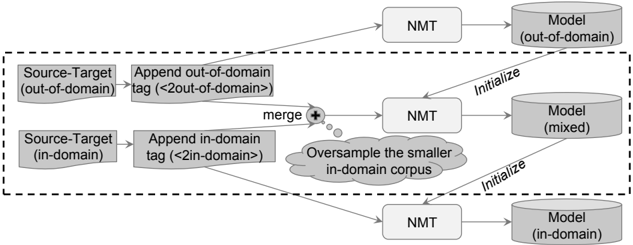
“All this can be avoided by performing Mixed-Fine-Tuning (MFT) (Chu et al., 2017) where the out-of-domain model is fine-tuned on a combination of both the out-of-domain data and the oversampled 1 in-domain data.”
BackgroundInfluentialSelf-citationHuang, S., Guo, J., Yu, Z., & Wen, Y. (2023) · Neural Computing and Applications · doi:10.1007/s00521-023-08377-4 · Cited by 7
“[7] proposed a mixed fine-tuning method, which fine-tunes the general domain model with the mix of the general domain data and over-sampling indomain data.”
BackgroundMethodUse of Neural Machine Translation in Multimodal Translation
Nair, M., Tanwar, S., Badotra, S., & Kukreja, V. (2023) · International Conference on Contemporary Computing and Informatics (IC3I) · doi:10.1109/ic3i59117.2023.10397780 · Cited by 7
When does Parameter-Efficient Transfer Learning Work for Machine Translation?
Üstün, A., & Stickland, A. C. (2022) · Conference on Empirical Methods in Natural Language Processing (EMNLP) · doi:10.18653/v1/2022.emnlp-main.540 · Cited by 13
Transfer Learning for Heterocycle Retrosynthesis
Wieczorek, E., Sin, J. W., Tanovic, S., Holland, M. T. O., Wilbraham, L., Sebastián-Pérez, V., Bradley, A. R., Miketa, D., Brennan, P. E., & Duarte, F. (2025) · Journal of Chemical Information and Modeling · doi:10.1021/acs.jcim.4c02041 · Cited by 7
Discussion on Bilingual Cognition in International Exchange Activities
Maimaiti, M., & Zou, X. (2018) · IFIP advances in information and communication technology · doi:10.1007/978-3-030-01313-4_17 · Cited by 6
Context-Aware Neural Machine Translation for Korean Honorific Expressions
Hwang, Y., Kim, Y., & Jung, K. (2021) · Electronics · doi:10.3390/electronics10131589 · Cited by 6
“This approach has been adopted in many subsequent works such as [21,22].”
MethodHaque, R., Moslem, Y., & Way, A. (2020) · Dublin City University Open Access Institutional Repository (Dublin City University) · Cited by 6
Transfer learning and subword sampling for asymmetric-resource one-to-many neural translation
Grönroos, S.-A., Virpioja, S., & Kurimo, M. (2020) · Machine Translation · doi:10.1007/s10590-020-09253-x · Cited by 7
“Chu et al. (2017) apply this strategy to domain adaptation.”
Supervised Adaptation of Sequence-to-Sequence Speech Recognition Systems using Batch-Weighting
Huber, C., Hussain, J., Nguyen, T. N., Song, K., Stüker, S., & Waibel, A. H. (2020) · doi:10.18653/v1/2020.lifelongnlp-1.2 · Cited by 11
Unsupervised Domain Adaptation for Neural Machine Translation with Iterative Back Translation.Preprint
Jin, D., Jin, Z., Zhou, J. T., & Szolovits, P. (2020) · arXiv (Cornell University) · Cited by 7
Towards Unified Multi-Domain Machine Translation With Mixture of Domain Experts
Lu, J., & Zhang, J. (2023) · IEEE/ACM Transactions on Audio Speech and Language Processing · doi:10.1109/taslp.2023.3316451 · Cited by 6
“Many works focus on the domain adaptation approaches [34], [35], [36], [37], which adapt the general NMT models to particular domains, fully utilizing the general translation knowledge.”
BackgroundPronoun-Targeted Fine-tuning for NMT with Hybrid Losses
Jwalapuram, P., Joty, S., & Shen, Y. (2020) · Conference on Empirical Methods in Natural Language Processing (EMNLP) · doi:10.18653/v1/2020.emnlp-main.177 · Cited by 5
Analyzing Challenges in Neural Machine Translation for Software Localization
Koneru, S., Huck, M., Exel, M., & Niehues, J. (2023) · Conference of the European Chapter of the Association for Computational Linguistics · doi:10.18653/v1/2023.eacl-main.179 · Cited by 5
“Domain adaptation and Multi-Domain models using tags are common techniques in NMT to inform the models about the type of content it is translating (Kobus et al., 2017; Chu et al., 2017; Pham et al., 2020; Xu et al., 2020).”
MethodA novel multi-domain machine reading comprehension model with domain interference mitigation
Zhou, C., Wang, Z., He, S., Zhang, H., & Su, J. (2022) · Neurocomputing · doi:10.1016/j.neucom.2022.05.102 · Cited by 5
CocoQa: Question Answering for Coding Conventions Over Knowledge Graphs
Du, T., Cao, J., Wu, Q., Li, W., Shen, B., & Chen, Y. (2019) · IEEE/ACM International Conference on Automated Software Engineering (ASE) · doi:10.1109/ase.2019.00108 · Cited by 5
Analyzing the Problems of Vocabulary in Japanese-Chinese Neural Network Machine Translation
罗, 雯. (2020) · Computer Science and Application · doi:10.12677/csa.2020.103040 · Cited by 5
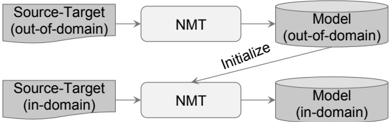
“103040 394 计算机科学与应用 关于领域自适应的方法,本文参考了 mixed fine tuning 的方法[12] [13],将翻译模型的训练分为三次 进行。 如图 2 所示,在第一次的训练中,仅利用外领域的语料进行训练,获得了外领域模型。第二次训练 以外领域模型为基础,将内外领域的语料进行混合训练,获得了交叉模型。第三次训练,以交叉模型为 基础,通过训练内领域的语料,获得了最终的内领域模型。”
Factorized Transformer for Multi-Domain Neural Machine Translation
Deng, Y., Yu, H., Yu, H., Duan, X., & Luo, W. (2020) · Findings of the Association for Computational Linguistics: EMNLP (Findings of EMNLP) · doi:10.18653/v1/2020.findings-emnlp.377 · Cited by 6
“Introducing regularization techniques such as L2 (Barone et al., 2017), EWC (Kirkpatrick et al., 2016; Thompson et al., 2019) and mix-finetuning (Chu et al., 2017) can alleviate the drop in the domains of IWSLT, however it limits the performance of in-domain.”
BackgroundMethodTowards Hybrid Human-Machine Translation ServicesPreprint
Barz, M., Polzehl, T., & Sonntag, D. (2018) · EasyChair preprint · doi:10.29007/kw5h · Cited by 5
Kozhirbayev, Z., & Yessenbayev, Z. (2025) · Electronics · doi:10.3390/electronics14153126 · Cited by 4
“Using a “mixed fine tuning”, which combines out-of-domain pre-training with tagged mixed-corpus fine-tuning, was recommended in order to reduce overfitting [4].”
DFKI-MLT System Description for the WMT18 Automatic Post-editing Task
Pylypenko, D., & Rubino, R. (2018) · Conference on Machine Translation (WMT) · doi:10.18653/v1/w18-6469 · Cited by 4
“This method was inspired by the work presented in (Chu et al., 2017).”
MethodImproving the Quality Trade-Off for Neural Machine Translation Multi-Domain Adaptation
Hasler, E., Domhan, T., Trénous, J., Tran, K. M., Byrne, B., & Hieber, F. (2021) · Conference on Empirical Methods in Natural Language Processing (EMNLP) · doi:10.18653/v1/2021.emnlp-main.666 · Cited by 9
“Different from the mixed fine-tuning of Chu et al. (2017), the domain is not known at test time in our case.”
BackgroundMethodNAIST’s Machine Translation Systems for IWSLT 2020 Conversational Speech Translation Task
Fukuda, R., Sudoh, K., & Nakamura, S. (2020) · International Conference on Spoken Language Translation (IWSLT) · doi:10.18653/v1/2020.iwslt-1.21 · Cited by 4
“In such a low-resource scenario, one promising way is domain adaptation using out-of-domain parallel corpora and in-domain monolingual corpora (Wang et al., 2016; Chu et al., 2017).”
BackgroundDabre, R., & Chakrabarty, A. (2020) · Workshop on Asian Translation (WAT) · doi:10.18653/v1/2020.wat-1.9 · Cited by 4
“We do not describe the multilingual or multi-domain NMT modeling techniques in this paper as they are the same as described in Johnson et al. (2017) and Chu et al. (2017).”
MethodInfluentialSelf-citationFGraDA: A Dataset and Benchmark for Fine-Grained Domain Adaptation in Machine Translation
Zhu, W., Huang, S., Pu, T., Huang, P., Zhang, X., Yu, J. X., Chen, W., Wang, Y., & Chen, J. (2022) · Language Resources and Evaluation Conference (LREC) · doi:10.63317/5j8tt3i8rcnc · Cited by 6
“However, the translation quality does not improve as greatly as reported in other research (Fre-itag and Al-Onaizan, 2016; Chu et al., 2017); the performance on real-time networks and smart phone are much lower than other two domains, showing the diversity and difficulty of these fine-grained domains.”
BackgroundTagged End-to-End Simultaneous Speech Translation Training Using Simultaneous Interpretation Data
Ko, Y., Fukuda, R., Nishikawa, Y., Kano, Y., Sudoh, K., & Nakamura, S. (2023) · International Conference on Spoken Language Translation (IWSLT) · doi:10.18653/v1/2023.iwslt-1.34 · Cited by 14
Translating scientific abstracts in the bio-medical domain with structure-aware models
Rauf, S. A., & Yvon, F. (2024) · Computer Speech & Language · doi:10.1016/j.csl.2024.101623 · Cited by 7
Document-Level Information as Side Constraints for Improved Neural Patent Translation
Jehl, L., & Riezler, S. (2018) · Conference of the Association for Machine Translation in the Americas · Cited by 4
Intelligence Is Asking The Right Question: A Study On Japanese Question Generation
Nio, L., & Murakami, K. (2018) · IEEE Spoken Language Technology Workshop (SLT) · doi:10.1109/slt.2018.8639526 · Cited by 5
“Various works have been done in this field exploring various techniques ranging from answer re-ranking algorithms, reinforcement learning, sum reader networks, gated-attention structures, to domain adaptation techniques [25, 26, 27, 28, 29, 30, 31].”
BackgroundEffective Soft-Adaptation for Neural Machine Translation
Wu, S., Zhang, D., & Zhou, M. Q. (2019) · Lecture notes in computer science · doi:10.1007/978-3-030-32236-6_22 · Cited by 4
Revisiting Simple Domain Adaptation Methods in Unsupervised Neural Machine TranslationPreprint
Sun, H., Wang, R., Chen, K., Utiyama, M., Sumita, E., Zhao, T., & Chu, C. (2019) · arXiv (Cornell University) · doi:10.48550/arxiv.1908.09605 · Cited by 6
“, 2017) and fine tuning (Luong and Manning, 2015; Sennrich et al., 2016a; Freitag and Al-Onaizan, 2016; Servan et al., 2016; Chu et al., 2017), architecture optimization (Kobus et al.”
BackgroundMethodSelf-citationPersonalizing Grammatical Error Correction: Adaptation to Proficiency Level and L1Preprint
Nădejde, M., & Tetreault, J. (2020) · arXiv (Cornell University) · doi:10.48550/arxiv.2006.02964 · Cited by 4
“Adapted models could also be improved by using the mixed fine tuning approach which uses a mix of in-domain and out-of-domain data (Chu et al., 2017).”
MethodPeinado, C. E. (2022) · UPCommons institutional repository (Universitat Politècnica de Catalunya) · doi:10.5821/dissertation-2117-365523 · Cited by 5
Thillainathan, S., Ranathunga, S., Yuan, S., Jayasena, S., & Lee, E.-S. A. (2024) · SSRN Electronic Journal · doi:10.2139/ssrn.5061381 · Cited by 4
Domain Adaptation for NMT via Filtered Iterative Back-Translation
Kumari, S., Jaiswal, N., Patidar, M., Patwardhan, M. S., Karande, S. S., Agarwal, P., & Vig, L. (2021) · Cited by 11
Wu, Z., Li, Z., Wei, D., Shang, H., Guo, J., Chen, X., Rao, Z., Yu, Z., Yang, J., Li, S., et al. (2023) · International Conference on Spoken Language Translation (IWSLT) · doi:10.18653/v1/2023.iwslt-1.13 · Cited by 7
“With the pre-trained basic model, we use domain adaptation method (Chu et al., 2017) to achieve basic formality control.”
MethodExploring iterative dual domain adaptation for neural machine translation
Liu, X., Zeng, J., Wang, X., Wang, Z., & Su, J. (2023) · Knowledge-Based Systems · doi:10.1016/j.knosys.2023.111182 · Cited by 3
Large-scale machine translation evaluation of the iADAATPA project
Castilho, S., Resende, N., Gaspari, F., Way, A., O’Dowd, T., Mazur, M., García–Herranz, M., Helle, A., Ramírez-Sánchez, G., Sánchez-Cartagena, V. M., et al. (2019) · Dublin City University Open Access Institutional Repository (Dublin City University) · Cited by 3
Improving Document-Level Neural Machine Translation with Domain Adaptation
Haq, S. U., Rauf, S. A., Shoukat, A., & Hira, N.-E. (2020) · Workshop on Neural Generation and Translation (WNGT) · doi:10.18653/v1/2020.ngt-1.27 · Cited by 3
“For domain adaptation, we use data augmentation method similar to (Chu et al., 2017) by oversampling small in-domain corpus.”
MethodEmbedding Meta-Textual Information for Improved Learning to Rank
Kuwa, T., Schamoni, S., & Riezler, S. (2020) · International Conference on Computational Linguistics · doi:10.18653/v1/2020.coling-main.487 · Cited by 5
The ADAPT Centre’s Neural MT Systems for the WAT 2020 Document-Level Translation Task
Jooste, W., Haque, R., & Way, A. (2020) · Workshop on Asian Translation (WAT) · doi:10.18653/v1/2020.wat-1.17 · Cited by 3
“Scenario 2: In the second scenario we implemented mixed fine-tuning of model parameters, where fine-tuning is conducted on the training data that consists of both in-domain data and out-of-domain data as described in Chu et al. (2017).”
MethodSiu, S. C. (2022) · Corpora and intercultural studies · doi:10.1007/978-981-19-6680-4_5 · Cited by 3
Cao, Z., Yang, B., Lin, H., Wu, S., Wei, X., Liu, D., Xie, J., Zhang, M., & Su, J. (2023) · Proceedings of the conference - Association for Computational Linguistics. Meeting · doi:10.18653/v1/2023.acl-long.321 · Cited by 3
A flexible tool for a qualia-enriched FrameNet: the FrameNet Brasil WebTool
Torrent, T. T., Matos, E. E. D. S., da Costa, A. D., Gamonal, M. A., Peron-Corrêa, S. R., & Paiva, V. M. R. L. (2024) · Language Resources and Evaluation · doi:10.1007/s10579-023-09714-8 · Cited by 3
“Hence, the problem addressed by this application of the enriched FN-Br database is that of domain adaptation in machine translation (MT) (Chu et al., 2017; Chu & Wang, 2018).”
Balancing Multi-Domain Corpora Learning for Open-Domain Response Generation
Xing, Y., Cai, J., Barlaug, N., Liu, P., & Gulla, J. A. (2022) · Findings of the Association for Computational Linguistics: NAACL · doi:10.18653/v1/2022.findings-naacl.162 · Cited by 5
Dynamic Tuning and Weighting of Meta-learning for NMT Domain Adaptation
Song, Z., Ma, Z., Qi, K., & Liu, G. (2021) · Lecture notes in computer science · doi:10.1007/978-3-030-86383-8_46 · Cited by 3
Word-based Domain Adaptation for Neural Machine TranslationPreprint
Shen, Y., Dahlmann, L., Petrushkov, P., Hewavitharana, S., & Khadivi, S. (2019) · arXiv (Cornell University) · doi:10.48550/arxiv.1906.03129 · Cited by 3
“Mixed fine-tuning [18] combines fine-tuning and multi-domain NMT.”
Iterative Dual Domain Adaptation for Neural Machine TranslationPreprint
Zeng, J., Liu, Y., Su, J., Ge, Y., Lu, Y., Yin, Y., & Luo, J. (2019) · arXiv (Cornell University) · doi:10.48550/arxiv.1912.07239 · Cited by 3
“To avoid overfitting, Chu et al. (2017) blended in-domain with out-of-domain corpora to fine-tune the pre-trained model, and Freitag and Al-Onaizan (2016) combined the fine-tuned model with the baseline via ensemble method.”
MethodInfluentialImproving transductive data selection algorithms for machine translation
Poncelas, A. (2019) · Dublin City University Open Access Institutional Repository (Dublin City University) · Cited by 3
Machine Translation in the Covid domain: an English-Irish case study for LoResMT 2021Preprint
Lankford, S., Afli, H., & Way, A. (2024) · arXiv (Cornell University) · doi:10.48550/arxiv.2403.01196 · Cited by 3
“A modification to this approach is known as mixed fine-tuning (Chu et al., 2017).”
MethodThe Reality of Multi-Lingual Machine TranslationPreprint
Kocmi, T., Macháček, D., & Bojar, O. (2022) · arXiv (Cornell University) · doi:10.48550/arxiv.2202.12814 · Cited by 3
The Dawn of the Human-Machine Era: A forecast of new and emerging language technologies
Sayers, D., Sousa‐Silva, R., Höhn, S., Ahmedi, L., Allkivi-Metsoja, K., Anastasiou, D., Beňuš, Š., Bowker, L., Bytyçi, E., Catalá, A., et al. (2021) · Portuguese National Funding Agency for Science, Research and Technology (RCAAP Project by FCT) · doi:10.20381/ruor-27012 · Cited by 9
Revisiting Pre-training of Embedding Layers in Transformer-based Neural Machine Translation
Neishi, M., & Yoshinaga, N. (2024) · Journal of Natural Language Processing · doi:10.5715/jnlp.31.534 · Cited by 2
An Ensemble Strategy with Gradient Conflict for Multi-Domain Neural Machine Translation
Man, Z., Zhang, Y., Yu, L., Chen, Y., Chen, Y., & Xu, J. (2023) · ACM Transactions on Asian and Low-Resource Language Information Processing · doi:10.1145/3638248 · Cited by 5
“Chu et al. [6] fine-tune the pre-trained model by mixing the in-domain and out-of-domain datasets, Freitag and Al-Onaizan [10] ensemble the fine-tuned model and the baseline in an ensemble manner.”
BackgroundMethodZhu, Y. Q., Shen, H., Li, Y., Qiang, J., Yuan, Y., & Wu, X. (2024) · IEEE Transactions on Emerging Topics in Computational Intelligence · doi:10.1109/tetci.2024.3412998 · Cited by 2
“The advances in UDA have far-ranging consequences in practical applications, such as computer vision [4], [5], machine translation [6], [7], personalized recommendation [8], [9], and fault diagnosis [10], [11].”
Zhang, Z., Zhang, Y., Liang, Y., Ma, C., Lu, X., Zhao, Y., Zhou, Y., & Zong, C. (2025) · IEEE Transactions on Audio Speech and Language Processing · doi:10.1109/taslpro.2025.3578754 · Cited by 4
“Benefiting from module coordination and joint training, a unified model often exhibits efficient transfer learning [39], [40] across domains or with a few training examples.”
Tagged Back-translation Revisited: Why Does It Really Work?
Marie, B., Rubino, R., & Fujita, A. (2020) · Journal of Natural Language Processing · doi:10.5715/jnlp.27.689 · Cited by 2
Controlling Japanese Machine Translation Output by Using JLPT Vocabulary Levels
Poncelas, A., & Htun, O. (2022) · Workshop on Text Simplification, Accessibility and Readability (TSAR) · doi:10.18653/v1/2022.tsar-1.7 · Cited by 2
“The addition of tags in the source sentences to control the output of the NMT models has been explored not only for different domains (Chu et al., 2017) but also for different languages (Johnson et al.”
BackgroundMethodInfluentialDeep transfer network of heterogeneous domain feature in machine translation
Liu, Y., Zhang, Y., & Zhang, X. (2022) · High-Confidence Computing · doi:10.1016/j.hcc.2022.100083 · Cited by 2
Elhuyar submission to the Biomedical Translation Task 2020 on terminology and abstracts translation
Corral, A., & Saralegi, X. (2020) · Conference on Machine Translation (WMT) · doi:10.18653/v1/2020.wmt-1.87 · Cited by 2
“Chu et al. (2017) propose to use con-trol tags to mark in-domain sentences prior to concatenating multiple domain corpora.”
MethodDabre, R., & Fujita, A. (2020) · Conference on Machine Translation (WMT) · doi:10.18653/v1/2020.wmt-1.61 · Cited by 2
“Also, we can prepend the source sentences with two artificial tokens, one indicating the domain of the corpus (Chu et al., 2017), and another indicating the target language into which we want to translate (Johnson et al.”
BackgroundMethodInfluentialSelf-citationLatent Group Dropout for Multilingual and Multidomain Machine Translation
Pham, M.-Q., Yvon, F., & Crego, J. (2022) · Findings of the Association for Computational Linguistics: NAACL · doi:10.18653/v1/2022.findings-naacl.189 · Cited by 2
“Domain adaptation for neural MT is surveyed in (Chu et al., 2017), while multidomain MT systems are notably studied in (Saunders, 2021; Pham et al.”
Coursera Corpus Mining and Multistage Fine-Tuning for Improving Lectures TranslationPreprint
Song, H., Dabre, R., Fujita, A., & Kurohashi, S. (2019) · arXiv (Cornell University) · doi:10.48550/arxiv.1912.11739 · Cited by 2
“In practice, domain adaptation techniques (Chu et al., 2017) are most useful in training an accurate MT system.”
BackgroundMethodSelf-citationLearning Neural Models for Natural Language Processing in the Face of Distributional ShiftPreprint
Michel, P. (2021) · arXiv (Cornell University) · doi:10.48550/arxiv.2109.01558 · Cited by 3
Lankford, S. (2024) · Dublin City University Open Access Institutional Repository (Dublin City University) · doi:10.48550/arxiv.2403.01580 · Cited by 4
Neural Machine Translation Transfer Model Based on Mutual Domain Guidance
Liu, Y., Zhang, L., & Zhang, Y. (2022) · IEEE Access · doi:10.1109/access.2022.3208951 · Cited by 2
“Considering out-of-domain bilingual corpus augmentation, Chu et al. , [20] used a feature attenuation algorithm to perform sentence selection.”
MethodContinual Incremental Language Learning for Neural Machine Translation
Resta, M., & Bacciu, D. (2022) · European Symposium on Artificial Neural Networks, Computational Intelligence and Machine Learning (ESANN) · doi:10.14428/esann/2022.es2022-80 · Cited by 1
“To overcome such limitations it is possible to use large models and fine-tuning schemes to adapt them to new domains [3].”
BackgroundA multi-domain adaptive neural machine translation method based on domain data balancer
Xu, J., Wen, Y., Huang, S., & Yu, Z. (2023) · Intelligent Data Analysis · doi:10.3233/ida-230155 · Cited by 1
“– Mixed domain model [12]: This model is trained on a mixture of data from the general domain and all specific domains.”
Metadata
- Authors
- Chu, C., Dabre, R., & Kurohashi, S.
- Affiliations
- The University of Osaka (JP)
- Kyoto University (JP)
- Corresponding author
- Chu, Chenhui
- Venue
- Proceedings of the 55th Annual Meeting of the Association for Computational Linguistics (Volume 2: Short Papers)
- Published
- 2017
- Pages
- 385-391
- ISSN
- 0736-587X (ISSN-L)
- OpenAlex
- W2744813330
- Cited by
- 215
- References
- 28
- Citations by year
- 2025: 15 · 2024: 15 · 2023: 21 · 2022: 21 · 2021: 27 · 2020: 41 · 2019: 39 · 2018: 27 · 2017: 9
- FWCI
- 14.47
- Type
- conference paper
- Language
- en
- Open access
- hybrid
- doi.org
- Licence
- cc-by
- Locations
- Proceedings of the conference - Association for Computational Linguistics. Meeting (publishedVersion, cc-by)
- Funders
- Department of Science and Technology, Ministry of Science and Technology, India
- Japan Society for the Promotion of Science
- Topics
- Physical Sciences › Computer Science › Artificial Intelligence › Natural Language Processing Techniques
- Physical Sciences › Computer Science › Artificial Intelligence › Domain Adaptation and Few-Shot Learning
- Physical Sciences › Computer Science › Artificial Intelligence › Topic Modeling
- Keywords
- domain adaptation, neural machine translation, fine-tuning
About these checks
Registry, retraction, Cites and statistics results are computed, not judged, with one exception: a printed reference that no index lists is read once by a model before it counts as a citation error. Claims are extracted by a model and kept only when their quote appears verbatim in the text; each cited source is then checked, with a model’s help, for whether it says what the claim relies on. Those verdicts can be wrong — read the claim’s quote and the cited source before relying on one.
Statistics and arithmetic are recomputed, not judged.
Confidence bands are shown only for fields calibrated on our annotated test set. None is calibrated yet, so no band is shown.
What counts as a claim ›How we measure confidence ›How we check this ›
Are you an author, or do you see a problem with this page? Request a review
Data sources
Bibliographic data: Semantic Scholar, OpenAlex, Crossref.
Contains information from the Semantic Scholar Academic Graph Datasets, made available under the ODC Attribution License (ODC-BY 1.0).
Semantic Scholar’s data is described in: Kinney, R., et al. (2023). The Semantic Scholar Open Data Platform. arXiv:2301.10140.
