

An Empirical Comparison of Domain Adaptation Methods for Neural Machine Translation
Open accessThe DOI matches its Crossref record; 25 of the 28 references it cites were found in a registry or an index.
Abstract
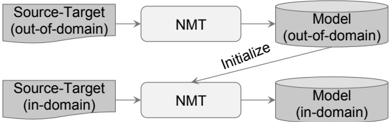
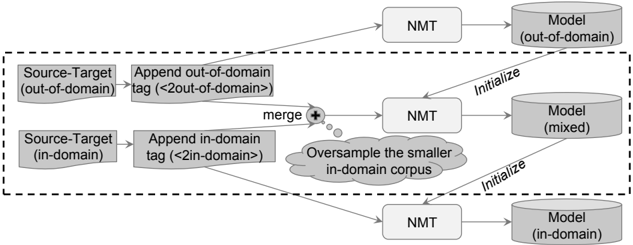
In this paper, we propose a novel domain adaptation method named "mixed fine tuning" for neural machine translation (NMT).We combine two existing approaches namely fine tuning and multi domain NMT.We first train an NMT model on an out-of-domain parallel corpus, and then fine tune it on a parallel corpus which is a mix of the in-domain and out-ofdomain corpora.All corpora are augmented with artificial tags to indicate specific domains.We empirically compare our proposed method against fine tuning and multi domain methods and discuss its benefits and shortcomings.
Overview
The claims and statistics of this paper haven’t been checked yet.
Free: it reads the open-access text and checks the first 5 claims that cite a source we can check. Create a free account to check every claim.
Integrity signals
Registry
Cites
Statistics
Figures
Verification
Claims the paper makes
The claims and statistics of this paper haven’t been checked yet.
Free: it reads the open-access text and checks the first 5 claims that cite a source we can check. Create a free account to check every claim.
Claims other papers make about this one
Each is checked against this paper’s own text: does it say what the citing paper says it does?
The cited source says what the claim attributes to it.
In the citing paper
“Specifically, the guidance signals could be style tokens [27,123], length specifications [56], domain tags [14], or any variety of other pieces of information used to control of the generated text.”
From Pre-train, Prompt, and Predict: A Systematic Survey of Prompting Methods in Natural Language Processing (2023) · cites this paper as [14]
Self-check
Percentages, sums and reported differences re-computed from the paper’s own numbers.
The self-check needs the paper’s full text.
Citations
Cites
Learning Phrase Representations using RNN Encoder–Decoder for Statistical Machine Translation
Cho, K., van Merrienboer, B., Gulcehre, C., Bahdanau, D., Bougares, F., Schwenk, H., & Bengio, Y. (2014) · Proceedings of the 2014 Conference on Empirical Methods in Natural Language Processing (EMNLP) · doi:10.3115/v1/d14-1179 · Cited by 25,545 · cited 2×
“One of the most attractive features of neural machine translation (NMT) (Bahdanau et al., 2015; Cho et al., 2014; Sutskever et al., 2014) is that it is possible to train an end to end system without the need to deal with word alignments, translation rules and complicated decoding algorithms, which are a characteristic…”
BackgroundSequence to Sequence Learning with Neural Networks
Sutskever, I., Vinyals, O., & Le, Q. V. (2014) · arXiv · doi:10.48550/arxiv.1409.3215 · Cited by 17,766 · cited 1×
“One of the most attractive features of neural machine translation (NMT) (Bahdanau et al., 2015; Cho et al., 2014; Sutskever et al., 2014) is that it is possible to train an end to end system without the need to deal with word alignments, translation rules and complicated decoding algorithms, which…”
BackgroundNeural Machine Translation by Jointly Learning to Align and Translate
Bahdanau, D., Cho, K., & Bengio, Y. (2014) · arXiv · doi:10.48550/arxiv.1409.0473 · Cited by 16,213 · cited 2×
“One of the most attractive features of neural machine translation (NMT) (Bahdanau et al., 2015; Cho et al., 2014; Sutskever et al., 2014) is that it is possible to train an end to end system without the need to deal with word alignments, translation rules and complicated decoding algorithms, which are a characteristic…”
BackgroundMoses: open source toolkit for statistical machine translation
Koehn, P., Zens, R., Dyer, C., Bojar, O., Constantin, A., Herbst, E., Hoang, H., Birch, A., Callison-Burch, C., Federico, M., et al. (2007) · Proceedings of the 45th Annual Meeting of the ACL on Interactive Poster and Demonstration Sessions - ACL '07 · doi:10.3115/1557769.1557821 · Cited by 4,735 · cited 1×
“We used the Moses PBSMT system (Koehn et al., 2007) for all of our MT experiments.”
MethodMinimum error rate training in statistical machine translation
Och, F. J. (2003) · Proceedings of the 41st Annual Meeting on Association for Computational Linguistics - ACL '03 · doi:10.3115/1075096.1075117 · Cited by 2,725 · cited 1×
“In all of our experiments, we used the GIZA++ toolkit 7 for word alignment; tuning was performed by minimum error rate training (Och, 2003), and it was re-run for every experiment.”
MethodStatistical Significance Tests for Machine Translation Evaluation.
Koehn, P. (2004) · Conference on Empirical Methods in Natural Language Processing (EMNLP) · Cited by 2,205
Google’s Multilingual Neural Machine Translation System: Enabling Zero-Shot Translation
Johnson, M., Schuster, M., Le, Q. V., Krikun, M., Wu, Y., Chen, Z., Thorat, N., Viégas, F., Wattenberg, M., Corrado, G., et al. (2017) · Transactions of the Association for Computational Linguistics · doi:10.1162/tacl_a_00065 · Cited by 1,747 · cited 1×
“Tag based NMT has also been shown to be effective for control the politeness of translations (Sennrich et al., 2016a) and multilingual NMT (Johnson et al., 2016).”
BackgroundMoses : open source toolkit for statistical machine translation
Koehn, P., Hoang, H., Birch, A., Callison-Burch, C., Federico, M., Bertoldi, N., Cowan, B., Shen, W., Moran, C., Zens, R., et al. (2007) · Edinburgh Research Explorer (University of Edinburgh) · Cited by 1,547
Transfer Learning for Low-Resource Neural Machine Translation
Zoph, B., Yuret, D., May, J., & Knight, K. (2016) · Proceedings of the 2016 Conference on Empirical Methods in Natural Language Processing · doi:10.18653/v1/d16-1163 · Cited by 788 · cited 8×
“However, it is reported that NMT works better than SMT only when there is an abundance of parallel corpora.”
BackgroundInfluentialStanford neural machine translation systems for spoken language domains.
Luong, M.-T., & Manning, C. D. (2015) · Cited by 499
Research works printed but not linked: 4
- [6]6. Fabien Cromieres, Chenhui Chu, Toshiaki Nakazawa, and Sadao Kurohashi. 2016. Kyoto univer- sity participation to wat 2016. In Proceed- ings of the 3rd Workshop on Asian Transla- tion (WAT2016). The COLING 2016 Organiz- ing Committee, Osaka, Japan, pages 166-174. http://aclweb.org/anthology/W16-4616.
- [14]14. Sadao Kurohashi, Toshihisa Nakamura, Yuji Mat- sumoto, and Makoto Nagao. 1994. Improvements of Japanese morphological analyzer JUMAN. In Pro- ceedings of the International Workshop on Sharable Natural Language. pages 22-28.
- [21]21. Rico Sennrich, Barry Haddow, and Alexandra Birch. 2016b. Improving neural machine translation models with monolingual data. In Proceed- ings of the 54th Annual Meeting of the As- sociation for Computational Linguistics (Volume 1: Long Papers). Association for Computa- tional Linguistics, Berlin, Germany, pages 86-96. http://www.aclweb.org/anthology/P16-1009.
- [22]22. Rico Sennrich, Barry Haddow, and Alexandra Birch. 2016c. Neural machine translation of rare words with subword units. In Proceed- ings of the 54th Annual Meeting of the As- sociation for Computational Linguistics (Volume 1: Long Papers). Association for Computational Linguistics, Berlin, Germany, pages 1715-1725. http://www.aclweb.org/anthology/P16-1162.
Cited by
Items 201–252 of 252
Yu, Z., Xu, J. C., Huang, X., Deng, Z., Wen, Y., Sun, L., Huang, Y., Peng, H., & Yu, P. S. (2025) · IEEE Transactions on Audio Speech and Language Processing · doi:10.1109/taslpro.2025.3570946 · Cited by 1
“Mix Fine-tune [39] merges data from both the general domain and all the specific domains for training, with oversampling of specific domain data.”
Chen, J., Li, C., & Zhou, W. (2025) · International Conference on Information Science and Education (ICISE-IE) · doi:10.1109/icise-ie68873.2025.11378955 · Cited by 1
“Adaptations like Domain Adaptive NMT [2] utilize fine-tuning, but they often suffer from catastrophic forgetting.”
Neural Machine Translation for Financial Listing Documents
Luo, L., Yang, H., Siu, S. C., & Chin, F. Y. L. (2018) · Lecture notes in computer science · doi:10.1007/978-3-030-04221-9_21 · Cited by 4
Review-Based Curriculum Learning for Neural Machine Translation
Hui, Z., Feng, C., & Zhang, T. (2022) · Communications in computer and information science · doi:10.1007/978-981-19-7960-6_3 · Cited by 1
Huang, S., Feng, C., Shi, G., Li, Z., Zhao, X., Li, X., & Wang, X. (2024) · ACM Transactions on Asian and Low-Resource Language Information Processing · doi:10.1145/3661305 · Cited by 1
“Chu et al. [5] propose the Mix Fine-Tuning (MFT) method, which fine-tunes the general domain model with the mix of general domain data and oversampled specific domain data.”
BackgroundMethodSong, H., Dabre, R., Chu, C., Fujita, A., & Kurohashi, S. (2024) · Journal of Information Processing · doi:10.2197/ipsjjip.32.628 · Cited by 1
Self-citationCombining Domain Knowledge and Deep Learning Makes NMT More Adaptive
Ding, L., He, Y., Zhou, L., & Liu, Q. (2017) · Communications in computer and information science · doi:10.1007/978-981-10-7134-8_9 · Cited by 1
Osaka University MT Systems for WAT 2018: Rewarding, Preordering, and Domain Adaptation
Kawara, Y., Takebayashi, Y., Chu, C., & Arase, Y. (2018) · Institutional Repositories DataBase (IRDB) · Cited by 1
Self-citationMino, H., Ito, H., Goto, I., Yamada, I., Tanaka, H., & Tokunaga, T. (2019) · Workshop on Asian Translation (WAT) · doi:10.18653/v1/d19-5212 · Cited by 1
“The multi-domain method (Chu et al., 2017; Sennrich et al., 2016a) is one of the most effective approaches to leverage out-of-domain data.”
BackgroundMethodDeep Blue Sonics’ Submission to IWSLT 2020 Open Domain Translation Task
Su, E., & Ren, Y. C. (2020) · International Conference on Spoken Language Translation (IWSLT) · doi:10.18653/v1/2020.iwslt-1.16 · Cited by 1
“Training the model with all available corpora, and fine-tuning it on a specific domain generally achieves best results in this domain (Chu et al., 2017).”
MethodInfosys Machine Translation System for WMT20 Similar Language Translation Task
Rathinasamy, K., Singh, A., Sivasambagupta, B., Neerchal, P. P., & Sivasankaran, V. (2020) · Conference on Machine Translation (WMT) · doi:10.18653/v1/2020.wmt-1.52 · Cited by 1
“Over-sampling (Chu et al., 2017; Junczys-Dowmunt and Grundkiewicz, 2018) real parallel data can overcome this problem.”
BackgroundGerman-Arabic Speech-to-Speech Translation for Psychiatric Diagnosis
Hussain, J., Behr, M., Chéragui, M. A., Stüker, S., Waibel, A., & Mediani, M. (2020) · KITopen · doi:10.5445/ir/1000166143 · Cited by 1
BJTU’s Submission to CCMT 2021 Translation Evaluation Task
Li, X., Wu, X., Wang, S., Liang, X., Li, Y., Huang, H., Chen, Y., & Xu, J. (2021) · Communications in computer and information science · doi:10.1007/978-981-16-7512-6_10 · Cited by 1
“Finetuning [2] with in-domain data can bring huge improvements.”
BackgroundUSST’s System for AutoSimTrans 2022
Hui, Z., & Jun, Y. L. (2022) · doi:10.18653/v1/2022.autosimtrans-1.7 · Cited by 1
“Besides, for better domain adaption, we combined mixed fine-tuning (Chu et al., 2017) with in-domain data filtering (Moore and Lewis, 2010; Ng et al., 2019) and proposed a new domain adaption method called “in-domain mixed fine-tuning”, which is empirically more effective than fine-tuning and mixed…”
MethodEffective Data Augmentation Methods for CCMT 2022
Wang, J., & Yang, L. (2022) · Communications in computer and information science · doi:10.1007/978-981-19-7960-6_14 · Cited by 1
“Fine Tuning Fine tuning [1] is an effective method which can bring improvements to neural network.”
MethodMachine Translation Based on Syntactic Structure
Zhou, X., & Zhang, S. (2023) · International Conference on Neural Networks, Information and Communication Engineering (NNICE) · doi:10.1109/nnice58320.2023.10105743 · Cited by 1
“…this problem, researchers have made the following two attempts: one is to expand the scale of the word list or install external dictionaries [1]; The second is to change the basic unit of translation from word to character or sub word, using finer grained language units to reduce the number…”
BackgroundSoft Alignment Objectives for Robust Adaptation of Language Generation
Štefánik, M., Kadlcík, M., & Sojka, P. (2022) · Annual Meeting of the Association for Computational Linguistics · doi:10.18653/v1/2023.acl-long.492 · Cited by 4
“Chu et al. (2017) enhance model robustness by mixing the pre-training and adaptation samples in continuous training, assuming that the full pre-training dataset is available, which is commonly not the case.”
BackgroundAdvanced techniques for domain adaptation in Statistical Machine Translation
Chinea-Ríos, M. (2019) · RiuNet (Universitat Politècnica de València) · doi:10.4995/thesis/10251/117611 · Cited by 1
Meta-Learning for Low-Resource Unsupervised Neural MachineTranslation.Preprint
Tae, Y., Park, C., Kim, T., Yang, S., Khan, M. A., Park, E., Qin, T., & Choo, J. (2020) · arXiv (Cornell University) · Cited by 1
Domain Adaptation of NMT models for English-Hindi Machine Translation Task at AdapMT ICON 2020Preprint
Joshi, R., Karnavat, R., Jirapure, K., & Joshi, R. B. (2020) · arXiv (Cornell University) · doi:10.48550/arxiv.2012.12112 · Cited by 1
Building generalizable models for discourse phenomena evaluation and machine translation
Jwalapuram, P. (2022) · DR-NTU (Nanyang Technological University) · doi:10.32657/10356/165027 · Cited by 1
Asadi, V., Shokpour, N., O’Neill, S., Dann, C. E., & Wang, J. (2023) · Research Square · doi:10.21203/rs.3.rs-3145838/v1 · Cited by 1
A Domain Adaptation Method for Neural Machine Translation
Tian, X., Liu, J., Pu, J., & Wang, J. (2018) · Lecture notes in electrical engineering · doi:10.1007/978-981-13-1328-8_41
Domain Adaptation for Neural Machine Translation with an Auxiliary Monolingual Loss
Rieß, S. (2019) · Open access LMU (Ludwid Maxmilian's Universitat Munchen) · doi:10.5282/ubm/epub.74083
Mao, Z., Shen, Y., Chu, C., Kurohashi, S., & Cheqing, J. (2020) · Workshop on Asian Translation (WAT) · doi:10.18653/v1/2020.wat-1.5
“We also revisit the domain adaption method (Chu et al., 2017) by adding tags of (cid:104) 2 indomain (cid:105) and (cid:104) 2 outofdomain (cid:105) during the training phase.”
BackgroundMethodSelf-citationFDMT: A Benchmark Dataset for Fine-grained Domain Adaptation in Machine Translation.Preprint
Zhu, W., Huang, S., Pu, T., Zhang, X., Yu, J. X., Chen, W., Wang, Y., & Chen, J. (2020) · arXiv (Cornell University)
Deep Generative Models for Natural Language Generation
Li, D. (2020) · ResearchWorks at the University of Washington (University of Washington)
Data Editing and Generation for Domain Adaptation in Neural Machine Translation
翁, 亦. (2018) · Institutional Repositories DataBase (IRDB)
Meta-learning for natural language processing
Zou, L. (2022) · Elsevier eBooks · doi:10.1016/b978-0-323-89931-4.00005-5
Demyanchuk, Y. I. (2023) · Вісник Житомирського державного університету імені Івана Франка Філологічні науки · doi:10.35433/philology.3(101).2023.142-153
Towards a Universal Python: Translating the Natural Modality of Python into Other Human Languages
Otten, J., Anastasopoulos, A., & Moran, K. (2023) · IEEE International Conference on Software Maintenance (ICSM) · doi:10.1109/icsme58846.2023.00044 · Cited by 2
“For example, in the future we plan to use established techniques from domain adaptation [20], [21], to fine-tune a well-performing general-domain translation model using data from the CS/SWE domain so as to better handle programming-related terms.”
MethodXu, J., Wen, Y., Xiang, Y., Jiang, S., Huang, Y., & Yu, Z. (2024) · International Journal of Machine Learning and Cybernetics · doi:10.1007/s13042-024-02253-w
“Previous research usually constructs a fully parameters-shared model to tackle the different domains [6, 35].”
Defect Quantification Using Novel Civil RGB-D Dataset
Midwinter, M., Al‐Sabbag, Z. A., Bajaj, R., & Yeum, C. M. (2024) · Lecture notes in civil engineering · doi:10.1007/978-3-031-61539-9_10
Guo, J., Liang, Y., & Xu, J. (2024) · doi:10.1109/icnlp60986.2024.10692378
A Data-Efficient Nearest-Neighbor Language Model via Lightweight Nets
Zhou, Q., Xiang, X., Wang, K., Zhang, Y., Wu, Y., & Li, Y. (2025) · Communications in computer and information science · doi:10.1007/978-981-96-2292-4_1
Lan-Bridge’s Submission to CCMT 2024 Translation Evaluation Task
Luo, M., Hu, G., & Wei, J. (2025) · Communications in computer and information science · doi:10.1007/978-981-96-2292-4_11
Ko, Y., Fukuda, R., Nishikawa, Y., Kano, Y., Sudoh, K., Sakti, S., & Nakamura, S. (2025) · Journal of Natural Language Processing · doi:10.5715/jnlp.32.404
Enhancing Domain-Specific Neural Machine Translation with Ensemble Attention Mechanisms
Purwitasari, D., Sholikah, R. W., Anggris, M. F., & Kusumawardani, R. P. (2025) · International Conference on Smart Computing, IoT and Machine Learning (SIML) · doi:10.1109/siml65326.2025.11080955
“The research conducted by Chu et al. [14] proposes a combination of the multi-domain and fine-tuning methods.”
CCKA: Continual Cross-Domain Knowledge Adaptation for Multi-Domain Machine Translation
Man, Z., Zhang, Y., Chen, Y., Chen, Y., & Xu, J. (2025) · IEEE Transactions on Audio Speech and Language Processing · doi:10.1109/taslpro.2025.3594292 · Cited by 1
“Fortunately, there is a continuous sharing of cross-domain knowledge between the new domain and the original domain [11], [12], which can simultaneously enhance the learning of original and new knowledge.”
Static and Dynamic Contextual Embedding for AutoML in Text Classification Tasks
Safikhani, P., & Broneske, D. (2025) · doi:10.1109/icnlp65360.2025.11108687
“Gururangan et al. [26] highlighted the significance of continued pretraining for enhancing domain adaptability, while Chu et al. [27] demonstrated that mixed-domain fine-tuning effectively promotes the learning of domain-invariant features.”
Continual Learning for Multilingual Neural Machine Translation via Meta-Contrastive Memory Replay
Zhou, L., Huang, D., Liu, J., Mo, F., & Huang, K. (2025) · Lecture notes in computer science · doi:10.1007/978-981-95-3349-7_15
Learning to Learn: When Chain-Of-Thought in Domain-Specific Machine Translation
Dai, Y., Chan, C. F., Wong, Y. K., & Pun, T. H. (2025) · International Joint Conference on Neural Networks (IJCNN) · doi:10.1109/ijcnn64981.2025.11229071
“However, the challenges in domain-specific machine translation (DMT) remain substantial [4], [5].”
An STE-Guided Machine Translation Method based on Evidence Theory
Ye, N., Yang, C., & Zhang, G. (2025) · International Joint Conference on Neural Networks (IJCNN) · doi:10.1109/ijcnn64981.2025.11229095
“2) Domain-adaptive models : We compared two fine-tuned translation models [23], two style transfer models [11] [12], and four retrieval-augmented translation models [28] [13] [29] [30].”
Document Meta-Information as Weak Supervision for Machine Translation
Jehl, L. (2019) · heiDOK (Heidelberg University) · doi:10.11588/heidok.00026780
Parsing Argumentative Structure in English-as-a-Foreign-Language Learner Essays
Putra, J. W. G., & Putra, J. W. G. (2021) · Institutional Repositories DataBase (IRDB)
Transfer learning and robustness for natural language processing
Jin, D. (2020) · DSpace@MIT (Massachusetts Institute of Technology) · Cited by 1
Toward domain-specific machine translation and quality estimation systems
Sharami, J. P. R. (2026) · arXiv (Cornell University) · doi:10.26116/tshd.47714582
Interpretable Neural Machine Translation from Translation to Post-Editing
出口, 祥. (2024) · Institutional Repositories DataBase (IRDB) · doi:10.34413/dr.02088
Efficient English-Vietnamese Medical Machine Translation: Insights from the VLSP 2025 Shared Task
Viet, T. H., Long, T. D., Quy, N. M., & Vinh, N. V. (2026) · VNU Journal of Science Computer Science and Communication Engineering · doi:10.25073/2588-1086/vnucsce.6588
“We analyze dataset characteristics, modeling strategies, and evaluation protocols, and discuss key findings and challenges observed across participating systems, especially those related to model size, domain adaptation [13], and translation quality.”
Using English-Based NLP Tools for Domain-Specific Text in Foreign Languages
Alatrush, N., Abdeljaber, L., Osorio, J., Heintze, D., Liko, B., Brandt, P. T., Khan, L. R., D'Orazio, V. J., & Alsarra, S. (2026) · IEEE Access · doi:10.1109/access.2026.3712041
“To improve domain-specific MT, researchers have also explored domain adaptation strategies, such as fine-tuning on in-domain data, dynamic data selection, and terminology-constrained decoding [16], [17], [18].”
Metadata
- Authors
- Chu, C., Dabre, R., & Kurohashi, S.
- Affiliations
- The University of Osaka (JP)
- Kyoto University (JP)
- Corresponding author
- Chu, Chenhui
- Venue
- Proceedings of the 55th Annual Meeting of the Association for Computational Linguistics (Volume 2: Short Papers)
- Published
- 2017
- Pages
- 385-391
- ISSN
- 0736-587X (ISSN-L)
- OpenAlex
- W2744813330
- Cited by
- 215
- References
- 28
- Citations by year
- 2025: 15 · 2024: 15 · 2023: 21 · 2022: 21 · 2021: 27 · 2020: 41 · 2019: 39 · 2018: 27 · 2017: 9
- FWCI
- 14.47
- Type
- conference paper
- Language
- en
- Open access
- hybrid
- doi.org
- Licence
- cc-by
- Locations
- Proceedings of the conference - Association for Computational Linguistics. Meeting (publishedVersion, cc-by)
- Funders
- Department of Science and Technology, Ministry of Science and Technology, India
- Japan Society for the Promotion of Science
- Topics
- Physical Sciences › Computer Science › Artificial Intelligence › Natural Language Processing Techniques
- Physical Sciences › Computer Science › Artificial Intelligence › Domain Adaptation and Few-Shot Learning
- Physical Sciences › Computer Science › Artificial Intelligence › Topic Modeling
- Keywords
- domain adaptation, neural machine translation, fine-tuning
About these checks
Registry, retraction, Cites and statistics results are computed, not judged, with one exception: a printed reference that no index lists is read once by a model before it counts as a citation error. Claims are extracted by a model and kept only when their quote appears verbatim in the text; each cited source is then checked, with a model’s help, for whether it says what the claim relies on. Those verdicts can be wrong — read the claim’s quote and the cited source before relying on one.
Statistics and arithmetic are recomputed, not judged.
Confidence bands are shown only for fields calibrated on our annotated test set. None is calibrated yet, so no band is shown.
What counts as a claim ›How we measure confidence ›How we check this ›
Are you an author, or do you see a problem with this page? Request a review
Data sources
Bibliographic data: Semantic Scholar, OpenAlex, Crossref.
Contains information from the Semantic Scholar Academic Graph Datasets, made available under the ODC Attribution License (ODC-BY 1.0).
Semantic Scholar’s data is described in: Kinney, R., et al. (2023). The Semantic Scholar Open Data Platform. arXiv:2301.10140.
