

The DOI matches its Crossref record; 34 of the 34 references it cites were found in a registry or an index.
Retrieve, Rerank and Rewrite: Soft Template Based Neural Summarization
Open accessAbstract
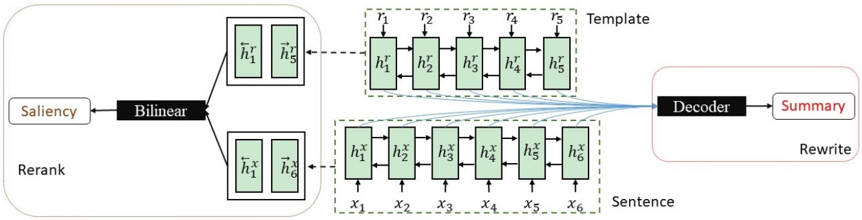
Most previous seq2seq summarization systems purely depend on the source text to generate summaries, which tends to work unstably.Inspired by the traditional template-based summarization approaches, this paper proposes to use existing summaries as soft templates to guide the seq2seq model.To this end, we use a popular IR platform to Retrieve proper summaries as candidate templates.Then, we extend the seq2seq framework to jointly conduct template Reranking and templateaware summary generation (Rewriting).Experiments show that, in terms of informativeness, our model significantly outperforms the state-of-the-art methods, and even soft templates themselves demonstrate high competitiveness.In addition, the import of high-quality external summaries improves the stability and readability of generated summaries.
Overview
The claims and statistics of this paper haven’t been checked yet.
Free: it reads the open-access text and checks the first 5 claims that cite a source we can check. Create a free account to check every claim.
Integrity signals
Registry
Cites
Statistics
Figures

Verification
Claims the paper makes
The claims and statistics of this paper haven’t been checked yet.
Free: it reads the open-access text and checks the first 5 claims that cite a source we can check. Create a free account to check every claim.
Self-check
Percentages, sums and reported differences re-computed from the paper’s own numbers.
The self-check needs the paper’s full text.
Citations
Cites
(2014) · Cited by 33,419
Learning Phrase Representations using RNN Encoder–Decoder for Statistical Machine Translation
Cho, K., van Merrienboer, B., Gulcehre, C., Bahdanau, D., Bougares, F., Schwenk, H., & Bengio, Y. (2014) · Proceedings of the 2014 Conference on Empirical Methods in Natural Language Processing (EMNLP) · doi:10.3115/v1/d14-1179 · Cited by 25,545
Neural Machine Translation by Jointly Learning to Align and Translate
Bahdanau, D., Cho, K., & Bengio, Y. (2014) · arXiv · doi:10.48550/arxiv.1409.0473 · Cited by 16,213
(2004) · Cited by 9,718
Effective Approaches to Attention-based Neural Machine Translation
Luong, T., Pham, H., & Manning, C. D. (2015) · Proceedings of the 2015 Conference on Empirical Methods in Natural Language Processing · doi:10.18653/v1/d15-1166 · Cited by 8,382
The Stanford CoreNLP Natural Language Processing Toolkit
Manning, C., Surdeanu, M., Bauer, J., Finkel, J., Bethard, S., & McClosky, D. (2014) · Proceedings of 52nd Annual Meeting of the Association for Computational Linguistics: System Demonstrations · doi:10.3115/v1/p14-5010 · Cited by 7,037
Google's Neural Machine Translation System: Bridging the Gap between Human and Machine Translation
Wu, Y., Schuster, M., Chen, Z., Le, Q. V., Norouzi, M., Macherey, W., Krikun, M., Cao, Y., Gao, Q., Macherey, K., et al. (2016) · arXiv · doi:10.48550/arxiv.1609.08144 · Cited by 5,319
Get To The Point: Summarization with Pointer-Generator Networks
See, A., Liu, P. J., & Manning, C. D. (2017) · Proceedings of the 55th Annual Meeting of the Association for Computational Linguistics (Volume 1: Long Papers) · doi:10.18653/v1/p17-1099 · Cited by 3,775
Learning Phrase Representations using RNN Encoder-Decoder for Statistical Machine Translation
Cho, K., van Merrienboer, B., Gulcehre, C., Bahdanau, D., Bougares, F., Schwenk, H., & Bengio, Y. (2014) · arXiv · doi:10.48550/arxiv.1406.1078 · Cited by 3,317
A Neural Attention Model for Abstractive Sentence Summarization
Rush, A. M., Chopra, S., & Weston, J. (2015) · Proceedings of the 2015 Conference on Empirical Methods in Natural Language Processing · doi:10.18653/v1/d15-1044 · Cited by 2,656
Abstractive Text Summarization using Sequence-to-sequence RNNs and Beyond
Nallapati, R., Zhou, B., dos Santos, C., Gulcehre, C., & Xiang, B. (2016) · Proceedings of The 20th SIGNLL Conference on Computational Natural Language Learning · doi:10.18653/v1/k16-1028 · Cited by 2,361
Incorporating Copying Mechanism in Sequence-to-Sequence Learning
Gu, J., Lu, Z., Li, H., & Li, V. O. K. (2016) · Proceedings of the 54th Annual Meeting of the Association for Computational Linguistics (Volume 1: Long Papers) · doi:10.18653/v1/p16-1154 · Cited by 1,446
A Deep Reinforced Model for Abstractive Summarization
Paulus, R., Xiong, C., & Socher, R. (2017) · arXiv · doi:10.48550/arxiv.1705.04304 · Cited by 1,182
Abstractive Sentence Summarization with Attentive Recurrent Neural Networks
Chopra, S., Auli, M., & Rush, A. M. (2016) · Proceedings of the 2016 Conference of the North American Chapter of the Association for Computational Linguistics: Human Language Technologies · doi:10.18653/v1/n16-1012 · Cited by 881
Get To The Point: Summarization with Pointer-Generator NetworksPreprint
See, A., Liu, P. J., & Manning, C. D. (2017) · arXiv (Cornell University) · doi:10.48550/arxiv.1704.04368 · Cited by 755
Effective Approaches to Attention-based Neural Machine Translation
Luong, M.-T., Pham, H., & Manning, C. D. (2015) · arXiv (Cornell University) · doi:10.48550/arxiv.1508.04025 · Cited by 655
A Thorough Examination of the CNN/Daily Mail Reading Comprehension Task
Chen, D., Bolton, J., & Manning, C. D. (2016) · Proceedings of the 54th Annual Meeting of the Association for Computational Linguistics (Volume 1: Long Papers) · doi:10.18653/v1/p16-1223 · Cited by 491
Summarization beyond sentence extraction: A probabilistic approach to sentence compression
Knight, K., & Marcu, D. (2002) · Artificial Intelligence · doi:10.1016/s0004-3702(02)00222-9 · Cited by 482
Abstractive Text Summarization Using Sequence-to-Sequence RNNs and Beyond
Nallapati, R. M., Zhou, B., dos Santos, C. N., et al. (2016) · arXiv (Cornell University) · doi:10.48550/arxiv.1602.06023 · Cited by 371
Faithful to the Original: Fact Aware Neural Abstractive Summarization
Cao, Z., Wei, F., Li, W., & Li, S. (2018) · Proceedings of the AAAI Conference on Artificial Intelligence · doi:10.1609/aaai.v32i1.11912 · Cited by 355
Self-citationGlobal Inference for Sentence Compression: An Integer Linear Programming Approach
Clarke, J., & Lapata, M. (2008) · Journal of Artificial Intelligence Research · doi:10.1613/jair.2433 · Cited by 303
Generating Sentences by Editing Prototypes
Guu, K., Hashimoto, T. B., Oren, Y., & Liang, P. (2018) · Transactions of the Association for Computational Linguistics · doi:10.1162/tacl_a_00030 · Cited by 300 · cited 2×
“Guu et al. (2017) also proposed to encode human-written sentences to improvement the performance of neural text generation.”
BackgroundMethodAn Information Retrieval Approach to Short Text ConversationPreprint
Ji, Z., Lu, Z., & Li, H. (2014) · arXiv (Cornell University) · doi:10.48550/arxiv.1408.6988 · Cited by 277
Incorporating Copying Mechanism in Sequence-to-Sequence LearningPreprint
Gu, J., Lu, Z., Li, H., et al. (2016) · arXiv (Cornell University) · doi:10.48550/arxiv.1603.06393 · Cited by 258
Headline generation based on statistical translation
Banko, M., Mittal, V. O., & Witbrock, M. J. (2000) · Proceedings of the 38th Annual Meeting on Association for Computational Linguistics - ACL '00 · doi:10.3115/1075218.1075259 · Cited by 240
Faithful to the Original: Fact Aware Neural Abstractive SummarizationPreprint
Cao, Z., Wei, F., Li, W., et al. (2017) · arXiv (Cornell University) · doi:10.48550/arxiv.1711.04434 · Cited by 173
Self-citationA Thorough Examination of the CNN/Daily Mail Reading Comprehension TaskPreprint
Chen, D., Bolton, J., & Manning, C. D. (2016) · arXiv (Cornell University) · doi:10.48550/arxiv.1606.02858 · Cited by 122
Saggion, H. (2017) · Synthesis lectures on human language technologies · doi:10.1007/978-3-031-02166-4 · Cited by 118
Joint Copying and Restricted Generation for Paraphrase
Cao, Z., Luo, C., Li, W., & Li, S. (2017) · Proceedings of the AAAI Conference on Artificial Intelligence · doi:10.1609/aaai.v31i1.10979 · Cited by 84
Self-citationJoint Copying and Restricted Generation for ParaphrasePreprint
Cao, Z., Luo, C., Li, W., et al. (2016) · arXiv (Cornell University) · doi:10.48550/arxiv.1611.09235 · Cited by 60
Self-citationNeural Headline Generation with Sentence-wise OptimizationPreprint
Ayana, A., Shen, S., Zhao, Y., Liu, Z., & Sun, M. (2016) · arXiv (Cornell University) · doi:10.48550/arxiv.1604.01904 · Cited by 55
Neural Headline Generation with Minimum Risk TrainingPreprint
Ayana, A., Shen, S., Liu, Z., & Sun, M. (2016) · arXiv (Cornell University) · Cited by 43
Generating Sentences by Editing PrototypesPreprint
Guu, K., Hashimoto, T., Oren, Y., et al. (2017) · arXiv (Cornell University) · doi:10.48550/arxiv.1709.08878 · Cited by 33
Template-Filtered Headline Summarization
Zhou, L., & Hovy, E. H. (2004) · Cited by 25
Research works printed but not linked: 2
- [14]14. Philipp Koehn and Rebecca Knowles. 2017. Six chal- lenges for neural machine translation. arXiv pre- print arXiv:1706.03872. · arXiv
- [21]21. Alexander M. Rush, Sumit Chopra, and Jason Weston. 2015b. A neural attention model for abstractive sen- tence summarization. In Proceedings of EMNLP, pages 379-389.
Cited by
Liu, P., Yuan, W., Fu, J., Jiang, Z., Hayashi, H., & Neubig, G. (2023) · ACM Computing Surveys · doi:10.1145/3560815 · Cited by 4,361
Unified Language Model Pre-training for Natural Language Understanding and Generation
Dong, L., Yang, N., Wang, W., Wei, F., Liu, X., Wang, Y., Gao, J., Zhou, M., & Hon, H.-W. (2019) · arXiv · doi:10.48550/arxiv.1905.03197 · Cited by 1,225
Self-citationLiu, P., Yuan, W., Fu, J., Jiang, Z., Hayashi, H., & Neubig, G. (2021) · arXiv · doi:10.48550/arxiv.2107.13586 · Cited by 4,352
ProphetNet: Predicting Future N-gram for Sequence-to-SequencePre-training
Qi, W., Yan, Y., Gong, Y., Liu, D., Duan, N., Chen, J., Zhang, R., & Zhou, M. (2020) · Findings of the Association for Computational Linguistics: EMNLP 2020 · doi:10.18653/v1/2020.findings-emnlp.217 · Cited by 374
Knowledge-Driven Encode, Retrieve, Paraphrase for Medical Image Report Generation
Li, C. Y., Liang, X., Hu, Z., & Xing, E. P. (2019) · Proceedings of the AAAI Conference on Artificial Intelligence · doi:10.1609/aaai.v33i01.33016666 · Cited by 299
Metadata
- Authors
- Cao, Z., Li, W., Li, S., & Wei, F.
- Affiliations
- Hong Kong Polytechnic University (HK)
- Peking University (CN)
- Microsoft Research Asia (China) (CN)
- Venue
- Proceedings of the 56th Annual Meeting of the Association for Computational Linguistics (Volume 1: Long Papers)
- Published
- 2018
- Pages
- 152-161
- ISSN
- 0736-587X (ISSN-L)
- OpenAlex
- W2798542795
- Cited by
- 202
- References
- 27
- Citations by year
- 2026: 1 · 2025: 11 · 2024: 10 · 2023: 21 · 2022: 26 · 2021: 37 · 2020: 48 · 2019: 43 · 2018: 5
- FWCI
- 13.58
- Type
- conference paper
- Language
- en
- Open access
- hybrid
- doi.org
- Licence
- cc-by
- Locations
- Proceedings of the conference - Association for Computational Linguistics. Meeting (publishedVersion, cc-by)
- PolyU Institutional Research Archive (Hong Kong Polytechnic University) (submittedVersion, cc-by-nc-sa)
- Funders
- National Natural Science Foundation of China (61672445, 61572049)
- Hong Kong Polytechnic University (G-YBP6)
- Topics
- Physical Sciences › Computer Science › Artificial Intelligence › Topic Modeling
- Physical Sciences › Computer Science › Artificial Intelligence › Advanced Text Analysis Techniques
- Physical Sciences › Computer Science › Artificial Intelligence › Natural Language Processing Techniques
- Keywords
- soft template, information retrieval, informativeness
About these checks
Registry, retraction, Cites and statistics results are computed, not judged, with one exception: a printed reference that no index lists is read once by a model before it counts as a citation error. Claims are extracted by a model and kept only when their quote appears verbatim in the text; each cited source is then checked, with a model’s help, for whether it says what the claim relies on. Those verdicts can be wrong — read the claim’s quote and the cited source before relying on one.
Statistics and arithmetic are recomputed, not judged.
Confidence bands are shown only for fields calibrated on our annotated test set. None is calibrated yet, so no band is shown.
What counts as a claim ›How we measure confidence ›How we check this ›
Are you an author, or do you see a problem with this page? Request a review
Data sources
Bibliographic data: Semantic Scholar, OpenAlex, Crossref.
Contains information from the Semantic Scholar Academic Graph Datasets, made available under the ODC Attribution License (ODC-BY 1.0).
Semantic Scholar’s data is described in: Kinney, R., et al. (2023). The Semantic Scholar Open Data Platform. arXiv:2301.10140.
