

Post-fire vegetation and fuel development influences fire severity patterns in reburns
Open accessThe DOI matches its Crossref record; 88 of the 88 references it cites were found in a registry or an index.
Abstract
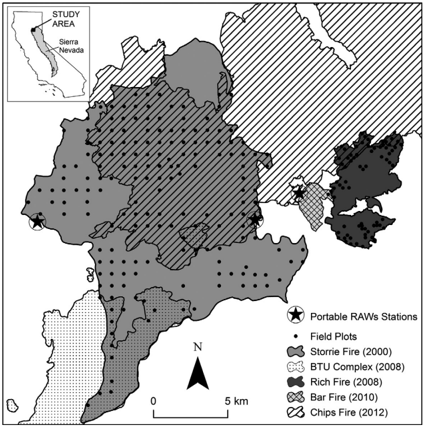
In areas where fire regimes and forest structure have been dramatically altered, there is increasing concern that contemporary fires have the potential to set forests on a positive feedback trajectory with successive reburns, one in which extensive stand‐replacing fire could promote more stand‐replacing fire. Our study utilized an extensive set of field plots established following four fires that occurred between 2000 and 2010 in the northern Sierra Nevada, California, USA that were subsequently reburned in 2012. The information obtained from these field plots allowed for a unique set of analyses investigating the effect of vegetation, fuels, topography, fire weather, and forest management on reburn severity. We also examined the influence of initial fire severity and time since initial fire on influential predictors of reburn severity. Our results suggest that high‐ to moderate‐severity fire in the initial fires led to an increase in standing snags and shrub vegetation, which in combination with severe fire weather promoted high‐severity fire effects in the subsequent reburn. Although fire behavior is largely driven by weather, our study demonstrates that post‐fire vegetation composition and structure are also important drivers of reburn severity. In the face of changing climatic regimes and increases in extreme fire weather, these results may provide managers with options to create more fire‐ resilient ecosystems. In areas where frequent high‐severity fire is undesirable, management activities such as thinning, prescribed fire, or managed wildland fire can be used to moderate fire behavior not only prior to initial fires, but also before subsequent reburns.
Overview
The claims and statistics of this paper haven’t been checked yet.
Free: it reads the open-access text and checks the first 5 claims that cite a source we can check. Create a free account to check every claim.
Integrity signals
Registry
Cites
Statistics
Figures



Verification
Claims the paper makes
The claims and statistics of this paper haven’t been checked yet.
Free: it reads the open-access text and checks the first 5 claims that cite a source we can check. Create a free account to check every claim.
Claims other papers make about this one
Each is checked against this paper’s own text: does it say what the citing paper says it does?
The source backs part of the claim, not all of it — or backs it for a different population, condition or comparison.
In the citing paper
“Areas that do burn under wildfire conditions (as opposed to prescribed fire) within 15-25 years after extensive mortality are prone to long-term conversion to shrub fields because of the potential loss of both established tree regeneration and seed source for postfire conifer regeneration (Coppoletta et al. 2016).”
From Drought, Tree Mortality, and Wildfire in Forests Adapted to Frequent Fire (2018) · cites this paper as Coppoletta et al. 2016
Experimental — accuracy not yet measured
Self-check
Percentages, sums and reported differences re-computed from the paper’s own numbers.
The self-check needs the paper’s full text.
Citations
Cites
R: A Language and Environment for Statistical Computing
R Core Team (2025) · doi:10.32614/r.manuals · Cited by 352,181
Resilience and Stability of Ecological Systems
Holling, C. S. (1973) · Annual Review of Ecology and Systematics · doi:10.1146/annurev.es.04.110173.000245 · Cited by 18,995 · cited 1×
“Altering conditions so that disturbance processes can act to increase, rather than reduce, forest heterogeneity may provide ecosystems with the ecological fexibility (Holling 1973) to withstand and persist through future changes in climate and climaterelated processes (Safford et al. 2012a).”
BackgroundGeneralized Additive Models: An Introduction with R
Wood, S. N. (2017) · doi:10.1201/9781315370279 · Cited by 13,852
Koyak, R. A., Hastie, T. J., & Tibshirani, R. J. (1991) · Journal of the American Statistical Association · doi:10.2307/2290538 · Cited by 7,596
Wood, S. N. (2006) · doi:10.1201/9781420010404 · Cited by 4,953
Bias in random forest variable importance measures: Illustrations, sources and a solution
Strobl, C., Boulesteix, A.-L., Zeileis, A., & Hothorn, T. (2007) · BMC Bioinformatics · doi:10.1186/1471-2105-8-25 · Cited by 3,688
Hastie, T., & Tibshirani, R. (1986) · Statistical Science · doi:10.1214/ss/1177013604 · Cited by 3,409
Conditional variable importance for random forests
Strobl, C., Boulesteix, A.-L., Kneib, T., Augustin, T., & Zeileis, A. (2008) · BMC Bioinformatics · doi:10.1186/1471-2105-9-307 · Cited by 3,254
Strobl, C., Malley, J., & Tutz, G. (2009) · Psychological Methods · doi:10.1037/a0016973 · Cited by 2,583 · cited 2×
“Predictor variables with importance values greater than the absolute value of the lowest negative score were considered infuential or of potential interest (Strobl et al. 2009).”
BackgroundMiller, J. D., & Thode, A. E. (2007) · Remote Sensing of Environment · doi:10.1016/j.rse.2006.12.006 · Cited by 1,431 · cited 2×
“Fire severity was estimated using the Relative differenced Normalized Burn Ratio (RdNBR), derived from Landsat Thematic Mapper data acquired during the frst growing season after the fre was controlled (Miller and Thode 2007).”
BackgroundMethod
Research works printed but not linked: 1
- 63. Safford, H., M. North and M. Meyer, 2012a. Climate change and the relevance of historical forest conditions. Pages 184 in M. North editor. Managing Sierra Nevada forests. Gen. Tech. Rep. PSW-GTR-237.
Cited by
Items 101–200 of 296
Fernández‐Guisuraga, J. M., & Calvo, L. (2023) · Fire Ecology · doi:10.1186/s42408-023-00232-0 · Cited by 32
“…Basin should be tailored to moderate fuel build-up and thus fire hazard and high fire severity not only prior to the initial wildfires, but also before subsequent reburns occur (Coppoletta et al. 2016) to avoid long-term ecosystem state changes in areas of interacting wildfire disturbances.”
BackgroundInfluentialFoster, D. E., Battles, J. J., Collins, B. M., York, R. A., & Stephens, S. L. (2020) · Ecosphere · doi:10.1002/ecs2.3198 · Cited by 36
“The likelihood of another wildfire occurring shortly after the first fire (i.e., reburn potential), which would result in rapid dead tree carbon release to the atmosphere, is another consideration (Coppoletta et al. 2016, Lydersen et al. 2019).”
BackgroundSelf-citationDo repeated wildfires promote restoration of oak woodlands in mixed-conifer landscapes?
Nemens, D. G., Varner, J. M., Kidd, K. R., & Wing, B. M. (2018) · Forest Ecology and Management · doi:10.1016/j.foreco.2018.05.023 · Cited by 34
What Drives Low-Severity Fire in the Southwestern USA?
Parks, S. A., Dobrowski, S. Z., & Panunto, M. H. (2018) · Forests · doi:10.3390/f9040165 · Cited by 32
“Moreover, low-severity fire often reinforces a pattern of low-severity fire in subsequent fire events [18,59,98].”
BackgroundAssessing giant sequoia mortality and regeneration following high‐severity wildfire
Soderberg, D. N., Das, A. J., Stephenson, N. L., Meyer, M. D., Brigham, C. A., & Flickinger, J. (2024) · Ecosphere · doi:10.1002/ecs2.4789 · Cited by 30
Persistent effects of fire severity on ponderosa pine regeneration niches and seedling growth
Owen, S. M., Sieg, C. H., Fulé, P. Z., Gehring, C. A., Baggett, L. S., Iniguez, J. M., Fornwalt, P. J., & Battaglia, M. A. (2020) · Forest Ecology and Management · doi:10.1016/j.foreco.2020.118502 · Cited by 31
“In addition, fires create canopy openings that enhance understory biomass production, and moderate to high-severity fires increase coarse woody fuel loads which may provide microsites favoring pine growth, but may eventually put seedlings at risk of burning as the wood decomposes and becomes more flammable (Fajardo et…”
BackgroundLong‐term empirical evidence shows post‐disturbance climate controls post‐fire regeneration
Guz, J., Gill, N. S., & Kulakowski, D. (2021) · Journal of Ecology · doi:10.1111/1365-2745.13771 · Cited by 30
“Our results suggest enduring post- disturbance regeneration, but a possible climatically driven shift in forest heterogeneity, which would have likely implications for future ecological dynamics (Coppoletta et al., 2016).”
BackgroundResultFire Ecology of the North American Mediterranean-Climate Zone
Safford, H. D., Butz, R. J., Bohlman, G. N., Coppoletta, M., Estes, B. L., Gross, S. E., Merriam, K. E., Meyer, M. D., Molinari, N. A., & Wuenschel, A. (2021) · Managing forest ecosystems · doi:10.1007/978-3-030-73267-7_9 · Cited by 33
Self-citationStrong Legacy Effects of Prior Burn Severity on Forest Resilience to a High-Severity Fire
Harris, L. B., Drury, S. A., & Taylor, A. H. (2020) · Ecosystems · doi:10.1007/s10021-020-00548-x · Cited by 28
System-level feedbacks of active fire regimes in large landscapes
Povak, N. A., Hessburg, P. F., Salter, R. B., Gray, R. W., & Prichard, S. J. (2023) · Fire Ecology · doi:10.1186/s42408-023-00197-0 · Cited by 30
Overcoming obstacles to prescribed fire in the North American Mediterranean climate zone
Williams, J. N., Quinn-Davidson, L. N., Safford, H. D., Grupenhoff, A., Middleton, B. R., Restaino, J., Smith, E., Adlam, C., & Rivera‐Huerta, H. (2023) · Frontiers in Ecology and the Environment · doi:10.1002/fee.2687 · Cited by 27
Miller, J. D., Safford, H. D., & Welch, K. R. (2016) · Forest Ecology and Management · doi:10.1016/j.foreco.2016.10.017 · Cited by 24
Fire interval and post-fire climate effects on serotinous forest resilience
Agne, M. C., Fontaine, J. B., Enright, N. J., & Harvey, B. J. (2022) · Fire Ecology · doi:10.1186/s42408-022-00145-4 · Cited by 26
Burton, J. E., Bennett, L. T., Kasel, S., Nitschke, C. R., Tanase, M. A., Fairman, T. A., Parker, L., Fedrigo, M., & Aponte, C. (2020) · Forest Ecology and Management · doi:10.1016/j.foreco.2020.118859 · Cited by 23
Fernández‐Guisuraga, J. M., & Calvo, L. (2025) · Fire Ecology · doi:10.1186/s42408-025-00371-6 · Cited by 29
“…results align with ecological expectations where repeated severe burns may reinforce a high-severity fire regime through a positive feedback loop (Coppoletta et al., 2016; Fernández-Guisuraga & Calvo 2023), with increasing aridity further facilitating the shift toward alternative ecosystem…”
Paudel, A., Coppoletta, M., Merriam, K. E., & Markwith, S. H. (2022) · Forest Ecology and Management · doi:10.1016/j.foreco.2022.120079 · Cited by 27
Self-citationReference scenarios for evaluating wood pellet production in the Southeastern United States
Parish, E. S., Dale, V. H., Kline, K. L., & Abt, R. C. (2017) · Wiley Interdisciplinary Reviews Energy and Environment · doi:10.1002/wene.259 · Cited by 21
“Removal of dead wood and thinning is an effective means to manage all lands to proactively reduce the risk of destructive wildfires, insect outbreaks, or storm damage.(49) Biomass residues may also be collected while managing recreation and conservation lands impacted by invasive species, disturbances, or required tre…”
BackgroundA machine learning model to predict wildfire burn severity for pre-fire risk assessments, Utah, USA
Klimas, K. B., Yocom, L. L., Murphy, B. P., David, S. R., Belmont, P., Lutz, J. A., DeRose, R. J., & Wall, S. A. (2025) · Fire Ecology · doi:10.1186/s42408-024-00346-z · Cited by 27
“…woodlands and ponderosa pine forests is likely due to differences in species ecology or forest structure that were not explicit in model terms—for example, midstory ladder fuels or conifer boughs that reach the ground are difficult to characterize with remotely sensed data (Coppoletta et al. 2015).”
Spotted owls and forest fire: Comment
Jones, G. M., Gutiérrez, R. J., Block, W. M., Carlson, P. C., Comfort, E. J., Cushman, S. A., Davis, R. J., Eyes, S. A., Franklin, A. B., Ganey, J. L., et al. (2020) · Ecosphere · doi:10.1002/ecs2.3312 · Cited by 21
“…(e.g., shrublands, non-native grasslands) following large, severe fires because of compromised seed sources, post-fire soil erosion and loss, high-severity re-burn, and climatic thresholds (Coppoletta et al. 2016, Stevens et al. 2017, Rissman et al. 2018, Shive et al. 2018, Wood and Jones 2019).”
BackgroundKreye, J. K., Kane, J. M., & Varner, J. M. (2023) · Fire Ecology · doi:10.1186/s42408-023-00176-5 · Cited by 20
“Anthropogenic alteration of historically fire-prone ecosystems can result in positive feedbacks that modify fire regimes through hastening or dampening fire (e.g., Nowacki and Abrams 2008; Coppoletta et al. 2016; Tepley et al. 2018).”
BackgroundJohnson, M. C., Kennedy, M. C., Harrison, S. C., Churchill, D. J., Pass, J., & Fischer, P. W. (2020) · Forest Ecology and Management · doi:10.1016/j.foreco.2020.118190 · Cited by 22
“Post disturbance management of large areas with firekilled trees is a central management concern for low severity, high firefrequency forest regimes (Coppoletta et al. 2016).”
BackgroundOdland, M., Goodwin, M. J., Smithers, B. V., Hurteau, M. D., & North, M. P. (2021) · Forest Ecology and Management · doi:10.1016/j.foreco.2021.119361 · Cited by 26
“…treatments may be analogous to conditions following wildfires in similar mixed-conifer forests, where high severity fire and shrub cover can create a positive feedback loop that induces type conversion from conifer forest to an alternate stable state of montane chaparral (Coppoletta et al., 2016).”
BackgroundComparing Fire Extent and Severity Mapping between Sentinel 2 and Landsat 8 Satellite Sensors
White, L. A., & Gibson, R. K. (2022) · Remote Sensing · doi:10.3390/rs14071661 · Cited by 21
Metlen, K. L., Fairbanks, T., Bennett, M., Volpe, J., Kuhn, B., Thompson, M. P., Thrailkill, J., Schindel, M., Helmbrecht, D., Scott, J. H., et al. (2021) · Canadian Journal of Forest Research · doi:10.1139/cjfr-2020-0480 · Cited by 25
Wilson, N., Bradstock, R. A., & Bedward, M. (2021) · Journal of Environmental Management · doi:10.1016/j.jenvman.2021.114011 · Cited by 22
McCord, M. G., Reilly, M. J., Butz, R. J., & Jules, E. S. (2019) · Canadian Journal of Forest Research · doi:10.1139/cjfr-2019-0161 · Cited by 22
Clark, M. L., Hakkenberg, C. R., Bailey, T., Burns, P., & Goetz, S. J. (2025) · Remote Sensing of Environment · doi:10.1016/j.rse.2025.114718 · Cited by 23
Kennedy, M. C., Johnson, M. C., & Harrison, S. C. (2020) · Forest Science · doi:10.1093/forsci/fxaa036 · Cited by 17
Does conserving roadless wildland increase wildfire activity in western US national forests?
Johnston, J. D., Kilbride, J. B., Meigs, G. W., Dunn, C. J., & Kennedy, R. E. (2021) · Environmental Research Letters · doi:10.1088/1748-9326/ac13ee · Cited by 20
Liang, S., & Hurteau, M. D. (2023) · Functional Ecology · doi:10.1111/1365-2435.14263 · Cited by 25
Controls of reburn severity vary with fire interval in the Klamath Mountains, California, USA
Grabinski-Parker, Z. S., Sherriff, R. L., & Kane, J. M. (2017) · Ecosphere · doi:10.1002/ecs2.2012 · Cited by 24
Taylor, A. H., Poulos, H. M., Kluber, J., Isaacs, R. E., Pawlikowski, N. C., & Barton, A. M. (2021) · Landscape Ecology · doi:10.1007/s10980-021-01260-4 · Cited by 24
Forest Fire Effects on Landscape Snow Albedo Recovery and Decay
Gersh, M., Gleason, K. E., & Surunis, A. (2022) · Remote Sensing · doi:10.3390/rs14164079 · Cited by 23
“cannot recover to their pre-fire conditions, remaining a heterogeneous mix of shrubland [46].”
BackgroundLand ownership impacts post-wildfire forest regeneration in Sierra Nevada mixed-conifer forests
Stephens, C. W., Collins, B. M., & Rogan, J. S. (2020) · Forest Ecology and Management · doi:10.1016/j.foreco.2020.118161 · Cited by 20
“Furthermore, passive post-fire management can lead to increased woody debris abundance and surface fuel continuity which contributes to subsequent uncharacteristically large and severe re-burns (Brown et al., 2003; Sessions et al., 2004; Akay et al., 2006; Monsanto and Agee, 2008; Keyser et al., 2009; Fraver et al., 2…”
BackgroundSelf-citationRecurring wildfires provoke type conversion in dry western forests
Nemens, D. G., Kidd, K. R., Varner, J. M., & Wing, B. M. (2022) · Ecosphere · doi:10.1002/ecs2.4184 · Cited by 18
Simulated fire behaviour in young, postfire lodgepole pine forests
Nelson, K. N., Turner, M. G., Romme, W. H., & Tinker, D. B. (2017) · International Journal of Wildland Fire · doi:10.1071/wf16226 · Cited by 19
“A growing body of evidence indicates that time-since-fire plays an important role in the self-regulation of fire, especially as fires overlap at shortened intervals (Peterson 2002; Collins et al. 2009; Price and Bradstock 2010; Teske et al. 2012; Collins et al. 2015; Parks et al. 2015; Coppoletta et al. 2016; Parks et…”
BackgroundKidd, K. R., & Varner, J. M. (2018) · Trees · doi:10.1007/s00468-018-1775-z · Cited by 17
“100 years) prior to the Chips Fire (2012), which created increased stand densities, and thus, shade, allowing A. macrophyllum and 1 3 C. nuttallii (optimal growth typically occurs in more mesic, shaded habitats) to persist on these steep, xeric slopes.”
BackgroundInfluentialFertel, H. M., North, M. P., Latimer, A. M., & Ng, J. (2022) · Forest Ecology and Management · doi:10.1016/j.foreco.2022.120270 · Cited by 16
Tortorelli, C. M., Latimer, A. M., & Young, D. J. N. (2024) · Ecological Applications · doi:10.1002/eap.3023 · Cited by 22
“…and microclimates on fire behavior, it is also driven by fire and fuel feed-backs, including consumption of surface fuels, increased snags and downed wood, and changes in the abundance and continuity of shrubs which tend to increase reburn severity (Coop et al., 2020; Coppoletta et al., 2016).”
BackgroundResultVegetation recovery rates provide insight into reburn severity in southwestern Oregon, USA
Weber, R. N., Powers, M. D., & Kennedy, R. E. (2022) · Forest Ecology and Management · doi:10.1016/j.foreco.2022.120292 · Cited by 16
Sharma, S., Aryal, J., Shao, Q., & Rajabifard, A. (2023) · IEEE Journal of Selected Topics in Applied Earth Observations and Remote Sensing · doi:10.1109/jstars.2023.3249643 · Cited by 12
“Similarly, Coppoletta et al. [41] modeled relationships using regression splines and found generalized additive models (GAMs) better suited to model nonlinear relationships in comparison to linear models.”
MethodOverstory Structure and Surface Cover Dynamics in the Decade Following the Hayman Fire, Colorado
Fornwalt, P. J., Stevens‐Rumann, C. S., & Collins, B. J. (2018) · Forests · doi:10.3390/f9030152 · Cited by 18
Self-citationGale, M. G., Cary, G. J., van Dijk, A. I. J. M., & Yebra, M. (2023) · Journal of Environmental Management · doi:10.1016/j.jenvman.2023.119474 · Cited by 17
When do contemporary wildfires restore forest structures in the Sierra Nevada?
Chamberlain, C. P., Bartl-Geller, B. N., Cansler, C. A., North, M. P., Meyer, M. D., van Wagtendonk, L., Redford, H. E., & Kane, V. R. (2024) · Fire Ecology · doi:10.1186/s42408-024-00324-5 · Cited by 14
“This suggests that a large portion of first-entry burned areas, even within moderate-severity patches, may still require additional low-to moderate-intensity wildfires or other forms of post-fire management (Coppoletta et al. 2016; Meyer et al. 2021; Steel et al. 2021).”
BackgroundTubbesing, C. L., Young, D. J. N., York, R. A., Stephens, S. L., & Battles, J. J. (2021) · Ecosystems · doi:10.1007/s10021-021-00645-5 · Cited by 19
Pyrodiversity in a Warming World: Research Challenges and Opportunities
Jones, G. M., Ayars, J., Parks, S. A., Chmura, H. E., Cushman, S. A., & Sanderlin, J. S. (2022) · Current Landscape Ecology Reports · doi:10.1007/s40823-022-00075-6 · Cited by 17
Fernández‐Guisuraga, J. M., & Fernandes, P. M. (2024) · Forest Ecology and Management · doi:10.1016/j.foreco.2024.121921 · Cited by 19
Sterner, S., Aslan, C. E., Best, R. J., & Chaudhry, T. (2022) · Forest Ecology and Management · doi:10.1016/j.foreco.2022.120394 · Cited by 16
Jaffe, M. R., Kreider, M. R., Affleck, D. L. R., Higuera, P. E., Seielstad, C., Parks, S. A., & Larson, A. J. (2023) · Forest Ecology and Management · doi:10.1016/j.foreco.2023.121283 · Cited by 13
Urban Fire Severity and Vegetation Dynamics in Southern California
Mathews, L. E. H., & Kinoshita, A. M. (2020) · Remote Sensing · doi:10.3390/rs13010019 · Cited by 13
“The combination of extra fuel loads, woody debris and abundant grasses accumulating in the riparian zone [48,49], and the high flammability of chaparral vegetation due to volatile compounds [6,25,47,50,51], may encourage intense and sustained fires that can severely impact vegetation health [25,52].”
BackgroundDuff, T. J., Cawson, J. G., & Penman, T. D. (2018) · Springer eBooks · doi:10.1007/978-3-319-51727-8_120-1 · Cited by 13
Peterson, D. W., Dodson, E. K., & Harrod, R. J. (2023) · Ecosphere · doi:10.1002/ecs2.4635 · Cited by 14
Post-fire reference densities for giant sequoia seedlings
Stephenson, N. L., Caprio, A. C., Soderberg, D. N., Das, A. J., Lopez, E. L., & Williams, P. (2023) · Forest Ecology and Management · doi:10.1016/j.foreco.2024.121916 · Cited by 16
Taylor, A. H., Airey, C. T., Estes, B. L., Harris, L. B., & Skinner, C. N. (2020) · Landscape Ecology · doi:10.1007/s10980-020-01118-1 · Cited by 13
Northrop, H., Axelson, J., Das, A. J., Stephenson, N. L., Vilanova, E., Stephens, S. L., & Battles, J. J. (2023) · Forest Ecology and Management · doi:10.1016/j.foreco.2023.121521 · Cited by 13
“2023), will increase the risk of high severity fire and potential for mass fire (Arno, 2000; Brown et al., 2003; Coppoletta et al., 2016; Stephens et al., 2018; Stephens et al., 2022).”
BackgroundKline, K. L., Dale, V. H., & Rose, E. (2021) · Frontiers in Forests and Global Change · doi:10.3389/ffgc.2021.674138 · Cited by 13
“Pre-commercial forest thinning activities decrease the risks of insect outbreaks, disease, and destructive wildfire (Coppoletta et al., 2016) and are supported by local biomass-for-energy markets.”
BackgroundKrofcheck, D., Litvak, M. E., & Hurteau, M. D. (2019) · Ecosphere · doi:10.1002/ecs2.2905 · Cited by 14
Carrión‐Paladines, V., Quezada, L. C., Malo, H. V., Ruáles, J. Z., Tumbaco, A. P., Pisco, M. Z., Panchi, N. L., Jiménez, L., Benítez, Á., & Loján-Córdova, J. (2024) · Journal of Ethnobiology and Ethnomedicine · doi:10.1186/s13002-024-00699-4 · Cited by 12
“Therefore, in line with recent studies like Cop-poletta et al. [89], the low fuel load in cultivated areas, as evidenced in this study, may lead to low-severity fires.”
ResultStephenson, N. L., Soderberg, D. N., Flickinger, J., Caprio, A. C., & Das, A. J. (2024) · Fire Ecology · doi:10.1186/s42408-024-00316-5 · Cited by 14
“…are not reduced (such as by prescribed surface fires), areas that previously burned at high severity have a high probability of reburning at high severity, especially during extreme fire weather (Coppoletta et al. 2016; Harris and Taylor 2017; Lydersen et al. 2017, 2019; Taylor et al. 2021, 2022).”
BackgroundA New Application of the Disturbance Index for Fire Severity in Coastal Dunes
DaSilva, M. D., Bruce, D., Hesp, P. A., & da Silva, G. M. (2021) · Remote Sensing · doi:10.3390/rs13234739 · Cited by 14
Buchholz, T. S., Gunn, J., Springsteen, B., Marland, G. H., Moritz, M. A., & Saah, D. S. (2021) · Mitigation and Adaptation Strategies for Global Change · doi:10.1007/s11027-021-09983-0 · Cited by 14
“a vegetation type change from forest to grassland or shrub types lasting at least several decades (Collins and Roller 2013; Coppoletta et al. 2016; Roccaforte et al. 2012; Rother and Veblen 2016, p. 20; Tubbesing et al. 2019; van Wagtendonk et al. 2012; Welch et al. 2016).”
BackgroundSpiegel, C. J., Mladenov, N., Wall, C. B., Hollman, K., Tran, C. H., Symons, C. C., & Shurin, J. B. (2023) · Global Change Biology · doi:10.1111/gcb.17061 · Cited by 12
“The two severity types generally represent the characteristics of post-fire vegetation as wildfire intensity and severity can lead to variable appearances (Coppoletta et al., 2016; Keeley, 2009).”
BackgroundFrancos, M., Pereira, P. A. D. S., & Úbeda, X. (2019) · Journal of Forestry Research · doi:10.1007/s11676-019-00936-7 · Cited by 11
Fire Regime Alteration in Natural Areas Underscores the Need to Restore a Key Ecological Process
Coppoletta, M., Safford, H. D., Estes, B. L., Meyer, M. D., Gross, S. E., Merriam, K. E., Butz, R. J., & Molinari, N. A. (2019) · Natural Areas Journal · doi:10.3375/043.039.0211 · Cited by 12
Self-citationWillson, K. G., Margolis, E. Q., & Hurteau, M. D. (2024) · Forest Ecology and Management · doi:10.1016/j.foreco.2024.122226 · Cited by 11
The persistence of Black-backed Woodpeckers following delayed salvage logging in the Sierra Nevada
Tarbill, G. L., White, A. M., & Manley, P. N. (2018) · Avian Conservation and Ecology · doi:10.5751/ace-01206-130116 · Cited by 11
Materiality Assessment of Natural Capital Risks in Australian Forestry
Smith, G. S., Ascui, F., O’Grady, A. P., & Pinkard, E. A. (2021) · Current Forestry Reports · doi:10.1007/s40725-021-00147-6 · Cited by 12
Donovan, V. M., Roberts, C. P., Wonkka, C. L., Wedin, D. A., & Twidwell, D. (2019) · Forests · doi:10.3390/f10030286 · Cited by 11
“Bare ground cover has been found to be an influential predictor of post-fire re-burn severity [47].”
BackgroundFire Severity in Reburns Depends on Vegetation Type in Arizona and New Mexico, U.S.A.
Yocom, L. L., Jenness, J., Fulé, P. Z., & Thode, A. E. (2022) · Forests · doi:10.3390/f13111957 · Cited by 12
Niziolek, D., Harris, L. B., & Taylor, A. H. (2024) · Forest Ecology and Management · doi:10.1016/j.foreco.2024.121848 · Cited by 10
Buettner, W. C., & Schultz, C. A. (2025) · Journal of Environmental Management · doi:10.1016/j.jenvman.2025.125272 · Cited by 12
Nucleation sites and forest recovery under high shrub competition
Ursell, T. L., & Safford, H. D. (2022) · Ecological Applications · doi:10.1002/eap.2711 · Cited by 12
“…frequency and the potential for short-interval reburns and where shrubdominated vegetation may decrease seedling growth and increase future fire severity (Coppoletta et al., 2016), forest recovery will depend on whether regeneration and tree growth can keep pace with mortality from wildfire events.”
BackgroundBristow, K. D., Harding, L. E., Lucas, R. W., & McCall, T. C. (2020) · Animal Production Science · doi:10.1071/an19373 · Cited by 10
Karna, Y. K., Penman, T. D., Aponte, C., Gutekunst, C., & Bennett, L. T. (2021) · International Journal of Wildland Fire · doi:10.1071/wf20153 · Cited by 9
Zong, X., & Tian, X. (2022) · International Journal of Wildland Fire · doi:10.1071/wf22033 · Cited by 9
Molina, J. R., Ortega, M., & y Silva, F. R. (2021) · Forests · doi:10.3390/f12040486 · Cited by 10
“On the other hand, prescribed fire implementation would regularly reduce TFL, pointing to fire intensity reduction for the transition from surface fire to crown fire [38], the severity of forest fire [14], suppression difficulty [31], and socioeconomic impacts and suppression costs [2].”
BackgroundChanging climate and disturbance effects on southwestern US forests
Hurteau, M. D., Baker, R., Gonterman, K., Granath, A., Lopez-Binder, J., Taylor, M. D., Rojas, L. S., Rotche, L., Graves, A., Goodwin, M. J., et al. (2024) · Forest Ecology and Management · doi:10.1016/j.foreco.2024.122388 · Cited by 12
Forest carbon protocols underestimate climate-driven carbon loss risks
Wu, C., Badgley, G., Goulden, M. L., Randerson, J. T., Trugman, A. T., Wang, J. A., Yang, L., Acil, N., Cook‐Patton, S. C., Cullenward, D., et al. (2026) · Nature · doi:10.1038/s41586-026-10571-y · Cited by 13
“However, this effect is probably limited to relatively short timescales (of the order of a decade) 34,35 and therefore has relatively small influence on our analysis (Supplementary Fig.”
Barker, J. W., Price, O. F., & Jenkins, M. E. (2021) · Ecosphere · doi:10.1002/ecs2.3715 · Cited by 8
Paudel, A., & Markwith, S. H. (2023) · Journal of Vegetation Science · doi:10.1111/jvs.13207 · Cited by 11
Postfire reproduction of a serotinous conifer, the giant sequoia, in the Nelder Grove, California
Hanson, C. T., Chi, T. Y., Baker, B. C., Khosla, M., & Dorsey, M. K. (2024) · Ecology and Evolution · doi:10.1002/ece3.11213 · Cited by 8
“Coppoletta et al. (2016) reported a somewhat higher probability of high-severity reburn in high-severity fire patches with high shrub cover, but the overall high-severity fire percentage in reburns within earlier high-severity fire patches was low, only 9.3% (i.e., 90.7% low-/moderate-severity fire…”
BackgroundInfluentialBeyond pre-Columbian burning: the impact of firewood collection on forest fuel loads
Markwith, S. H., & Paudel, A. (2021) · Canadian Journal of Forest Research · doi:10.1139/cjfr-2021-0207 · Cited by 10
Huang, S., Ramirez, C., McElhaney, M., Clark, C. F., & Yao, Z. (2019) · Earth and Space Science · doi:10.1029/2018ea000489 · Cited by 8
“However, this information is often restricted to case studies of high‐severity fires, prescribed fires, or one‐time post‐fire measurements across fire severity classes (Coppoletta et al., 2016; Eskelson & Monleon, 2018).”
BackgroundMethodBrewen, C. J., Berrill, J., Ritchie, M. W., Boston, K., Dagley, C. M., Jones, B. E., Coppoletta, M., & Burnett, C. L. (2021) · PLoS ONE · doi:10.1371/journal.pone.0232995 · Cited by 7
Self-citationCalhoun, K. L., Connor, T., Gaynor, K. M., Scoyoc, A. V., McInturff, A., Kreling, S. E. S., & Brashares, J. S. (2024) · Movement Ecology · doi:10.1186/s40462-024-00488-4 · Cited by 7
“These managed wildfire approaches also serve an important function in reducing the incidence of megafires by promoting landscape heterogeneity and reducing continuous fuel loads [83, 84].”
BackgroundExamining post-fire environmental change and succession in Canada
Brown, K. J., Metsaranta, J. M., Paré, D., Perrakis, D. D. B., van der Kamp, D., Webster, K. L., Whitman, E., Arsenault, A., Dranga, S. A., Harvey, J. E., et al. (2026) · Environmental Reviews · doi:10.1139/er-2025-0224 · Cited by 8
Recent fire history enhances semi-arid conifer forest drought resistance
Norlen, C. A., Hemes, K. S., Wang, J. A., Randerson, J. T., Battles, J. J., Tubbesing, C. L., & Goulden, M. L. (2024) · Forest Ecology and Management · doi:10.1016/j.foreco.2024.122331 · Cited by 8
Hopkins, J. R., Semenova‐Nelsen, T. A., Huffman, J. M., Jones, N. J., Robertson, K. M., Platt, W., & Sikes, B. A. (2025) · The Science of The Total Environment · doi:10.1016/j.scitotenv.2025.178386 · Cited by 7
Nolan, R. H., Gibson, R. K., Cirulis, B. A., Holyland, B., Samson, S. A., Jenkins, M. E., Penman, T. D., & Boer, M. M. (2024) · International Journal of Wildland Fire · doi:10.1071/wf22179 · Cited by 6
Paudel, A., Chen, Y., Brodylo, D., & Markwith, S. H. (2024) · Journal of Geovisualization and Spatial Analysis · doi:10.1007/s41651-024-00185-1 · Cited by 6
“High-severity fire now constitutes approximately 1/3 of burned area and spreads rapidly due to extremely dry vegetation, montane topography, as well as high temperatures and wind speeds (Coppoletta et al. 2016; Goss et al. 2020).”
InfluentialVegetation and Fluvial Geomorphology Dynamics after an Urban Fire
Mathews, L. E. H., & Kinoshita, A. M. (2020) · Geosciences · doi:10.3390/geosciences10080317 · Cited by 5
“In urban riparian areas, the combination of the highly flammable chaparral [33,37,54,59] near extra fuel loads presented by both the woody debris and abundant grasses of riparian-originated fires [59,60] encourage intense and sustained fires that can severely impact vegetation health [36,61,62].”
BackgroundFuels management mitigates megafires to the benefit of old forest species
McGinn, K. A., Jones, G. M., Kramer, H. A., Whitmore, S. A., Winiarski, J. M., Ng, E. M.-Y., Wood, C. M., Sawyer, S. C., Thompson, C., & Peery, M. Z. (2025) · Forest Ecology and Management · doi:10.1016/j.foreco.2025.123316 · Cited by 7
Model analysis of post-fire management and potential reburn fire behavior
Kennedy, M. C., Johnson, M. C., & Harrison, S. C. (2023) · Journal of Environmental Management · doi:10.1016/j.jenvman.2023.119664 · Cited by 6
Das, A. J., Rosenthal, L. M., & Shive, K. L. (2025) · Forest Ecology and Management · doi:10.1016/j.foreco.2024.122486 · Cited by 5
Phumsathan, S., Daonurai, K., Kraichak, E., Sungkaew, S., Teerawatananon, A., & Pongpattananurak, N. (2022) · Sustainability · doi:10.3390/su142215067 · Cited by 12
Prescribed fire shrub consumption in a Sierra Nevada mixed-conifer forest
Jaffe, M. R., Collins, B. M., Levine, J. I., Northrop, H., Malandra, F., Krofcheck, D., Hurteau, M. D., Stephens, S. L., & North, M. P. (2021) · Canadian Journal of Forest Research · doi:10.1139/cjfr-2020-0454 · Cited by 5
“While a transition to grass as the dominant fuel type may be relatively benign or beneficial from a wildfire hazard standpoint, a transition to a shrub fuel type can be problematic (Coppoletta et al. 2016).”
BackgroundSelf-citationLalonde, S. J., Mach, K. J., Anderson, C. M., Francis, E. J., Sanchez, D. L., Stanton, C., Turner, P., & Field, C. B. (2018) · Ecosphere · doi:10.1002/ecs2.2321 · Cited by 5
Gutierrez-Flores, I. R., Panca, M., & Oyague, E. (2024) · Environmental Challenges · doi:10.1016/j.envc.2024.101044 · Cited by 5
Towards wildfire risk reduction goals and targets for Europe – Opportunities and challenges
Berchtold, C., Petersen, K., Kaskara, M., Pettinari, M. L., Vinders, J. N., Schlierkamp, J., Kalapodis, N., Sakkas, G., Brunet, P., Soldatos, J. K., et al. (2025) · Climate Risk Management · doi:10.1016/j.crm.2025.100744 · Cited by 4
Carbon costs of different pathways for reducing fire hazard in the Sierra Nevada
Zhu, Y., Foster, D. E., Collins, B. M., Stephens, S. L., York, R. A., Roughton, A. T., Moghaddas, E. E. Y., Sanders, J. E., & Battles, J. J. (2025) · Ecological Applications · doi:10.1002/eap.70111 · Cited by 5
“Post-wildfire consequences were also not captured, including the potential for tree regeneration failure (e.g., Davis et al., 2019, Nagelson et al., 2024), and severe reburning in short succession (e.g., Coppoletta et al., 2016).”
Self-citation
Metadata
- Authors
- Coppoletta, M., Merriam, K. E., & Collins, B. M.
- Affiliations
- US Forest Service (US)
- Corresponding author
- Coppoletta, Michelle
- Venue
- Ecological Applications
- Publisher
- Wiley
- Published
- 2016-04
- Volume
- 26
- Issue
- 3
- Pages
- 686-699
- ISSN
- 1051-0761 (ISSN-L)
- 1939-5582
- OpenAlex
- W1943565020
- Cited by
- 295
- References
- 87
- Citations by year
- 2026: 19 · 2025: 27 · 2024: 28 · 2023: 24 · 2022: 26 · 2021: 37 · 2020: 57 · 2019: 18 · 2018: 26 · 2017: 20 · 2016: 12
- FWCI
- 18.79
- Type
- journal article
- Language
- en
- Open access
- hybrid
- doi.org
- Licence
- Locations
- Ecological Applications (publishedVersion, cc-by-nc-nd)
- PubMed (publishedVersion)
- Funders
- United States Department of Agriculture Forest Service
- Plumas National Forest
- Topics
- Physical Sciences › Environmental Science › Global and Planetary Change › Fire effects on ecosystems
- Physical Sciences › Environmental Science › Ecology › Rangeland and Wildlife Management
- Life Sciences › Agricultural and Biological Sciences › Forestry › Forest Management and Policy
- Keywords
- reburn, fire severity, post-fire vegetation, stand-replacing fire, fire weather, fire behavior, forest management, prescribed burning, thinning, fire regime change, Sierra Nevada, snags, shrubland vegetation, topography
- MeSH terms
- California, Conservation of Natural Resources, Environmental Monitoring, Fires, Plants, Ecosystem, Plant Development, Forests
About these checks
Registry, retraction, Cites and statistics results are computed, not judged, with one exception: a printed reference that no index lists is read once by a model before it counts as a citation error. Claims are extracted by a model and kept only when their quote appears verbatim in the text; each cited source is then checked, with a model’s help, for whether it says what the claim relies on. Those verdicts can be wrong — read the claim’s quote and the cited source before relying on one.
Statistics and arithmetic are recomputed, not judged.
Confidence bands are shown only for fields calibrated on our annotated test set. None is calibrated yet, so no band is shown.
What counts as a claim ›How we measure confidence ›How we check this ›
Are you an author, or do you see a problem with this page? Request a review
Data sources
Bibliographic data: Semantic Scholar, OpenAlex, Crossref.
Contains information from the Semantic Scholar Academic Graph Datasets, made available under the ODC Attribution License (ODC-BY 1.0).
Semantic Scholar’s data is described in: Kinney, R., et al. (2023). The Semantic Scholar Open Data Platform. arXiv:2301.10140.
