

Post-fire vegetation and fuel development influences fire severity patterns in reburns
Open accessThe DOI matches its Crossref record; 88 of the 88 references it cites were found in a registry or an index.
Abstract
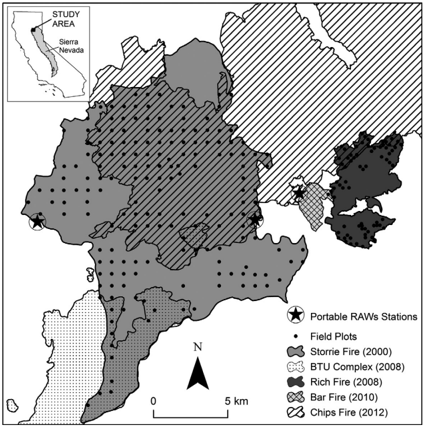
In areas where fire regimes and forest structure have been dramatically altered, there is increasing concern that contemporary fires have the potential to set forests on a positive feedback trajectory with successive reburns, one in which extensive stand‐replacing fire could promote more stand‐replacing fire. Our study utilized an extensive set of field plots established following four fires that occurred between 2000 and 2010 in the northern Sierra Nevada, California, USA that were subsequently reburned in 2012. The information obtained from these field plots allowed for a unique set of analyses investigating the effect of vegetation, fuels, topography, fire weather, and forest management on reburn severity. We also examined the influence of initial fire severity and time since initial fire on influential predictors of reburn severity. Our results suggest that high‐ to moderate‐severity fire in the initial fires led to an increase in standing snags and shrub vegetation, which in combination with severe fire weather promoted high‐severity fire effects in the subsequent reburn. Although fire behavior is largely driven by weather, our study demonstrates that post‐fire vegetation composition and structure are also important drivers of reburn severity. In the face of changing climatic regimes and increases in extreme fire weather, these results may provide managers with options to create more fire‐ resilient ecosystems. In areas where frequent high‐severity fire is undesirable, management activities such as thinning, prescribed fire, or managed wildland fire can be used to moderate fire behavior not only prior to initial fires, but also before subsequent reburns.
Overview
The claims and statistics of this paper haven’t been checked yet.
Free: it reads the open-access text and checks the first 5 claims that cite a source we can check. Create a free account to check every claim.
Integrity signals
Registry
Cites
Statistics
Figures



Verification
Claims the paper makes
The claims and statistics of this paper haven’t been checked yet.
Free: it reads the open-access text and checks the first 5 claims that cite a source we can check. Create a free account to check every claim.
Claims other papers make about this one
Each is checked against this paper’s own text: does it say what the citing paper says it does?
The source backs part of the claim, not all of it — or backs it for a different population, condition or comparison.
In the citing paper
“Areas that do burn under wildfire conditions (as opposed to prescribed fire) within 15-25 years after extensive mortality are prone to long-term conversion to shrub fields because of the potential loss of both established tree regeneration and seed source for postfire conifer regeneration (Coppoletta et al. 2016).”
From Drought, Tree Mortality, and Wildfire in Forests Adapted to Frequent Fire (2018) · cites this paper as Coppoletta et al. 2016
Experimental — accuracy not yet measured
Self-check
Percentages, sums and reported differences re-computed from the paper’s own numbers.
The self-check needs the paper’s full text.
Citations
Cites
R: A Language and Environment for Statistical Computing
R Core Team (2025) · doi:10.32614/r.manuals · Cited by 352,181
Resilience and Stability of Ecological Systems
Holling, C. S. (1973) · Annual Review of Ecology and Systematics · doi:10.1146/annurev.es.04.110173.000245 · Cited by 18,995 · cited 1×
“Altering conditions so that disturbance processes can act to increase, rather than reduce, forest heterogeneity may provide ecosystems with the ecological fexibility (Holling 1973) to withstand and persist through future changes in climate and climaterelated processes (Safford et al. 2012a).”
BackgroundGeneralized Additive Models: An Introduction with R
Wood, S. N. (2017) · doi:10.1201/9781315370279 · Cited by 13,852
Koyak, R. A., Hastie, T. J., & Tibshirani, R. J. (1991) · Journal of the American Statistical Association · doi:10.2307/2290538 · Cited by 7,596
Wood, S. N. (2006) · doi:10.1201/9781420010404 · Cited by 4,953
Bias in random forest variable importance measures: Illustrations, sources and a solution
Strobl, C., Boulesteix, A.-L., Zeileis, A., & Hothorn, T. (2007) · BMC Bioinformatics · doi:10.1186/1471-2105-8-25 · Cited by 3,688
Hastie, T., & Tibshirani, R. (1986) · Statistical Science · doi:10.1214/ss/1177013604 · Cited by 3,409
Conditional variable importance for random forests
Strobl, C., Boulesteix, A.-L., Kneib, T., Augustin, T., & Zeileis, A. (2008) · BMC Bioinformatics · doi:10.1186/1471-2105-9-307 · Cited by 3,254
Strobl, C., Malley, J., & Tutz, G. (2009) · Psychological Methods · doi:10.1037/a0016973 · Cited by 2,583 · cited 2×
“Predictor variables with importance values greater than the absolute value of the lowest negative score were considered infuential or of potential interest (Strobl et al. 2009).”
BackgroundMiller, J. D., & Thode, A. E. (2007) · Remote Sensing of Environment · doi:10.1016/j.rse.2006.12.006 · Cited by 1,431 · cited 2×
“Fire severity was estimated using the Relative differenced Normalized Burn Ratio (RdNBR), derived from Landsat Thematic Mapper data acquired during the frst growing season after the fre was controlled (Miller and Thode 2007).”
BackgroundMethod
Research works printed but not linked: 1
- 63. Safford, H., M. North and M. Meyer, 2012a. Climate change and the relevance of historical forest conditions. Pages 184 in M. North editor. Managing Sierra Nevada forests. Gen. Tech. Rep. PSW-GTR-237.
Cited by
Wildfire-Driven Forest Conversion in Western North American Landscapes
Coop, J. D., Parks, S. A., Stevens-Rumann, C. S., Crausbay, S. D., Higuera, P. E., Hurteau, M. D., Tepley, A., Whitman, E., Assal, T., Collins, B. M., et al. (2020) · BioScience · doi:10.1093/biosci/biaa061 · Cited by 642
“In low-elevation forests in California, large forested areas were converted to shrubland when they burned in high-severity fires between 2000 and 2010 (Coppoletta et al. 2016).”
Self-citationClimate change impact on future wildfire danger and activity in southern Europe: a review
Dupuy, J.-L., Fargeon, H., Martin-StPaul, N., Pimont, F., Ruffault, J., Guijarro, M., Hernando, C., Madrigal, J., & Fernandes, P. (2020) · Annals of Forest Science · doi:10.1007/s13595-020-00933-5 · Cited by 433
Drought, Tree Mortality, and Wildfire in Forests Adapted to Frequent Fire
Stephens, S. L., Collins, B. M., Fettig, C. J., Finney, M. A., Hoffman, C. M., Knapp, E. E., North, M. P., Safford, H., & Wayman, R. B. (2018) · BioScience · doi:10.1093/biosci/bix146 · Cited by 407
Self-citationHagmann, R. K., Hessburg, P. F., Prichard, S. J., Povak, N. A., Brown, P. M., Fulé, P. Z., Keane, R. E., Knapp, E. E., Lydersen, J. M., Metlen, K. L., et al. (2021) · Ecological Applications · doi:10.1002/eap.2431 · Cited by 400
“However, overlapping disturbances occurring in rapid succession, e.g., frequent fire, can override site potential, leading to relatively stationary patches of nonforest on forest-capable sites (Coppoletta et al. 2016, Prichard et al. 2017, Coop et al. 2020, McCord et al. 2020).”
BackgroundGibson, R., Danaher, T., Hehir, W., & Collins, L. (2020) · Remote Sensing of Environment · doi:10.1016/j.rse.2020.111702 · Cited by 383
Adapting western North American forests to climate change and wildfires: 10 common questions
Prichard, S. J., Hessburg, P. F., Hagmann, R. K., Povak, N. A., Dobrowski, S. Z., Hurteau, M. D., Kane, V. R., Keane, R. E., Kobziar, L. N., Kolden, C. A., et al. (2021) · Ecological Applications · doi:10.1002/eap.2433 · Cited by 336
“Fuel conditions in large patches of stand-replacing fire are usually dominated by coarse wood, regenerating shrubs, and hardwoods, increasing the risk of subsequent high-severity, and occurrence of long-duration re-burns (Coppoletta et al. 2016, Prichard et al. 2017).”
BackgroundClimate, Environment, and Disturbance History Govern Resilience of Western North American Forests
Hessburg, P. F., Miller, C. L., Parks, S. A., Povak, N. A., Taylor, A. H., Higuera, P. E., Prichard, S. J., North, M. P., Collins, B. M., Hurteau, M. D., et al. (2019) · Frontiers in Ecology and Evolution · doi:10.3389/fevo.2019.00239 · Cited by 308
“Such fires generally do not restore forest resilience but instead increase the likelihood of burning again at high-severity (Coppoletta et al., 2016).”
BackgroundSelf-citationShort-interval severe fire erodes the resilience of subalpine lodgepole pine forests
Turner, M. G., Braziunas, K. H., Hansen, W. D., & Harvey, B. J. (2019) · Proceedings of the National Academy of Sciences · doi:10.1073/pnas.1902841116 · Cited by 257
“Although highseverity fire often begets high-severity fire, because live fuels recover quickly (100, 102, 134), conversion of dense stands to sparse stands or nonforest could alter fire spread or reduce burn severity.”
Tamm Review: Shifting global fire regimes: Lessons from reburns and research needs
Prichard, S. J., Stevens-Rumann, C. S., & Hessburg, P. F. (2017) · Forest Ecology and Management · doi:10.1016/j.foreco.2017.03.035 · Cited by 241
“In California, Coppeletta et al. (2016) reported that although burn severity in reburned areas was largely driven by weather, rapid shrub regrowth after the initial fire influenced higher burn severity.”
BackgroundHigh-severity fire: evaluating its key drivers and mapping its probability across western US forests
Parks, S. A., Holsinger, L. M., Panunto, M. H., Jolly, W. M., Dobrowski, S. Z., & Dillon, G. K. (2018) · Environmental Research Letters · doi:10.1088/1748-9326/aab791 · Cited by 241
“…conversions from dry forest to nonforest vegetation (shrubland and grassland) are now evident, but it is important to note that such conversions appear to be triggered only by high-severity fire (not low severity) (Savage and Mast 2005, Coop et al 2016, Coppoletta et al 2016).”
BackgroundHessburg, P. F., Prichard, S. J., Hagmann, R. K., Povak, N. A., & Lake, F. K. (2021) · Ecological Applications · doi:10.1002/eap.2432 · Cited by 232
“…the landscape during the lengthy period of fire exclusion) by harvest or reburning can mimic this historical reburn influence, thereby minimizing surface fuels in some developing new forests (Stevens-Rumann and Morgan 2016), and reducing future wildfire vulnerability (Coppoletta et al. 2016).”
BackgroundTaylor, A. H., Trouet, V., Skinner, C. N., & Stephens, S. (2016) · Proceedings of the National Academy of Sciences · doi:10.1073/pnas.1609775113 · Cited by 228
“Accumulating evidence indicates that the increase in area of canopy-killing fires is initiating a persistent vegetation switch from forest to fire-dependent shrub lands over large areas that is maintained by positive feedbacks between shrub lands and repeat high-severity fire (47, 48).”
BackgroundHessburg, P. F., Spies, T. A., Perry, D. A., Skinner, C. N., Taylor, A. H., Brown, P. M., Stephens, S. L., Larson, A. J., Churchill, D. J., Povak, N. A., et al. (2016) · Forest Ecology and Management · doi:10.1016/j.foreco.2016.01.034 · Cited by 206
Self-citationU.S. federal fire and forest policy: emphasizing resilience in dry forests
Stephens, S. L., Collins, B. M., Biber, E., & Fulé, P. Z. (2016) · Ecosphere · doi:10.1002/ecs2.1584 · Cited by 205
“There is uncertainty in both tree regeneration (e.g., Collins and Roller 2013) and susceptibility to reburning (e.g., Coppoletta et al. 2016) following such events in these forests.”
BackgroundSelf-citationReilly, M. J., Dunn, C. J., Meigs, G. W., Spies, T. A., Kennedy, R. E., Bailey, J. D., & Briggs, K. (2017) · Ecosphere · doi:10.1002/ecs2.1695 · Cited by 204
Tepley, A. J., Thompson, J. R., Epstein, H. E., & Anderson‐Teixeira, K. J. (2017) · Global Change Biology · doi:10.1111/gcb.13704 · Cited by 202
Tepley, A. J., Thomann, E., Veblen, T. T., Perry, G. L. W., Holz, A., Paritsis, J., Kitzberger, T., & Anderson‐Teixeira, K. J. (2018) · Journal of Ecology · doi:10.1111/1365-2745.12950 · Cited by 191
Changing spatial patterns of stand-replacing fire in California conifer forests
Stevens, J. T., Collins, B. M., Miller, J. D., North, M. P., & Stephens, S. L. (2017) · Forest Ecology and Management · doi:10.1016/j.foreco.2017.08.051 · Cited by 182
“Forest resilience is reduced when contiguous stand-replacing patches become larger because tree regeneration towards patch interior is slowed by dispersal limitation, and the likelihood of future stand-replacing fire within these patches increases (Stevens et al., 2014; Chambers et al., 2016; Coppoletta et al., 2016;…”
BackgroundInfluentialSelf-citationTamm Review: Reforestation for resilience in dry western U.S. forests
North, M. P., Stevens, J. T., Greene, D. F., Coppoletta, M., Knapp, E. E., Latimer, A. M., Restaino, C. M., Tompkins, R. E., Welch, K. R., York, R. A., et al. (2019) · Forest Ecology and Management · doi:10.1016/j.foreco.2018.09.007 · Cited by 179
“Most montane shrub fields burn at high-severity under severe fire weather conditions, especially when live fuel moisture is at seasonal lows (Coppoletta et al., 2016).”
BackgroundInfluentialSelf-citationFire and climate change: conserving seasonally dry forests is still possible
Stephens, S. L., Westerling, A. L., Hurteau, M. D., Peery, M. Z., Schultz, C. A., & Thompson, S. (2020) · Frontiers in Ecology and the Environment · doi:10.1002/fee.2218 · Cited by 175
“Furthermore, when an area burns at high severity, there is a greater likelihood that subsequent fires will also be of high severity, which can reinforce a lower C, non- forested condition (Coppoletta et al. 2016; Liang et al. 2017).”
BackgroundFire Reduces Fungal Species Richness and In Situ Mycorrhizal Colonization: A Meta-Analysis
Dove, N. C., & Hart, S. C. (2017) · Fire Ecology · doi:10.4996/fireecology.130237746 · Cited by 171
Davis, K. T., Peeler, J., Fargione, J., Haugo, R. D., Metlen, K. L., Robles, M. D., & Woolley, T. (2024) · Forest Ecology and Management · doi:10.1016/j.foreco.2024.121885 · Cited by 168
“…due to high shrub and coarse woody fuel loads; likewise, areas that initially burn at low or moderate severity are more likely to burn again at low or moderate severity in subsequent wildfires (Coppoletta et al., 2016; Harris and Taylor, 2017; Lydersen et al., 2017; Taylor et al., 2022, 2021).”
BackgroundEvidence of fuels management and fire weather influencing fire severity in an extreme fire event
Lydersen, J. M., Collins, B. M., Brooks, M. L., Matchett, J. R., Shive, K. L., Povak, N. A., Kane, V. R., & Smith, D. F. (2017) · Ecological Applications · doi:10.1002/eap.1586 · Cited by 167
Self-citationPyrosilviculture Needed for Landscape Resilience of Dry Western United States Forests
North, M. P., York, R. A., Collins, B. M., Hurteau, M. D., Jones, G. M., Knapp, E. E., Kobziar, L. N., McCann, H., Meyer, M. D., Stephens, S. L., et al. (2021) · Journal of Forestry · doi:10.1093/jofore/fvab026 · Cited by 177
“Big gaps created by many modern wildfires are much larger than the seed-dispersal capabilities of most conifers (Collins et al. 2017, Stevens et al. 2017) and can promote type conversion for several decades or longer (Coppoletta et al. 2016, Coop et al. 2020).”
Self-citationPrichard, S. J., Povak, N. A., Kennedy, M. C., & Peterson, D. W. (2020) · Ecological Applications · doi:10.1002/eap.2104 · Cited by 151
Koontz, M. J., North, M. P., Werner, C. M., Fick, S. E., & Latimer, A. M. (2020) · Ecology Letters · doi:10.1111/ele.13447 · Cited by 150
Bennett, L. T., Bruce, M. J., MacHunter, J., Kohout, M., Tanase, M. A., & Aponte, C. (2016) · Forest Ecology and Management · doi:10.1016/j.foreco.2016.08.047 · Cited by 140
Previous burns and topography limit and reinforce fire severity in a large wildfire
Harris, L. B., & Taylor, A. H. (2017) · Ecosphere · doi:10.1002/ecs2.2019 · Cited by 141
Vegetation-fire feedback reduces projected area burned under climate change
Hurteau, M. D., Liang, S., Westerling, A. L., & Wiedinmyer, C. (2019) · Scientific Reports · doi:10.1038/s41598-019-39284-1 · Cited by 123
Living on the edge: trailing edge forests at risk of fire‐facilitated conversion to non‐forest
Parks, S. A., Dobrowski, S. Z., Shaw, J. D., & Miller, C. (2019) · Ecosphere · doi:10.1002/ecs2.2651 · Cited by 131
“…to high severity that occur at short time intervals (<~15 yr between reburns) have also been shown to shift successional trajectories toward shrub- and grass-dominated systems (Coop et al. 2016, Coppoletta et al. 2016, Harvey et al. 2016, Stevens-Rumann and Morgan 2016, Tepley et al. 2017).”
BackgroundShive, K. L., Preisler, H. K., Welch, K. R., Safford, H. D., Butz, R. J., O’Hara, K. L., & Stephens, S. L. (2018) · Ecological Applications · doi:10.1002/eap.1756 · Cited by 119
Walker, R. B., Coop, J. D., Parks, S. A., & Trader, L. (2018) · Ecosphere · doi:10.1002/ecs2.2182 · Cited by 107
Haffey, C., Sisk, T. D., Allen, C. D., Thode, A. E., & Margolis, E. Q. (2018) · Fire Ecology · doi:10.4996/fireecology.140114316 · Cited by 120
Serra-Diaz, J. M., Maxwell, C. J., Lucash, M. S., Scheller, R. M., Laflower, D. M., Miller, A. D., Tepley, A. J., Epstein, H. E., Anderson‐Teixeira, K. J., & Thompson, J. R. (2018) · Scientific Reports · doi:10.1038/s41598-018-24642-2 · Cited by 117
“…dry portions of the landscape could face a substantial lengthening of the time to forest recovery after high-severity fire, increasing the probability that the post-fire SCH vegetation is perpetuated by repeated fire before it has a chance to return to forest cover (Coppoletta et al., 2016).”
BackgroundHigh severity fire and mixed conifer forest-chaparral dynamics in the southern Cascade Range, USA
Airey, C. T., Skinner, C. N., & Taylor, A. H. (2015) · Forest Ecology and Management · doi:10.1016/j.foreco.2015.12.016 · Cited by 116
Steel, Z. L., Koontz, M. J., & Safford, H. D. (2018) · Landscape Ecology · doi:10.1007/s10980-018-0665-5 · Cited by 100
“In large high-severity patches, type conversion to shrub fields can ensue, and may be prolonged to a quasi-permanent state if areas are reburned at high-severity before conifer species can reestablish and become resistant to fire (Coppoletta et al. 2016; Tepley et al. 2017).”
BackgroundBrodie, E. G., Knapp, E. E., Brooks, W. R., Drury, S. A., & Ritchie, M. W. (2024) · Fire Ecology · doi:10.1186/s42408-023-00241-z · Cited by 140
“Shrubs are known for burning with high intensity and contributing greater severity effects under extreme fire weather conditions (Coppoletta et al. 2016; Lydersen et al. 2014).”
Repeated wildfires alter forest recovery of mixed‐conifer ecosystems
Stevens‐Rumann, C., & Morgan, P. (2016) · Ecological Applications · doi:10.1890/15-1521.1 · Cited by 93
Romeiro, J. M. N., Eid, T., Antón‐Fernández, C., Kangas, A. S., & Trømborg, E. (2022) · Forest Ecology and Management · doi:10.1016/j.foreco.2022.120071 · Cited by 94
Comparative Plant Succession among Terrestrial Biomes of the World
Prach, K., & Walker, L. R. (2020) · Cambridge University Press eBooks · doi:10.1017/9781108561167 · Cited by 98
Response of Sierra Nevada forests to projected climate–wildfire interactions
Liang, S., Hurteau, M. D., & Westerling, A. L. (2016) · Global Change Biology · doi:10.1111/gcb.13544 · Cited by 98
“Once established, a positive feedback loop can form with subsequent fires to reinforce a shrub dominated community and reduce tree regeneration (Odion et al., 2010; Coppoletta et al., 2016; Lauvaux et al., 2016).”
BackgroundSpatial patterns of ponderosa pine regeneration in high-severity burn patches
Owen, S. M., Sieg, C. H., Meador, A. J. S., Fulé, P. Z., Iniguez, J. M., Baggett, L. S., Fornwalt, P. J., & Battaglia, M. A. (2017) · Forest Ecology and Management · doi:10.1016/j.foreco.2017.09.005 · Cited by 101
Parks, S. A., Guiterman, C. H., Margolis, E. Q., Lonergan, M., Whitman, E., Abatzoglou, J. T., Falk, D. A., Johnston, J. D., Daniels, L. D., Lafon, C. W., et al. (2025) · Nature Communications · doi:10.1038/s41467-025-56333-8 · Cited by 116
Viedma, O., Chico, F., Fernández, J. J. Á., Madrigal, C., Safford, H. D., & Moreno, J. M. (2020) · Remote Sensing of Environment · doi:10.1016/j.rse.2020.111891 · Cited by 95
Anticipating fire‐mediated impacts of climate change using a demographic framework
Davis, K. T., Higuera, P. E., & Sala, A. (2018) · Functional Ecology · doi:10.1111/1365-2435.13132 · Cited by 82
Ecological resilience and vegetation transition in the face of two successive large wildfires
Steel, Z. L., Foster, D. E., Coppoletta, M., Lydersen, J. M., Stephens, S. L., Paudel, A., Markwith, S. H., Merriam, K. E., & Collins, B. M. (2021) · Journal of Ecology · doi:10.1111/1365-2745.13764 · Cited by 93
“We conducted a comparison of data collection methods as part of a related study (Coppoletta et al., 2016) and found no significant differences in live tree density estimates among methodologies.”
BackgroundMethodSelf-citationWilliams, J. N., Safford, H. D., Enstice, N., Steel, Z. L., & Paulson, A. K. (2023) · Ecosphere · doi:10.1002/ecs2.4397 · Cited by 88
Stevens, J. T., Haffey, C., Coop, J. D., Fornwalt, P. J., Yocom, L. L., Allen, C. D., Bradley, A. F., Burney, O. T., Carril, D., Chambers, M. E., et al. (2021) · Forest Ecology and Management · doi:10.1016/j.foreco.2021.119678 · Cited by 90
“However in cases where shrubs or other woody resprouters dominate after fire, cover of this hardwood vegetation can be a better predictor of highseverity fire than coarse woody debris (Coppoletta et al., 2016), and”
BackgroundFernández‐Guisuraga, J. M., Suárez‐Seoane, S., García-Llamas, P., & Calvo, L. (2021) · Journal of Environmental Management · doi:10.1016/j.jenvman.2021.112462 · Cited by 81
Alternative characterization of forest fire regimes: incorporating spatial patterns
Collins, B. M., Stevens, J. T., Miller, J. D., Stephens, S. L., Brown, P. M., & North, M. P. (2017) · Landscape Ecology · doi:10.1007/s10980-017-0528-5 · Cited by 74
“prone to re-burn at high severity when wildfire returns (Coppoletta et al. 2016).”
BackgroundSelf-citationJager, H. I., Long, J. W., Malison, R. L., Murphy, B. P., Rust, A. J., Silva, L. G. M., Sollmann, R., Steel, Z. L., Bowen, M. D., Dunham, J. B., et al. (2021) · Ecology and Evolution · doi:10.1002/ece3.8026 · Cited by 81
“When reburning occurs, positive (destabilizing) feedback can push the landscape over a tipping point leading to a non- forest- dominated ecosystem (Chambers et al., 2019; Coop et al., 2016; Coppoletta et al., 2016), especially in dry fuel- limited forests at low elevations (Hessburg et al., 2019).”
BackgroundStatus and prospects for renewable energy using wood pellets from the southeastern United States
Dale, V. H., Kline, K. L., Parish, E. S., Cowie, A., Emory, R., Malmsheimer, R. W., Slade, R., Smith, C. T., Wigley, T. B., Bentsen, N. S., et al. (2017) · GCB Bioenergy · doi:10.1111/gcbb.12445 · Cited by 82
“Furthermore, markets for products made from low-value wood provide extra income (Malmsheimer & Fernholz, 2015) that can be used for management practices such as thinning that decrease risks of insect outbreaks, disease and destructive wildfire (Coppoletta et al., 2016); increase site productivity and consequent carbon…”
BackgroundCova, G. R., Kane, V. R., Prichard, S. J., North, M. P., & Cansler, C. A. (2022) · Forest Ecology and Management · doi:10.1016/j.foreco.2022.120620 · Cited by 77
Richter, C., Rejmánek, M., Miller, J. E. D., Welch, K. R., Weeks, J., & Safford, H. D. (2019) · Ecosphere · doi:10.1002/ecs2.2882 · Cited by 79
“Severely burned areas in low and middle elevation California forests are at high risk of (semi)permanent conversion to shrubs in the event of another high-severity fire before forest cover has been able to re-establish (Coppoletta et al. 2016, Tepley et al. 2017).”
BackgroundBuma, B. J., Weiss, S. A., Hayes, K. R., & Lucash, M. S. (2020) · Environmental Research Letters · doi:10.1088/1748-9326/ab6c70 · Cited by 75
“Climate and topography strongly influence recovering vegetation that ultimately fuels subsequent fires (Coppoletta et al 2016, Erni et al 2017, Grabinski et al 2017, Parks et al 2018) and climate (especially inter-annual moisture deficits, Westerling 2016) affects flammability as well.”
BackgroundBassett, M., Leonard, S. W. J., Chia, E. K., Clarke, M. F., & Bennett, A. F. (2017) · Forest Ecology and Management · doi:10.1016/j.foreco.2017.04.006 · Cited by 76
Sieg, C. H., Linn, R., Pimont, F., Hoffman, C. M., McMillin, J. D., Winterkamp, J., & Baggett, L. S. (2017) · Fire Ecology · doi:10.4996/fireecology.130300123 · Cited by 72
Steel, Z. L., Fogg, A. M., Burnett, R. D., Roberts, L. J., & Safford, H. D. (2021) · Diversity and Distributions · doi:10.1111/ddi.13281 · Cited by 72
“As fires continue to grow larger and more severe, we are likely to see directional shifts from conifer forests to montane chaparral or forests dominated by resprouting oaks (Coop et al., 2020; Coppoletta et al., 2016; Safford & Vallejo, 2019; Tepley et al., 2017).”
Povak, N. A., Kane, V. R., Collins, B. M., Lydersen, J. M., & Kane, J. T. (2019) · Landscape Ecology · doi:10.1007/s10980-019-00947-z · Cited by 70
Self-citationHigh‐severity and short‐interval wildfires limit forest recovery in the Central Cascade Range
Busby, S. U., Moffett, K. B., & Holz, A. (2020) · Ecosphere · doi:10.1002/ecs2.3247 · Cited by 72
Combustion and Stubble Burning: A Major Concern for the Environment and Human Health
Chanana, I., Sharma, A., Kumar, P., Kumar, L., Kulshreshtha, S., Kumar, S., & Patel, S. K. S. (2023) · Fire · doi:10.3390/fire6020079 · Cited by 74
“9 of 18 Between 15–25 years, areas burning below the prescribed fire conditions succeeding large-scale mortality become converted to long-term shrub fields due to the significant loss of seed sources and regenerative trees for the regeneration of post-fire conifers [93]. post-fire conifers [93].”
BackgroundRelating Fire-Caused Change in Forest Structure to Remotely Sensed Estimates of Fire Severity
Lydersen, J. M., Collins, B. M., Miller, J. D., Fry, D. L., & Stephens, S. L. (2016) · Fire Ecology · doi:10.4996/fireecology.1203099 · Cited by 61
Self-citationLandesmann, J. B., Tiribelli, F., Paritsis, J., Veblen, T. T., & Kitzberger, T. (2020) · Journal of Vegetation Science · doi:10.1111/jvs.12936 · Cited by 64
Duff, T. J., Keane, R. E., Penman, T. D., & Tolhurst, K. G. (2017) · Forests · doi:10.3390/f8090351 · Cited by 72
“Furthermore, with variation in post fire conditions [27] or fire severity [101,102] having the potential to influence vegetation recovery, using time since fire as the sole moderator of fuel properties may not necessarily deliver outcomes that meet”
BackgroundWildfire impacts on California spotted owl nesting habitat in the Sierra Nevada
Stephens, S. L., Miller, J. D., Collins, B. M., North, M. P., Keane, J. J., & Roberts, S. L. (2016) · Ecosphere · doi:10.1002/ecs2.1478 · Cited by 64
“Furthermore, these vegetation structure and fuel differences contribute to different feedback effects on subsequent fire (Coppoletta et al. 2016).”
BackgroundSelf-citationFirst-entry wildfires can create opening and tree clump patterns characteristic of resilient forests
Kane, V. R., Bartl-Geller, B. N., North, M. P., Kane, J. T., Lydersen, J. M., Jeronimo, S. M. A., Collins, B. M., & Moskal, L. M. (2019) · Forest Ecology and Management · doi:10.1016/j.foreco.2019.117659 · Cited by 63
Self-citationPositive severity feedback between consecutive fires in dry eucalypt forests of southern Australia
Barker, J. W., & Price, O. F. (2018) · Ecosphere · doi:10.1002/ecs2.2110 · Cited by 60
“Environmental Systems Research Institute, Redlands, California, USA.”
BackgroundInfluentialDrivers of California’s changing wildfires: a state-of-the-knowledge synthesis
MacDonald, G. M. S. D., Wall, T., Enquist, C. A. F., LeRoy, S. R., Bradford, J. B., Breshears, D. D., Brown, T. J., Cayan, D. R., Dong, C., Falk, D. A., et al. (2023) · International Journal of Wildland Fire · doi:10.1071/wf22155 · Cited by 68
“As an outcome, permanent vegetation type conversions have (and will continue to) become more frequent as previous ecosystems lose resilience and are unable to recover (Coppoletta et al. 2016; Falk et al. 2022; Guiterman et al. 2022).”
BackgroundNdalila, M. N., Williamson, G. J., & Bowman, D. M. J. S. (2018) · Fire · doi:10.3390/fire1030040 · Cited by 58
Restoring surface fire stabilizes forest carbon under extreme fire weather in the Sierra Nevada
Krofcheck, D., Hurteau, M. D., Scheller, R. M., & Loudermilk, E. L. (2017) · Ecosphere · doi:10.1002/ecs2.1663 · Cited by 56
García-Llamas, P., Suárez‐Seoane, S., Fernández–Manso, A., Quintano, C., & Calvo, L. (2020) · Journal of Environmental Management · doi:10.1016/j.jenvman.2020.110706 · Cited by 54
Lydersen, J. M., Collins, B. M., Coppoletta, M., Jaffe, M. R., Northrop, H., & Stephens, S. L. (2019) · Fire Ecology · doi:10.1186/s42408-019-0060-x · Cited by 49
Self-citationQuantifying pyrodiversity and its drivers
Steel, Z. L., Collins, B. M., Sapsis, D. B., & Stephens, S. L. (2021) · Proceedings of the Royal Society B Biological Sciences · doi:10.1098/rspb.2020.3202 · Cited by 47
“Where the frequency of high-severity fire exceeds the natural range of variation of an ecosystem, higher rates of type-conversion (e.g. from forests to shrubland) may occur (Coppoletta et al. 2016; Welch et al. 2016).”
BackgroundSelf-citationAltered fire regimes cause long‐term lichen diversity losses
Miller, J. E. D., Root, H. T., & Safford, H. D. (2018) · Global Change Biology · doi:10.1111/gcb.14393 · Cited by 53
Taylor, A. H., Harris, L. B., & Drury, S. A. (2021) · Ecosphere · doi:10.1002/ecs2.3734 · Cited by 53
High‐severity fire drives persistent floristic homogenization in human‐altered forests
Weeks, J., Miller, J. E. D., Steel, Z. L., Batzer, E. E., & Safford, H. D. (2023) · Ecosphere · doi:10.1002/ecs2.4409 · Cited by 48
Kobziar, L. N., Hiers, J. K., Belcher, C. M., Bond, W. J., Enquist, C. A. F., Loudermilk, E. L., Miesel, J., O’Brien, J. J., Pausas, J. G., Hood, S. M., et al. (2024) · Fire Ecology · doi:10.1186/s42408-024-00272-0 · Cited by 55
“High-severity fires in mixed-conifer forests of the North American MCR may be followed by the growth of highly flammable shrubs, which can promote repeated high-severity fires, thus blocking forest recovery (Coppoletta et al. 2016; Tepley et al. 2017).”
BackgroundMapping Burned Areas of Mato Grosso State Brazilian Amazon Using Multisensor Datasets
Shimabukuro, Y. E., Dutra, A. C., Arai, E., Duarte, V., Cassol, H., Pereira, G., & Cardozo, F. D. S. (2020) · Remote Sensing · doi:10.3390/rs12223827 · Cited by 79
“These data allow for active fire detection, which registers the instantaneous temperature of objects in combustion using spectral bands between 4 and 11 μm [20,21]; burned area estimation, which uses the spectral bands in the visible, near-infrared, and mid-infrared regions of the electromagnetic spectrum to detect ch…”
BackgroundWildfire severity and postfire salvage harvest effects on long‐term forest regeneration
Povak, N. A., Churchill, D. J., Cansler, C. A., Hessburg, P. F., Kane, V. R., Kane, J. T., Lutz, J. A., & Larson, A. J. (2020) · Ecosphere · doi:10.1002/ecs2.3199 · Cited by 46
“In a recent detailed assessment of the climatic drivers of postfire regeneration across much of the western United States, Davis et al. (2019) found that certain seasonal and annual climate variables have recently crossed key physiological tolerances relevant to successful Douglas fir and ponderosa pine regeneration.”
BackgroundInfluentialShrub removal in reforested post-fire areas increases native plant species richness
Bohlman, G. N., North, M. P., & Safford, H. D. (2016) · Forest Ecology and Management · doi:10.1016/j.foreco.2016.05.008 · Cited by 45
“Re-burns of these chaparral stands tend to burn at high severity, further inhibiting conifer regeneration, leading to a potentially permanent type-conversion to shrubfields depending on fire frequency (Lauvaux et al., 2016; Coppoletta et al., 2016).”
Background‘Mind the Gap’—reforestation needs vs. reforestation capacity in the western United States
Dobrowski, S. Z., Aghai, M. M., du, A. C., Downer, R., Fargione, J., Haase, D. L., Hoecker, T. J., Kildisheva, O. A., Murdoch, A., Newman, S., et al. (2024) · Frontiers in Forests and Global Change · doi:10.3389/ffgc.2024.1402124 · Cited by 43
“…combusts most of the finer fuels but can leave a concentration of large logs and snags, making tree planting difficult, hazardous, and, if left unaddressed, likely to produce lethal temperatures to seedlings in the case of a subsequent ignition (Peterson et al., 2015; Coppoletta et al., 2016).”
Collins, B. M., Lydersen, J. M., Everett, R. G., & Stephens, S. L. (2018) · Fire Ecology · doi:10.1186/s42408-018-0004-x · Cited by 45
Self-citationSimulated Increases in Fire Activity Reinforce Shrub Conversion in a Southwestern US Forest
Keyser, A. R., Krofcheck, D., Remy, C. C., Allen, C. D., & Hurteau, M. D. (2020) · Ecosystems · doi:10.1007/s10021-020-00498-4 · Cited by 38
Chiono, L. A., Fry, D. L., Collins, B. M., Chatfield, A. H., & Stephens, S. L. (2017) · Ecosphere · doi:10.1002/ecs2.1648 · Cited by 41
Self-citationGoodwin, M. J., North, M. P., Zald, H. S. J., & Hurteau, M. D. (2018) · Forest Ecology and Management · doi:10.1016/j.foreco.2018.07.058 · Cited by 39
Kane, J. M., Kreye, J. K., Barajas-Ramirez, R., & Varner, J. M. (2021) · Forest Ecology and Management · doi:10.1016/j.foreco.2021.119100 · Cited by 37
Higher incidence of high‐severity fire in and near industrially managed forests
Levine, J. I., Collins, B. M., Steel, Z. L., de Valpine, P., & Stephens, S. L. (2022) · Frontiers in Ecology and the Environment · doi:10.1002/fee.2499 · Cited by 42
“We know from previous research that extreme weather is an important driver of fire severity, and that differences in forest structure and fuel load can be less important under extreme weather conditions (Coppoletta et al. 2016; Stevens et al. 2017).”
BackgroundSelf-citationPostfire restoration framework for national forests in California
Meyer, M. D., Long, J. W., & Safford, H. D. (2021) · doi:10.2737/psw-gtr-270 · Cited by 44
Intensifying Fire Season Aridity Portends Ongoing Expansion of Severe Wildfire in Western US Forests
Parks, S. A., Coop, J. D., & Davis, K. T. (2025) · Global Change Biology · doi:10.1111/gcb.70429 · Cited by 48
Kline, K. L., Dale, V. H., Rose, E., & Tonn, B. E. (2021) · Sustainability · doi:10.3390/su13020821 · Cited by 42
“management practices such as thinning that decrease the risk of insect outbreaks, disease, and destructive wildfire [65]; increase site productivity and hence carbon uptake rates [66]; and support nontimber objectives such as recreation and habitat for wildlife [67].”
BackgroundFernández‐Guisuraga, J. M., Suárez‐Seoane, S., Fernandes, P. M., Fernández‐García, V., Fernández–Manso, A., Quintano, C., & Calvo, L. (2022) · Forest Ecosystems · doi:10.1016/j.fecs.2022.100022 · Cited by 41
Post-fire surface fuel dynamics in California forests across three burn severity classes
Eskelson, B. N. I., & Monleón, V. J. (2018) · International Journal of Wildland Fire · doi:10.1071/wf17148 · Cited by 38
Ray, C., Cluck, D. R., Wilkerson, R. L., Siegel, R. B., White, A. M., Tarbill, G. L., Sawyer, S. C., & Howell, C. A. (2019) · Fire Ecology · doi:10.1186/s42408-019-0040-1 · Cited by 39
Wayman, R. B., & Safford, H. D. (2021) · Ecological Applications · doi:10.1002/eap.2287 · Cited by 42
Churchill, D. J., Jeronimo, S. M. A., Hessburg, P. F., Cansler, C. A., Povak, N. A., Kane, V. R., Lutz, J. A., & Larson, A. J. (2021) · Forest Ecology and Management · doi:10.1016/j.foreco.2021.119796 · Cited by 40
“Three class metrics –percent land (percentage of the landscape area- PL), area-weighted mean patch size (MPS), and cumulative patch size distributions– were selected to parsimoniously capture the primary changes from the fires in a parsimonious manner (Cushman et al. 2008).”
BackgroundUnderstanding ecological contexts for active reforestation following wildfires
White, A. M., & Long, J. W. (2018) · New Forests · doi:10.1007/s11056-018-9675-z · Cited by 37
Burton, J. E., Cawson, J. G., Noske, P. J., & Sheridan, G. (2019) · Forests · doi:10.3390/f10050436 · Cited by 35
Where and why do conifer forests persist in refugia through multiple fire events?
Downing, W. M., Meigs, G. W., Gregory, M. J., & Krawchuk, M. A. (2021) · Global Change Biology · doi:10.1111/gcb.15655 · Cited by 37
“Time since fire is generally interpreted as a proxy for fuel accumulation (Coppoletta et al., 2016), a process that rapidly (5– 10 years) diminishes the self- limiting effect of fire in the K- S (Donato et al., 2013).”
BackgroundResultInfluentialForbes, B., Reilly, S., Clark, M. L., Ferrell, R., Kelly, A., Krause, P., Matley, C., O’Neil, M., Villasenor, M., Disney, M. I., et al. (2022) · Frontiers in Forests and Global Change · doi:10.3389/ffgc.2022.818713 · Cited by 39
“…California, RdNBR has been well-calibrated with field measurements of wildfire severity (Miller et al., 2009), and Landsat-based time series of RdNBR have been used to track regional shifts in fire severity (Mallek et al., 2013; Coppoletta et al., 2016; Stevens et al., 2017; Nigro and Molinari, 2019).”
MethodPawlikowski, N. C., Coppoletta, M., Knapp, E. E., & Taylor, A. H. (2018) · Forest Ecology and Management · doi:10.1016/j.foreco.2018.12.016 · Cited by 33
“High-severity fire effects in recent re-entry burns have led to high-severity fire effects in reburns that can initiate long-term shifts from forest to vegetation types such as grassland or shrubland (Coppoletta et al., 2016; Guiterman et al., 2018; Savage and Mast, 2005).”
BackgroundSelf-citation
Metadata
- Authors
- Coppoletta, M., Merriam, K. E., & Collins, B. M.
- Affiliations
- US Forest Service (US)
- Corresponding author
- Coppoletta, Michelle
- Venue
- Ecological Applications
- Publisher
- Wiley
- Published
- 2016-04
- Volume
- 26
- Issue
- 3
- Pages
- 686-699
- ISSN
- 1051-0761 (ISSN-L)
- 1939-5582
- OpenAlex
- W1943565020
- Cited by
- 295
- References
- 87
- Citations by year
- 2026: 19 · 2025: 27 · 2024: 28 · 2023: 24 · 2022: 26 · 2021: 37 · 2020: 57 · 2019: 18 · 2018: 26 · 2017: 20 · 2016: 12
- FWCI
- 18.79
- Type
- journal article
- Language
- en
- Open access
- hybrid
- doi.org
- Licence
- Locations
- Ecological Applications (publishedVersion, cc-by-nc-nd)
- PubMed (publishedVersion)
- Funders
- United States Department of Agriculture Forest Service
- Plumas National Forest
- Topics
- Physical Sciences › Environmental Science › Global and Planetary Change › Fire effects on ecosystems
- Physical Sciences › Environmental Science › Ecology › Rangeland and Wildlife Management
- Life Sciences › Agricultural and Biological Sciences › Forestry › Forest Management and Policy
- Keywords
- reburn, fire severity, post-fire vegetation, stand-replacing fire, fire weather, fire behavior, forest management, prescribed burning, thinning, fire regime change, Sierra Nevada, snags, shrubland vegetation, topography
- MeSH terms
- California, Conservation of Natural Resources, Environmental Monitoring, Fires, Plants, Ecosystem, Plant Development, Forests
About these checks
Registry, retraction, Cites and statistics results are computed, not judged, with one exception: a printed reference that no index lists is read once by a model before it counts as a citation error. Claims are extracted by a model and kept only when their quote appears verbatim in the text; each cited source is then checked, with a model’s help, for whether it says what the claim relies on. Those verdicts can be wrong — read the claim’s quote and the cited source before relying on one.
Statistics and arithmetic are recomputed, not judged.
Confidence bands are shown only for fields calibrated on our annotated test set. None is calibrated yet, so no band is shown.
What counts as a claim ›How we measure confidence ›How we check this ›
Are you an author, or do you see a problem with this page? Request a review
Data sources
Bibliographic data: Semantic Scholar, OpenAlex, Crossref.
Contains information from the Semantic Scholar Academic Graph Datasets, made available under the ODC Attribution License (ODC-BY 1.0).
Semantic Scholar’s data is described in: Kinney, R., et al. (2023). The Semantic Scholar Open Data Platform. arXiv:2301.10140.
