

Post-fire vegetation and fuel development influences fire severity patterns in reburns
Open accessThe DOI matches its Crossref record; 88 of the 88 references it cites were found in a registry or an index.
Abstract
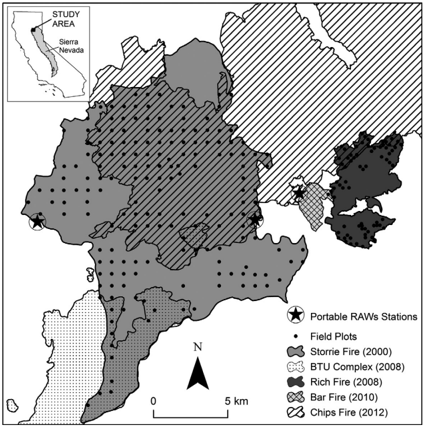
In areas where fire regimes and forest structure have been dramatically altered, there is increasing concern that contemporary fires have the potential to set forests on a positive feedback trajectory with successive reburns, one in which extensive stand‐replacing fire could promote more stand‐replacing fire. Our study utilized an extensive set of field plots established following four fires that occurred between 2000 and 2010 in the northern Sierra Nevada, California, USA that were subsequently reburned in 2012. The information obtained from these field plots allowed for a unique set of analyses investigating the effect of vegetation, fuels, topography, fire weather, and forest management on reburn severity. We also examined the influence of initial fire severity and time since initial fire on influential predictors of reburn severity. Our results suggest that high‐ to moderate‐severity fire in the initial fires led to an increase in standing snags and shrub vegetation, which in combination with severe fire weather promoted high‐severity fire effects in the subsequent reburn. Although fire behavior is largely driven by weather, our study demonstrates that post‐fire vegetation composition and structure are also important drivers of reburn severity. In the face of changing climatic regimes and increases in extreme fire weather, these results may provide managers with options to create more fire‐ resilient ecosystems. In areas where frequent high‐severity fire is undesirable, management activities such as thinning, prescribed fire, or managed wildland fire can be used to moderate fire behavior not only prior to initial fires, but also before subsequent reburns.
Overview
The claims and statistics of this paper haven’t been checked yet.
Free: it reads the open-access text and checks the first 5 claims that cite a source we can check. Create a free account to check every claim.
Integrity signals
Registry
Cites
Statistics
Figures



Verification
Claims the paper makes
The claims and statistics of this paper haven’t been checked yet.
Free: it reads the open-access text and checks the first 5 claims that cite a source we can check. Create a free account to check every claim.
Claims other papers make about this one
Each is checked against this paper’s own text: does it say what the citing paper says it does?
The source backs part of the claim, not all of it — or backs it for a different population, condition or comparison.
In the citing paper
“Areas that do burn under wildfire conditions (as opposed to prescribed fire) within 15-25 years after extensive mortality are prone to long-term conversion to shrub fields because of the potential loss of both established tree regeneration and seed source for postfire conifer regeneration (Coppoletta et al. 2016).”
From Drought, Tree Mortality, and Wildfire in Forests Adapted to Frequent Fire (2018) · cites this paper as Coppoletta et al. 2016
Experimental — accuracy not yet measured
Self-check
Percentages, sums and reported differences re-computed from the paper’s own numbers.
The self-check needs the paper’s full text.
Citations
Cites
R: A Language and Environment for Statistical Computing
R Core Team (2025) · doi:10.32614/r.manuals · Cited by 352,181
Resilience and Stability of Ecological Systems
Holling, C. S. (1973) · Annual Review of Ecology and Systematics · doi:10.1146/annurev.es.04.110173.000245 · Cited by 18,995 · cited 1×
“Altering conditions so that disturbance processes can act to increase, rather than reduce, forest heterogeneity may provide ecosystems with the ecological fexibility (Holling 1973) to withstand and persist through future changes in climate and climaterelated processes (Safford et al. 2012a).”
BackgroundGeneralized Additive Models: An Introduction with R
Wood, S. N. (2017) · doi:10.1201/9781315370279 · Cited by 13,852
Koyak, R. A., Hastie, T. J., & Tibshirani, R. J. (1991) · Journal of the American Statistical Association · doi:10.2307/2290538 · Cited by 7,596
Wood, S. N. (2006) · doi:10.1201/9781420010404 · Cited by 4,953
Bias in random forest variable importance measures: Illustrations, sources and a solution
Strobl, C., Boulesteix, A.-L., Zeileis, A., & Hothorn, T. (2007) · BMC Bioinformatics · doi:10.1186/1471-2105-8-25 · Cited by 3,688
Hastie, T., & Tibshirani, R. (1986) · Statistical Science · doi:10.1214/ss/1177013604 · Cited by 3,409
Conditional variable importance for random forests
Strobl, C., Boulesteix, A.-L., Kneib, T., Augustin, T., & Zeileis, A. (2008) · BMC Bioinformatics · doi:10.1186/1471-2105-9-307 · Cited by 3,254
Strobl, C., Malley, J., & Tutz, G. (2009) · Psychological Methods · doi:10.1037/a0016973 · Cited by 2,583 · cited 2×
“Predictor variables with importance values greater than the absolute value of the lowest negative score were considered infuential or of potential interest (Strobl et al. 2009).”
BackgroundMiller, J. D., & Thode, A. E. (2007) · Remote Sensing of Environment · doi:10.1016/j.rse.2006.12.006 · Cited by 1,431 · cited 2×
“Fire severity was estimated using the Relative differenced Normalized Burn Ratio (RdNBR), derived from Landsat Thematic Mapper data acquired during the frst growing season after the fre was controlled (Miller and Thode 2007).”
BackgroundMethodBasic principles of forest fuel reduction treatments
Agee, J. K., & Skinner, C. N. (2005) · Forest Ecology and Management · doi:10.1016/j.foreco.2005.01.034 · Cited by 1,397
Large wildfire trends in the western United States, 1984–2011
Dennison, P. E., Brewer, S. C., Arnold, J. D., & Moritz, M. A. (2014) · Geophysical Research Letters · doi:10.1002/2014gl059576 · Cited by 1,322 · cited 10×
“Large wildfre trends in the western United States, 1984-2011.”
BackgroundInfluentialThe forgotten stage of forest succession: early‐successional ecosystems on forest sites
Swanson, M. E., Franklin, J. F., Beschta, R. L., Crisafulli, C. M., DellaSala, D. A., Hutto, R. L., Lindenmayer, D. B., & Swanson, F. J. (2011) · Frontiers in Ecology and the Environment · doi:10.1890/090157 · Cited by 1,013
Handbook for Inventorying Downed Woody Material
Brown, J. K. (2019) · Cited by 842
Generalized additive models in plant ecology
Yee, T. W., & Mitchell, N. D. (1991) · Journal of Vegetation Science · doi:10.2307/3236170 · Cited by 724 · cited 1×
“As suggested by Hastie and Tibshirani (1990) and Yee and Mitchell (1991), we ftted parametric functions whenever inclusion of nonlinear effects did not signifcantly improve the ft of the model (assessed using Akaike information criterion; AIC) or when signifcant interactions were present.”
MethodHothorn, T. (2005) · Biostatistics · doi:10.1093/biostatistics/kxj011 · Cited by 684
DETERMINING REFERENCE CONDITIONS FOR ECOSYSTEM MANAGEMENT OF SOUTHWESTERN PONDEROSA PINE FORESTS
Fulé, P. Z., Covington, W. W., & Moore, M. M. (1997) · Ecological Applications · doi:10.1890/1051-0761(1997)007[0895:drcfem]2.0.co;2 · Cited by 661 · cited 1×
“There is an abundance of evidence from fre history studies demonstrating recurring fre on short return intervals (5–15 years) in dry forests throughout the western United States (e.g., Fulé et al. 1997, Heyerdahl et al. 2001, Brown et al. 2008, Taylor 2010).”
BackgroundAspect transformation in site productivity research
飯塚, 寛. (1967) · 日本林學會誌 · Cited by 555
Estimating wildfire behavior and effects
Albini, F. A. (1976) · Digital Commons - USU (Utah State University) · Cited by 505
Comparison of burn severity assessments using Differenced Normalized Burn Ratio and ground data
Cocke, A. E., Fulé, P. Z., & Crouse, J. E. (2005) · International Journal of Wildland Fire · doi:10.1071/wf04010 · Cited by 493 · cited 1×
“Other studies have documented greater snag basal area (Cocke et al. 2005) and higher shrub cover (Crotteau et al. 2013, Cocking et al. 2014) in areas that have burned at moderate to high severity.”
BackgroundSPATIAL CONTROLS OF HISTORICAL FIRE REGIMES: A MULTISCALE EXAMPLE FROM THE INTERIOR WEST, USA
Heyerdahl, E. K., Brubaker, L. B., & Agee, J. K. (2001) · Ecology · doi:10.1890/0012-9658(2001)082[0660:scohfr]2.0.co;2 · Cited by 474 · cited 1×
“There is an abundance of evidence from fre history studies demonstrating recurring fre on short return intervals (5–15 years) in dry forests throughout the western United States (e.g., Fulé et al. 1997, Heyerdahl et al. 2001, Brown et al. 2008, Taylor 2010).”
BackgroundManaging forests and fire in changing climates
Stephens, S. L., Agee, J. K., Fulé, P. Z., North, M. P., Romme, W. H., Swetnam, T. W., & Turner, M. G. (2013) · Science · doi:10.1126/science.1240294 · Cited by 464 · cited 3×
“There is a strong basis demonstrating the need for fuels reduction and restoration in dry forests to promote fre resilience (Franklin and Johnson 2012, Stephens et al. 2013); the need for suppression actions to protect life, property, and other vulnerable resources is also widely recognized.”
BackgroundNotes and Observations: Aspect Transformation in Site Productivity Research
Beers, T. W., Dress, P. E., & Wensel, L. C. (1966) · Journal of Forestry · doi:10.1093/jof/64.10.691 · Cited by 403 · cited 1×
“690 Ecological Applications elevation (m), slope (degrees), Beers’ transformed aspect (Beers et al. 1966), and slope curvature (i.e., convex or concave), were derived for each plot from a 10-m digital elevation model.”
MethodDillon, G. K., Holden, Z. A., Morgan, P., Crimmins, M. A., Heyerdahl, E. K., & Luce, C. H. (2011) · Ecosphere · doi:10.1890/es11-00271.1 · Cited by 385 · cited 2×
“…co v e r (% ) 60 ea rs ) l f ire (y Ti m e sin ce in itia Initial fire severity (RdNBR) S Q R T (snag basal area + 1) Initial fire severity(RdNBR) April 2016 695 aspect infuence vegetation composition and structure, as well as the accumulation and spatial arrangement of fuels (Dillon et al. 2011).”
BackgroundSpatial Controls of Historical Fire Regimes: A Multiscale Example from the Interior West, USA
Heyerdahl, E. K., Brubaker, L. B., & Agee, J. K. (2001) · Ecology · doi:10.2307/2680187 · Cited by 381
The fire frequency‐severity relationship and the legacy of fire suppression in California forests
Steel, Z. L., Safford, H. D., & Viers, J. H. (2015) · Ecosphere · doi:10.1890/es14-00224.1 · Cited by 339 · cited 1×
“Where and when conditions allow, fuel reduction activities may also include the managed use of wildland fre under moderate weather conditions (Steel et al. 2015).”
BackgroundPost-Wildfire Logging Hinders Regeneration and Increases Fire Risk
Donato, D. C., Fontaine, J. B., Campbell, J. L., Robinson, W. D., Kauffman, J. B., & Law, B. E. (2006) · Science · doi:10.1126/science.1122855 · Cited by 322 · cited 1×
“There are a number of studies that have outlined the potential negative impacts of post-fre logging (Beschta et al. 2004, Donato et al. 2006) and these risks need to be balanced with the risk of future high-severity fre.”
BackgroundUsing Fire to Increase the Scale, Benefits, and Future Maintenance of Fuels Treatments
North, M., Collins, B. M., & Stephens, S. (2012) · Journal of Forestry · doi:10.5849/jof.12-021 · Cited by 317
Self-citationImpact of fire suppression on a mixed-conifer forest
Parsons, D. J., & DeBenedetti, S. H. (1979) · Forest Ecology and Management · doi:10.1016/0378-1127(79)90034-3 · Cited by 312 · cited 1×
“This is exacerbated in most dry forest types of the western United States, where fre exclusion has led to very high pre-fre tree densities (Parsons and Debenedetti 1979, Nafcy et al. 2010, Scholl and Taylor 2010, Collins et al. 2011, Stevens-Rumann et al. 2013).”
BackgroundInteractions Among Wildland Fires in a Long-Established Sierra Nevada Natural Fire Area
Collins, B. M., Miller, J. D., Thode, A. E., Kelly, M., van Wagtendonk, J. W., & Stephens, S. L. (2009) · Ecosystems · doi:10.1007/s10021-008-9211-7 · Cited by 296 · cited 3×
“Fires consume fuel, which can limit the extent and effects of subsequent fres (Collins et al. 2009, Parks et al. 2014).”
BackgroundSelf-citationReburn severity in managed and unmanaged vegetation in a large wildfire
Thompson, J. R., Spies, T. A., & Ganio, L. M. (2007) · Proceedings of the National Academy of Sciences · doi:10.1073/pnas.0700229104 · Cited by 291 · cited 3×
“In some cases, postfre thinning can increase surface fuels by relocating tops, branches, and broken boles to the ground during harvest (Thompson et al. 2007).”
BackgroundMethodTHE TOPOGRAPHIC RELATIVE MOISTURE INDEX: AN APPROACH TO SOIL-MOISTURE ASSESSMENT IN MOUNTAIN TERRAIN
Parker, A. J. (1982) · Physical Geography · doi:10.1080/02723646.1982.10642224 · Cited by 287 · cited 1×
“Slope, aspect, slope curvature, and topographic position were then used to derive the Topographic Relative Moisture Index (TRMI) using the methods described in Parker (1982).”
MethodScholl, A. E., & Taylor, A. H. (2010) · Ecological Applications · doi:10.1890/08-2324.1 · Cited by 247 · cited 1×
“This is exacerbated in most dry forest types of the western United States, where fre exclusion has led to very high pre-fre tree densities (Parsons and Debenedetti 1979, Nafcy et al. 2010, Scholl and Taylor 2010, Collins et al. 2011, Stevens-Rumann et al. 2013).”
BackgroundCollins, B. M., Everett, R. G., & Stephens, S. L. (2011) · Ecosphere · doi:10.1890/es11-00026.1 · Cited by 240 · cited 2×
“This is exacerbated in most dry forest types of the western United States, where fre exclusion has led to very high pre-fre tree densities (Parsons and Debenedetti 1979, Nafcy et al. 2010, Scholl and Taylor 2010, Collins et al. 2011, Stevens-Rumann et al. 2013).”
BackgroundSelf-citationMiller, J. D., & Safford, H. (2012) · Fire Ecology · doi:10.4996/fireecology.0803041 · Cited by 235 · cited 1×
“However, given that the current extent of stand-replacing fre effects are thought to be outside the historical range of variability (Miller and Safford 2012, Mallek et al. 2013), some studies suggest post-fre management may be necessary to promote soil and water conservation, fre resilience,…”
BackgroundPostfire Management on Forested Public Lands of the Western United States
BESCHTA, R. L., RHODES, J. J., KAUFFMAN, J. B., GRESSWELL, R. E., MINSHALL, G. W., KARR, J. R., PERRY, D. A., HAUER, F. R., & FRISSELL, C. A. (2004) · Conservation Biology · doi:10.1111/j.1523-1739.2004.00495.x · Cited by 232 · cited 1×
“There are a number of studies that have outlined the potential negative impacts of post-fre logging (Beschta et al. 2004, Donato et al. 2006) and these risks need to be balanced with the risk of future high-severity fre.”
BackgroundClimate change and growth scenarios for California wildfire
Westerling, A. L., Bryant, B. P., Preisler, H. K., Holmes, T. P., Hidalgo, H. G., Das, T., & Shrestha, S. R. (2011) · Climatic Change · doi:10.1007/s10584-011-0329-9 · Cited by 217 · cited 1×
“688 Ecological Applications Vol. 26, No. 3 long-term vegetation state changes (Westerling et al. 2011, Collins 2014, Dennison et al. 2014).”
BackgroundParks, S. A., Miller, C., Nelson, C. R., & Holden, Z. A. (2014) · Ecosystems · doi:10.1007/s10021-013-9704-x · Cited by 212 · cited 5×
“…effect is that time since initial fre is a proxy for fuel accumulation (Collins et al. 2009), and longer periods of time result in higher live and 1020 8 dead fuel loads, which can lead to greater heat output 6 4 2 0 from combustion and higher fre severity (Lydersen et al. 2014, Parks et al. 2014).”
BackgroundResultInfluentialPost-Fire Management and Restoration of Southern European Forests
(2012) · Managing Forest Ecosystems · doi:10.1007/978-94-007-2208-8 · Cited by 194 · cited 1×
“…2013), some studies suggest post-fre management may be necessary to promote soil and water conservation, fre resilience, biodiversity, and re-establishment of pre-fre vegetation types, such as coniferous forest (Barton 2002, Goforth and Minnich 2008, Moreira et al. 2012, Collins and Roller 2013).”
BackgroundA Restoration Framework for Federal Forests in the Pacific Northwest
Franklin, J. F., & Johnson, K. N. (2012) · Journal of Forestry · doi:10.5849/jof.10-006 · Cited by 187 · cited 1×
“There is a strong basis demonstrating the need for fuels reduction and restoration in dry forests to promote fre resilience (Franklin and Johnson 2012, Stephens et al. 2013); the need for suppression actions to protect life, property, and other vulnerable resources is also widely recognized.”
BackgroundFuel treatment effectiveness in California yellow pine and mixed conifer forests
Safford, H. D., Stevens, J. T., Merriam, K., Meyer, M. D., & Latimer, A. M. (2012) · Forest Ecology and Management · doi:10.1016/j.foreco.2012.02.013 · Cited by 185 · cited 2×
“Properly implemented fuel treatments have been well documented to moderate the behavior of wildfres (Agee and Skinner 2005, Raymond and Peterson 2005, Safford et al. 2009, 2012b, Vaillant et al. 2009).”
BackgroundSelf-citationMallek, C., Safford, H., Viers, J., & Miller, J. (2013) · Ecosphere · doi:10.1890/es13-00217.1 · Cited by 183 · cited 1×
“…given that the current extent of stand-replacing fre effects are thought to be outside the historical range of variability (Miller and Safford 2012, Mallek et al. 2013), some studies suggest post-fre management may be necessary to promote soil and water conservation, fre resilience, biodiversity,…”
BackgroundSafford, H. D., Schmidt, D. A., & Carlson, C. H. (2009) · Forest Ecology and Management · doi:10.1016/j.foreco.2009.05.024 · Cited by 180 · cited 1×
“Properly implemented fuel treatments have been well documented to moderate the behavior of wildfres (Agee and Skinner 2005, Raymond and Peterson 2005, Safford et al. 2009, 2012b, Vaillant et al. 2009).”
BackgroundCoarse woody debris: Managing benefits and fire hazard in the recovering forest
Brown, J. K., Reinhardt, E. D., & Kramer, K. A. (2003) · doi:10.2737/rmrs-gtr-105 · Cited by 178 · cited 6×
“For example, thinning may not be necessary in some areas where post-fre fuel loads fall within an acceptable range or are considered ecologically benefcial (Brown et al. 2003).”
BackgroundMethodInfluentialEarly forest dynamics in stand-replacing fire patches in the northern Sierra Nevada, California, USA
Collins, B. M., & Roller, G. B. (2013) · Landscape Ecology · doi:10.1007/s10980-013-9923-8 · Cited by 169 · cited 3×
“…2013), some studies suggest post-fre management may be necessary to promote soil and water conservation, fre resilience, biodiversity, and re-establishment of pre-fre vegetation types, such as coniferous forest (Barton 2002, Goforth and Minnich 2008, Moreira et al. 2012, Collins and Roller 2013).”
BackgroundSelf-citationFuel treatments alter the effects of wildfire in a mixed-evergreen forest, Oregon, USA
Raymond, C. L., & Peterson, D. L. (2005) · Canadian Journal of Forest Research · doi:10.1139/x05-206 · Cited by 169 · cited 1×
“Properly implemented fuel treatments have been well documented to moderate the behavior of wildfres (Agee and Skinner 2005, Raymond and Peterson 2005, Safford et al. 2009, 2012b, Vaillant et al. 2009).”
BackgroundPost-fire regeneration across a fire severity gradient in the southern Cascades
Crotteau, J. S., Morgan Varner, J., & Ritchie, M. W. (2013) · Forest Ecology and Management · doi:10.1016/j.foreco.2012.09.022 · Cited by 168 · cited 3×
“…be no clear answer to these questions, several studies have demonstrated that large shrub patches (e.g., >100 ha) can considerably slow or inhibit the development of pinedominated forests (Barton 2002, Goforth and Minnich 2008, Roccaforte et al. 2012, Collins and Roller 2013, Crotteau et al. 2013).”
BackgroundBirch, D. S., Morgan, P., Kolden, C. A., Abatzoglou, J. T., Dillon, G. K., Hudak, A. T., & Smith, A. M. S. (2015) · Ecosphere · doi:10.1890/es14-00213.1 · Cited by 167 · cited 1×
“Unlike other studies of fre severity (e.g., Dillon et al. 2011, Birch et al. 2015), we found that topography was not a strong predictor of reburn severity.”
BackgroundLydersen, J. M., North, M. P., & Collins, B. M. (2014) · Forest Ecology and Management · doi:10.1016/j.foreco.2014.06.005 · Cited by 161 · cited 3×
“…of complex ecological data, particularly when there are numerous potential predictor variables, as well as hierarchical and nonlinear relationships among predictor variables and between predictor and response variables (e.g., Thompson and Spies 2010, Walter and Platt 2013, Lydersen et al. 2014).”
BackgroundResultSelf-citationLatent resilience in ponderosa pine forest: effects of resumed frequent fire
Larson, A. J., Belote, R. T., Cansler, C. A., Parks, S. A., & Dietz, M. S. (2013) · Ecological Applications · doi:10.1890/13-0066.1 · Cited by 159 · cited 2×
“Over time, these frequently occurring fres resulted in a stabilizing negative feedback (sensu Larson et al. 2013), in which fres consumed surface fuel and in some cases understory and mid-story vegetation (ladder fuels), reducing the intensity and effects of subsequent fres (Fig.”
BackgroundNaficy, C., Sala, A., Keeling, E. G., Graham, J., & DeLuca, T. H. (2010) · Ecological Applications · doi:10.1890/09-0217.1 · Cited by 157
Vegetation and weather explain variation in crown damage within a large mixed-severity wildfire
Thompson, J. R., & Spies, T. A. (2009) · Forest Ecology and Management · doi:10.1016/j.foreco.2009.07.031 · Cited by 137 · cited 2×
“The Land Facet Corridor Designer ArcGIS extension developed by Jenness et al. (2013) was used to derive topographic position for each plot at two spatial scales using 300- and 1000-m circular neighborhoods (Thompson et al. 2007, Thompson and Spies 2009, 2010).”
MethodResultvan Wagtendonk, J. W., van Wagtendonk, K. A., & Thode, A. E. (2012) · Fire Ecology · doi:10.4996/fireecology.0801011 · Cited by 122 · cited 1×
“Our results demonstrating a positive relationship between initial fre severity and the severity of a subsequent reburn are in agreement with fndings from several previous studies (e.g., Holden et al. 2010, Thompson and Spies 2010, van Wagtendonk et al. 2012, Parks et al. 2014).”
ResultTopographic Variation in Structure of Mixed-Conifer Forests Under an Active-Fire Regime
Lydersen, J. M., & North, M. P. (2012) · Ecosystems · doi:10.1007/s10021-012-9573-8 · Cited by 122 · cited 2×
“This feedback of low- to moderate-severity fre begetting future fres with similar effects exists in some contemporary forests where fre regimes have been restored (e.g., Collins et al. 2009, Lydersen and North 2012, Larson et al. 2013, Parks et al. 2014).”
BackgroundRoccaforte, J. P., Fulé, P. Z., Chancellor, W. W., & Laughlin, D. C. (2012) · Canadian Journal of Forest Research · doi:10.1139/x2012-010 · Cited by 115 · cited 1×
“…be no clear answer to these questions, several studies have demonstrated that large shrub patches (e.g., >100 ha) can considerably slow or inhibit the development of pinedominated forests (Barton 2002, Goforth and Minnich 2008, Roccaforte et al. 2012, Collins and Roller 2013, Crotteau et al. 2013).”
BackgroundNagel, T. A., & Taylor, A. H. (2005) · The Journal of the Torrey Botanical Society · doi:10.3159/1095-5674(2005)132[442:fapomc]2.0.co;2 · Cited by 115 · cited 2×
“696 Ecological Applications A strong shrub response following high-severity fre can be a desirable outcome, particularly in areas where montane chaparral has been lost due to fre suppression (Nagel and Taylor 2005, Cocking et al. 2014).”
BackgroundAlexander, J. D., Seavy, N. E., Ralph, C. J., & Hogoboom, B. (2006) · International Journal of Wildland Fire · doi:10.1071/wf05053 · Cited by 109
Mountain Pine Beetle in Ponderosa Pine–Prospects for Silvicultural Control in Second-Growth Stands
Sartwell, C., & Stevens, R. E. (1975) · Journal of Forestry · doi:10.1093/jof/73.3.136 · Cited by 105 · cited 1×
“Three-dimensional surface plot showing the interacforest managers as an indicator of greater susceptibilitytive effect of initial fre severity and time since initial fre on reburn to insect infestation (Sartwell and Stevens 1975).”
BackgroundThe role of fire in the California pine forests
Show, S. B., & Kotok, E. I. (1924) · doi:10.5962/bhl.title.107935 · Cited by 104
Miller, J. D., Collins, B. M., Lutz, J. A., Stephens, S. L., van Wagtendonk, J. W., & Yasuda, D. A. (2012) · Ecosphere · doi:10.1890/es12-00158.1 · Cited by 102 · cited 1×
“Altered forest conditions resulting from decades of fre exclusion and overstory removal harvesting have changed contemporary fre patterns, leading to uncharacteristically large stand-replacing patches (Miller et al. 2012, Stephens et al. 2013).”
BackgroundSelf-citationSnag and woody debris dynamics following severe wildfires in northern Arizona ponderosa pine forests
Passovoy, M. D., & Fulé, P. Z. (2006) · Forest Ecology and Management · doi:10.1016/j.foreco.2005.11.016 · Cited by 101 · cited 2×
“Passovoy and Fulé (2006) suggest that passive management may be appropriate in places where snags and coarse woody debris do not exceed management thresholds and where salvage actions are not warranted for other reasons, such as public safety, insect infestation, or economic constraints.”
BackgroundBarton, A. M. (2002) · Forest Ecology and Management · doi:10.1016/s0378-1127(01)00618-1 · Cited by 101 · cited 2×
“…2013), some studies suggest post-fre management may be necessary to promote soil and water conservation, fre resilience, biodiversity, and re-establishment of pre-fre vegetation types, such as coniferous forest (Barton 2002, Goforth and Minnich 2008, Moreira et al. 2012, Collins and Roller 2013).”
BackgroundFIRE AND FOREST HISTORY AT MOUNT RUSHMORE
Brown, P. M., Wienk, C. L., & Symstad, A. J. (2008) · Ecological Applications · doi:10.1890/07-1337.1 · Cited by 93 · cited 1×
“There is an abundance of evidence from fre history studies demonstrating recurring fre on short return intervals (5–15 years) in dry forests throughout the western United States (e.g., Fulé et al. 1997, Heyerdahl et al. 2001, Brown et al. 2008, Taylor 2010).”
BackgroundTaylor, A. H. (2010) · Journal of Vegetation Science · doi:10.1111/j.1654-1103.2009.01164.x · Cited by 85 · cited 4×
“This is exacerbated in most dry forest types of the western United States, where fre exclusion has led to very high pre-fre tree densities (Parsons and Debenedetti 1979, Nafcy et al. 2010, Scholl and Taylor 2010, Collins et al. 2011, Stevens-Rumann et al. 2013).”
BackgroundInfluentialThompson, J. R., & Spies, T. A. (2010) · Landscape Ecology · doi:10.1007/s10980-010-9456-3 · Cited by 81 · cited 6×
“1, Thompson and Spies 2010).”
BackgroundMethodResultInfluentialToward a Theory of Landscape Fire
McKenzie, D., Miller, C., & Falk, D. A. (2010) · Ecological studies · doi:10.1007/978-94-007-0301-8_1 · Cited by 78 · cited 1×
“These patterns, in turn, infuence the behavior and severity of subsequent fres (McKenzie et al. 2011).”
BackgroundLong‐term effects of fire severity on oak–conifer dynamics in the southern Cascades
Cocking, M. I., Varner, J. M., & Knapp, E. E. (2014) · Ecological Applications · doi:10.1890/13-0473.1 · Cited by 77 · cited 1×
“688 Ecological Applications Vol. 26, No. 3 long-term vegetation state changes (Westerling et al. 2011, Collins 2014, Dennison et al. 2014).”
Backgroundvan Wagtendonk, J. W. (2006) · University of California Press eBooks · doi:10.1525/california/9780520246058.003.0003 · Cited by 76 · cited 1×
“Standing snags affect fre behavior and spread by800 acting as both a source for embers and a receptive surface for ignition from embers (van Wagtendonk 2006).”
BackgroundBurn Severity of Areas Reburned by Wildfires in the Gila National Forest, New Mexico, USA
Holden, Z. A., Morgan, P., & Hudak, A. T. (2010) · Fire Ecology · doi:10.4996/fireecology.0603085 · Cited by 74
Ritchie, M. W., Knapp, E. E., & Skinner, C. N. (2012) · Forest Ecology and Management · doi:10.1016/j.foreco.2012.09.001 · Cited by 73 · cited 3×
“As standing snags fall, they contribute to elevated surface fuel loads (McIver and Ottmar 2007, Ritchie et al. 2013), hinder fre suppression efforts (Brown et al. 2003), increase fre residence time (Brown et al. 2003, Monsanto and Agee 2008), and indirectly result in torching of live 600 400…”
BackgroundWalter, J. A., & Platt, R. V. (2013) · Forest Ecology and Management · doi:10.1016/j.foreco.2013.03.038 · Cited by 69 · cited 1×
“…of complex ecological data, particularly when there are numerous potential predictor variables, as well as hierarchical and nonlinear relationships among predictor variables and between predictor and response variables (e.g., Thompson and Spies 2010, Walter and Platt 2013, Lydersen et al. 2014).”
BackgroundMonsanto, P. G., & Agee, J. K. (2008) · Forest Ecology and Management · doi:10.1016/j.foreco.2008.03.048 · Cited by 68 · cited 1×
“…surface fuel loads (McIver and Ottmar 2007, Ritchie et al. 2013), hinder fre suppression efforts (Brown et al. 2003), increase fre residence time (Brown et al. 2003, Monsanto and Agee 2008), and indirectly result in torching of live 600 400 200 trees as a result of preheating (Ritchie et al. 2013).”
BackgroundFire weather and large fire potential in the northern Sierra Nevada
Collins, B. M. (2014) · Agricultural and Forest Meteorology · doi:10.1016/j.agrformet.2014.01.005 · Cited by 66 · cited 1×
“688 Ecological Applications Vol. 26, No. 3 long-term vegetation state changes (Westerling et al. 2011, Collins 2014, Dennison et al. 2014).”
BackgroundSelf-citationGoforth, B. R., & Minnich, R. A. (2008) · Forest Ecology and Management · doi:10.1016/j.foreco.2008.03.032 · Cited by 63 · cited 2×
“…2013), some studies suggest post-fre management may be necessary to promote soil and water conservation, fre resilience, biodiversity, and re-establishment of pre-fre vegetation types, such as coniferous forest (Barton 2002, Goforth and Minnich 2008, Moreira et al. 2012, Collins and Roller 2013).”
BackgroundMcIver, J. D., & Ottmar, R. D. (2006) · Forest Ecology and Management · doi:10.1016/j.foreco.2006.10.021 · Cited by 61 · cited 1×
“As standing snags fall, they contribute to elevated surface fuel loads (McIver and Ottmar 2007, Ritchie et al. 2013), hinder fre suppression efforts (Brown et al. 2003), increase fre residence time (Brown et al. 2003, Monsanto and Agee 2008), and indirectly result in torching of live 600 400…”
BackgroundEffect of Fuel Treatments on Fuels and Potential Fire Behavior in California, USA, National Forests
Vaillant, N. M., Fites-Kaufman, J., Reiner, A. L., Noonan-Wright, E. K., & Dailey, S. N. (2009) · Fire Ecology · doi:10.4996/fireecology.0502014 · Cited by 58
Keyser, T. L., Smith, F. W., & Shepperd, W. D. (2009) · International Journal of Wildland Fire · doi:10.1071/wf08004 · Cited by 51 · cited 1×
“However, where tree mortality is high, there is increased potential for hazardous surface fuel accumulations, as fre-killed trees lose limbs and ultimately fall (Keyser et al. 2009, Ritchie et al. 2013).”
Backgroundvan Wagtendonk, J. W., & Moore, P. E. (2010) · Forest Ecology and Management · doi:10.1016/j.foreco.2010.02.024 · Cited by 50 · cited 1×
“6) is consistent with other studies that have shown that fuels can recover to their pre- burn levels in 9–15 years (Thompson and Spies 2009, van Wagtendonk and Moore 2010).”
ResultTen years after wildfires: How does varying tree mortality impact fire hazard and forest resiliency?
Stevens‐Rumann, C. S., Sieg, C. H., & Hunter, M. E. (2011) · Forest Ecology and Management · doi:10.1016/j.foreco.2011.12.003 · Cited by 48 · cited 3×
“Stevens-Rumann et al. (2012) suggest burning post-fre landscapes when 1000-h fuel moistures are high, so that there is some consumption of coarse woody debris and a reduction in detrimental soil heating.”
BackgroundInfluentialDonato, D. C., Fontaine, J. B., Kauffman, J. B., Robinson, W. D., & Law, B. E. (2013) · International Journal of Wildland Fire · doi:10.1071/wf12109 · Cited by 48 · cited 1×
“Donato et al. (2013) also found that the window of low reburn potential may close relatively quickly (5–10 years) as regenerating vegetation and litter accumulates on the surface.”
BackgroundKnapp, E. E., Weatherspoon, C. P., & Skinner, C. N. (2012) · Fire Ecology · doi:10.4996/fireecology.0801032 · Cited by 45 · cited 1×
“Historically, shrubs were a common component of Sierra Nevada mixed- conifer forests, but had a very patchy distribution (Knapp et al. 2012).”
BackgroundWhite, A. M., Zipkin, E. F., Manley, P. N., & Schlesinger, M. D. (2013) · PLoS ONE · doi:10.1371/journal.pone.0063088 · Cited by 38
Classifying the biological condition of small streams: an example using benthic macroinvertebrates
Maloney, K. O., Weller, D. E., Russell, M. J., & Hothorn, T. (2009) · Journal of the North American Benthological Society · doi:10.1899/08-142.1 · Cited by 38 · cited 1×
“By only including infuential predictor variables identifed from the RF we attempted to minimize potentially spurious results that RT can be prone to (Maloney et al. 2009).”
MethodStevens‐Rumann, C. S., Shive, K. L., Fulé, P. Z., & Sieg, C. H. (2013) · International Journal of Wildland Fire · doi:10.1071/wf12216 · Cited by 35 · cited 1×
“This is exacerbated in most dry forest types of the western United States, where fre exclusion has led to very high pre-fre tree densities (Parsons and Debenedetti 1979, Nafcy et al. 2010, Scholl and Taylor 2010, Collins et al. 2011, Stevens-Rumann et al. 2013).”
BackgroundBlack‐backed woodpecker nest‐tree preference in burned forests of the Sierra Nevada, California
Seavy, N. E., Burnett, R. D., & Taille, P. J. (2012) · Wildlife Society Bulletin · doi:10.1002/wsb.210 · Cited by 33 · cited 1×
“In fact, early seral plant communities that develop following high-severity fre provide habitat to a number of wildlife species (e.g., Swanson et al. 2011, Seavy et al. 2012).”
BackgroundREVEGETATION AFTER FOUR STAND-REPLACING FIRES IN THE LAKE TAHOE BASIN
Russell, W. H., McBride, J. R., & Rowntree, R. A. (1998) · Biodiversity Heritage Library (Smithsonian Institution) · doi:10.5281/zenodo.16159382 · Cited by 26
Collins, B. M., & Skinner, C. N. (2014) · Cited by 9
Self-citationCoppoletta, M., Merriam, K. E., & Collins, B. M. (2015) · Forest Service Research Data Archive · doi:10.2737/rds-2015-0039 · Cited by 1
Self-citation
Research works printed but not linked: 1
- 63. Safford, H., M. North and M. Meyer, 2012a. Climate change and the relevance of historical forest conditions. Pages 184 in M. North editor. Managing Sierra Nevada forests. Gen. Tech. Rep. PSW-GTR-237.
Cited by
Wildfire-Driven Forest Conversion in Western North American Landscapes
Coop, J. D., Parks, S. A., Stevens-Rumann, C. S., Crausbay, S. D., Higuera, P. E., Hurteau, M. D., Tepley, A., Whitman, E., Assal, T., Collins, B. M., et al. (2020) · BioScience · doi:10.1093/biosci/biaa061 · Cited by 642
“In low-elevation forests in California, large forested areas were converted to shrubland when they burned in high-severity fires between 2000 and 2010 (Coppoletta et al. 2016).”
Self-citationClimate change impact on future wildfire danger and activity in southern Europe: a review
Dupuy, J.-L., Fargeon, H., Martin-StPaul, N., Pimont, F., Ruffault, J., Guijarro, M., Hernando, C., Madrigal, J., & Fernandes, P. (2020) · Annals of Forest Science · doi:10.1007/s13595-020-00933-5 · Cited by 433
Drought, Tree Mortality, and Wildfire in Forests Adapted to Frequent Fire
Stephens, S. L., Collins, B. M., Fettig, C. J., Finney, M. A., Hoffman, C. M., Knapp, E. E., North, M. P., Safford, H., & Wayman, R. B. (2018) · BioScience · doi:10.1093/biosci/bix146 · Cited by 407
Self-citationHagmann, R. K., Hessburg, P. F., Prichard, S. J., Povak, N. A., Brown, P. M., Fulé, P. Z., Keane, R. E., Knapp, E. E., Lydersen, J. M., Metlen, K. L., et al. (2021) · Ecological Applications · doi:10.1002/eap.2431 · Cited by 400
“However, overlapping disturbances occurring in rapid succession, e.g., frequent fire, can override site potential, leading to relatively stationary patches of nonforest on forest-capable sites (Coppoletta et al. 2016, Prichard et al. 2017, Coop et al. 2020, McCord et al. 2020).”
BackgroundGibson, R., Danaher, T., Hehir, W., & Collins, L. (2020) · Remote Sensing of Environment · doi:10.1016/j.rse.2020.111702 · Cited by 383
Metadata
- Authors
- Coppoletta, M., Merriam, K. E., & Collins, B. M.
- Affiliations
- US Forest Service (US)
- Corresponding author
- Coppoletta, Michelle
- Venue
- Ecological Applications
- Publisher
- Wiley
- Published
- 2016-04
- Volume
- 26
- Issue
- 3
- Pages
- 686-699
- ISSN
- 1051-0761 (ISSN-L)
- 1939-5582
- OpenAlex
- W1943565020
- Cited by
- 295
- References
- 87
- Citations by year
- 2026: 19 · 2025: 27 · 2024: 28 · 2023: 24 · 2022: 26 · 2021: 37 · 2020: 57 · 2019: 18 · 2018: 26 · 2017: 20 · 2016: 12
- FWCI
- 18.79
- Type
- journal article
- Language
- en
- Open access
- hybrid
- doi.org
- Licence
- Locations
- Ecological Applications (publishedVersion, cc-by-nc-nd)
- PubMed (publishedVersion)
- Funders
- United States Department of Agriculture Forest Service
- Plumas National Forest
- Topics
- Physical Sciences › Environmental Science › Global and Planetary Change › Fire effects on ecosystems
- Physical Sciences › Environmental Science › Ecology › Rangeland and Wildlife Management
- Life Sciences › Agricultural and Biological Sciences › Forestry › Forest Management and Policy
- Keywords
- reburn, fire severity, post-fire vegetation, stand-replacing fire, fire weather, fire behavior, forest management, prescribed burning, thinning, fire regime change, Sierra Nevada, snags, shrubland vegetation, topography
- MeSH terms
- California, Conservation of Natural Resources, Environmental Monitoring, Fires, Plants, Ecosystem, Plant Development, Forests
About these checks
Registry, retraction, Cites and statistics results are computed, not judged, with one exception: a printed reference that no index lists is read once by a model before it counts as a citation error. Claims are extracted by a model and kept only when their quote appears verbatim in the text; each cited source is then checked, with a model’s help, for whether it says what the claim relies on. Those verdicts can be wrong — read the claim’s quote and the cited source before relying on one.
Statistics and arithmetic are recomputed, not judged.
Confidence bands are shown only for fields calibrated on our annotated test set. None is calibrated yet, so no band is shown.
What counts as a claim ›How we measure confidence ›How we check this ›
Are you an author, or do you see a problem with this page? Request a review
Data sources
Bibliographic data: Semantic Scholar, OpenAlex, Crossref.
Contains information from the Semantic Scholar Academic Graph Datasets, made available under the ODC Attribution License (ODC-BY 1.0).
Semantic Scholar’s data is described in: Kinney, R., et al. (2023). The Semantic Scholar Open Data Platform. arXiv:2301.10140.
