

Post-fire vegetation and fuel development influences fire severity patterns in reburns
Open accessThe DOI matches its Crossref record; 88 of the 88 references it cites were found in a registry or an index.
Abstract
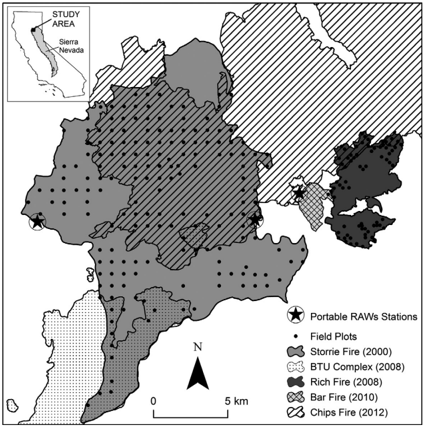
In areas where fire regimes and forest structure have been dramatically altered, there is increasing concern that contemporary fires have the potential to set forests on a positive feedback trajectory with successive reburns, one in which extensive stand‐replacing fire could promote more stand‐replacing fire. Our study utilized an extensive set of field plots established following four fires that occurred between 2000 and 2010 in the northern Sierra Nevada, California, USA that were subsequently reburned in 2012. The information obtained from these field plots allowed for a unique set of analyses investigating the effect of vegetation, fuels, topography, fire weather, and forest management on reburn severity. We also examined the influence of initial fire severity and time since initial fire on influential predictors of reburn severity. Our results suggest that high‐ to moderate‐severity fire in the initial fires led to an increase in standing snags and shrub vegetation, which in combination with severe fire weather promoted high‐severity fire effects in the subsequent reburn. Although fire behavior is largely driven by weather, our study demonstrates that post‐fire vegetation composition and structure are also important drivers of reburn severity. In the face of changing climatic regimes and increases in extreme fire weather, these results may provide managers with options to create more fire‐ resilient ecosystems. In areas where frequent high‐severity fire is undesirable, management activities such as thinning, prescribed fire, or managed wildland fire can be used to moderate fire behavior not only prior to initial fires, but also before subsequent reburns.
Overview
The claims and statistics of this paper haven’t been checked yet.
Free: it reads the open-access text and checks the first 5 claims that cite a source we can check. Create a free account to check every claim.
Integrity signals
Registry
Cites
Statistics
Figures



Verification
Claims the paper makes
The claims and statistics of this paper haven’t been checked yet.
Free: it reads the open-access text and checks the first 5 claims that cite a source we can check. Create a free account to check every claim.
Claims other papers make about this one
Each is checked against this paper’s own text: does it say what the citing paper says it does?
The source backs part of the claim, not all of it — or backs it for a different population, condition or comparison.
In the citing paper
“Areas that do burn under wildfire conditions (as opposed to prescribed fire) within 15-25 years after extensive mortality are prone to long-term conversion to shrub fields because of the potential loss of both established tree regeneration and seed source for postfire conifer regeneration (Coppoletta et al. 2016).”
From Drought, Tree Mortality, and Wildfire in Forests Adapted to Frequent Fire (2018) · cites this paper as Coppoletta et al. 2016
Experimental — accuracy not yet measured
Self-check
Percentages, sums and reported differences re-computed from the paper’s own numbers.
The self-check needs the paper’s full text.
Citations
Cites
R: A Language and Environment for Statistical Computing
R Core Team (2025) · doi:10.32614/r.manuals · Cited by 352,181
Resilience and Stability of Ecological Systems
Holling, C. S. (1973) · Annual Review of Ecology and Systematics · doi:10.1146/annurev.es.04.110173.000245 · Cited by 18,995 · cited 1×
“Altering conditions so that disturbance processes can act to increase, rather than reduce, forest heterogeneity may provide ecosystems with the ecological fexibility (Holling 1973) to withstand and persist through future changes in climate and climaterelated processes (Safford et al. 2012a).”
BackgroundGeneralized Additive Models: An Introduction with R
Wood, S. N. (2017) · doi:10.1201/9781315370279 · Cited by 13,852
Koyak, R. A., Hastie, T. J., & Tibshirani, R. J. (1991) · Journal of the American Statistical Association · doi:10.2307/2290538 · Cited by 7,596
Wood, S. N. (2006) · doi:10.1201/9781420010404 · Cited by 4,953
Bias in random forest variable importance measures: Illustrations, sources and a solution
Strobl, C., Boulesteix, A.-L., Zeileis, A., & Hothorn, T. (2007) · BMC Bioinformatics · doi:10.1186/1471-2105-8-25 · Cited by 3,688
Hastie, T., & Tibshirani, R. (1986) · Statistical Science · doi:10.1214/ss/1177013604 · Cited by 3,409
Conditional variable importance for random forests
Strobl, C., Boulesteix, A.-L., Kneib, T., Augustin, T., & Zeileis, A. (2008) · BMC Bioinformatics · doi:10.1186/1471-2105-9-307 · Cited by 3,254
Strobl, C., Malley, J., & Tutz, G. (2009) · Psychological Methods · doi:10.1037/a0016973 · Cited by 2,583 · cited 2×
“Predictor variables with importance values greater than the absolute value of the lowest negative score were considered infuential or of potential interest (Strobl et al. 2009).”
BackgroundMiller, J. D., & Thode, A. E. (2007) · Remote Sensing of Environment · doi:10.1016/j.rse.2006.12.006 · Cited by 1,431 · cited 2×
“Fire severity was estimated using the Relative differenced Normalized Burn Ratio (RdNBR), derived from Landsat Thematic Mapper data acquired during the frst growing season after the fre was controlled (Miller and Thode 2007).”
BackgroundMethod
Research works printed but not linked: 1
- 63. Safford, H., M. North and M. Meyer, 2012a. Climate change and the relevance of historical forest conditions. Pages 184 in M. North editor. Managing Sierra Nevada forests. Gen. Tech. Rep. PSW-GTR-237.
Cited by
Items 201–296 of 296
Moore, I., Collins, B. M., Foster, D. E., Tompkins, R. E., Stevens, J. T., & Stephens, S. L. (2021) · International Journal of Wildland Fire · doi:10.1071/wf20131 · Cited by 4
Self-citationLinares, M., & Ni‐Meister, W. (2024) · Remote Sensing · doi:10.3390/rs16081461 · Cited by 8
“Whereas high-severity fires led to the most significant change in vegetation from dense conifer forests to low-stature grassland from 2001 to 2016 (Figure 4) [51].”
Impacts of mega drought in fire-prone montane forests and implications for forest management
Hankin, L. E., Crumrine, S. A., & Anderson, C. T. (2024) · Forest Ecology and Management · doi:10.1016/j.foreco.2024.122010 · Cited by 4
Rasolozaka, M., Schüßler, D., Randriafenontsoa, J., Andriatsitohaina, F., Rakotomamonjy, P., Rabarison, H., & Radespiel, U. (2025) · Remote Sensing Applications Society and Environment · doi:10.1016/j.rsase.2025.101521 · Cited by 6
Jasperse, L., Collins, B. M., Coppoletta, M., Merriam, K. E., & Stephens, S. L. (2025) · Fire Ecology · doi:10.1186/s42408-025-00378-z · Cited by 4
“Fire severity for each fire was estimated using the Relative Differenced Normalized Burn Ratio (RdNBR) to facilitate comparisons with prior analyses (Coppoletta et al. 2016) and for its utility in comparing severity between fires throughout time and space, allowing for landscape-level analyses…”
InfluentialSelf-citationvonHedemann, N., Breidenbach, T., Carney, C. P., Childers, L. C., David-Chavez, D., Havrilla, C. A., Hill, M., Mahmoud, H. N., Mueller, N. D., Schultz, C. A., et al. (2023) · Climate Policy · doi:10.1080/14693062.2023.2242313 · Cited by 4
“However, in overstocked western US forests that are adapted to frequent fi res that have been suppressed for decades, planting additional trees is maladaptive and can increase fi re hazard (Coppoletta et al., 2015; Thompson et al., 2007).”
BackgroundGoodwin, M. J., & Hurteau, M. D. (2024) · Tree Physiology · doi:10.1093/treephys/tpae004 · Cited by 4
Sapkota, R. P., Dhital, N. B., Shrestha, A. K., Khadka, U. R., Pokhrel, C. P., Joshi, G. R., & Rijal, K. P. (2025) · Global Ecology and Conservation · doi:10.1016/j.gecco.2025.e03443 · Cited by 5
Kane, J. M., & Carrasco, J. T. (2025) · Forest Ecology and Management · doi:10.1016/j.foreco.2025.123078 · Cited by 5
Quantifying post-fire live tree presence and spatial variation using Sentinel-2 time series
Saberi, S. J., van Mantgem, P. J., Wright, M., Wong, C. Y. S., Latimer, A. M., & Young, D. J. N. (2026) · Forest Ecology and Management · doi:10.1016/j.foreco.2025.123461 · Cited by 4
Sakulich, J., Poulos, H. M., Gatewood, R. G., Wogan, K. A., Marks, C., & Taylor, A. H. (2022) · Fire · doi:10.3390/fire5040119 · Cited by 4
Rakholia, S., Yosef, R., Yadav, N., Karimloo, L., Pleitner, M., & Kothari, R. (2025) · Animals · doi:10.3390/ani15131844 · Cited by 4
“Post-fire restoration strategies often involve planting native and endemic trees to aid in revegetation and restore ecosystem services critical for wildlife survival, such as providing shelter and food resources [45,46].”
The drivers and predictability of wildfire re-burns in the western United States (US)
Solander, K. C., Talsma, C. J., & Vesselinov, V. V. (2023) · Environmental Research Climate · doi:10.1088/2752-5295/acb079 · Cited by 3
Severity, Logging and Microsite Influence Post-Fire Regeneration of Maritime Pine
Carrillo, C., Hernando, C., Díez, C., Guijarro, M., & Madrigal, J. (2024) · Fire · doi:10.3390/fire7040125 · Cited by 5
Interventions to restore wildfire-altered forests in California
Long, J. W., Walsh, D., Coppoletta, M., Tompkins, R. E., Meyer, M. D., Isbell, C., Bohlman, G. N., & North, M. P. (2023) · doi:10.2737/psw-gtr-278 · Cited by 3
Self-citationZhang, Y., Li, W., Caldwell, P. V., Sebestyen, S. D., Tang, C., Toot, R., Mihiar, C., Mondry, Z., Song, Y., Mosher, D. V., et al. (2025) · Environmental Research Letters · doi:10.1088/1748-9326/ae20af · Cited by 5
Williams, P., WATSON, P., Kington, D., Collins, E., Virkki, D. A., & Tran, C. (2026) · Australian Journal of Botany · doi:10.1071/bt25079 · Cited by 2
Case, E. J., & Harrison, S. P. (2016) · Forest Ecology and Management · doi:10.1016/j.foreco.2016.10.058 · Cited by 3
Fogg, A. M., Roberts, L. J., Burnett, R. D., & Campos, B. R. (2022) · Fire Ecology · doi:10.1186/s42408-022-00144-5 · Cited by 4
“reforestation, removing hazardous trees, and reducing fuel loads that may lead to future extreme fire behavior (Beschta et al. 2004; Long et al. 2014; Coppoletta et al. 2016).”
BackgroundPrach, K., & Walker, L. R. (2020) · Cambridge University Press eBooks · doi:10.1017/9781108561167.005 · Cited by 2
Queimadas em áreas do Cerrado brasileiro
Júnior, F. R. F., Souza, R. B. B., Cedro, T. A. P., Valério, R. A., Dias, E. S., & dos Santos, J. Y. G. (2020) · Revista Ibero-Americana de Ciências Ambientais · doi:10.6008/cbpc2179-6858.2020.007.0046 · Cited by 2
Levine, C. (2017) · eScholarship (California Digital Library) · Cited by 2
Duff, T. J., Cawson, J. G., & Penman, T. D. (2020) · Springer eBooks · doi:10.1007/978-3-319-52090-2_120 · Cited by 3
Prach, K., & Walker, L. R. (2020) · Cambridge University Press eBooks · doi:10.1017/9781108561167.012 · Cited by 1
Managing pine forest ecosystems after fire: The need of being proactive under future uncertainty
Lucas‐Borja, M. E., Peterson, C. L., & Stevens‐Rumann, C. S. (2025) · Forest Ecology and Management · doi:10.1016/j.foreco.2025.123188 · Cited by 3
Evaluating the potential of forest fuel treatments to reduce future wildfire emissions
Johnston, K., Schmidt, D. M., Levine, C., Buchholz, T. S., & Saah, D. S. (2025) · International Journal of Wildland Fire · doi:10.1071/wf25026 · Cited by 1
Bagcilar, S. H., Cale, A. B., Urza, A. K., Hanan, E. J., & Sullivan, B. W. (2025) · Ecosystems · doi:10.1007/s10021-025-01035-x · Cited by 1
Prach, K., & Walker, L. R. (2020) · Cambridge University Press eBooks · doi:10.1017/9781108561167.003 · Cited by 1
Postfire dynamics of standing dead tree stock in northern boreal forests
Mukhortova, L., Владиленович, К. Л., & Schepaschenko, D. G. (2022) · BIO Web of Conferences · doi:10.1051/bioconf/20225200038 · Cited by 1
Alvey, E. C. (2016) · Cited by 1
Mass Tree Mortality, Fuels, and Fire: A Guide for Sierra Nevada Forest Landowners
McMahon, D. E., Axelson, J., & Kocher, S. (2020) · doi:10.3733/ucanr.8683 · Cited by 1
“Even in areas with many snags, however, temperature, humidity, and the presence of shrubs to act as ladder fuels may be more important than dead fuel loads in determining fire intensity and severity (Coppoletta et al. 2016; Stephens et al. 2018).”
BackgroundWilliams, J. N., Long, J. W., Meyer, M. D., Estes, B. L., Coppoletta, M., & Safford, H. D. (2021) · Managing forest ecosystems · doi:10.1007/978-3-030-63625-8_26 · Cited by 1
Self-citationUnderstanding Woody Fuel Dynamics Following Stand-Replacing Wildfires
Johnson, M. C., Kennedy, M. C., & Harrison, S. C. (2022) · Managing forest ecosystems · doi:10.1007/978-3-030-88555-7_8 · Cited by 1
Kocher, S. D., & Wade, D. (2022) · Northwest Science · doi:10.3955/046.095.0303 · Cited by 1
“…et al. 2011), concern has been growing that, without intervention, burned forests across large expanses may shift in composition of tree species (Tubbesing et al. 2020) or convert to other vegetation types altogether, such as shrub and grassland (Millar and Stephenson 2015, Coppoletta et al. 2016).”
BackgroundPost-wildfire salvage logging effects on snag structure and dead woody fuel loadings
Johnson, M. C., Kennedy, M. C., Harrison, S. C., Alvarado, E., Desautel, C., Holford, J., & Logue, S. (2022) · Canadian Journal of Forest Research · doi:10.1139/cjfr-2021-0089 · Cited by 2
GAISRO ŽALOS NUSTATYMO MIŠKUI METODOLOGIJA PAGAL „SENTINEL“ NUOTOLINIŲ TYRIMŲ DUOMENIS
Nareiko, V., & Visockienė, J. S. (2018) · Conference for Junior Researchers "Science – Future of Lithuania" · doi:10.3846/geo.2018.010
Gustafson, G. G. (2018) · OhioLink ETD Center (Ohio Library and Information Network)
Miller, C. (2020) · Springer eBooks · doi:10.1007/978-3-319-52090-2_250
Brewen, C. J. (2019) · Digital Commons - USU (Utah State University) · Cited by 1
Tubbesing, C. L. (2020) · eScholarship (California Digital Library)
Literature and Search Phrases Used in Comparative Analyses
Prach, K., & Walker, L. R. (2020) · Cambridge University Press eBooks · doi:10.1017/9781108561167.023
Conclusions and Future Research Challenges
Prach, K., & Walker, L. R. (2020) · Cambridge University Press eBooks · doi:10.1017/9781108561167.021
Prach, K., & Walker, L. R. (2020) · Cambridge University Press eBooks · doi:10.1017/9781108561167.004
Succession by Disturbance Type
Prach, K., & Walker, L. R. (2020) · Cambridge University Press eBooks · doi:10.1017/9781108561167.006
Plot-level ladder fuel estimation from a suite of remote sensing and field methods
Forbes, B. K., Reilly, S. P., Clark, M. L., Ferrell, R. M., Kelly, A., Krause, P., Matley, C., O’Neil, M., Villasenor, M., Disney, M. I., et al. (2021) · Forest Service Research Data Archive · doi:10.2737/rds-2021-0101
Prach, K., & Walker, L. R. (2020) · Cambridge University Press eBooks · doi:10.1017/9781108561167.009
Prach, K., & Walker, L. R. (2020) · Cambridge University Press eBooks · doi:10.1017/9781108561167.010
Prach, K., & Walker, L. R. (2020) · Cambridge University Press eBooks · doi:10.1017/9781108561167.013
Prach, K., & Walker, L. R. (2020) · Cambridge University Press eBooks · doi:10.1017/9781108561167.007
Prach, K., & Walker, L. R. (2020) · Cambridge University Press eBooks · doi:10.1017/9781108561167.022
Prach, K., & Walker, L. R. (2020) · Cambridge University Press eBooks · doi:10.1017/9781108561167.018
Prach, K., & Walker, L. R. (2020) · Cambridge University Press eBooks · doi:10.1017/9781108561167.001
Prach, K., & Walker, L. R. (2020) · Cambridge University Press eBooks · doi:10.1017/9781108561167.015
(2020) · Cambridge University Press eBooks · doi:10.1017/9781108561167.024
Prach, K., & Walker, L. R. (2020) · Cambridge University Press eBooks · doi:10.1017/9781108561167.002
Prach, K., & Walker, L. R. (2020) · Cambridge University Press eBooks · doi:10.1017/9781108561167.016
Prach, K., & Walker, L. R. (2020) · Cambridge University Press eBooks · doi:10.1017/9781108561167.019
Prach, K., & Walker, L. R. (2020) · Cambridge University Press eBooks · doi:10.1017/9781108561167.008
Prach, K., & Walker, L. R. (2020) · Cambridge University Press eBooks · doi:10.1017/9781108561167.020
Prach, K., & Walker, L. R. (2020) · Cambridge University Press eBooks · doi:10.1017/9781108561167.011
Prach, K., & Walker, L. R. (2020) · Cambridge University Press eBooks · doi:10.1017/9781108561167.014
Prach, K., & Walker, L. R. (2020) · Cambridge University Press eBooks · doi:10.1017/9781108561167.017
Miller, C. (2019) · Springer eBooks · doi:10.1007/978-3-319-51727-8_250-1
Prach, K., & Walker, L. R. (2020) · Cambridge University Press eBooks · doi:10.1017/9781108561167.025
Fire-climate interactions in the Southwest: Literature review and annotated bibliography
Mueller, S., Sample, M., Evans, A. M., Flatley, W. T., Thode, A. E., & Friggens, M. M. (2022) · doi:10.2737/rmrs-gtr-432 · Cited by 2
BPGA: an interactive Shiny application for basic population genetic analysis of genotype dataPreprint
Fibla, J. (2022) · EcoEvoRxiv · doi:10.32942/x2rp4v
Battles, J. J., Northrop, H., Axelson, J., Das, A. J., Stephenson, N. L., Vilanova, E., & Stephens, S. L. (2023) · SSRN Electronic Journal · doi:10.2139/ssrn.4534501
Impacts of Mega Drought in Fire-Prone Montane Forests and Implications for Forest ManagementPreprint
Hankin, L. E., Crumrine, S. A., & Anderson, C. T. (2023) · SSRN Electronic Journal · doi:10.2139/ssrn.4584237
Impacts of Mega Drought in Fire-Prone Montane Forests and Implications for Forest ManagementPreprint
Hankin, L. E., Crumrine, S. A., & Anderson, C. T. (2024) · SSRN Electronic Journal · doi:10.2139/ssrn.4788821
Hopkins, J. R., Semenova‐Nelsen, T. A., Huffman, J. M., Jones, N. J., Robertson, K. M., Platt, W., & Sikes, B. A. (2024) · bioRxiv (Cold Spring Harbor Laboratory) · doi:10.1101/2024.05.08.592975
(2024) · Elsevier eBooks · doi:10.1016/b978-0-12-815024-5.16001-x
York, R. A., Lennon, A., Redmond, M. D., & Collins, B. M. (2025) · Forestry An International Journal of Forest Research · doi:10.1093/forestry/cpaf025
“Because of heavy competition from shrubs following high severity disturbances (Battles et al. 2001, Coppoletta et al. 2016), substantially reducing competing vegetation is suggested as necessary to grow young seedlings quickly and economically in planted forests (McDonald and Fiddler 1993, Finley…”
InfluentialSelf-citationInfluence of Increasing Fires on Mixed Conifer Stand Dynamics in the U.S. Southwest
Baker, S. D., Waring, K. M., Auty, D., & Wilhelmi, N. P. (2025) · Forests · doi:10.3390/f16060967
Multi-scale assessment of wildfire use on carbon stocks in the Sierra Nevada, CA
Nesbit, K. A., Collins, B. M., Steel, Z. L., Battles, J. J., Goulden, M. L., & Stephens, S. L. (2025) · Fire Ecology · doi:10.1186/s42408-025-00389-w
“Other studies in the Sierra Nevada have shown that forested areas that burn at high severity are likely to reburn at high severity due to high amounts of large dead wood and shrubs that are created after the first fire (Coppoletta et al. 2016; Lydersen et al. 2019).”
Self-citationScott, M. B., Wallace, H., Aguilar-Argüello, S., & Gross, S. E. (2025) · Forest Ecology and Management · doi:10.1016/j.foreco.2025.123384
LUO, M., Yedinak, K. M., Bourne, K. J., & Whitman, T. L. (2025) · bioRxiv (Cold Spring Harbor Laboratory) · doi:10.64898/2025.12.04.691661
“In contrast, high-intensity, low-85 frequency forest fires can produce large PyC pulses, though the slow regeneration of woody biomass may limit subsequent additions 28,29 (Fig.”
Niziolek, D., Taylor, A. H., & Harris, L. B. (2025) · Forest Ecology and Management · doi:10.1016/j.foreco.2025.123417
Calhoun, K. L., Connor, T., Gaynor, K. M., Scoyoc, A. V., McInturff, A., Kreling, S. E. S., & Brashares, J. S. (2024) · Figshare · doi:10.6084/m9.figshare.26420340
Vegetation structure modulates fire severity in regenerated Mediterranean forestPreprint
Deltell, L., Santana, V. M., & Baeza, M. J. (2025) · SSRN Electronic Journal · doi:10.2139/ssrn.5563632
Ireland, K. B., Peterson, D. W., Ellis, T., Dickinson, J. D., & Harrod, R. J. (2026) · International Journal of Wildland Fire · doi:10.1071/wf25147
Cifuentes-Croquevielle, C., Machuca, F., Barahona‐Segovia, R. M., Matus, F., & Zúñiga‐Feest, A. (2026) · Pedobiologia · doi:10.1016/j.pedobi.2026.151117 · Cited by 1
Do Giant Sequoias Regenerate in Large Crown Fire Patches?
Hanson, C. T., Chi, T. Y., Khosla, M., & Swolgaard, C. A. (2026) · Ecology and Evolution · doi:10.1002/ece3.73306
“Moreover, when high-severity fire areas reburn in a subsequent fire, they experience mostly lower-severity surface fire (Coppoletta et al. 2016).”
Fernández‐Guisuraga, J. M., Beltrán-Marcos, D., Martín-Escribano, C., & Calvo, L. (2026) · Forest Ecosystems · doi:10.1016/j.fecs.2026.100473 · Cited by 1
Complex effects of fire severity on a serotinous conifer
Merriam, K. E., & Bovee, K. M. (2026) · Fire Ecology · doi:10.1186/s42408-026-00489-1
“…spread of wild-fire in as little as 10 years in immature stands of Baker cypress (McNamara et al. 2019b), high snag densities can also contribute to increased fuel loads that put immature populations at increased risk of fires occurring before the new cohort produces cones (Coppoletta et al. 2016).”
Self-citationBirch, J. D., Dickinson, M. B., Knapp, E. E., Ewell, C. M., & Miesel, J. (2026) · Fire Ecology · doi:10.1186/s42408-026-00510-7
“This may preempt positive feedback cycles where high-severity wildfire leads to abundant post-fire fuel deposition and therefore more high-severity wildfire (Coppoletta et al. 2016; Harris et al. 2021).”
Zhao, S., Whitman, E., Dawe, D. A., Coop, J. D., Parks, S. A., & Parisien, M. (2026) · Ecosphere · doi:10.1002/ecs2.70760
Kasel, S., Voet, J. M., Baker, P. J., Nitschke, C. R., & Trouvé, R. (2026) · Dendrochronologia · doi:10.1016/j.dendro.2026.126590
A framework to guide data collection on the social benefits and costs of post-wildfire reforestation
Jones, K. W., Burney, O. T., Hurteau, M. D., Sloan, J. L., Chambers, M. E., Foe, R., Hurteau, S. R., Mineau, A., Nelson, J., Quam, L. A., et al. (2026) · Frontiers in Forests and Global Change · doi:10.3389/ffgc.2026.1845425
Fire resilience in a Mediterranean cultural landscapePreprint
Azpeleta, A. (2026) · Research Square · doi:10.21203/rs.3.rs-10728343/v1
Compositional legacies of fire suppression maintained after fire re-entry
Cramer, S. M., Lutz, J. A., & Germain, S. J. (2026) · Fire Ecology · doi:10.1186/s42408-026-00586-1 · Cited by 1
“Conversely, high-severity fire tends to beget high-severity fire that can change forests into shrublands (Coppoletta et al. 2016; Millar and Ste-phenson 2015).”
Poulos, H. M., Hardy, S., Otaola, J. L., & Barton, A. M. (2026) · Big Earth Data · doi:10.1080/20964471.2026.2735134
Structural vegetation traits modulate fire severity in post-fire Mediterranean shrublands
Deltell, L., Santana, V. M., & Baeza, J. (2026) · Plant Ecology · doi:10.1007/s11258-026-01688-1
“Likewise, fire severity can condition post-fire vegetation response (Witten - berg et al. 2007; Röder et al. 2008; Coppoletta et al. 2016; Turner et al. 2019 ).”
Kasinda, E. M., Rutina, L., Fabiano, E. C., & Moreira, F. (2026) · Frontiers in Sustainable Resource Management · doi:10.3389/fsrma.2026.1927825
Fire history and atmospheric drying jointly control forest reburn severity
Bitters, M. E., Korinek, N., McIntosh, T. L., Cattau, M. E., Tuff, T., & Balch, J. K. (2026) · Fire Ecology · doi:10.1186/s42408-026-00604-2
“This pattern is consistent with fuel recovery and increasing structural connectivity following fire (Coppoletta et al. 2016), and aligns with prior work showing that vegetation regrowth can restore the potential for high-severity fire within one to several decades, depending on productivity and…”
Metadata
- Authors
- Coppoletta, M., Merriam, K. E., & Collins, B. M.
- Affiliations
- US Forest Service (US)
- Corresponding author
- Coppoletta, Michelle
- Venue
- Ecological Applications
- Publisher
- Wiley
- Published
- 2016-04
- Volume
- 26
- Issue
- 3
- Pages
- 686-699
- ISSN
- 1051-0761 (ISSN-L)
- 1939-5582
- OpenAlex
- W1943565020
- Cited by
- 295
- References
- 87
- Citations by year
- 2026: 19 · 2025: 27 · 2024: 28 · 2023: 24 · 2022: 26 · 2021: 37 · 2020: 57 · 2019: 18 · 2018: 26 · 2017: 20 · 2016: 12
- FWCI
- 18.79
- Type
- journal article
- Language
- en
- Open access
- hybrid
- doi.org
- Licence
- Locations
- Ecological Applications (publishedVersion, cc-by-nc-nd)
- PubMed (publishedVersion)
- Funders
- United States Department of Agriculture Forest Service
- Plumas National Forest
- Topics
- Physical Sciences › Environmental Science › Global and Planetary Change › Fire effects on ecosystems
- Physical Sciences › Environmental Science › Ecology › Rangeland and Wildlife Management
- Life Sciences › Agricultural and Biological Sciences › Forestry › Forest Management and Policy
- Keywords
- reburn, fire severity, post-fire vegetation, stand-replacing fire, fire weather, fire behavior, forest management, prescribed burning, thinning, fire regime change, Sierra Nevada, snags, shrubland vegetation, topography
- MeSH terms
- California, Conservation of Natural Resources, Environmental Monitoring, Fires, Plants, Ecosystem, Plant Development, Forests
About these checks
Registry, retraction, Cites and statistics results are computed, not judged, with one exception: a printed reference that no index lists is read once by a model before it counts as a citation error. Claims are extracted by a model and kept only when their quote appears verbatim in the text; each cited source is then checked, with a model’s help, for whether it says what the claim relies on. Those verdicts can be wrong — read the claim’s quote and the cited source before relying on one.
Statistics and arithmetic are recomputed, not judged.
Confidence bands are shown only for fields calibrated on our annotated test set. None is calibrated yet, so no band is shown.
What counts as a claim ›How we measure confidence ›How we check this ›
Are you an author, or do you see a problem with this page? Request a review
Data sources
Bibliographic data: Semantic Scholar, OpenAlex, Crossref.
Contains information from the Semantic Scholar Academic Graph Datasets, made available under the ODC Attribution License (ODC-BY 1.0).
Semantic Scholar’s data is described in: Kinney, R., et al. (2023). The Semantic Scholar Open Data Platform. arXiv:2301.10140.
