

The DOI matches its Crossref record; 20 of the 28 references it cites were found in a registry or an index, and 8 are not checked yet; 2 of the 51 sources its claims cite were checked for support.
Drivers of academic dishonesty and multi-level prevention strategies: an umbrella review
Open accessAbstract
Introducción: Academic dishonesty remains persistent in higher education, exacerbated by online assessment, contract cheating markets and generative AI. Objective: This umbrella review synthesised review-level evidence on drivers of academic dishonesty and prevention strategies recommended for higher education. Methodology: Searches were conducted in Scopus and Web of Science Core Collection from database inception to June 2025, without date restrictions, and complemented with citation searching. Seventy-eight peer-reviewed reviews were included. A structured extraction and coding instrument was piloted; review-level text segments were coded through keyword-assisted content analysis, independent coding and consensus. Findings are reported as non-exclusive review-level frequencies, not causal effect sizes. Results: The most recurrent driver domains were motivation, attitudes and moral reasoning (43.6%), pressure, stress and workload (35.9%), assessment design and teaching context (33.3%), institutional governance gaps (28.2%) and technology-mediated opportunity (26.9%). The most frequent strategy domains were technology/AI and online-integrity guidance (73.1%), embedded integrity education (66.7%), institutional governance and policy (60.3%), monitoring controls (39.7%) and culture/communication (37.2%). Conclusions: The findings support a multi-level integrity programme combining assessment redesign, curriculum-embedded integrity education, staff development, transparent policy, proportionate monitoring and continuing evaluation.
Verified 2026-11-11 · 8 references not checked yet
Overview
AI snapshot
Written from the paper’s full text.
TL;DR
This umbrella review synthesized 78 peer-reviewed reviews (1998–2025) on drivers of academic dishonesty and recommended prevention strategies in higher education. It reports non-exclusive review-level frequencies, with motivation/attitudes/moral reasoning and technology/AI guidance as the most recurrent cause and strategy domains, respectively.
Key findings
- Most recurrent cause domains were motivation, attitudes and moral reasoning (43.6%), pressure, stress and workload (35.9%), assessment design and teaching context (33.3%), institutional governance gaps (28.2%) and technology-mediated opportunity (26.9%); peer norms and social influence was 24.4%, competition/performance orientation 23.1%, skills deficits/misunderstanding 14.1%, and opportunity/low perceived detection risk 12.8%.
- Most frequent strategy domains were technology/AI and online-integrity guidance (73.1%, 57/78), embedded integrity education (66.7%, 52/78), institutional governance and policy (60.3%, 47/78), detection/monitoring/technological controls (39.7%, 31/78) and culture/communication/shared responsibility (37.2%, 29/78); assessment redesign was 33.3% (26/78), student skills support 29.5% (23/78), student engagement mechanisms 23.1% (18/78), staff development 16.7% (13/78), supportive learning environment 15.4% (12/78), and evaluation/continuous improvement 9.0% (7/78).
- The 78 included reviews covered 1998–2025: 53 (67.9%) were published 2020–2025, 16 (20.5%) 2015–2019, and 9 (11.5%) before 2015; at least 30 were classified as systematic reviews, four as scoping reviews, and four as bibliometric reviews, with the remainder narrative, integrative or broadly labelled literature reviews.
- Findings support a multi-level integrity programme combining assessment redesign, curriculum-embedded integrity education, staff development, transparent policy, proportionate monitoring and continuing evaluation; frequencies are non-exclusive review-level indicators, not causal effect sizes.
Methods
- Umbrella review design, reported with PRISMA 2020 and PRIOR principles; searches in Scopus and Web of Science Core Collection in June 2025 from database inception, with no date restriction, plus backward and forward citation searching; inclusion required peer-reviewed English-language reviews focused on higher education.
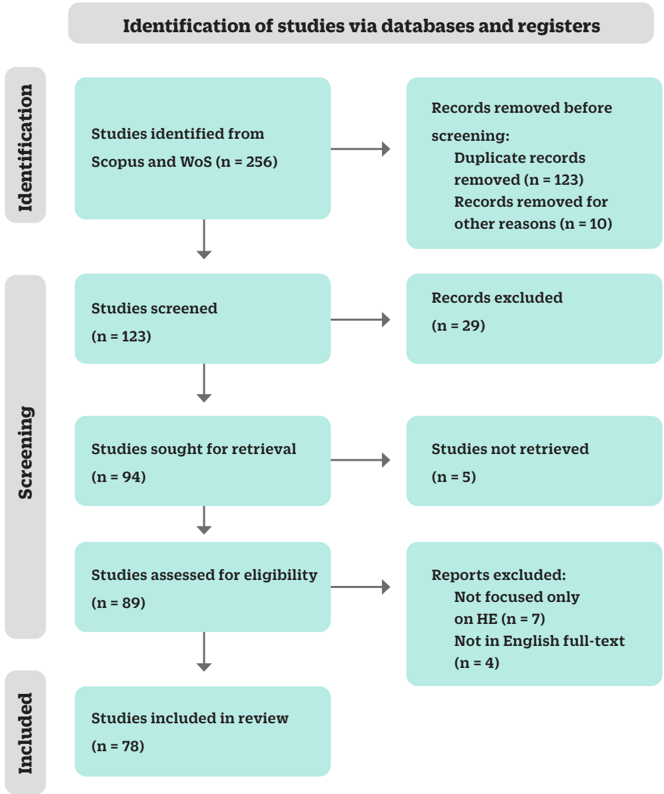
- Selection: 256 records were exported and deduplicated, removing 123 duplicates and 10 additional records, leaving 123 for title/abstract screening; 29 were excluded, 94 full texts were sought, five were not retrieved, 89 were assessed for eligibility, 11 were excluded (not higher-education focused, n = 7; not available in English full text, n = 4), yielding 78 included reviews.
- Thematic synthesis coded review-level text segments using a piloted structured extraction/coding instrument, keyword-assisted content analysis, independent coding and consensus; interrater reliability was Krippendorff’s alpha 0.82; AMSTAR 2 was used where review methods were sufficiently reported, and results are reported as non-exclusive review-level frequencies.
Limitations
- Stated in the paper: the review was restricted to Scopus and Web of Science and to English-language reviews, potentially underrepresenting regional literature, non-English scholarship and grey literature; primary-study overlap was monitored but not quantified through a corrected covered area because many reviews did not provide complete primary-study lists; appraisal was complicated by heterogeneous review types, so methodological quality was used as a sensitivity lens rather than a uniform exclusion criterion; review-level frequencies depend on how strongly each topic has attracted review activity and do not establish causal magnitude or intervention effectiveness.
- Evident in the text: frequencies are non-exclusive and do not sum to 100%; the corpus includes systematic, scoping, bibliometric, narrative and integrative reviews with different search procedures, disciplinary scopes and synthesis logics, and some reviews focused on specific modalities while others addressed academic integrity more broadly.
- Evident in the text: incomplete descriptive information was coded as not reported and not imputed, and reports with incomplete descriptive information were retained if eligible, which the authors say affected interpretive weight.
Model-written summary. Check it against the paper before relying on it.
Integrity signals
Registry
Cites
Statistics
Figures
Verification
Claims the paper makes
43 Own result · 33 No basis given · 22 Own method · 12 Not checked yet · 11 Own interpretation · 10 Sources not found · 9 Check pending · 2 Partly supported · 1 No full text of the sources · accuracy not yet measured
The paper states this without a source or data behind it here, so there is nothing to check it against. The quote shows it is in the paper.
In the paper
“Reviews converged on the idea that assessment vulnerability can be built into over-reliance on repetitive tasks, predictable formats, limited scaffolding and unclear collaboration boundaries.”
§ Drivers of academic dishonesty and multi-level prevention strategies: an umbrella review > Causes of academic dishonesty reported across reviews
plainstates a cause- Asserted: passes — The authors put it forward as true.
- Checkable: passes — It can be checked against evidence.
- Load-bearing: passes — The paper’s conclusions depend on it.
- Based: passes — The paper gives a reason why it holds.
- Rests on an assumption: The frequency with which a driver or strategy is mentioned across included reviews indicates its importance or the strength of recommendation.
The paper states this without a source or data behind it here, so there is nothing to check it against. The quote shows it is in the paper.
In the paper
“Conversely, where tasks were personalised, staged and integrated with feedback, reviews tended to describe reduced opportunity and reduced perceived need to cheat.”
§ Drivers of academic dishonesty and multi-level prevention strategies: an umbrella review > Causes of academic dishonesty reported across reviews
hedgedstates an association- Asserted: passes — The authors put it forward as true.
- Checkable: passes — It can be checked against evidence.
- Load-bearing: passes — The paper’s conclusions depend on it.
- Based: passes — The paper gives a reason why it holds.
- Rests on an assumption: The frequency with which a driver or strategy is mentioned across included reviews indicates its importance or the strength of recommendation.
A result the paper reports from its own data — it cites no other source for it, so there is none to check. The quote shows it is in the paper.
In the paper
“The most frequent strategy domains were technology/AI and online-integrity guidance (73.1%), embedded integrity education (66.7%), institutional governance and policy (60.3%), monitoring controls (39.7%) and culture/communication (37.2%).”
§ Drivers of academic dishonesty and multi-level prevention strategies: an umbrella review > Abstract
plain- Asserted: passes — The authors put it forward as true.
- Checkable: passes — It can be checked against evidence.
- Load-bearing: unclear — It is unclear whether the paper’s conclusions depend on it.
- Based: passes — The paper gives a reason why it holds.
- Rests on an assumption: The frequency with which a driver or strategy is mentioned across included reviews indicates its importance or the strength of recommendation.
A result the paper reports from its own data — it cites no other source for it, so there is none to check. The quote shows it is in the paper.
In the paper
“The most recurrent driver domains were motivation, attitudes and moral reasoning (43.6%), pressure, stress and workload (35.9%), assessment design and teaching context (33.3%), institutional governance gaps (28.2%) and technologymediated opportunity (26.9%).”
§ Drivers of academic dishonesty and multi-level prevention strategies: an umbrella review > Abstract
plainstates a cause- Asserted: passes — The authors put it forward as true.
- Checkable: passes — It can be checked against evidence.
- Load-bearing: unclear — It is unclear whether the paper’s conclusions depend on it.
- Based: passes — The paper gives a reason why it holds.
- Rests on an assumption: The frequency with which a driver or strategy is mentioned across included reviews indicates its importance or the strength of recommendation.
A result the paper reports from its own data — it cites no other source for it, so there is none to check. The quote shows it is in the paper.
In the paper
“General academic integrity, academic dishonesty, cheating or misconduct appeared in 52 reviews”
§ Drivers of academic dishonesty and multi-level prevention strategies: an umbrella review > Characteristics of the review sample and appraisal outcomes
plain- Asserted: passes — The authors put it forward as true.
- Checkable: passes — It can be checked against evidence.
- Load-bearing: unclear — It is unclear whether the paper’s conclusions depend on it.
- Based: passes — The paper gives a reason why it holds.
A result the paper reports from its own data — it cites no other source for it, so there is none to check. The quote shows it is in the paper.
In the paper
“plagiarism, writing or citation issues in 25”
§ Drivers of academic dishonesty and multi-level prevention strategies: an umbrella review > Characteristics of the review sample and appraisal outcomes
plain- Asserted: passes — The authors put it forward as true.
- Checkable: passes — It can be checked against evidence.
- Load-bearing: unclear — It is unclear whether the paper’s conclusions depend on it.
- Based: passes — The paper gives a reason why it holds.
A result the paper reports from its own data — it cites no other source for it, so there is none to check. The quote shows it is in the paper.
In the paper
“The most frequent strategy domains were technology/AI and online-integrity guidance (73.1%), embedded integrity education (66.7%), institutional governance and policy (60.3%), monitoring controls (39.7%) and culture/communication (37.2%).”
§ Drivers of academic dishonesty and multi-level prevention strategies: an umbrella review > Abstract
plain- Asserted: passes — The authors put it forward as true.
- Checkable: passes — It can be checked against evidence.
- Load-bearing: unclear — It is unclear whether the paper’s conclusions depend on it.
- Based: passes — The paper gives a reason why it holds.
- Rests on an assumption: The frequency with which a driver or strategy is mentioned across included reviews indicates its importance or the strength of recommendation.
A result the paper reports from its own data — it cites no other source for it, so there is none to check. The quote shows it is in the paper.
In the paper
“The most recurrent driver domains were motivation, attitudes and moral reasoning (43.6%), pressure, stress and workload (35.9%), assessment design and teaching context (33.3%), institutional governance gaps (28.2%) and technologymediated opportunity (26.9%).”
§ Drivers of academic dishonesty and multi-level prevention strategies: an umbrella review > Abstract
plainstates a cause- Asserted: passes — The authors put it forward as true.
- Checkable: passes — It can be checked against evidence.
- Load-bearing: unclear — It is unclear whether the paper’s conclusions depend on it.
- Based: passes — The paper gives a reason why it holds.
- Rests on an assumption: The frequency with which a driver or strategy is mentioned across included reviews indicates its importance or the strength of recommendation.
The paper states this without a source or data behind it here, so there is nothing to check it against. The quote shows it is in the paper.
In the paper
“The corpus was predominantly multi-country or global in scope because most included reviews synthesized international primary studies.”
§ Drivers of academic dishonesty and multi-level prevention strategies: an umbrella review > Characteristics of the review sample and appraisal outcomes
plain- Asserted: passes — The authors put it forward as true.
- Checkable: passes — It can be checked against evidence.
- Load-bearing: unclear — It is unclear whether the paper’s conclusions depend on it.
- Based: passes — The paper gives a reason why it holds.
A result the paper reports from its own data — it cites no other source for it, so there is none to check. The quote shows it is in the paper.
In the paper
“The most frequent strategy domains were technology/AI and online-integrity guidance (73.1%), embedded integrity education (66.7%), institutional governance and policy (60.3%), monitoring controls (39.7%) and culture/communication (37.2%).”
§ Drivers of academic dishonesty and multi-level prevention strategies: an umbrella review > Abstract
plain- Asserted: passes — The authors put it forward as true.
- Checkable: passes — It can be checked against evidence.
- Load-bearing: unclear — It is unclear whether the paper’s conclusions depend on it.
- Based: passes — The paper gives a reason why it holds.
- Rests on an assumption: The frequency with which a driver or strategy is mentioned across included reviews indicates its importance or the strength of recommendation.
- It may state two separate claims as one. 54
- Probably not a substantial claim. 65
- The quote only partly states this claim. 1
The cited sources support only part of this claim — read each source’s verdict below.
In the paper
“At the same time, integrity research cautions against framing misconduct as a simple morality problem; many integrity breaches occur in contexts of misunderstanding, language and academic literacy challenges, or ambiguous collaboration rules, which require educative responses and clearer assessment guidance (Harrad et al., 2024;Perkins et al., 2020).”
§ Drivers of academic dishonesty and multi-level prevention strategies: an umbrella review > Introduction
What the sources say
plainstates a possible cause- Asserted: passes — The authors put it forward as true.
- Checkable: passes — It can be checked against evidence.
- Load-bearing: passes — The paper’s conclusions depend on it.
- Based: passes — The paper gives a reason why it holds.
It may state two separate claims as one.
The cited sources support only part of this claim — read each source’s verdict below.
In the paper
“Recent empirical and review work similarly highlights motivational profiles, learning goals and the perceived meaning of tasks as relevant antecedents to misconduct, supporting the view that prevention should include both capability-building and assessment redesign rather than relying solely on deterrence (Ellis & Murdoch, 2024;Perkins et al., 2020).”
§ Drivers of academic dishonesty and multi-level prevention strategies: an umbrella review > Introduction
What the sources say
- Not matchedcites Ellis & Murdoch, 2024
Couldn’t be matched to a paper in Crossref, so it can’t be checked.
- Partly supportedcites Perkins et al., 2020 sourceExperimental — accuracy not yet measured
Split into 2 atoms — 1 confirmed, 0 partially supported, 0 disputed, 0 misattributed, 1 unverifiable. Expand the claim to see per-atom verdicts.
plainstates an association- Asserted: passes — The authors put it forward as true.
- Checkable: passes — It can be checked against evidence.
- Load-bearing: passes — The paper’s conclusions depend on it.
- Based: passes — The paper gives a reason why it holds.
It may state two separate claims as one.
- Not matched
The paper states this without a source or data behind it here, so there is nothing to check it against. The quote shows it is in the paper.
In the paper
“Review-level evidence rarely frames misconduct as a single-factor phenomenon; rather, it positions academic dishonesty as a product of individual motivations operating within opportunity structures and institutional climates.”
§ Drivers of academic dishonesty and multi-level prevention strategies: an umbrella review > Causes of academic dishonesty reported across reviews
plainstates a cause- Asserted: passes — The authors put it forward as true.
- Checkable: passes — It can be checked against evidence.
- Load-bearing: passes — The paper’s conclusions depend on it.
- Based: passes — The paper gives a reason why it holds.
It may state two separate claims as one.
- Rests on an assumption: The frequency with which a driver or strategy is mentioned across included reviews indicates its importance or the strength of recommendation.
A result the paper reports from its own data — it cites no other source for it, so there is none to check. The quote shows it is in the paper.
In the paper
“16 (20.5%)between 2015 and 2019”
§ Drivers of academic dishonesty and multi-level prevention strategies: an umbrella review > Characteristics of the review sample and appraisal outcomes
plain- Asserted: passes — The authors put it forward as true.
- Checkable: passes — It can be checked against evidence.
- Load-bearing: fails — The paper’s conclusions may not depend on it.
- Based: passes — The paper gives a reason why it holds.
Probably not a substantial claim. The paper’s conclusions may not depend on it.
A result the paper reports from its own data — it cites no other source for it, so there is none to check. The quote shows it is in the paper.
In the paper
“9 (11.5%)before 2015”
§ Drivers of academic dishonesty and multi-level prevention strategies: an umbrella review > Characteristics of the review sample and appraisal outcomes
plain- Asserted: passes — The authors put it forward as true.
- Checkable: passes — It can be checked against evidence.
- Load-bearing: fails — The paper’s conclusions may not depend on it.
- Based: passes — The paper gives a reason why it holds.
Probably not a substantial claim. The paper’s conclusions may not depend on it.
The paper states this without a source or data behind it here, so there is nothing to check it against. The quote shows it is in the paper.
In the paper
“Reviews repeatedly connected time scarcity, deadline congestion, anxiety about progression and workload accumulation with elevated temptation to outsource or copy, especially when students perceived limited support and low feasibility of legitimate completion.”
§ Drivers of academic dishonesty and multi-level prevention strategies: an umbrella review > Causes of academic dishonesty reported across reviews
plainstates an association- Asserted: passes — The authors put it forward as true.
- Checkable: passes — It can be checked against evidence.
- Load-bearing: passes — The paper’s conclusions depend on it.
- Based: passes — The paper gives a reason why it holds.
It may state two separate claims as one.
- Rests on an assumption: The frequency with which a driver or strategy is mentioned across included reviews indicates its importance or the strength of recommendation.
A result the paper reports from its own data — it cites no other source for it, so there is none to check. The quote shows it is in the paper.
In the paper
“The extraction matrix classified at least 30 reviews as systematic reviews”
§ Drivers of academic dishonesty and multi-level prevention strategies: an umbrella review > Characteristics of the review sample and appraisal outcomes
plain- Asserted: passes — The authors put it forward as true.
- Checkable: passes — It can be checked against evidence.
- Load-bearing: fails — The paper’s conclusions may not depend on it.
- Based: passes — The paper gives a reason why it holds.
Probably not a substantial claim. The paper’s conclusions may not depend on it.
A result the paper reports from its own data — it cites no other source for it, so there is none to check. The quote shows it is in the paper.
In the paper
“four as scoping reviews”
§ Drivers of academic dishonesty and multi-level prevention strategies: an umbrella review > Characteristics of the review sample and appraisal outcomes
plain- Asserted: passes — The authors put it forward as true.
- Checkable: passes — It can be checked against evidence.
- Load-bearing: fails — The paper’s conclusions may not depend on it.
- Based: passes — The paper gives a reason why it holds.
Probably not a substantial claim. The paper’s conclusions may not depend on it.
The paper states this without a source or data behind it here, so there is nothing to check it against. The quote shows it is in the paper.
In the paper
“Narrative, integrative and bibliometric reviews contributed useful conceptual and trend evidence, but their findings were interpreted with greater caution”
§ Drivers of academic dishonesty and multi-level prevention strategies: an umbrella review > Characteristics of the review sample and appraisal outcomes
plain- Asserted: passes — The authors put it forward as true.
- Checkable: passes — It can be checked against evidence.
- Load-bearing: unclear — It is unclear whether the paper’s conclusions depend on it.
- Based: passes — The paper gives a reason why it holds.
It may state two separate claims as one.
A result the paper reports from its own data — it cites no other source for it, so there is none to check. The quote shows it is in the paper.
In the paper
“four as bibliometric reviews”
§ Drivers of academic dishonesty and multi-level prevention strategies: an umbrella review > Characteristics of the review sample and appraisal outcomes
plain- Asserted: passes — The authors put it forward as true.
- Checkable: passes — It can be checked against evidence.
- Load-bearing: fails — The paper’s conclusions may not depend on it.
- Based: passes — The paper gives a reason why it holds.
Probably not a substantial claim. The paper’s conclusions may not depend on it.
A result the paper reports from its own data — it cites no other source for it, so there is none to check. The quote shows it is in the paper.
In the paper
“Seventy-eight peer-reviewed reviews were included.”
§ Drivers of academic dishonesty and multi-level prevention strategies: an umbrella review > Abstract
plain- Asserted: passes — The authors put it forward as true.
- Checkable: passes — It can be checked against evidence.
- Load-bearing: passes — The paper’s conclusions depend on it.
- Based: passes — The paper gives a reason why it holds.
Probably not a substantial claim.
A result the paper reports from its own data — it cites no other source for it, so there is none to check. The quote shows it is in the paper.
In the paper
“53 reviews (67.9%) were published between 2020 and 2025”
§ Drivers of academic dishonesty and multi-level prevention strategies: an umbrella review > Characteristics of the review sample and appraisal outcomes
plain- Asserted: passes — The authors put it forward as true.
- Checkable: passes — It can be checked against evidence.
- Load-bearing: fails — The paper’s conclusions may not depend on it.
- Based: passes — The paper gives a reason why it holds.
Probably not a substantial claim. The paper’s conclusions may not depend on it.
A result the paper reports from its own data — it cites no other source for it, so there is none to check. The quote shows it is in the paper.
In the paper
“The 78 included reviews covered the period 1998-2025.”
§ Drivers of academic dishonesty and multi-level prevention strategies: an umbrella review > Characteristics of the review sample and appraisal outcomes
plain- Asserted: passes — The authors put it forward as true.
- Checkable: passes — It can be checked against evidence.
- Load-bearing: fails — The paper’s conclusions may not depend on it.
- Based: passes — The paper gives a reason why it holds.
Probably not a substantial claim. The paper’s conclusions may not depend on it.
The paper states this without a source or data behind it here, so there is nothing to check it against. The quote shows it is in the paper.
In the paper
“No lower publication-date limit was applied; the eligible corpus therefore covered reviews published between 1998 and 2025.”
§ Drivers of academic dishonesty and multi-level prevention strategies: an umbrella review > Review sample and eligibility criteria
plain- Asserted: passes — The authors put it forward as true.
- Checkable: passes — It can be checked against evidence.
- Load-bearing: passes — The paper’s conclusions depend on it.
- Based: passes — The paper gives a reason why it holds.
It may state two separate claims as one.
The paper states this without a source or data behind it here, so there is nothing to check it against. The quote shows it is in the paper.
In the paper
“Reviews consistently argued that culturebuilding requires repeated messaging, visible leadership, staff alignment and student partnership”
§ Drivers of academic dishonesty and multi-level prevention strategies: an umbrella review > Prevention and mitigation strategies reported across reviews
boostedstates a cause- Asserted: passes — The authors put it forward as true.
- Checkable: passes — It can be checked against evidence.
- Load-bearing: passes — The paper’s conclusions depend on it.
- Based: passes — The paper gives a reason why it holds.
It may state two separate claims as one.
The paper states this without a source or data behind it here, so there is nothing to check it against. The quote shows it is in the paper.
In the paper
“Reviews described technology as increasing access, speed and anonymity for misconduct, while also complicating detection and proof standards.”
§ Drivers of academic dishonesty and multi-level prevention strategies: an umbrella review > Prevention and mitigation strategies reported across reviews
plainstates a cause- Asserted: passes — The authors put it forward as true.
- Checkable: passes — It can be checked against evidence.
- Load-bearing: passes — The paper’s conclusions depend on it.
- Based: passes — The paper gives a reason why it holds.
It may state two separate claims as one.
The paper states this without a source or data behind it here, so there is nothing to check it against. The quote shows it is in the paper.
In the paper
“Reviews frequently described helping friends, social pressure to share work and perceived prevalence as normalising conditions, particularly when students believed misconduct was common and rarely sanctioned.”
§ Drivers of academic dishonesty and multi-level prevention strategies: an umbrella review > Prevention and mitigation strategies reported across reviews
plainstates an association- Asserted: passes — The authors put it forward as true.
- Checkable: passes — It can be checked against evidence.
- Load-bearing: unclear — It is unclear whether the paper’s conclusions depend on it.
- Based: passes — The paper gives a reason why it holds.
It may state two separate claims as one.
The paper states this without a source or data behind it here, so there is nothing to check it against. The quote shows it is in the paper.
In the paper
“Guidance on technology/ AI and online integrity was the most recurrent recommendation, but the review literature does not support technology-only responses.”
§ Drivers of academic dishonesty and multi-level prevention strategies: an umbrella review > Practice-oriented synthesis
plain- Asserted: passes — The authors put it forward as true.
- Checkable: passes — It can be checked against evidence.
- Load-bearing: passes — The paper’s conclusions depend on it.
- Based: passes — The paper gives a reason why it holds.
It may state two separate claims as one.
A check of a cited source is scheduled, or we don’t hold its full text yet; the claim is checked once it runs.
In the paper
“At student level, reviews repeatedly recommend structured integrity education and processes, but the review evidence positions them as proportionate safeguards rather than as substitutes for learning-centered prevention (Cotton et al., 2024;Susnjak, 2024).”
§ Drivers of academic dishonesty and multi-level prevention strategies: an umbrella review > Practice-oriented synthesis
What the sources say
plain- Asserted: passes — The authors put it forward as true.
- Checkable: passes — It can be checked against evidence.
- Load-bearing: passes — The paper’s conclusions depend on it.
- Based: passes — The paper gives a reason why it holds.
Probably not a substantial claim. It may state two separate claims as one.
The paper states this without a source or data behind it here, so there is nothing to check it against. The quote shows it is in the paper.
In the paper
“Two further mid-frequency domains were central to implementation coherence: culture, communication and shared responsibility (37.2%), and assessment redesign and authentic assessment (33.3%).”
§ Drivers of academic dishonesty and multi-level prevention strategies: an umbrella review > Prevention and mitigation strategies reported across reviews
plainstates an association- Asserted: passes — The authors put it forward as true.
- Checkable: passes — It can be checked against evidence.
- Load-bearing: passes — The paper’s conclusions depend on it.
- Based: passes — The paper gives a reason why it holds.
It may state two separate claims as one.
The paper states this without a source or data behind it here, so there is nothing to check it against. The quote shows it is in the paper.
In the paper
“Reviews emphasised that clear institutional positions on permissible and impermissible technology use, coupled with assessment adjustments, are necessary to avoid ambiguity”
§ Drivers of academic dishonesty and multi-level prevention strategies: an umbrella review > Prevention and mitigation strategies reported across reviews
plainstates a cause- Asserted: passes — The authors put it forward as true.
- Checkable: passes — It can be checked against evidence.
- Load-bearing: passes — The paper’s conclusions depend on it.
- Based: passes — The paper gives a reason why it holds.
Probably not a substantial claim. It may state two separate claims as one.
The paper states this without a source or data behind it here, so there is nothing to check it against. The quote shows it is in the paper.
In the paper
“when students see variable enforcement or perceive policies as symbolic, norms may drift toward permissiveness.”
§ Drivers of academic dishonesty and multi-level prevention strategies: an umbrella review > Prevention and mitigation strategies reported across reviews
hedgedstates a possible cause- Asserted: passes — The authors put it forward as true.
- Checkable: passes — It can be checked against evidence.
- Load-bearing: fails — The paper’s conclusions may not depend on it.
- Based: passes — The paper gives a reason why it holds.
Probably not a substantial claim. The paper’s conclusions may not depend on it.
A result the paper reports from its own data — it cites no other source for it, so there is none to check. The quote shows it is in the paper.
In the paper
“staff development and consistent handling (16.7%)”
§ Drivers of academic dishonesty and multi-level prevention strategies: an umbrella review > Prevention and mitigation strategies reported across reviews
plain- Asserted: passes — The authors put it forward as true.
- Checkable: passes — It can be checked against evidence.
- Load-bearing: fails — The paper’s conclusions may not depend on it.
- Based: passes — The paper gives a reason why it holds.
Probably not a substantial claim. The paper’s conclusions may not depend on it.
A result the paper reports from its own data — it cites no other source for it, so there is none to check. The quote shows it is in the paper.
In the paper
“supportive learning environments (15.4%)”
§ Drivers of academic dishonesty and multi-level prevention strategies: an umbrella review > Prevention and mitigation strategies reported across reviews
plain- Asserted: passes — The authors put it forward as true.
- Checkable: passes — It can be checked against evidence.
- Load-bearing: fails — The paper’s conclusions may not depend on it.
- Based: passes — The paper gives a reason why it holds.
Probably not a substantial claim. The paper’s conclusions may not depend on it.
The paper states this without a source or data behind it here, so there is nothing to check it against. The quote shows it is in the paper.
In the paper
“At teacher level, reviews prioritise assessment integrity through authenticity, personalisation, scaffolding and explicit collaboration rules, complemented by staff development for consistent prevention and response.”
§ Drivers of academic dishonesty and multi-level prevention strategies: an umbrella review > Practice-oriented synthesis
plain- Asserted: passes — The authors put it forward as true.
- Checkable: passes — It can be checked against evidence.
- Load-bearing: passes — The paper’s conclusions depend on it.
- Based: passes — The paper gives a reason why it holds.
Probably not a substantial claim. It may state two separate claims as one.
The paper states this without a source or data behind it here, so there is nothing to check it against. The quote shows it is in the paper.
In the paper
“assessment redesign requires reducing replicability, increasing personalisation and building formative stages that reduce last-minute risk.”
§ Drivers of academic dishonesty and multi-level prevention strategies: an umbrella review > Prevention and mitigation strategies reported across reviews
plainstates a cause- Asserted: passes — The authors put it forward as true.
- Checkable: passes — It can be checked against evidence.
- Load-bearing: passes — The paper’s conclusions depend on it.
- Based: passes — The paper gives a reason why it holds.
It may state two separate claims as one.
The paper states this without a source or data behind it here, so there is nothing to check it against. The quote shows it is in the paper.
In the paper
“Instead, review evidence converges on building an integrated integrity programme with clearly assigned ownership across organisational levels.”
§ Drivers of academic dishonesty and multi-level prevention strategies: an umbrella review > Practice-oriented synthesis
boosted- Asserted: passes — The authors put it forward as true.
- Checkable: passes — It can be checked against evidence.
- Load-bearing: passes — The paper’s conclusions depend on it.
- Based: passes — The paper gives a reason why it holds.
Probably not a substantial claim.
A result the paper reports from its own data — it cites no other source for it, so there is none to check. The quote shows it is in the paper.
In the paper
“Reviews favoured embedded or staged integrity education, discipline-specific refreshers, academic literacy integration and explicit instruction on citation, paraphrasing and acceptable collaboration.”
§ Drivers of academic dishonesty and multi-level prevention strategies: an umbrella review > Prevention and mitigation strategies reported across reviews
plain- Asserted: passes — The authors put it forward as true.
- Checkable: passes — It can be checked against evidence.
- Load-bearing: passes — The paper’s conclusions depend on it.
- Based: passes — The paper gives a reason why it holds.
Probably not a substantial claim. It may state two separate claims as one.
The paper states this without a source or data behind it here, so there is nothing to check it against. The quote shows it is in the paper.
In the paper
“Reviews described how ambiguous rules, inconsistent messaging, weak procedural transparency and uneven case handling can produce uncertainty about boundaries and weaken deterrence.”
§ Drivers of academic dishonesty and multi-level prevention strategies: an umbrella review > Prevention and mitigation strategies reported across reviews
plainstates a cause- Asserted: passes — The authors put it forward as true.
- Checkable: passes — It can be checked against evidence.
- Load-bearing: passes — The paper’s conclusions depend on it.
- Based: passes — The paper gives a reason why it holds.
Probably not a substantial claim. It may state two separate claims as one.
The paper states this without a source or data behind it here, so there is nothing to check it against. The quote shows it is in the paper.
In the paper
“The corpus included systematic, scoping, bibliometric, narrative and integrative reviews with different search procedures, disciplinary scopes and synthesis logics.”
§ Drivers of academic dishonesty and multi-level prevention strategies: an umbrella review > Practice-oriented synthesis
plain- Asserted: passes — The authors put it forward as true.
- Checkable: passes — It can be checked against evidence.
- Load-bearing: passes — The paper’s conclusions depend on it.
- Based: passes — The paper gives a reason why it holds.
Probably not a substantial claim. It may state two separate claims as one.
A result the paper reports from its own data — it cites no other source for it, so there is none to check. The quote shows it is in the paper.
In the paper
“was typically framed as prevention through capability-building.”
§ Drivers of academic dishonesty and multi-level prevention strategies: an umbrella review > Prevention and mitigation strategies reported across reviews
plain- Asserted: passes — The authors put it forward as true.
- Checkable: passes — It can be checked against evidence.
- Load-bearing: fails — The paper’s conclusions may not depend on it.
- Based: passes — The paper gives a reason why it holds.
Probably not a substantial claim. The paper’s conclusions may not depend on it.
The paper states this without a source or data behind it here, so there is nothing to check it against. The quote shows it is in the paper.
In the paper
“Some reviews focused on specific modalities such as plagiarism, contract cheating or online exams, while others addressed academic integrity more broadly.”
§ Drivers of academic dishonesty and multi-level prevention strategies: an umbrella review > Practice-oriented synthesis
plain- Asserted: passes — The authors put it forward as true.
- Checkable: passes — It can be checked against evidence.
- Load-bearing: fails — The paper’s conclusions may not depend on it.
- Based: passes — The paper gives a reason why it holds.
Probably not a substantial claim. The paper’s conclusions may not depend on it. It may state two separate claims as one.
The paper states this without a source or data behind it here, so there is nothing to check it against. The quote shows it is in the paper.
In the paper
“Many reviews stressed standardised case handling across units to reduce inequity and protect legitimacy, particularly in technologymediated cases where proof may be contested.”
§ Drivers of academic dishonesty and multi-level prevention strategies: an umbrella review > Prevention and mitigation strategies reported across reviews
plainstates a cause- Asserted: passes — The authors put it forward as true.
- Checkable: passes — It can be checked against evidence.
- Load-bearing: fails — The paper’s conclusions may not depend on it.
- Based: passes — The paper gives a reason why it holds.
Probably not a substantial claim. The paper’s conclusions may not depend on it.
The paper states this without a source or data behind it here, so there is nothing to check it against. The quote shows it is in the paper.
In the paper
“Reviews recommended coherent policy architecture (definitions, procedures, proportional sanctions and appeals), regular updating and transparent communication so that rules become operational rather than symbolic.”
§ Drivers of academic dishonesty and multi-level prevention strategies: an umbrella review > Prevention and mitigation strategies reported across reviews
plainstates a cause- Asserted: passes — The authors put it forward as true.
- Checkable: passes — It can be checked against evidence.
- Load-bearing: passes — The paper’s conclusions depend on it.
- Based: passes — The paper gives a reason why it holds.
Probably not a substantial claim. It may state two separate claims as one.
In the paper
“A widely cited systematic review estimated a historical self-report average of 3.52% for commercial contract cheating, noting wide variation across studies and a need for improved measurement and consistent definitions (Newton, 2018).”
§ Drivers of academic dishonesty and multi-level prevention strategies: an umbrella review > Introduction
What the sources say
- Check pendingcites Newton, 2018 source
hedged- Asserted: passes — The authors put it forward as true.
- Checkable: passes — It can be checked against evidence.
- Load-bearing: fails — The paper’s conclusions may not depend on it.
- Based: passes — The paper gives a reason why it holds.
Probably not a substantial claim. The paper’s conclusions may not depend on it.
The paper states this without a source or data behind it here, so there is nothing to check it against. The quote shows it is in the paper.
In the paper
“The rapid adoption of large language models has blurred boundaries between legitimate learning support and illegitimate substitution of student work, prompting universities to revise policies, redesign assessments and clarify acceptable practice.”
§ Drivers of academic dishonesty and multi-level prevention strategies: an umbrella review > Introduction
plainstates a cause- Asserted: passes — The authors put it forward as true.
- Checkable: passes — It can be checked against evidence.
- Load-bearing: passes — The paper’s conclusions depend on it.
- Based: passes — The paper gives a reason why it holds.
It may state two separate claims as one.
In the paper
“Complementary approaches focus on self-regulation and the judgment-action gap, emphasizing that students may endorse integrity in principle yet behave differently under time pressure, stress or perceived unfairness (Stephens, 2018).”
§ Drivers of academic dishonesty and multi-level prevention strategies: an umbrella review > Introduction
What the sources say
- Not matchedcites Stephens, 2018
Couldn’t be matched to a paper in Crossref, so it can’t be checked.
hedgedstates a possible cause- Asserted: passes — The authors put it forward as true.
- Checkable: passes — It can be checked against evidence.
- Load-bearing: unclear — It is unclear whether the paper’s conclusions depend on it.
- Based: passes — The paper gives a reason why it holds.
It may state two separate claims as one.
- Not matched
In the paper
“For non-systematic review formats (e.g., narrative, integrative or bibliometric reviews), appraisal focused on transparency of search sources, eligibility criteria, data extraction and synthesis approach using a structured checklist aligned with review typology principles (Grant & Booth, 2009).”
§ Drivers of academic dishonesty and multi-level prevention strategies: an umbrella review > Methodological appraisal
What the sources say
- Not checked — no full text of the sourcecites Grant & Booth, 2009 source
plain- Asserted: passes — The authors put it forward as true.
- Checkable: passes — It can be checked against evidence.
- Load-bearing: fails — The paper’s conclusions may not depend on it.
- Based: passes — The paper gives a reason why it holds.
Probably not a substantial claim. The paper’s conclusions may not depend on it.
In the paper
“Review evidence on online exam cheating documents a broad range of motivations, behaviours and mitigation approaches, including the importance of “cheat-resistant” assessment design and the limits of purely technological controls when incentives remain high and tasks are standardised (Noorbehbahani et al., 2022).”
§ Drivers of academic dishonesty and multi-level prevention strategies: an umbrella review > Introduction
What the sources say
- Not checked yetcites Noorbehbahani et al., 2022 source
plainstates an association- Asserted: passes — The authors put it forward as true.
- Checkable: passes — It can be checked against evidence.
- Load-bearing: passes — The paper’s conclusions depend on it.
- Based: passes — The paper gives a reason why it holds.
It may state two separate claims as one.
A conclusion the paper draws from its own results — it cites no other source for it, so there is none to check. The quote shows it is in the paper.
In the paper
“a multi-level integrity programme combining assessment redesign, curriculum-embedded integrity education, staff development, transparent policy, proportionate monitoring and continuing evaluation.”
§ Drivers of academic dishonesty and multi-level prevention strategies: an umbrella review > Abstract
plainstates a cause- Asserted: passes — The authors put it forward as true.
- Checkable: passes — It can be checked against evidence.
- Load-bearing: passes — The paper’s conclusions depend on it.
- Based: passes — The paper gives a reason why it holds.
Probably not a substantial claim.
- Rests on an assumption: The frequency with which a driver or strategy is mentioned across included reviews indicates its importance or the strength of recommendation.
- Rests on an assumption: The prevention strategies recommended across reviews are appropriate or effective for reducing academic dishonesty in higher education.
In the paper
“At the same time, conceptual debates continue regarding how institutions label and respond to integrity breaches, including the risk that policy language and practice conflate unintentional mistakes with attempts to gain illegitimate advantage, with equity implications for some student groups (Harrad et al., 2024).”
§ Drivers of academic dishonesty and multi-level prevention strategies: an umbrella review > Introduction
What the sources say
- Check pendingcites Harrad et al., 2024 source
plainstates an association- Asserted: passes — The authors put it forward as true.
- Checkable: passes — It can be checked against evidence.
- Load-bearing: fails — The paper’s conclusions may not depend on it.
- Based: passes — The paper gives a reason why it holds.
Probably not a substantial claim. The paper’s conclusions may not depend on it. It may state two separate claims as one.
None of the sources cited for this claim have been checked yet.
In the paper
“Reporting was guided by PRISMA 2020 and by principles from the PRIOR statement for overviews of reviews, adapted to the reviewof-reviews unit of analysis (Gates et al., 2022;Page et al., 2021).”
§ Drivers of academic dishonesty and multi-level prevention strategies: an umbrella review > Design
What the sources say
plain- Asserted: passes — The authors put it forward as true.
- Checkable: passes — It can be checked against evidence.
- Load-bearing: fails — The paper’s conclusions may not depend on it.
- Based: passes — The paper gives a reason why it holds.
Probably not a substantial claim. The paper’s conclusions may not depend on it.
None of the sources cited for this claim have been checked yet.
In the paper
“Subsequent work has examined predictors of contract cheating and emphasised that institutional context, assessment design and student opportunity perceptions affect engagement with outsourcing services (Awdry et al., 2022;Bretag et al., 2019).”
§ Drivers of academic dishonesty and multi-level prevention strategies: an umbrella review > Introduction
What the sources say
- Not matchedcites Awdry et al., 2022
Couldn’t be matched to a paper in Crossref, so it can’t be checked.
- Not checked — no full text of the sourcecites Bretag et al., 2019 source
plainstates a cause- Asserted: passes — The authors put it forward as true.
- Checkable: passes — It can be checked against evidence.
- Load-bearing: passes — The paper’s conclusions depend on it.
- Based: passes — The paper gives a reason why it holds.
It may state two separate claims as one.
- Not matched
A check of a cited source is scheduled, or we don’t hold its full text yet; the claim is checked once it runs.
In the paper
“Sectorfocused scholarship has similarly emphasised that policy alone is insufficient, and that assessment redesign and integrity education are needed to support defensible academic standards in the context of ubiquitous AI tools (Cotton et al., 2024;Susnjak, 2024).”
§ Drivers of academic dishonesty and multi-level prevention strategies: an umbrella review > Introduction
What the sources say
plain- Asserted: passes — The authors put it forward as true.
- Checkable: passes — It can be checked against evidence.
- Load-bearing: fails — The paper’s conclusions may not depend on it.
- Based: passes — The paper gives a reason why it holds.
Probably not a substantial claim. The paper’s conclusions may not depend on it. It may state two separate claims as one.
In the paper
“Concerns have intensified as universities scale online and blended provision and as digital tools broaden the opportunity structure for misconduct, creating new tensions between accessibility, valid assessment and defensible integrity processes (Khan et al., 2022;Susnjak, 2024).”
§ Drivers of academic dishonesty and multi-level prevention strategies: an umbrella review > Introduction
What the sources say
plainstates a cause- Asserted: passes — The authors put it forward as true.
- Checkable: passes — It can be checked against evidence.
- Load-bearing: unclear — It is unclear whether the paper’s conclusions depend on it.
- Based: passes — The paper gives a reason why it holds.
It may state two separate claims as one.
What the paper did — it cites no source for this, so there is none to check. The quote shows it is in the paper.
In the paper
“Searches were conducted in Scopus and Web of Science Core Collection from database inception to June 2025, without date restrictions, and complemented with citation searching.”
§ Drivers of academic dishonesty and multi-level prevention strategies: an umbrella review > Abstract
plain- Asserted: passes — The authors put it forward as true.
- Checkable: passes — It can be checked against evidence.
- Load-bearing: passes — The paper’s conclusions depend on it.
- Based: passes — The paper gives a reason why it holds.
Probably not a substantial claim. It may state two separate claims as one.
What the paper did — it cites no source for this, so there is none to check. The quote shows it is in the paper.
In the paper
“Themes were non-exclusive, as reviews often reported multiple drivers and multi-component recommendations; therefore, percentages do not sum to 100%.”
§ Drivers of academic dishonesty and multi-level prevention strategies: an umbrella review > Synthesis and handling of incomplete reports
plainstates a cause- Asserted: passes — The authors put it forward as true.
- Checkable: passes — It can be checked against evidence.
- Load-bearing: fails — The paper’s conclusions may not depend on it.
- Based: passes — The paper gives a reason why it holds.
Probably not a substantial claim. The paper’s conclusions may not depend on it. It may state two separate claims as one.
What the paper did — it cites no source for this, so there is none to check. The quote shows it is in the paper.
In the paper
“Rigour was strengthened through a three-researcher workflow spanning retrieval, screening and coding.One researcher ran the searches, a second independently replicated them to confirm syntax, filters and exports, and a third verified the final corpus and documentation.”
§ Drivers of academic dishonesty and multi-level prevention strategies: an umbrella review > Data management, reliability and decision rules
plainstates a cause- Asserted: passes — The authors put it forward as true.
- Checkable: passes — It can be checked against evidence.
- Load-bearing: fails — The paper’s conclusions may not depend on it.
- Based: passes — The paper gives a reason why it holds.
Probably not a substantial claim. The paper’s conclusions may not depend on it. It may state two separate claims as one.
In the paper
“Where review methods were sufficiently reported, methodological quality was appraised using AMSTAR 2, which is suitable for systematic reviews of interventions and mixed evidence (Shea et al., 2017).”
§ Drivers of academic dishonesty and multi-level prevention strategies: an umbrella review > Methodological appraisal
What the sources say
- Not checked yetcites Shea et al., 2017 source
plain- Asserted: passes — The authors put it forward as true.
- Checkable: passes — It can be checked against evidence.
- Load-bearing: fails — The paper’s conclusions may not depend on it.
- Based: passes — The paper gives a reason why it holds.
Probably not a substantial claim. The paper’s conclusions may not depend on it. It may state two separate claims as one.
None of the sources cited for this claim have been checked yet.
In the paper
“Umbrella reviews are appropriate when a topic has generated multiple secondary syntheses that vary in scope and method, and where decision-makers require an integrated, practice-facing synthesis across review types and subtopics (Aromataris et al., 2015;Gates et al., 2022).”
§ Drivers of academic dishonesty and multi-level prevention strategies: an umbrella review > Design
What the sources say
- Not matchedcites Aromataris et al., 2015
Couldn’t be matched to a paper in Crossref, so it can’t be checked.
- Not checked yetcites Gates et al., 2022 source
plain- Asserted: passes — The authors put it forward as true.
- Checkable: passes — It can be checked against evidence.
- Load-bearing: passes — The paper’s conclusions depend on it.
- Based: passes — The paper gives a reason why it holds.
Probably not a substantial claim.
- Not matched
In the paper
“Overlap between reviews was monitored at the level of cited review scope and primary-study descriptions where reported, although a corrected covered area was not calculated because many reviews did not provide full primary-study lists (Pieper et al., 2014).”
§ Drivers of academic dishonesty and multi-level prevention strategies: an umbrella review > Synthesis and handling of incomplete reports
What the sources say
- Not matchedcites Pieper et al., 2014
Couldn’t be matched to a paper in Crossref, so it can’t be checked.
plain- Asserted: passes — The authors put it forward as true.
- Checkable: passes — It can be checked against evidence.
- Load-bearing: fails — The paper’s conclusions may not depend on it.
- Based: passes — The paper gives a reason why it holds.
Probably not a substantial claim. The paper’s conclusions may not depend on it. It may state two separate claims as one.
- Not matched
What the paper did — it cites no source for this, so there is none to check. The quote shows it is in the paper.
In the paper
“Text segments were coded into thematic domains and aggregated to produce reviewlevel frequencies (number and percentage of included reviews mentioning each theme).”
§ Drivers of academic dishonesty and multi-level prevention strategies: an umbrella review > Synthesis and handling of incomplete reports
plain- Asserted: passes — The authors put it forward as true.
- Checkable: passes — It can be checked against evidence.
- Load-bearing: passes — The paper’s conclusions depend on it.
- Based: passes — The paper gives a reason why it holds.
Probably not a substantial claim.
In the paper
“Backward and forward citation searching was undertaken for included reviews to identify additional eligible reviews that might be inconsistently indexed (Higgins et al., 2022).”
§ Drivers of academic dishonesty and multi-level prevention strategies: an umbrella review > Design
What the sources say
- Not matchedcites Higgins et al., 2022
Couldn’t be matched to a paper in Crossref, so it can’t be checked.
plain- Asserted: passes — The authors put it forward as true.
- Checkable: passes — It can be checked against evidence.
- Load-bearing: fails — The paper’s conclusions may not depend on it.
- Based: passes — The paper gives a reason why it holds.
Probably not a substantial claim. The paper’s conclusions may not depend on it.
- Not matched
What the paper did — it cites no source for this, so there is none to check. The quote shows it is in the paper.
In the paper
“The codebook defined each domain, inclusion and exclusion rules and examples.”
§ Drivers of academic dishonesty and multi-level prevention strategies: an umbrella review > Information sources and search strategy
plain- Asserted: passes — The authors put it forward as true.
- Checkable: passes — It can be checked against evidence.
- Load-bearing: fails — The paper’s conclusions may not depend on it.
- Based: passes — The paper gives a reason why it holds.
Probably not a substantial claim. The paper’s conclusions may not depend on it.
What the paper did — it cites no source for this, so there is none to check. The quote shows it is in the paper.
In the paper
“During final coding, later batches of included reviews added examples and disciplinary variation but did not generate new top-level cause or strategy domains.”
§ Drivers of academic dishonesty and multi-level prevention strategies: an umbrella review > Selection process
plain- Asserted: passes — The authors put it forward as true.
- Checkable: passes — It can be checked against evidence.
- Load-bearing: passes — The paper’s conclusions depend on it.
- Based: passes — The paper gives a reason why it holds.
Probably not a substantial claim. It may state two separate claims as one.
In the paper
“This literature also underscores a practical dilemma: some forms of detection are contested and may generate false positives or inequitable impacts, increasing the importance of transparent, educative approaches and proportionate enforcement (Ellis & Murdoch, 2024).”
§ Drivers of academic dishonesty and multi-level prevention strategies: an umbrella review > Introduction
What the sources say
- Not matchedcites Ellis & Murdoch, 2024
Couldn’t be matched to a paper in Crossref, so it can’t be checked.
hedgedstates a possible cause- Asserted: passes — The authors put it forward as true.
- Checkable: passes — It can be checked against evidence.
- Load-bearing: unclear — It is unclear whether the paper’s conclusions depend on it.
- Based: passes — The paper gives a reason why it holds.
It may state two separate claims as one.
- Not matched
None of the sources cited for this claim have been checked yet.
In the paper
“Academic dishonesty remains a persistent challenge for higher education because it can undermine the validity of assessment, the credibility of qualifications and public trust in higher education systems (McCabe & Treviño, 1993;McCabe et al., 2001;Noorbehbahani et al., 2022).”
§ Drivers of academic dishonesty and multi-level prevention strategies: an umbrella review > Introduction
What the sources say
plainstates a cause- Asserted: passes — The authors put it forward as true.
- Checkable: passes — It can be checked against evidence.
- Load-bearing: passes — The paper’s conclusions depend on it.
- Based: passes — The paper gives a reason why it holds.
It may state two separate claims as one.
In the paper
“A thematic synthesis was undertaken to consolidate review findings on causes and strategies (Thomas & Harden, 2008).”
§ Drivers of academic dishonesty and multi-level prevention strategies: an umbrella review > Synthesis and handling of incomplete reports
What the sources say
- Not checked yetcites Thomas & Harden, 2008 source
plain- Asserted: passes — The authors put it forward as true.
- Checkable: passes — It can be checked against evidence.
- Load-bearing: passes — The paper’s conclusions depend on it.
- Based: passes — The paper gives a reason why it holds.
Probably not a substantial claim.
The paper states this without a source or data behind it here, so there is nothing to check it against. The quote shows it is in the paper.
In the paper
“The “contextual” argument remains highly relevant: students' decisions are shaped by what they think others do, what they think staff will do, and what institutional rules mean in practice.”
§ Drivers of academic dishonesty and multi-level prevention strategies: an umbrella review > Introduction
plainstates a cause- Asserted: passes — The authors put it forward as true.
- Checkable: passes — It can be checked against evidence.
- Load-bearing: passes — The paper’s conclusions depend on it.
- Based: passes — The paper gives a reason why it holds.
It may state two separate claims as one.
What the paper did — it cites no source for this, so there is none to check. The quote shows it is in the paper.
In the paper
“Interrater reliability was assessed using Krippendorff's alpha (0.82).”
§ Drivers of academic dishonesty and multi-level prevention strategies: an umbrella review > Data management, reliability and decision rules
plain- Asserted: passes — The authors put it forward as true.
- Checkable: passes — It can be checked against evidence.
- Load-bearing: fails — The paper’s conclusions may not depend on it.
- Based: passes — The paper gives a reason why it holds.
Probably not a substantial claim. The paper’s conclusions may not depend on it.
In the paper
“An umbrella review, which treats reviews as the unit of analysis, is particularly suitable for consolidating mature bodies of secondary literature and producing higher-level synthesis that can inform policy and practice.”
§ Drivers of academic dishonesty and multi-level prevention strategies: an umbrella review > Design
What the sources say
- Not matchedcites Aromataris et al., 2015
Couldn’t be matched to a paper in Crossref, so it can’t be checked.
plain- Asserted: passes — The authors put it forward as true.
- Checkable: passes — It can be checked against evidence.
- Load-bearing: passes — The paper’s conclusions depend on it.
- Based: passes — The paper gives a reason why it holds.
Probably not a substantial claim.
- Not matched
What the paper did — it cites no source for this, so there is none to check. The quote shows it is in the paper.
In the paper
“All data were stored in a version-controlled spreadsheet to ensure an audit trail.”
§ Drivers of academic dishonesty and multi-level prevention strategies: an umbrella review > Data management, reliability and decision rules
plain- Asserted: passes — The authors put it forward as true.
- Checkable: passes — It can be checked against evidence.
- Load-bearing: fails — The paper’s conclusions may not depend on it.
- Based: passes — The paper gives a reason why it holds.
Probably not a substantial claim. The paper’s conclusions may not depend on it.
What the paper did — it cites no source for this, so there is none to check. The quote shows it is in the paper.
In the paper
“Pilot extraction ensured consistent interpretation of what constitutes a cause versus an associated factor and what constitutes a strategy versus a general recommendation.”
§ Drivers of academic dishonesty and multi-level prevention strategies: an umbrella review > Information sources and search strategy
plainstates a cause- Asserted: passes — The authors put it forward as true.
- Checkable: passes — It can be checked against evidence.
- Load-bearing: fails — The paper’s conclusions may not depend on it.
- Based: passes — The paper gives a reason why it holds.
Probably not a substantial claim. The paper’s conclusions may not depend on it.
What the paper did — it cites no source for this, so there is none to check. The quote shows it is in the paper.
In the paper
“Search terms were developed iteratively by the research team through scoping and refinement to balance sensitivity (capturing diverse integrity terminology) and specificity”
§ Drivers of academic dishonesty and multi-level prevention strategies: an umbrella review > Information sources and search strategy
plain- Asserted: passes — The authors put it forward as true.
- Checkable: passes — It can be checked against evidence.
- Load-bearing: fails — The paper’s conclusions may not depend on it.
- Based: passes — The paper gives a reason why it holds.
Probably not a substantial claim. The paper’s conclusions may not depend on it.
What the paper did — it cites no source for this, so there is none to check. The quote shows it is in the paper.
In the paper
“Screening was calibrated on a subset and then conducted independently, with discrepancies resolved through structured consensus.”
§ Drivers of academic dishonesty and multi-level prevention strategies: an umbrella review > Data management, reliability and decision rules
plain- Asserted: passes — The authors put it forward as true.
- Checkable: passes — It can be checked against evidence.
- Load-bearing: fails — The paper’s conclusions may not depend on it.
- Based: passes — The paper gives a reason why it holds.
Probably not a substantial claim. The paper’s conclusions may not depend on it. It may state two separate claims as one.
In the paper
“Umbrella reviews offer a structured approach to comparing and integrating findings across multiple reviews, including where review types differ, enabling the identification of convergent themes and consistent recommendations (Aromataris et al., 2015).”
§ Drivers of academic dishonesty and multi-level prevention strategies: an umbrella review > Design
What the sources say
- Not matchedcites Aromataris et al., 2015
Couldn’t be matched to a paper in Crossref, so it can’t be checked.
plainstates a cause- Asserted: passes — The authors put it forward as true.
- Checkable: passes — It can be checked against evidence.
- Load-bearing: passes — The paper’s conclusions depend on it.
- Based: passes — The paper gives a reason why it holds.
Probably not a substantial claim.
- Not matched
What the paper did — it cites no source for this, so there is none to check. The quote shows it is in the paper.
In the paper
“A structured extraction and coding instrument was piloted; review-level text segments were coded through keyword-assisted content analysis, independent coding and consensus.”
§ Drivers of academic dishonesty and multi-level prevention strategies: an umbrella review > Abstract
plain- Asserted: passes — The authors put it forward as true.
- Checkable: passes — It can be checked against evidence.
- Load-bearing: passes — The paper’s conclusions depend on it.
- Based: passes — The paper gives a reason why it holds.
Probably not a substantial claim. It may state two separate claims as one.
What the paper did — it cites no source for this, so there is none to check. The quote shows it is in the paper.
In the paper
“Older reviews were retained because the purpose was to map the evolution and convergence of review-level evidence, including foundational syntheses that continue to shape current conceptual categories.”
§ Drivers of academic dishonesty and multi-level prevention strategies: an umbrella review > Review sample and eligibility criteria
plainstates a cause- Asserted: passes — The authors put it forward as true.
- Checkable: passes — It can be checked against evidence.
- Load-bearing: passes — The paper’s conclusions depend on it.
- Based: passes — The paper gives a reason why it holds.
Probably not a substantial claim.
What the paper did — it cites no source for this, so there is none to check. The quote shows it is in the paper.
In the paper
“Missing or incomplete information (e.g., review period, country scope, discipline or primary-study count) was coded as not reported and was not imputed.”
§ Drivers of academic dishonesty and multi-level prevention strategies: an umbrella review > Synthesis and handling of incomplete reports
plain- Asserted: passes — The authors put it forward as true.
- Checkable: passes — It can be checked against evidence.
- Load-bearing: fails — The paper’s conclusions may not depend on it.
- Based: passes — The paper gives a reason why it holds.
Probably not a substantial claim. The paper’s conclusions may not depend on it. It may state two separate claims as one.
What the paper did — it cites no source for this, so there is none to check. The quote shows it is in the paper.
In the paper
“Findings are reported as non-exclusive review-level frequencies, not causal effect sizes.”
§ Drivers of academic dishonesty and multi-level prevention strategies: an umbrella review > Abstract
plain- Asserted: passes — The authors put it forward as true.
- Checkable: passes — It can be checked against evidence.
- Load-bearing: passes — The paper’s conclusions depend on it.
- Based: passes — The paper gives a reason why it holds.
Probably not a substantial claim.
The paper states this without a source or data behind it here, so there is nothing to check it against. The quote shows it is in the paper.
In the paper
“Scopus and Web of Science provide broad peer-reviewed higher-education coverage and replicable exports.”
§ Drivers of academic dishonesty and multi-level prevention strategies: an umbrella review > Information sources and search strategy
plain- Asserted: passes — The authors put it forward as true.
- Checkable: passes — It can be checked against evidence.
- Load-bearing: fails — The paper’s conclusions may not depend on it.
- Based: fails — The paper may give no reason why it holds.
Probably not a substantial claim. The paper’s conclusions may not depend on it. The paper may give no reason why it holds. It may state two separate claims as one.
In the paper
“Recent guidance for overviews of reviews also emphasizes the importance of transparent reporting, careful management of overlap and explicit synthesis methods, supporting the use of umbrella review methods when the objective is to inform decision-making across a broad topic with extensive review-level evidence (Gates et al., 2022).”
§ Drivers of academic dishonesty and multi-level prevention strategies: an umbrella review > Design
What the sources say
- Not checked yetcites Gates et al., 2022 source
plainstates an association- Asserted: passes — The authors put it forward as true.
- Checkable: passes — It can be checked against evidence.
- Load-bearing: passes — The paper’s conclusions depend on it.
- Based: passes — The paper gives a reason why it holds.
Probably not a substantial claim. It may state two separate claims as one.
The paper states this without a source or data behind it here, so there is nothing to check it against. The quote shows it is in the paper.
In the paper
“A substantial body of research indicates that dishonest behaviour is not reducible to individual character or a deficit of values.Instead, it reflects an interaction between personal motivations, perceptions of peer behaviour, opportunity structures embedded in assessment, and the clarity and credibility of institutional responses.”
§ Drivers of academic dishonesty and multi-level prevention strategies: an umbrella review > Introduction
hedgedstates a cause- Asserted: passes — The authors put it forward as true.
- Checkable: passes — It can be checked against evidence.
- Load-bearing: passes — The paper’s conclusions depend on it.
- Based: passes — The paper gives a reason why it holds.
It may state two separate claims as one.
In the paper
“In such contexts, the risk is fragmented governance, where institutions adopt isolated tools or policies without aligning them to the dominant drivers identified across the literature and without coordinating responsibility across organisational levels (Ellis & Murdoch, 2024;Khan et al., 2022).”
§ Drivers of academic dishonesty and multi-level prevention strategies: an umbrella review > Design
What the sources say
- Not matchedcites Ellis & Murdoch, 2024
Couldn’t be matched to a paper in Crossref, so it can’t be checked.
- Check pendingcites Khan et al., 2022 source
plainstates a cause- Asserted: passes — The authors put it forward as true.
- Checkable: fails — It may be too vague to check against evidence.
- Load-bearing: passes — The paper’s conclusions depend on it.
- Based: passes — The paper gives a reason why it holds.
Probably not a substantial claim. It may be too vague to check against evidence.
- Not matched
What the paper did — it cites no source for this, so there is none to check. The quote shows it is in the paper.
In the paper
“The review sample was considered sufficient because it represented all eligible peer-reviewed reviews retrieved from the two selected databases plus citation searching; sufficiency was therefore documentary and thematic rather than statistical.”
§ Drivers of academic dishonesty and multi-level prevention strategies: an umbrella review > Selection process
plain- Asserted: passes — The authors put it forward as true.
- Checkable: passes — It can be checked against evidence.
- Load-bearing: passes — The paper’s conclusions depend on it.
- Based: passes — The paper gives a reason why it holds.
It may state two separate claims as one.
In the paper
“Thematic coding used a calibrated codebook, independent coding and consensus adjudication for ambiguous cases, following established content-analysis procedures (Krippendorff, 2018).”
§ Drivers of academic dishonesty and multi-level prevention strategies: an umbrella review > Data management, reliability and decision rules
What the sources say
- Not matchedcites Krippendorff, 2018
Couldn’t be matched to a paper in Crossref, so it can’t be checked.
plain- Asserted: passes — The authors put it forward as true.
- Checkable: passes — It can be checked against evidence.
- Load-bearing: passes — The paper’s conclusions depend on it.
- Based: passes — The paper gives a reason why it holds.
Probably not a substantial claim. It may state two separate claims as one.
- Not matched
In the paper
“Reviews in fields such as nursing highlight how misconduct risks extend beyond educational fairness to professional standards and downstream public safety concerns, strengthening the case for institution-wide prevention programmes and robust learning supports (He et al., 2024).”
§ Drivers of academic dishonesty and multi-level prevention strategies: an umbrella review > Introduction
What the sources say
- Not matchedcites He et al., 2024
Couldn’t be matched to a paper in Crossref, so it can’t be checked.
plainstates a cause- Asserted: passes — The authors put it forward as true.
- Checkable: passes — It can be checked against evidence.
- Load-bearing: passes — The paper’s conclusions depend on it.
- Based: passes — The paper gives a reason why it holds.
Probably not a substantial claim. It may state two separate claims as one.
- Not matched
What the paper did — it cites no source for this, so there is none to check. The quote shows it is in the paper.
In the paper
“Appraisal outcomes were used to support sensitivity in interpretation, not as exclusion criteria, because the corpus intentionally included heterogeneous review types.”
§ Drivers of academic dishonesty and multi-level prevention strategies: an umbrella review > Methodological appraisal
plainstates a cause- Asserted: passes — The authors put it forward as true.
- Checkable: passes — It can be checked against evidence.
- Load-bearing: passes — The paper’s conclusions depend on it.
- Based: passes — The paper gives a reason why it holds.
Probably not a substantial claim. It may state two separate claims as one.
What the paper did — it cites no source for this, so there is none to check. The quote shows it is in the paper.
In the paper
“review-level frequencies depend on how strongly each topic has attracted review activity; they do not establish causal magnitude or intervention effectiveness.”
§ Drivers of academic dishonesty and multi-level prevention strategies: an umbrella review > Additional information
plainstates a cause- Asserted: passes — The authors put it forward as true.
- Checkable: passes — It can be checked against evidence.
- Load-bearing: fails — The paper’s conclusions may not depend on it.
- Based: passes — The paper gives a reason why it holds.
Probably not a substantial claim. The paper’s conclusions may not depend on it. It may state two separate claims as one.
A conclusion the paper draws from its own results — it cites no other source for it, so there is none to check. The quote shows it is in the paper.
In the paper
“The frequencies reported here should not be generalized as rates of misconduct across students or institutions; they are transferable as review-level indicators of recurring concerns and recommended responses in higher”
§ Drivers of academic dishonesty and multi-level prevention strategies: an umbrella review > Practice-oriented synthesis
plain- Asserted: passes — The authors put it forward as true.
- Checkable: fails — It may be too vague to check against evidence.
- Load-bearing: passes — The paper’s conclusions depend on it.
- Based: passes — The paper gives a reason why it holds.
Probably not a substantial claim. It may be too vague to check against evidence. It may state two separate claims as one.
A conclusion the paper draws from its own results — it cites no other source for it, so there is none to check. The quote shows it is in the paper.
In the paper
“Institutional AI policies are necessary to reduce ambiguity, but they are insufficient when assessment tasks remain easily outsourced or when staff interpret rules inconsistently.”
§ Drivers of academic dishonesty and multi-level prevention strategies: an umbrella review > Practice-oriented synthesis
plainstates a cause- Asserted: passes — The authors put it forward as true.
- Checkable: passes — It can be checked against evidence.
- Load-bearing: passes — The paper’s conclusions depend on it.
- Based: passes — The paper gives a reason why it holds.
It may state two separate claims as one.
In the paper
“In professional programmes, this is particularly important because academic misconduct may conceal competence gaps with implications beyond the university, as shown in review evidence on nursing education (He et al., 2024).”
§ Drivers of academic dishonesty and multi-level prevention strategies: an umbrella review > Practice-oriented synthesis
What the sources say
- Not matchedcites He et al., 2024
Couldn’t be matched to a paper in Crossref, so it can’t be checked.
hedgedstates a possible cause- Asserted: passes — The authors put it forward as true.
- Checkable: passes — It can be checked against evidence.
- Load-bearing: passes — The paper’s conclusions depend on it.
- Based: passes — The paper gives a reason why it holds.
It may state two separate claims as one.
- Not matched
None of the sources cited for this claim have been checked yet.
In the paper
“Assessment redesign, formative scaffolding and transparent guidance can reduce opportunity while also making legitimate completion more feasible (Bretag et al., 2019;Ellis & Murdoch, 2024;Noorbehbahani et al., 2022).”
§ Drivers of academic dishonesty and multi-level prevention strategies: an umbrella review > Practice-oriented synthesis
What the sources say
plainstates a cause- Asserted: passes — The authors put it forward as true.
- Checkable: passes — It can be checked against evidence.
- Load-bearing: passes — The paper’s conclusions depend on it.
- Based: passes — The paper gives a reason why it holds.
It may state two separate claims as one.
What the paper did — it cites no source for this, so there is none to check. The quote shows it is in the paper.
In the paper
“the review was restricted to Scopus and Web of Science and to English-language reviews”
§ Drivers of academic dishonesty and multi-level prevention strategies: an umbrella review > Additional information
plain- Asserted: passes — The authors put it forward as true.
- Checkable: passes — It can be checked against evidence.
- Load-bearing: fails — The paper’s conclusions may not depend on it.
- Based: passes — The paper gives a reason why it holds.
Probably not a substantial claim. The paper’s conclusions may not depend on it. It may state two separate claims as one.
A conclusion the paper draws from its own results — it cites no other source for it, so there is none to check. The quote shows it is in the paper.
In the paper
“These recommendations indicate that prevention is not only a matter of policy or technology but also of students' capacity to complete work legitimately and staff capacity to respond consistently.”
§ Drivers of academic dishonesty and multi-level prevention strategies: an umbrella review > Prevention and mitigation strategies reported across reviews
hedged- Asserted: passes — The authors put it forward as true.
- Checkable: passes — It can be checked against evidence.
- Load-bearing: passes — The paper’s conclusions depend on it.
- Based: passes — The paper gives a reason why it holds.
Probably not a substantial claim. It may state two separate claims as one.
In the paper
“The finding also aligns with meta-analytic evidence that perceived peer cheating is strongly associated with students' own dishonest behaviour (Zhao et al., 2022).”
§ Drivers of academic dishonesty and multi-level prevention strategies: an umbrella review > Practice-oriented synthesis
What the sources say
- Not checked yetcites Zhao et al., 2022 source
boostedstates an association- Asserted: passes — The authors put it forward as true.
- Checkable: passes — It can be checked against evidence.
- Load-bearing: unclear — It is unclear whether the paper’s conclusions depend on it.
- Based: passes — The paper gives a reason why it holds.
The quote only partly states this claim.
What the paper did — it cites no source for this, so there is none to check. The quote shows it is in the paper.
In the paper
“appraisal was complicated by heterogeneous review types, so methodological quality was used as a sensitivity lens rather than as a uniform exclusion criterion.”
§ Drivers of academic dishonesty and multi-level prevention strategies: an umbrella review > Additional information
plain- Asserted: passes — The authors put it forward as true.
- Checkable: passes — It can be checked against evidence.
- Load-bearing: fails — The paper’s conclusions may not depend on it.
- Based: passes — The paper gives a reason why it holds.
Probably not a substantial claim. The paper’s conclusions may not depend on it. It may state two separate claims as one.
In the paper
“This interpretation is consistent with the theory of planned behaviour, which links conduct to attitudes, subjective norms and perceived behavioural control (Ajzen, 1991)”
§ Drivers of academic dishonesty and multi-level prevention strategies: an umbrella review > Practice-oriented synthesis
What the sources say
- Not checked yetcites Ajzen, 1991 source
plainstates an association- Asserted: passes — The authors put it forward as true.
- Checkable: passes — It can be checked against evidence.
- Load-bearing: fails — The paper’s conclusions may not depend on it.
- Based: passes — The paper gives a reason why it holds.
Probably not a substantial claim. The paper’s conclusions may not depend on it.
A conclusion the paper draws from its own results — it cites no other source for it, so there is none to check. The quote shows it is in the paper.
In the paper
“which may underrepresent regional literature, non-English scholarship and grey literature.”
§ Drivers of academic dishonesty and multi-level prevention strategies: an umbrella review > Additional information
hedgedstates a possible cause- Asserted: passes — The authors put it forward as true.
- Checkable: passes — It can be checked against evidence.
- Load-bearing: fails — The paper’s conclusions may not depend on it.
- Based: passes — The paper gives a reason why it holds.
Probably not a substantial claim. The paper’s conclusions may not depend on it.
What the paper did — it cites no source for this, so there is none to check. The quote shows it is in the paper.
In the paper
“primary-study overlap between reviews was monitored but not quantified through a corrected covered area because many reviews did not provide complete primary-study lists”
§ Drivers of academic dishonesty and multi-level prevention strategies: an umbrella review > Additional information
plain- Asserted: passes — The authors put it forward as true.
- Checkable: passes — It can be checked against evidence.
- Load-bearing: fails — The paper’s conclusions may not depend on it.
- Based: passes — The paper gives a reason why it holds.
Probably not a substantial claim. The paper’s conclusions may not depend on it.
A conclusion the paper draws from its own results — it cites no other source for it, so there is none to check. The quote shows it is in the paper.
In the paper
“In conclusion, this umbrella review indicates that higher education institutions should move from fragmented and reactive responses toward integrated integrity programmes.”
§ Drivers of academic dishonesty and multi-level prevention strategies: an umbrella review > Practice-oriented synthesis
hedged- Asserted: passes — The authors put it forward as true.
- Checkable: fails — It may be too vague to check against evidence.
- Load-bearing: passes — The paper’s conclusions depend on it.
- Based: passes — The paper gives a reason why it holds.
Probably not a substantial claim. It may be too vague to check against evidence.
The paper relies on this without support.
The frequency with which a driver or strategy is mentioned across included reviews indicates its importance or the strength of recommendation.
“Findings are reported as non-exclusive review-level frequencies, not causal effect sizes.”
The paper relies on this without support.
The prevention strategies recommended across reviews are appropriate or effective for reducing academic dishonesty in higher education.
“a multi-level integrity programme combining assessment redesign, curriculum-embedded integrity education, staff development, transparent policy, proportionate monitoring and continuing evaluation.”
The paper relies on this without support.
The 78 included reviews are a sufficiently comprehensive and representative sample of the review literature on academic dishonesty in higher education to support the synthesis.
“The 78 included reviews covered the period 1998-2025.”
The paper relies on this without support.
The recommendations reported across reviews reflect evidence-based practice rather than authors' opinions.
“Across the 78 reviews, recommendations strongly favoured portfolio approaches that combine educative, assessment-based and governancebased measures.”
Citations
Cites
The PRISMA 2020 statement: An updated guideline for reporting systematic reviews
Page, M. J., McKenzie, J. E., Bossuyt, P. M., Boutron, I., Hoffmann, T. C., Mulrow, C. D., Shamseer, L., Tetzlaff, J. M., Akl, E. A., Brennan, S. E., et al. (2021) · BMJ · doi:10.1136/bmj.n71 · Cited by 108,283
The theory of planned behavior
Ajzen, I. (1991) · Organizational Behavior and Human Decision Processes · doi:10.1016/0749-5978(91)90020-t · Cited by 90,587
A typology of reviews: an analysis of 14 review types and associated methodologies
Grant, M. J., & Booth, A. (2009) · Health Information & Libraries Journal · doi:10.1111/j.1471-1842.2009.00848.x · Cited by 10,817
Shea, B. J., Reeves, B. C., Wells, G., Thuku, M., Hamel, C., Moran, J., Moher, D., Tugwell, P., Welch, V., Kristjansson, E., et al. (2017) · BMJ · doi:10.1136/bmj.j4008 · Cited by 10,636
Methods for the thematic synthesis of qualitative research in systematic reviews
Thomas, J., & Harden, A. (2008) · BMC Medical Research Methodology · doi:10.1186/1471-2288-8-45 · Cited by 9,312
Chatting and cheating: Ensuring academic integrity in the era of ChatGPT
Cotton, D. R. E., Cotton, P. A., & Shipway, J. R. (2024) · Innovations in Education and Teaching International · doi:10.1080/14703297.2023.2190148 · Cited by 3,087
Aromataris, E., Fernandez, R., Godfrey, C. M., Holly, C., Khalil, H., & Tungpunkom, P. (2015) · International Journal of Evidence-Based Healthcare · doi:10.1097/xeb.0000000000000055 · Cited by 2,587
De-duplication of database search results for systematic reviews in EndNote
Bramer, W. M., Giustini, D., de Jonge, G. B., Holland, L., & Bekhuis, T. (2016) · Journal of the Medical Library Association : JMLA · doi:10.3163/1536-5050.104.3.014 · Cited by 2,103
Cheating in Academic Institutions: A Decade of Research
McCabe, D. L., Trevino, L. K., & Butterfield, K. D. (2001) · Ethics & Behavior · doi:10.1207/s15327019eb1103_2 · Cited by 1,379
Gates, M., Gates, A., Pieper, D., Fernandes, R. M., Tricco, A. C., Moher, D., Brennan, S. E., Li, T., Pollock, M., Lunny, C., et al. (2022) · BMJ · doi:10.1136/bmj-2022-070849 · Cited by 856
Research works printed but not linked: 4
- He, F. X., Fanaian, M., Zhang, N. M., Lea, X., Geale, S. K., Gielis, L., Razaghi, K., & Evans, A. (2024). Acade- mic dishonesty in university nursing students: A scoping review. International Journal of Nursing References
- Page, M. J., & Welch, V. A. (Eds.). (2022). In Cochrane handbook for systematic reviews of interventions (Version 6.3). Cochrane. https://training.cochrane. org/handbook
- Krippendorff, K. (2018). Content analysis: An introduction to its methodology (4th ed.). Sage.
- s15326985ep4103_1 · DOI · Paper page
Cited by
Still being checked.
Metadata
- Authors
- Estrella-Bote, V. D. R., Vallespir-Adillón, M., Julián, M., & Comas-Forgas, R.
- Affiliations
- Universidad Europea de Valencia (ES)
- Venue
- Revista Digital de Investigación en Docencia Universitaria
- Published
- 2026-06-15
- Volume
- 20
- Issue
- 1
- Pages
- e2492
- ISSN
- 2223-2516 (ISSN-L)
- OpenAlex
- W7202068685
- Semantic Scholar
- a2af5008543c85600de66bed2b444440bc79989d
- Cited by
- 0
- References
- 20
- FWCI
- 0.00
- Type
- journal article
- Language
- en
- Open access
- diamond
- doi.org
- Licence
- Locations
- Revista Digital de Investigación en Docencia Universitaria (publishedVersion, cc-by-nc-sa)
- Funders
- European Regional Development Fund (10.13039/501100011033, 13039/501100011033, MICIU/ AEI /10.13039/501100011033, AEI/10.13039/501100011033, 501100011033, MICIU/AEI/10)
- Agencia Estatal de Investigación
- Topics
- Social Sciences › Education › Academic integrity and plagiarism
- Social Sciences › Business, Management and Accounting › Organizational Behavior and Human Resource Management › Ethics in Business and Education
- Social Sciences › Education › Artificial Intelligence in Education
- Keywords
- academic dishonesty, academic integrity, higher education, prevention, online assessment, contract cheating, generative AI, integrity education, assessment design, student motivation, workload and stress, institutional governance, academic integrity policy
About these checks
Registry, retraction, Cites and statistics results are computed, not judged, with one exception: a printed reference that no index lists is read once by a model before it counts as a citation error. Claims are extracted by a model and kept only when their quote appears verbatim in the text; each cited source is then checked, with a model’s help, for whether it says what the claim relies on. Those verdicts can be wrong — read the claim’s quote and the cited source before relying on one.
A language model drew the claims from the paper on 2026-11-11, under version 3 of the claim definition (model deepseek-v4.1-flash, prompt extract-v3).
A second model labelled each claim on 2026-11-11 (model jev-1.13-20260917, definition revision gold-guideline-v0.2).
Cited sources are checked with a language model’s help (gpt-6-sol).
Statistics and arithmetic are recomputed, not judged.
Confidence bands are shown only for fields calibrated on our annotated test set. None is calibrated yet, so no band is shown.
What counts as a claim ›How we measure confidence ›How we check this ›
Are you an author, or do you see a problem with this page? Request a review
