

Macrophage migration inhibitory factor is a novel structure component of centrioles and a novel transcriptional factor
Open accessThe DOI matches its Crossref record; 35 of the 35 references it cites were found in a registry or an index.
Abstract
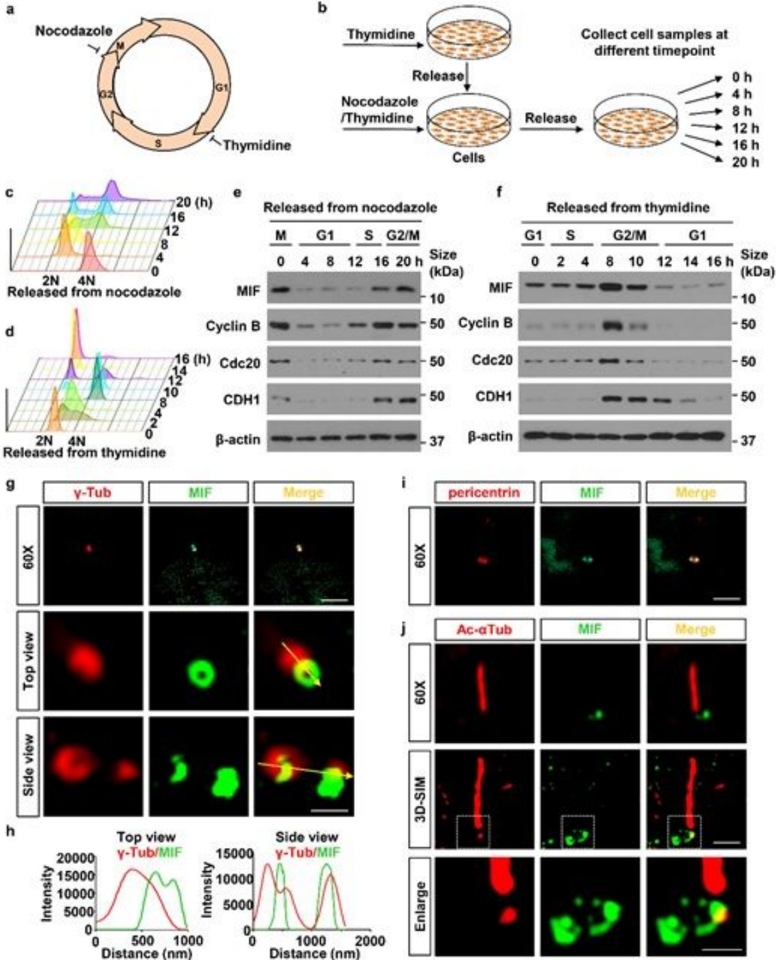
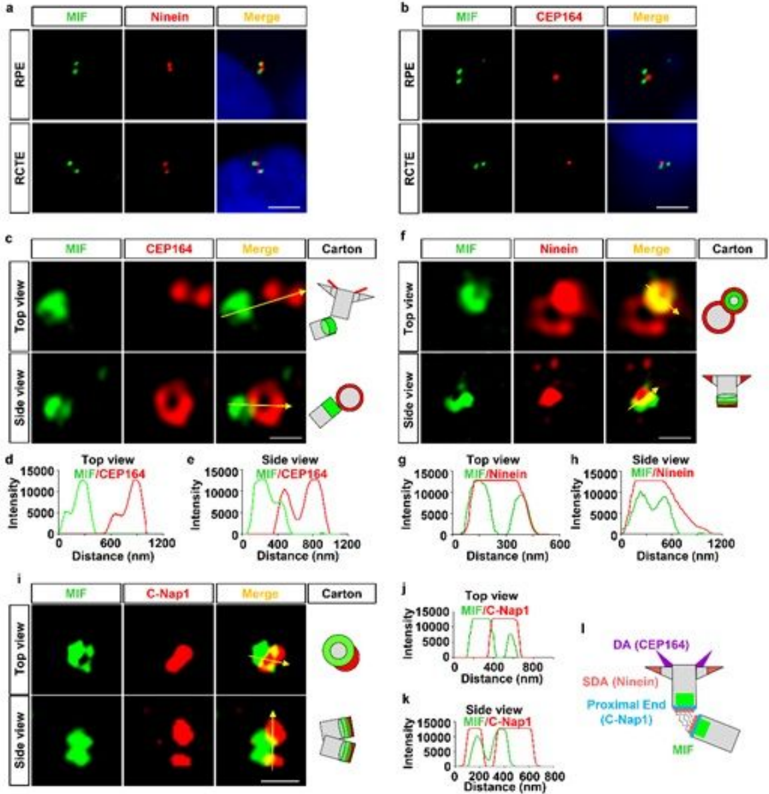
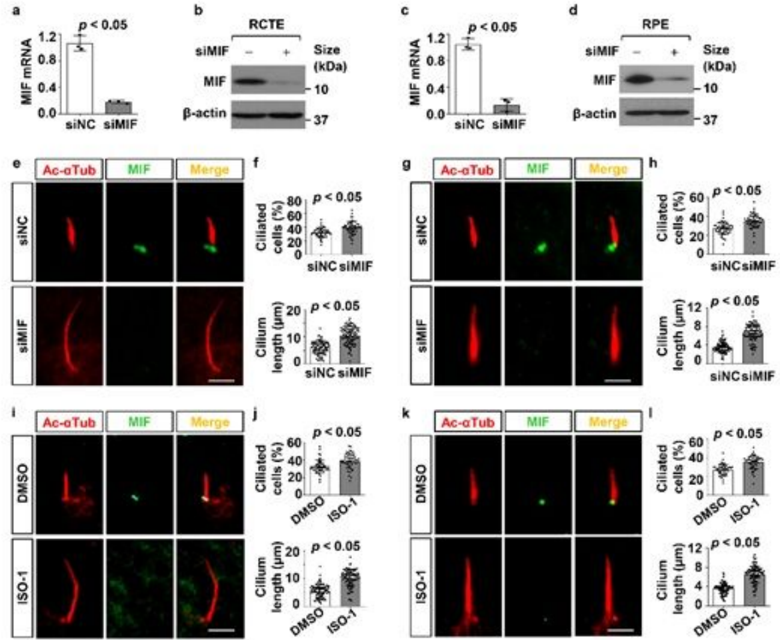
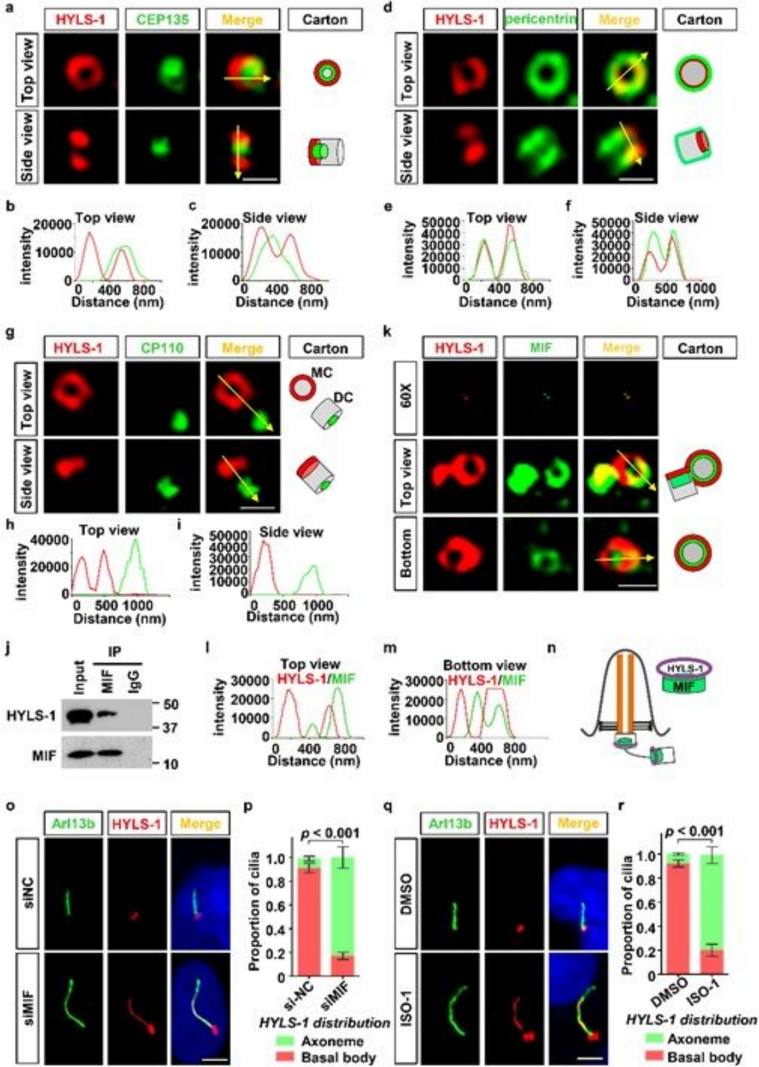
Ciliopathies are a group of human diseases that affect the cellular cilia or the cilia anchoring structures, the bosal bodies, or ciliary function. Macrophage migration inhibitory factor (MIF) as an important inflammatory cytokine plays a prominent role in the pathogenesis of various human diseases. However, the role of MIF in ciliopathies remains elusive. In this study, we show that MIF is a structure protein of basal bodies, which forms a ring-like structure at proximal end of centrioles to regulate cilia assembly and elongation. Importantly, we identify MIF as a novel transcriptional factor, which regulates the expression of ciliary genes and genes associated with different signaling pathways. The phosphatidylinositol-5-phosphate 4-kinase type 2 alpha (PIP4K2a) mediated MIF phosphorylation at S91 is necessary for the nuclear translocation of MIF, a process that is regulated by 14-3-3ζ. This study suggests that MIF is a key player in cilia biogenesis and transcriptional regulation in homeostasis.
Overview
The claims and statistics of this paper haven’t been checked yet.
Free: it reads the open-access text and checks the first 5 claims that cite a source we can check. Create a free account to check every claim.
Integrity signals
Registry
Cites
Statistics
Figures
Verification
Claims the paper makes
The claims and statistics of this paper haven’t been checked yet.
Free: it reads the open-access text and checks the first 5 claims that cite a source we can check. Create a free account to check every claim.
Claims other papers make about this one
Each is checked against this paper’s own text: does it say what the citing paper says it does?
The source backs part of the claim, not all of it — or backs it for a different population, condition or comparison.
In the citing paper
“These findings are in line with current evidence that MIF regulates ciliary gene transcription by binding to the promoters of the IFT-A (Ift121, Ift139, Ift140, Ift144) and IFT-B (Ift27, Ift88) genes and plays a critical role in cilia formation and elongation [84].”
From Abnormal accumulation of extracellular vesicles in hippocampal dystrophic axons and regulation by the primary cilia in Alzheimer's disease (2023) · cites this paper as [84]
Experimental — accuracy not yet measured
Self-check
Percentages, sums and reported differences re-computed from the paper’s own numbers.
The self-check needs the paper’s full text.
Citations
Cites
Macrophage migration inhibitory factor: a regulator of innate immunity
Calandra, T., & Roger, T. (2003) · Nature Reviews Immunology · doi:10.1038/nri1200 · Cited by 1,795
The Primary Cilium as the Cell's Antenna: Signaling at a Sensory Organelle
Singla, V., & Reiter, J. F. (2006) · Science · doi:10.1126/science.1124534 · Cited by 1,189
MIF Signal Transduction Initiated by Binding to CD74
Leng, L., Metz, C. N., Fang, Y., Xu, J., Donnelly, S., Baugh, J., Delohery, T., Chen, Y., Mitchell, R. A., & Bucala, R. (2003) · The Journal of Experimental Medicine · doi:10.1084/jem.20030286 · Cited by 1,154
CENTRIOLES AND THE FORMATION OF RUDIMENTARY CILIA BY FIBROBLASTS AND SMOOTH MUSCLE CELLS
Sorokin, S. (1962) · The Journal of Cell Biology · doi:10.1083/jcb.15.2.363 · Cited by 732
Morrison, D. K. (2009) · Trends in Cell Biology · doi:10.1016/j.tcb.2008.10.003 · Cited by 605
The centrosome cycle: Centriole biogenesis, duplication and inherent asymmetries
Nigg, E. A., & Stearns, T. (2011) · Nature Cell Biology · doi:10.1038/ncb2345 · Cited by 570
Intracellular action of the cytokine MIF to modulate AP-1 activity and the cell cycle through Jab1
Kleemann, R., Hausser, A., Geiger, G., Mischke, R., Burger-Kentischer, A., Flieger, O., Johannes, F.-J., Roger, T., Calandra, T., Kapurniotu, A., et al. (2000) · Nature · doi:10.1038/35041591 · Cited by 568
Cep164, a novel centriole appendage protein required for primary cilium formation
Graser, S., Stierhof, Y.-D., Lavoie, S. B., Gassner, O. S., Lamla, S., Le Clech, M., & Nigg, E. A. (2007) · The Journal of Cell Biology · doi:10.1083/jcb.200707181 · Cited by 516
Fry, A. M., Mayor, T., Meraldi, P., Stierhof, Y.-D., Tanaka, K., & Nigg, E. A. (1998) · The Journal of Cell Biology · doi:10.1083/jcb.141.7.1563 · Cited by 450
The roles of cilia in developmental disorders and disease
Bisgrove, B. W., & Yost, H. J. (2006) · Development · doi:10.1242/dev.02595 · Cited by 347
Mechanism and Regulation of Centriole and Cilium Biogenesis
Breslow, D. K., & Holland, A. J. (2019) · Annual Review of Biochemistry · doi:10.1146/annurev-biochem-013118-111153 · Cited by 290
The p53-dependent effects of macrophage migration inhibitory factor revealed by gene targeting
Fingerle-Rowson, G., Petrenko, O., Metz, C. N., Forsthuber, T. G., Mitchell, R., Huss, R., Moll, U., Müller, W., & Bucala, R. (2003) · Proceedings of the National Academy of Sciences · doi:10.1073/pnas.1533295100 · Cited by 284
Cilium assembly and disassembly
Sánchez, I., & Dynlacht, B. D. (2016) · Nature Cell Biology · doi:10.1038/ncb3370 · Cited by 278
Goetz, S. C., Liem, K. F., & Anderson, K. V. (2012) · Cell · doi:10.1016/j.cell.2012.10.010 · Cited by 266
Primary Cilia and the Cell Cycle
Plotnikova, O. V., Pugacheva, E. N., & Golemis, E. A. (2009) · Methods in Cell Biology · doi:10.1016/s0091-679x(08)94007-3 · Cited by 236
Centriolar Kinesin Kif24 Interacts with CP110 to Remodel Microtubules and Regulate Ciliogenesis
Kobayashi, T., Tsang, W. Y., Li, J., Lane, W., & Dynlacht, B. D. (2011) · Cell · doi:10.1016/j.cell.2011.04.028 · Cited by 220
Macrophage Migration Inhibitory Factor Promotes Intestinal Tumorigenesis
Wilson, J. M., Coletta, P. L., Cuthbert, R. J., Scott, N. A., MacLennan, K., Hawcroft, G., Leng, L., Lubetsky, J. B., Jin, K. K., Lolis, E., et al. (2005) · Gastroenterology · doi:10.1053/j.gastro.2005.07.061 · Cited by 158
Kim, S., & Dynlacht, B. D. (2013) · Current Opinion in Cell Biology · doi:10.1016/j.ceb.2013.04.011 · Cited by 156
Three-dimensional architecture of epithelial primary cilia
Sun, S., Fisher, R. L., Bowser, S. S., Pentecost, B. T., & Sui, H. (2019) · Proceedings of the National Academy of Sciences · doi:10.1073/pnas.1821064116 · Cited by 140
Macrophage migration inhibitory factor promotes cyst growth in polycystic kidney disease
Chen, L., Zhou, X., Fan, L. X., Yao, Y., Swenson-Fields, K. I., Gadjeva, M., Wallace, D. P., Peters, D. J. M., Yu, A., Grantham, J. J., et al. (2015) · Journal of Clinical Investigation · doi:10.1172/jci80467 · Cited by 139
Self-citationLysine methyltransferase SMYD2 promotes cyst growth in autosomal dominant polycystic kidney disease
Li, L. X., Fan, L. X., Zhou, J. X., Grantham, J. J., Calvet, J. P., Sage, J., & Li, X. (2017) · Journal of Clinical Investigation · doi:10.1172/jci90921 · Cited by 131
Self-citationKif3a interacts with Dynactin subunit p150Glued to organize centriole subdistal appendages
Kodani, A., Sirerol-Piquer, M. S., Seol, A. D., García‐Verdugo, J. M., & Reiter, J. F. (2013) · The EMBO Journal · doi:10.1038/emboj.2013.3 · Cited by 114
Heterotaxia, Congenital Heart Disease, and Primary Ciliary Dyskinesia
Brueckner, M. K. (2007) · Circulation · doi:10.1161/circulationaha.107.699256 · Cited by 111
The hydrolethalus syndrome protein HYLS-1 links core centriole structure to cilia formation
Dammermann, A., Pemble, H., Mitchell, B. J., McLeod, I., Yates, J. R., Kintner, C., Desai, A. B., & Oegema, K. (2009) · Genes & Development · doi:10.1101/gad.1810409 · Cited by 88
Huang, N., Zhang, D., Li, F., Chai, P., Wang, S., Teng, J., & Chen, J. (2018) · Nature Communications · doi:10.1038/s41467-018-06990-9 · Cited by 87
MIF, CD74 and other partners in kidney disease: Tales of a promiscuous couple
Sánchez-Niño, M. D., Sanz, A. B., Ruiz‐Andrés, O., Poveda, J., Izquierdo, M. C., Selgas, R., Egido, J., & Ortíz, A. (2012) · Cytokine & Growth Factor Reviews · doi:10.1016/j.cytogfr.2012.08.001 · Cited by 82
Dual blockade of the lipid kinase PIP4Ks and mitotic pathways leads to cancer-selective lethality
Kitagawa, M., Liao, P.-J., Lee, K. H., Wong, J., Shang, S. C., Minami, N., Sampetrean, O., Saya, H., Lingyun, D., Prabhu, N., et al. (2017) · Nature Communications · doi:10.1038/s41467-017-02287-5 · Cited by 80
MIF Maintains the Tumorigenic Capacity of Brain Tumor–Initiating Cells by Directly Inhibiting p53
Fukaya, R., Ohta, S., Yaguchi, T., Matsuzaki, Y., Sugihara, E., Okano, H., Saya, H., Kawakami, Y., Kawase, T., Yoshida, K., et al. (2016) · Cancer Research · doi:10.1158/0008-5472.can-15-1011 · Cited by 77
Gadjeva, M. G., Nagashima, J., Zaidi, T., Mitchell, R. A., & Pier, G. B. (2010) · PLoS Pathogens · doi:10.1371/journal.ppat.1000826 · Cited by 53
Han, Y., Yu, G., Sarioglu, H., Caballero-Martinez, A., Schlott, F., Ueffing, M., Haase, H., Peschel, C., & Krackhardt, A. M. (2012) · Journal of Proteomics · doi:10.1016/j.jprot.2012.11.015 · Cited by 49
MIF loss impairs Myc-induced lymphomagenesis
Talos, F., Mena, P., Fingerle‐Rowson, G., Moll, U. M., & Petrenko, O. (2005) · Cell Death and Differentiation · doi:10.1038/sj.cdd.4401653 · Cited by 46
Cullin-3–KCTD10-mediated CEP97 degradation promotes primary cilium formation
Nagai, T., Mukoyama, S., Kagiwada, H., Goshima, N., & Mizuno, K. (2018) · Journal of Cell Science · doi:10.1242/jcs.219527 · Cited by 38
The hydrolethalus syndrome protein HYLS-1 regulates formation of the ciliary gate
Wei, Q., Zhang, Y., Schouteden, C., Zhang, Y., Zhang, Q., Dong, J., Wonesch, V., Ling, K., Dammermann, A., & Hu, J. (2016) · Nature Communications · doi:10.1038/ncomms12437 · Cited by 32
A global genomic view of MIF knockdown-mediated cell cycle arrest
Liu, L., Ji, C., Chen, J., Li, Y., Fu, X., Xie, Y., Gu, S., & Mao, Y. (2008) · Cell Cycle · doi:10.4161/cc.7.11.6011 · Cited by 30
Hou, Y., Wu, Z., Zhang, Y., Chen, H., Hu, J., Guo, Y., Peng, Y., & Wei, Q. (2020) · Frontiers in Cell and Developmental Biology · doi:10.3389/fcell.2020.00301 · Cited by 18
Cited by
Jang, J., Yeo, S., Baek, S., Jung, H. J., Lee, M. S., Choi, S. H., & Choe, Y. (2023) · Acta Neuropathologica Communications · doi:10.1186/s40478-023-01637-3 · Cited by 20
“These findings are in line with current evidence that MIF regulates ciliary gene transcription by binding to the promoters of the IFT-A (Ift121, Ift139, Ift140, Ift144) and IFT-B (Ift27, Ift88) genes and plays a critical role in cilia formation and elongation [84].”
Result
Metadata
- Authors
- Zhang, L., Zhang, H., Li, X., Agborbesong, E., & Li, X.
- Affiliations
- Mayo Clinic (US)
- Corresponding author
- Li, Xiaoyan
- Li, Xiaogang
- Venue
- Research Square
- Published
- 2020-12-29
- OpenAlex
- W3126611651
- Cited by
- 1
- References
- 35
- Citations by year
- 2023: 1
- Type
- posted content
- Language
- en
- Open access
- green
- doi.org
- Locations
- Research Square (acceptedVersion, cc-by)
- Funders
- PKD Foundation
- National Institutes of Health (DK106912)
- National Institute of Diabetes and Digestive and Kidney Diseases (P30DK106912, R01DK084097, R01DK126662)
- Topics
- Life Sciences › Biochemistry, Genetics and Molecular Biology › Genetics › Genetic and Kidney Cyst Diseases
- Life Sciences › Immunology and Microbiology › Immunology › Macrophage Migration Inhibitory Factor
- Health Sciences › Medicine › Pulmonary and Respiratory Medicine › Cystic Fibrosis Research Advances
- Keywords
- macrophage migration inhibitory factor, centrioles, basal bodies, ciliopathies, cilia assembly, transcriptional regulation, PIP4K2A, nuclear translocation, 14-3-3ζ
About these checks
Registry, retraction, Cites and statistics results are computed, not judged, with one exception: a printed reference that no index lists is read once by a model before it counts as a citation error. Claims are extracted by a model and kept only when their quote appears verbatim in the text; each cited source is then checked, with a model’s help, for whether it says what the claim relies on. Those verdicts can be wrong — read the claim’s quote and the cited source before relying on one.
Statistics and arithmetic are recomputed, not judged.
Confidence bands are shown only for fields calibrated on our annotated test set. None is calibrated yet, so no band is shown.
What counts as a claim ›How we measure confidence ›How we check this ›
Are you an author, or do you see a problem with this page? Request a review
Data sources
Bibliographic data: Semantic Scholar, OpenAlex, Crossref.
Contains information from the Semantic Scholar Academic Graph Datasets, made available under the ODC Attribution License (ODC-BY 1.0).
Semantic Scholar’s data is described in: Kinney, R., et al. (2023). The Semantic Scholar Open Data Platform. arXiv:2301.10140.
