

The DOI matches its Crossref record; 1 of the 1 references it cites were found in a registry or an index.
Diversity, distribution and conservation of crocodiles (Order: Crocodylia) in Guinea-Bissau, West Africa
Open accessPreprint — published as 10.1038/s41598-025-08789-3 · Paper page
Abstract
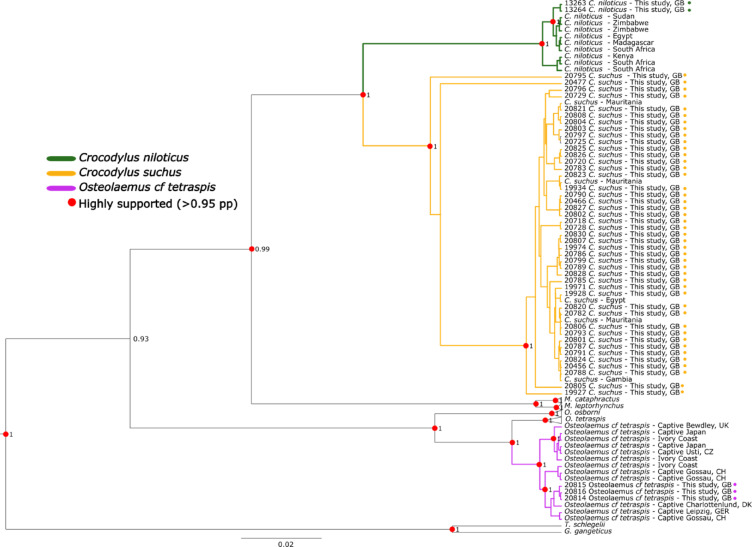
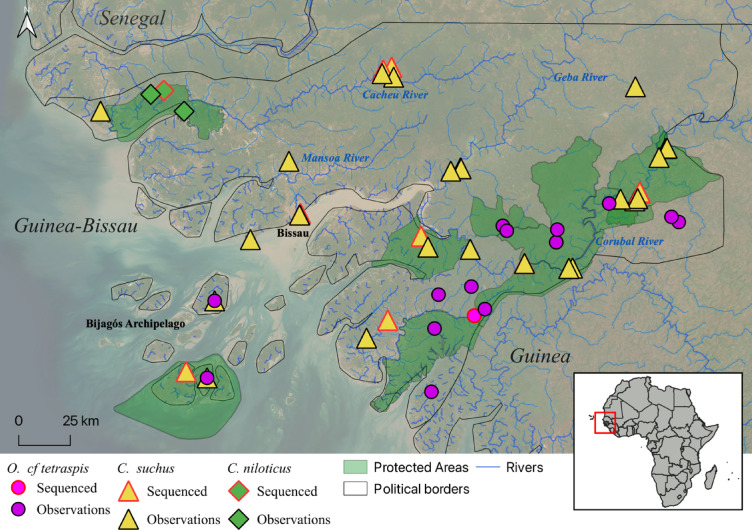
Challenges in freshwater organism conservation in West Africa are worsened by significant knowledge gaps, even for charismatic species like crocodiles. This study addresses these gaps by assessing crocodile diversity, distribution, and conservation threats in Guinea-Bissau, where existing data is outdated. We used visual surveys, inquiries, molecular barcoding, camera trapping, and bibliographic reviews to investigate crocodile populations. Notably, we found evidence suggesting the Nile crocodile (Crocodylus niloticus), previously thought extinct in West Africa since about 200 years, may persist in the Cacheu region (Guinea-Bissau). We also confirmed the presence of the West African crocodile (Crocodylus suchus) in major river basins and coastal lagoons, including the Bijagós Archipelago, and the West African dwarf crocodile (Osteolaemus cf tetraspis) in the southern mainland and the Bijagós Archipelago. Habitat loss and deliberate killings were identified as major threats. Standardized surveys and genetic sampling are essential to assess population size, connectivity, and genetic diversity, informing evolutionary studies and conservation planning. Conservation efforts should prioritize habitat protection through community-managed reserves and restoration initiatives. Additionally, engaging local communities to raise awareness and develop conflict mitigation strategies is crucial, particularly in areas with human-crocodile interactions.
Overview
The claims and statistics of this paper haven’t been checked yet.
Run the check — free, no account needed. It reads the open-access text and checks the sources it cites.
Integrity signals
Registry
Cites
Statistics
Figures
Verification
Claims the paper makes
The claims and statistics of this paper haven’t been checked yet.
Run the check — free, no account needed. It reads the open-access text and checks the sources it cites.
Self-check
Percentages, sums and reported differences re-computed from the paper’s own numbers.
The self-check needs the paper’s full text.
Citations
Cites
Scientists’ warning to humanity on the freshwater biodiversity crisis
Albert, J. S., Destouni, G., Duke-Sylvester, S. M., Magurran, A. E., Oberdorff, T., Reis, R. E., Winemiller, K. O., & Ripple, W. J. (2021) · Ambio · doi:10.1007/s13280-020-01318-8 · Cited by 943
Research works printed but not linked: 58
- Sayer, C. A. et al. One-quarter of freshwater fauna threatened with extinction. Nature 638, 138–145 (2025). · DOI
- Farooq, H., Azevedo, J. A. R., Soares, A., Antonelli, A. & Faurby, S. Mapping Africa’s Biodiversity: More of the Same Is Just Not Good Enough. Syst. Biol. 70, 623–633 (2021). · DOI
- Myers, N., Mittermeier, R. A., Mittermeier, C. G., Fonseca, D., Kent, J. & G. A. B. & Biodiversity hotspots for conservation priorities. Nature 403, 853–858 (2000). · DOI · Paper page
- Oates, J. F., Bergl, R. A. & Linder, J. M. Africa’s Gulf of Guinea Forests: Biodiversity Patterns and Conservation Priorities.
- Brito, J. C. et al. Unravelling biodiversity, evolution and threats to conservation in the Sahara-Sahel. Biol. Rev. 89, 215–231 (2014). · DOI
- dos Reis-SilvaF. P., A. F. Amphibian and reptile dataset across different land-use types in Guinea-Bissau. (2024). https://doi.org/10.1101/2024.11.21.624282 · DOI
- Luiselli, L. et al. State of knowledge of research in the Guinean forests of West Africa region. Acta Oecol. 94, 3–11 (2019). · DOI
- Hortal, J. et al. Seven Shortfalls that Beset Large-Scale Knowledge of Biodiversity. Annu. Rev. Ecol. Evol. Syst. 46, 523–549 (2015). · DOI · Paper page
- Mazzotti, F. J. et al. Alligators and crocodiles as indicators for restoration of Everglades ecosystems. Ecol. Indic. 9, S137–S149 (2009). · DOI
- Van Der Ploeg, J., Cauillan-Cureg, M., Van Weerd, M. & Persoon, G. Why must we protect crocodiles?’ Explaining the value of the Philippine crocodile to rural communities. J. Integr. Environ. Sci. 8, 287–298 (2011). · DOI
- Somaweera, R. et al. The ecological importance of crocodylians: towards evidence-based justification for their conservation. Biol. Rev. 95, 936–959 (2020). · DOI
- Humphries, M. S., Myburgh, J. G., Campbell, R., Buah-Kwofie, A. & Combrink, X. Organochlorine pesticide bioaccumulation in wild Nile crocodile (Crocodylus niloticus) fat tissues: Environmental influences on changing residue levels and contaminant profiles. Sci. Total Environ. 753, 142068 (2021). · DOI
- Rainwater, T. R. et al. Fauna Associated with American Alligator (Alligator mississippiensis) Nests in Coastal South Carolina, USA. Animals 14, 620 (2024). · DOI
- Ouré, R. B. & Sinsin, B. Does Crocodile Conservation Matter in Sacred Natural Sites of Benin (Western Africa)? West Afr. J. Appl. Ecol. 31, (2023).
- Pooley, S. A. Cultural Herpetology of Nile Crocodiles in Africa. Conserv. Soc. 14, 391–405 (2016). · DOI
- Hekkala, E. et al. An ancient icon reveals new mysteries: Mummy DNA resurrects a cryptic species within the Nile crocodile. Mol. Ecol. 20, 4199–4215 (2011). · DOI
- Shirley, M. H., Vliet, K. A., Carr, A. N. & Austin, J. D. Rigorous approaches to species delimitation have significant implications for African crocodilian systematics and conservation. Proc. R. Soc. B Biol. Sci. 281, 20132483 (2014).
- Shirley, M. H., Carr, A. N., Nestler, J. H., Vliet, K. A. & Brochu, C. A. Systematic revision of the living African slender-snouted crocodiles (Mecistops gray, 1844). Zootaxa 4504, 151–193 (2018). · DOI
- Velo-Antón, G., Godinho, R., Campos, J. C. & Brito, J. C. Should i stay or should i go? Dispersal and population structure in small, isolated desert populations of west african crocodiles. PLoS ONE 9, (2014). · DOI
- van Asch, B. et al. Phylogeography, genetic diversity, and population structure of Nile crocodile populations at the fringes of the southern African distribution. PLoS ONE 14, (2019).
- Luiselli, L. et al. Understanding the influence of non-wealth factors in determining bushmeat consumption: Results from four West African countries. Acta Oecol. 94, 47–56 (2019). · DOI
- Shirley, M. H. & Mecistops cataphractus, M. H. The IUCN Red List of Threatened Species 2014: e.T5660A3044332. (2013). https://doi.org/10.2305/IUCN.UK.2014-1.RLTS.T5660A3044332.en · DOI
- Eaton, M. J., Martin, A., Thorbjarnarson, J. & Amato, G. Species-level diversification of African dwarf crocodiles (Genus Osteolaemus): A geographic and phylogenetic perspective. Mol. Phylogenet Evol. 50, 496–506 (2009). · DOI
- Trape, J. F., Trape, S. & Chirio, L. Lézards, Crocodiles et Tortues d’Afrique Occidentale et Du Sahara. (IRD Éditions, (2012). 10.4000/books.irdeditions.37699 · DOI
- Smolensky, N. L., Hurtado, L. A. & Fitzgerald, L. A. DNA barcoding of Cameroon samples enhances our knowledge on the distributional limits of putative species of Osteolaemus (African dwarf crocodiles). Conserv. Genet. 16, 235–240 (2015). · DOI
- Ross, J. P. & Crocodiles Status Survey and Conservation Action Plan. 2nd Edition. IUCN/SSC Crocodile Specialist Group. (1998).
- Naabeh, C. S. S., Oppong, S. K., Amoah, E., Ahmed, S. & Anokye, A. The Vulnerable West African Dwarf Crocodile (Osteolaemus Sp. Aff. Tetraspis) is Worth Conserving in Urban Ecosystems: Evidence from Ghana. Preprint at (2023). https://doi.org/10.21203/rs.3.rs-2778658/v1 · DOI
- Olunusi, B. O. Wildlife trade dynamics: exploring bushmeat market with a view toward social and ecological justice in Ibadan Metropolis Nigeria. Front. Conserv. Sci. 5, 1401308 (2024). · DOI
- Benoit, L. & Marie-Josée Robillard. Proposition d’un plan d’aménagement de la réserve de la biosphère de l’archipel des Bijagos. Volume 2. Les espèces. (1991). 10.13140/RG.2.2.17554.79044 · DOI
- IUCN, Crocodylus niloticus, S., Combrink, X., Lippai, C. & Balaguera-Reina, S. A. The IUCN Red List of Threatened Species 2019: e.T45433088A3010181. (2017). https://doi.org/10.2305/IUCN.UK.2019-1.RLTS.T45433088A3010181.en · DOI
- Schmitz, A. et al. Molecular evidence for species level divergence in African Nile Crocodiles Crocodylus niloticus (Laurenti, 1786). C.R. Palevol. 2, 703–712 (2003). · DOI
- Kumi, N. & Abiodun, B. J. Potential impacts of 1.5°C and 2°C global warming on rainfall onset, cessation and length of rainy season in West Africa. Environ. Res. Lett. 13, 055009 (2018). · DOI
- Venter, J. A., Fouché, P. S. O. & Vlok, W. Current distribution of the southern barred minnow, Opsaridium peringueyi (Pisces: Cyprinidae), in South Africa: Is there reason for concern? Afr. Zool. 45, 244–253 (2010). · DOI
- Brandt, M. et al. Reduction of tree cover in West African woodlands and promotion in semi-arid farmlands. Nat. Geosci. 11, 328–333 (2018). · DOI
- Herrmann, S. M., Brandt, M., Rasmussen, K. & Fensholt, R. Accelerating land cover change in West Africa over four decades as population pressure increased. Commun. Earth Environ. 1, 53 (2020). · DOI
- Ayamba, A. J., Thomas, T. K., Ajebe, H. N., Juscar, N. & Venceslas, P. M. Distribution of Dwarf Crocodile (Osteolaemus Tetraspis Cope, 1861) Populations on the Outskirts of the Ebo Forest: Implications for Conservation. Am. J. Environ. Stud. 7, 1–14 (2024). · DOI
- Ferreira Da Silva, M. J. et al. Disrupted dispersal and its genetic consequences: Comparing protected and threatened baboon populations (Papio papio) in West Africa. PLOS ONE. 13, e0194189 (2018). · DOI
- Becker, M. S. et al. Wire-snare bushmeat poaching and the large African carnivore guild: Impacts, knowledge gaps, and field-based mitigation. Biol. Conserv. 289, 110376 (2024). · DOI
- Wegner, G. I. et al. Averting wildlife-borne infectious disease epidemics requires a focus on socio-ecological drivers and a redesign of the global food system. eClinicalMedicine 47, 101386 (2022). · DOI
- Public health risks involved. in the human consumption of reptile meat - Scientific Opinion of the Panel on Biological Hazards. EFSA J. 10.2903/j.efsa.2007.578 · DOI
- Abrahms, B. et al. Climate change as a global amplifier of human–wildlife conflict. Nat. Clim. Change. 13, 224–234 (2023). · DOI
- Mekonen, S. Coexistence between human and wildlife: the nature, causes and mitigations of human wildlife conflict around Bale Mountains National Park, Southeast Ethiopia. BMC Ecol. 20, 51 (2020). · DOI
- Chakanyuka, T. & Utete, B. Adaptive co-management, co‐existence or just wildlife conservation? Case study of the human and Nile crocodile (Crocodylus niloticus) conflicts in Ngezi Dam, Mashonaland West, Zimbabwe. Afr. J. Ecol. 60, 759–768 (2022). · DOI
- Ashepet, M. G., Dahdouh-Guebas, F., Redpath, S., Pooley, S. & Huge, J. The state and perceptions of human-crocodile interactions around Murchison falls conservation area, Uganda. Hum. Dimens Wildl. 29, 194–209 (2024). · DOI
- Raimundo Lopes, N. D., Li, T., Qian, D., Matomela, N. & Sá, R. M. Factors influencing coastal land cover change and corresponding impact on habitat quality in the North-western Coastline of Guinea-Bissau (NC-GB). Ocean. Coast Manag. 224, 106181 (2022). · DOI
- Temudo, M. P. & Santos, P. Shifting environments in Eastern Guinea-Bissau, West Africa: The length of fallows in question. NJAS Wagening J. Life Sci. 80, 57–64 (2017). · DOI
- Campos, J. C., Martínez-Freiría, F., Sousa, F. V., Santarém, F. & Brito, J. C. Update of distribution, habitats, population size, and threat factors for the West African crocodile in Mauritania. Amphib Reptil. 37, 325–330 (2016). · DOI
- Matangi, D. Understanding Human-wildlife conflict and its impact on agroecology transition In Zimbabwe. Tech. Rep.
- Kpéra, G. N. et al. A pond with crocodiles never dries up’: a frame analysis of human–crocodile relationships in agro-pastoral dams in Northern Benin. Int. J. Agric. Sustain. 12, 316–333 (2014). · DOI
- Palmeirim, A. F., Seck, S., Palma, L. & Ladle, R. J. Shifting values and the fate of sacred forests in Guinea-Bissau: are community-managed forests the answer? Environ. Conserv. 50, 152–155 (2023). · DOI
- Palma, L. et al. African Forest elephants persist in Guinea-Bissau but require an emergency conservation plan. Oryx 58, 125–128 (2024). · DOI
- Boom, R. et al. Rapid and simple method for purification of nucleic acids. J. Clin. Microbiol. 28, 495–503 (1990). · DOI
- Janke, A. & Arnason, U. The complete mitochondrial genome of Alligator mississippiensis and the separation between recent archosauria (birds and crocodiles). Mol. Biol. Evol. 14, 1266–1272 (1997). · DOI
- Franke, F. A. et al. Genetic differentiation of the African dwarf crocodile Osteolaemus tetraspis Cope, 1861 (Crocodylia: Crocodylidae) and consequences for European zoos. Org. Divers. Evol. 13, 255–266 (2013). · DOI
- Hekkala, E. R. et al. The secrets of Sobek – A crocodile mummy mitogenome from ancient Egypt. J. Archaeol. Sci. Rep. 33, (2020).
- Bouckaert, R. et al. BEAST 2.5: An advanced software platform for Bayesian evolutionary analysis. PLOS Comput. Biol. 15, e1006650 (2019). · DOI · Paper page
- Minh, B. Q. et al. IQ-TREE 2: New Models and Efficient Methods for Phylogenetic Inference in the Genomic Era. Mol. Biol. Evol. 37, 1530–1534 (2020). · DOI · Paper page
- Rambaut, A., Drummond, A. J., Xie, D., Baele, G. & Suchard, M. A. Posterior Summarization in Bayesian Phylogenetics Using Tracer 1.7. Syst. Biol. 67, 901–904 (2018). · DOI · Paper page
Metadata
- Authors
- Pizzigalli, C., Regalla, A., Palmeirim, A. F., Palma, L., Lopes-Lima, M., Razgour, O., Godinho, R., Intipe, W. A., & Brito, J. C.
- Affiliations
- Universidade do Porto (PT)
- Instituto da Biodiversidade e das Áreas Protegidas (IBAP)
- University of Lisbon (PT)
- CIBIO, Centro de Investigação em Biodiversidade e Recursos Genéticos, Campus de Vairão, Universidade do Porto, 4485-661 Vairão, Portugal
- University of Exeter (GB)
- Corresponding author
- Pizzigalli, Cristian
- ORCID
- Venue
- Scientific Reports
- Published
- 2025-03-31
- Volume
- 15
- Issue
- 1
- Pages
- 24703-24703
- ISSN
- 2045-2322 (ISSN-L)
- PMC
- PMC12241385
- OpenAlex
- W4412150710
- Cited by
- 5
- References
- 1
- Citations by year
- 2026: 4 · 2025: 1
- FWCI
- 2.05
- Type
- journal article
- Language
- en
- Open access
- gold
- doi.org
- Locations
- Scientific Reports (publishedVersion, cc-by)
- Research Square (acceptedVersion, cc-by)
- Europe PMC (PubMed Central) (publishedVersion, cc-by)
- PubMed Central (publishedVersion, cc-by)
- PubMed (publishedVersion)
- DOAJ (DOAJ: Directory of Open Access Journals) (submittedVersion, cc-by-sa)
- Funders
- European Commission (854248)
- Fundação para a Ciência e a Tecnologia (CEECINSTLA/00020/2022, 2022.07926.CEECIND, FCT - InBIO Programático FUI 2020-2023 (UIDP/50027/2020), 2020.05054.BD, CEECINST/00014/2018/CP1512/CT0001)
- Topics
- Life Sciences › Agricultural and Biological Sciences › Ecology, Evolution, Behavior and Systematics › Amphibian and Reptile Biology
- Physical Sciences › Environmental Science › Ecology › Wildlife Ecology and Conservation
- Physical Sciences › Environmental Science › Nature and Landscape Conservation › Fish Ecology and Management Studies
- Keywords
- crocodiles, crocodilians, species diversity, species distribution, conservation threats, Nile crocodile, Crocodylus niloticus, Osteolaemus tetraspis, habitat loss, human-crocodile conflict, freshwater conservation, Guinea-Bissau, Bijagós Archipelago
- MeSH terms
- Alligators and Crocodiles, Animals, Conservation of Natural Resources, Guinea-Bissau, Ecosystem, Biodiversity
About these checks
Registry, retraction, Cites and statistics results are computed, not judged, with one exception: a printed reference that no index lists is read once by a model before it counts as a citation error. Claims are extracted by a model and kept only when their quote appears verbatim in the text; each cited source is then checked, with a model’s help, for whether it says what the claim relies on. Those verdicts can be wrong — read the claim’s quote and the cited source before relying on one.
Statistics and arithmetic are recomputed, not judged.
Confidence bands are shown only for fields calibrated on our annotated test set. None is calibrated yet, so no band is shown.
What counts as a claim ›How we measure confidence ›How we check this ›
Are you an author, or do you see a problem with this page? Request a review
How to cite
Cite CoChat for the checks on this page, and the paper for its own findings.
- This page
- CoChat. (2026). Citation check: Diversity, distribution and conservation of crocodiles (Order: Crocodylia) in Guinea-Bissau, West Africa. https://app.cochat.ai/papers/10.21203/rs.3.rs-6183800/v1
- The paper
- Pizzigalli, C., Regalla, A., Palmeirim, A. F., Palma, L., Lopes-Lima, M., Razgour, O., Godinho, R., Intipe, W. A., & Brito, J. C. (2025). Diversity, distribution and conservation of crocodiles (Order: Crocodylia) in Guinea-Bissau, West Africa. Scientific Reports. https://doi.org/10.21203/rs.3.rs-6183800/v1
