

Buy Now, Pay Later Credit: User Characteristics and Effects on Spending Patterns
Open accessThe DOI matches its Crossref record; 16 of the 17 references it cites were found in a registry or an index; 9 of the 18 sources its claims cite were checked for support.
Abstract
This paper studies the impact of the emerging market for “buy now, pay later” (BNPL) installment loans on consumption patterns using detailed financial transactions data. For liquidity-constrained consumers, BNPL increases total spending and overdraft fees, but also facilitates greater expenditure smoothing. For all users, BNPL access boosts spending on retail goods, suggesting static substitution towards retail consumption. These inter-temporal and static substitution effects are much larger than a reasonably-calibrated lifecycle model with liquidity constraints can capture. Our findings are more consistent with a “liquidity flypaper effect” whereby the additional retail liquidity from BNPL “sticks where it hits,” increasing short-term spending.
Overview
CoChat Summary
## TL;DR
Using a large transaction-level panel, the paper studies the US BNPL market and finds that BNPL access raises spending and shifts spending toward retail. The effects are large, persist in IV estimates, and are more consistent with a “liquidity flypaper effect” than with standard lifecycle substitution alone.
## Key findings
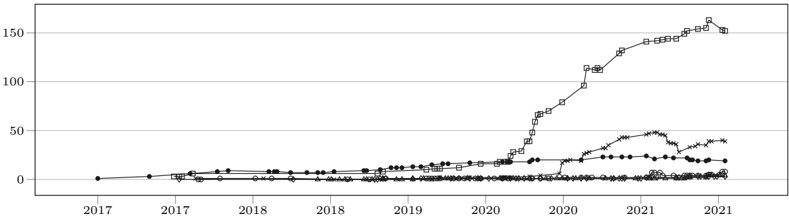
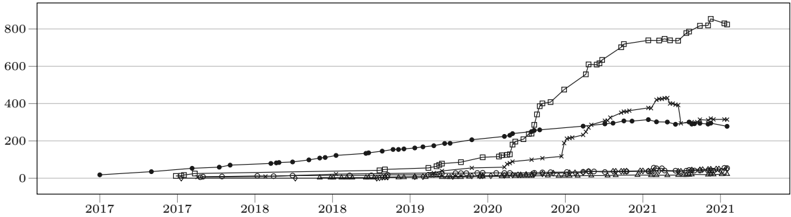
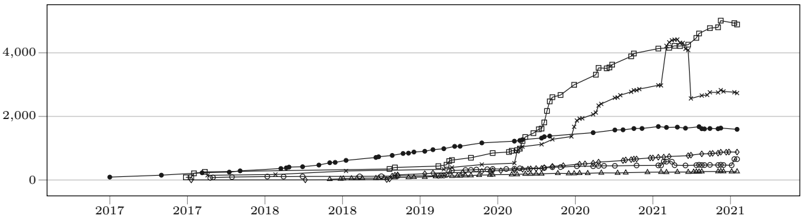
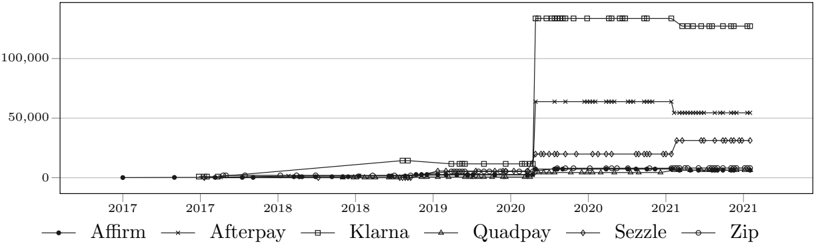
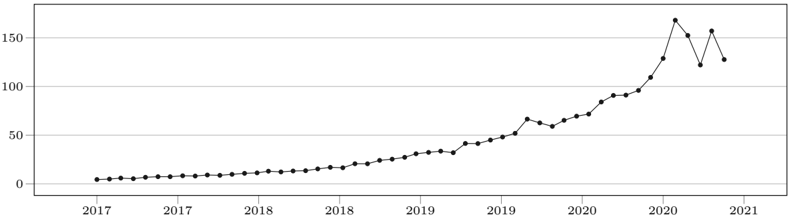
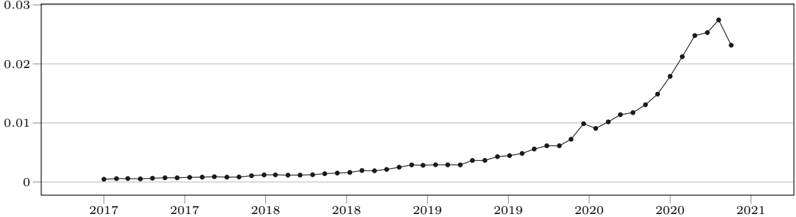
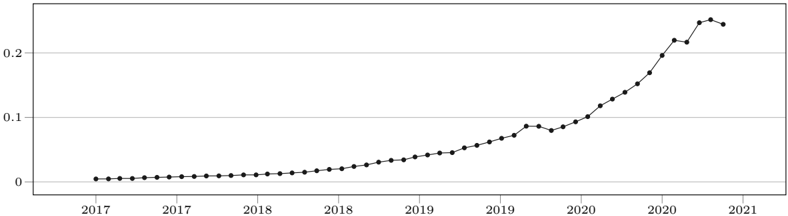
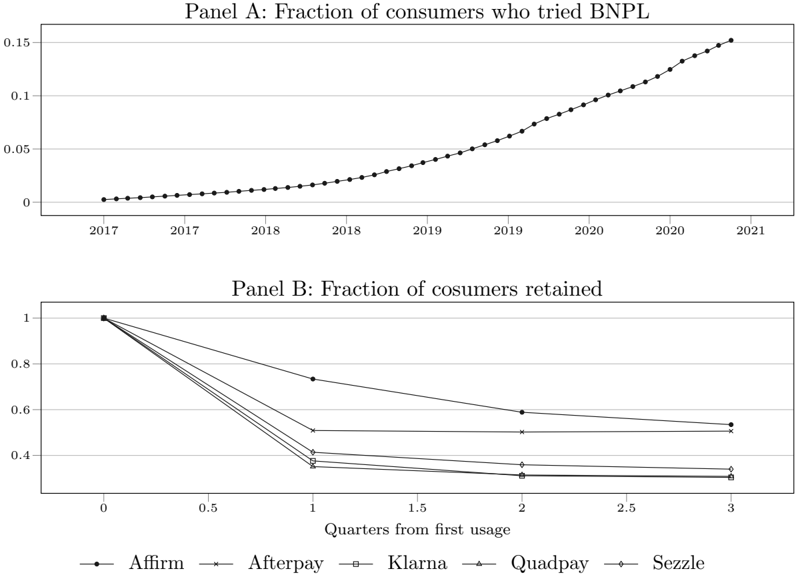
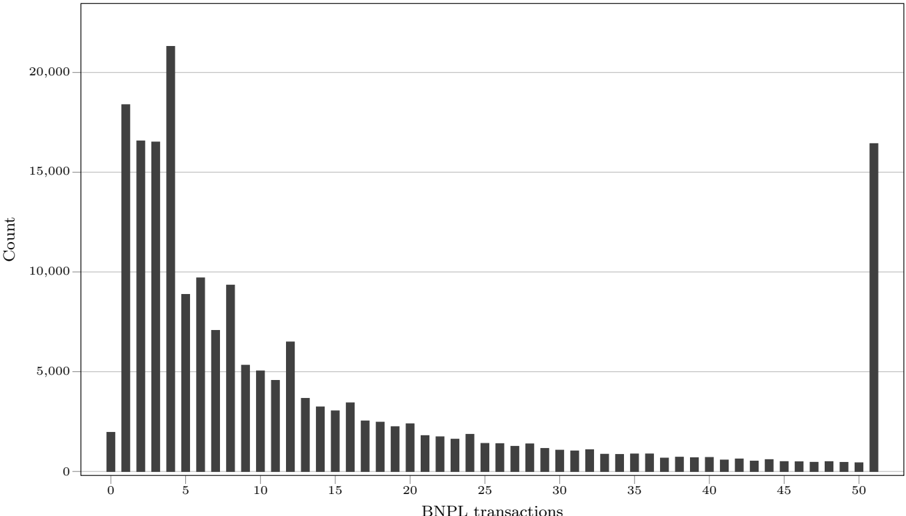
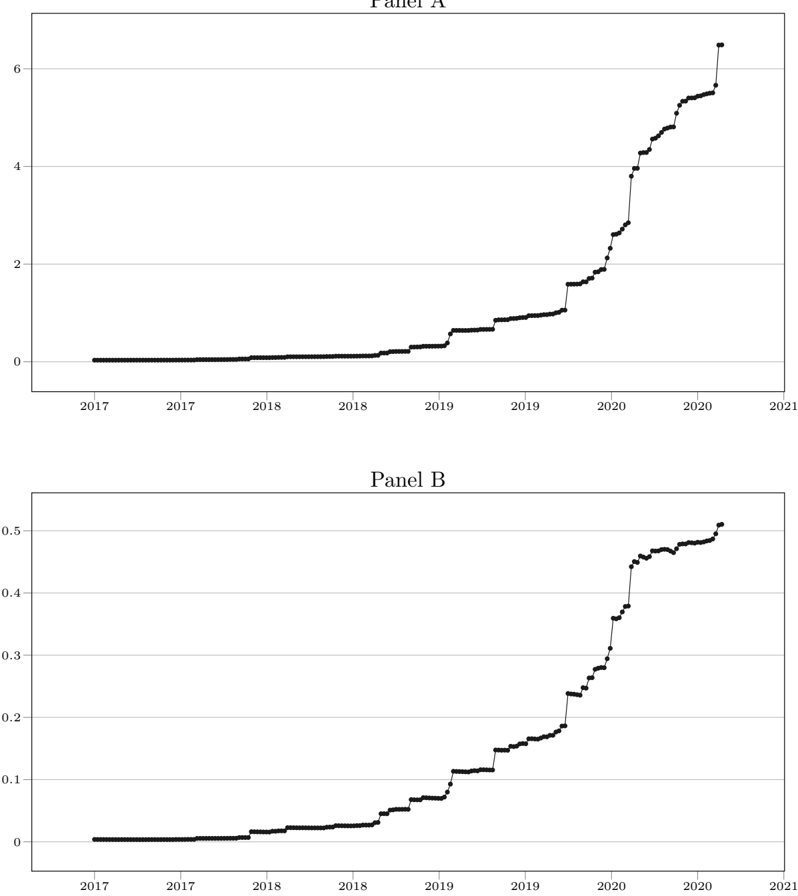
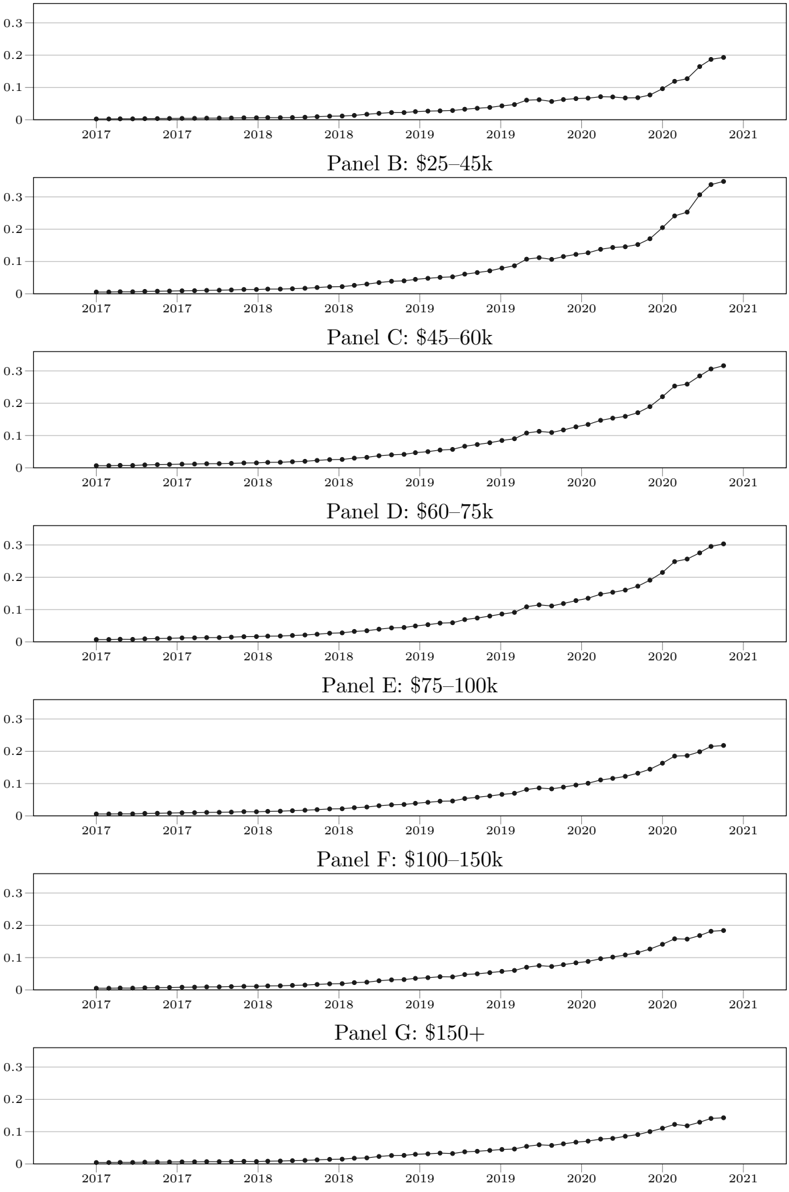
- By 2021, BNPL spending was about 2% of total credit card spending, the number of BNPL users was about one-fifth the number of credit card users, about 16% of all users had ever used BNPL, and about 30% of BNPL users were persistent users.
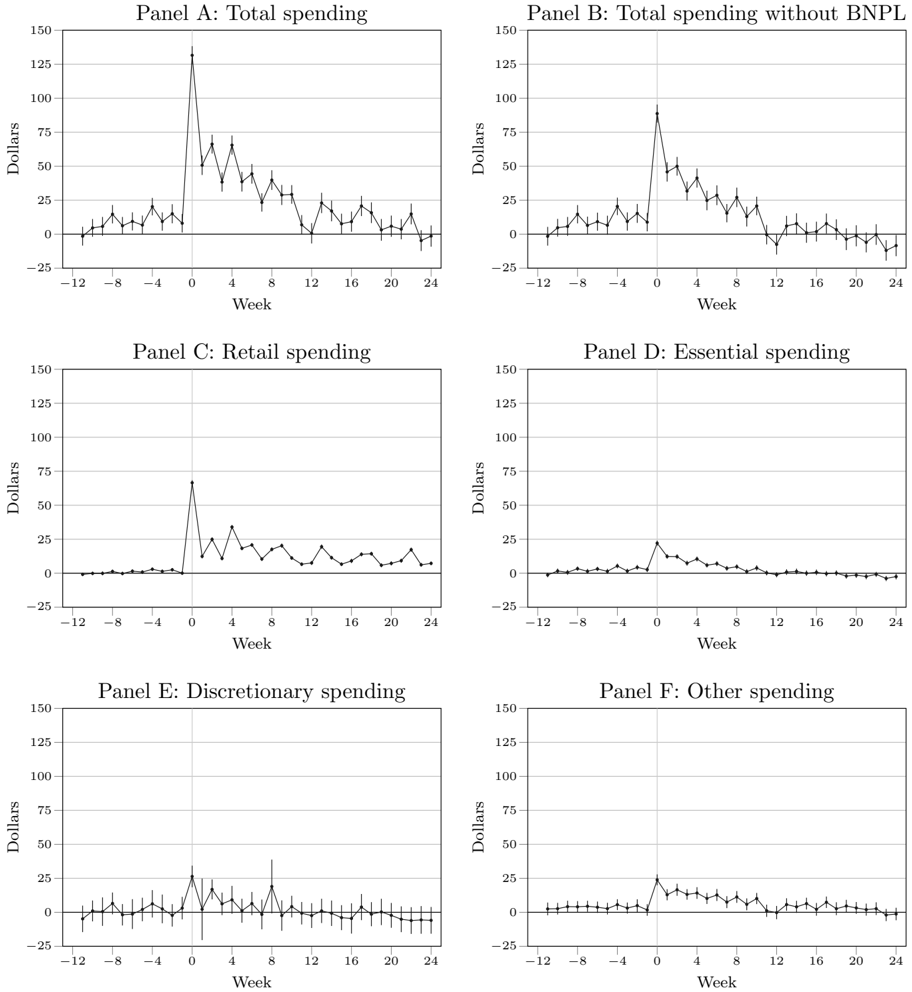
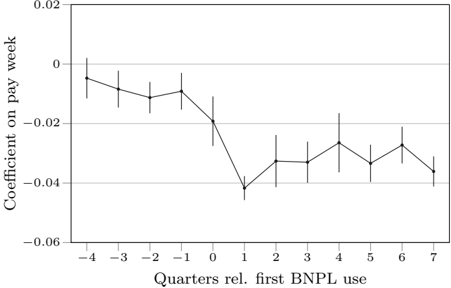
- In difference-in-differences evidence, total spending increases by around $130 at the time of first BNPL use and remains elevated over the following 24 weeks; of this, about $30 is BNPL spend and the rest is other spending, including retail.
- In IV/TSLS estimates, post-BNPL availability increases total spending by around $60 per week, and the increase is concentrated almost entirely in non-BNPL retail spending.
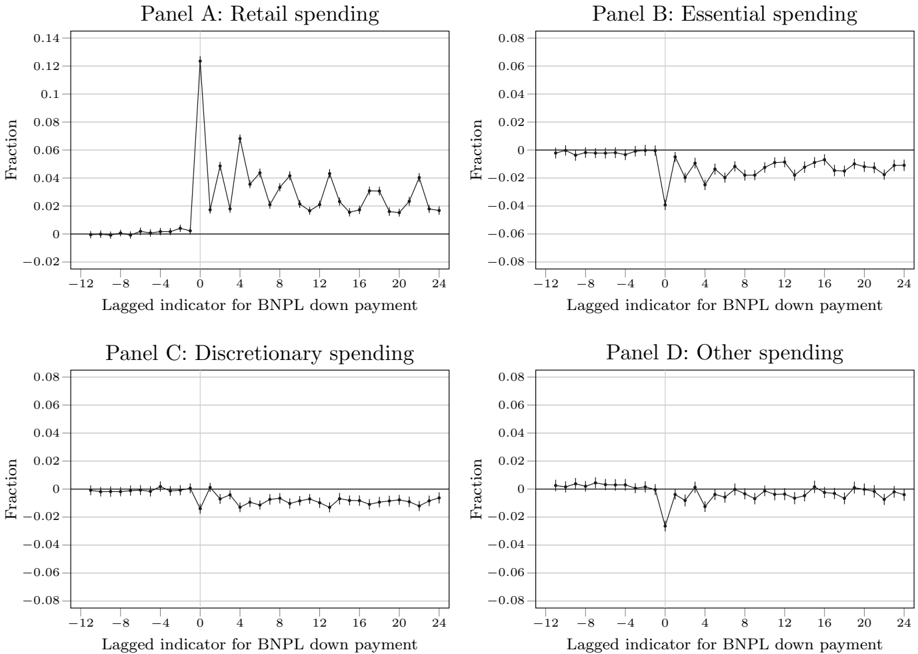
- BNPL access increases the retail share of total spending; Table V reports a TSLS effect of 0.0629 on retail spending share, and the paper notes this is larger than what standard substitution calibrations can explain.
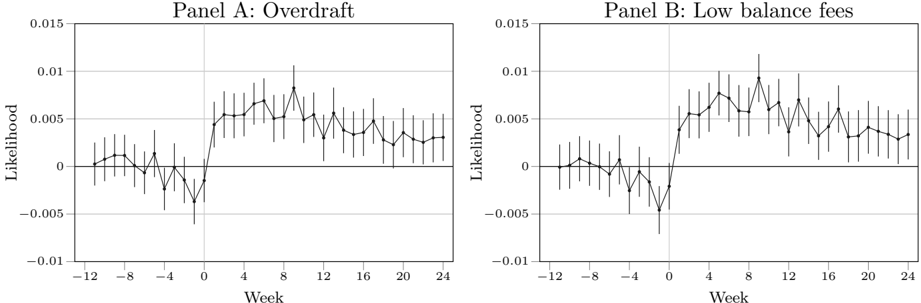
- BNPL use is associated with worse liquidity outcomes: the probability of incurring an overdraft fee rises by 0.47 percentage points and a low-balance fee by 0.48 percentage points; credits to savings accounts and liquid bank balances decline.
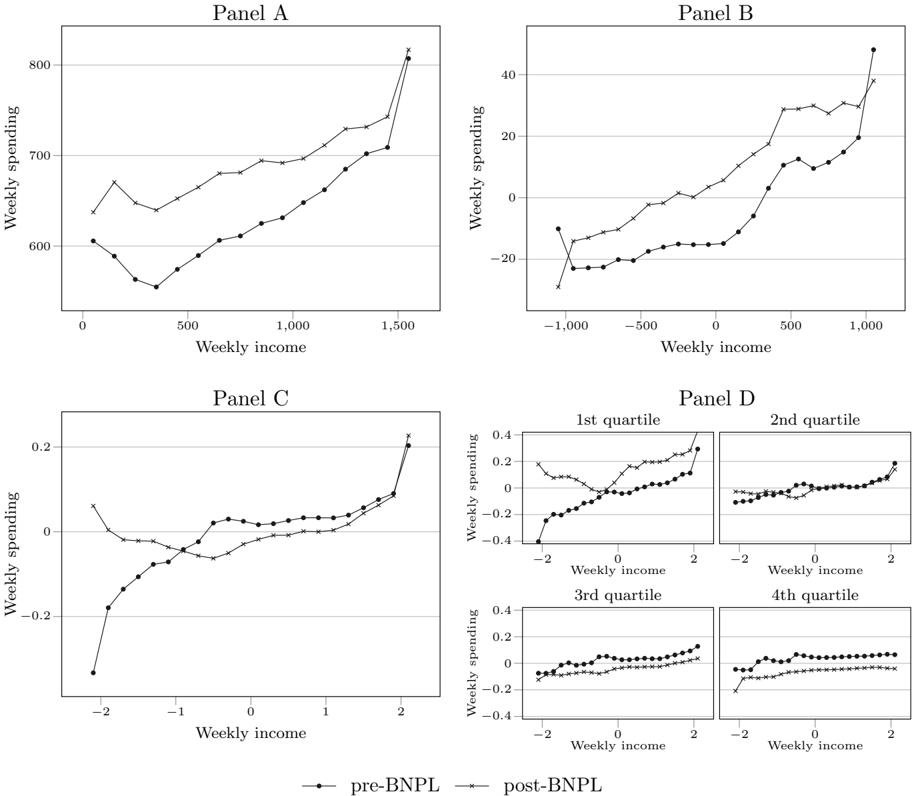
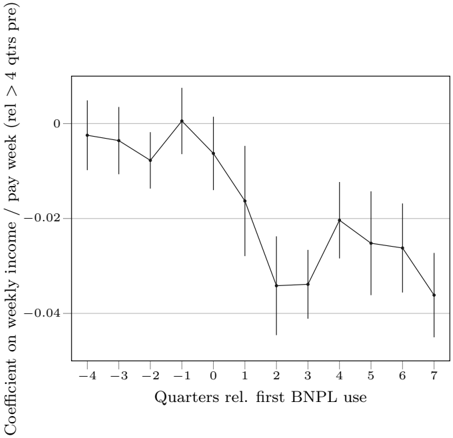
- BNPL availability reduces the correlation between spending and income, especially for lower-income users; in Table IX, the pre-BNPL salary × payweek coefficient is 0.0357 in quartile I and the post-BNPL interaction is -0.0344 (with similarly signed TSLS results), indicating much weaker income sensitivity after BNPL access.
## Methods
- Constructs a large unbalanced panel from de-identified bank and credit-card transaction data plus demographics, covering about 10 million active consumers on average from January 2010 to May 2021; an individual-level analysis sample includes 400,000 unique users and 39 million user-week observations.
- Identifies BNPL transactions from merchant classifications and uses Builtwith.com retailer BNPL adoption dates for about 20,000 retailers to create an exposure instrument based on past shopping baskets.
- Uses difference-in-differences/event-time regressions around first BNPL use, then 2SLS/TSLS with retailer-adoption exposure as an instrument; examines heterogeneity by liquidity proxies (saver status, below-$400 liquidity, credit-card use) and by pre-BNPL salary quartile.
## Limitations
- The paper itself states that the estimates rely on an instrument based on retailer BNPL adoption timing, with an exclusion restriction that the pre-period shopping mix interacted with retailer adoption affects spending only through BNPL access; this is an assumption, not directly testable.
- The paper notes that some observed changes may be mechanical because BNPL purchases trigger repayments in later weeks; this is a measurement/interpretation issue the authors discuss.
- Evident from the text: the data are transaction-based and aggregated from a data provider, so BNPL identification and some consumption measures depend on merchant classification and inferred constructs, which may miss some activity or misclassify some transactions.
Model-written summary. Check it against the paper before relying on it.
Integrity signals
Registry
Cites
Statistics
Figures
Verification
Claims the paper makes
7 Valid · 6 Not valid · 17 Not checked · 197 Own results and interpretations
Every source the paper cites for this claim was checked and supports it.
In the paper
“Our findings are more consistent with a 'liquidity flypaper effect' where additional retail liquidity through BNPL 'sticks where it hits', than a standard lifecycle model with liquidity constraints.”
What the sources say
- Supportedcites Hines and Thaler, 1995 matched to “Anomalies: The Flypaper Effect” (1995) source
The Commentary (page unavailable) describes flypaper effects as spending that responds to where money arrives, even when other funds could be raised without difficulty. The BNPL findings and comparison with a lifecycle model are the citing authors’ own interpretation; this source supports the flypaper concept they invoke, not an empirical claim about BNPL. (LLM, conf=0.88)
plain- Asserted: passes — The authors put it forward as true.
- Checkable: passes — It can be checked against evidence.
- Load-bearing: passes — The paper’s conclusions depend on it.
- Based: passes — The paper gives a reason why it holds.
- Supported
The cited sources support only part of this claim — read each source’s verdict below.
In the paper
“Gross and Souleles (2002) and Aydin (2022) use observational and experimental variation in credit limits on existing credit cards and find marginal propensities to consume of around 10-15%.”
What the sources say
- Supportedcites Gross and Souleles (2002) matched to “Do Liquidity Constraints and Interest Rates Matter for Consumer Behavior? Evidence from Credit Card Data” (2002) source
The Conclusion (Section VIII) states directly that 'The average long-run MPC out of liquidity ranges between 10-14 percent', which matches the claim's 'around 10-15%' (footnote 32 in Section VII likewise refers to 'the 0.10-0.14 estimated in this paper'; Table II row (3) gives bTot = 0.14 with account fixed effects, row (7) 0.08). The Introduction (Section I) and Section V confirm the identification strategy the claim attributes here: an observational panel of thousands of existing individual credit card accounts from several issuers, exploiting variation in credit limit changes on those accounts, with endogeneity addressed via issuer timing instruments and controls rather than a field experiment — the experimental half of the joint sentence belongs to Aydin (2022), not to this source. No part attributed to Gross and Souleles is unsupported. (LLM, conf=0.90)
- Not matchedcites Aydin (2022)
An author–year citation the paper’s reference list doesn’t settle. We don’t search these by name.
plainstates a cause- Asserted: passes — The authors put it forward as true.
- Checkable: passes — It can be checked against evidence.
- Load-bearing: passes — The paper’s conclusions depend on it.
- Based: passes — The paper gives a reason why it holds.
- Supported
Every source the paper cites for this claim was checked and supports it.
In the paper
“We attribute the finding that BNPL significantly tilts expenditures towards retail to a 'liquidity flypaper effect' (Hines and Thaler, 1995), where liquidity in one expenditure category drives additional same-category expenditure.”
What the sources say
- Supportedcites Hines and Thaler, 1995 matched to “Anomalies: The Flypaper Effect” (1995) source
The Introduction (page unavailable) describes the flypaper effect as money that “sticks where it hits,” with grants stimulating spending by recipient governments. The Commentary extends flypaper-like effects beyond government. The citation supports the mechanism the citing authors invoke to interpret their own BNPL finding; it is not presented as evidence that Hines and Thaler studied BNPL. (LLM, conf=0.87)
plainstates a cause- Asserted: passes — The authors put it forward as true.
- Checkable: passes — It can be checked against evidence.
- Load-bearing: passes — The paper’s conclusions depend on it.
- Based: passes — The paper gives a reason why it holds.
- Supported
A result the paper reports from its own data — it cites no other source for it, so there is none to check. The quote shows it is in the paper.
In the paper
“higher income users are more likely to use BNPL for larger ticket items”
hedgedstates an association- Asserted: passes — The authors put it forward as true.
- Checkable: passes — It can be checked against evidence.
- Load-bearing: unclear — It is unclear whether the paper’s conclusions depend on it.
- Based: passes — The paper gives a reason why it holds.
A result the paper reports from its own data — it cites no other source for it, so there is none to check. The quote shows it is in the paper.
In the paper
“Figure 2 shows that by 2021, BNPL spending was approximately 2% of total credit card spending”
- Also stated in: § VII. Conclusion · plain
“by 2021, BNPL spending was approximately 2% of total credit card spending”
plain- Asserted: passes — The authors put it forward as true.
- Checkable: passes — It can be checked against evidence.
- Load-bearing: unclear — It is unclear whether the paper’s conclusions depend on it.
- Based: passes — The paper gives a reason why it holds.
- Also stated in: § VII. Conclusion · plain
146 more claims
Create a free account to see all 227 claims and to verify the 2 references still open.
- Probably not a substantial claim. 34
- It may state two separate claims as one. 37
- The quote only partly states this claim. 22
Citations
Cites
Competition in two-sided markets
Armstrong, M. (2006) · The RAND Journal of Economics · doi:10.1111/j.1756-2171.2006.tb00037.x · Cited by 3,315
Gross, D. B., & Souleles, N. S. (2002) · The Quarterly Journal of Economics · doi:10.1162/003355302753399472 · Cited by 867
Anomalies: The Flypaper Effect
Hines, J. R., & Thaler, R. H. (1995) · Journal of Economic Perspectives · doi:10.1257/jep.9.4.217 · Cited by 821
Consumer Spending during Unemployment: Positive and Normative Implications
Ganong, P., & Noel, P. (2019) · American Economic Review · doi:10.1257/aer.20170537 · Cited by 433
Gomes, F., Haliassos, M., & Ramadorai, T. (2021) · Journal of Economic Literature · doi:10.1257/jel.20201461 · Cited by 396
The Liquid Hand-to-Mouth: Evidence from Personal Finance Management Software
Olafsson, A., & Pagel, M. (2018) · Review of Financial Studies · doi:10.1093/rfs/hhy055 · Cited by 257
Gross, D., & Souleles, N. (2001) · National Bureau of Economic Research · doi:10.3386/w8314 · Cited by 190
Havranek, T., & Sokolova, A. (2020) · Review of Economic Dynamics · doi:10.1016/j.red.2019.05.004 · Cited by 141
Income Changes and Consumption: Evidence from the 2013 Federal Government Shutdown
Baker, S. R., & Yannelis, C. (2017) · Review of Economic Dynamics · doi:10.1016/j.red.2016.09.005 · Cited by 130
Buy now, pay later (BNPL) ...on your credit card
Guttman‐Kenney, B., Firth, C., & Gathergood, J. (2023) · Journal of Behavioral and Experimental Finance · doi:10.1016/j.jbef.2023.100788 · Cited by 92
Research works printed but not linked: 4
- Backman, Maurie, and Jack Caporal, 2022, Study: Buy Now, Pay Later Services Grow in Popularity, The Ascent, https://www.fool.com/the-ascent/research/buy-now-pay -later-statistics/ .
- This table reports estimates of β and ˜ β coefficients in person/week regression specifications (3) and (5) that includes person, person × payweek, and calendar time × city of residence × income group fixed effects. LHS variables are defined in A.I. The first column reports OLS estimates of coefficients in (3). The second column reports OLS estimates of the IV reduced form coefficients in (5). The third column reports TSLS estimates of coefficients in (3) using the exposure instrument. Robust standard errors clustered at the person and calendar time level are in parentheses. Results are estimated for individuals who initiated BNPL transactions before 2020
- This table reports estimates of β and ˜ β coefficients in person/week regression specifications (3) and (5) that includes person, person × payweek, and calendar time × city of residence × income group fixed effects. LHS variables are spending defined in A.I and scaled by total spending. The first column reports OLS estimates of coefficients in (3). The second column reports OLS estimates of the IV reduced form coefficients in (5). The third column reports TSLS estimates of coefficients in (3) using the exposure instrument. Robust standard errors clustered at the person and calendar time level are in parentheses. Results are estimated for individuals who initiated BNPL transactions before 2020
- This table reports estimates of β and ˜ β coefficients in person/week regression specifications (3) and (5) that includes person, person × payweek, and calendar time × city of residence × income group fixed effects. LHS variables are total BNPL spending defined in A.I. The first column reports OLS estimates of coefficients in (3). The second column reports OLS estimates of the IV reduced form coefficients in (5). The third column reports TSLS estimates of coefficients in (3) using the exposure instrument. Robust standard errors clustered at the person and calendar time level are in parentheses. Results are estimated for individuals who initiated BNPL transactions before 2020
Cited by
The effects of buy now, pay later (BNPL) on customers’ online purchase behavior
Kumar, A., Salo, J., & Bezawada, R. (2024) · Journal of Retailing · doi:10.1016/j.jretai.2024.09.004 · Cited by 189
Cashless Payment and Financial InclusionPreprint
Ouyang, S. (2021) · SSRN Electronic Journal · doi:10.2139/ssrn.3948925 · Cited by 46
Effects of Buy Now, Pay Later on Financial Well-BeingPreprint
Papich, S. (2022) · SSRN Electronic Journal · doi:10.2139/ssrn.4247360 · Cited by 22
AI DRIVEN ISLAMIC BUY NOW PAY LATER (BNPL) – A LEGAL ANALYSIS
Katterbauer, K., Syed, H. M., Genç, S. Y., et al. (2023) · Journal of Management and Islamic Finance · doi:10.22515/jmif.v3i1.6671 · Cited by 8
«Decoding Buy Now, Pay Later in Egypt: A Dive into Adoption Drivers and Financial Behaviors»
Abdelbary, I. (2023) · بحوث اقتصادية عربية · doi:10.21608/asfer.2023.320991 · Cited by 12
“BNPL providers make money by charging merchants fees of around 5-8%, substantially higher than the 2-3% charged by credit card companies (Di Maggio et al., 2022).”
BackgroundInfluentialJust show the option: adding a BNPL payment option in online shopping can nudge purchase intention
Li, J., Liang, X., & Xv, S. (2025) · Electronic Commerce Research and Applications · doi:10.1016/j.elerap.2025.101536 · Cited by 6
Consumer Payment Behavior by Income and Demographics
Greene, C., Perry, J., & Stavins, J. (2024) · Working paper series · doi:10.29412/res.wp.2024.08 · Cited by 3
Buy Now, Pay Later: Drivers and Challenges in Increasing Adoption
Gaju, A. (2025) · Proceedings of the World Conference on Management Business and Economics · doi:10.33422/worldmbe.v1i1.995 · Cited by 5
Development of new payment services and the role of the fintech sector during the COVID-19 pandemic
Macierzyński, W. Ł., & Macierzyński, M. (2023) · Central European Review of Economics & Finance · doi:10.24136/ceref.2023.014 · Cited by 1
The Credit Card Debt Puzzle: New Facts and TheoryPreprint
Aubyn, C. S. (2024) · Research Square · doi:10.21203/rs.3.rs-3845133/v1 · Cited by 1
Fintech Lending and Debt SpiralPreprint
Dai, L., Han, J., Shi, J., & Zhang, B. (2025) · SSRN Electronic Journal · doi:10.2139/ssrn.5165625 · Cited by 2
Exploring the Association Between Buy Now, Pay Later (BNPL) Usage and Perceived Financial Well-BeingPreprint
Das, V. (2024) · SSRN Electronic Journal · doi:10.2139/ssrn.4957294
Buy now, pay later *Preprint
Lima, R. C., & Correia‐da‐Silva, J. (2024) · SSRN Electronic Journal · doi:10.2139/ssrn.5032275
Materialism and compulsive buying behavior: the role of impulsive buying and Pay U Later
Sarangi, S., Jena, A. K., Singh, R. K. R., & Anderson, J. E. (2026) · Journal of Financial Services Marketing · doi:10.1057/s41264-026-00381-8 · Cited by 1
“As Di Maggio et al. (2022) observed, our understanding of BNPL user characteristics and spending patterns remains limited, creating an important research opportunity that this study seeks to address.”
Metadata
- Authors
- Di Maggio, M., Katz, J., & Williams, E.
- Affiliations
- Harvard University (US)
- Corresponding author
- Williams, Emily
- ORCID
- Williams, Emily
- Venue
- Social Science Research Network
- Publisher
- Elsevier BV
- Published
- 2022
- ISSN
- 1556-5068 (ISSN-L)
- OpenAlex
- W4295858073
- Cited by
- 15
- References
- 10
- Citations by year
- 2026: 2 · 2025: 3 · 2024: 5 · 2023: 3 · 2022: 1
- Type
- posted content
- Language
- en
- Open access
- green
- doi.org
- Locations
- SSRN Electronic Journal (acceptedVersion)
- RePEc: Research Papers in Economics (submittedVersion)
- Topics
- Social Sciences › Economics, Econometrics and Finance › Finance › Financial Literacy, Pension, Retirement Analysis
- Social Sciences › Business, Management and Accounting › Management Information Systems › FinTech, Crowdfunding, Digital Finance
- Social Sciences › Economics, Econometrics and Finance › Finance › Banking stability, regulation, efficiency
- Keywords
- buy now pay later, installment loans, consumer spending, liquidity constraints, overdraft fees, retail consumption, substitution effect, life-cycle model
About these checks
Registry, retraction, Cites and statistics results are computed, not judged, with one exception: a printed reference that no index lists is read once by a model before it counts as a citation error. Claims are extracted by a model and kept only when their quote appears verbatim in the text; each cited source is then checked, with a model’s help, for whether it says what the claim relies on. Those verdicts can be wrong — read the claim’s quote and the cited source before relying on one.
The claim verdicts this report counts are experimental: their accuracy is not yet measured.
A language model drew the claims from the paper on 2026-10-10, under version 3 of the claim definition (model deepseek-v4.1-flash, prompt extract-v3).
A second model labelled each claim on 2026-10-10 (model jev-1.13-20260917, definition revision gold-guideline-v0.2).
Cited sources are checked with a language model’s help (gpt-6-sol and qwen3.8-omni-flash).
Statistics and arithmetic are recomputed, not judged.
Confidence bands are shown only for fields calibrated on our annotated test set. None is calibrated yet, so no band is shown.
What counts as a claim ›How we measure confidence ›How we check this ›
Are you an author, or do you see a problem with this page? Request a review
Data sources
Bibliographic data: Semantic Scholar, OpenAlex, Crossref.
Contains information from the Semantic Scholar Academic Graph Datasets, made available under the ODC Attribution License (ODC-BY 1.0).
Semantic Scholar’s data is described in: Kinney, R., et al. (2023). The Semantic Scholar Open Data Platform. arXiv:2301.10140.
