

The DOI matches its Crossref record; 17 of the 17 references it cites were found in a registry or an index.
Quantum minimal surfaces from quantum error correction
Abstract
We show that complementary state-specific reconstruction of logical (bulk) operators is equivalent to the existence of a quantum minimal surface prescription for physical (boundary) entropies. This significantly generalizes both sides of an equivalence previously shown by Harlow[1]; in particular, we do not require the entanglement wedge to be the same for all states in the code space. In developing this theorem, we construct an emergent bulk geometry for general quantum codes, defining ``areas'' associated to arbitrary logical subsystems, and argue that this definition is ``functionally unique.'' We also formalize a definition of bulk reconstruction that we call ``state-specific product unitary’’ reconstruction. This definition captures the quantum error correction (QEC) properties present in holographic codes and has potential independent interest as a very broad generalization of QEC; it includes most traditional versions of QEC as special cases. Our results extend to approximate codes, and even to the ``non-isometric codes'' that seem to describe the interior of a black hole at late times.
Overview
The claims and statistics of this paper haven’t been checked yet.
Run the check — free, no account needed. It reads the open-access text and checks the sources it cites.
Integrity signals
Registry
Cites
Statistics
Figures
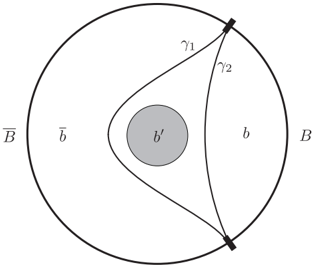
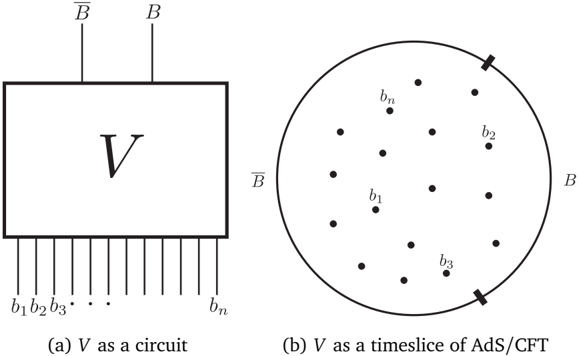
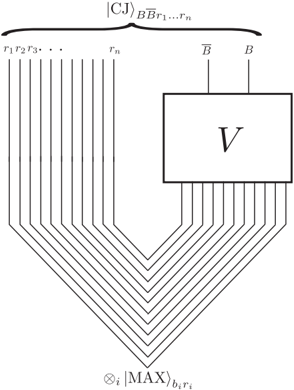

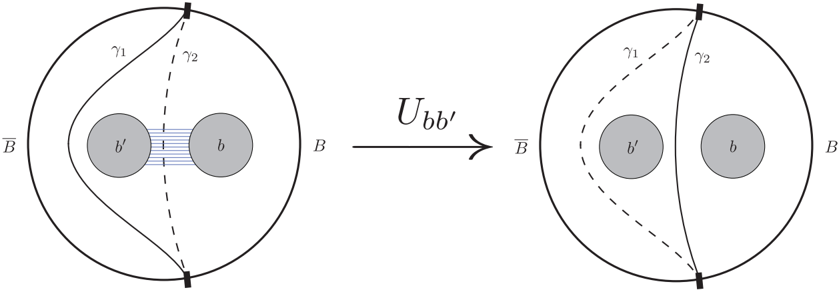

Verification
Claims the paper makes
The claims and statistics of this paper haven’t been checked yet.
Run the check — free, no account needed. It reads the open-access text and checks the sources it cites.
Claims other papers make about this one
Each is checked against this paper’s own text: does it say what the citing paper says it does?
The cited source says what the claim attributes to it.
In the citing paper
“This is much weaker than having a fixed isometry approximating the holographic map for any state[68,95,97].”
From The baby universe is fine and the CFT knows it: on holography for closed universes (2025) · cites this paper as [97]
Self-check
Percentages, sums and reported differences re-computed from the paper’s own numbers.
The self-check needs the paper’s full text.
Citations
Cites
Quantum Computation and Quantum Information: 10th Anniversary Edition
Nielsen, M. A., & Chuang, I. L. (2012) · doi:10.1017/cbo9780511976667 · Cited by 8,436
Ryu, S., & Takayanagi, T. (2006) · Physical Review Letters · doi:10.1103/physrevlett.96.181602 · Cited by 4,302
Black Holes: Complementarity or Firewalls?
Almheiri, A., Marolf, D., Polchinski, J., & Sully, J. (2012) · arXiv · doi:10.48550/arxiv.1207.3123 · Cited by 1,471
The Theory of Quantum Information
Watrous, J. (2018) · doi:10.1017/9781316848142 · Cited by 1,325
Cool horizons for entangled black holes
Maldacena, J., & Susskind, L. (2013) · Fortschritte der Physik · doi:10.1002/prop.201300020 · Cited by 1,304
Entanglement wedge reconstruction and the information paradox
Penington, G. (2020) · Journal of High Energy Physics · doi:10.1007/jhep09(2020)002 · Cited by 968 · cited 5×
“In particular, they play a vital role in recent progress on the black hole information problem [9,10].”
BackgroundMethodInfluentialSelf-citationReplica wormholes and the black hole interior
Penington, G., Shenker, S. H., Stanford, D., & Yang, Z. (2019) · arXiv · doi:10.48550/arxiv.1911.11977 · Cited by 809
Self-citationReplica wormholes and the black hole interior
Penington, G., Shenker, S. H., Stanford, D., & Yang, Z. (2022) · Journal of High Energy Physics · doi:10.1007/jhep03(2022)205 · Cited by 807
Self-citationBulk locality and quantum error correction in AdS/CFT
Almheiri, A., Dong, X., & Harlow, D. (2015) · Journal of High Energy Physics · doi:10.1007/jhep04(2015)163 · Cited by 802
Relative entropy equals bulk relative entropy
Jafferis, D. L., Lewkowycz, A., Maldacena, J., & Suh, S. J. (2015) · arXiv · doi:10.48550/arxiv.1512.06431 · Cited by 534
Entanglement Equilibrium and the Einstein Equation
Jacobson, T. (2016) · Physical Review Letters · doi:10.1103/physrevlett.116.201101 · Cited by 302
Entanglement Wedge Reconstruction via Universal Recovery Channels
Cotler, J., Hayden, P., Penington, G., Salton, G., Swingle, B., & Walter, M. (2017) · arXiv · doi:10.48550/arxiv.1704.05839 · Cited by 221
Self-citationEntropy, Extremality, Euclidean Variations, and the Equations of Motion
Dong, X., & Lewkowycz, A. (2017) · arXiv · doi:10.48550/arxiv.1705.08453 · Cited by 135
Entropy, extremality, euclidean variations, and the equations of motion
Dong, X., & Lewkowycz, A. (2018) · Journal of High Energy Physics · doi:10.1007/jhep01(2018)081 · Cited by 135
The Python’s Lunch: geometric obstructions to decoding Hawking radiation
Brown, A. R., Gharibyan, H., Penington, G., & Susskind, L. (2020) · Journal of High Energy Physics · doi:10.1007/jhep08(2020)121 · Cited by 124
Self-citationThe Information-Disturbance Tradeoff and the Continuity of Stinespring's Representation
Kretschmann, D., Schlingemann, D., & Werner, R. F. (2008) · IEEE Transactions on Information Theory · doi:10.1109/tit.2008.917696 · Cited by 122
Approximate Quantum Error Correction Revisited: Introducing the Alpha-Bit
Hayden, P., & Penington, G. (2020) · Communications in Mathematical Physics · doi:10.1007/s00220-020-03689-1 · Cited by 40
Self-citation
Research works printed but not linked: 34
- 10.1007/s00220-017-2904-z · DOI
- 10.1007/JHEP06(2015)149 · DOI · Paper page
- 10.1103/PhysRevLett.117.021601 · DOI · Paper page
- 10.1103/PhysRevX.9.031011 · DOI · Paper page
- 10.1007/JHEP12(2019)007 · DOI · Paper page
- 10.1007/JHEP10(2019)240 · DOI · Paper page
- 10.1007/JHEP05(2019)052 · DOI · Paper page
- 10.1007/JHEP12(2019)063 · DOI · Paper page
- 10.1007/JHEP04(2021)062 · DOI
- 10.1007/JHEP11(2013)074 · DOI · Paper page
- 10.1007/JHEP01(2015)073 · DOI · Paper page
- 10.22331/q-2022-02-16-655 · DOI
- 10.1088/1126-6708/2007/09/120 · DOI · Paper page
- 10.1007/JHEP06(2016)004 · DOI · Paper page
- 10.1103/PhysRevD.100.126006 · DOI
- 10.1007/BF02787889 · DOI
- 10.1007/JHEP11(2016)009 · DOI · Paper page
- 10.1088/1361-6382/ac2de5 · DOI · Paper page
- 10.1103/PhysRevA.56.2567 · DOI · Paper page
- 10.1103/PhysRevLett.104.120501 · DOI · Paper page
- 10.1088/1367-2630/6/1/026 · DOI · Paper page
- 10.1109/TIT.2012.2191695. · DOI · Paper page
- 10.1007/s00220-021-04040-y · DOI
- 10.1007/978-3-319-21891-5 · DOI
- 10.1007/JHEP02(2013)062 · DOI · Paper page
- 10.1103/PhysRevLett.111.171301 · DOI · Paper page
- 10.1103/PhysRevLett.75.1260 · DOI · Paper page
- 10.1007/JHEP04(2014)195 · DOI · Paper page
- 10.1007/JHEP03(2014)051 · DOI · Paper page
- 10.1007/JHEP08(2017)057 · DOI
- 10.1007/JHEP01(2016)122 · DOI
- 10.1103/PhysRevD.101.046001 · DOI
- 10.1038/nphys444 · DOI
- 10.1088/0305-4470/37/5/L01 · DOI
Cited by
Sorted by citations
The baby universe is fine and the CFT knows it: on holography for closed universes
Antonini, S., Rath, P., Sasieta, M., Swingle, B., & Vilar López, A. (2025) · Journal of High Energy Physics · doi:10.1007/jhep12(2025)159 · Cited by 35
Metadata
- Authors
- Akers, C., & Penington, G.
- Venue
- SciPost Physics
- Publisher
- Stichting SciPost
- Published
- 2022-05-12
- Volume
- 12
- Issue
- 5
- ISSN
- 2542-4653
- Cited by
- 65
- References
- 17
- Language
- en
- Funders
- Air Force Office of Scientific Research (FA9550-19-1-0360)
- Simons Foundation
- United States Department of Energy (DE-SC0019380)
About these checks
Registry, retraction, Cites and statistics results are computed, not judged, with one exception: a printed reference that no index lists is read once by a model before it counts as a citation error. Claims are extracted by a model and kept only when their quote appears verbatim in the text; each cited source is then checked, with a model’s help, for whether it says what the claim relies on. Those verdicts can be wrong — read the claim’s quote and the cited source before relying on one.
Statistics and arithmetic are recomputed, not judged.
Confidence bands are shown only for fields calibrated on our annotated test set. None is calibrated yet, so no band is shown.
What counts as a claim ›How we measure confidence ›How we check this ›
Are you an author, or do you see a problem with this page? Request a review
