

The DOI matches its Crossref record; 29 of the 29 references it cites were found in a registry or an index.
Acceptance of an assistive robot in older adults: a mixed-method study of human–robot interaction over a 1-month period in the Living Lab setting
Open accessAbstract
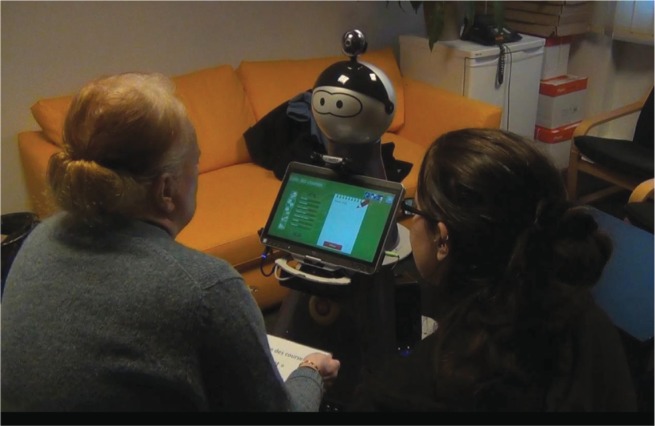
BACKGROUND: There is growing interest in investigating acceptance of robots, which are increasingly being proposed as one form of assistive technology to support older adults, maintain their independence, and enhance their well-being. In the present study, we aimed to observe robot-acceptance in older adults, particularly subsequent to a 1-month direct experience with a robot. SUBJECTS AND METHODS: Six older adults with mild cognitive impairment (MCI) and five cognitively intact healthy (CIH) older adults were recruited. Participants interacted with an assistive robot in the Living Lab once a week for 4 weeks. After being shown how to use the robot, participants performed tasks to simulate robot use in everyday life. Mixed methods, comprising a robot-acceptance questionnaire, semistructured interviews, usability-performance measures, and a focus group, were used. RESULTS: Both CIH and MCI subjects were able to learn how to use the robot. However, MCI subjects needed more time to perform tasks after a 1-week period of not using the robot. Both groups rated similarly on the robot-acceptance questionnaire. They showed low intention to use the robot, as well as negative attitudes toward and negative images of this device. They did not perceive it as useful in their daily life. However, they found it easy to use, amusing, and not threatening. In addition, social influence was perceived as powerful on robot adoption. Direct experience with the robot did not change the way the participants rated robots in their acceptance questionnaire. We identified several barriers to robot-acceptance, including older adults' uneasiness with technology, feeling of stigmatization, and ethical/societal issues associated with robot use. CONCLUSION: It is important to destigmatize images of assistive robots to facilitate their acceptance. Universal design aiming to increase the market for and production of products that are usable by everyone (to the greatest extent possible) might help to destigmatize assistive devices.
Overview
The claims and statistics of this paper haven’t been checked yet.
Run the check — free, no account needed. It reads the open-access text and checks the sources it cites.
Integrity signals
Registry
Cites
Statistics
Figures
Verification
Claims the paper makes
The claims and statistics of this paper haven’t been checked yet.
Run the check — free, no account needed. It reads the open-access text and checks the sources it cites.
Claims other papers make about this one
Each is checked against this paper’s own text: does it say what the citing paper says it does?
In the citing paper
“Seven studies reported that technology was neither accepted nor adhered to [22, 25, 26, 28, 39, 40, 48].”
From Acceptance and use of innovative assistive technologies among people with cognitive impairment and their caregivers: a systematic review (2019) · cites this paper as [48]
In the citing paper
“When it comes to use of robots in health care, our results show that the users had generally low interest to use the robot, as well as negative attitudes toward and negative images for this type of devices [24, 26, 48].”
From Acceptance and use of innovative assistive technologies among people with cognitive impairment and their caregivers: a systematic review (2019) · cites this paper as [48]
Self-check
Percentages, sums and reported differences re-computed from the paper’s own numbers.
The self-check needs the paper’s full text.
Citations
Cites
Using thematic analysis in psychology
Braun, V., & Clarke, V. (2006) · Qualitative Research in Psychology · doi:10.1191/1478088706qp063oa · Cited by 194,414
(2014) · SAGE Publications Ltd eBooks · doi:10.4135/9781446294406.n148 · Cited by 7,272
Neufeld, A., & Ryan, A. G. (1988) · Canadian Journal of Program Evaluation · doi:10.3138/cjpe.3.006 · Cited by 5,906
Current concepts in mild cognitive impairment
Petersen, R. C., Doody, R., Kurz, A., Mohs, R. C., Morris, J. C., Rabins, P. V., Ritchie, K., Rossor, M., Thal, L., & Winblad, B. (2001) · Archives of Neurology · doi:10.1001/archneur.58.12.1985 · Cited by 4,781
Assessing Acceptance of Assistive Social Agent Technology by Older Adults: the Almere Model
Heerink, M., Kröse, B., Evers, V., & Wielinga, B. (2010) · International Journal of Social Robotics · doi:10.1007/s12369-010-0068-5 · Cited by 1,229
Assistive social robots in elderly care: a review
Broekens, J., Heerink, M., & Rosendal, H. (2009) · Gerontechnology · doi:10.4017/gt.2009.08.02.002.00 · Cited by 950
Acceptance of Healthcare Robots for the Older Population: Review and Future Directions
Broadbent, E., Stafford, R., & MacDonald, B. (2009) · International Journal of Social Robotics · doi:10.1007/s12369-009-0030-6 · Cited by 887
Older adults' use of information and communications technology in everyday life
SELWYN, N., GORARD, S., FURLONG, J., & MADDEN, L. (2003) · Ageing and Society · doi:10.1017/s0144686x03001302 · Cited by 617
Older adults: Are they ready to adopt health-related ICT?
Heart, T., & Kalderon, E. (2013) · Int. J. Medical Informatics · doi:10.1016/j.ijmedinf.2011.03.002 · Cited by 599
Universal Design : Barrier Free Environments for Everyone
Mace, R. L. (1985) · Medical Entomology and Zoology · Cited by 275
Cited by
Sorted by citations
Items 101–200 of 261
Factors that influence robot acceptance
Xu, L., & Yu, F. (2019) · Chinese Science Bulletin (Chinese Version) · doi:10.1360/tb-2019-0136 · Cited by 21
Use of a Humanoid Robot in Supporting Dementia Care: A Qualitative Analysis
Liao, Y. K., Jao, Y., Boltz, M. P., Adekeye, O. T., Berish, D. E., Yuan, F., & Zhao, X. (2023) · SAGE Open Nursing · doi:10.1177/23779608231179528 · Cited by 20
The role of product development in the battle against product-related stigma – a literature review
Schröppel, T., Miehling, J., & Wartzack, S. J. (2021) · Journal of Engineering Design · doi:10.1080/09544828.2021.1879031 · Cited by 20
Huang, T., & Huang, C. (2021) · Work · doi:10.3233/wor-205166 · Cited by 20
AI bias in Human-Robot Interaction: An evaluation of the Risk in Gender Biased Robots
Hitron, T., Megidish, B., Todress, E., Yaar, N. M., & Erel, H. (2022) · IEEE RO-MAN · doi:10.1109/ro-man53752.2022.9900673 · Cited by 26
Human-robot interactions in autonomous hospital transports
Zachariae, A., Plahl, F., Tang, Y., Mamaev, I., Hein, B., & Wurll, C. (2024) · Robotics and Autonomous Systems · doi:10.1016/j.robot.2024.104755 · Cited by 26
Investigating Drivers of Customer Experience with Virtual Conversational Agents
Nguyen, T. T., Trivedi, R. H., Fukukawa, K., & Adomako, S. (2025) · Information Systems Frontiers · doi:10.1007/s10796-024-10572-0 · Cited by 26
Bidirectional Multi-modal Signs of Checking Human-Robot Engagement and Interaction
Maniscalco, U., Storniolo, P., & Messina, A. (2022) · International Journal of Social Robotics · doi:10.1007/s12369-021-00855-w · Cited by 19
Maranesi, E., Amabili, G., Cucchieri, G., Bolognini, S., Margaritini, A., & Bevilacqua, R. (2022) · Studies in computational intelligence · doi:10.1007/978-981-16-8488-3_16 · Cited by 18
Ohneberg, C., Warmbein, A., Stöbich, N., Rathgeber, I., Kruppa, A., Nast-Kolb, J., Träger, M. F., Bahou, A., Stahl, O., Eberl, I., et al. (2022) · BMC Nursing · doi:10.1186/s12912-022-01088-6 · Cited by 20
Hauser, E., Chan, Y., Chonkar, P., Hemkumar, G., Wang, H., Dua, D., Gupta, S., Enriquez, E. M., Kao, T. H., Hart, J., et al. (2023) · International Symposium on Trustworthy Autonomous Systems (TAS) · doi:10.1145/3597512.3599707 · Cited by 18
Paletta, L., Fellner, M., Schüssler, S., Zuschnegg, J., Steiner, J., Lerch, A., Lammer, L., & Prodromou, D. (2018) · International Conference on PErvasive Technologies Related to Assistive Environments (PETRA) · doi:10.1145/3197768.3203182 · Cited by 19
Robotic assistance for people with dementia: a viable option for the future?
Gerłowska, J., Furtak-Niczyporuk, M., & Rejdak, K. (2020) · Expert Review of Medical Devices · doi:10.1080/17434440.2020.1770592 · Cited by 19
Mizuno, J., Saito, D., Sadohara, K., Nihei, M., Ohnaka, S., Suzurikawa, J., & Inoue, T. (2021) · International Journal of Environmental Research and Public Health · doi:10.3390/ijerph18052498 · Cited by 19
Maier, A., Eicher, C., Kiselev, J., Klebbe, R., Greuèl, M., Kettemann, D., Gaudlitz, M., Walter, B., Oleimeulen, U., Münch, C., et al. (2021) · JMIR Rehabilitation and Assistive Technologies · doi:10.2196/18972 · Cited by 18
A living lab to develop smart home services for the residential welfare of older adults
Hong, S., Jang, E., Cho, J., Lee, J.-S., Rhee, J. H., Lee, H., Lee, M.-Y., Cha, S. H., Koo, C., Baik, O. M., et al. (2024) · Technology in Society · doi:10.1016/j.techsoc.2024.102577 · Cited by 18
The Use of Social Robots and the Uncanny Valley Phenomenon
Jeglinski-Mende, M. A., Fischer, M. H., & Kühne, K. (2019) · Springer eBooks · doi:10.1007/978-3-030-19734-6_3 · Cited by 17
Almalki, M., Alsulami, M. H., Alshdadi, A. A., Almuayqil, S. N., Alsaqer, M., Atkins, A. S., & Choukou, M.-A. (2022) · International Journal of Environmental Research and Public Health · doi:10.3390/ijerph192416760 · Cited by 20
Aging with robots: A brief review on eldercare automation
Zhang, Y., Luo, L., & Wang, X. (2024) · Interdisciplinary Nursing Research · doi:10.1097/nr9.0000000000000052 · Cited by 15
Older people and robotic technologies in the home
Petrie, H., & Darzentas, J. (2017) · International Conference on PErvasive Technologies Related to Assistive Environments (PETRA) · doi:10.1145/3056540.3056553 · Cited by 15
Elderly Users' Interaction with Conversational Agent
Chung, K., Oh, Y. H., & Ju, D. Y. (2019) · International Conference on Human-Agent Interaction (HAI) · doi:10.1145/3349537.3352791 · Cited by 15
Zhang, W.-Z., & Lian, R. (2025) · BMC Psychology · doi:10.1186/s40359-025-02741-w · Cited by 20
Robben, D., Fukuda, E., & de Haas, M. (2023) · ACM/IEEE International Conference on Human-Robot Interaction (HRI) · doi:10.1145/3568294.3580134 · Cited by 16
Wu, C.-H., Ahtinen, A., & Väänänen, K. (2023) · IEEE RO-MAN · doi:10.1109/ro-man57019.2023.10309627 · Cited by 14
Perceptions of socially assistive robots: A pilot study exploring older adults’ concerns
Harrington, E. E., Bishop, A. J., Do, H. M., & Sheng, W. (2021) · Current Psychology · doi:10.1007/s12144-021-01627-5 · Cited by 15
Zeng, H., Sheng, Y., & Zhu, J. (2025) · Information · doi:10.3390/info16110948 · Cited by 13
On robot acceptance and adoption a case study
Moradi, M., Moradi, M., & Bayat, F. (2018) · doi:10.1109/rios.2018.8406626 · Cited by 14
Mlakar, I., Kampič, T., Flis, V., Kobilica, N., Molan, M., Smrke, U., Plohl, N., & Bergauer, A. (2022) · BMJ Open · doi:10.1136/bmjopen-2021-054310 · Cited by 13
AMIGO—A Socially Assistive Robot for Coaching Multimodal Training of Persons with Dementia
Paletta, L., Schüssler, S., Zuschnegg, J., Steiner, J., Pansy-Resch, S., Lammer, L., Prodromou, D., Brunsch, S., Lodron, G., & Fellner, M. (2019) · Human-computer interaction series · doi:10.1007/978-3-030-17107-0_13 · Cited by 15
Assche, M. V., Petrovic, M., Cambier, D., Calders, P., Gelder, P. V., & van de Velde, D. (2022) · Disability and Rehabilitation: Assistive Technology · doi:10.1080/17483107.2022.2075477 · Cited by 13
Rodríguez-Domínguez, M. T., Bazago-Dómine, M. I. I., Jiménez-Palomares, M., Pérez-González, G., Núñez, P., Santano‐Mogena, E., & Garrido-Ardila, E. M. (2024) · International Journal of Social Robotics · doi:10.1007/s12369-024-01106-4 · Cited by 12
Assche, M. V., Petrović, M., Cambier, D. C., Calders, P., Gelder, P. V., Werner, F., & VELDE, D. V. D. (2024) · International Journal of Social Robotics · doi:10.1007/s12369-024-01115-3 · Cited by 12
Reichel, P., Bassler, C. T., & Spörrle, M. (2024) · Personality and Individual Differences · doi:10.1016/j.paid.2024.112665 · Cited by 12
A Brief Review of Robotics Technologies to Support Social Interventions for Older Users
Conti, D., Nuovo, S. D., & Nuovo, A. G. D. (2020) · Smart innovation, systems and technologies · doi:10.1007/978-981-15-5784-2_18 · Cited by 11
Isabet, B., Rigaud, A., Li, W., & Pino, M. (2022) · JMIR Research Protocols · doi:10.2196/40528 · Cited by 19
Self-citationHoppe, J. A., Tuisku, O., Johansson‐Pajala, R., Pekkarinen, S., Hennala, L., Gustafsson, C., Melkas, H., & Thommes, K. (2022) · Computers in Human Behavior Reports · doi:10.1016/j.chbr.2022.100258 · Cited by 13
Bibliometric Review of Design for Digital Inclusion
Li, G., Li, D., & Tang, T. (2023) · Sustainability · doi:10.3390/su151410962 · Cited by 13
AboJabel, H., & Ayalon, L. (2023) · Technology in Society · doi:10.1016/j.techsoc.2023.102386 · Cited by 14
Leite, E. D. S., Rodrigues, T. P., de Farias, M. D. C. A. D., Moreira, M. A. S. P., Bittencourt, G. K. G. D., de Oliveira, F. B., Simpson, C. A., & Silva, A. O. (2016) · International Archives of Medicine · doi:10.3823/1892 · Cited by 12
Elsheikh, A., Al‐Thani, D., & Othman, A. (2025) · Frontiers in Robotics and AI · doi:10.3389/frobt.2025.1626471 · Cited by 11
On the importance of patient acceptance for medical robotic imaging
Eilers, C., van Kemenade, R., Busam, B., & Navab, N. (2023) · International Journal of Computer Assisted Radiology and Surgery · doi:10.1007/s11548-023-02948-5 · Cited by 11
Talaei‐Khoei, A., Lewis, L. M., Khoei, T. T., Ghapanchi, A. H., & Vichitvanichphong, S. (2015) · Victoria University Research Repository (Victoria University) · Cited by 11
Tanioka, T., Locsin, R. C., Betriana, F., Yoshihiro, K. A. I., Osaka, K., Baua, M. E., & Schoenhofer, S. O. (2021) · International Journal of Environmental Research and Public Health · doi:10.3390/ijerph182111184 · Cited by 11
Kim, J., Park, K., & Ryu, H. (2022) · International Journal of Environmental Research and Public Health · doi:10.3390/ijerph192416657 · Cited by 11
Khalili‐Mahani, N., & Sawchuk, K. (2022) · JMIR Aging · doi:10.2196/43564 · Cited by 12
Improving the Interaction of Older Adults with a Socially Assistive Table Setting Robot
Olatunji, S., Markfeld, N., Gutman, D., Givati, S., Sarne-Fleischmann, V., Oron-Gilad, T., & Edan, Y. (2019) · Lecture notes in computer science · doi:10.1007/978-3-030-35888-4_53 · Cited by 11
Does Humanness Matter? An Ethical Evaluation of Sharing Care Work with Social Robots
Mihailov, E., & Wangmo, T. (2025) · Science and Engineering Ethics · doi:10.1007/s11948-025-00547-y · Cited by 12
Lehmann, S., Ruf, E., & Misoch, S. (2021) · Communications in computer and information science · doi:10.1007/978-3-030-70807-8_2 · Cited by 10
A systematic review of assistance robots for elderly care
Sharma, A., Rathi, Y., Patni, V., & Sinha, D. K. (2021) · International Conference on Communication Information and Computing Technology (ICCICT) · doi:10.1109/iccict50803.2021.9510142 · Cited by 11
Dsouza, S. A., Ramachandran, M., Bangera, K., & Acharya, V. (2022) · Disability and Rehabilitation Assistive Technology · doi:10.1080/17483107.2022.2138995 · Cited by 12
Žvanut, B., & Mihelič, A. (2024) · Frontiers in Psychology · doi:10.3389/fpsyg.2024.1343077 · Cited by 9
Factors influencing the intention to use assistive technologies by older adults
Ejdys, J., & Gulc, A. (2022) · Human Technology · doi:10.14254/1795-6889.2022.18-1.2 · Cited by 8
Butakor, P. K. (2023) · International Journal of Innovative Technologies in Social Science · doi:10.31435/rsglobal_ijitss/30092023/8057 · Cited by 9
Exploration of communication robot use for older patients in an acute hospital based on case trials
Noguchi, H., Koyano, Y., Mori, H., Komiyama, C., Sanada, H., & Mori, T. (2019) · doi:10.24462/jnse.6.2_70 · Cited by 10
de Azevedo, F. X. M., Heimgärtner, R., & Nebe, K. (2022) · Ergonomics · doi:10.1080/00140139.2022.2127920 · Cited by 9
Investigation of the adaptation of older adults to online learning and artificial intelligence
Kabul, E. G., Çalık, B. B., Özcan, N. T., & Gürsoy, S. (2024) · Revista Española de Geriatría y Gerontología · doi:10.1016/j.regg.2024.101477 · Cited by 10
Challenges in Seniors Adopting Assistive Robots: A Systematic Review
Ariani, A., Kapadia, V., Talaei‐Khoei, A., Li, J., & RAY, P. K. (2016) · The International Technology Management Review · doi:10.2991/itmr.2016.6.2.1 · Cited by 9
Older adults’ expectations, experiences, and preferences in programming physical robot assistance
Ajaykumar, G., Pineda, K. T., & Huang, C. (2023) · International Journal of Human-Computer Studies · doi:10.1016/j.ijhcs.2023.103127 · Cited by 9
Robot Use for Older Adults – Attitudes, Wishes and Concerns. First Results from Switzerland
Lehmann, S., Ruf, E., & Misoch, S. (2020) · Communications in computer and information science · doi:10.1007/978-3-030-50732-9_9 · Cited by 8
Frenkel, J., Kirst, S., Naumann, S., Simon, M., Seßner, J., Roesler, E., Onnasch, L., & Dziobek, I. (2025) · Scientific Reports · doi:10.1038/s41598-025-93970-x · Cited by 12
Zhang, W., & Lian, R. (2025) · International Journal of Human-Computer Interaction · doi:10.1080/10447318.2025.2520937 · Cited by 7
Martín‐García, A. V., Pérez, B. M. G., & Aceros, J. C. (2021) · Interface - Comunicação Saúde Educação · doi:10.1590/interface.210399 · Cited by 7
Zhou, J., & Gao, Q. (2021) · Wiley eBooks · doi:10.1002/9781119636113.ch48 · Cited by 7
A Systematic Literature Review on the Use of Social Robots in Elderly Care
Hermann, J., Oktay, S., Lisetschko, A., & Doğangün, A. (2023) · Australian Conference on Computer-Human Interaction (OzCHI) · doi:10.1145/3638380.3638412 · Cited by 6
Lee, K., Wong, J., Wong, K. L. Y., Wong, J., Cabrera-Guerra, J., Singh, R., Fong, A., Lou, R., Mann, J., Jackson, L., et al. (2025) · Digital Health · doi:10.1177/20552076251393299 · Cited by 6
Humanoid Robot–Assisted Support for Health Care in Older Adults: Systematic Scoping Review
Cui, L., Li, Y., Yang, X., Liu, X., Zhang, L., & Hou, L. (2026) · JMIR Aging · doi:10.2196/83849 · Cited by 7
Bi, X., Gao, Y., Sun, E., Yan, Y., Zhou, Y., & Ye, X. (2022) · International Journal of Environmental Research and Public Health · doi:10.3390/ijerph20010508 · Cited by 6
Robot-Assisted Training with Swedish and Israeli Older Adults
Akalın, N., Krakovski, M., Avioz-Sarig, O., Loutfi, A., & Edan, Y. (2021) · Lecture notes in computer science · doi:10.1007/978-3-030-90525-5_42 · Cited by 6
Roboter zur Unterstützung im Alter
Ruf, E., Lehmann, S., Pauli, C., & Misoch, S. (2020) · HMD Praxis der Wirtschaftsinformatik · doi:10.1365/s40702-020-00681-0 · Cited by 6
Emotionale Reaktionen älterer Menschen gegenüber Sozial Assistiven Robotern
Ruf, E., Pauli, C., & Misoch, S. (2022) · Gruppe Interaktion Organisation Zeitschrift für Angewandte Organisationspsychologie (GIO) · doi:10.1007/s11612-022-00641-w · Cited by 7
He, Y., Liu, Q., He, Q., & Li, L. (2022) · Clinical Interventions in Aging · doi:10.2147/cia.s367781 · Cited by 6
A Systematic Review on Assistive Technology Terminologies, Concepts, and Definitions
Lourenço, J. W., de Jesus, P. A. C., Lourenço, F., Canciglieri, O., & Schaefer, J. L. (2025) · Technologies · doi:10.3390/technologies13080349 · Cited by 7
Klier, C., & Lugrin, B. (2025) · Frontiers in Robotics and AI · doi:10.3389/frobt.2025.1607373 · Cited by 5
Examining Technology Perspectives of Older Adults With Mild Cognitive Impairment: Scoping Review
Schmidt, S. B., Isbel, S. T., John, B. M., Subramanian, R., & D'Cunha, N. M. (2025) · JMIR Aging · doi:10.2196/78229 · Cited by 9
Yeo, Y., Lau, Y., Ang, W. W., Wong, Q. F., Tam, H. L., Loh, W. L., Wong, S. H., & Lau, S. T. (2023) · Geriatric Nursing · doi:10.1016/j.gerinurse.2023.10.012 · Cited by 5
Khan, N., Ghosh, R., Migovich, M., Johnson, A., Witherow, A., Taylor, C., Schroder, M., Vongpanya, T., Sarkar, M. S., & Sarkar, N. (2022) · Lecture notes in computer science · doi:10.1007/978-3-031-05581-2_15 · Cited by 5
Exploring the Acceptance and Adoption of Humanoid Robots Among Older Adults: Systematic Review
Elsheikh, A., & Al‐Thani, D. (2024) · Lecture notes in computer science · doi:10.1007/978-3-031-61698-3_25 · Cited by 5
Anxiety-Related Ai Configuration and Ai Usage Behavior Among Lecturers: Gender's Moderating Role
Christian, M., Pardede, R., Yulita, H., Dewi, Y. K., Wibowo, S., & Sunarno, S. (2024) · IEEE International Conference on Control & Automation, Electronics, Robotics, Internet of Things, and Artificial Intelligence (CERIA) · doi:10.1109/ceria64726.2024.10914840 · Cited by 7
Use of Telepresence Robots in Glaucoma Patient Education
Ooms, A., Shaikh, I. S., Patel, N. M., Kardashian-Sieger, T., Srinivasan, N., Zhou, B., Wilson, L., Szirth, B. C., & Khouri, A. S. (2020) · Journal of Glaucoma · doi:10.1097/ijg.0000000000001731 · Cited by 5
Social Robots for Meaningful Seated Activities: Acceptance & Use by Older Adults
Sadler, J., Khan, A., Lwin, M., & Mubin, O. (2024) · Healthcare · doi:10.3390/healthcare12131334 · Cited by 5
Change management: a systematic review on implementing robotic technology in healthcare
Oguntoyinbo, S., Barazi, R., Leon, M., & Western, D. (2025) · Journal of Organizational Change Management · doi:10.1108/jocm-01-2025-0041 · Cited by 4
Digital Health Technologies Applied in Patients With Early Cognitive Change: Scoping Review
Zhang, Y., Zhu, X., Yang, S., Wong, A. K. C., & Chen, X. (2025) · Journal of Medical Internet Research · doi:10.2196/82881 · Cited by 4
Baudin, K., Sundström, A., & Lindner, H. Y. N. (2024) · BMC Geriatrics · doi:10.1186/s12877-024-04979-2 · Cited by 4
Andtfolk, M., Fagerström, L., Eide, H., & Nyholm, L. (2025) · International Journal of Social Robotics · doi:10.1007/s12369-025-01212-x · Cited by 4
Shore, L., de Eyto, A., & O'Sullivan, L. W. (2018) · Proceedings of DRS · doi:10.21606/drs.2018.477 · Cited by 4
Jones, K. S., & Garcia, N. A. (2021) · Ecological psychology · doi:10.1080/10407413.2021.1965478 · Cited by 4
Wasić, C., Bahrmann, F., Vogt, S., Böhme, H.-J., & Graessel, E. (2022) · Lecture notes in computer science · doi:10.1007/978-3-031-08645-8_29 · Cited by 4
Human-robot interactions with an autonomous health screening robot in long-term care settings
Getson, C., & Nejat, G. (2023) · Advanced Robotics · doi:10.1080/01691864.2023.2293133 · Cited by 4
Developing a regional design support service
Salminen, J., Rinkinen, S., & Khan, R. (2015) · Info · doi:10.1108/info-01-2015-0007 · Cited by 4
Akzeptanz und Marktfähigkeit sozialer Roboter
Korn, O., Buchweitz, L., Theil, A., Fracasso, F., & Cesta, A. (2021) · Springer eBooks · doi:10.1007/978-3-658-31114-8_4 · Cited by 4
King, B., & Barry, C. D. (2019) · International Journal for Human Caring · doi:10.20467/1091-5710.23.2.168 · Cited by 4
Acceptance of Needy Socially Assistive Robots: A Systematic Review
Jones, N., Loizides, F., & Jones, K. (2025) · International Journal of Social Robotics · doi:10.1007/s12369-025-01272-z · Cited by 3
Wang, Y., Chen, H., Cheng, H. M., Qiu, J., Huang, R., Zou, C., Song, G., Liu, M., Liu, Q., Zhang, J., et al. (2025) · Innovation in Aging · doi:10.1093/geroni/igaf097 · Cited by 3
Conde, M., Fischedick, S., Richter, K., Arboleda, S. A., Gross, H.-M., Raake, A., & Doering, N. (2025) · ACM Trans. Hum. Robot Interact. · doi:10.1145/3770851 · Cited by 3
Robots for Older Adults: A Scoping Review
Olatunji, S., Tsai, Y.-L., Gowrishankar, S. A., Bayles, M. A., & Rogers, W. A. (2026) · ACM Transactions on Human-Robot Interaction · doi:10.1145/3799977 · Cited by 3
Slane, A., & Pedersen, I. (2024) · International Journal of Social Robotics · doi:10.1007/s12369-024-01188-0 · Cited by 3
Yang, A. C. H., Choe, E. Y., & Zhang, F. (2025) · Industrial Management & Data Systems · doi:10.1108/imds-05-2024-0464 · Cited by 3
Tónay, G., Pilissy, T., Tóth, A., & Fazekas, G. (2023) · International Journal of Rehabilitation Research · doi:10.1097/mrr.0000000000000571 · Cited by 6
Stiti, S., Caroux, L., Gaillard, P., Paubel, P., & Déguine, O. (2023) · PLoS ONE · doi:10.1371/journal.pone.0285927 · Cited by 3
Chow, K. K., Ip, C. S., Yau, C., Zeng, J., & Zhong, J. (2025) · Lecture notes in computer science · doi:10.1007/978-981-96-0786-0_3 · Cited by 4
Metadata
- Authors
- Wu, Y.-H., Wrobel, J., Cornuet, M., Kerhervé, H., Damnée, S., & Rigaud, A.-S.
- Affiliations
- Assistance Publique – Hôpitaux de Paris (FR)
- Corresponding author
- Wu, Ya-Huei
- Venue
- Clinical Interventions in Aging
- Publisher
- Informa UK Limited
- Published
- 2014-05
- Volume
- 9
- Pages
- 801
- ISSN
- 1176-9092 (ISSN-L)
- 1178-1998
- PMC
- PMC4020879
- OpenAlex
- W2060200729
- Cited by
- 261
- References
- 29
- Citations by year
- 2026: 18 · 2025: 30 · 2024: 24 · 2023: 27 · 2022: 39 · 2021: 36 · 2020: 25 · 2019: 26 · 2018: 14 · 2017: 8 · 2016: 9 · 2015: 5
- FWCI
- 10.88
- Type
- journal article
- Language
- en
- Open access
- gold
- doi.org
- Licence
- Locations
- Clinical Interventions in Aging (publishedVersion, cc-by-nc)
- Europe PMC (PubMed Central) (publishedVersion, cc-by-nc)
- PubMed Central (publishedVersion, cc-by-nc)
- PubMed (publishedVersion)
- Funders
- Agence Nationale de la Recherche (ANR-09-TECS-0012)
- Caisse nationale de solidarité pour l'autonomie
- Direction Générale de l’Armement
- Topics
- Social Sciences › Psychology › Social Psychology › Social Robot Interaction and HRI
- Health Sciences › Medicine › Geriatrics and Gerontology › Technology Use by Older Adults
- Social Sciences › Business, Management and Accounting › Marketing › AI in Service Interactions
- Keywords
- assistive robots, robot acceptance, older adults, mild cognitive impairment, human-robot interaction, living labs, intention to use, social influence, stigmatization, universal design, technology adoption barriers
- MeSH terms
- Activities of Daily Living, Aged, Aged, 80 and over, Attitude to Computers, Female, Humans, Interviews as Topic, Male, Surveys and Questionnaires, Robotics, Self-Help Devices, User-Computer Interface, Focus Groups, Cognitive Dysfunction
About these checks
Registry, retraction, Cites and statistics results are computed, not judged, with one exception: a printed reference that no index lists is read once by a model before it counts as a citation error. Claims are extracted by a model and kept only when their quote appears verbatim in the text; each cited source is then checked, with a model’s help, for whether it says what the claim relies on. Those verdicts can be wrong — read the claim’s quote and the cited source before relying on one.
Statistics and arithmetic are recomputed, not judged.
Confidence bands are shown only for fields calibrated on our annotated test set. None is calibrated yet, so no band is shown.
What counts as a claim ›How we measure confidence ›How we check this ›
Are you an author, or do you see a problem with this page? Request a review
