

The DOI matches its Crossref record; 21 of the 22 references it cites were found in a registry or an index.
Actigraphy-based sleep estimation in adolescents and adults: a comparison with polysomnography using two scoring algorithms
Open accessAbstract
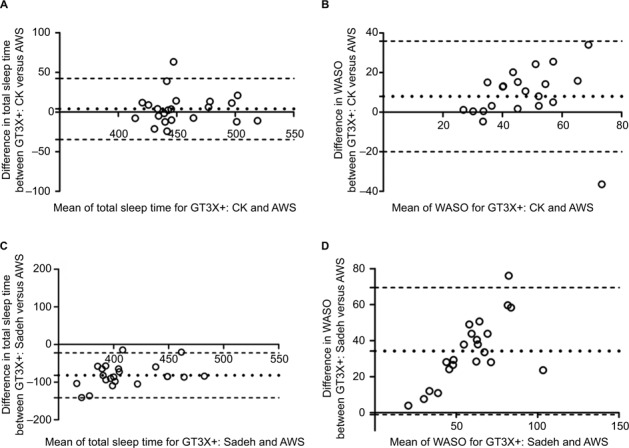
Objectives: Actigraphy is widely used to estimate sleep–wake time, despite limited information regarding the comparability of different devices and algorithms. We compared estimates of sleep–wake times determined by two wrist actigraphs (GT3X+ versus Actiwatch Spectrum [AWS]) to in-home polysomnography (PSG), using two algorithms (Sadeh and Cole–Kripke) for the GT3X+ recordings. Subjects and methods: Participants included a sample of 35 healthy volunteers (13 school children and 22 adults, 46% male) from Boston, MA, USA. Twenty-two adults wore the GT3X+ and AWS simultaneously for at least five consecutive days and nights. In addition, actigraphy and PSG were concurrently measured in 12 of these adults and another 13 children over a single night. We used intraclass correlation coefficients (ICCs), epoch-by-epoch comparisons, paired t -tests, and Bland–Altman plots to determine the level of agreement between actigraphy and PSG, and differences between devices and algorithms. Results: Each actigraph showed comparable accuracy (0.81–0.86) for sleep–wake estimation compared to PSG. When analyzing data from the GT3X+, the Cole–Kripke algorithm was more sensitive (0.88–0.96) to detect sleep, but less specific (0.35–0.64) to detect wake than the Sadeh algorithm (sensitivity: 0.82–0.91, specificity: 0.47–0.68). Total sleep time measured using the GT3X+ with both algorithms was similar to that obtained by PSG (ICC=0.64–0.88). In contrast, agreement between the GT3X+ and PSG wake after sleep onset was poor (ICC=0.00–0.10). In adults, the GT3X+ using the Cole–Kripke algorithm provided data comparable to the AWS (mean bias=3.7±19.7 minutes for total sleep time and 8.0±14.2 minutes for wake after sleep onset). Conclusion: The two actigraphs provided comparable and accurate data compared to PSG, although both poorly identified wake episodes (i.e., had low specificity). Use of actigraphy scoring algorithm influenced the mean bias and level of agreement in sleep–wake times estimates. The GT3X+, when analyzed by the Cole–Kripke, but not the Sadeh algorithm, provided comparable data to the AWS. Keywords: validation, actigraphy, polysomnography, scoring algorithm
Overview
The claims and statistics of this paper haven’t been checked yet.
Run the check — free, no account needed. It reads the open-access text and checks the sources it cites.
Integrity signals
Registry
Cites
Statistics
Figures
Verification
Claims the paper makes
The claims and statistics of this paper haven’t been checked yet.
Run the check — free, no account needed. It reads the open-access text and checks the sources it cites.
Claims other papers make about this one
Each is checked against this paper’s own text: does it say what the citing paper says it does?
In the citing paper
“Another research study for in-home polysomnography (PSG) using the Cole–Kripke algorithm on a sample of 35 healthy volunteers found that it was more sensitive to identify sleep (88–96%), but less specific to detect awake time (35–64%) [195].”
From Review of Wearable Devices and Data Collection Considerations for Connected Health (2021) · cites this paper as [195]
In the citing paper
“Previous research indicates that this algorithm undervalued sleep and exaggerated wakefulness in children and vice versa in adults.”
From Review of Wearable Devices and Data Collection Considerations for Connected Health (2021) · cites this paper as [195]
In the citing paper
“However, research suggests that [195] Cole–Kripke sleep misclassification was high in research involving children as compared to adults.”
From Review of Wearable Devices and Data Collection Considerations for Connected Health (2021) · cites this paper as [195]
Self-check
Percentages, sums and reported differences re-computed from the paper’s own numbers.
The self-check needs the paper’s full text.
Citations
Cites
(2007) · Cited by 6,530
The consensus sleep diary: standardizing prospective sleep self-monitoring
Carney, C. E., Buysse, D. J., Ancoli-Israel, S., Edinger, J. D., Krystal, A. D., Lichstein, K. L., & Morin, C. M. (2012) · Sleep · doi:10.5665/sleep.1642 · Cited by 2,172 · cited 1×
“, San Francisco, CA, USA).(13) All logs and participants’ answers were sent to a secure webbased dashboard.”
Automatic sleep/wake identification from wrist activity.
Cole, R., Kripke, D., Gruen, W., Mullaney, D., & Gillin, J. (1992) · Sleep · doi:10.1093/sleep/15.5.461 · Cited by 1,971
Activity-Based Sleep-Wake Identification: An Empirical Test of Methodological Issues
Sadeh, A., Sharkey, M., & Carskadon, M. A. (1994) · Sleep · doi:10.1093/sleep/17.3.201 · Cited by 1,487
The role and validity of actigraphy in sleep medicine: an update
Sadeh, A. (2011) · Sleep Medicine Reviews · doi:10.1016/j.smrv.2010.10.001 · Cited by 1,415
Use of actigraphy for assessment in pediatric sleep research
Meltzer, L. J., Montgomery‐Downs, H. E., Insana, S., & Walsh, C. M. (2012) · Sleep Medicine Reviews · doi:10.1016/j.smrv.2011.10.002 · Cited by 679
Further Validation of Actigraphy for Sleep Studies
de Souza, L., Benedito‐Silva, A. A., Pires, M. L. N., Poyares, D. R., Tufik, S., & Calil, H. M. (2003) · SLEEP · doi:10.1093/sleep/26.1.81 · Cited by 587
Direct Comparison of Two New Actigraphs and Polysomnography in Children and Adolescents
Meltzer, L. J., Walsh, C. M., Traylor, J. T., & Westin, A. M. L. (2011) · SLEEP · doi:10.5665/sleep.1608 · Cited by 339
Zinkhan, M., Berger, K., Hense, S., Nagel, M., Obst, A., Koch, B., Penzel, T., Fietze, I., Ahrens, W., Young, P., et al. (2014) · Sleep Medicine · doi:10.1016/j.sleep.2014.04.015 · Cited by 232
A Novel Adaptive Wrist Actigraphy Algorithm for Sleep-Wake Assessment in Sleep Apnea Patients
Hedner, J. A., Pillar, G., Pittman, S. D., Zou, D., Grote, L., & White, D. P. (2004) · SLEEP · doi:10.1093/sleep/27.8.1560 · Cited by 214
Cited by
Sorted by citations
Wearable Sleep Technology in Clinical and Research Settings
DE ZAMBOTTI, M., CELLINI, N., GOLDSTONE, A., COLRAIN, I. M., & BAKER, F. C. (2019) · Medicine & Science in Sports & Exercise · doi:10.1249/mss.0000000000001947 · Cited by 564
Review of Wearable Devices and Data Collection Considerations for Connected Health
Vijayan, V., Connolly, J. P., Condell, J., McKelvey, N., & Gardiner, P. (2021) · Sensors · doi:10.3390/s21165589 · Cited by 435
Sleep disturbances and sleep disorders in adults living with chronic pain: a meta-analysis
Mathias, J. L., Cant, M. L., & Burke, A. L. J. (2018) · Sleep Medicine · doi:10.1016/j.sleep.2018.05.023 · Cited by 310
Mobile EEG in research on neurodevelopmental disorders: Opportunities and challenges
Lau‐Zhu, A., Lau, M., & McLoughlin, G. (2019) · Developmental Cognitive Neuroscience · doi:10.1016/j.dcn.2019.100635 · Cited by 220
Chronotype, Social Jet Lag, and Cardiometabolic Risk Factors in Early Adolescence
Feliciano, E. M. C., Rifas‐Shiman, S. L., Quante, M., Redline, S. S., Oken, E., & Taveras, E. M. (2019) · Archives of Pediatrics and Adolescent Medicine · doi:10.1001/jamapediatrics.2019.3089 · Cited by 203
Self-citation
Metadata
- Authors
- Quante, M., Kaplan, E. R., Cailler, M., Rueschman, M., Wang, R., Weng, J., Taveras, E. M., & Redline, S.
- Affiliations
- Brigham and Women's Hospital (US)
- Harvard University (US)
- Corresponding author
- Quante, Mirja
- Venue
- Nature and Science of Sleep
- Publisher
- Informa UK Limited
- Published
- 2018-01
- Volume
- Volume 10
- Pages
- 13-20
- ISSN
- 1179-1608 (ISSN-L)
- PMC
- PMC5779275
- OpenAlex
- W2783706351
- Cited by
- 298
- References
- 22
- Citations by year
- 2026: 35 · 2025: 27 · 2024: 53 · 2023: 41 · 2022: 42 · 2021: 41 · 2020: 31 · 2019: 19 · 2018: 8
- FWCI
- 32.40
- Type
- journal article
- Language
- en
- Open access
- gold
- doi.org
- Licence
- Locations
- Nature and Science of Sleep (publishedVersion, cc-by-nc)
- Europe PMC (PubMed Central) (publishedVersion, cc-by-nc)
- PubMed Central (publishedVersion, cc-by-nc)
- PubMed (publishedVersion)
- Digital Access to Scholarship at Harvard (DASH) (Harvard University) (submittedVersion, cc-by)
- Dove Medical Press (Taylor and Francis Group) (submittedVersion, cc-by-nc)
- Funders
- Max Kade Foundation
- National Cancer Institute (U54CA155626)
- Topics
- Social Sciences › Psychology › Experimental and Cognitive Psychology › Sleep and related disorders
- Life Sciences › Neuroscience › Endocrine and Autonomic Systems › Circadian rhythm and melatonin
- Social Sciences › Psychology › Experimental and Cognitive Psychology › Sleep and Work-Related Fatigue
- Keywords
- actigraphy, polysomnography, total sleep time, wake after sleep onset, adolescents, adults, device agreement, home sleep monitoring
About these checks
Registry, retraction, Cites and statistics results are computed, not judged, with one exception: a printed reference that no index lists is read once by a model before it counts as a citation error. Claims are extracted by a model and kept only when their quote appears verbatim in the text; each cited source is then checked, with a model’s help, for whether it says what the claim relies on. Those verdicts can be wrong — read the claim’s quote and the cited source before relying on one.
Statistics and arithmetic are recomputed, not judged.
Confidence bands are shown only for fields calibrated on our annotated test set. None is calibrated yet, so no band is shown.
What counts as a claim ›How we measure confidence ›How we check this ›
Are you an author, or do you see a problem with this page? Request a review
