

Reduction in bacterial load using hypochlorous acid hygiene solution on ocular skin
Open accessThe DOI matches its Crossref record; 24 of the 25 references it cites were found in a registry or an index.
Abstract
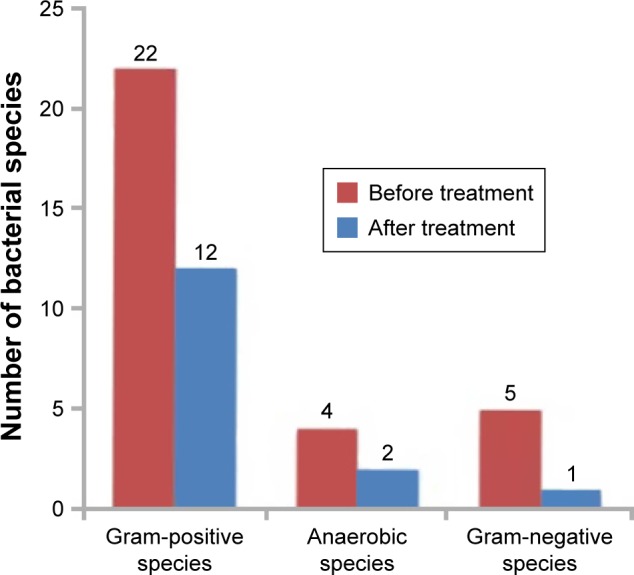
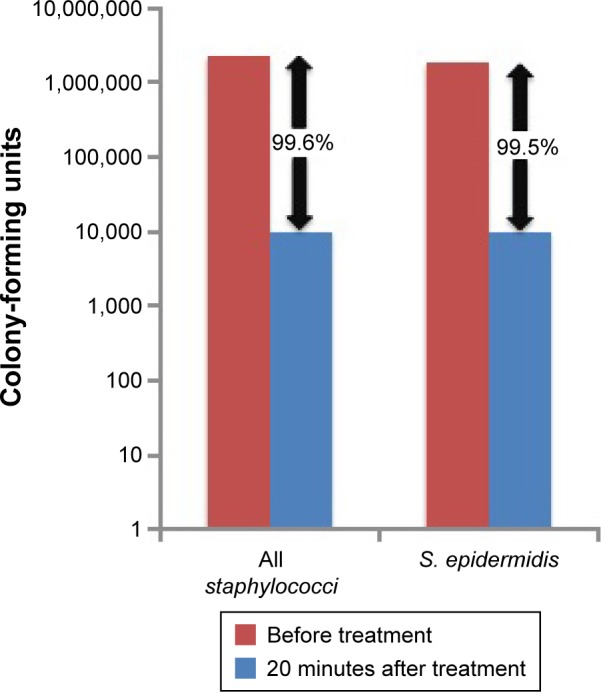
Purpose: To examine the magnitude of bacterial load reduction on the surface of the periocular skin 20 minutes after application of a saline hygiene solution containing 0.01% pure hypochlorous acid (HOCl). Methods: Microbiological specimens were collected immediately prior to applying the hygiene solution and again 20 minutes later. Total microbial colonies were counted and each unique colony morphology was processed to identify the bacterial species and to determine the susceptibility profile to 15 selected antibiotics. Results: Specimens were analyzed from the skin samples of 71 eyes from 36 patients. Prior to treatment, 194 unique bacterial isolates belonging to 33 different species were recovered. Twenty minutes after treatment, 138 unique bacterial isolates belonging to 26 different species were identified. Staphylococci accounted for 61% of all strains recovered and Staphylococcus epidermidis strains comprised 60% of the staphylococcal strains. No substantial differences in the distribution of Gram-positive, Gram-negative, or anaerobic species were noted before and after treatment. The quantitative data demonstrated a >99% reduction in the staphylococcal load on the surface of the skin 20 minutes following application of the hygiene solution. The total S. epidermidis colony-forming units were reduced by 99.5%. The HOCl hygiene solution removed staphylococcal isolates that were resistant to multiple antibiotics equally well as those isolates that were susceptible to antibiotics. Conclusion: The application of a saline hygiene solution preserved with pure HOCl acid reduced the bacterial load significantly without altering the diversity of bacterial species remaining on the skin under the lower eyelid. Keywords: blepharitis, microbiome, Propionibacterium acnes , Corynebacterium , Staphylococcus aureus , Staphylococcus epidermidis
Overview
The claims and statistics of this paper haven’t been checked yet.
Free: it reads the open-access text and checks the first 5 claims that cite a source we can check. Create a free account to check every claim.
Integrity signals
Registry
Cites
Statistics
Figures
Verification
Claims the paper makes
The claims and statistics of this paper haven’t been checked yet.
Free: it reads the open-access text and checks the first 5 claims that cite a source we can check. Create a free account to check every claim.
Claims other papers make about this one
Each is checked against this paper’s own text: does it say what the citing paper says it does?
In the citing paper
“Remarkably, in addition to endogenous and environmental sources, skin HOCl exposure also occurs through application of topical disinfectants employed worldwide as clinical and consumer products (167–171).”
From Hypochlorous Acid: From Innate Immune Factor and Environmental Toxicant to Chemopreventive Agent Targeting Solar UV-Induced Skin Cancer (2022) · cites this paper as [167]
Self-check
Percentages, sums and reported differences re-computed from the paper’s own numbers.
The self-check needs the paper’s full text.
Citations
Cites
Grice, E. A., & Segre, J. A. (2011) · Nature Reviews Microbiology · doi:10.1038/nrmicro2537 · Cited by 3,143
Reliability and Validity of the Ocular Surface Disease Index
Schiffman, R. M. (2000) · Archives of Ophthalmology · doi:10.1001/archopht.118.5.615 · Cited by 3,045
Staphylococcus epidermidis — the 'accidental' pathogen
Otto, M. (2009) · Nature Reviews Microbiology · doi:10.1038/nrmicro2182 · Cited by 1,808
Prevalence of dry eye syndrome among US women
Schaumberg, D. A., Sullivan, D. A., Buring, J. E., & Dana, M. R. (2003) · American Journal of Ophthalmology · doi:10.1016/s0002-9394(03)00218-6 · Cited by 1,225
The International Workshop on Meibomian Gland Dysfunction: Executive Summary
Nichols, K. K., Foulks, G. N., Bron, A. J., Glasgow, B. J., Dogru, M., Tsubota, K., Lemp, M. A., & Sullivan, D. A. (2011) · Investigative Opthalmology & Visual Science · doi:10.1167/iovs.10-6997a · Cited by 1,008
Nelson, J. D., Shimazaki, J., Benitez-del-Castillo, J. M., Craig, J. P., McCulley, J. P., Den, S., & Foulks, G. N. (2011) · Investigative Opthalmology & Visual Science · doi:10.1167/iovs.10-6997b · Cited by 877
Robbins and Cotran Pathologic Basis of Disease
Kumar, V., Robbins, S. L., & Cotran, R. S. (2004) · LA Referencia (Red Federada de Repositorios Institucionales de Publicaciones Científicas) · Cited by 606
Lemp, M. A., Crews, L. A., Bron, A. J., Foulks, G. N., & Sullivan, B. D. (2012) · Cornea · doi:10.1097/ico.0b013e318225415a · Cited by 570
Baudouin, C., Messmer, E. M., Aragona, P., Geerling, G., Akova, Y. A., Benítez-del-Castillo, J., Boboridis, K. G., Merayo-Lloves, J., Rolando, M., & Labetoulle, M. (2016) · British Journal of Ophthalmology · doi:10.1136/bjophthalmol-2015-307415 · Cited by 516
Bacterial Competition for Human Nasal Cavity Colonization: Role of Staphylococcal agr Alleles
Lina, G., Boutite, F., Tristan, A., Bes, M., Etienne, J., & Vandenesch, F. (2003) · Applied and Environmental Microbiology · doi:10.1128/aem.69.1.18-23.2003 · Cited by 381 · cited 2×
“However, some investigators theorize that some resident bacterial species may play a beneficial role by competing with more pathogenic organisms.(11) Numerous studies to characterize microorganisms from blepharitis have been conducted.”
Background
Cited by
Contact Lens Technology: From Fundamentals to Applications
Moreddu, R., Vigolo, D., & Yetisen, A. K. (2019) · Advanced Healthcare Materials · doi:10.1002/adhm.201900368 · Cited by 264
Block, M. S., & Rowan, B. G. (2020) · Journal of Oral and Maxillofacial Surgery · doi:10.1016/j.joms.2020.06.029 · Cited by 242
“tions, including chronic wound care and disinfection.(34,36,43,45,46,63) In addition to the use of HOCl as a”
TFOS DEWS III: Management and Therapy
Jones, L., Craig, J. P., Markoulli, M. P., Karpecki, P. M., Akpek, E. K., Basu, S., Bitton, E., Chen, W., Dhaliwal, D. K., Doğru, M., et al. (2025) · American Journal of Ophthalmology · doi:10.1016/j.ajo.2025.05.039 · Cited by 235
Sheppard, J. D., & Nichols, K. K. (2023) · Ophthalmology and Therapy · doi:10.1007/s40123-023-00669-1 · Cited by 171
An algorithm for the preoperative diagnosis and treatment of ocular surface disorders
Starr, C. E., Gupta, P. K., Farid, M., Beckman, K. A., Chan, C. C., Yeu, E., Gomes, J. Á. P., Ayers, B., Berdahl, J. P., Holland, E. J., et al. (2019) · Journal of Cataract & Refractive Surgery · doi:10.1016/j.jcrs.2019.03.023 · Cited by 170
Metadata
- Authors
- Stroman, D., Mintun, K., Epstein, A., Brimer, C., Patel, C., Branch, J., & Najafi-Tagol, K.
- Affiliations
- NovaBay Pharmaceuticals (United States) (US)
- Turner Eye Institute (US)
- Corresponding author
- Stroman, David
- Venue
- Clinical Ophthalmology
- Publisher
- Informa UK Limited
- Published
- 2017-04
- Volume
- Volume 11
- Pages
- 707-714
- ISSN
- 1177-5467 (ISSN-L)
- 1177-5483
- PMC
- PMC5402722
- OpenAlex
- W2605637929
- Cited by
- 82
- References
- 25
- Citations by year
- 2026: 4 · 2025: 14 · 2024: 7 · 2023: 16 · 2022: 13 · 2021: 9 · 2020: 12 · 2019: 4 · 2018: 3
- FWCI
- 5.07
- Type
- journal article
- Language
- en
- Open access
- gold
- doi.org
- Licence
- Locations
- Clinical ophthalmology (publishedVersion, cc-by-nc)
- Europe PMC (PubMed Central) (publishedVersion, cc-by-nc)
- PubMed Central (publishedVersion, cc-by-nc)
- PubMed (publishedVersion)
- Dove Medical Press (Taylor and Francis Group) (submittedVersion, cc-by-nc)
- Topics
- Health Sciences › Medicine › Ophthalmology › Ocular Infections and Treatments
- Life Sciences › Immunology and Microbiology › Applied Microbiology and Biotechnology › Antimicrobial agents and applications
- Health Sciences › Medicine › Infectious Diseases › Infection Control in Healthcare
- Keywords
- hypochlorous acid, bacterial reduction, Staphylococcus epidermidis, Staphylococcus aureus, Propionibacterium acnes, Corynebacterium, blepharitis, antibiotic resistance
About these checks
Registry, retraction, Cites and statistics results are computed, not judged, with one exception: a printed reference that no index lists is read once by a model before it counts as a citation error. Claims are extracted by a model and kept only when their quote appears verbatim in the text; each cited source is then checked, with a model’s help, for whether it says what the claim relies on. Those verdicts can be wrong — read the claim’s quote and the cited source before relying on one.
Statistics and arithmetic are recomputed, not judged.
Confidence bands are shown only for fields calibrated on our annotated test set. None is calibrated yet, so no band is shown.
What counts as a claim ›How we measure confidence ›How we check this ›
Are you an author, or do you see a problem with this page? Request a review
How to cite
Cite CoChat for the checks on this page, and the paper for its own findings.
- This page
- CoChat. (2026). Citation check: Reduction in bacterial load using hypochlorous acid hygiene solution on ocular skin. https://app.cochat.ai/papers/10.2147/opth.s132851
- The paper
- Stroman, D., Mintun, K., Epstein, A., Brimer, C., Patel, C., Branch, J., & Najafi-Tagol, K. (2017). Reduction in bacterial load using hypochlorous acid hygiene solution on ocular skin. Clinical Ophthalmology. https://doi.org/10.2147/opth.s132851
Data sources
Bibliographic data: Semantic Scholar, OpenAlex, Crossref.
Contains information from the Semantic Scholar Academic Graph Datasets, made available under the ODC Attribution License (ODC-BY 1.0).
Semantic Scholar’s data is described in: Kinney, R., et al. (2023). The Semantic Scholar Open Data Platform. arXiv:2301.10140.
