

The DOI matches its Crossref record; 55 of the 56 references it cites were found in a registry or an index; 8 of the 29 sources its claims cite were checked for support.
Multivariate analysis of water quality in the Dhaleshwari River, Bangladesh: identifying pollution sources and environmental implications
Open accessAbstract
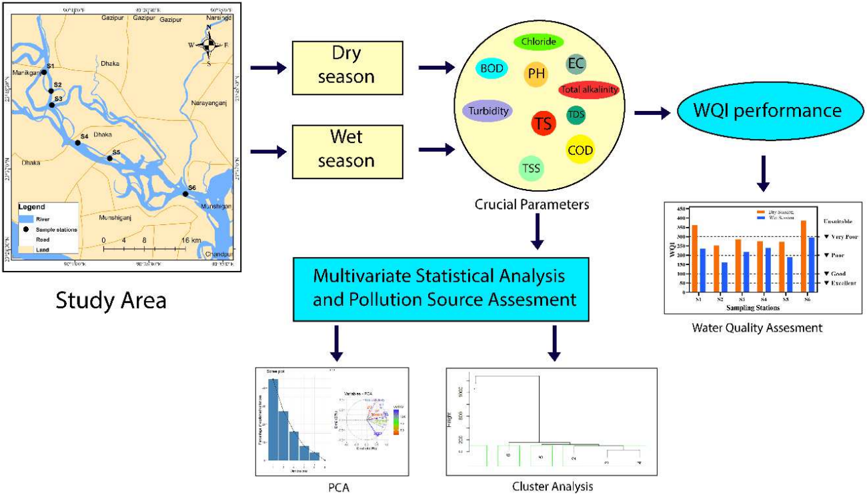
This study aims to evaluate the current water quality status of the Dhaleshwari River, considering seasonal variations, and identify potential pollution sources using physicochemical parameters, multivariate statistical analysis, and the water quality index (WQI) method. Sampling was conducted at six locations along the Dhaleshwari River from January 2021 to April 2022, encompassing both dry and wet seasons. Eleven physicochemical parameters were tested following standard procedures. The calculated WQI values demonstrated that the overall water quality of the Dhaleshwari River is very poor (264.7 ± 64.5). Seasonal variation in water quality was significant, with the worst quality (305.7 ± 54.3) observed during the dry season; however, water quality during the wet season was also unsatisfactory (223.6 ± 46.3). Geospatial analysis shows the distribution of water quality in the study locations. Principal components analysis was performed for source appointment, which indicated that direct wastewater discharge from surrounding industries, particularly tanneries, as well as municipal wastewater, were the major pollution sources. In conclusion, this study sheds light on the deteriorating water quality of the Dhaleshwari River due to industrialization and human activities. The findings underscore the urgent need for interventions to mitigate pollution sources and improve the overall health of the river ecosystem.
Overview
AI snapshot
Written from the paper’s full text.
TL;DR
The study assessed Dhaleshwari River water quality at six stations over dry and wet seasons (January 2021–April 2022) using 11 physicochemical parameters, WQI, and multivariate statistics. It found generally very poor water quality, worst in the dry season, with industrial/tannery and municipal wastewater as major pollution sources.
Key findings
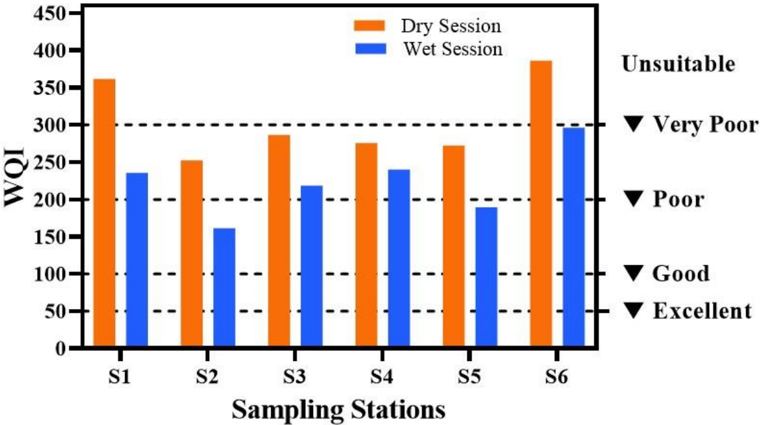
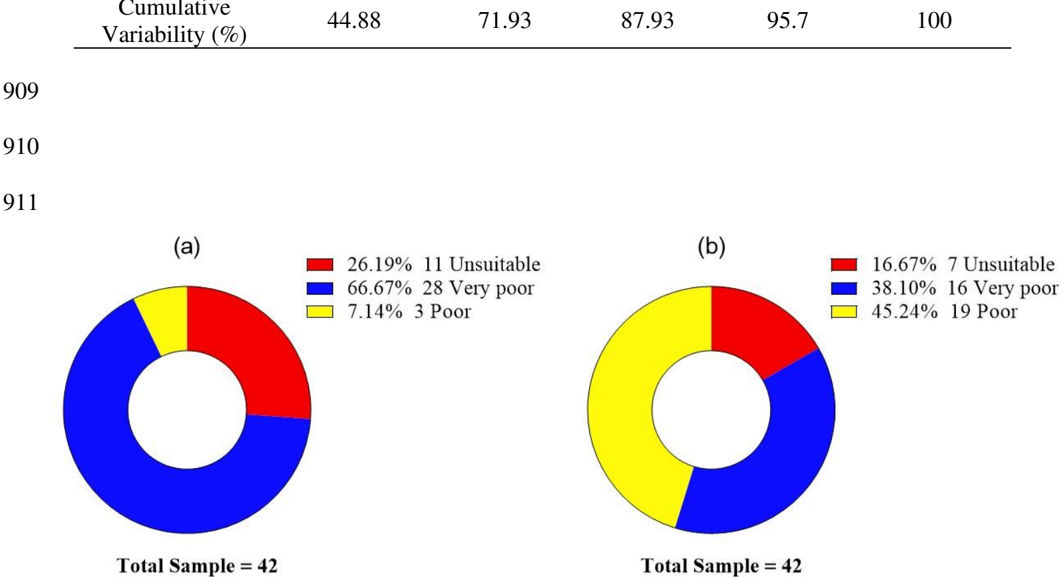
- WQI indicated very poor overall water quality. In Table S2, S6 dry season had WQI 386 and S1 dry season 361.6, both “unsuitable for use without proper treatment”; S2 wet season had 161.3 and S5 wet season 189.6, both “poor”; other station-season values were “very poor.” Dry-season samples were 26.19% unsuitable, 66.67% very poor, and 7.14% poor; wet-season samples were 16.67% unsuitable, 38.10% very poor, and 45.24% poor, with no good or excellent samples.
- Several parameters exceeded standards: BOD5 ranged 2–46 mg/L, COD 6–90 mg/L, and turbidity 11–530 mg/L; no turbidity value met the ECR recommended 5 mg/L, and all COD values exceeded the 10 mg/L ECR limit. DO ranged 0.4–10 mg/L, and in the dry season all stations except S2 had average DO below the ECR value of ≥6 mg/L.
- Dry-season correlations were strong and positive among EC, TDS, TS, BOD5, COD, and chloride (e.g., EC–TDS r = 1, EC–TS r = 1, TDS–TS r = 0.99, EC–chloride r = 0.93, TS–chloride r = 0.95) and strongly negative between DO and TSS (r = −0.93) and DO and COD (r = −0.83). PCA explained 89.23% of dry-season variability with two factors (PC1 59.23%, PC2 29.9%) and 44.8% with PC1 in the wet season; cluster analysis grouped the six sampling stations into four clusters.
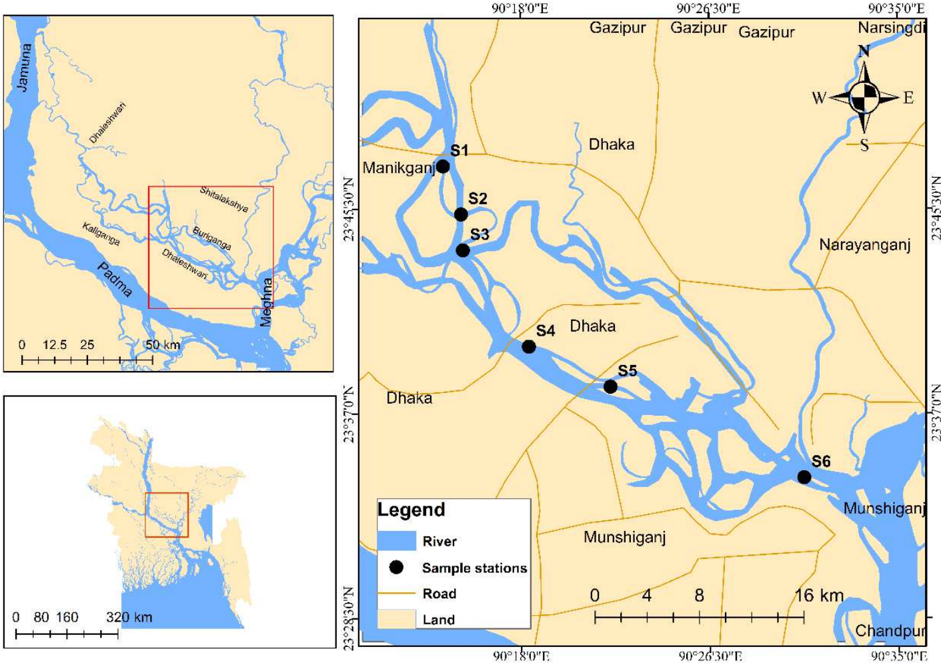
- PCA and spatial analysis identified direct wastewater discharge from surrounding industries, particularly tanneries, plus municipal wastewater as major pollution sources; S1 is near the BSCIC tannery industrial area and S6 is downstream near the Buriganga River confluence.
Methods
- Water samples were collected from six stations within about 50 km of the Dhaleshwari River from January 2021 to April 2022, covering dry and wet seasons, with six samples per station per season. Eleven physicochemical parameters were tested following standard procedures using HACH meters, a Shimadzu UV Visible Spectrophotometer, HACH BOD TRAK II, and a HACH turbidity meter.
- Statistical analysis used one-way ANOVA among sampling stations, t-tests for seasonal variation, Pearson correlation, PCA, cluster analysis, and the weighted arithmetic Water Quality Index method. Analyses were conducted in R, GraphPad Prism 8, and Microsoft Excel; maps were generated in ESRI ArcMap 10.5.
Limitations
- The paper does not state a limitations section.
- Evident from the text: the study covers only 11 physicochemical parameters and does not include heavy metals or microbial indicators, despite focusing on tannery and industrial pollution. Sampling is limited to six stations and two seasons, so source identification is correlational rather than directly traced.
- The text and tables contain some inconsistencies or apparent typographical issues, such as PCA cumulative variability reported as 89.23% in the text versus 89.13% in Table S1, DO–BOD5 correlation reported as “r = -79,” and a truncated Table 3.
Model-written summary. Check it against the paper before relying on it.
Integrity signals
Registry
Cites
Statistics
Figures
Verification
Claims the paper makes
67 Own result · 26 Own interpretation · 7 No basis given · 5 Sources not found · 5 No full text of the sources · 4 Not checked yet · 3 Partly supported · 3 Couldn’t confirm · accuracy not yet measured
The cited sources that could be checked couldn’t confirm or dispute this claim.
In the paper
“Overall, all the observed EC values except for S1 were found within the limit of 1200 𝜇s/cm set in the Environment Conservation Rules (ECR), 1997 (schedule 10) [49].”
§ Multivariate Analysis of Water Quality in the Dhaleshwari River, Bangladesh: Identifying Pollution Sources and Environmental Implications > 3.1 Distribution of the physical parameters and seasonal fluctuations
What the sources say
- Could not verifycites [49] sourceExperimental — accuracy not yet measured
The Abstract lists the water-quality parameters studied but does not include electrical conductivity (EC). A search of the full-text copy for EC, the 1200 μS/cm limit, and the Environment Conservation Rules found no passage addressing the claimed station-by-station comparison. (LLM, conf=0.75)
plain- Asserted: passes — The authors put it forward as true.
- Checkable: passes — It can be checked against evidence.
- Load-bearing: unclear — It is unclear whether the paper’s conclusions depend on it.
- Based: passes — The paper gives a reason why it holds.
- Rests on an assumption: The six sampling stations are representative of the Dhaleshwari River's overall water quality.
- Could not verify
The cited sources support only part of this claim — read each source’s verdict below.
In the paper
“The tannery industry (S1) (Fig. 8) emerges as a significant contributor to environmental challenges, yielding both tanned and untanned solid waste alongside liquid effluents bearing substantial organic loads, chloride, and chromium [63,64].”
§ Multivariate Analysis of Water Quality in the Dhaleshwari River, Bangladesh: Identifying Pollution Sources and Environmental Implications > 3.4. Spatial-temporal groupings and WQI
What the sources say
- Partly supportedcites [63] sourceExperimental — accuracy not yet measured
The Results and Discussion section reports organic pollution and elevated chromium in River Landzu, but it does not identify a tannery as their source or describe tanned and untanned solid waste. It also reports that chloride in the river samples was within permissible levels; these river measurements do not establish the claimed composition of tannery effluent. (LLM, conf=0.78)
- Not matchedcites [64]
Couldn’t be matched to a paper in Crossref, so it can’t be checked.
plaindirect- Asserted: passes — The authors put it forward as true.
- Checkable: passes — It can be checked against evidence.
- Load-bearing: passes — The paper’s conclusions depend on it.
- Based: passes — The paper gives a reason why it holds.
- Partly supported
The cited sources that could be checked couldn’t confirm or dispute this claim.
In the paper
“However, in the dry season, since no rainfall occurred, the river water pH and alkalinity were comparatively higher than in the wet [54].”
§ Multivariate Analysis of Water Quality in the Dhaleshwari River, Bangladesh: Identifying Pollution Sources and Environmental Implications > 3.2. Comparison among chemical and biochemical contaminants and seasonality
What the sources say
- Could not verifycites [54] sourceExperimental — accuracy not yet measured
Section 2, “Water Quality Index” (page unavailable), lists pH and alkalinity as water-quality variables but does not compare their dry- and wet-season levels. Searches for dry season, rainfall, and seasonal variation found no passage in our copy addressing the claimed comparison or its explanation. (LLM, conf=0.76)
plaindirect- Asserted: passes — The authors put it forward as true.
- Checkable: passes — It can be checked against evidence.
- Load-bearing: unclear — It is unclear whether the paper’s conclusions depend on it.
- Based: passes — The paper gives a reason why it holds.
- Rests on an assumption: The sampling period from January 2021 to April 2022 and the sampled dry and wet seasons are representative of typical seasonal conditions of the river.
- Could not verify
A result the paper reports from its own data — it cites no other source for it, so there is none to check. The quote shows it is in the paper.
In the paper
“Cluster analysis grouped the six sampling stations into four distinct clusters based on water quality similarities across both seasons.”
§ Multivariate Analysis of Water Quality in the Dhaleshwari River, Bangladesh: Identifying Pollution Sources and Environmental Implications > Abstract
plaincorrelational- Asserted: passes — The authors put it forward as true.
- Checkable: passes — It can be checked against evidence.
- Load-bearing: passes — The paper’s conclusions depend on it.
- Based: passes — The paper gives a reason why it holds.
- Rests on an assumption: The six sampling stations are representative of the Dhaleshwari River's overall water quality.
A result the paper reports from its own data — it cites no other source for it, so there is none to check. The quote shows it is in the paper.
In the paper
“The results of the study reveal a high degree of fluctuation in the BOD5 values within each of the stations, ranging from 2-46 mg/L.”
§ Multivariate Analysis of Water Quality in the Dhaleshwari River, Bangladesh: Identifying Pollution Sources and Environmental Implications > 3.2. Comparison among chemical and biochemical contaminants and seasonality
plain- Asserted: passes — The authors put it forward as true.
- Checkable: passes — It can be checked against evidence.
- Load-bearing: passes — The paper’s conclusions depend on it.
- Based: passes — The paper gives a reason why it holds.
- Rests on an assumption: The six sampling stations are representative of the Dhaleshwari River's overall water quality.
- Rests on an assumption: The sampling period from January 2021 to April 2022 and the sampled dry and wet seasons are representative of typical seasonal conditions of the river.
A result the paper reports from its own data — it cites no other source for it, so there is none to check. The quote shows it is in the paper.
In the paper
“The obtained COD values from various sampling stations and seasons exhibit substantial fluctuations, with values ranging from 6-90 mg/L throughout the year (Table 3).”
§ Multivariate Analysis of Water Quality in the Dhaleshwari River, Bangladesh: Identifying Pollution Sources and Environmental Implications > 3.2. Comparison among chemical and biochemical contaminants and seasonality
plain- Asserted: passes — The authors put it forward as true.
- Checkable: passes — It can be checked against evidence.
- Load-bearing: unclear — It is unclear whether the paper’s conclusions depend on it.
- Based: passes — The paper gives a reason why it holds.
- Rests on an assumption: The six sampling stations are representative of the Dhaleshwari River's overall water quality.
- Rests on an assumption: The sampling period from January 2021 to April 2022 and the sampled dry and wet seasons are representative of typical seasonal conditions of the river.
A result the paper reports from its own data — it cites no other source for it, so there is none to check. The quote shows it is in the paper.
In the paper
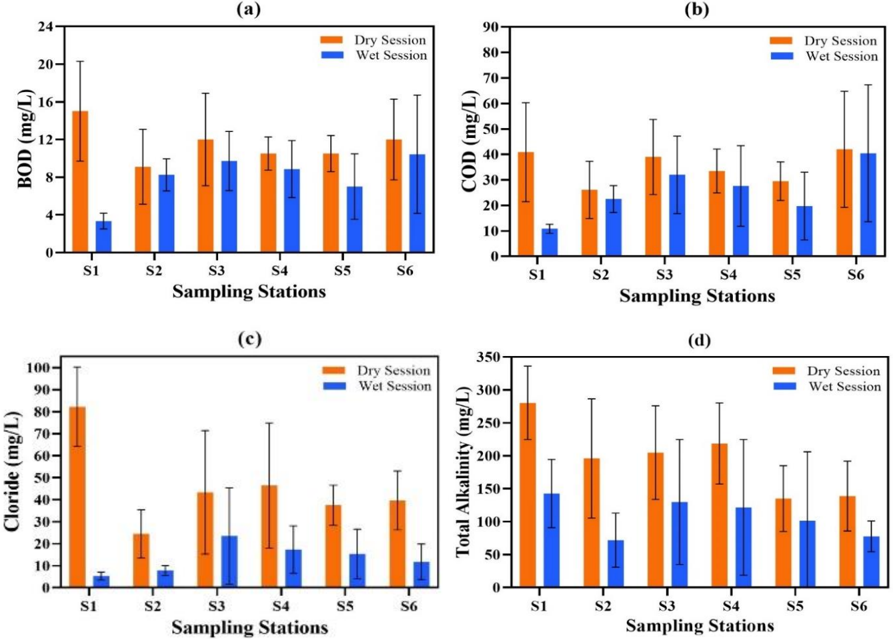
“A marked variation in the total alkalinity value was observed between the dry and wet seasons at all of the sampling stations.”
§ Multivariate Analysis of Water Quality in the Dhaleshwari River, Bangladesh: Identifying Pollution Sources and Environmental Implications > 3.2. Comparison among chemical and biochemical contaminants and seasonality
plaincorrelational- Asserted: passes — The authors put it forward as true.
- Checkable: passes — It can be checked against evidence.
- Load-bearing: unclear — It is unclear whether the paper’s conclusions depend on it.
- Based: passes — The paper gives a reason why it holds.
- Rests on an assumption: The six sampling stations are representative of the Dhaleshwari River's overall water quality.
- Rests on an assumption: The sampling period from January 2021 to April 2022 and the sampled dry and wet seasons are representative of typical seasonal conditions of the river.
A result the paper reports from its own data — it cites no other source for it, so there is none to check. The quote shows it is in the paper.
In the paper
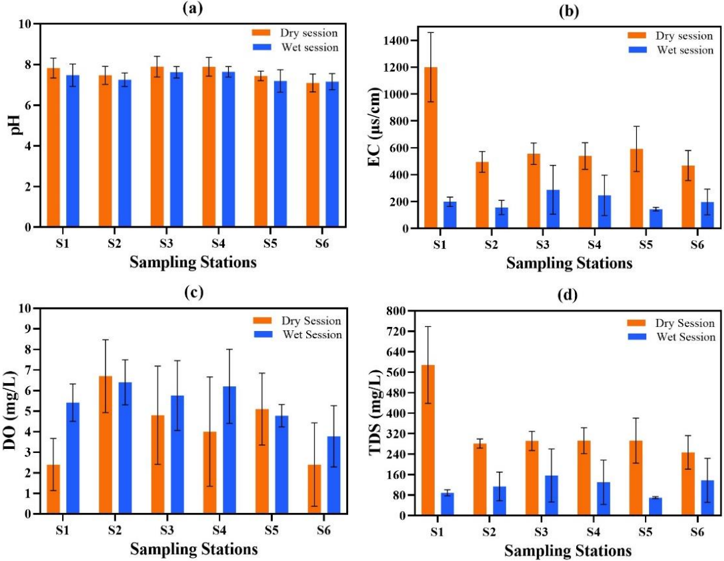
“Dissolved Oxygen (DO) values obtained from all the sampling stations showed high fluctuations throughout the year (0.4-10 mg/L (Fig. 2c).”
§ Multivariate Analysis of Water Quality in the Dhaleshwari River, Bangladesh: Identifying Pollution Sources and Environmental Implications > 3.1 Distribution of the physical parameters and seasonal fluctuations
plain- Asserted: passes — The authors put it forward as true.
- Checkable: passes — It can be checked against evidence.
- Load-bearing: unclear — It is unclear whether the paper’s conclusions depend on it.
- Based: passes — The paper gives a reason why it holds.
- Rests on an assumption: The six sampling stations are representative of the Dhaleshwari River's overall water quality.
- Rests on an assumption: The sampling period from January 2021 to April 2022 and the sampled dry and wet seasons are representative of typical seasonal conditions of the river.
A result the paper reports from its own data — it cites no other source for it, so there is none to check. The quote shows it is in the paper.
In the paper
“Average DO values at different stations showed that all the stations in the dry season except for S2 had lower DO than the set value (≥6 mg/L) in ECR 1997 (schedule 3), while a DO value of (4-6 mg/L) is recommended for aquatic animals.”
§ Multivariate Analysis of Water Quality in the Dhaleshwari River, Bangladesh: Identifying Pollution Sources and Environmental Implications > 3.1 Distribution of the physical parameters and seasonal fluctuations
plain- Asserted: passes — The authors put it forward as true.
- Checkable: passes — It can be checked against evidence.
- Load-bearing: unclear — It is unclear whether the paper’s conclusions depend on it.
- Based: passes — The paper gives a reason why it holds.
- Rests on an assumption: The six sampling stations are representative of the Dhaleshwari River's overall water quality.
- Rests on an assumption: The sampling period from January 2021 to April 2022 and the sampled dry and wet seasons are representative of typical seasonal conditions of the river.
A result the paper reports from its own data — it cites no other source for it, so there is none to check. The quote shows it is in the paper.
In the paper
“The chloride values obtained from various sampling stations depict a significant seasonal variance (t-test, p < 0.01).”
§ Multivariate Analysis of Water Quality in the Dhaleshwari River, Bangladesh: Identifying Pollution Sources and Environmental Implications > 3.2. Comparison among chemical and biochemical contaminants and seasonality
plaincorrelational- Asserted: passes — The authors put it forward as true.
- Checkable: passes — It can be checked against evidence.
- Load-bearing: unclear — It is unclear whether the paper’s conclusions depend on it.
- Based: passes — The paper gives a reason why it holds.
- Rests on an assumption: The six sampling stations are representative of the Dhaleshwari River's overall water quality.
- Rests on an assumption: The sampling period from January 2021 to April 2022 and the sampled dry and wet seasons are representative of typical seasonal conditions of the river.
- It may state two separate claims as one. 51
- Probably not a substantial claim. 7
- The quote only partly states this claim. 2
The cited sources support only part of this claim — read each source’s verdict below.
In the paper
“the accelerating industrialization, unregulated urbanization, and poorly executed development plans have resulted in severe environmental degradation of the rivers.”
§ Multivariate Analysis of Water Quality in the Dhaleshwari River, Bangladesh: Identifying Pollution Sources and Environmental Implications > 1. Introduction
What the sources say
- Partly supportedcites [13] sourceExperimental — accuracy not yet measured
Section 3.2 reports industrial effluent and domestic sewage entering rivers near Shiyan City, and Section 4 concludes that water quality in several rivers in the Danjiangkou Reservoir Basin, China, has deteriorated. These passages support a link between industrial and urban pollution and river degradation, but they do not address rivers in Bangladesh, unregulated urbanization, or poorly executed development plans. Page numbers were not available in our copy. (LLM, conf=0.86)
- Not checked — no full text of the sourcecites [14] source
- Not checked yetcites [15] Das, 2011, Heavy metals in industrial effluents (tannery and textile) and adjacent rivers of Dhaka city, Bangladesh, Terrestrial and Aquatic Environmental Toxicology
plaindirect- Asserted: passes — The authors put it forward as true.
- Checkable: passes — It can be checked against evidence.
- Load-bearing: passes — The paper’s conclusions depend on it.
- Based: passes — The paper gives a reason why it holds.
It may state two separate claims as one.
- Partly supported
The cited sources that could be checked couldn’t confirm or dispute this claim.
In the paper
“Moreover, rainwater is a little bit acidic in character, that could also be a reason for decreasing the pH and alkalinity [53].”
§ Multivariate Analysis of Water Quality in the Dhaleshwari River, Bangladesh: Identifying Pollution Sources and Environmental Implications > 3.2. Comparison among chemical and biochemical contaminants and seasonality
What the sources say
- Could not verifycites [53] sourceExperimental — accuracy not yet measured
The Trend analysis (section 3.1; page unavailable) reports decreasing pH at some sites but suggests anthropogenic wastes as a possible cause. The passages retrieved for rainwater, rainfall, and alkalinity do not address whether acidic rainwater could lower pH or alkalinity. (LLM, conf=0.76)
hedgedconditional- Asserted: passes — The authors put it forward as true.
- Checkable: passes — It can be checked against evidence.
- Load-bearing: unclear — It is unclear whether the paper’s conclusions depend on it.
- Based: passes — The paper gives a reason why it holds.
It may state two separate claims as one.
- Could not verify
The cited sources support only part of this claim — read each source’s verdict below.
In the paper
“EC is the measurement of dissolved minerals, salts, and ionic compounds; therefore, it is frequently measured as a water quality parameter that presents a very strong positive correlation with the TS, TDS, and minerals (Cl -) [45,56,57].”
§ Multivariate Analysis of Water Quality in the Dhaleshwari River, Bangladesh: Identifying Pollution Sources and Environmental Implications > 3.3. Interaction between and among the physical and chemical components
What the sources say
- Partly supportedcites [45] sourceExperimental — accuracy not yet measured
The correlation matrix (Section 3.3.1; page not available) reports strong positive correlations between EC and TDS (r = 0.947) and between EC and TSS (r = 0.856). It reports a positive but less strong correlation with chloride (r = 0.621). The paper measures TSS, not the claimed TS, and these findings from one river do not establish that such correlations occur frequently in general. (LLM, conf=0.88)
- Partly supportedcites [56] sourceExperimental — accuracy not yet measured
The EC section says electrical conductivity measures the concentration of ions in water, and the TDS section identifies dissolved ions including chloride. Neither section reports a correlation—let alone a very strong positive correlation—between EC and TS, TDS, or chloride. (LLM, conf=0.87)
- Not checked — no full text of the sourcecites [57] source
boostedcorrelational- Asserted: passes — The authors put it forward as true.
- Checkable: passes — It can be checked against evidence.
- Load-bearing: fails — The paper’s conclusions may not depend on it.
- Based: passes — The paper gives a reason why it holds.
Probably not a substantial claim. The paper’s conclusions may not depend on it. It may state two separate claims as one.
- Partly supported
None of the sources cited for this claim have been checked yet.
In the paper
“Since the degradation of organic contaminants demands oxygen from the waterbody, there is an inverse relationship between BOD5, COD, and DO [15,58].”
§ Multivariate Analysis of Water Quality in the Dhaleshwari River, Bangladesh: Identifying Pollution Sources and Environmental Implications > 3.3. Interaction between and among the physical and chemical components
What the sources say
- Not checked yetcites [15] Das, 2011, Heavy metals in industrial effluents (tannery and textile) and adjacent rivers of Dhaka city, Bangladesh, Terrestrial and Aquatic Environmental Toxicology
- Could not verifycites [58] sourceExperimental — accuracy not yet measured
The Chief Determinants of Global Threat section identifies organic loads as a pollution source, but does not discuss oxygen consumed during degradation or a relationship between BOD5, COD, and dissolved oxygen. Searches for those measures, dissolved oxygen, and oxygen depletion found no passage addressing the claimed inverse relationship. (LLM, conf=0.74)
plaindirect- Asserted: passes — The authors put it forward as true.
- Checkable: passes — It can be checked against evidence.
- Load-bearing: passes — The paper’s conclusions depend on it.
- Based: passes — The paper gives a reason why it holds.
It may state two separate claims as one.
A result the paper reports from its own data — it cites no other source for it, so there is none to check. The quote shows it is in the paper.
In the paper
“Notably, the highest maximum value (845 mg/L) and the peak average value (588±150.2mg/L) were recorded at S1 during the dry season, while the lowest average value (69.9±3.4 mg/L) was observed at S5 during the wet season (Fig. 2d).”
§ Multivariate Analysis of Water Quality in the Dhaleshwari River, Bangladesh: Identifying Pollution Sources and Environmental Implications > 3.1 Distribution of the physical parameters and seasonal fluctuations
plain- Asserted: passes — The authors put it forward as true.
- Checkable: passes — It can be checked against evidence.
- Load-bearing: unclear — It is unclear whether the paper’s conclusions depend on it.
- Based: passes — The paper gives a reason why it holds.
It may state two separate claims as one.
- Rests on an assumption: The six sampling stations are representative of the Dhaleshwari River's overall water quality.
- Rests on an assumption: The sampling period from January 2021 to April 2022 and the sampled dry and wet seasons are representative of typical seasonal conditions of the river.
A result the paper reports from its own data — it cites no other source for it, so there is none to check. The quote shows it is in the paper.
In the paper
“It was observed that there were no statistically significant differences in the BOD5 values among the sampling stations, as determined by ANOVA (p> 0.05).However, significant seasonal variations were discovered, as indicated by the t-test (p < 0.05).”
§ Multivariate Analysis of Water Quality in the Dhaleshwari River, Bangladesh: Identifying Pollution Sources and Environmental Implications > 3.2. Comparison among chemical and biochemical contaminants and seasonality
plain- Asserted: passes — The authors put it forward as true.
- Checkable: passes — It can be checked against evidence.
- Load-bearing: unclear — It is unclear whether the paper’s conclusions depend on it.
- Based: passes — The paper gives a reason why it holds.
It may state two separate claims as one.
- Rests on an assumption: The six sampling stations are representative of the Dhaleshwari River's overall water quality.
- Rests on an assumption: The sampling period from January 2021 to April 2022 and the sampled dry and wet seasons are representative of typical seasonal conditions of the river.
A result the paper reports from its own data — it cites no other source for it, so there is none to check. The quote shows it is in the paper.
In the paper
“pH of most samples found within the DoE standard (6.5-8.5) for drinking purposes and healthy aquatic life, except for samples from S3, S4 and S6 in the dry season.”
§ Multivariate Analysis of Water Quality in the Dhaleshwari River, Bangladesh: Identifying Pollution Sources and Environmental Implications > 3.1 Distribution of the physical parameters and seasonal fluctuations
plain- Asserted: passes — The authors put it forward as true.
- Checkable: passes — It can be checked against evidence.
- Load-bearing: unclear — It is unclear whether the paper’s conclusions depend on it.
- Based: passes — The paper gives a reason why it holds.
It may state two separate claims as one.
- Rests on an assumption: The six sampling stations are representative of the Dhaleshwari River's overall water quality.
- Rests on an assumption: The sampling period from January 2021 to April 2022 and the sampled dry and wet seasons are representative of typical seasonal conditions of the river.
A result the paper reports from its own data — it cites no other source for it, so there is none to check. The quote shows it is in the paper.
In the paper
“The ANOVA results revealed no statistically significant variation in COD value among the sampling stations (p > 0.05) and seasons (t-test, p > 0.05).”
§ Multivariate Analysis of Water Quality in the Dhaleshwari River, Bangladesh: Identifying Pollution Sources and Environmental Implications > 3.2. Comparison among chemical and biochemical contaminants and seasonality
plain- Asserted: passes — The authors put it forward as true.
- Checkable: passes — It can be checked against evidence.
- Load-bearing: unclear — It is unclear whether the paper’s conclusions depend on it.
- Based: passes — The paper gives a reason why it holds.
It may state two separate claims as one.
- Rests on an assumption: The six sampling stations are representative of the Dhaleshwari River's overall water quality.
- Rests on an assumption: The sampling period from January 2021 to April 2022 and the sampled dry and wet seasons are representative of typical seasonal conditions of the river.
A result the paper reports from its own data — it cites no other source for it, so there is none to check. The quote shows it is in the paper.
In the paper
“A statistically significant variation was observed among sampling stations (ANOVA, p < 0.01), while no significant seasonal variation was found (ttest, p > 0.05).”
§ Multivariate Analysis of Water Quality in the Dhaleshwari River, Bangladesh: Identifying Pollution Sources and Environmental Implications > 3.1 Distribution of the physical parameters and seasonal fluctuations
plain- Asserted: passes — The authors put it forward as true.
- Checkable: passes — It can be checked against evidence.
- Load-bearing: unclear — It is unclear whether the paper’s conclusions depend on it.
- Based: passes — The paper gives a reason why it holds.
It may state two separate claims as one.
- Rests on an assumption: The six sampling stations are representative of the Dhaleshwari River's overall water quality.
- Rests on an assumption: The sampling period from January 2021 to April 2022 and the sampled dry and wet seasons are representative of typical seasonal conditions of the river.
A result the paper reports from its own data — it cites no other source for it, so there is none to check. The quote shows it is in the paper.
In the paper
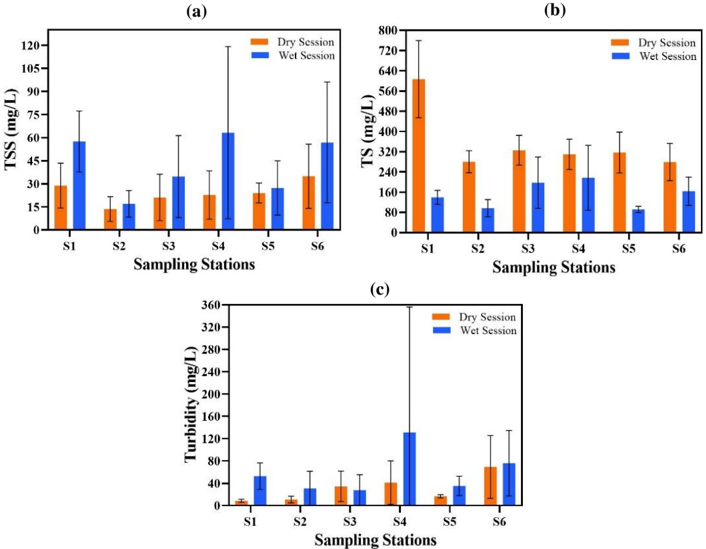
“Similar to TDS, total suspended solids (TSS) values were observed to be comparatively higher in the wet season than in the dry, and they ranged from 5 to 151 mg/L throughout the year.”
§ Multivariate Analysis of Water Quality in the Dhaleshwari River, Bangladesh: Identifying Pollution Sources and Environmental Implications > 3.1 Distribution of the physical parameters and seasonal fluctuations
plaincorrelational- Asserted: passes — The authors put it forward as true.
- Checkable: passes — It can be checked against evidence.
- Load-bearing: unclear — It is unclear whether the paper’s conclusions depend on it.
- Based: passes — The paper gives a reason why it holds.
It may state two separate claims as one.
- Rests on an assumption: The six sampling stations are representative of the Dhaleshwari River's overall water quality.
- Rests on an assumption: The sampling period from January 2021 to April 2022 and the sampled dry and wet seasons are representative of typical seasonal conditions of the river.
A result the paper reports from its own data — it cites no other source for it, so there is none to check. The quote shows it is in the paper.
In the paper
“Variation between the sampling stations was also high with the lowest average value (2.4±1.3)observed at S1 and highest average value (6.7±1.8)found at S2, both in the dry season.”
§ Multivariate Analysis of Water Quality in the Dhaleshwari River, Bangladesh: Identifying Pollution Sources and Environmental Implications > 3.1 Distribution of the physical parameters and seasonal fluctuations
plain- Asserted: passes — The authors put it forward as true.
- Checkable: passes — It can be checked against evidence.
- Load-bearing: unclear — It is unclear whether the paper’s conclusions depend on it.
- Based: passes — The paper gives a reason why it holds.
It may state two separate claims as one.
- Rests on an assumption: The six sampling stations are representative of the Dhaleshwari River's overall water quality.
- Rests on an assumption: The sampling period from January 2021 to April 2022 and the sampled dry and wet seasons are representative of typical seasonal conditions of the river.
A result the paper reports from its own data — it cites no other source for it, so there is none to check. The quote shows it is in the paper.
In the paper
“The ANOVA results indicated statistically significant differences in TSS values among the sampling stations (p ≤ 0.05).However, no significant seasonal variation was observed (t-test, p > 0.05).”
§ Multivariate Analysis of Water Quality in the Dhaleshwari River, Bangladesh: Identifying Pollution Sources and Environmental Implications > 3.1 Distribution of the physical parameters and seasonal fluctuations
plain- Asserted: passes — The authors put it forward as true.
- Checkable: passes — It can be checked against evidence.
- Load-bearing: unclear — It is unclear whether the paper’s conclusions depend on it.
- Based: passes — The paper gives a reason why it holds.
It may state two separate claims as one.
- Rests on an assumption: The six sampling stations are representative of the Dhaleshwari River's overall water quality.
- Rests on an assumption: The sampling period from January 2021 to April 2022 and the sampled dry and wet seasons are representative of typical seasonal conditions of the river.
A result the paper reports from its own data — it cites no other source for it, so there is none to check. The quote shows it is in the paper.
In the paper
“Seasonal variation in water quality was significant, with the worst quality observed during the dry season; however, water quality during the wet season was also unsatisfactory.”
§ Multivariate Analysis of Water Quality in the Dhaleshwari River, Bangladesh: Identifying Pollution Sources and Environmental Implications > Abstract
plaincorrelational- Asserted: passes — The authors put it forward as true.
- Checkable: passes — It can be checked against evidence.
- Load-bearing: passes — The paper’s conclusions depend on it.
- Based: passes — The paper gives a reason why it holds.
It may state two separate claims as one.
- Rests on an assumption: The sampling period from January 2021 to April 2022 and the sampled dry and wet seasons are representative of typical seasonal conditions of the river.
A result the paper reports from its own data — it cites no other source for it, so there is none to check. The quote shows it is in the paper.
In the paper
“Notably, ANOVA analysis revealed statistically significant differences in TS values among the various sampling stations (p ≤ 0.05), while t-test results indicated significant variations across seasons (p < 0.01).”
§ Multivariate Analysis of Water Quality in the Dhaleshwari River, Bangladesh: Identifying Pollution Sources and Environmental Implications > 3.1 Distribution of the physical parameters and seasonal fluctuations
plain- Asserted: passes — The authors put it forward as true.
- Checkable: passes — It can be checked against evidence.
- Load-bearing: unclear — It is unclear whether the paper’s conclusions depend on it.
- Based: passes — The paper gives a reason why it holds.
It may state two separate claims as one.
- Rests on an assumption: The six sampling stations are representative of the Dhaleshwari River's overall water quality.
- Rests on an assumption: The sampling period from January 2021 to April 2022 and the sampled dry and wet seasons are representative of typical seasonal conditions of the river.
The paper states this without a source or data behind it here, so there is nothing to check it against. The quote shows it is in the paper.
In the paper
“During the dry season, the maximum chloride value (110 mg/L) and the highest mean value (82.2±18) mg/L were observed at S1.”
- Also stated in: § 3.2. Comparison among chemical and biochemical contaminants and seasonality · hedged
“Conversely, the low chloride concentration (5.4±1.8)mg/L recorded at the same station during the wet season may be a result of the high river water flow during the monsoon, leading to the transportation of discharged pollutants downstream.”
§ Multivariate Analysis of Water Quality in the Dhaleshwari River, Bangladesh: Identifying Pollution Sources and Environmental Implications > 3.2. Comparison among chemical and biochemical contaminants and seasonality
plainconditional- Asserted: passes — The authors put it forward as true.
- Checkable: passes — It can be checked against evidence.
- Load-bearing: passes — The paper’s conclusions depend on it.
- Based: passes — The paper gives a reason why it holds.
It may state two separate claims as one.
- Rests on an assumption: The six sampling stations are representative of the Dhaleshwari River's overall water quality.
- Rests on an assumption: The sampling period from January 2021 to April 2022 and the sampled dry and wet seasons are representative of typical seasonal conditions of the river.
- Also stated in: § 3.2. Comparison among chemical and biochemical contaminants and seasonality · hedged
A result the paper reports from its own data — it cites no other source for it, so there is none to check. The quote shows it is in the paper.
In the paper
“pH values of water collected at various sampling stations and during different seasons of the year were found to range from 6.12 to 8.8 and 6.5 to 8 in the dry and wet seasons, respectively (Table 3).”
§ Multivariate Analysis of Water Quality in the Dhaleshwari River, Bangladesh: Identifying Pollution Sources and Environmental Implications > 3.1 Distribution of the physical parameters and seasonal fluctuations
plain- Asserted: passes — The authors put it forward as true.
- Checkable: passes — It can be checked against evidence.
- Load-bearing: unclear — It is unclear whether the paper’s conclusions depend on it.
- Based: passes — The paper gives a reason why it holds.
It may state two separate claims as one.
- Rests on an assumption: The six sampling stations are representative of the Dhaleshwari River's overall water quality.
- Rests on an assumption: The sampling period from January 2021 to April 2022 and the sampled dry and wet seasons are representative of typical seasonal conditions of the river.
A result the paper reports from its own data — it cites no other source for it, so there is none to check. The quote shows it is in the paper.
In the paper
“Statistically significant differences in DO value were found among sampling stations (ANOVA, p < 0.01).But no statistically significant seasonal variation was found (t-test, p > 0.05).”
§ Multivariate Analysis of Water Quality in the Dhaleshwari River, Bangladesh: Identifying Pollution Sources and Environmental Implications > 3.1 Distribution of the physical parameters and seasonal fluctuations
plain- Asserted: passes — The authors put it forward as true.
- Checkable: passes — It can be checked against evidence.
- Load-bearing: unclear — It is unclear whether the paper’s conclusions depend on it.
- Based: passes — The paper gives a reason why it holds.
It may state two separate claims as one.
- Rests on an assumption: The six sampling stations are representative of the Dhaleshwari River's overall water quality.
- Rests on an assumption: The sampling period from January 2021 to April 2022 and the sampled dry and wet seasons are representative of typical seasonal conditions of the river.
A result the paper reports from its own data — it cites no other source for it, so there is none to check. The quote shows it is in the paper.
In the paper
“The highest average value of TSS (63.2±55.9mg/L) was found at S4 during the wet season, while the lowest average value (21.1±15 mg/L) was recorded at S2 during the dry season (Table 3).”
§ Multivariate Analysis of Water Quality in the Dhaleshwari River, Bangladesh: Identifying Pollution Sources and Environmental Implications > 3.1 Distribution of the physical parameters and seasonal fluctuations
plain- Asserted: passes — The authors put it forward as true.
- Checkable: passes — It can be checked against evidence.
- Load-bearing: unclear — It is unclear whether the paper’s conclusions depend on it.
- Based: passes — The paper gives a reason why it holds.
It may state two separate claims as one.
- Rests on an assumption: The six sampling stations are representative of the Dhaleshwari River's overall water quality.
- Rests on an assumption: The sampling period from January 2021 to April 2022 and the sampled dry and wet seasons are representative of typical seasonal conditions of the river.
A result the paper reports from its own data — it cites no other source for it, so there is none to check. The quote shows it is in the paper.
In the paper
“The majority of the values obtained in both seasons were found to be above the recommended value (≤ 2 mg/L) for drinking purposes and also unsuitable for recreational activities (≤ 3 mg/L).”
§ Multivariate Analysis of Water Quality in the Dhaleshwari River, Bangladesh: Identifying Pollution Sources and Environmental Implications > 3.2. Comparison among chemical and biochemical contaminants and seasonality
plain- Asserted: passes — The authors put it forward as true.
- Checkable: passes — It can be checked against evidence.
- Load-bearing: passes — The paper’s conclusions depend on it.
- Based: passes — The paper gives a reason why it holds.
It may state two separate claims as one.
- Rests on an assumption: The six sampling stations are representative of the Dhaleshwari River's overall water quality.
- Rests on an assumption: The sampling period from January 2021 to April 2022 and the sampled dry and wet seasons are representative of typical seasonal conditions of the river.
A result the paper reports from its own data — it cites no other source for it, so there is none to check. The quote shows it is in the paper.
In the paper
“The highest (15±5.3mg/L) and lowest (3.3±0.8 mg/L) average values were found at S1 during the dry and wet seasons, respectively (Table 3).”
§ Multivariate Analysis of Water Quality in the Dhaleshwari River, Bangladesh: Identifying Pollution Sources and Environmental Implications > 3.2. Comparison among chemical and biochemical contaminants and seasonality
plain- Asserted: passes — The authors put it forward as true.
- Checkable: passes — It can be checked against evidence.
- Load-bearing: unclear — It is unclear whether the paper’s conclusions depend on it.
- Based: passes — The paper gives a reason why it holds.
It may state two separate claims as one.
- Rests on an assumption: The six sampling stations are representative of the Dhaleshwari River's overall water quality.
- Rests on an assumption: The sampling period from January 2021 to April 2022 and the sampled dry and wet seasons are representative of typical seasonal conditions of the river.
A result the paper reports from its own data — it cites no other source for it, so there is none to check. The quote shows it is in the paper.
In the paper
“This parameter exhibits considerable seasonal variability, with the maximum mean value of (607.2±153)mg/L recorded during the dry season at S1 and the minimum average value of (91.9±12.6)mg/L observed during the wet season at S5 (Fig. 3b).”
§ Multivariate Analysis of Water Quality in the Dhaleshwari River, Bangladesh: Identifying Pollution Sources and Environmental Implications > 3.1 Distribution of the physical parameters and seasonal fluctuations
plain- Asserted: passes — The authors put it forward as true.
- Checkable: passes — It can be checked against evidence.
- Load-bearing: unclear — It is unclear whether the paper’s conclusions depend on it.
- Based: passes — The paper gives a reason why it holds.
It may state two separate claims as one.
- Rests on an assumption: The six sampling stations are representative of the Dhaleshwari River's overall water quality.
- Rests on an assumption: The sampling period from January 2021 to April 2022 and the sampled dry and wet seasons are representative of typical seasonal conditions of the river.
A result the paper reports from its own data — it cites no other source for it, so there is none to check. The quote shows it is in the paper.
In the paper
“Notably, a statistically significant difference in EC values was observed among the sampling stations (ANOVA, p ≤ 0.01) and seasons (ttest, p ≤ 0.01).”
§ Multivariate Analysis of Water Quality in the Dhaleshwari River, Bangladesh: Identifying Pollution Sources and Environmental Implications > 3.1 Distribution of the physical parameters and seasonal fluctuations
plain- Asserted: passes — The authors put it forward as true.
- Checkable: passes — It can be checked against evidence.
- Load-bearing: unclear — It is unclear whether the paper’s conclusions depend on it.
- Based: passes — The paper gives a reason why it holds.
It may state two separate claims as one.
- Rests on an assumption: The six sampling stations are representative of the Dhaleshwari River's overall water quality.
- Rests on an assumption: The sampling period from January 2021 to April 2022 and the sampled dry and wet seasons are representative of typical seasonal conditions of the river.
A result the paper reports from its own data — it cites no other source for it, so there is none to check. The quote shows it is in the paper.
In the paper
“However, there was no statistical significance in the turbidity variations observed among the sampling stations (ANOVA, p > 0.05) and seasons (t-test, p > 0.05).”
§ Multivariate Analysis of Water Quality in the Dhaleshwari River, Bangladesh: Identifying Pollution Sources and Environmental Implications > 3.1 Distribution of the physical parameters and seasonal fluctuations
plain- Asserted: passes — The authors put it forward as true.
- Checkable: passes — It can be checked against evidence.
- Load-bearing: unclear — It is unclear whether the paper’s conclusions depend on it.
- Based: passes — The paper gives a reason why it holds.
It may state two separate claims as one.
- Rests on an assumption: The six sampling stations are representative of the Dhaleshwari River's overall water quality.
- Rests on an assumption: The sampling period from January 2021 to April 2022 and the sampled dry and wet seasons are representative of typical seasonal conditions of the river.
A result the paper reports from its own data — it cites no other source for it, so there is none to check. The quote shows it is in the paper.
In the paper
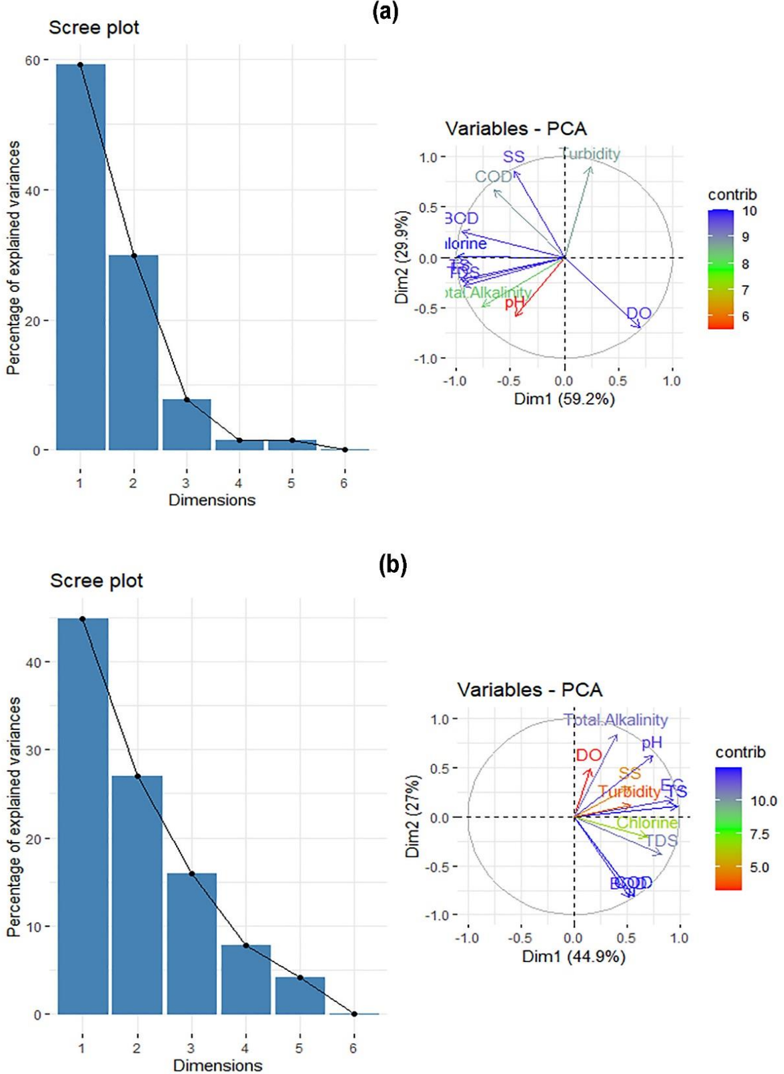
“In PC2, which consists of 29.9% variance (Fig. 6a)”
§ Multivariate Analysis of Water Quality in the Dhaleshwari River, Bangladesh: Identifying Pollution Sources and Environmental Implications > 3.3. Interaction between and among the physical and chemical components
plain- Asserted: passes — The authors put it forward as true.
- Checkable: passes — It can be checked against evidence.
- Load-bearing: unclear — It is unclear whether the paper’s conclusions depend on it.
- Based: passes — The paper gives a reason why it holds.
The quote only partly states this claim.
A result the paper reports from its own data — it cites no other source for it, so there is none to check. The quote shows it is in the paper.
In the paper
“The highest mean alkalinity value (280.4±55.8)mg/L was found at S1 during the dry season, while the lowest value (72±41.1)mg/L was found at S2 during the wet season.”
§ Multivariate Analysis of Water Quality in the Dhaleshwari River, Bangladesh: Identifying Pollution Sources and Environmental Implications > 3.2. Comparison among chemical and biochemical contaminants and seasonality
plain- Asserted: passes — The authors put it forward as true.
- Checkable: passes — It can be checked against evidence.
- Load-bearing: unclear — It is unclear whether the paper’s conclusions depend on it.
- Based: passes — The paper gives a reason why it holds.
It may state two separate claims as one.
- Rests on an assumption: The six sampling stations are representative of the Dhaleshwari River's overall water quality.
- Rests on an assumption: The sampling period from January 2021 to April 2022 and the sampled dry and wet seasons are representative of typical seasonal conditions of the river.
A result the paper reports from its own data — it cites no other source for it, so there is none to check. The quote shows it is in the paper.
In the paper
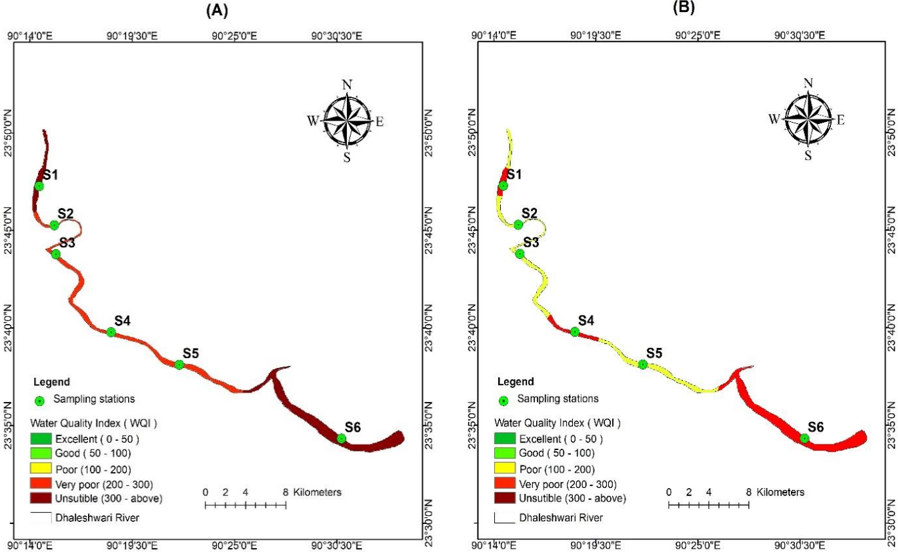
“Among all samples tested during the dry season, 26.19%, 66.67%, and 7.14% represent unsuitable, very poor, and poor status, respectively.”
§ Multivariate Analysis of Water Quality in the Dhaleshwari River, Bangladesh: Identifying Pollution Sources and Environmental Implications > Spatial distribution of water quality according to the WQI: A) Dry season, B) Wet season
plain- Asserted: passes — The authors put it forward as true.
- Checkable: passes — It can be checked against evidence.
- Load-bearing: passes — The paper’s conclusions depend on it.
- Based: passes — The paper gives a reason why it holds.
It may state two separate claims as one.
A result the paper reports from its own data — it cites no other source for it, so there is none to check. The quote shows it is in the paper.
In the paper
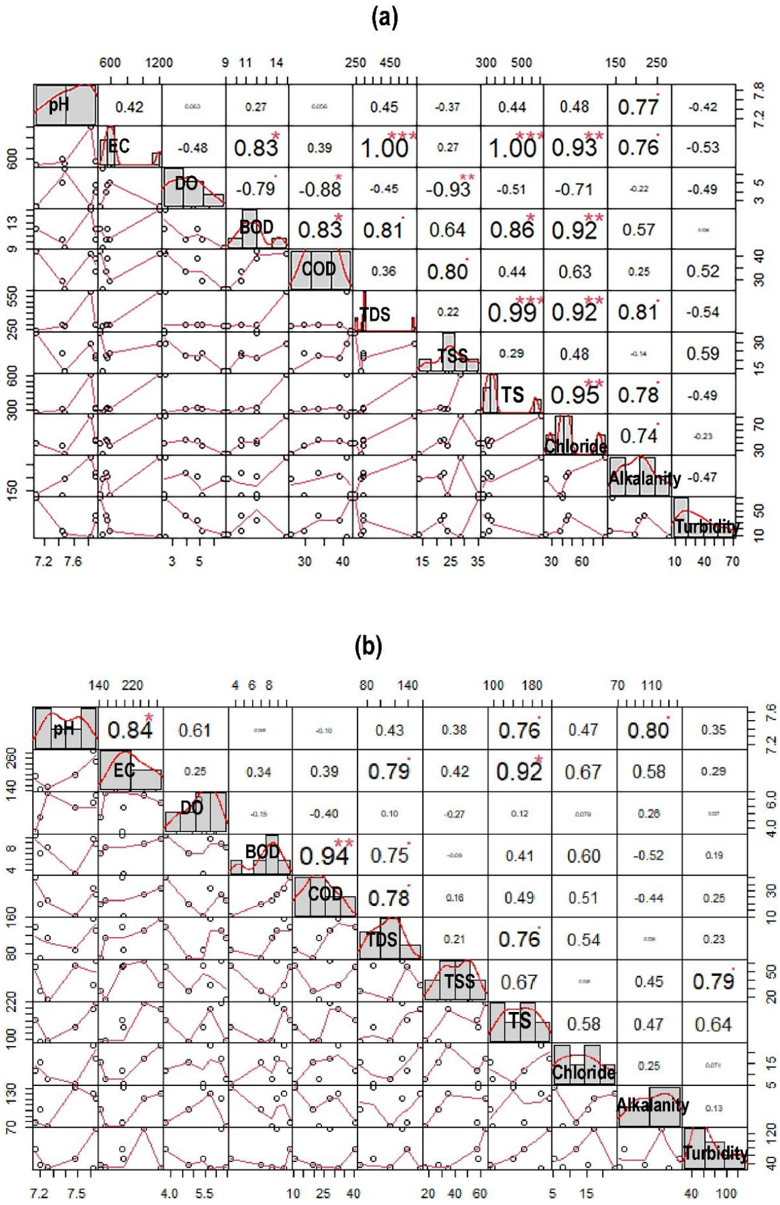
“In the wet season, significant positive correlations have been found between BOD5-COD (r = 0.94, p 0.01), pH-EC (r = 0.84), and EC-TS (r = 0.92), p < 0.05.”
§ Multivariate Analysis of Water Quality in the Dhaleshwari River, Bangladesh: Identifying Pollution Sources and Environmental Implications > 3.3. Interaction between and among the physical and chemical components
plaincorrelational- Asserted: passes — The authors put it forward as true.
- Checkable: passes — It can be checked against evidence.
- Load-bearing: passes — The paper’s conclusions depend on it.
- Based: passes — The paper gives a reason why it holds.
It may state two separate claims as one.
- Rests on an assumption: The six sampling stations are representative of the Dhaleshwari River's overall water quality.
- Rests on an assumption: The sampling period from January 2021 to April 2022 and the sampled dry and wet seasons are representative of typical seasonal conditions of the river.
A result the paper reports from its own data — it cites no other source for it, so there is none to check. The quote shows it is in the paper.
In the paper
“The highest average WQI was recorded at S6 during the dry season, while the lowest value was found at S2 during the wet season (as shown in Table 3).”
§ Multivariate Analysis of Water Quality in the Dhaleshwari River, Bangladesh: Identifying Pollution Sources and Environmental Implications > Spatial distribution of water quality according to the WQI: A) Dry season, B) Wet season
plain- Asserted: passes — The authors put it forward as true.
- Checkable: passes — It can be checked against evidence.
- Load-bearing: unclear — It is unclear whether the paper’s conclusions depend on it.
- Based: passes — The paper gives a reason why it holds.
It may state two separate claims as one.
The paper states this without a source or data behind it here, so there is nothing to check it against. The quote shows it is in the paper.
In the paper
“During the dry season, the total alkalinity value was found to be greater than the set value (150 mg/l) in the ECR, 1997.On the other hand, most of the values were found to be within the set value during the wet months (Fig. 4d).”
§ Multivariate Analysis of Water Quality in the Dhaleshwari River, Bangladesh: Identifying Pollution Sources and Environmental Implications > 3.2. Comparison among chemical and biochemical contaminants and seasonality
plain- Asserted: passes — The authors put it forward as true.
- Checkable: passes — It can be checked against evidence.
- Load-bearing: unclear — It is unclear whether the paper’s conclusions depend on it.
- Based: passes — The paper gives a reason why it holds.
It may state two separate claims as one.
- Rests on an assumption: The six sampling stations are representative of the Dhaleshwari River's overall water quality.
- Rests on an assumption: The sampling period from January 2021 to April 2022 and the sampled dry and wet seasons are representative of typical seasonal conditions of the river.
A result the paper reports from its own data — it cites no other source for it, so there is none to check. The quote shows it is in the paper.
In the paper
“Specifically, during the dry season, stations S1 and S6 exhibit water quality that is unsuitable for use without proper treatment, while the remaining stations exhibit very poor water quality.”
§ Multivariate Analysis of Water Quality in the Dhaleshwari River, Bangladesh: Identifying Pollution Sources and Environmental Implications > Spatial distribution of water quality according to the WQI: A) Dry season, B) Wet season
plain- Asserted: passes — The authors put it forward as true.
- Checkable: passes — It can be checked against evidence.
- Load-bearing: passes — The paper’s conclusions depend on it.
- Based: passes — The paper gives a reason why it holds.
It may state two separate claims as one.
A result the paper reports from its own data — it cites no other source for it, so there is none to check. The quote shows it is in the paper.
In the paper
“Whereas in the wet season the correlation among pH, EC, BOD5, COD, and TS is strongly positive and no significant negative correlation is found among the parameters (Fig. 5b).”
§ Multivariate Analysis of Water Quality in the Dhaleshwari River, Bangladesh: Identifying Pollution Sources and Environmental Implications > 3.3. Interaction between and among the physical and chemical components
boostedcorrelational- Asserted: passes — The authors put it forward as true.
- Checkable: passes — It can be checked against evidence.
- Load-bearing: unclear — It is unclear whether the paper’s conclusions depend on it.
- Based: passes — The paper gives a reason why it holds.
It may state two separate claims as one.
- Rests on an assumption: The six sampling stations are representative of the Dhaleshwari River's overall water quality.
- Rests on an assumption: The sampling period from January 2021 to April 2022 and the sampled dry and wet seasons are representative of typical seasonal conditions of the river.
A result the paper reports from its own data — it cites no other source for it, so there is none to check. The quote shows it is in the paper.
In the paper
“and EC-BOD5 (r = 0.83), BOD5-COD (r = 0.86), and BOD5-TS (r = 0.86 at p < 0.01.”
§ Multivariate Analysis of Water Quality in the Dhaleshwari River, Bangladesh: Identifying Pollution Sources and Environmental Implications > 3.3. Interaction between and among the physical and chemical components
plaincorrelational- Asserted: passes — The authors put it forward as true.
- Checkable: passes — It can be checked against evidence.
- Load-bearing: unclear — It is unclear whether the paper’s conclusions depend on it.
- Based: passes — The paper gives a reason why it holds.
It may state two separate claims as one.
- Rests on an assumption: The six sampling stations are representative of the Dhaleshwari River's overall water quality.
- Rests on an assumption: The sampling period from January 2021 to April 2022 and the sampled dry and wet seasons are representative of typical seasonal conditions of the river.
A result the paper reports from its own data — it cites no other source for it, so there is none to check. The quote shows it is in the paper.
In the paper
“On the other hand, a strong negative correlation has been found between DO-TSS (r = -0.93),DO-COD (r = -0.83)at p < 0.01 and DO-BOD5 (r = -79) at p < 0.05.”
§ Multivariate Analysis of Water Quality in the Dhaleshwari River, Bangladesh: Identifying Pollution Sources and Environmental Implications > 3.3. Interaction between and among the physical and chemical components
boostedcorrelational- Asserted: passes — The authors put it forward as true.
- Checkable: passes — It can be checked against evidence.
- Load-bearing: passes — The paper’s conclusions depend on it.
- Based: passes — The paper gives a reason why it holds.
It may state two separate claims as one.
- Rests on an assumption: The six sampling stations are representative of the Dhaleshwari River's overall water quality.
- Rests on an assumption: The sampling period from January 2021 to April 2022 and the sampled dry and wet seasons are representative of typical seasonal conditions of the river.
A result the paper reports from its own data — it cites no other source for it, so there is none to check. The quote shows it is in the paper.
In the paper
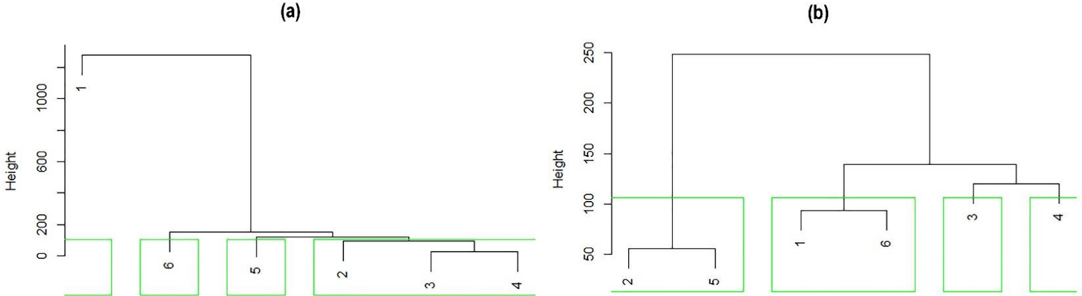
“Conversely, during the wet season, stations 1 and 6 and stations 2 and 5 formed two distinct clusters, while stations 3 and 4 remained as separate clusters.”
§ Multivariate Analysis of Water Quality in the Dhaleshwari River, Bangladesh: Identifying Pollution Sources and Environmental Implications > 3.4. Spatial-temporal groupings and WQI
plainn = 6- Asserted: passes — The authors put it forward as true.
- Checkable: passes — It can be checked against evidence.
- Load-bearing: passes — The paper’s conclusions depend on it.
- Based: passes — The paper gives a reason why it holds.
It may state two separate claims as one.
A result the paper reports from its own data — it cites no other source for it, so there is none to check. The quote shows it is in the paper.
In the paper
“During the dry season, stations 2, 3, and 4 were amalgamated into one cluster, while stations 1, 5, and 6 remained as individual clusters.”
§ Multivariate Analysis of Water Quality in the Dhaleshwari River, Bangladesh: Identifying Pollution Sources and Environmental Implications > 3.4. Spatial-temporal groupings and WQI
plainn = 6- Asserted: passes — The authors put it forward as true.
- Checkable: passes — It can be checked against evidence.
- Load-bearing: passes — The paper’s conclusions depend on it.
- Based: passes — The paper gives a reason why it holds.
It may state two separate claims as one.
A result the paper reports from its own data — it cites no other source for it, so there is none to check. The quote shows it is in the paper.
In the paper
“moderate positive loading with COD (0.36), TSS (0.47), and turbidity (0.493) and negative loading with pH (-0.32) and DO (-0.38)”
§ Multivariate Analysis of Water Quality in the Dhaleshwari River, Bangladesh: Identifying Pollution Sources and Environmental Implications > 3.3. Interaction between and among the physical and chemical components
plaincorrelational- Asserted: passes — The authors put it forward as true.
- Checkable: passes — It can be checked against evidence.
- Load-bearing: passes — The paper’s conclusions depend on it.
- Based: passes — The paper gives a reason why it holds.
It may state two separate claims as one. The quote only partly states this claim.
The paper states this without a source or data behind it here, so there is nothing to check it against. The quote shows it is in the paper.
In the paper
“A substantial variability in water quality observed among the six sampling stations, with the dry season registering the most unfavorable conditions.”
§ Multivariate Analysis of Water Quality in the Dhaleshwari River, Bangladesh: Identifying Pollution Sources and Environmental Implications > 4. Conclusion
plaincorrelational- Asserted: passes — The authors put it forward as true.
- Checkable: passes — It can be checked against evidence.
- Load-bearing: passes — The paper’s conclusions depend on it.
- Based: passes — The paper gives a reason why it holds.
It may state two separate claims as one.
The paper states this without a source or data behind it here, so there is nothing to check it against. The quote shows it is in the paper.
In the paper
“However, a stark contrast is evident between Fig. 8a and Fig. 8b during the wet season.”
§ Multivariate Analysis of Water Quality in the Dhaleshwari River, Bangladesh: Identifying Pollution Sources and Environmental Implications > 3.4. Spatial-temporal groupings and WQI
plainconditional- Asserted: passes — The authors put it forward as true.
- Checkable: passes — It can be checked against evidence.
- Load-bearing: passes — The paper’s conclusions depend on it.
- Based: passes — The paper gives a reason why it holds.
Probably not a substantial claim.
A result the paper reports from its own data — it cites no other source for it, so there is none to check. The quote shows it is in the paper.
In the paper
“During the wet seasons, 16.67%, 38.10%, and 45.24% of total samples represented these statuses (as shown in Fig. 9).”
§ Multivariate Analysis of Water Quality in the Dhaleshwari River, Bangladesh: Identifying Pollution Sources and Environmental Implications > Spatial distribution of water quality according to the WQI: A) Dry season, B) Wet season
plain- Asserted: passes — The authors put it forward as true.
- Checkable: passes — It can be checked against evidence.
- Load-bearing: unclear — It is unclear whether the paper’s conclusions depend on it.
- Based: passes — The paper gives a reason why it holds.
It may state two separate claims as one.
A result the paper reports from its own data — it cites no other source for it, so there is none to check. The quote shows it is in the paper.
In the paper
“In the dry season, very strong correlations have been found among EC-TDS (r = 1), EC-TS (r = 1), TDS-TS (r = 0.99), EC-Chloride (r = 0.93), BOD5-Chloride (r = 0.92), TDS-Chloride (r = 0.92), and TS-Chloride (r = 0.95) at p < 0.001”
§ Multivariate Analysis of Water Quality in the Dhaleshwari River, Bangladesh: Identifying Pollution Sources and Environmental Implications > 3.3. Interaction between and among the physical and chemical components
boostedcorrelational- Asserted: passes — The authors put it forward as true.
- Checkable: passes — It can be checked against evidence.
- Load-bearing: passes — The paper’s conclusions depend on it.
- Based: passes — The paper gives a reason why it holds.
It may state two separate claims as one.
- Rests on an assumption: The six sampling stations are representative of the Dhaleshwari River's overall water quality.
- Rests on an assumption: The sampling period from January 2021 to April 2022 and the sampled dry and wet seasons are representative of typical seasonal conditions of the river.
A result the paper reports from its own data — it cites no other source for it, so there is none to check. The quote shows it is in the paper.
In the paper
“Moreover, a positive correlation was detected between pH-TS, pH-Total Alkalinity, EC-TDS, TDS-COD, TDS-TS, and SS-Turbidity at a statistical significance level of p <0.1.”
§ Multivariate Analysis of Water Quality in the Dhaleshwari River, Bangladesh: Identifying Pollution Sources and Environmental Implications > 3.3. Interaction between and among the physical and chemical components
plaincorrelational- Asserted: passes — The authors put it forward as true.
- Checkable: passes — It can be checked against evidence.
- Load-bearing: unclear — It is unclear whether the paper’s conclusions depend on it.
- Based: passes — The paper gives a reason why it holds.
It may state two separate claims as one.
- Rests on an assumption: The six sampling stations are representative of the Dhaleshwari River's overall water quality.
- Rests on an assumption: The sampling period from January 2021 to April 2022 and the sampled dry and wet seasons are representative of typical seasonal conditions of the river.
A result the paper reports from its own data — it cites no other source for it, so there is none to check. The quote shows it is in the paper.
In the paper
“There were no statistically significant differences in the total alkalinity values among the sampling stations (as determined by ANOVA, p > 0.05).However, there was a strong seasonal variation in the values (as determined by the t-test, p < 0.01).”
§ Multivariate Analysis of Water Quality in the Dhaleshwari River, Bangladesh: Identifying Pollution Sources and Environmental Implications > 3.2. Comparison among chemical and biochemical contaminants and seasonality
plain- Asserted: passes — The authors put it forward as true.
- Checkable: passes — It can be checked against evidence.
- Load-bearing: unclear — It is unclear whether the paper’s conclusions depend on it.
- Based: passes — The paper gives a reason why it holds.
It may state two separate claims as one.
- Rests on an assumption: The six sampling stations are representative of the Dhaleshwari River's overall water quality.
- Rests on an assumption: The sampling period from January 2021 to April 2022 and the sampled dry and wet seasons are representative of typical seasonal conditions of the river.
None of the sources cited for this claim have been checked yet.
In the paper
“However, a significant portion of this literature dates back considerably, rendering it inadequate in capturing the current state of the river.”
§ Multivariate Analysis of Water Quality in the Dhaleshwari River, Bangladesh: Identifying Pollution Sources and Environmental Implications > 1. Introduction
What the sources say
plain- Asserted: passes — The authors put it forward as true.
- Checkable: passes — It can be checked against evidence.
- Load-bearing: passes — The paper’s conclusions depend on it.
- Based: passes — The paper gives a reason why it holds.
It may state two separate claims as one.
A conclusion the paper draws from its own results — it cites no other source for it, so there is none to check. The quote shows it is in the paper.
In the paper
“The organic deposition is enhanced by the direct and indirect effluents; perhaps the domestic effluent sources could have an impact on increasing the BOD level in the river more than ever before.”
§ Multivariate Analysis of Water Quality in the Dhaleshwari River, Bangladesh: Identifying Pollution Sources and Environmental Implications > 3.2. Comparison among chemical and biochemical contaminants and seasonality
hedgedconditional- Asserted: passes — The authors put it forward as true.
- Checkable: passes — It can be checked against evidence.
- Load-bearing: passes — The paper’s conclusions depend on it.
- Based: passes — The paper gives a reason why it holds.
Probably not a substantial claim. It may state two separate claims as one.
A conclusion the paper draws from its own results — it cites no other source for it, so there is none to check. The quote shows it is in the paper.
In the paper
“Additionally, the increased flow rate fosters greater water mixing, reducing stagnation and, in turn, diminishing the likelihood of chemical reactions among various pollutants.”
§ Multivariate Analysis of Water Quality in the Dhaleshwari River, Bangladesh: Identifying Pollution Sources and Environmental Implications > 3.3. Interaction between and among the physical and chemical components
plaindirect- Asserted: passes — The authors put it forward as true.
- Checkable: passes — It can be checked against evidence.
- Load-bearing: passes — The paper’s conclusions depend on it.
- Based: passes — The paper gives a reason why it holds.
It may state two separate claims as one.
- Rests on an assumption: The sampling period from January 2021 to April 2022 and the sampled dry and wet seasons are representative of typical seasonal conditions of the river.
In the paper
“In a compelling research article by [59], a striking pattern emerges as they delve into the dynamics of organic contaminants and suspended solid particles within a waterbody.Their findings reveal a robust and significant correlation during the dry season, underscoring the pronounced influence of environmental factors during this period.However, as the rains descend and the wet season unfolds, this”
§ Multivariate Analysis of Water Quality in the Dhaleshwari River, Bangladesh: Identifying Pollution Sources and Environmental Implications > 3.3. Interaction between and among the physical and chemical components
What the sources say
- Not checked — no full text of the sourcecites [59] source
boostedcorrelational- Asserted: passes — The authors put it forward as true.
- Checkable: passes — It can be checked against evidence.
- Load-bearing: fails — The paper’s conclusions may not depend on it.
- Based: passes — The paper gives a reason why it holds.
Probably not a substantial claim. The paper’s conclusions may not depend on it. It may state two separate claims as one.
None of the sources cited for this claim could be matched to a paper in Crossref, so there is nothing to check it against.
In the paper
“These discharges carry high concentrations of dyes, fibers, organic matter, oil, grease, and toxic compounds, manifesting as elevated BOD, COD, alkalinity, TDS, and a subsequent decline in DO levels within river waters [65,66].”
§ Multivariate Analysis of Water Quality in the Dhaleshwari River, Bangladesh: Identifying Pollution Sources and Environmental Implications > 3.4. Spatial-temporal groupings and WQI
What the sources say
- Not matchedcites [65]
Couldn’t be matched to a paper in Crossref, so it can’t be checked.
- Not matchedcites [66]
Couldn’t be matched to a paper in Crossref, so it can’t be checked.
plaindirect- Asserted: passes — The authors put it forward as true.
- Checkable: passes — It can be checked against evidence.
- Load-bearing: passes — The paper’s conclusions depend on it.
- Based: passes — The paper gives a reason why it holds.
It may state two separate claims as one.
- Not matched
A conclusion the paper draws from its own results — it cites no other source for it, so there is none to check. The quote shows it is in the paper.
In the paper
“This investigation identifies industrial waste discharge from tannery industries, alongside other multifunctional industries within the BSCIC industrial estate, shipyards, as well as municipal discharge, as the primary sources of pollution affecting the Dhaleshwari river.”
§ Multivariate Analysis of Water Quality in the Dhaleshwari River, Bangladesh: Identifying Pollution Sources and Environmental Implications > 4. Conclusion
plaindirect- Asserted: passes — The authors put it forward as true.
- Checkable: passes — It can be checked against evidence.
- Load-bearing: passes — The paper’s conclusions depend on it.
- Based: passes — The paper gives a reason why it holds.
It may state two separate claims as one.
- Rests on an assumption: PCA loadings can be interpreted as indicating pollution sources.
- Rests on an assumption: Soil erosion and rainwater runoff from farmlands increase turbidity and TSS/SS concentrations in surface waters.
- Rests on an assumption: The Buriganga River is a secondary pollution source for the Dhaleshwari River at the S6 juncture.
- Rests on an assumption: Shipbuilding yards discharge substantial quantities of oil, grease, and heavy metals into the river.
A conclusion the paper draws from its own results — it cites no other source for it, so there is none to check. The quote shows it is in the paper.
In the paper
“This alignment suggests that during the dry season, PC1 may serve as a composite indicator of water quality.Higher PC1 values may signify improved water quality characterized by increased DO levels and reduced concentrations of EC, TDS, TS, and chloride.”
§ Multivariate Analysis of Water Quality in the Dhaleshwari River, Bangladesh: Identifying Pollution Sources and Environmental Implications > 3.3. Interaction between and among the physical and chemical components
hedgedcorrelational- Asserted: passes — The authors put it forward as true.
- Checkable: passes — It can be checked against evidence.
- Load-bearing: passes — The paper’s conclusions depend on it.
- Based: passes — The paper gives a reason why it holds.
It may state two separate claims as one.
A conclusion the paper draws from its own results — it cites no other source for it, so there is none to check. The quote shows it is in the paper.
In the paper
“Station 1 is situated in close proximity to the BSCIC tannery industrial area, where water stagnation occurs due to reduced river flow, causing a significant increase in pollution levels due to the discharge of a large amount of wastewater from the tannery.”
§ Multivariate Analysis of Water Quality in the Dhaleshwari River, Bangladesh: Identifying Pollution Sources and Environmental Implications > 3.4. Spatial-temporal groupings and WQI
plaindirect- Asserted: passes — The authors put it forward as true.
- Checkable: passes — It can be checked against evidence.
- Load-bearing: passes — The paper’s conclusions depend on it.
- Based: passes — The paper gives a reason why it holds.
It may state two separate claims as one.
In the paper
“These results are similar to those reported by [18], who observed an elevated pollution level at the tannery location.”
§ Multivariate Analysis of Water Quality in the Dhaleshwari River, Bangladesh: Identifying Pollution Sources and Environmental Implications > Spatial distribution of water quality according to the WQI: A) Dry season, B) Wet season
What the sources say
- Not checked — no full text of the sourcecites [18] ECR (1997) The Environment Conservation Rules. Department of Environment, Ministry of Environment and Forest, Government of the People's Republic of Bangladesh, pp. 179–227. source
plain- Asserted: passes — The authors put it forward as true.
- Checkable: passes — It can be checked against evidence.
- Load-bearing: fails — The paper’s conclusions may not depend on it.
- Based: passes — The paper gives a reason why it holds.
Probably not a substantial claim. The paper’s conclusions may not depend on it.
A conclusion the paper draws from its own results — it cites no other source for it, so there is none to check. The quote shows it is in the paper.
In the paper
“These effluents notably elevate BOD levels, devouring oxygen resources in water bodies.”
§ Multivariate Analysis of Water Quality in the Dhaleshwari River, Bangladesh: Identifying Pollution Sources and Environmental Implications > 3.4. Spatial-temporal groupings and WQI
plaindirect- Asserted: passes — The authors put it forward as true.
- Checkable: passes — It can be checked against evidence.
- Load-bearing: passes — The paper’s conclusions depend on it.
- Based: passes — The paper gives a reason why it holds.
It may state two separate claims as one.
A conclusion the paper draws from its own results — it cites no other source for it, so there is none to check. The quote shows it is in the paper.
In the paper
“This inverse relationship between DO and suspended particles aligns with established principles of water quality dynamics, where elevated”
§ Multivariate Analysis of Water Quality in the Dhaleshwari River, Bangladesh: Identifying Pollution Sources and Environmental Implications > 3.3. Interaction between and among the physical and chemical components
plaincorrelational- Asserted: passes — The authors put it forward as true.
- Checkable: passes — It can be checked against evidence.
- Load-bearing: fails — The paper’s conclusions may not depend on it.
- Based: passes — The paper gives a reason why it holds.
Probably not a substantial claim. The paper’s conclusions may not depend on it.
The paper states this without a source or data behind it here, so there is nothing to check it against. The quote shows it is in the paper.
In the paper
“Similarly, suspended particles could have similar kinds of contaminants that could potentially reduce the DO during aerobic decomposition.”
§ Multivariate Analysis of Water Quality in the Dhaleshwari River, Bangladesh: Identifying Pollution Sources and Environmental Implications > 3.3. Interaction between and among the physical and chemical components
hedgedconditional- Asserted: passes — The authors put it forward as true.
- Checkable: passes — It can be checked against evidence.
- Load-bearing: fails — The paper’s conclusions may not depend on it.
- Based: fails — The paper may give no reason why it holds.
Probably not a substantial claim. The paper’s conclusions may not depend on it. The paper may give no reason why it holds.
None of the sources cited for this claim could be matched to a paper in Crossref, so there is nothing to check it against.
In the paper
“The situation is compounded by the daily discharge of approximately 6000 tons of untreated liquid waste, encompassing tannery, residential, and municipal wastewater, into the Buriganga, where it subsequently commingles with the Dhaleshwari river [67,68].”
§ Multivariate Analysis of Water Quality in the Dhaleshwari River, Bangladesh: Identifying Pollution Sources and Environmental Implications > 3.4. Spatial-temporal groupings and WQI
What the sources say
- Not matchedcites [67]
Couldn’t be matched to a paper in Crossref, so it can’t be checked.
- Not matchedcites [68]
Couldn’t be matched to a paper in Crossref, so it can’t be checked.
plaindirect- Asserted: passes — The authors put it forward as true.
- Checkable: passes — It can be checked against evidence.
- Load-bearing: unclear — It is unclear whether the paper’s conclusions depend on it.
- Based: passes — The paper gives a reason why it holds.
It may state two separate claims as one.
- Not matched
A conclusion the paper draws from its own results — it cites no other source for it, so there is none to check. The quote shows it is in the paper.
In the paper
“Station 6 is located downstream close to the mouth of the Buriganga River, while Station 1 is located upstream and exhibits the worst water quality after S6, indicating effluent discharge from nearby Tannery Industries.”
§ Multivariate Analysis of Water Quality in the Dhaleshwari River, Bangladesh: Identifying Pollution Sources and Environmental Implications > Spatial distribution of water quality according to the WQI: A) Dry season, B) Wet season
hedgeddirect- Asserted: passes — The authors put it forward as true.
- Checkable: passes — It can be checked against evidence.
- Load-bearing: passes — The paper’s conclusions depend on it.
- Based: passes — The paper gives a reason why it holds.
It may state two separate claims as one.
The paper relies on this without support.
The six sampling stations are representative of the Dhaleshwari River's overall water quality.
“Water samples were collected from six sampling sites within the range of about 50 km of the river consisting of the main industrial settlement, including BSCIC Tannery industrial state, BSCIC Industrial State, Keraniganj as well as the converging point of Buriganga river.”
The paper relies on this without support.
The sampling period from January 2021 to April 2022 and the sampled dry and wet seasons are representative of typical seasonal conditions of the river.
“Water sampling has been carried out both during the wet and dry seasons from January, 2021 to April, 2022 at the six sampling stations (Table 1).”
The paper relies on this without support.
PCA loadings can be interpreted as indicating pollution sources.
“In PC2, which consists of 29.9% variance (Fig. 6a), moderate positive loading with COD (0.36), TSS (0.47), and turbidity (0.493) and negative loading with pH (-0.32) and DO (-0.38) can be associated with inorganic components discharged from domestic and industrial activities as well as several point and nonpoint sources [61].”
The paper relies on this without support.
Soil erosion and rainwater runoff from farmlands increase turbidity and TSS/SS concentrations in surface waters.
“Furthermore, soil erosion and rainwater runoff from these fields contribute to heightened turbidity levels and increased concentrations of TSS and SS in surface waters.”
The paper relies on this without support.
The Buriganga River is a secondary pollution source for the Dhaleshwari River at the S6 juncture.
“The Buriganga, (declared ECA in 2009) is one of Bangladesh's most polluted rivers, serves as a secondary pollution source for the Dhaleshwari river at this juncture.”
The paper relies on this without support.
Shipbuilding yards discharge substantial quantities of oil, grease, and heavy metals into the river.
“Further intensifying the environmental challenge in this region are the numerous shipbuilding yards, both small and large, which discharge substantial quantities of oil, grease, and heavy metals into the river.”
Self-check
Percentages, sums and reported differences re-computed from the paper’s own numbers.
Each contradiction between two passages listed here was confirmed by an independent check.
Rated major: it would touch a result — a value a result rests on, reported and recomputed p-values on opposite sides of the significance level, two passages that conflict with no sign which is right, or a cited work retracted before this paper was published.
In the paper
§ Multivariate Analysis of Water Quality in the Dhaleshwari River, Bangladesh: Identifying Pollution Sources and Environmental Implications > 2.2. Sampling Methods
“Water sampling has been carried out both during the wet and dry seasons from January, 2021 to April, 2022 at the six sampling stations (Table 1).In each station's samples were collected six times in each season.”
§ Multivariate Analysis of Water Quality in the Dhaleshwari River, Bangladesh: Identifying Pollution Sources and Environmental Implications > Spatial distribution of water quality according to the WQI: A) Dry season, B) Wet season
“Among all samples tested during the dry season, 26.19%, 66.67%, and 7.14% represent unsuitable, very poor, and poor status, respectively.During the wet seasons, 16.67%, 38.10%, and 45.24% of total samples represented these statuses (as shown in Fig. 9).”
Rated major: it would touch a result — a value a result rests on, reported and recomputed p-values on opposite sides of the significance level, two passages that conflict with no sign which is right, or a cited work retracted before this paper was published.
In the paper
§ Multivariate Analysis of Water Quality in the Dhaleshwari River, Bangladesh: Identifying Pollution Sources and Environmental Implications > 3.2. Comparison among chemical and biochemical contaminants and seasonality
“The obtained COD values from various sampling stations and seasons exhibit substantial fluctuations, with values ranging from 6-90 mg/L throughout the year (Table 3).”
§ Multivariate Analysis of Water Quality in the Dhaleshwari River, Bangladesh: Identifying Pollution Sources and Environmental Implications > 3.2. Comparison among chemical and biochemical contaminants and seasonality
“All the COD values were higher than the recommended limit of 10 mg/L set by the ECR, 1997 for drinking and recreational purposes.”
Citations
Cites
Standard methods: For the examination of water and waste water
Water Environment Federation., Water Pollution Control Federation., American Water Works Association., & American Public Health Association. (1990) · Analytical Biochemistry · doi:10.1016/0003-2697(90)90598-4 · Cited by 72,107
Global threats to human water security and river biodiversity
Vörösmarty, C. J., McIntyre, P. B., Gessner, M. O., Dudgeon, D., Prusevich, A., Green, P., Glidden, S., Bunn, S. E., Sullivan, C. A., Liermann, C. R., et al. (2010) · Nature · doi:10.1038/nature09440 · Cited by 7,582
Shrestha, S., & Kazama, F. (2006) · Environmental Modelling & Software · doi:10.1016/j.envsoft.2006.02.001 · Cited by 1,842
Singh, K. P., Malik, A., Mohan, D., & Sinha, S. (2004) · Water Research · doi:10.1016/j.watres.2004.06.011 · Cited by 1,685
Vega, M., Pardo, R., Barrado, E., & Debán, L. (1998) · Water Research · doi:10.1016/s0043-1354(98)00138-9 · Cited by 1,011
A water quality index-do we dare?
Brown, R. M., McClelland, N. I., Deininger, R., & Tozer, R. G. (1970) · Cited by 1,008
Singh, K. P., Malik, A., & Sinha, S. (2005) · Analytica Chimica Acta · doi:10.1016/j.aca.2005.02.006 · Cited by 979
Wunderlin, D. A., del Pilar, D. M., Amé, M. V., Pesce, S. F., Hued, A. C., & Ángeles, B. M. D. L. (2001) · Water Research · doi:10.1016/s0043-1354(00)00592-3 · Cited by 955
Water Quality Assessment in Terms of Water Quality Index
Tyagi, S., Sharma, B., Singh, P., & Dobhal, R. (2020) · American Journal of Water Resources · doi:10.12691/ajwr-1-3-3 · Cited by 908
Evaluation of water quality using water quality index (WQI) method and GIS in Aksu River (SW-Turkey)
Şener, Ş., Şener, E., & Davraz, A. (2017) · Science of The Total Environment · doi:10.1016/j.scitotenv.2017.01.102 · Cited by 643
Assessing river water quality using water quality index in Lake Taihu Basin, China
Wu, Z., Wang, X., Chen, Y., Cai, Y., & Deng, J. (2018) · Science of The Total Environment · doi:10.1016/j.scitotenv.2017.08.293 · Cited by 569
Reghunath, R. (2002) · Water Research · doi:10.1016/s0043-1354(01)00490-0 · Cited by 514
Razo‐Soto, I., Carrizales, L., Castro-Larragoitia, J., Díaz‐Barriga, F., & Monroy, M. G. (2004) · Water Air & Soil Pollution · doi:10.1023/b:wate.0000015350.14520.c1 · Cited by 444
Groundwater quality assessment using water quality index (WQI) under GIS framework
Ram, A., Tiwari, S., Pandey, H. K., Chaurasia, A. K., Singh, S., & Singh, Y. V. (2021) · Applied Water Science · doi:10.1007/s13201-021-01376-7 · Cited by 425
Uddin, M. J., & Jeong, Y.-K. (2021) · Heliyon · doi:10.1016/j.heliyon.2021.e06107 · Cited by 254
Meeting China’s Water Shortage Crisis: Current Practices and Challenges
Cheng, H., Hu, Y., & Zhao, J. (2009) · Environmental Science & Technology · doi:10.1021/es801934a · Cited by 244
Rahman, A., Jahanara, I., & Jolly, Y. N. (2021) · Water Science and Engineering · doi:10.1016/j.wse.2021.06.006 · Cited by 168
Kibena, J., Nhapi, I., & Gumindoga, W. (2013) · Physics and Chemistry of the Earth Parts A/B/C · doi:10.1016/j.pce.2013.09.017 · Cited by 163
Analytical Studies on Water Quality Index of River Landzu
Yisa (2010) · American Journal of Applied Sciences · doi:10.3844/ajassp.2010.453.458 · Cited by 152
Lee, J., Cheon, J., Lee, K., Lee, S., & Lee, M. (2001) · Journal of Environmental Quality · doi:10.2134/jeq2001.3051548x · Cited by 149
River water quality assessment using environmentric techniques: case study of Jakara River Basin
Mustapha, A., Aris, A. Z., Juahir, H., Ramli, M. F., & Kura, N. U. (2013) · Environmental Science and Pollution Research · doi:10.1007/s11356-013-1542-z · Cited by 136
Kibria, G., Hossain, M. M., Mallick, D., Lau, T., & Wu, R. S. S. (2016) · Chemosphere · doi:10.1016/j.chemosphere.2016.08.121 · Cited by 131
Identification of Water Quality Differences in Nevada Through Index Application
Miller, W. W., Joung, H. M., Mahannah, C. N., & Garrett, J. (1986) · Journal of Environmental Quality · doi:10.2134/jeq1986.00472425001500030012x · Cited by 125
Islam, M. S., Uddin, M. E., Tareq, S. M., Shammi, M., Kamal, A. K., Sugano, T., Kurasaki, M., Saito, T., Tanaka, S., & Kuramitz, H. (2015) · Environments · doi:10.3390/environments2030280 · Cited by 110
Napacho, Z., & Manyele, S. (2010) · African Journal of Environmental Science and Technology · doi:10.4314/ajest.v4i11.71349 · Cited by 82
Howladar, M. F., Chakma, E., Jahan Koley, N., Islam, S., Numanbakth, M. A. A., Ahmed, Z., Chowdhury, T. R., & Akter, S. (2021) · Groundwater for Sustainable Development · doi:10.1016/j.gsd.2020.100523 · Cited by 71
Rahman, S., & Hossain, F. (2007) · Water Resources Management · doi:10.1007/s11269-007-9167-y · Cited by 64
Hasan, M. M., Ahmed, M. S., Adnan, R., & Shafiquzzaman, M. (2020) · Environmental and Sustainability Indicators · doi:10.1016/j.indic.2020.100068 · Cited by 64
Self-citationMatta, G., Kumar, A., Nayak, A., Kumar, P., Kumar, A., & Tiwari, A. K. (2020) · Arabian Journal of Geosciences · doi:10.1007/s12517-020-05999-z · Cited by 64
Wahiduzzaman, M., Islam, M. M., Sikder, A. H. F., & Parveen, Z. (2021) · Biological Trace Element Research · doi:10.1007/s12011-021-02963-0 · Cited by 64
Water Pollution in a Densely Populated Megapolis, Dhaka
Bashar, T., & Fung, I. W. H. (2020) · Water · doi:10.3390/w12082124 · Cited by 59
Water quality study of the Struma river basin, Bulgaria (1989–1998)
Simeonova, P., Simeonov, V., & Andreev, G. (2003) · Open Chemistry · doi:10.2478/bf02479264 · Cited by 57
Pradhan, U. K., Shirodkar, P. V., & Sahu, B. K. (2009) · Cited by 55
Chen, P., Li, L., & Zhang, H. (2015) · Water · doi:10.3390/w7062591 · Cited by 54
Bharose, S. P. R., & Singh, D. (2017) · International Journal of Current Microbiology and Applied Sciences · doi:10.20546/ijcmas.2017.604.224 · Cited by 47
Nasir, M. F. M., Samsudin, M. S., Mohamad, I., Awaluddin, M. R. A., Mansor, M. A., Juahir, H., & Ramli, N. (2011) · Universiti Putra Malaysia Institutional Repository (Universiti Putra Malaysia) · Cited by 44
Jerome, C., & Pius, A. (2010) · American Journal of Scientific and Industrial Research · doi:10.5251/ajsir.2010.1.3.595.603 · Cited by 44
Islam, M. A. S., Hossain, M. E., & Majed, N. (2021) · Earth · doi:10.3390/earth2040041 · Cited by 42
Howladar, M. F. (2017) · Groundwater for Sustainable Development · doi:10.1016/j.gsd.2017.03.004 · Cited by 33
Ahsan, M. A. (2018) · American Journal of Environmental Protection · doi:10.11648/j.ajep.20180702.12 · Cited by 30
Spatial pattern analysis of manufacturing industries in Keraniganj, Dhaka, Bangladesh
Hassan, M. M., Alenezi, M. S., & Good, R. Z. (2019) · GeoJournal · doi:10.1007/s10708-018-9961-5 · Cited by 30
Water Quality Assessment of an Industrial Zone Polluted Aquatic Body in Dhaka, Bangladesh
Akter, M. (2014) · American Journal of Environmental Protection · doi:10.11648/j.ajep.20140305.14 · Cited by 27
An Assessment of the River Water Quality Parameters: A case of Jamuna River
Uddin, M., Alam, M., Mobin, M., & Miah, M. (2015) · Journal of Environmental Science and Natural Resources · doi:10.3329/jesnr.v7i1.22179 · Cited by 24
Hu, J., Qiao, Y., Zhou, L., & Li, S. (2012) · Environmental Science and Pollution Research · doi:10.1007/s11356-012-0791-6 · Cited by 24
Assessment of Water Quality and Microbial Load of Dhaleshwari River Tangail, Bangladesh
Real, M. K. H., Khanam, N., Mia, M. Y., & Nasreen, M. (2017) · Advances in Microbiology · doi:10.4236/aim.2017.76041 · Cited by 23
Nagaraju, A., Kumar, K. S., Thejaswi, A., & Sharifi, Z. (2014) · American journal of water resources · doi:10.12691/ajwr-2-3-2 · Cited by 21
Physico Chemical Characterization of Tannery Effluent and Its Impact on the Nearby River
Reda, A. H. (2016) · OALib · doi:10.4236/oalib.1102427 · Cited by 17
Rahman, M. A., & Habiba, U. (2023) · HydroResearch · doi:10.1016/j.hydres.2023.05.001 · Cited by 11
Self-citationHeavy metals in water, sediment and three fish species of Dhaleshwari river, Savar
Mohanta, L. C., Niloy, M. N. H., Chowdhury, G. W., Islam, D., & Lipy, E. P. (2019) · Bangladesh Journal of Zoology · doi:10.3329/bjz.v47i2.44337 · Cited by 10
Matli, C. S., & Nivedita, N. (2021) · International Journal of Environment · doi:10.3126/ije.v10i1.38417 · Cited by 10
Md Wahiduzzaman, Hossain, M. F., & Parveen, Z. (2022) · Dhaka University Journal of Biological Sciences · doi:10.3329/dujbs.v31i1.57914 · Cited by 9
Akter, S., Kamrujjaman, K., & Rashed-Ul-Islam, R.-U.-I. (2019) · International Journal of Sciences · doi:10.18483/ijsci.2073 · Cited by 6
Mallick, Z., Hossain, R. B., Ayshi, F. T., Tahsin, A., & Mallick, S. P. (2021) · doi:10.31224/osf.io/6rgtz · Cited by 5
Dossou, P. M., Zevounou, C., Alassane, A., Kaki, C., Boukari, M., & Mama, D. (2021) · Journal of Geoscience and Environment Protection · doi:10.4236/gep.2021.97010 · Cited by 3
Doing government to the people
Abernethy, V. (1997) · Population and Environment · doi:10.1007/bf02208421 · Cited by 1
Research works printed but not linked: 10
- Ahmed, 2009, Heavy metals concentration in water, sediments and their bioaccumulations in some freshwater fishes and mussel in Dhaleshwari River, Bangladesh, Terrestrial and Aquatic Environmental Toxicology, 3, 33
- Alam M. K. (2003) Cleanup of the Buriganga River: Integrating the Environment into Decision Making. PhD thesis. Murdoch University, Australia.
- Al-badaii, 2013, Water quality assessment of the Semenyih River, Journal of Chemistry, 3216, 112
- Das, 2011, Heavy metals in industrial effluents (tannery and textile) and adjacent rivers of Dhaka city, Bangladesh, Terrestrial and Aquatic Environmental Toxicology, 5, 8
- DoE (2016) Final Report Geospatial Technology Based Water Quality Monitoring System for Bangladesh, pp. 305–329.
- Essien-Ibok, 2010, Seasonality in the physical and chemical characteristics of Mbo River, Akwa Ibom State, Nigeria, Nigerian Journal of Agriculture, Food and Environment, 6, 60
- Fed, 1965, An index number system for rating water quality, Journal Water Pollution Control Federation, 37, 300
- Government of the People's Republic of Bangladesh Ministry of Environment and Forest (1997) The Environment Conservation Rules, 1997 (Schedule 9: Standards for Sewage Discharge, pp. 179–227).
- Islam, 2012, Status of water quality in the Dhaleshwari River and its effect on aquatic organism, Journal of Environmental Science and Water Resources, 1, 192
- Mortula, 2002, Study on waste disposal at DEPZ, Bangladesh Environment (BAPA), 2, 807
Cited by
Sorted by citations
Hridoy, M. A. A. M., Neogi, S., Ujjaman, R., & Hasan, M. (2025) · Results in Chemistry · doi:10.1016/j.rechem.2025.102306 · Cited by 48
Self-citationDas, R. K., Marma, M., Mizan, A., Chen, G., & Alam, M. S. (2025) · Toxics · doi:10.3390/toxics13090803 · Cited by 40
Adejuwon, E. O., Ogwueleka, T. C., Ogungbemi, E. O., Prabhu, R., Rendon-Nava, A., & Yates, K. (2025) · Iranian Journal of Science and Technology Transactions of Civil Engineering · doi:10.1007/s40996-024-01712-2 · Cited by 18
Songara, Y., Singhal, A., Garg, R. D., & Rallapalli, S. (2025) · Scientific Reports · doi:10.1038/s41598-025-08620-z · Cited by 10
Ruma, A. F., Jolly, Y. N., Samad, M. A., & Mohiuddin, A. S. M. (2025) · Cleaner Water · doi:10.1016/j.clwat.2025.100167 · Cited by 7
Metadata
- Authors
- Ali, M. S., Begum, S., Rabbi, F. M., Sumaia, Hasan, M. K., Rahman, M. A., Rahman, M. M., & Rahaman, M. H.
- Affiliations
- a Department of Environment, Ministry of Environment, Forest and Climate Change, Government of the People's Republic of Bangladesh, Agargaon, Sher-e-Bangla Nagar, Dhaka 1207, Bangladesh
- Jashore University of Science and Technology (BD)
- Chongqing University (CN)
- Corresponding author
- Rahaman, Md. Hasibur
- ORCID
- Venue
- Water Practice & Technology
- Publisher
- IWA Publishing
- Published
- 2024-10-01
- Volume
- 19
- Issue
- 10
- Pages
- 4128-4147
- ISSN
- 1751-231X (ISSN-L)
- OpenAlex
- W4403213447
- Semantic Scholar
- 5922a2601375afd0a760f06ffc28d7047c31ff52
- Cited by
- 13
- References
- 56
- Citations by year
- 2026: 6 · 2025: 7
- FWCI
- 1.47
- Type
- journal article
- Language
- en
- Open access
- hybrid
- doi.org
- Licence
- Locations
- Water Practice & Technology (publishedVersion, cc-by)
- Research Square (acceptedVersion, cc-by)
- Funders
- Ministry of Environment
- Ministry of Environment, Forest and Climate Change
- Topics
- Physical Sciences › Environmental Science › Water Science and Technology › Water Quality and Pollution Assessment
- Physical Sciences › Environmental Science › Water Science and Technology › Water Quality and Resources Studies
- Physical Sciences › Environmental Science › Ecology › Research studies in Vietnam
- Keywords
- river water quality, pollution source identification, seasonal variation, water quality index, tannery wastewater, industrial wastewater discharge, municipal wastewater, physicochemical parameters, principal component analysis, river health
About these checks
Registry, retraction, Cites and statistics results are computed, not judged, with one exception: a printed reference that no index lists is read once by a model before it counts as a citation error. Claims are extracted by a model and kept only when their quote appears verbatim in the text; each cited source is then checked, with a model’s help, for whether it says what the claim relies on. Those verdicts can be wrong — read the claim’s quote and the cited source before relying on one.
A language model drew the claims from the paper on 2026-11-08, under version 3 of the claim definition (model deepseek-v4.1-flash, prompt extract-v3).
A second model labelled each claim on 2026-11-08 (model jev-1.13-20260917, definition revision gold-guideline-v0.2).
Cited sources are checked with a language model’s help (gpt-6-sol).
Statistics and arithmetic are recomputed, not judged.
Confidence bands are shown only for fields calibrated on our annotated test set. None is calibrated yet, so no band is shown.
What counts as a claim ›How we measure confidence ›How we check this ›
Are you an author, or do you see a problem with this page? Request a review
