

The DOI matches its Crossref record; 277 of the 277 references it cites were found in a registry or an index.
Alzheimer's disease: Targeting the Cholinergic System
Open accessAbstract
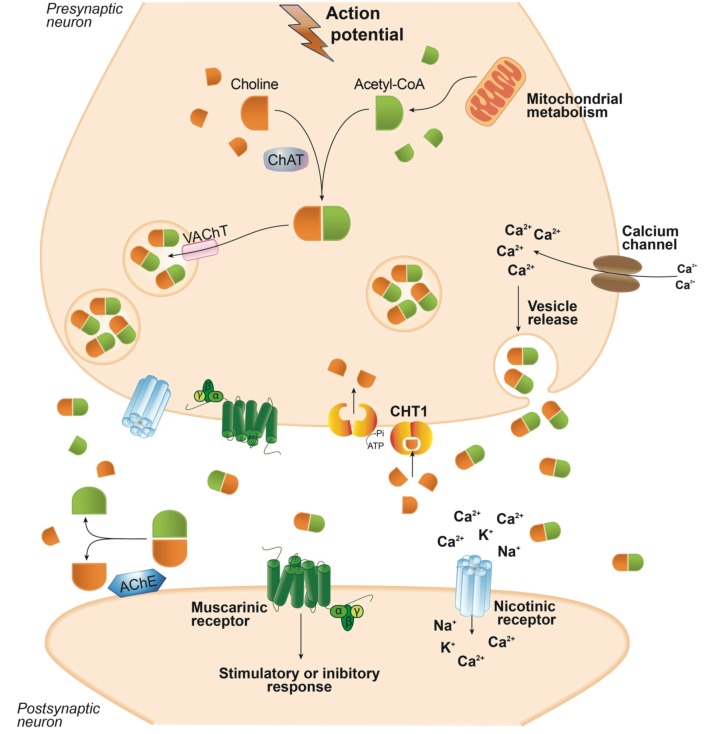
Acetylcholine (ACh) has a crucial role in the peripheral and central nervous systems. The enzyme choline acetyltransferase (ChAT) is responsible for synthesizing ACh from acetyl-CoA and choline in the cytoplasm and the vesicular acetylcholine transporter (VAChT) uptakes the neurotransmitter into synaptic vesicles. Following depolarization, ACh undergoes exocytosis reaching the synaptic cleft, where it can bind its receptors, including muscarinic and nicotinic receptors. ACh present at the synaptic cleft is promptly hydrolyzed by the enzyme acetylcholinesterase (AChE), forming acetate and choline, which is recycled into the presynaptic nerve terminal by the high-affinity choline transporter (CHT1). Cholinergic neurons located in the basal forebrain, including the neurons that form the nucleus basalis of Meynert, are severely lost in Alzheimer's disease (AD). AD is the most ordinary cause of dementia affecting 25 million people worldwide. The hallmarks of the disease are the accumulation of neurofibrillary tangles and amyloid plaques. However, there is no real correlation between levels of cortical plaques and AD-related cognitive impairment. Nevertheless, synaptic loss is the principal correlate of disease progression and loss of cholinergic neurons contributes to memory and attention deficits. Thus, drugs that act on the cholinergic system represent a promising option to treat AD patients.
Overview
The claims and statistics of this paper haven’t been checked yet.
Run the check — free, no account needed. It reads the open-access text and checks the sources it cites.
Integrity signals
Registry
Cites
Statistics
Figures
Verification
Claims the paper makes
The claims and statistics of this paper haven’t been checked yet.
Run the check — free, no account needed. It reads the open-access text and checks the sources it cites.
Claims other papers make about this one
Each is checked against this paper’s own text: does it say what the citing paper says it does?
In the citing paper
“AchE also interacts with Aβ peptide and promotes plaque formation [9].”
From Recent Advancements in Pathogenesis, Diagnostics and Treatment of Alzheimer’s Disease (2020) · cites this paper as [9]
In the citing paper
“Popular neuroprotective strategies for AD management consist of discovering small molecules with the ability to block these Aβ interactions with intracellular and extracellular targets to avoid caspase activation and the expression of proapoptotic proteins, to reduce the stress kinase signaling cascades, to inhibit tau protein phosphorylation, to counterpoise cholinergic functional loss, and to bo”
From The Multifaceted Role of Neuroprotective Plants in Alzheimer’s Disease Treatment (2022) · cites this paper as [38]
In the citing paper
“Neuronal loss has also been related to the dysregulation of the cholinergic system and glutamatergic system (Ferreira-Vieira et al. 2016).”
From Alzheimer’s disease: Targeting the glutamatergic system (2020) · cites this paper as Ferreira-Vieira et al. 2016
Self-check
Percentages, sums and reported differences re-computed from the paper’s own numbers.
The self-check needs the paper’s full text.
Citations
Cites
Amyloid oligomers exacerbate tau pathology in a mouse model of tauopathy
Selenica, M.-L. B., Brownlow, M., Jimenez, J. P., Lee, D. C., Pena, G., Dickey, C. A., Gordon, M. N., & Morgan, D. (2013) · Neurodegenerative Diseases · doi:10.1159/000337230 · Cited by 10,359
Glenner, G. G., & Wong, C. W. (1984) · Biochemical and Biophysical Research Communications · doi:10.1016/s0006-291x(84)80190-4 · Cited by 5,404
Global prevalence of dementia: a Delphi consensus study
Ferri, C. P., Prince, M. J., Brayne, C., Brodaty, H., Fratiglioni, L., Ganguli, M., Hall, K. S., Hasegawa, K., Hendrie, H. C., Huang, Y., et al. (2005) · The Lancet · doi:10.1016/s0140-6736(05)67889-0 · Cited by 5,336
The precursor of Alzheimer's disease amyloid A4 protein resembles a cell-surface receptor
Kang, J., Lemaire, H.-G., Unterbeck, A., Salbaum, J. M., Masters, C. L., Grzeschik, K.-H., Multhaup, G., Beyreuther, K., & Müller-Hill, B. (1987) · Nature · doi:10.1038/325733a0 · Cited by 4,619
Alzheimer's Disease Is a Synaptic Failure
Selkoe, D. J. (2002) · Science · doi:10.1126/science.1074069 · Cited by 4,420
Terry, R. D., Masliah, E., Salmon, D. P., Butters, N., DeTeresa, R., Hill, R., Hansen, L. A., & Katzman, R. (1991) · Annals of Neurology · doi:10.1002/ana.410300410 · Cited by 4,397
Alzheimer's Disease and Senile Dementia: Loss of Neurons in the Basal Forebrain
Whitehouse, P., Price, D., Struble, R., Clark, A., Coyle, J., & DeLong, M. R. (1982) · Science · doi:10.1126/science.7058341 · Cited by 3,627
Immunization with amyloid-β attenuates Alzheimer-disease-like pathology in the PDAPP mouse
Schenk, D., Barbour, R., Dunn, W., Gordon, G., Grajeda, H., Guido, T., Hu, K., Huang, J., Johnson-Wood, K., Khan, K., et al. (1999) · Nature · doi:10.1038/22124 · Cited by 3,160
Central cholinergic pathways in the rat: An overview based on an alternative nomenclature (Ch1–Ch6)
Mesulam, M. M., Mufson, E. J., Wainer, B. H., & Levey, A. I. (1983) · Neuroscience · doi:10.1016/0306-4522(83)90108-2 · Cited by 2,329
Mesulam, M. ‐., Mufson, E. J., Levey, A. I., & Wainer, B. H. (1983) · Journal of Comparative Neurology · doi:10.1002/cne.902140206 · Cited by 1,962
Research works printed but not linked: 1
- [1]Loewi O. Über humerole übertragbarkeit der herznervenwirkung. I Mitteilung Pflugers Arch., 1921, 189, 239-242. 10. 1007/BF01738910 1921
Cited by
Sorted by citations
Comprehensive Review on Alzheimer’s Disease: Causes and Treatment
Breijyeh, Z., & Karaman, R. (2020) · Molecules · doi:10.3390/molecules25245789 · Cited by 2,789
Zhang, J., Zhang, Y., Wang, J., Xia, Y., Zhang, J., & Chen, L. (2024) · Signal Transduction and Targeted Therapy · doi:10.1038/s41392-024-01911-3 · Cited by 1,138
Basso, J. C., & Suzuki, W. A. (2016) · Brain Plasticity · doi:10.3233/bpl-160040 · Cited by 911
Chen, Y., Xu, J., & Chen, Y. (2021) · Nutrients · doi:10.3390/nu13062099 · Cited by 917
Recent Advancements in Pathogenesis, Diagnostics and Treatment of Alzheimer’s Disease
Khan, S., Barve, K. H., & Kumar, M. S. (2020) · Current Neuropharmacology · doi:10.2174/1570159x18666200528142429 · Cited by 820
“AchE also interacts with Aβ peptide and promotes plaque formation [9].”
Background
Metadata
- Authors
- H. Ferreira-Vieira, T., M. Guimaraes, I., R. Silva, F., & M. Ribeiro, F.
- Venue
- Current Neuropharmacology
- Publisher
- Bentham Science Publishers Ltd.
- Published
- 2016-01-22
- Volume
- 14
- Issue
- 1
- Pages
- 101-115
- ISSN
- 1570-159X (ISSN-L)
- PMC
- PMC4787279
- OpenAlex
- W2261085470
- Cited by
- 1,551
- References
- 277
- Citations by year
- 2026: 120 · 2025: 191 · 2024: 207 · 2023: 224 · 2022: 224 · 2021: 214 · 2020: 173 · 2019: 108 · 2018: 44 · 2017: 35 · 2016: 8
- FWCI
- 52.31
- Type
- journal article
- Language
- en
- Open access
- green
- www.ncbi.nlm.nih.gov
- Licence
- cc-by-nc
- Locations
- Current Neuropharmacology (publishedVersion)
- PubMed Central (publishedVersion, cc-by-nc)
- PubMed (publishedVersion)
- Topics
- Health Sciences › Medicine › Pharmacology (medical) › Cholinesterase and Neurodegenerative Diseases
- Life Sciences › Neuroscience › Cellular and Molecular Neuroscience › Alzheimer's disease research and treatments
- Life Sciences › Neuroscience › Cellular and Molecular Neuroscience › Neuroscience and Neuropharmacology Research
- Keywords
- Alzheimer's disease, cholinergic system, acetylcholine, choline acetyltransferase, vesicular acetylcholine transporter, acetylcholinesterase, choline transporter 1, muscarinic receptors, nicotinic acetylcholine receptors, cholinergic neurons, nucleus basalis of Meynert, synaptic loss, acetylcholinesterase inhibitors, cholinergic drugs
- MeSH terms
- Acetylcholine, Alzheimer Disease, Animals, Cholinesterase Inhibitors, Humans, Receptors, Cholinergic, Drug Delivery Systems, Cholinergic Agents, Cholinergic Neurons
About these checks
Registry, retraction, Cites and statistics results are computed, not judged, with one exception: a printed reference that no index lists is read once by a model before it counts as a citation error. Claims are extracted by a model and kept only when their quote appears verbatim in the text; each cited source is then checked, with a model’s help, for whether it says what the claim relies on. Those verdicts can be wrong — read the claim’s quote and the cited source before relying on one.
Statistics and arithmetic are recomputed, not judged.
Confidence bands are shown only for fields calibrated on our annotated test set. None is calibrated yet, so no band is shown.
What counts as a claim ›How we measure confidence ›How we check this ›
Are you an author, or do you see a problem with this page? Request a review
