

The DOI matches its Crossref record; 33 of the 34 references it cites were found in a registry or an index, and 1 are not checked yet.
An Epidemiological Study on the Prevalence of Atrial Fibrillation in the Chinese Population of Mainland China
Open accessAbstract
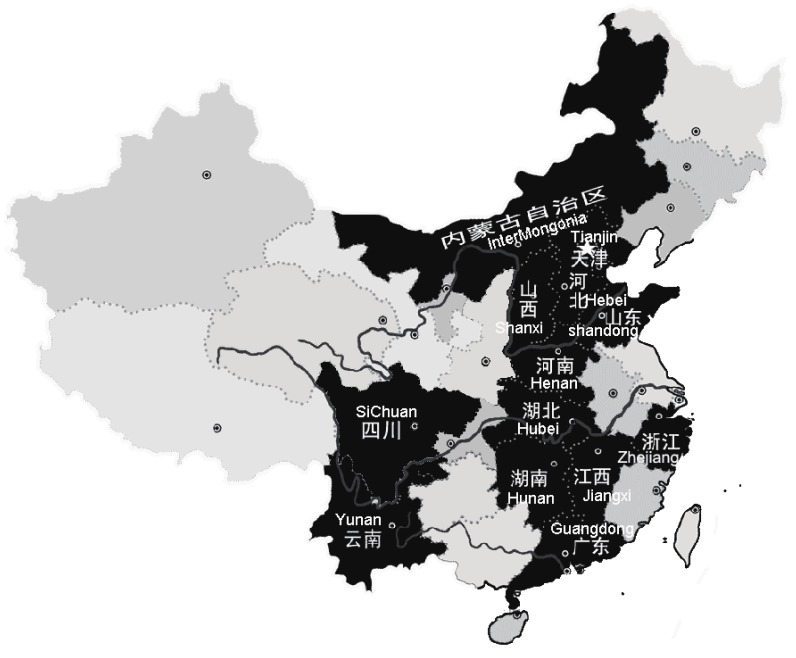
BACKGROUND: Atrial fibrillation (AF) is the most common arrhythmia encountered in clinical practice. Since only limited data on the Chinese population, which is the largest in the world, is available, we conducted an epidemiological study on the prevalence and risk factors of AF in mainland China. METHODS: This population-based study conducted by cluster sampling comprised 29079 participants forming 14 cohorts from 13 provinces across China, where the population was nearly 1 billion. Every participant underwent electrocardiogram and physical examinations and responded to the interviewer-led questionnaire(s). Univariate and multiple statistical analyses were conducted to explore the relationship between AF prevalence and risk factors. RESULTS: The age-standardized prevalence of AF in China (>or=30 y) was 0.65%, and it increased with age. Men showed a higher prevalence of AF than women (0.91% [age-standardized, 0.66%] vs. 0.65% [0.63%], P = 0.013); several significant risk factors (age, hyperthyroidism, coronary heart disease, and rheumatic heart disease) were identified for AF in the general population. Stroke prevalence was much higher in AF patients than in non-AF people (12.95% vs. 2.28%, P < 0.001). AF was confirmed to be a significant independent risk factor for stroke prevalence in the studied population (OR = 2.776, [1.814, 4.248], P < 0.001). We found that AF patients received poor treatment (2.7%, warfarin; 39.7%, aspirin). DISCUSSION: This study conducted on a large sample size demonstrates that AF prevalence in mainland China is slightly lower than that in Western countries and similar to that in Asian areas, and confirms that AF is a serious public health problem in China. We identified several potential risk factors, but their associations with AF still need to be further studied.
Overview
The claims and statistics of this paper haven’t been checked yet.
Run the check — free, no account needed. It reads the open-access text and checks the sources it cites.
Integrity signals
Registry
Cites
Statistics
Figures
Verification
Claims the paper makes
The claims and statistics of this paper haven’t been checked yet.
Run the check — free, no account needed. It reads the open-access text and checks the sources it cites.
Claims other papers make about this one
Each is checked against this paper’s own text: does it say what the citing paper says it does?
In the citing paper
“The overall prevalence of AF varies by ancestry; prevalence studies of Asian populations have been less consistent than those of North American and European poulations.”
From Atrial fibrillation in women: epidemiology, pathophysiology, presentation, and prognosis (2016) · cites this paper as [22]
In the citing paper
“whereas data from Singapore indicated that prevalence was lower in women (0.6% versus 2.6%).22”
From Atrial fibrillation in women: epidemiology, pathophysiology, presentation, and prognosis (2016) · cites this paper as [22]
Self-check
Percentages, sums and reported differences re-computed from the paper’s own numbers.
The self-check needs the paper’s full text.
Citations
Cites
Atrial fibrillation as an independent risk factor for stroke: the Framingham study
Wolf, P. A., Abbott, R. D., & Kannel, W. B. (1991) · Stroke · doi:10.1161/01.str.22.8.983 · Cited by 7,388
Go, A. S., Hylek, E. M., Phillips, K. A., Chang, Y., Henault, L. E., Selby, J. V., & Singer, D. E. (2001) · JAMA · doi:10.1001/jama.285.18.2370 · Cited by 6,205
Benjamin, E. J. (1994) · JAMA · doi:10.1001/jama.1994.03510350050036 · Cited by 2,613
Feinberg, W. M. (1995) · Archives of Internal Medicine · doi:10.1001/archinte.155.5.469 · Cited by 2,282
Kannel, W. B., Wolf, P. A., Benjamin, E. J., & Levy, D. (1998) · The American Journal of Cardiology · doi:10.1016/s0002-9149(98)00583-9 · Cited by 2,033
ACC/AHA/ESC guidelines for the management of patients with atrial fibrillation: executive summary
Fuster, V., Rydén, L., ASINGER, R. W., Cannom, D. S., Crijns, H. J. G. M., Frye, R. L., Halperin, J. L., Kay, G. N., Klein, W. W., Lévy, S., et al. (2001) · Journal of the American College of Cardiology · doi:10.1016/s0735-1097(01)01587-x · Cited by 1,362
Prevalence of atrial fibrillation in elderly subjects (the Cardiovascular Health Study)
Furberg, C. D., Psaty, B. M., Manolio, T. A., Gardin, J. M., Smith, V. E., & Rautaharju, P. M. (1994) · The American Journal of Cardiology · doi:10.1016/0002-9149(94)90363-8 · Cited by 1,096
Schneider, E. L. (1990) · JAMA · doi:10.1001/jama.263.17.2335 · Cited by 713
Population prevalence, incidence, and predictors of atrial fibrillation in the Renfrew/Paisley study
Stewart, S., Hart, C. L., Hole, D. J., & McMurray, J. J. V. (2001) · Heart · doi:10.1136/heart.86.5.516 · Cited by 661
Page, R. L., Wilkinson, W. E., Clair, W. K., McCarthy, E. A., & Pritchett, E. L. (1994) · Circulation · doi:10.1161/01.cir.89.1.224 · Cited by 627
Research works printed but not linked: 3
- 16. Minassian DC. Epidemiology in practice: sample size calculation for eye surveys: a simple method. J Comm Eye Health 1997;10(23):42-44.
- 17. Weiner JS, Lourie JA, editors. Practical human biology. New York: Academic Press; 1981.
- 10.1001/jama.271.11.840 · DOI · Paper page
Cited by
Sorted by citations
Stærk, L., Sherer, J. A., Ko, D., Benjamin, E. J., & Helm, R. H. (2017) · Circulation Research · doi:10.1161/circresaha.117.309732 · Cited by 1,267
Global epidemiology of atrial fibrillation
Rahman, F., Kwan, G. F., & Benjamin, E. J. (2014) · Nature Reviews Cardiology · doi:10.1038/nrcardio.2014.118 · Cited by 731
Mass Screening for Untreated Atrial Fibrillation: The STROKESTOP Study
Svennberg, E., Engdahl, J., Al-Khalili, F., Friberg, L., Frykman, V., & Rosenqvist, M. (2015) · Circulation · doi:10.1161/circulationaha.114.014343 · Cited by 605
The Global Burden of Atrial Fibrillation and Stroke
Lip, G. Y. H., Brechin, C. M., & Lane, D. A. (2012) · CHEST Journal · doi:10.1378/chest.11-2888 · Cited by 382
Atrial fibrillation in women: epidemiology, pathophysiology, presentation, and prognosis
Ko, D., Rahman, F., Schnabel, R. B., Yin, X., Benjamin, E. J., & Christophersen, I. E. (2016) · Nature Reviews Cardiology · doi:10.1038/nrcardio.2016.45 · Cited by 353
Metadata
- Authors
- Zhou, Z., & Hu, D.
- Affiliations
- Peking University (CN)
- ORCID
- Hu, Dayi
- Venue
- Journal of Epidemiology
- Publisher
- Japan Epidemiological Association
- Published
- 2008
- Volume
- 18
- Issue
- 5
- Pages
- 209-216
- ISSN
- 0917-5040 (ISSN-L)
- 1349-9092
- PMC
- PMC4771592
- OpenAlex
- W1997977417
- Cited by
- 257
- References
- 33
- Citations by year
- 2026: 2 · 2025: 2 · 2024: 12 · 2023: 13 · 2022: 21 · 2021: 18 · 2020: 16 · 2019: 13 · 2018: 22 · 2017: 30 · 2016: 22 · 2015: 21 · 2014: 22 · 2013: 13 · 2012: 11
- FWCI
- 4.56
- Type
- journal article
- Language
- en
- Open access
- gold
- doi.org
- Licence
- cc-by
- Locations
- Journal of Epidemiology (publishedVersion, cc-by)
- PubMed Central (publishedVersion, cc-by)
- PubMed (publishedVersion)
- Greater South Information System
- Topics
- Health Sciences › Medicine › Cardiology and Cardiovascular Medicine › Atrial Fibrillation Management and Outcomes
- Health Sciences › Medicine › Clinical Neurology › Acute Ischemic Stroke Management
- Health Sciences › Medicine › Pulmonary and Respiratory Medicine › Cardiovascular and Diving-Related Complications
- Keywords
- atrial fibrillation, prevalence, risk factors, stroke, hyperthyroidism, coronary artery disease, rheumatic heart disease, sex differences, anticoagulation, warfarin, aspirin, Chinese population
- MeSH terms
- Adult, Aged, Aged, 80 and over, Alcohol Drinking, Anti-Arrhythmia Agents, Atrial Fibrillation, China, Female, Health Surveys, Humans, Male, Middle Aged, Surveys and Questionnaires, Smoking, Prevalence, Cluster Analysis, Logistic Models, Odds Ratio, Epidemiologic Studies, Risk Assessment
About these checks
Registry, retraction, Cites and statistics results are computed, not judged, with one exception: a printed reference that no index lists is read once by a model before it counts as a citation error. Claims are extracted by a model and kept only when their quote appears verbatim in the text; each cited source is then checked, with a model’s help, for whether it says what the claim relies on. Those verdicts can be wrong — read the claim’s quote and the cited source before relying on one.
Statistics and arithmetic are recomputed, not judged.
Confidence bands are shown only for fields calibrated on our annotated test set. None is calibrated yet, so no band is shown.
What counts as a claim ›How we measure confidence ›How we check this ›
Are you an author, or do you see a problem with this page? Request a review
