

Future Medical Artificial Intelligence Application Requirements and Expectations of Physicians in German University Hospitals: Web-Based Survey
Open accessPublished version of a preprint
The DOI matches its Crossref record; 95 of the 95 references it cites were found in a registry or an index.
Abstract
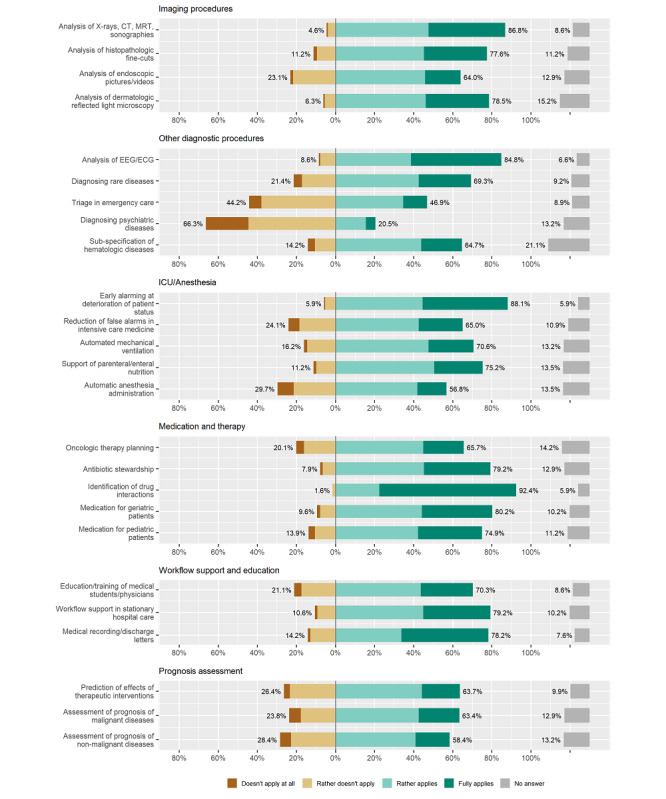
Background: The increasing development of artificial intelligence (AI) systems in medicine driven by researchers and entrepreneurs goes along with enormous expectations for medical care advancement. AI might change the clinical practice of physicians from almost all medical disciplines and in most areas of health care. While expectations for AI in medicine are high, practical implementations of AI for clinical practice are still scarce in Germany. Moreover, physicians’ requirements and expectations of AI in medicine and their opinion on the usage of anonymized patient data for clinical and biomedical research have not been investigated widely in German university hospitals. Objective: This study aimed to evaluate physicians’ requirements and expectations of AI in medicine and their opinion on the secondary usage of patient data for (bio)medical research (eg, for the development of machine learning algorithms) in university hospitals in Germany. Methods: A web-based survey was conducted addressing physicians of all medical disciplines in 8 German university hospitals. Answers were given using Likert scales and general demographic responses. Physicians were asked to participate locally via email in the respective hospitals. Results: The online survey was completed by 303 physicians (female: 121/303, 39.9%; male: 173/303, 57.1%; no response: 9/303, 3.0%) from a wide range of medical disciplines and work experience levels. Most respondents either had a positive (130/303, 42.9%) or a very positive attitude (82/303, 27.1%) towards AI in medicine. There was a significant association between the personal rating of AI in medicine and the self-reported technical affinity level (H4=48.3, P<.001). A vast majority of physicians expected the future of medicine to be a mix of human and artificial intelligence (273/303, 90.1%) but also requested a scientific evaluation before the routine implementation of AI-based systems (276/303, 91.1%). Physicians were most optimistic that AI applications would identify drug interactions (280/303, 92.4%) to improve patient care substantially but were quite reserved regarding AI-supported diagnosis of psychiatric diseases (62/303, 20.5%). Of the respondents, 82.5% (250/303) agreed that there should be open access to anonymized patient databases for medical and biomedical research. Conclusions: Physicians in stationary patient care in German university hospitals show a generally positive attitude towards using most AI applications in medicine. Along with this optimism comes several expectations and hopes that AI will assist physicians in clinical decision making. Especially in fields of medicine where huge amounts of data are processed (eg, imaging procedures in radiology and pathology) or data are collected continuously (eg, cardiology and intensive care medicine), physicians’ expectations of AI to substantially improve future patient care are high. In the study, the greatest potential was seen in the application of AI for the identification of drug interactions, assumedly due to the rising complexity of drug administration to polymorbid, polypharmacy patients. However, for the practical usage of AI in health care, regulatory and organizational challenges still have to be mastered.
Overview
The claims and statistics of this paper haven’t been checked yet.
Free: it reads the open-access text and checks the first 5 claims that cite a source we can check. Create a free account to check every claim.
Integrity signals
Registry
Cites
Statistics
Figures



Verification
Claims the paper makes
The claims and statistics of this paper haven’t been checked yet.
Free: it reads the open-access text and checks the first 5 claims that cite a source we can check. Create a free account to check every claim.
Claims other papers make about this one
Each is checked against this paper’s own text: does it say what the citing paper says it does?
The source backs part of the claim, not all of it — or backs it for a different population, condition or comparison.
In the citing paper
“Hereby, a facilitating factor is that the outcomes and clinical effectivenes of AI applications should be evidence-based, ideally relying on large randomized controlled trials (RCTs) to support claims about its effectiveness and safety [36, 38, 39, 42, 58], while the development process itself should be transparent [63] and the AI system used should be explainable and verifiable [63].”
From Healthcare professionals’ perspectives on artificial intelligence in patient care: a systematic review of hindering and facilitating factors on different levels (2025) · cites this paper as [58]
Experimental — accuracy not yet measured
Self-check
Percentages, sums and reported differences re-computed from the paper’s own numbers.
The self-check needs the paper’s full text.
Citations
Cites
Wickham, H. (2016) · Use R! · doi:10.1007/978-3-319-24277-4 · Cited by 33,115
The FAIR Guiding Principles for scientific data management and stewardship
Wilkinson, M. D., Dumontier, M., Aalbersberg, I. J., Appleton, G., Axton, M., Baak, A., Blomberg, N., Boiten, J.-W., da Silva Santos, L. B., Bourne, P. E., et al. (2016) · Scientific Data · doi:10.1038/sdata.2016.18 · Cited by 18,423
Dermatologist-level classification of skin cancer with deep neural networks
Esteva, A., Kuprel, B., Novoa, R. A., Ko, J., Swetter, S. M., Blau, H. M., & Thrun, S. (2017) · Nature · doi:10.1038/nature21056 · Cited by 14,362 · cited 1×
“4 Analysis of dermatologic reflected light microscopy [44,45]”
BackgroundHigh-performance medicine: the convergence of human and artificial intelligence
Topol, E. J. (2019) · Nature Medicine · doi:10.1038/s41591-018-0300-7 · Cited by 10,450 · cited 2×
“Here, we partly reference peer-reviewed publications of AI algorithms, comparing AI algorithms with physicians cited by Topol [32].”
BackgroundMethodMIMIC-III, a freely accessible critical care database
Johnson, A. E. W., Pollard, T. J., Shen, L., Lehman, L.-W. H., Feng, M., Ghassemi, M., Moody, B., Szolovits, P., Anthony Celi, L., & Mark, R. G. (2016) · Scientific Data · doi:10.1038/sdata.2016.35 · Cited by 8,141
A guide to deep learning in healthcare
Esteva, A., Robicquet, A., Ramsundar, B., Kuleshov, V., DePristo, M., Chou, K., Cui, C., Corrado, G., Thrun, S., & Dean, J. (2019) · Nature Medicine · doi:10.1038/s41591-018-0316-z · Cited by 5,312
The future of digital health with federated learning
Rieke, N., Hancox, J., Li, W., Milletarì, F., Roth, H. R., Albarqouni, S., Bakas, S., Galtier, M. N., Landman, B. A., Maier-Hein, K., et al. (2020) · npj Digital Medicine · doi:10.1038/s41746-020-00323-1 · Cited by 4,015 · cited 1×
“In this context, federated ML [30] is a promising approach to obtain powerful, accurate, safe, robust, and unbiased models by enabling multiple organizations to train collaboratively without the need to exchange or centralize datasets.”
BackgroundThe Future of Digital Health with Federated Learning
Rieke, N., Hancox, J., Li, W., Milletari, F., Roth, H., Albarqouni, S., Bakas, S., Galtier, M. N., Landman, B., Maier-Hein, K., et al. (2020) · arXiv · doi:10.48550/arxiv.2003.08119 · Cited by 3,495 · cited 1×
“In this context, federated ML [30] is a promising approach to obtain powerful, accurate, safe, robust, and unbiased models by enabling multiple organizations to train collaboratively without the need to exchange or centralize datasets.”
BackgroundEhteshami Bejnordi, B., Veta, M., Johannes van Diest, P., van Ginneken, B., Karssemeijer, N., Litjens, G., van der Laak, J. A. W. M., and the CAMELYON16 Consortium, Hermsen, M., Manson, Q. F., et al. (2017) · JAMA · doi:10.1001/jama.2017.14585 · Cited by 3,293 · cited 1×
“2 Analysis of histopathologic fine cuts [39,40]”
Hannun, A. Y., Rajpurkar, P., Haghpanahi, M., Tison, G. H., Bourn, C., Turakhia, M. P., & Ng, A. Y. (2019) · Nature Medicine · doi:10.1038/s41591-018-0268-3 · Cited by 3,148 · cited 2×
“1 Analysis of electroencephalography (EEG)/electrocardiography (ECG) [46,47]”
Influential
Research works printed but not linked: 3
- Choi, E, 2016, JMLR Workshop Conf Proc, 56, 301
- Article metrics: MIMIC-III, a freely accessible critical care databaseScientific data20212021-02-21https://www.nature.com/articles/sdata201635/metrics
- RaghuMZhangCKleinbergJBengioSTransfusion: Understanding transfer learning for medical imagingAdvances in Neural Information Processing Systems 32 (NeurIPS 2019)20192021-02-21https://papers.nips.cc/paper/2019/hash/eb1e78328c46506b46a4ac4a1e378b91-Abstract.html
Cited by
Items 101–125 of 125
Singh, B. (2024) · Advances in human and social aspects of technology book series · doi:10.4018/979-8-3693-6190-0.ch019
Yoğun Bakım Ünitesinde Çalışan Doktorların Yapay Zeka İle İlgili Bakış Açıları
Uluç, K. (2025) · Acta Medica Nicomedia · doi:10.53446/actamednicomedia.1624017
Leonard, F., Lyttle, M. D., O’Sullivan, D. M., Gilligan, J., Roland, D., & Barrett, M. (2025) · medRxiv · doi:10.1101/2025.07.06.25330977
Halawani, I. R., Alsubhi, M. N., AlMosained, H., Alkhwildi, L. A., Aljehani, M., Alghamdi, A. M., Alghamdi, F. S., Mortada, H. H., & Aljindan, F. (2025) · European Journal of Plastic Surgery · doi:10.1007/s00238-025-02357-8
Revisión bibliométrica sobre la adopción de inteligencia artificial en la educación superior
Jiménez, M. U., López-Mallama, Ó. M., & Espinosa, A. A. (2025) · Revista Guillermo de Ockham · doi:10.21500/22563202.7780
Additional file 1 of Large language models for generating medical examinations: systematic review
Artsi, Y., Sorin, V., Konen, E., Glicksberg, B. S., Nadkarni, G., & Klang, E. (2024) · Figshare · doi:10.6084/m9.figshare.26699639
Daniyal, M., Qureshi, M., Marzo, R. R., Aljuaid, M. M., & Shahid, D. (2024) · Figshare · doi:10.6084/m9.figshare.25792775
Additional file 3 of Large language models for generating medical examinations: systematic review
Artsi, Y., Sorin, V., Konen, E., Glicksberg, B. S., Nadkarni, G., & Klang, E. (2024) · Figshare · doi:10.6084/m9.figshare.26699645
Additional file 2 of Large language models for generating medical examinations: systematic review
Artsi, Y., Sorin, V., Konen, E., Glicksberg, B. S., Nadkarni, G., & Klang, E. (2024) · Figshare · doi:10.6084/m9.figshare.26699642
الحمامي, س., فاضل, ب., العمري, ط., & كشوب, م. (2025) · University of Sharjah (UoS) Journal of Humanities and Social Sciences · doi:10.36394/jhss/22/1/17
Lamberts, M., Brinkman, W., van Goor, H., Tebbes, M., & Smits, M. (2026) · doi:10.2196/preprints.93854
Vladika, J., Fichtl, A. M., & Matthes, F. (2026) · Scientific Reports · doi:10.1038/s41598-026-45245-2 · Cited by 1
“This follows the findings of related surveys on the use of AI in medicine 17,27,28 , but also newer ones on the use of LLMs by physicians and students 29–32 .”
Levai, C. M., Stanga, L., Nussbaum, L. A., Gherman, A.-M., Popa, D. I., & Fizedean, C. M. (2026) · Journal of Clinical Medicine · doi:10.3390/jcm15103565
Azizah, W., Prabowo, R., & Purnomo, A. (2026) · Lecture notes in electrical engineering · doi:10.1007/978-981-95-9233-3_3
Smart Healthcare Solutions for Urban Health Development
Eddabbah, M., Zaouiat, C. A., Hachoumi, N., Takhdat, K., & Guezzaz, A. (2026) · Green energy and technology · doi:10.1007/978-3-031-99001-4_33 · Cited by 1
Chen, X., Fu, P., Luo, X., Kang, C., Huang, G., Wu, Y., Zhang, M., Yin, X., & Chen, Z. (2026) · Archives of Computational Methods in Engineering · doi:10.1007/s11831-026-10668-7
“Especially in specialized fields like this one that rely on images and require processing large volumes of data, AI can assist doctors in improving patient outcomes by enabling efficient diagnosis [ 35, 36].”
Shallal, T. M. A. (2026) · doi:10.2196/preprints.104548
Moral diversity and the challenge of responsibility in AI-CDSS
Liedtke, W., & Langanke, M. (2026) · Philosophy Ethics and Humanities in Medicine · doi:10.1186/s13010-026-00226-1 · Cited by 1
“Additionally, attitudinal ambivalence may further deepen the problem: patients may simultaneously value technological efficiency and fear dehumanization or loss of con-trol, just as professionals demand an improvement of AI literacy [57, 58].”
Alblewi, S. M. (2026) · Frontiers in Medicine · doi:10.3389/fmed.2026.1820831 · Cited by 1
“In a German study, only 42.9% of physicians expressed a positive (or highly positive) view of AI in medicine, although most expected it to play a large role in the future of health-care (24).”
InfluentialTheilen, R., Kramer, T., Scharffenberg, M., Jung, I.-C., Zerlik, M., de Abreu, M. G., Sepehr, S., KOCH, T., Sedlmayr, B., Huhle, R., et al. (2026) · Journal of Clinical Monitoring and Computing · doi:10.1007/s10877-026-01464-6
“These findings align with previous surveys in radiology and other medical fields, which also reported cautious optimism and interest in AI adoption [9, 11 –16 ].”
Tokarski, P. I., Łazaruk, K., Czapla, K., Czarnecki, D., & Dzieńkowski, M. (2026) · Communications in computer and information science · doi:10.1007/978-3-032-31144-3_20
Lamberts, M., Brinkman, W., van Goor, H., Tebbes, M., & Smits, M. (2026) · JMIR AI · doi:10.2196/93854
Kaddu‐Mulindwa, D., Mao, X., Duhem, C., Wilde, S. C.-D., Rauh, S., Klein, G., Jacob, F., & Servais, S. (2026) · Frontiers in Digital Health · doi:10.3389/fdgth.2026.1860757 · Cited by 1
Artificial Intelligence in Prehospital Tele-Emergency Medicine: A Survey of Acceptance and Attitudes
Durdova, N., Schmidt, M., Schröder, H., Thoma, P., Groß, D., & Wilhelmy, S. (2026) · Healthcare · doi:10.3390/healthcare14172753
“Moreover, AI is able to collect and analyze large datasets [14,75].”
Perspectives of general practitioners in China on using AI in clinical practice: A qualitative study
Jiang, H., Li, Y., Wang, Y., Shen, W., Wang, B., Lei, H., Lu, Y., Li, X., Liu, Y., & Hao, Y. (2026) · Digital Health · doi:10.1177/20552076261493253
Metadata
- Authors
- Maassen, O., Fritsch, S., Palm, J., Deffge, S., Kunze, J., Marx, G., Riedel, M., Schuppert, A., & Bickenbach, J.
- Affiliations
- Universitätsklinikum Aachen (DE)
- Forschungszentrum Jülich (DE)
- Jena University Hospital (DE)
- University of Iceland (IS)
- Corresponding author
- Maassen, Oliver
- ORCID
- Venue
- Journal of Medical Internet Research
- Publisher
- JMIR Publications Inc.
- Published
- 2021-03-05
- Volume
- 23
- Issue
- 3
- Pages
- e26646
- ISSN
- 1438-8871 (ISSN-L)
- PMC
- PMC7980122
- OpenAlex
- W3130272805
- Cited by
- 125
- References
- 95
- Citations by year
- 2026: 22 · 2025: 32 · 2024: 34 · 2023: 14 · 2022: 16 · 2021: 6
- FWCI
- 5.10
- Type
- journal article
- Language
- en
- Open access
- gold
- doi.org
- Licence
- cc-by
- Locations
- Journal of Medical Internet Research (publishedVersion, cc-by)
- PubMed Central (publishedVersion, cc-by)
- PubMed (publishedVersion)
- DOAJ (DOAJ: Directory of Open Access Journals) (submittedVersion, cc-by-sa)
- Funders
- Bundesministerium für Bildung und Forschung (01ZZ1803M, 01ZZ1803C, 01ZZ1803B)
- Topics
- Health Sciences › Medicine › Health Informatics › Artificial Intelligence in Healthcare and Education
- Health Sciences › Health Professions › Health Information Management › Artificial Intelligence in Healthcare
- Health Sciences › Health Professions › Health Information Management › Electronic Health Records Systems
- Keywords
- artificial intelligence in healthcare, physician expectations, anonymized patient data, clinical decision support, psychiatric diagnosis, university hospital, German physicians, clinical implementation of AI, polypharmacy
- MeSH terms
- Artificial Intelligence, Female, Hospitals, University, Humans, Male, Motivation, Physicians, Surveys and Questionnaires, Radiology, Internet
About these checks
Registry, retraction, Cites and statistics results are computed, not judged, with one exception: a printed reference that no index lists is read once by a model before it counts as a citation error. Claims are extracted by a model and kept only when their quote appears verbatim in the text; each cited source is then checked, with a model’s help, for whether it says what the claim relies on. Those verdicts can be wrong — read the claim’s quote and the cited source before relying on one.
Statistics and arithmetic are recomputed, not judged.
Confidence bands are shown only for fields calibrated on our annotated test set. None is calibrated yet, so no band is shown.
What counts as a claim ›How we measure confidence ›How we check this ›
Are you an author, or do you see a problem with this page? Request a review
Data sources
Bibliographic data: Semantic Scholar, OpenAlex, Crossref.
Contains information from the Semantic Scholar Academic Graph Datasets, made available under the ODC Attribution License (ODC-BY 1.0).
Semantic Scholar’s data is described in: Kinney, R., et al. (2023). The Semantic Scholar Open Data Platform. arXiv:2301.10140.
