

Work-Focused Versus Generic Internet-Based Interventions for Employees With Stress-Related Disorders: Randomized Controlled Trial
Open accessPublished version of a preprint
The DOI matches its Crossref record; 89 of the 89 references it cites were found in a registry or an index.
Abstract
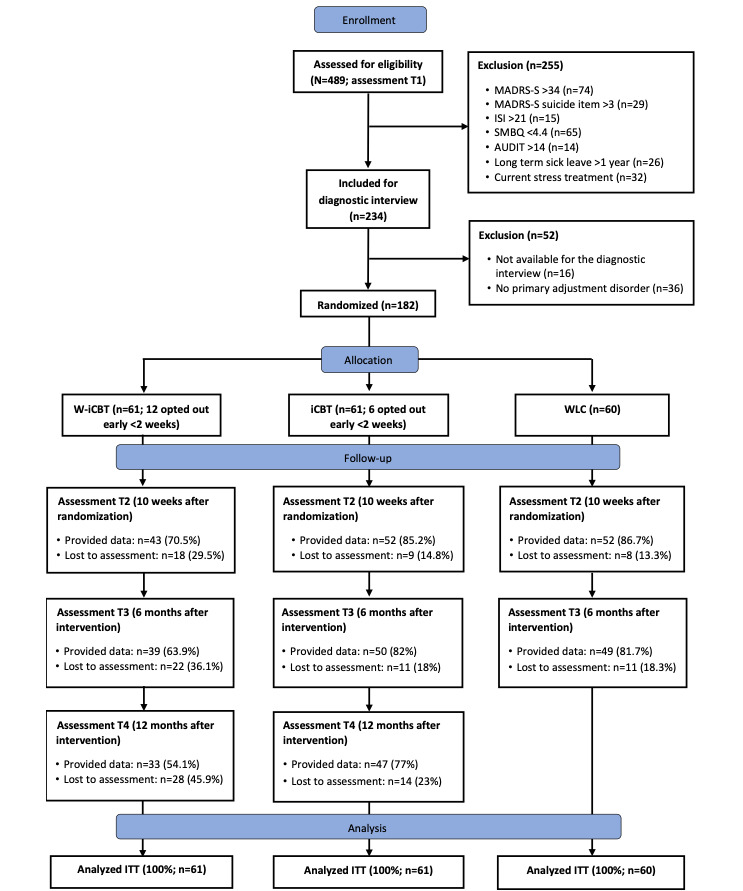
BACKGROUND: In recent decades, stress-related disorders have received more attention, with an increasing prevalence, especially within the working population. The internet provides new options for broad dissemination, and a growing body of evidence suggests that web-based interventions for stress might be effective. However, few studies have examined the efficacy of interventions in clinical samples and work-related outcomes. OBJECTIVE: The aim of this study was to evaluate the efficacy of an internet-based cognitive behavioral intervention for stress-related disorders integrating work-related aspects (work-focused and internet-based cognitive behavioral therapy [W-iCBT]), compared with a generic internet-based cognitive behavioral therapy (iCBT) group and a waitlist control (WLC) group. METHODS: In this trial, 182 employees, mainly employed in the health care, IT, or educational sector, who fulfilled the criteria for a stress-related disorder, were randomized to a 10-week W-iCBT (n=61, 33.5%), generic iCBT (n=61, 33.5%), or WLC (n=60, 33%). Self-rated questionnaires on perceived stress, burnout, exhaustion, and other mental health- and work-related outcomes were administered before and after the treatment and at 6- and 12-month follow-ups. RESULTS: Compared with the WLC group, participants of the W-iCBT and iCBT groups showed an equal and significant reduction in the primary outcome (Shirom-Melamed Burnout Questionnaire [SMBQ]) from pretreatment to posttreatment assessment (Cohen d=1.00 and 0.83, respectively) and at the 6-month follow-up (Cohen d=0.74 and 0.74, respectively). Significant moderate-to-large effect sizes were also found in the secondary health- and work-related outcomes. The W-iCBT was the only group that exhibited significant effects on work ability and short-term sickness absence. Short-term sickness absence was 445 days lower than the WLC group and 324 days lower than the iCBT intervention group. However, no significant differences were found in terms of work experience or long-term sick leave. CONCLUSIONS: The work-focused and generic iCBT interventions proved to be superior compared with the control condition in reducing chronic stress and several other mental health-related symptoms. Interestingly, effects on work ability and short-term sickness absence were only seen between the W-iCBT intervention and the WLC groups. These preliminary results are promising, indicating that treatments that include work aspects may have the potential to accelerate recovery and reduce short-term sickness absence because of stress-related disorders. TRIAL REGISTRATION: ClinicalTrials.gov NCT05240495; https://clinicaltrials.gov/ct2/show/NCT05240495 (retrospectively registered).
Overview
The claims and statistics of this paper haven’t been checked yet.
Free: it reads the open-access text and checks the first 5 claims that cite a source we can check. Create a free account to check every claim.
Integrity signals
Registry
Cites
Statistics
Figures
Verification
Claims the paper makes
The claims and statistics of this paper haven’t been checked yet.
Free: it reads the open-access text and checks the first 5 claims that cite a source we can check. Create a free account to check every claim.
Claims other papers make about this one
Each is checked against this paper’s own text: does it say what the citing paper says it does?
The cited source says what the claim attributes to it.
In the citing paper
“we found significant and large effects on burnout, depression, and insomnia in a recent study (Persson Asplund et al., 2023) of a teen-week iCBT for stress-related disorders, including both behavioral activation and sleep restriction.”
From Learning how to recover from stress: Results from an internet-based randomized controlled pilot trial (2023) · cites this paper as Persson Asplund et al., 2023
Self-check
Percentages, sums and reported differences re-computed from the paper’s own numbers.
The self-check needs the paper’s full text.
Citations
Cites
An inventory for measuring depression
BECK, A. T. (1961) · Archives of General Psychiatry · doi:10.1001/archpsyc.1961.01710120031004 · Cited by 38,032 · cited 1×
“In a comparative study [55], the MADRS-S correlated highly ( r =.87) with the Beck Depression Inventory [56], indicating acceptable convergent validity.”
A Global Measure of Perceived Stress
Cohen, S., Kamarck, T., & Mermelstein, R. (1983) · Journal of Health and Social Behavior · doi:10.2307/2136404 · Cited by 32,807 · cited 1×
“Perceived stress was measured using the 10-item version of the Perceived Stress Scale (PSS-10), translated into Swedish [50,51].”
A Brief Measure for Assessing Generalized Anxiety Disorder: The GAD-7
Spitzer, R. L., Kroenke, K., Williams, J. B. W., & Löwe, B. (2006) · Archives of Internal Medicine · doi:10.1001/archinte.166.10.1092 · Cited by 31,765 · cited 1×
“The GAD-7 has good internal consistency reliability ( α =.83); test-retest reliability ( r =.83); as well as criterion, construct, factorial, and procedural validity [57].”
A new depression scale designed to be sensitive to change
Montgomery, S. A., & Åsberg, M. (1979) · British Journal of Psychiatry · doi:10.1192/bjp.134.4.382 · Cited by 13,962 · cited 1×
“The instrument has good reliability [54] indicated by a Cronbach α of .75 in this study sample.”
SAUNDERS, J. B., AASLAND, O. G., BABOR, T. F., DE LA FUENTE, J. R., & GRANT, M. (1993) · Addiction · doi:10.1111/j.1360-0443.1993.tb02093.x · Cited by 13,597 · cited 1×
“The Alcohol Use Disorders Identification Test (AUDIT) [60] was used to assess potential alcohol dependence or abuse.”
CONSORT 2010 Statement: updated guidelines for reporting parallel group randomised trials
the CONSORT Group, Schulz, K. F., Altman, D. G., & Moher, D. (2010) · BMC Medicine · doi:10.1186/1741-7015-8-18 · Cited by 13,371
Missing data: our view of the state of the art
Schafer, J. L., & Graham, J. W. (2002) · Psychological Methods · doi:10.1037/1082-989x.7.2.147 · Cited by 11,638
(1998) · PubMed · Cited by 10,216
CONSORT 2010 Statement: updated guidelines for reporting parallel group randomised trials
Schulz, K. F., Altman, D. G., Moher, D., & for the CONSORT Group (2010) · BMJ · doi:10.1136/bmj.c332 · Cited by 9,329
Validation of the Insomnia Severity Index as an outcome measure for insomnia research
Bastien, C. (2001) · Sleep Medicine · doi:10.1016/s1389-9457(00)00065-4 · Cited by 8,067 · cited 2×
“The ISI exhibits adequate internal consistency measures ( α =.74) and is a sensitive measure for detecting changes in perceived sleep difficulties [58].”
Research works printed but not linked: 2
- American Psychiatric Association Diagnostic and Statistical Manual of Mental Disorders (DSM-5). 5th edition 2013 Washington, DC, USA American Psychiatric Association
- Öst LG Tillämpad Avslappning: Manual till en Beteendeterapeutisk Coping-Teknik. 5th revision 2009 Stockholm, Sweden Lars-Göran Öst
Cited by
Ehlers, A., Wild, J., Warnock-Parkes, E., Grey, N., Murray, H., Kerr, A., Rozental, A., Thew, G., Janecka, M., Beierl, E. T., et al. (2023) · The Lancet Psychiatry · doi:10.1016/s2215-0366(23)00181-5 · Cited by 68
Self-citationOptimizing Workplace Digital Mental Health Interventions: Systematic Review and Meta-Analysis
Stratton, E., Morris, R. W., Milton, A. C., Deady, M., Choi, I., & Glozier, N. (2025) · Journal of Medical Internet Research · doi:10.2196/71253 · Cited by 18
Nomeikaitė, A., Geležėlytė, O., Berger, T., Andersson, G., & Kazlauskas, E. (2023) · Internet Interventions · doi:10.1016/j.invent.2023.100686 · Cited by 11
Asplund, R. P., Carvallo, F., Christensson, H., Videsäter, E., Häggman, A., Ljótsson, B., Carlbring, P., & Andersson, G. (2023) · Internet Interventions · doi:10.1016/j.invent.2023.100681 · Cited by 6
Askarizadeh, M. M., Gholamhosseini, L., Khajouei, R., Homayee, S., Askarizadeh, F., & Ahmadian, L. (2025) · BMC Medical Informatics and Decision Making · doi:10.1186/s12911-024-02817-4 · Cited by 12
Shiri, R., Varje, P., & Toppinen‐Tanner, S. (2025) · Journal of Psychosomatic Research · doi:10.1016/j.jpsychores.2025.112140 · Cited by 9
Vernmark, K., Hursti, T. J., Blom, V., Asplund, R. P., Nathanson, E., Engelro, L., Radvogin, E., & Andersson, G. (2024) · Clinical Psychology in Europe · doi:10.32872/cpe.12899 · Cited by 5
Bagasi, A. T., Harbi, E. K. A., Alabbasi, S. M., Alqaedi, R. O., Alharbi, B. A., & Alhomaid, T. A. (2025) · Cureus · doi:10.7759/cureus.88715 · Cited by 17
Sasaki, N., Ogawa, S., Sawada, U., Shimazu, T., Powell, B. J., Takeno, H., Tsutsumi, A., & Imamura, K. (2024) · Internet Interventions · doi:10.1016/j.invent.2024.100754 · Cited by 6
Föyen, L. F., Sennerstam, V., Kontio, E., Lekander, M., Hedman‐Lagerlöf, E., & Lindsäter, E. (2025) · Psychotherapy and Psychosomatics · doi:10.1159/000547266 · Cited by 1
“These results align with several recent studies reporting no effects [43–45], or even negative effects, of psychological interventions compared to waitlist control or care as usual for reducing SA [11, 12, 46].”
Shahrokhi, S., Basirat, Z., Barat, S., Kheirkhah, F., Rad, H. A., Mirtabar, S. M., & Faramarzi, M. (2025) · Iranian Journal of Nursing and Midwifery Research · doi:10.4103/ijnmr.ijnmr_345_23 · Cited by 1
“[23] Therapists also faced challenges in providing internet‑based therapy to pregnant women.”
Coleshill, M. J., Black, M., Luck, K., Willis, K. J., Smallwood, N., Stephens, H., Gillings, T., Fraser, L., Putland, M., Kampel, L., et al. (2025) · Contemporary Clinical Trials Communications · doi:10.1016/j.conctc.2025.101514
“Despite this heterogeneity, several studies have found support for web-based cognitive-behavioural therapy (CBT) as a promising and scalable treatment option [16,17].”
Feasibility, utility, and acceptability of an online ACT-based rehabilitation for clinical burnout
van de Leur, J. C., Lundbäck, K., Forslund, S., Virtanen, N., & Buhrman, M. (2025) · Cognitive Behaviour Therapy · doi:10.1080/16506073.2025.2530420 · Cited by 3
“These results have been replicated in a study where self-referred employees (76.9% with clinical burnout) were randomized to regular CBT, work-focused CBT, and waitlist control (Persson Asplund et al., 2023).”
InfluentialLee, C. T., Harty, S., Enrique, Á., Jiménez-Díaz, A., Hisler, G. C., Duffy, D. J., & Richards, D. (2025) · doi:10.2196/preprints.80689
Effectiveness of work ability interventions on productivity: a systematic review
Pasi, K., Eija, S., Immonen, M., Kangas, P., Rissanen, E., & Linnosmaa, I. (2025) · Journal of Occupational Health · doi:10.1093/joccuh/uiaf051 · Cited by 4
Askarizadeh, M. M., Gholamhosseini, L., Khajouei, R., Askarizade, R., Askarizadeh, F., Rahmani, Z., Homaei, S., Aminizadeh, M., Nakhaeizadeh, M., & Ahmadian, L. (2025) · BMC Health Services Research · doi:10.1186/s12913-025-13341-0
Lee, C. T., Harty, S., Enrique, Á., Jiménez-Díaz, A., Hisler, G. C., Duffy, D. J., & Richards, D. (2026) · Journal of Medical Internet Research · doi:10.2196/80689
“This is particularly pertinent given the evidence supporting the superiority of tailored over nontailored digital interventions [26,27,44].”
Impact of Cognitive Behavioral Therapy on Psychological Well-Being and Work-Related Quality of Life
Priya, S., & Rajini, G. (2025) · International Conference on Emerging Engineering Technologies and Applications (IC-EETA) · doi:10.1109/ic-eeta66496.2025.11548067
Metadata
- Authors
- Persson Asplund, R., Asplund, S., von Buxhoeveden, H., Delby, H., Eriksson, K., Svenning Gerhardsson, M., Palm, J., Skyttberg, T., Torstensson, J., Ljótsson, B., Carlbring, P., & Andersson, G.
- Affiliations
- Uppsala University (SE)
- Linköping University (SE)
- Karolinska Institutet (SE)
- Stockholm University (SE)
- ORCID
- Venue
- Journal of Medical Internet Research
- Publisher
- JMIR Publications Inc.
- Published
- 2023-04-25
- Volume
- 25
- Pages
- e34446
- ISSN
- 1438-8871 (ISSN-L)
- PMC
- PMC10170369
- OpenAlex
- W4316088458
- Cited by
- 18
- References
- 88
- Citations by year
- 2026: 1 · 2025: 12 · 2024: 2 · 2023: 3
- FWCI
- 4.64
- Type
- journal article
- Language
- en
- Open access
- gold
- doi.org
- Licence
- cc-by
- Locations
- Journal of Medical Internet Research (publishedVersion, cc-by)
- PubMed Central (publishedVersion, cc-by)
- PubMed (publishedVersion)
- KTH Publication Database DiVA (KTH Royal Institute of Technology) (submittedVersion, cc-by)
- DOAJ (DOAJ: Directory of Open Access Journals) (submittedVersion, cc-by-sa)
- Funders
- Linköpings Universitet
- Forskningsrådet om Hälsa, Arbetsliv och Välfärd
- Nederlandse Organisatie voor Toegepast Natuurwetenschappelijk Onderzoek
- Topics
- Social Sciences › Psychology › Applied Psychology › Digital Mental Health Interventions
- Social Sciences › Psychology › Social Psychology › Stress and Burnout Research
- Health Sciences › Medicine › Public Health, Environmental and Occupational Health › Workplace Health and Well-being
- Keywords
- internet-based cognitive behavioral therapy, burnout, occupational stress, work ability, sick leave, employee mental health, workplace interventions, perceived stress, healthcare workers, information technology workforce, educational workers, long-term sick leave, work experience, medication adherence, treatment acceptability
- MeSH terms
- Burnout, Psychological, Internet-Based Intervention, Humans, Mental Health, Cognitive Behavioral Therapy, Treatment Outcome, Internet
About these checks
Registry, retraction, Cites and statistics results are computed, not judged, with one exception: a printed reference that no index lists is read once by a model before it counts as a citation error. Claims are extracted by a model and kept only when their quote appears verbatim in the text; each cited source is then checked, with a model’s help, for whether it says what the claim relies on. Those verdicts can be wrong — read the claim’s quote and the cited source before relying on one.
Statistics and arithmetic are recomputed, not judged.
Confidence bands are shown only for fields calibrated on our annotated test set. None is calibrated yet, so no band is shown.
What counts as a claim ›How we measure confidence ›How we check this ›
Are you an author, or do you see a problem with this page? Request a review
Data sources
Bibliographic data: Semantic Scholar, OpenAlex, Crossref.
Contains information from the Semantic Scholar Academic Graph Datasets, made available under the ODC Attribution License (ODC-BY 1.0).
Semantic Scholar’s data is described in: Kinney, R., et al. (2023). The Semantic Scholar Open Data Platform. arXiv:2301.10140.
