

Work-Focused Versus Generic Internet-Based Interventions for Employees With Stress-Related Disorders: Randomized Controlled Trial
Open accessPublished version of a preprint
The DOI matches its Crossref record; 89 of the 89 references it cites were found in a registry or an index.
Abstract
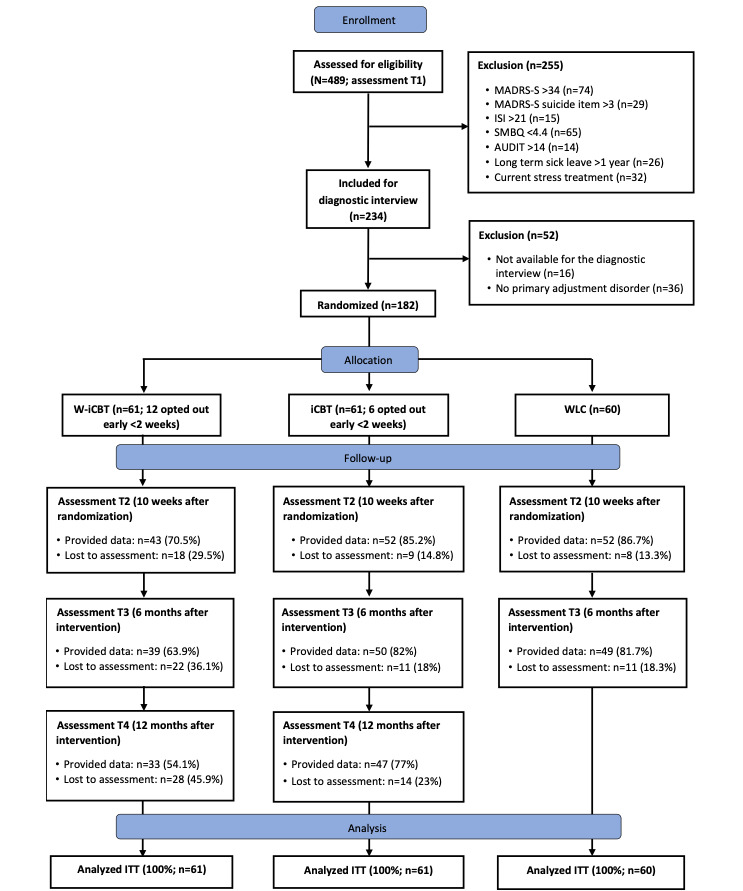
BACKGROUND: In recent decades, stress-related disorders have received more attention, with an increasing prevalence, especially within the working population. The internet provides new options for broad dissemination, and a growing body of evidence suggests that web-based interventions for stress might be effective. However, few studies have examined the efficacy of interventions in clinical samples and work-related outcomes. OBJECTIVE: The aim of this study was to evaluate the efficacy of an internet-based cognitive behavioral intervention for stress-related disorders integrating work-related aspects (work-focused and internet-based cognitive behavioral therapy [W-iCBT]), compared with a generic internet-based cognitive behavioral therapy (iCBT) group and a waitlist control (WLC) group. METHODS: In this trial, 182 employees, mainly employed in the health care, IT, or educational sector, who fulfilled the criteria for a stress-related disorder, were randomized to a 10-week W-iCBT (n=61, 33.5%), generic iCBT (n=61, 33.5%), or WLC (n=60, 33%). Self-rated questionnaires on perceived stress, burnout, exhaustion, and other mental health- and work-related outcomes were administered before and after the treatment and at 6- and 12-month follow-ups. RESULTS: Compared with the WLC group, participants of the W-iCBT and iCBT groups showed an equal and significant reduction in the primary outcome (Shirom-Melamed Burnout Questionnaire [SMBQ]) from pretreatment to posttreatment assessment (Cohen d=1.00 and 0.83, respectively) and at the 6-month follow-up (Cohen d=0.74 and 0.74, respectively). Significant moderate-to-large effect sizes were also found in the secondary health- and work-related outcomes. The W-iCBT was the only group that exhibited significant effects on work ability and short-term sickness absence. Short-term sickness absence was 445 days lower than the WLC group and 324 days lower than the iCBT intervention group. However, no significant differences were found in terms of work experience or long-term sick leave. CONCLUSIONS: The work-focused and generic iCBT interventions proved to be superior compared with the control condition in reducing chronic stress and several other mental health-related symptoms. Interestingly, effects on work ability and short-term sickness absence were only seen between the W-iCBT intervention and the WLC groups. These preliminary results are promising, indicating that treatments that include work aspects may have the potential to accelerate recovery and reduce short-term sickness absence because of stress-related disorders. TRIAL REGISTRATION: ClinicalTrials.gov NCT05240495; https://clinicaltrials.gov/ct2/show/NCT05240495 (retrospectively registered).
Overview
The claims and statistics of this paper haven’t been checked yet.
Free: it reads the open-access text and checks the first 5 claims that cite a source we can check. Create a free account to check every claim.
Integrity signals
Registry
Cites
Statistics
Figures
Verification
Claims the paper makes
The claims and statistics of this paper haven’t been checked yet.
Free: it reads the open-access text and checks the first 5 claims that cite a source we can check. Create a free account to check every claim.
Claims other papers make about this one
Each is checked against this paper’s own text: does it say what the citing paper says it does?
The cited source says what the claim attributes to it.
In the citing paper
“we found significant and large effects on burnout, depression, and insomnia in a recent study (Persson Asplund et al., 2023) of a teen-week iCBT for stress-related disorders, including both behavioral activation and sleep restriction.”
From Learning how to recover from stress: Results from an internet-based randomized controlled pilot trial (2023) · cites this paper as Persson Asplund et al., 2023
Self-check
Percentages, sums and reported differences re-computed from the paper’s own numbers.
The self-check needs the paper’s full text.
Citations
Cites
An inventory for measuring depression
BECK, A. T. (1961) · Archives of General Psychiatry · doi:10.1001/archpsyc.1961.01710120031004 · Cited by 38,032 · cited 1×
“In a comparative study [55], the MADRS-S correlated highly ( r =.87) with the Beck Depression Inventory [56], indicating acceptable convergent validity.”
A Global Measure of Perceived Stress
Cohen, S., Kamarck, T., & Mermelstein, R. (1983) · Journal of Health and Social Behavior · doi:10.2307/2136404 · Cited by 32,807 · cited 1×
“Perceived stress was measured using the 10-item version of the Perceived Stress Scale (PSS-10), translated into Swedish [50,51].”
A Brief Measure for Assessing Generalized Anxiety Disorder: The GAD-7
Spitzer, R. L., Kroenke, K., Williams, J. B. W., & Löwe, B. (2006) · Archives of Internal Medicine · doi:10.1001/archinte.166.10.1092 · Cited by 31,765 · cited 1×
“The GAD-7 has good internal consistency reliability ( α =.83); test-retest reliability ( r =.83); as well as criterion, construct, factorial, and procedural validity [57].”
A new depression scale designed to be sensitive to change
Montgomery, S. A., & Åsberg, M. (1979) · British Journal of Psychiatry · doi:10.1192/bjp.134.4.382 · Cited by 13,962 · cited 1×
“The instrument has good reliability [54] indicated by a Cronbach α of .75 in this study sample.”
SAUNDERS, J. B., AASLAND, O. G., BABOR, T. F., DE LA FUENTE, J. R., & GRANT, M. (1993) · Addiction · doi:10.1111/j.1360-0443.1993.tb02093.x · Cited by 13,597 · cited 1×
“The Alcohol Use Disorders Identification Test (AUDIT) [60] was used to assess potential alcohol dependence or abuse.”
CONSORT 2010 Statement: updated guidelines for reporting parallel group randomised trials
the CONSORT Group, Schulz, K. F., Altman, D. G., & Moher, D. (2010) · BMC Medicine · doi:10.1186/1741-7015-8-18 · Cited by 13,371
Missing data: our view of the state of the art
Schafer, J. L., & Graham, J. W. (2002) · Psychological Methods · doi:10.1037/1082-989x.7.2.147 · Cited by 11,638
(1998) · PubMed · Cited by 10,216
CONSORT 2010 Statement: updated guidelines for reporting parallel group randomised trials
Schulz, K. F., Altman, D. G., Moher, D., & for the CONSORT Group (2010) · BMJ · doi:10.1136/bmj.c332 · Cited by 9,329
Validation of the Insomnia Severity Index as an outcome measure for insomnia research
Bastien, C. (2001) · Sleep Medicine · doi:10.1016/s1389-9457(00)00065-4 · Cited by 8,067 · cited 2×
“The ISI exhibits adequate internal consistency measures ( α =.74) and is a sensitive measure for detecting changes in perceived sleep difficulties [58].”
Jacobson, N. S., & Truax, P. (1991) · Journal of Consulting and Clinical Psychology · doi:10.1037/0022-006x.59.1.12 · Cited by 7,770 · cited 1×
“To evaluate clinically significant changes, we used the guidelines by Jacobson and Truax [75].”
Scoville, W. B. (1949) · Journal of neurosurgery · doi:10.3171/jns.1949.6.1.0065 · Cited by 7,381
Sonnentag, S., & Fritz, C. (2007) · Journal of Occupational Health Psychology · doi:10.1037/1076-8998.12.3.204 · Cited by 2,133 · cited 2×
“Inspired by the recovery from work training by Hahn et al [41,71], we included modules corresponding to the subdimensions of the REQ, namely, psychological detachment, relaxation, mastery, and control.”
Handbook of Life Stress, Cognition and Health
PASTOR, L. H. (1989) · American Journal of Psychiatry · doi:10.1176/ajp.146.10.1347 · Cited by 1,404
Effects of occupational stress management intervention programs: A meta-analysis.
Richardson, K. M., & Rothstein, H. R. (2008) · Journal of Occupational Health Psychology · doi:10.1037/1076-8998.13.1.69 · Cited by 1,374
Assessing Psychiatric Impairment in Primary Care with the Sheehan Disability Scale
Leon, A. C., Olfson, M., Portera, L., Farber, L., & Sheehan, D. V. (1997) · The International Journal of Psychiatry in Medicine · doi:10.2190/t8em-c8yh-373n-1uwd · Cited by 987 · cited 2×
“The α level was .66 in this study sample [69,70].”
(2001) · Medical Entomology and Zoology · Cited by 915
Work stress in the etiology of coronary heart disease—a meta-analysis
Kivimäki, M., Virtanen, M., Elovainio, M., Kouvonen, A., Väänänen, A., & Vahtera, J. (2006) · Scandinavian Journal of Work, Environment & Health · doi:10.5271/sjweh.1049 · Cited by 905
Kessler, R. C., Akiskal, H. S., Ames, M., Birnbaum, H., Greenberg, P., .A, R. M., Jin, R., Merikangas, K. R., Simon, G. E., & Wang, P. S. (2006) · American Journal of Psychiatry · doi:10.1176/ajp.2006.163.9.1561 · Cited by 868
Kessler, R. C., Akiskal, H. S., Ames, M., Birnbaum, H., Greenberg, P., .A, R. M., Jin, R., Merikangas, K. R., Simon, G. E., & Wang, P. S. (2006) · American Journal of Psychiatry · doi:10.1176/appi.ajp.163.9.1561 · Cited by 868
Svanborg, P., & Åsberg, M. (1994) · Acta Psychiatrica Scandinavica · doi:10.1111/j.1600-0447.1994.tb01480.x · Cited by 693 · cited 1×
“We used the Montgomery Åsberg Depression Rating Scale self-assessment (MADRS-S) [53] to measure symptoms of depression.”
Work stress precipitates depression and anxiety in young, working women and men
MELCHIOR, M., CASPI, A., MILNE, B. J., DANESE, A., POULTON, R., & MOFFITT, T. E. (2007) · Psychological Medicine · doi:10.1017/s0033291707000414 · Cited by 691 · cited 1×
“…disorders and well-known health implications, such as coronary artery disease, lowered immune functioning, anxiety, depression, and insomnia [4-8], chronic stress has been associated with impaired work functioning and problems in work participation such as sickness absence (SA) and…”
Psychoneuroimmunology: psychological influences on immune function and health
Kiecolt-Glaser, J. K., McGuire, L., Robles, T. F., & Glaser, R. (2002) · Journal of Consulting and Clinical Psychology · doi:10.1037/0022-006x.70.3.537 · Cited by 686
The cost of work-related stress to society: A systematic review
Hassard, J., Teoh, K. R. H., Visockaite, G., Dewe, P., & Cox, T. (2018) · Journal of Occupational Health Psychology · doi:10.1037/ocp0000069 · Cited by 652 · cited 3×
“Decreased work participation is problematic, as it has direct effects on people’s well-being and leads to immense costs for society [16].”
InfluentialPsychosocial stress and impaired sleep
Åkerstedt, T. (2006) · Scandinavian Journal of Work, Environment & Health · doi:10.5271/sjweh.1054 · Cited by 585 · cited 2×
“Chronic stress can lead to a wide range of disorders and clinical outcomes, including stress-related disorders [4-8].”
Workplace interventions for common mental disorders: A systematic meta-review
Joyce, S., Modini, M., Christensen, H., Mykletun, A., Bryant, R., Mitchell, P. B., & Harvey, S. B. (2016) · Psychological Medicine · doi:10.1017/s0033291715002408 · Cited by 525 · cited 2×
“Workplace involvement is an important factor for returning to work [13,84].”
Burnout and risk factors for cardiovascular diseases
Melamed, S., Kushnir, T., & Shirom, A. (1992) · Behavioral Medicine · doi:10.1080/08964289.1992.9935172 · Cited by 490 · cited 1×
“The Shirom Melamed Burnout Questionnaire (SMBQ) [47,48] is a 22-item scale (graded 1-7) used to assess different aspects of chronic stress and burnout (physical fatigue, cognitive weariness, tension, and listlessness).”
Svanborg, P., & Åsberg, M. (2001) · Journal of Affective Disorders · doi:10.1016/s0165-0327(00)00242-1 · Cited by 481 · cited 1×
“In a comparative study [55], the MADRS-S correlated highly ( r =.87) with the Beck Depression Inventory [56], indicating acceptable convergent validity.”
Chronic burnout, somatic arousal and elevated salivary cortisol levels
Melamed, S., Ugarten, U., Shirom, A., Kahana, L., Lerman, Y., & Froom, P. (1999) · Journal of Psychosomatic Research · doi:10.1016/s0022-3999(99)00007-0 · Cited by 436 · cited 1×
“The SMBQ has exhibited good internal consistency with a Cronbach α of .92 [49] and in this study, indicated by an α of .84.”
Hahn, V. C., Binnewies, C., Sonnentag, S., & Mojza, E. J. (2011) · Journal of Occupational Health Psychology · doi:10.1037/a0022169 · Cited by 421 · cited 3×
“Inspired by the recovery from work training by Hahn et al [41,71], we included modules corresponding to the subdimensions of the REQ, namely, psychological detachment, relaxation, mastery, and control.”
Test-retest reliability of the Work Ability Index questionnaire
de Zwart, B. C. H. (2002) · Occupational Medicine · doi:10.1093/occmed/52.4.177 · Cited by 420 · cited 2×
“Studies [64] [67,68].”
Heber, E., Ebert, D. D., Lehr, D., Cuijpers, P., Berking, M., Nobis, S., & Riper, H. (2017) · Journal of Medical Internet Research · doi:10.2196/jmir.5774 · Cited by 408
Bouwmans, C., De Jong, K., Timman, R., Zijlstra-Vlasveld, M., Van der Feltz-Cornelis, C., Tan, S. S., & Hakkaart-van Roijen, L. (2013) · BMC Health Services Research · doi:10.1186/1472-6963-13-217 · Cited by 401 · cited 2×
“Absence from work was measured according to the Trimbos and Institute of Medical Technology Assessment Cost Questionnaire for Psychiatry (TiC-P) [73].”
Nonparametric statistical tests for the continuous data: the basic concept and the practical use
Nahm, F. S. (2016) · Korean Journal of Anesthesiology · doi:10.4097/kjae.2016.69.1.8 · Cited by 389
van der Klink, J. J. L., Blonk, R. W. B., Schene, A. H., & van Dijk, F. J. H. (2003) · Occupational and Environmental Medicine · doi:10.1136/oem.60.6.429 · Cited by 378
Common Mental Disorders in the Workforce: Recent Findings from Descriptive and Social Epidemiology
Sanderson, K., & Andrews, G. (2006) · The Canadian Journal of Psychiatry · doi:10.1177/070674370605100202 · Cited by 370 · cited 1×
“…well-known health implications, such as coronary artery disease, lowered immune functioning, anxiety, depression, and insomnia [4-8], chronic stress has been associated with impaired work functioning and problems in work participation such as sickness absence (SA) and long-term sick leave [13-15].”
Physiological correlates of burnout among women
Grossi, G., Perski, A., Evengård, B., Blomkvist, V., & Orth-Gomér, K. (2003) · Journal of Psychosomatic Research · doi:10.1016/s0022-3999(02)00633-5 · Cited by 359 · cited 2×
“The Shirom Melamed Burnout Questionnaire (SMBQ) [47,48] is a 22-item scale (graded 1-7) used to assess different aspects of chronic stress and burnout (physical fatigue, cognitive weariness, tension, and listlessness).”
Bhui, K. S., Dinos, S., Stansfeld, S. A., & White, P. D. (2012) · Journal of Environmental and Public Health · doi:10.1155/2012/515874 · Cited by 287 · cited 4×
“However, considering organizational-level factors and clinical samples, interventions have been less successful [17,18].”
InfluentialBlonk, R. W. B., Brenninkmeijer, V., Lagerveld, S. E., & Houtman, I. L. D. (2006) · Work & Stress · doi:10.1080/02678370600856615 · Cited by 280 · cited 1×
“Gradual exposure can help individuals develop more effective coping skills when dealing with work-related stressors (eg, assertiveness) and stimulate a gradual RTW setting for individuals on long-term sick leave [21].”
Grossi, G., Perski, A., Osika, W., & Savic, I. (2015) · Scandinavian Journal of Psychology · doi:10.1111/sjop.12251 · Cited by 273
Stratton, E., Lampit, A., Choi, I., Calvo, R. A., Harvey, S. B., & Glozier, N. (2017) · PLOS ONE · doi:10.1371/journal.pone.0189904 · Cited by 252
Nordin, M., & Nordin, S. (2013) · Scandinavian Journal of Psychology · doi:10.1111/sjop.12071 · Cited by 252 · cited 1×
“Perceived stress was measured using the 10-item version of the Perceived Stress Scale (PSS-10), translated into Swedish [50,51].”
Computerised Cognitive Behavioural Therapy for Insomnia: A Systematic Review and Meta-Analysis
Cheng, S. K., & Dizon, J. (2012) · Psychotherapy and Psychosomatics · doi:10.1159/000335379 · Cited by 241 · cited 1×
“In addition, participants with insomnia could choose to focus on sleep management between weeks 5 and 9, including well-established CBT techniques such as sleep restriction, stimulus control, sleep hygiene, and cognitive interventions [45,46].”
Hoefsmit, N., Houkes, I., & Nijhuis, F. J. N. (2012) · Journal of Occupational Rehabilitation · doi:10.1007/s10926-012-9359-z · Cited by 238 · cited 1×
“Workplace involvement is an important factor for returning to work [13,84].”
Heinemann (2017) · doi:10.1177/2158244017697154 · Cited by 221
Work-focused treatment of common mental disorders and return to work: A comparative outcome study.
Lagerveld, S. E., Blonk, R. W. B., Brenninkmeijer, V., Wijngaards-de Meij, L., & Schaufeli, W. B. (2012) · Journal of Occupational Health Psychology · doi:10.1037/a0027049 · Cited by 219 · cited 3×
“Despite the well-documented efficacy of stress management interventions [17], and some promising results of work-focused interventions [20-25], the range of interventions is not proportionate to the needs of distressed employees [26].”
SCHENE, A. H., KOETER, M. W. J., KIKKERT, M. J., SWINKELS, J. A., & McCRONE, P. (2007) · Psychological Medicine · doi:10.1017/s0033291706009366 · Cited by 203
Validation of the insomnia severity index as a web-based measure
Thorndike, F. P., Ritterband, L. M., Saylor, D. K., Magee, J. C., Gonder-Frederick, L. A., & Morin, C. M. (2011) · Behavioral Sleep Medicine · doi:10.1080/15402002.2011.606766 · Cited by 186 · cited 1×
“It has previously been validated as an internet-based measure [59].”
Interventions to facilitate return to work in adults with adjustment disorders
Arends, I., Bruinvels, D. J., Rebergen, D. S., Nieuwenhuijsen, K., Madan, I., Neumeyer-Gromen, A., Bültmann, U., & Verbeek, J. H. (2012) · Cochrane Database of Systematic Reviews · doi:10.1002/14651858.cd006389.pub2 · Cited by 182
Holländare, F., Andersson, G., & Engström, I. (2010) · Journal of Medical Internet Research · doi:10.2196/jmir.1392 · Cited by 179
Selin, K. H. (2003) · Alcoholism Clinical and Experimental Research · doi:10.1097/01.alc.0000085633.23230.4a · Cited by 178 · cited 1×
“In a study of the psychometric properties of the Swedish version of the AUDIT, both internal and test-retest reliabilities were satisfactory [61].”
Ebert, D. D., Heber, E., Berking, M., Riper, H., Cuijpers, P., Funk, B., & Lehr, D. (2016) · Occupational and Environmental Medicine · doi:10.1136/oemed-2015-103269 · Cited by 176 · cited 1×
“The effect in this study was larger compared with previous internet-based stress management studies, including recovery techniques and the REQ [46,81,82].”
Thiart, H., Lehr, D., Ebert, D. D., Berking, M., & Riper, H. (2015) · Scandinavian Journal of Work, Environment & Health · doi:10.5271/sjweh.3478 · Cited by 168 · cited 2×
“In addition, participants with insomnia could choose to focus on sleep management between weeks 5 and 9, including well-established CBT techniques such as sleep restriction, stimulus control, sleep hygiene, and cognitive interventions [45,46].”
Relationship between the self-assessment and clinical assessment of health status and work ability.
Eskelinen, L., Kohvakka, A., Merisalo, T., Hurri, H., & Wägar, G. (1991) · PubMed · Cited by 165
The effectiveness of controlled interventions on employees’ burnout: A meta‐analysis
Maricuţoiu, L. P., Sava, F. A., & Butta, O. (2016) · Journal of Occupational and Organizational Psychology · doi:10.1111/joop.12099 · Cited by 163 · cited 1×
“However, considering organizational-level factors and clinical samples, interventions have been less successful [17,18].”
The psychometric validation of the Sheehan Disability Scale (SDS) in patients with bipolar disorder
Arbuckle, R. A., Frye, M. A., Brecher, M., Paulsson, B., Rajagopalan, K., Palmer, S., & Innocenti, A. D. (2008) · Psychiatry Research · doi:10.1016/j.psychres.2007.11.018 · Cited by 161 · cited 2×
“The α level was .66 in this study sample [69,70].”
The Prevalence of Psychological Distress in Employees and Associated Occupational Risk Factors
Hilton, M. F., Whiteford, H. A., Sheridan, J. S., Cleary, C. M., Chant, D. C., Wang, P. S., & Kessler, R. C. (2008) · Journal of Occupational & Environmental Medicine · doi:10.1097/jom.0b013e31817e9171 · Cited by 154 · cited 1×
“Despite the well-documented efficacy of stress management interventions [17], and some promising results of work-focused interventions [20-25], the range of interventions is not proportionate to the needs of distressed employees [26].”
Associations between functional capacity and work ability among elderly municipal employees.
Nygård, C., Eskelinen, L., SUVANTO, S., Tuomi, K., & Ilmarinen, J. (1991) · PubMed · Cited by 151
Besèr, A., Sorjonen, K., Wahlberg, K., Peterson, U., Nygren, Å., & Åsberg, M. (2014) · Scandinavian Journal of Psychology · doi:10.1111/sjop.12088 · Cited by 134 · cited 4×
“The KEDS-9 has satisfactory reliability, with a Cronbach α of .94 [ 52] and correspondingly .74 for this trial.”
InfluentialWorksite stress management training: Moderated effects and clinical significance
Flaxman, P. E., & Bond, F. W. (2010) · Journal of Occupational Health Psychology · doi:10.1037/a0020522 · Cited by 126 · cited 1×
“The third and fourth weeks included exercises related to behavioral activation [43], work-home balance, and value-based action skills derived from Acceptance Commitment Therapy [44].”
Ebert, D. D., Lehr, D., Heber, E., Riper, H., Cuijpers, P., & Berking, M. (2016) · Scandinavian Journal of Work, Environment & Health · doi:10.5271/sjweh.3573 · Cited by 120 · cited 1×
“The effect in this study was larger compared with previous internet-based stress management studies, including recovery techniques and the REQ [46,81,82].”
Finnes, A., Enebrink, P., Ghaderi, A., Dahl, J., Nager, A., & Öst, L.-G. (2019) · International Archives of Occupational and Environmental Health · doi:10.1007/s00420-018-1380-x · Cited by 99 · cited 2×
“However, it remains uncertain what moderates these effects [19].”
InfluentialRebergen, D. S., Bruinvels, D. J., Bezemer, P. D., van der Beek, A. J., & van Mechelen, W. (2009) · Journal of Occupational & Environmental Medicine · doi:10.1097/jom.0b013e3181990d32 · Cited by 87
Höglund, P., Hakelind, C., & Nordin, S. (2020) · BMC Psychiatry · doi:10.1186/s12888-020-02557-5 · Cited by 83 · cited 1×
“Few studies have been published regarding the prevalence of ED, but in a recent study, based on physician-based diagnosis in 3406 participants, 4.2% reported ED [12].”
InfluentialAlmén, N., Lundberg, H., Sundin, Ö., & Jansson, B. (2018) · Nordic Psychology · doi:10.1080/19012276.2018.1443280 · Cited by 76 · cited 1×
“The questionnaire is answered on a 5-point Likert scale and has been validated in a Swedish population, showing excellent internal consistency ( α =.92) [72].”
Andersson, G., Carlbring, P., & Rozental, A. (2019) · Frontiers in Psychiatry · doi:10.3389/fpsyt.2019.00749 · Cited by 71 · cited 1×
“There are indications that greater initial symptom severity results in higher response and remission rates [77,78].”
Long-term follow-up of residual symptoms in patients treated for stress-related exhaustion
Glise, K., Wiegner, L., & Jonsdottir, I. H. (2020) · BMC Psychology · doi:10.1186/s40359-020-0395-8 · Cited by 70 · cited 1×
“However, we still struggle with the fact that about one-third of patients relapse or continue to experience residual symptoms several years after treatment for stress-related disorders [80].”
Maslach, C., & Leiter, M. P. (2007) · Elsevier eBooks · doi:10.1016/b978-012373947-6/00062-3 · Cited by 69
Internet-based stress management for distressed managers: results from a randomised controlled trial
Persson Asplund, R., Dagöö, J., Fjellström, I., Niemi, L., Hansson, K., Zeraati, F., Ziuzina, M., Geraedts, A., Ljótsson, B., Carlbring, P., et al. (2018) · Occupational and Environmental Medicine · doi:10.1136/oemed-2017-104458 · Cited by 68 · cited 2×
“Studies also suggest that internet-based interventions for stress can have sustained effects on stress reduction [31-33], be cost-effective [34,35], and have positive effects on participants’ experiences of health and well-being in both work and private life [36].”
InfluentialKröger, C., Bode, K., Wunsch, E.-M., Kliem, S., Grocholewski, A., & Finger, F. (2015) · Journal of Occupational Health Psychology · doi:10.1037/a0038341 · Cited by 67 · cited 1×
“Despite the well-documented efficacy of stress management interventions [17], and some promising results of work-focused interventions [20-25], the range of interventions is not proportionate to the needs of distressed employees [26].”
Internet-Based Cognitive Behavioral Therapy for Chronic Stress: A Randomized Controlled Trial
Lindsäter, E., Axelsson, E., Salomonsson, S., Santoft, F., Ejeby, K., Ljótsson, B., Åkerstedt, T., Lekander, M., & Hedman-Lagerlöf, E. (2018) · Psychotherapy and Psychosomatics · doi:10.1159/000490742 · Cited by 64
Self-citationEbert, D. D., Kählke, F., Buntrock, C., Berking, M., Smit, F., Heber, E., Baumeister, H., Funk, B., Riper, H., & Lehr, D. (2017) · Scandinavian Journal of Work, Environment & Health · doi:10.5271/sjweh.3691 · Cited by 56 · cited 1×
“Studies also suggest that internet-based interventions for stress can have sustained effects on stress reduction [31-33], be cost-effective [34,35], and have positive effects on participants’ experiences of health and well-being in both work and private life [36].”
Adel, M., Akbar, R., & Ehsan, G. (2019) · Journal of Occupational Health · doi:10.1002/1348-9585.12028 · Cited by 56 · cited 1×
“Studies [64] [67,68].”
Web-based interventions for the management of stress in the workplace: Focus, form, and efficacy
Ryan, C., Bergin, M., Chalder, T., & Wells, J. S. G. (2017) · Journal of Occupational Health · doi:10.1539/joh.16-0227-ra · Cited by 42
The Work Experience Measurement Scale (WEMS): A useful tool in workplace health promotion
Nilsson, P., Andersson, H. I., & Ejlertsson, G. (2013) · Work · doi:10.3233/wor-121541 · Cited by 38 · cited 2×
“The Work Experience Measurement Scale (WEMS) is an instrument measuring the experience of work from a health resource perspective [63].”
de Weerd, B. J., van Dijk, M. K., van der Linden, J. N., Roelen, C. A. M., & Verbraak, M. J. P. M. (2016) · Work · doi:10.3233/wor-162307 · Cited by 32 · cited 1×
“There are some indications that work-directed interventions, integrating work aspects (eg, increasing control and support) with individual psychological treatment, are effective in accelerating return to work (RTW) for those absent with common mental health problems [20-24].”
Neurasthenia: Modern Malady or Historical Relic?
Overholser, J. C., & Beale, E. E. (2019) · The Journal of Nervous and Mental Disease · doi:10.1097/nmd.0000000000000943 · Cited by 31
van de Leur, J. C., Buhrman, M., Åhs, F., Rozental, A., & Jansen, G. B. (2020) · BMC Psychiatry · doi:10.1186/s12888-020-02907-3 · Cited by 30 · cited 2×
“To meet the criteria for clinically significant change in the primary outcome SMBQ, participants had to demonstrate a reliable change of 0.69 and score less than the cutoff of 4.4, following a recent study in a clinical sample [76].”
InfluentialPeralta, N., Godoi Vasconcelos, A. G., Härter Griep, R., & Miller, L. (2012) · Salud Colectiva · doi:10.1590/s1851-82652012000200005 · Cited by 29 · cited 1×
“Studies [64] [67,68].”
Weisel, K. K., Lehr, D., Heber, E., Zarski, A.-C., Berking, M., Riper, H., & Ebert, D. D. (2018) · Journal of Medical Internet Research · doi:10.2196/jmir.9387 · Cited by 28 · cited 1×
“There are indications that greater initial symptom severity results in higher response and remission rates [77,78].”
Lindsäter, E., Axelsson, E., Salomonsson, S., Santoft, F., Ljótsson, B., Åkerstedt, T., Lekander, M., & Hedman-Lagerlöf, E. (2019) · Journal of Medical Internet Research · doi:10.2196/14675 · Cited by 27 · cited 1×
“Studies also suggest that internet-based interventions for stress can have sustained effects on stress reduction [31-33], be cost-effective [34,35], and have positive effects on participants’ experiences of health and well-being in both work and private life [36].”
Saboonchi, F., Perski, A., & Grossi, G. (2013) · Scandinavian Journal of Caring Sciences · doi:10.1111/j.1471-6712.2012.01089.x · Cited by 26 · cited 1×
“This might reflect that SMBQ and KEDS measure different underlying constructs, as noted in previous research [79].”
Kristiansen, J., Friborg, M. K., Eller, N. H., Brandt, L. P. A., Glasscock, D., Pihl‐Thingvad, J., Persson, R., Besèr, A., Åsberg, M., & Thorsen, S. V. (2019) · BMC Psychiatry · doi:10.1186/s12888-019-2066-y · Cited by 23 · cited 1×
“Later international publications have suggested that ED is not an exclusively Swedish condition [10,11].”
Asplund, R. P., Jäderlind, A., Björk, I. H., Ljótsson, B., Carlbring, P., & Andersson, G. (2019) · Internet Interventions · doi:10.1016/j.invent.2019.100282 · Cited by 22 · cited 2×
“Studies also suggest that internet-based interventions for stress can have sustained effects on stress reduction [31-33], be cost-effective [34,35], and have positive effects on participants’ experiences of health and well-being in both work and private life [36].”
Fischer, S., Cacace, M., & Wiencke, M. (2016) · Springer eBooks · doi:10.1007/978-3-319-32331-2 · Cited by 21
Is Today's 21st Century Burnout 19th Century's Neurasthenia?
Lipsitt, D. R. (2019) · The Journal of Nervous and Mental Disease · doi:10.1097/nmd.0000000000001014 · Cited by 20
Kutchins, H., & Kirk, S. A. (1995) · Social Work · doi:10.1093/sw/40.2.286 · Cited by 14
The Effectiveness of Online Stress Management Training Interventions: A Systematic Literature Review
van Wingerden, J., & Derks, D. (2018) · International Journal of Learning and Development · doi:10.5296/ijld.v8i3.13600 · Cited by 12 · cited 1×
“Studies suggest that stress can be managed through internet-and computer-based interventions [27-30].”
Watkins, E. R. (2003) · Behavioural and Cognitive Psychotherapy · doi:10.1017/s1352465803272118 · Cited by 3
Research works printed but not linked: 2
- American Psychiatric Association Diagnostic and Statistical Manual of Mental Disorders (DSM-5). 5th edition 2013 Washington, DC, USA American Psychiatric Association
- Öst LG Tillämpad Avslappning: Manual till en Beteendeterapeutisk Coping-Teknik. 5th revision 2009 Stockholm, Sweden Lars-Göran Öst
Cited by
Ehlers, A., Wild, J., Warnock-Parkes, E., Grey, N., Murray, H., Kerr, A., Rozental, A., Thew, G., Janecka, M., Beierl, E. T., et al. (2023) · The Lancet Psychiatry · doi:10.1016/s2215-0366(23)00181-5 · Cited by 68
Self-citationOptimizing Workplace Digital Mental Health Interventions: Systematic Review and Meta-Analysis
Stratton, E., Morris, R. W., Milton, A. C., Deady, M., Choi, I., & Glozier, N. (2025) · Journal of Medical Internet Research · doi:10.2196/71253 · Cited by 18
Nomeikaitė, A., Geležėlytė, O., Berger, T., Andersson, G., & Kazlauskas, E. (2023) · Internet Interventions · doi:10.1016/j.invent.2023.100686 · Cited by 11
Asplund, R. P., Carvallo, F., Christensson, H., Videsäter, E., Häggman, A., Ljótsson, B., Carlbring, P., & Andersson, G. (2023) · Internet Interventions · doi:10.1016/j.invent.2023.100681 · Cited by 6
Askarizadeh, M. M., Gholamhosseini, L., Khajouei, R., Homayee, S., Askarizadeh, F., & Ahmadian, L. (2025) · BMC Medical Informatics and Decision Making · doi:10.1186/s12911-024-02817-4 · Cited by 12
Metadata
- Authors
- Persson Asplund, R., Asplund, S., von Buxhoeveden, H., Delby, H., Eriksson, K., Svenning Gerhardsson, M., Palm, J., Skyttberg, T., Torstensson, J., Ljótsson, B., Carlbring, P., & Andersson, G.
- Affiliations
- Uppsala University (SE)
- Linköping University (SE)
- Karolinska Institutet (SE)
- Stockholm University (SE)
- ORCID
- Venue
- Journal of Medical Internet Research
- Publisher
- JMIR Publications Inc.
- Published
- 2023-04-25
- Volume
- 25
- Pages
- e34446
- ISSN
- 1438-8871 (ISSN-L)
- PMC
- PMC10170369
- OpenAlex
- W4316088458
- Cited by
- 18
- References
- 88
- Citations by year
- 2026: 1 · 2025: 12 · 2024: 2 · 2023: 3
- FWCI
- 4.64
- Type
- journal article
- Language
- en
- Open access
- gold
- doi.org
- Licence
- cc-by
- Locations
- Journal of Medical Internet Research (publishedVersion, cc-by)
- PubMed Central (publishedVersion, cc-by)
- PubMed (publishedVersion)
- KTH Publication Database DiVA (KTH Royal Institute of Technology) (submittedVersion, cc-by)
- DOAJ (DOAJ: Directory of Open Access Journals) (submittedVersion, cc-by-sa)
- Funders
- Linköpings Universitet
- Forskningsrådet om Hälsa, Arbetsliv och Välfärd
- Nederlandse Organisatie voor Toegepast Natuurwetenschappelijk Onderzoek
- Topics
- Social Sciences › Psychology › Applied Psychology › Digital Mental Health Interventions
- Social Sciences › Psychology › Social Psychology › Stress and Burnout Research
- Health Sciences › Medicine › Public Health, Environmental and Occupational Health › Workplace Health and Well-being
- Keywords
- internet-based cognitive behavioral therapy, burnout, occupational stress, work ability, sick leave, employee mental health, workplace interventions, perceived stress, healthcare workers, information technology workforce, educational workers, long-term sick leave, work experience, medication adherence, treatment acceptability
- MeSH terms
- Burnout, Psychological, Internet-Based Intervention, Humans, Mental Health, Cognitive Behavioral Therapy, Treatment Outcome, Internet
About these checks
Registry, retraction, Cites and statistics results are computed, not judged, with one exception: a printed reference that no index lists is read once by a model before it counts as a citation error. Claims are extracted by a model and kept only when their quote appears verbatim in the text; each cited source is then checked, with a model’s help, for whether it says what the claim relies on. Those verdicts can be wrong — read the claim’s quote and the cited source before relying on one.
Statistics and arithmetic are recomputed, not judged.
Confidence bands are shown only for fields calibrated on our annotated test set. None is calibrated yet, so no band is shown.
What counts as a claim ›How we measure confidence ›How we check this ›
Are you an author, or do you see a problem with this page? Request a review
Data sources
Bibliographic data: Semantic Scholar, OpenAlex, Crossref.
Contains information from the Semantic Scholar Academic Graph Datasets, made available under the ODC Attribution License (ODC-BY 1.0).
Semantic Scholar’s data is described in: Kinney, R., et al. (2023). The Semantic Scholar Open Data Platform. arXiv:2301.10140.
