

Identifying the Active Ingredients of a Computerized Speech and Language Therapy Intervention for Poststroke Aphasia: Multiple Methods Investigation Alongside a Randomized Controlled Trial
Open accessPublished version of a preprint
The DOI matches its Crossref record; 33 of the 33 references it cites were found in a registry or an index.
Abstract
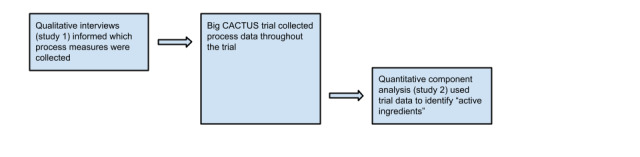
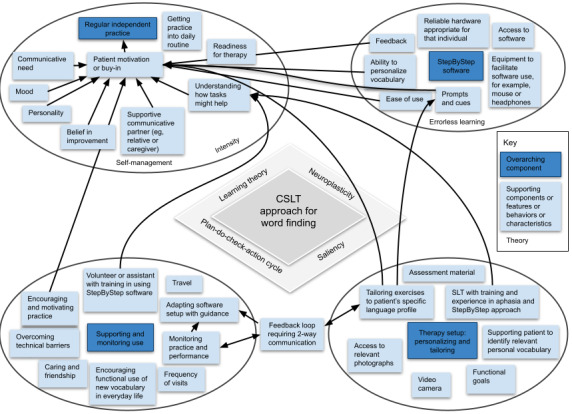
BACKGROUND: Aphasia is a communication disorder affecting more than one-third of stroke survivors. Computerized Speech and Language Therapy (CSLT) is a complex intervention requiring computer software, speech and language therapists, volunteers, or therapy assistants, as well as self-managed practice from the person with aphasia. CSLT was found to improve word finding, a common symptom of aphasia, in a multicenter randomized controlled trial (Clinical and Cost Effectiveness of Computer Treatment for Aphasia Post Stroke [Big CACTUS]). OBJECTIVE: This study provides a detailed description of the CSLT intervention delivered in the Big CACTUS trial and identified the active ingredients of the intervention directly associated with improved word finding for people with aphasia. METHODS: We conducted a multiple methods study within the context of a randomized controlled trial. In study 1, qualitative interviews explored key informants' understanding of the CSLT intervention, how the components interacted, and how they could be measured. Qualitative data were transcribed verbatim and analyzed thematically. Qualitative findings informed the process measures collected as part of a process evaluation of the CSLT intervention delivered in the Big CACTUS trial. In study 2, quantitative analyses explored the relationship between intervention process measures (length of computer therapy access; therapists' knowledge of CSLT; degree of rationale for CSLT tailoring; and time spent using the software to practice cued confrontation naming, noncued naming, and using words in functional sentences) and change in word-finding ability over a 6-month intervention period. RESULTS: Qualitative interviews were conducted with 7 CSLT approach experts. Thematic analysis identified four overarching components of the CSLT approach: (1) the StepByStep software (version 5; Steps Consulting Ltd), (2) therapy setup: tailoring and personalizing, (3) regular independent practice, and (4) support and monitoring. Quantitative analyses included process and outcome data from 83 participants randomized to the intervention arm of the Big CACTUS trial. The process measures found to be directly associated with improved word-finding ability were therapists providing a thorough rationale for tailoring the computerized therapy exercises and the amount of time the person with aphasia spent using the computer software to practice using words in functional sentences. CONCLUSIONS: The qualitative exploration of the CSLT approach provided a detailed description of the components, theories, and mechanisms underpinning the intervention and facilitated the identification of process measures to be collected in the Big CACTUS trial. Quantitative analysis furthered our understanding of which components of the intervention are associated with clinical improvement. To optimize the benefits of using the CSLT approach for word finding, therapists are advised to pay particular attention to the active ingredients of the intervention: tailoring the therapy exercises based on the individual's specific language difficulties and encouraging people with aphasia to practice the exercises focused on saying words in functional sentences. TRIAL REGISTRATION: ISRCTN Registry ISRCTN68798818; https://www.isrctn.com/ISRCTN68798818.
Overview
The claims and statistics of this paper haven’t been checked yet.
Free: it reads the open-access text and checks the first 5 claims that cite a source we can check. Create a free account to check every claim.
Integrity signals
Registry
Cites
Statistics
Figures
Verification
Claims the paper makes
The claims and statistics of this paper haven’t been checked yet.
Free: it reads the open-access text and checks the first 5 claims that cite a source we can check. Create a free account to check every claim.
Claims other papers make about this one
Each is checked against this paper’s own text: does it say what the citing paper says it does?
The source backs part of the claim, not all of it — or backs it for a different population, condition or comparison.
In the citing paper
“CSLT studies predominantly used personalised word lists and cueing hierarchies to target individual lexical deficits”
From Exploring the Effectiveness of Technology‐Based Interventions in Aphasia Rehabilitation: A Systematic Review (2026) · cites this paper as Harrison et al. 2023
Experimental — accuracy not yet measured
Self-check
Percentages, sums and reported differences re-computed from the paper’s own numbers.
The self-check needs the paper’s full text.
Citations
Cites
Using thematic analysis in psychology
Braun, V., & Clarke, V. (2006) · Qualitative Research in Psychology · doi:10.1191/1478088706qp063oa · Cited by 194,414
Hoffmann, T. C., Glasziou, P. P., Boutron, I., Milne, R., Perera, R., Moher, D., Altman, D. G., Barbour, V., Macdonald, H., Johnston, M., et al. (2014) · BMJ · doi:10.1136/bmj.g1687 · Cited by 10,548 · cited 1×
“The introduction of the Template for Intervention Description and Replication (TIDieR) checklist and guide [14] has both encouraged researchers to provide more detail about their interventions but also acted as an evaluation tool to demonstrate how infrequently intervention details are reported.”
MethodFeigin, V. L., Stark, B. A., Johnson, C. O., Roth, G. A., Bisignano, C., Abady, G. G., Abbasifard, M., Abbasi-Kangevari, M., Abd-Allah, F., Abedi, V., et al. (2021) · The Lancet Neurology · doi:10.1016/s1474-4422(21)00252-0 · Cited by 7,937
Process evaluation of complex interventions: Medical Research Council guidance
Moore, G. F., Audrey, S., Barker, M., Bond, L., Bonell, C., Hardeman, W., Moore, L., O'Cathain, A., Tinati, T., Wight, D., et al. (2015) · BMJ · doi:10.1136/bmj.h1258 · Cited by 6,204 · cited 1×
“Qualitative findings informed the process measures collected as part of a process evaluation [17] of the CSLT intervention delivered in the Big CACTUS trial.”
MethodA conceptual framework for implementation fidelity
Carroll, C., Patterson, M., Wood, S., Booth, A., Rick, J., & Balain, S. (2007) · Implementation Science · doi:10.1186/1748-5908-2-40 · Cited by 2,559
Babyak, M. A. (2004) · Psychosomatic Medicine · doi:10.1097/01.psy.0000127692.23278.a9 · Cited by 2,061 · cited 1×
“However, the method was used because it offers increased transparency compared to using an automated regression function, such as Stepwise regression [33].”
MethodDevelopment and validation of a revised short version of the working alliance inventory
Hatcher, R. L., & Gillaspy, J. A. (2006) · Psychotherapy Research · doi:10.1080/10503300500352500 · Cited by 1,355 · cited 1×
“The quality of the relationship was measured using the Working Alliance Inventory–Short Revised Therapist version (WAI-SRT), which was completed by the assistant or volunteer 4 months into the intervention period [23].”
MethodHarnessing neuroplasticity for clinical applications
Cramer, S. C., Sur, M., Dobkin, B. H., O'Brien, C., Sanger, T. D., Trojanowski, J. Q., Rumsey, J. M., Hicks, R., Cameron, J., Chen, D., et al. (2011) · Brain · doi:10.1093/brain/awr039 · Cited by 1,259 · cited 1×
“The importance of practice being carried out regularly was discussed in relation to the theory of neuroplasticity [22].”
BackgroundFidelity Criteria: Development, Measurement, and Validation
MOWBRAY, C. (2003) · The American Journal of Evaluation · doi:10.1016/s1098-2140(03)00057-2 · Cited by 884 · cited 1×
“Process measures included the use of unvalidated tools to measure tailoring, therapist knowledge, motivation, ease of use, and personalization—a limitation widely acknowledged in fidelity research due, in part, to the need for measures to be tailored to specific interventions [31,32].”
Engelter, S. T., Gostynski, M., Papa, S., Frei, M., Born, C., Ajdacic-Gross, V., Gutzwiller, F., & Lyrer, P. A. (2006) · Stroke · doi:10.1161/01.str.0000221815.64093.8c · Cited by 688 · cited 1×
“Approximately one-third of stroke survivors experience aphasia, an acquired communication disorder, affecting the production and comprehension of verbal language and the ability to read or write [2].”
BackgroundLessons from Complex Interventions to Improve Health
Hawe, P. (2015) · Annual Review of Public Health · doi:10.1146/annurev-publhealth-031912-114421 · Cited by 607 · cited 1×
“Hawe [24] proposed that complexity can be a property both of an intervention and the context in which it is operationalized and that we can only truly understand that complexity by recognizing that knowledge generation comes from clinicians and implementers as much as it comes from intervention…”
BackgroundTrotter, R. T. (2012) · Preventive Medicine · doi:10.1016/j.ypmed.2012.07.003 · Cited by 499 · cited 1×
“We identified the key informants using a nominated expert sampling strategy [18].”
MethodToward the Effective and Efficient Measurement of Implementation Fidelity
Schoenwald, S. K., Garland, A. F., Chapman, J. E., Frazier, S. L., Sheidow, A. J., & Southam-Gerow, M. A. (2011) · Administration and Policy in Mental Health and Mental Health Services Research · doi:10.1007/s10488-010-0321-0 · Cited by 422 · cited 1×
“Process measures included the use of unvalidated tools to measure tailoring, therapist knowledge, motivation, ease of use, and personalization—a limitation widely acknowledged in fidelity research due, in part, to the need for measures to be tailored to specific interventions [31,32].”
Aphasia therapy on a neuroscience basis
Pulvermüller, F., & Berthier, M. L. (2008) · Aphasiology · doi:10.1080/02687030701612213 · Cited by 296 · cited 1×
“…literature suggests that it is beneficial to practice the language in relevant action contexts (referred to as the behavioral relevance principle [27]), this could provide a possible explanation for why “naming words in functional sentences” (which sometimes included an action, eg, “Where do you…”
BackgroundThe treatment of anomia using errorless learning
Fillingham, J. K., Sage, K., & Lambon Ralph †, M. A. (2006) · Neuropsychological Rehabilitation · doi:10.1080/09602010443000254 · Cited by 250 · cited 1×
“The key theory underpinning the StepByStep software itself is that of errorless learning [21].”
BackgroundInterviews and focus groups in qualitative research: an update for the digital age
Gill, P., & Baillie, J. (2018) · British Dental Journal · doi:10.1038/sj.bdj.2018.815 · Cited by 203 · cited 1×
“Focus groups would have provided an opportunity to illuminate agreement and inconsistencies in participants’ understanding of the key components of the CSLT approach [30].”
BackgroundPalmer, R., Dimairo, M., Cooper, C., Enderby, P., Brady, M., Bowen, A., Latimer, N., Julious, S., Cross, E., Alshreef, A., et al. (2019) · The Lancet Neurology · doi:10.1016/s1474-4422(19)30192-9 · Cited by 200 · cited 5×
“Demonstrating that CSLT can be used to support sufficient amounts of therapy practice to enable effective retrieval of specific words, with speech and language therapists (SLTs) needing to provide additional support and activities to help people with aphasia use the words in everyday contexts [5,7].”
BackgroundMethodInfluentialSelf-citationHasson, H., Blomberg, S., & Dunér, A. (2012) · Implementation Science · doi:10.1186/1748-5908-7-23 · Cited by 194 · cited 1×
“Complex interventions are not static and they do not operate within a vacuum [29].”
BackgroundCollins, L. M., Trail, J. B., Kugler, K. C., Baker, T. B., Piper, M. E., & Mermelstein, R. J. (2014) · Translational Behavioral Medicine · doi:10.1007/s13142-013-0239-7 · Cited by 119 · cited 1×
“Intervention components may include the content of an intervention, features that promote adherence, or aspects of implementation [9].”
BackgroundIntensive language therapy in chronic aphasia: Which aspects contribute most?
Barthel, G., Meinzer, M., Djundja, D., & Rockstroh, B. (2008) · Aphasiology · doi:10.1080/02687030701415880 · Cited by 105 · cited 1×
“The tailoring of the type and difficulty of therapy exercises is supported by evidence of the effectiveness of model-oriented aphasia therapy, which tailors exercises based on the patient’s symptoms [25].”
BackgroundUsing Indices of Fidelity to Intervention Core Components to Identify Program Active Ingredients
Abry, T., Hulleman, C. S., & Rimm-Kaufman, S. E. (2015) · American Journal of Evaluation · doi:10.1177/1098214014557009 · Cited by 105 · cited 2×
“The importance of identifying the active ingredients (the essential and indispensable aspects) of interventions has been recognized in aphasia research [10] and beyond [11].”
BackgroundThye, M., & Mirman, D. (2018) · NeuroImage: Clinical · doi:10.1016/j.nicl.2018.10.017 · Cited by 99 · cited 1×
“Possible factors might include individual differences, such as lesion size [34]; wider contextual factors, such as social support; or other components of the intervention not measured within this study.”
BackgroundEffect of computer therapy in aphasia: a systematic review
Zheng, C., Lynch, L., & Taylor, N. (2015) · Aphasiology · doi:10.1080/02687038.2014.996521 · Cited by 89 · cited 1×
“A review demonstrated that CSLT is effective compared to no therapy but acknowledged the need for more research to establish whether it is effective compared to face-to-face speech and language therapy [6].”
Backgroundvan Olmen, J., Ku, G. M., Bermejo, R., Kegels, G., Hermann, K., & Damme, W. V. (2011) · Globalization and Health · doi:10.1186/1744-8603-7-38 · Cited by 79
Vaezipour, A., Campbell, J., Theodoros, D., & Russell, T. (2020) · JMIR mhealth and uhealth · doi:10.2196/18858 · Cited by 65 · cited 1×
“A wide variety of mobile apps for word finding are available on the market, and this finding suggests that being able to practice in sentences may be a key feature to look for in order to maximize improvement of word retrieval [28].”
BackgroundPalmer, R., Witts, H., & Chater, T. (2018) · PLOS ONE · doi:10.1371/journal.pone.0200096 · Cited by 60 · cited 1×
“Due to health care costs, limited speech and language therapy is provided to people with poststroke aphasia beyond the first few months [3].”
BackgroundSelf-citationJayes, M., & Palmer, R. (2014) · International Journal of Speech-Language Pathology · doi:10.3109/17549507.2013.795999 · Cited by 53 · cited 1×
“The Consent Support Tool [19] was used to determine the optimum format to present information to people with aphasia.”
MethodSelf-citationPalmer, R., Dimairo, M., Latimer, N., Cross, E., Brady, M., Enderby, P., Bowen, A., Julious, S., Harrison, M., Alshreef, A., et al. (2020) · Health Technology Assessment · doi:10.3310/hta24190 · Cited by 53 · cited 4×
“From October 2014 to August 2016, people with aphasia were recruited into a pragmatic, 3-arm, single-blind (outcome assessor), individually randomized controlled trial of CSLT [5,7].”
BackgroundMethodInfluentialSelf-citationComplex intervention modelling should capture the dynamics of adaptation
Greenwood-Lee, J., Hawe, P., Nettel-Aguirre, A., Shiell, A., & Marshall, D. A. (2016) · BMC Medical Research Methodology · doi:10.1186/s12874-016-0149-8 · Cited by 36 · cited 2×
“As therapists implement the CSLT approach with inevitable adaptations to the local context [12], it may be most beneficial to people with aphasia if they are mindful of the importance of these aspects of the intervention and seek to retain them when adapting the approach locally.”
BackgroundReporting of Telehealth-Delivered Dietary Intervention Trials in Chronic Disease: Systematic Review
Warner, M. M., Kelly, J. T., Reidlinger, D. P., Hoffmann, T., & Campbell, K. L. (2017) · Journal of Medical Internet Research · doi:10.2196/jmir.8193 · Cited by 28 · cited 1×
“Intervention reporting has been found wanting in both aphasia [15] and telehealth research [16].”
BackgroundBurke, J., Palmer, R., & Harrison, M. (2021) · Disability and Rehabilitation · doi:10.1080/09638288.2020.1871519 · Cited by 23 · cited 1×
“SLTs have identified that tailoring computer software to the needs of individuals can be time-consuming [26].”
BackgroundSelf-citationAn Umbrella Review of Aphasia Intervention descriPtion In Research: the AsPIRE project
Dipper, L. T., Franklin, S., de Aguiar, V., Baumgaertner, A., Brady, M., Best, W., Bruehl, S., Denes, G., Godecke, E., Gil, M., et al. (2021) · Aphasiology · doi:10.1080/02687038.2020.1852001 · Cited by 18 · cited 1×
“Intervention reporting has been found wanting in both aphasia [15] and telehealth research [16].”
BackgroundQuantifying aphasia treatment: The effect of aphasia severity on treatment dose
Lerman, A. (2022) · Aphasiology · doi:10.1080/02687038.2022.2089970 · Cited by 6 · cited 1×
“The importance of identifying the active ingredients (the essential and indispensable aspects) of interventions has been recognized in aphasia research [10] and beyond [11].”
Background
Cited by
Atalık, G., & Kayıkçı, M. E. K. (2024) · Disability and Rehabilitation Assistive Technology · doi:10.1080/17483107.2024.2431056 · Cited by 3
Alhejji, B., Cunningham, S., Dorney, S., & Palmer, R. (2026) · International Journal of Language & Communication Disorders · doi:10.1111/1460-6984.70322 · Cited by 1
“CSLT studies predominantly used personalised word lists and cueing hierarchies to target individual lexical deficits (e.g., Lavoie et al. 2018 ; Harrison et al. 2023 ; Upton et al. 2024 ; González-Sánchez and Vereda Alonso 2025 ), while VR studies embedded naming within communicative exchanges and…”
Self-citationKim, S., Kim, M., Cho, S., Kim, J., Kim, J., & Kim, Y. (2025) · Digital Health · doi:10.1177/20552076251381630 · Cited by 1
Telerehabilitation in aphasia after stroke: a systematic review of qualitative research
Cetinkaya, B., EROĞLU, H. S., & Benafif, S. (2026) · Aphasiology · doi:10.1080/02687038.2026.2754996
Metadata
- Authors
- Harrison, M., Palmer, R., & Cooper, C.
- Affiliations
- University of Sheffield (GB)
- Corresponding author
- Harrison, Madeleine
- Venue
- JMIR Rehabilitation and Assistive Technologies
- Publisher
- JMIR Publications Inc.
- Published
- 2023-12-05
- Volume
- 10
- Pages
- e47542
- ISSN
- 2369-2529 (ISSN-L)
- PMC
- PMC10731555
- OpenAlex
- W4389335956
- Semantic Scholar
- d8156d65bd8036ff6382f20c200089c1dc7e2bff
- Cited by
- 3
- References
- 33
- Citations by year
- 2026: 1 · 2025: 1 · 2024: 1
- FWCI
- 0.45
- Type
- journal article
- Language
- en
- Open access
- gold
- doi.org
- Licence
- cc-by
- Locations
- JMIR Rehabilitation and Assistive Technologies (publishedVersion, cc-by)
- PubMed Central (publishedVersion, cc-by)
- PubMed (publishedVersion)
- White Rose Research Online (University of Leeds, The University of Sheffield, University of York) (acceptedVersion, cc-by)
- DOAJ (DOAJ: Directory of Open Access Journals) (submittedVersion, cc-by-sa)
- Topics
- Life Sciences › Neuroscience › Cognitive Neuroscience › Neurobiology of Language and Bilingualism
- Health Sciences › Health Professions › Occupational Therapy › Assistive Technology in Communication and Mobility
- Health Sciences › Medicine › Rehabilitation › Stroke Rehabilitation and Recovery
- Keywords
- post-stroke aphasia, word retrieval, active ingredients, therapist knowledge, stroke rehabilitation, process evaluation, randomized controlled trial design
About these checks
Registry, retraction, Cites and statistics results are computed, not judged, with one exception: a printed reference that no index lists is read once by a model before it counts as a citation error. Claims are extracted by a model and kept only when their quote appears verbatim in the text; each cited source is then checked, with a model’s help, for whether it says what the claim relies on. Those verdicts can be wrong — read the claim’s quote and the cited source before relying on one.
Statistics and arithmetic are recomputed, not judged.
Confidence bands are shown only for fields calibrated on our annotated test set. None is calibrated yet, so no band is shown.
What counts as a claim ›How we measure confidence ›How we check this ›
Are you an author, or do you see a problem with this page? Request a review
Data sources
Bibliographic data: Semantic Scholar, OpenAlex, Crossref.
Contains information from the Semantic Scholar Academic Graph Datasets, made available under the ODC Attribution License (ODC-BY 1.0).
Semantic Scholar’s data is described in: Kinney, R., et al. (2023). The Semantic Scholar Open Data Platform. arXiv:2301.10140.
