

Medicaid Education and Eligibility Planning for Caregivers: Website Usability and Validation Study
Open accessThe DOI matches its Crossref record; 34 of the 34 references it cites were found in a registry or an index; none of the 31 sources its claims cite is checked for support yet.
Abstract
Background: Most older Americans have not saved enough to cover long-term care costs. Medicaid—a public health care program for low-income individuals—can help Americans with qualifying care needs pay for assistance in a nursing home or for services in the home. Determining financial eligibility for Medicaid is complicated, and the application process is often managed by family caregivers with limited knowledge of Medicaid programs. Objective: A one-stop digital solution is needed to help family caregivers plan for the cost of long-term care services and learn about getting help paying for services through Medicaid. We aimed to develop a web application that (1) educates informal caregivers about Medicaid programs and eligibility criteria, (2) informs them about the cost of home and institutional care in their local area with and without Medicaid coverage, and (3) uses a custom algorithm to provide personalized financial eligibility information based on the care recipient’s income, assets, and monthly spending. Methods: We first interviewed aging services providers and informal family caregivers, then developed a web application that was refined based on user experience interviews with English- and Spanish-speaking caregivers. In the final validation phase, asynchronous usability sessions were recorded with 109 informal caregivers who completed a series of tasks. Participants viewed and rated animated Medicaid “explainer” videos, input financial information to enable the custom algorithm to determine the care recipient’s eligibility for Medicaid, adjusted settings on a care cost calculator to estimate the regional cost of home and institutional care services, and completed a Medicaid knowledge quiz before and after using the website. Results: After engaging with the website and watching the videos, scores on a Medicaid knowledge quiz increased by 61.2% (2-tailed t 92 =12.9, P <.001). Participants found it easy to enter the care recipient’s financial information to determine Medicaid eligibility (out of 7; mean 5.9, SD 1.3) and perceived the care cost calculator as very helpful (out of 7; mean 6.3, SD 1.2). The website received a very high System Usability Scale rating of 88.3 out of 100 (SD 13.1). Caregivers verbalized wanting more education on complex financial concepts that impact Medicaid eligibility and asset preservation. Conclusions: A comprehensive Medicaid planning website can significantly improve caregivers’ knowledge of Medicaid and provide them with a personalized roadmap for accessing care services. The custom algorithm powering the Medicaid eligibility determination could be further refined to account for state-based exceptions. This application may reduce caregiver burden and help support the long-term care planning process.
Overview
CoChat Summary
TL;DR
A web application was developed to educate family caregivers about Medicaid long-term care eligibility and costs, then validated in an asynchronous usability study with 109 caregivers. It significantly improved Medicaid knowledge and received very high usability ratings, though participants still struggled with some complex financial concepts and calculator tasks.
Key findings
- Medicaid knowledge quiz scores increased by 61.2% after using the website and watching explainer videos: mean pretest 42.4% correct (SD 0.19%) to posttest 68.4% (SD 0.15%); paired-samples t test t92=12.9, P<.001.
- The website received a System Usability Scale score of 88.3 out of 100 (SD 13.1), and participants rated the care cost calculator as very helpful (mean 6.3/7, SD 1.19) and entering financial information as fairly easy (mean 5.9/7, SD 1.34).
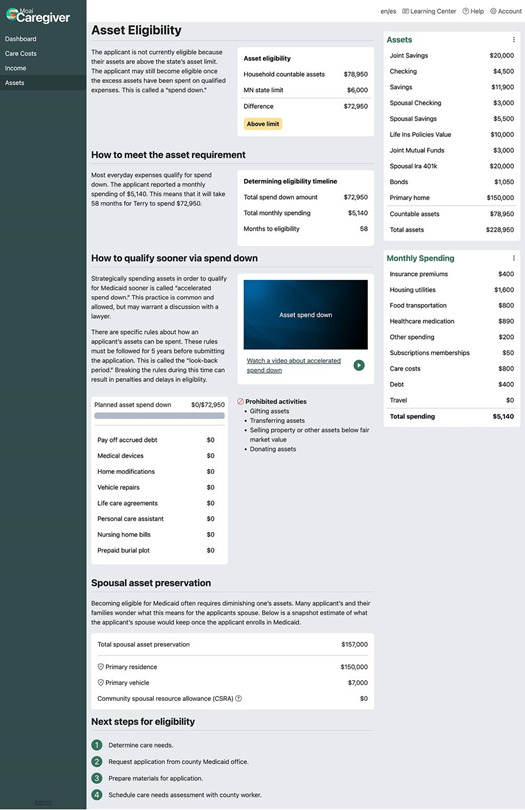
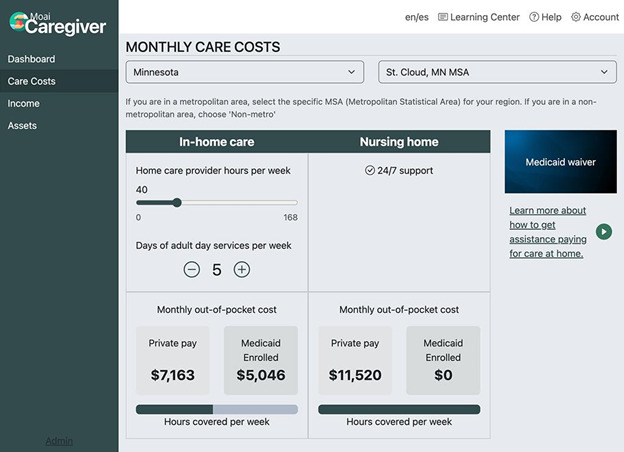
- Most participants (89/109, 81.7%) correctly entered the displayed Medicaid spend-down amount on the Assets page, but only 59/109 (54.1%) successfully completed the first care cost calculator task and 56% completed the second.
- There were no significant differences in knowledge gains between participants with prior Medicaid experience and those without (t68=0.05; P=.96).
Methods
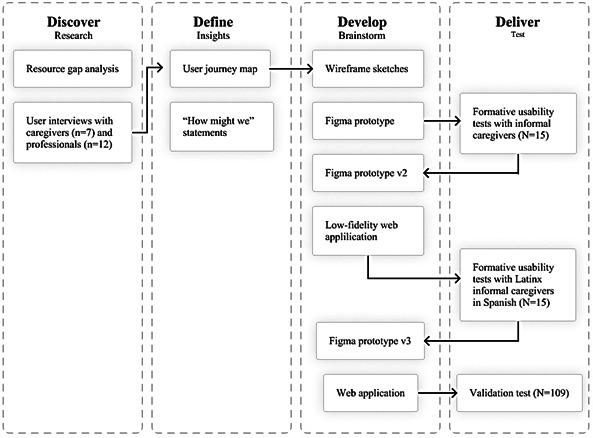
- Website development followed the Double Diamond design-thinking process, including interviews with informal caregivers and aging services providers, formative usability testing with 15 informal caregivers of older adults with ADRD, and testing with 15 Spanish-speaking informal caregivers.
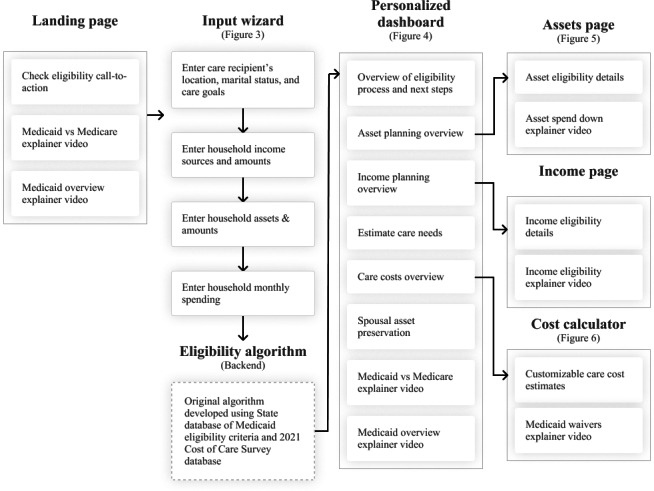
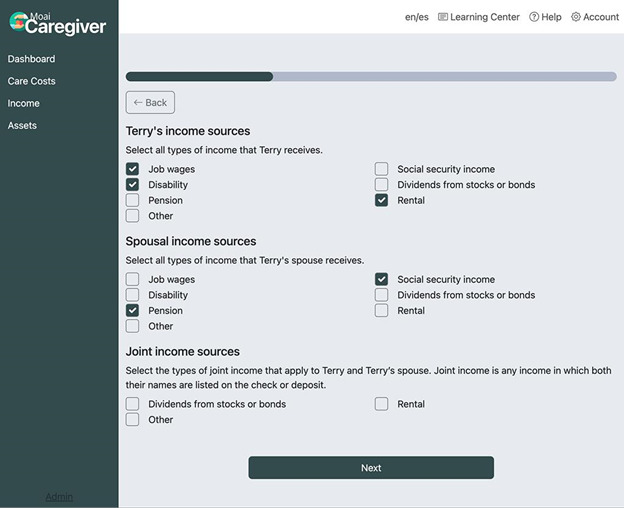
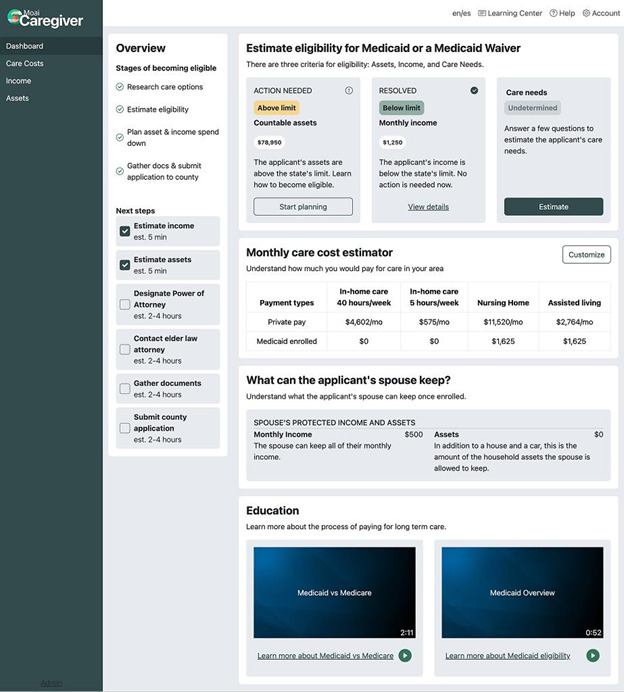
- Final validation used asynchronous usability sessions via Userfeel with 109 current or former caregivers of adults aged >60 years; participants completed Medicaid knowledge pretest/posttest, watched and rated 4 of 6 explainer videos, used an intake wizard for eligibility determination, adjusted a care cost calculator, and completed the SUS.
- Analysis included descriptive statistics, paired-samples t test for pretest-posttest knowledge change, independent-samples t test for prior Medicaid experience, and review of screen/audio recordings for task completion and verbal feedback.
Limitations
- The paper states that asynchronous sessions limited follow-up questions; 2 participants encountered error messages preventing task completion, 5 did not watch all required videos due to slow loading, and Userfeel did not allow randomization of question/task ordering, possibly producing order effects.
- The paper states that the “Create an Account” feature was removed for confidentiality, which may have negatively affected privacy perceptions; many participants approximated or “made up” financial amounts, affecting eligibility calculations.
- The paper states validation was entirely in English with experienced users, limiting generalizability; future studies should include inexperienced web users, older caregivers (>70 years), participants with varied government-program experience, delayed follow-up for knowledge retention, other languages, and more spousal caregivers. Evident from the text: demographic/caregiving data were missing for 17 participants (15.6%), and 77% of participants were classified as “power users,” which may further limit representativeness.
Model-written summary. Check it against the paper before relying on it.
Integrity signals
Registry
Cites
Statistics
Figures
Verification
Claims the paper makes
0 Valid · 3 Not valid · 24 Not checked · 101 Own results and interpretations
A result the paper reports from its own data — it cites no other source for it, so there is none to check. The quote shows it is in the paper.
In the paper
“After engaging with the website and watching the videos, scores on a Medicaid knowledge quiz increased by 61.2% (2-tailed t92=12.9, P<.001).”
§ Medicaid Education and Eligibility Planning for Caregivers: Website Usability and Validation Study > Abstract > Results
plainstates a cause- Asserted: passes — The authors put it forward as true.
- Checkable: passes — It can be checked against evidence.
- Load-bearing: passes — The paper’s conclusions depend on it.
- Based: passes — The paper gives a reason why it holds.
- Rests on an assumption not shown here.
A result the paper reports from its own data — it cites no other source for it, so there is none to check. The quote shows it is in the paper.
In the paper
“| Did not learn anything useful | 1.17 (0.55) | 1=Strongly disagree to 5=Strongly agree |”
§ Medicaid Education and Eligibility Planning for Caregivers: Website Usability and Validation Study > Results > Intake Wizard and Medicaid Eligibility Determination
plain- Asserted: passes — The authors put it forward as true.
- Checkable: passes — It can be checked against evidence.
- Load-bearing: passes — The paper’s conclusions depend on it.
- Based: passes — The paper gives a reason why it holds.
A result the paper reports from its own data — it cites no other source for it, so there is none to check. The quote shows it is in the paper.
In the paper
“Errors were largely due to not selecting the correct state or MSA (n=30).”
§ Medicaid Education and Eligibility Planning for Caregivers: Website Usability and Validation Study > Results > Care Cost Calculator
plainstates a causen = 30- Asserted: passes — The authors put it forward as true.
- Checkable: passes — It can be checked against evidence.
- Load-bearing: unclear — It is unclear whether the paper’s conclusions depend on it.
- Based: passes — The paper gives a reason why it holds.
A result the paper reports from its own data — it cites no other source for it, so there is none to check. The quote shows it is in the paper.
In the paper
“The score was 89.4 out of 100 (SD 18.8)”
§ Medicaid Education and Eligibility Planning for Caregivers: Website Usability and Validation Study > Results > User Satisfaction
plain- Asserted: passes — The authors put it forward as true.
- Checkable: passes — It can be checked against evidence.
- Load-bearing: unclear — It is unclear whether the paper’s conclusions depend on it.
- Based: passes — The paper gives a reason why it holds.
A result the paper reports from its own data — it cites no other source for it, so there is none to check. The quote shows it is in the paper.
In the paper
“and 11 (10%) could not locate the number displayed.”
§ Medicaid Education and Eligibility Planning for Caregivers: Website Usability and Validation Study > Results > Intake Wizard and Medicaid Eligibility Determination
plain- Asserted: passes — The authors put it forward as true.
- Checkable: passes — It can be checked against evidence.
- Load-bearing: unclear — It is unclear whether the paper’s conclusions depend on it.
- Based: passes — The paper gives a reason why it holds.
58 more claims
Create a free account to see all 128 claims and to verify the 27 references still open.
- It may state two separate claims as one. 38
- Probably not a substantial claim. 43
Self-check
Percentages, sums and reported differences re-computed from the paper’s own numbers.
Each contradiction between two passages listed here was confirmed by an independent check.
Rated minor: it would not touch a result — a value no result rests on, a p-value that stays on the same side of the significance level, or a conflict that is clerical, resolved elsewhere in the paper, or outside its own findings.
In the paper
“44 (41.3%) were not Medicaid-enrolled”
§ Medicaid Education and Eligibility Planning for Caregivers: Website Usability and Validation Study > Results > Participant Characteristics
Reported 41.3 · recomputed 40.366972
Rated minor: it would not touch a result — a value no result rests on, a p-value that stays on the same side of the significance level, or a conflict that is clerical, resolved elsewhere in the paper, or outside its own findings.
In the paper
“assets below the limit (42/109, 39.3% said yes)”
§ Medicaid Education and Eligibility Planning for Caregivers: Website Usability and Validation Study > Results > Intake Wizard and Medicaid Eligibility Determination
Reported 39.3 · recomputed 38.53211
Rated minor: it would not touch a result — a value no result rests on, a p-value that stays on the same side of the significance level, or a conflict that is clerical, resolved elsewhere in the paper, or outside its own findings.
In the paper
“income below the state limit (55/109, 51.4% said yes)”
§ Medicaid Education and Eligibility Planning for Caregivers: Website Usability and Validation Study > Results > Intake Wizard and Medicaid Eligibility Determination
Reported 51.4 · recomputed 50.458716
Rated minor: it would not touch a result — a value no result rests on, a p-value that stays on the same side of the significance level, or a conflict that is clerical, resolved elsewhere in the paper, or outside its own findings.
In the paper
“Furthermore, 28 participants responded that the person they care or cared for was enrolled in Medicaid or received a Medicaid waiver for HCBS, 44 (41.3%) were not Medicaid-enrolled, 12 (11%) were unsure, and 9 (14.7%) were missing.”
§ Medicaid Education and Eligibility Planning for Caregivers: Website Usability and Validation Study > Results > Participant Characteristics
Reported 109 · recomputed 93
Rated minor: it would not touch a result — a value no result rests on, a p-value that stays on the same side of the significance level, or a conflict that is clerical, resolved elsewhere in the paper, or outside its own findings.
In the paper
§ Medicaid Education and Eligibility Planning for Caregivers: Website Usability and Validation Study > Results > Care Cost Calculator
“Using the same settings, participants were asked to enter the average cost displayed for in-home care if the care recipient was NOT enrolled in Medicare (ie, private pay).”
§ Medicaid Education and Eligibility Planning for Caregivers: Website Usability and Validation Study > Methods > Overview of Web Application
“Out-of-pocket costs for private pay are compared to out-of-pocket costs for Medicaid-enrolled individuals.”
1 more finding
Create a free account to see every finding of this check.
Citations
Cites
SUS: A 'Quick and Dirty' Usability Scale
(1996) · Usability Evaluation In Industry · doi:10.1201/9781498710411-35 · Cited by 8,989
The System Usability Scale: Past, Present, and Future
Lewis, J. R. (2018) · International Journal of Human–Computer Interaction · doi:10.1080/10447318.2018.1455307 · Cited by 1,958
The Factor Structure of the System Usability Scale
Lewis, J. R., & Sauro, J. (2009) · Lecture Notes in Computer Science · doi:10.1007/978-3-642-02806-9_12 · Cited by 1,278
Kokolakis, S. (2017) · Computers & Security · doi:10.1016/j.cose.2015.07.002 · Cited by 1,229
Brame, C. J. (2016) · CBE—Life Sciences Education · doi:10.1187/cbe.16-03-0125 · Cited by 1,124
Manly, J. J., Jones, R. N., Langa, K. M., Ryan, L. H., Levine, D. A., McCammon, R., Heeringa, S. G., & Weir, D. (2022) · JAMA Neurology · doi:10.1001/jamaneurol.2022.3543 · Cited by 560 · cited 1×
“The likelihood of needing LTSS and the overall cost are much greater for those living with Alzheimer disease and related dementias (ADRD) [2-4], which affects approximately 1 in 10 adults aged 65 years and older [5].”
Weinmann, M., Schneider, C., & Brocke, J. V. (2016) · Business & Information Systems Engineering · doi:10.1007/s12599-016-0453-1 · Cited by 553
Overcoming Online Information Privacy Concerns: An Information-Processing Theory Approach
Hann, I.-H., Hui, K.-L., Lee, S.-Y. T., & Png, I. P. L. (2007) · Journal of Management Information Systems · doi:10.2753/mis0742-1222240202 · Cited by 481
Long-Term Care: Who Gets It, Who Provides It, Who Pays, And How Much?
Kaye, H. S., Harrington, C., & LaPlante, M. P. (2010) · Health Affairs · doi:10.1377/hlthaff.2009.0535 · Cited by 358
The Disproportionate Impact Of Dementia On Family And Unpaid Caregiving To Older Adults
Kasper, J. D., Freedman, V. A., Spillman, B. C., & Wolff, J. L. (2015) · Health Affairs · doi:10.1377/hlthaff.2015.0536 · Cited by 354
Policymaking by Other Means: Do States Use Administrative Barriers to Limit Access to Medicaid?
Moynihan, D. P., Herd, P., & Ribgy, E. (2013) · Administration & Society · doi:10.1177/0095399713503540 · Cited by 192
Direct and indirect cost of managing alzheimer’s disease and related dementias in the United States
Deb, A., Thornton, J. D., Sambamoorthi, U., & Innes, K. (2017) · Expert Review of Pharmacoeconomics & Outcomes Research · doi:10.1080/14737167.2017.1313118 · Cited by 190
Administrative Easing: Rule Reduction and Medicaid Enrollment
FOX, A. M., Stazyk, E. C., & Feng, W. (2019) · Public Administration Review · doi:10.1111/puar.13131 · Cited by 170
The US Medicaid Program: Coverage, Financing, Reforms, and Implications for Health Equity
Donohue, J. M., Cole, E. S., James, C. V., Jarlenski, M., Michener, J. D., & Roberts, E. T. (2022) · JAMA · doi:10.1001/jama.2022.14791 · Cited by 169
Cooke, L. (2010) · IEEE Transactions on Professional Communication · doi:10.1109/tpc.2010.2052859 · Cited by 128
AFIFY, M. K. (2020) · Turkish Online Journal of Distance Education · doi:10.17718/tojde.803360 · Cited by 80
Hassan, A. Y. I. (2020) · JMIR Aging · doi:10.2196/20310 · Cited by 78
Long-term Services and Supports (LTSS): a growing challenge for an aging America
Thomas, K. S., & Applebaum, R. (2015) · Public Policy & Aging Report · doi:10.1093/ppar/prv003 · Cited by 58
Vaughan, C., Trail, T. E., Mahmud, A., Dellva, S., Tanielian, T., & Friedman, E. (2018) · Journal of Medical Internet Research · doi:10.2196/jmir.9895 · Cited by 47 · cited 1×
“…developed to improve caregiver well-being and resilience [25], motivate physical activity [26], coordinate care [27], and engage with peer support [28], but to date, there is no one-stop solution designed for older adults and their caregivers to get personalized information on offsetting the high…”
Soares, S., Hoffmeister, L. V., Fernandes, M. D. F., Henriques, A., & Costa, A. (2024) · JMIR Aging · doi:10.2196/54913 · Cited by 36
Intention to adopt mHealth apps among informal caregivers: cross-sectional study
Ghahramani, F., & Wang, J. (2021) · JMIR mHealth and uHealth · doi:10.2196/24755 · Cited by 32
Out‐of‐pocket costs attributable to dementia: A longitudinal analysis
Oney, M., White, L., & Coe, N. B. (2022) · Journal of the American Geriatrics Society · doi:10.1111/jgs.17746 · Cited by 29
Designing and evaluating IT applications for informal caregivers: scoping review
Premanandan, S., Ahmad, A., Cajander, Å., Ågerfalk, P., & van Gemert-Pijnen, L. (2024) · Journal of Medical Internet Research · doi:10.2196/57393 · Cited by 23
Egan, K. J., Hodgson, W., Dunlop, M. D., Imperatore, G., Kirk, A. F., & Maguire, R. (2021) · JMIR Formative Research · doi:10.2196/27358 · Cited by 22
Turk, A., Fairclough, E., Smith, G. G., Lond, B. J., Nanton, V., & Dale, J. R. (2019) · JMIR Aging · doi:10.2196/13875 · Cited by 22
Rebalancing Medicaid Long-Term Services And Supports
(2015) · doi:10.1377/hpb20150917.439553 · Cited by 21
Shen, H., Han, Y., Shi, W., Yu, J., Shan, X., Wang, H., & Wang, J. (2025) · JMIR mHealth and uHealth · doi:10.2196/65983 · Cited by 16
Fabius, C. D., Okoye, S. M., Mulcahy, J., Burgdorf, J. G., & Wolff, J. L. (2022) · The Journals of Gerontology Series B · doi:10.1093/geronb/gbac072 · Cited by 16
Long-Term Services and Supports
Hado, E., & Komisar, H. (2019) · doi:10.26419/ppi.00079.001 · Cited by 15
What policymakers need to know about long-term services and supports
Wiener, J. M., Lepore, M., & Jones, J. (2018) · Public Policy & Aging Report · doi:10.1093/ppar/pry001 · Cited by 14
Scattarelli, J., Moeller, K., Urbanski, D., & DeLiema, M. (2026) · Journal of Applied Gerontology · doi:10.1177/07334648251333181 · Cited by 3
Self-citationHealth Policy Brief: Rebalancing Medicaid Long-Term Services And Supports
(2015) · Forefront Group · doi:10.1377/forefront.20150918.050656 · Cited by 2
Long-term care residents meet ‘cost of shortfall in care’
(1988) · Elderly Care · doi:10.7748/eldc.8.5.5.s4 · Cited by 1
Boutilier, J. J., Loganathar, P., Linden, A. R., Scheer, E. R., Noejovich, S. I., Elliott, C., Zuraw, M., & Werner, N. E. (2022) · JMIR Aging · doi:10.2196/41912 · Cited by 1
Cited by
Still being checked.
Metadata
- Authors
- DeLiema, M., Gao, S., Scattarelli, J., Moeller, K., & Olofinboba, O.
- Affiliations
- University of Minnesota (US)
- Moai Technologies (United States) (US)
- Corresponding author
- DeLiema, Marguerite
- Venue
- JMIR Aging
- Publisher
- JMIR Publications Inc.
- Published
- 2025-08-27
- Volume
- 8
- Pages
- e77441-e77441
- ISSN
- 2561-7605 (ISSN-L)
- PMC
- PMC12386547
- OpenAlex
- W4413085370
- Cited by
- 0
- References
- 34
- FWCI
- 0.00
- Type
- journal article
- Language
- en
- Open access
- gold
- doi.org
- Licence
- cc-by
- Locations
- JMIR Aging (publishedVersion, cc-by)
- Europe PMC (PubMed Central) (publishedVersion, cc-by)
- PubMed Central (publishedVersion, cc-by)
- PubMed (publishedVersion)
- DOAJ (DOAJ: Directory of Open Access Journals) (submittedVersion)
- Funders
- Small Business Innovation Research
- National Institute on Aging (R44AG074135)
- Topics
- Health Sciences › Medicine › Geriatrics and Gerontology › Technology Use by Older Adults
- Physical Sciences › Computer Science › Human-Computer Interaction › Usability and User Interface Design
- Health Sciences › Medicine › Geriatrics and Gerontology › Geriatric Care and Nursing Homes
- Keywords
- Medicaid, family caregivers, long-term care planning, Medicaid eligibility, web application usability, home care costs, nursing home costs, caregiver education, Spanish-speaking caregivers, asset preservation, elder care financing
- MeSH terms
- Adult, Aged, Eligibility Determination, Female, Humans, Long-Term Care, Male, Medicaid, Middle Aged, United States, Caregivers, Internet
About these checks
Registry, retraction, Cites and statistics results are computed, not judged, with one exception: a printed reference that no index lists is read once by a model before it counts as a citation error. Claims are extracted by a model and kept only when their quote appears verbatim in the text; each cited source is then checked, with a model’s help, for whether it says what the claim relies on. Those verdicts can be wrong — read the claim’s quote and the cited source before relying on one.
A language model drew the claims from the paper on 2026-11-24, under version 3 of the claim definition (model deepseek-v4.1-flash, prompt extract-v3).
A second model labelled each claim on 2026-11-24 (model jev-1.13-20260917, definition revision gold-guideline-v0.2).
Statistics and arithmetic are recomputed, not judged.
Confidence bands are shown only for fields calibrated on our annotated test set. None is calibrated yet, so no band is shown.
What counts as a claim ›How we measure confidence ›How we check this ›
Are you an author, or do you see a problem with this page? Request a review
Data sources
Bibliographic data: Semantic Scholar, OpenAlex, Crossref.
Contains information from the Semantic Scholar Academic Graph Datasets, made available under the ODC Attribution License (ODC-BY 1.0).
Semantic Scholar’s data is described in: Kinney, R., et al. (2023). The Semantic Scholar Open Data Platform. arXiv:2301.10140.
