

The DOI matches its Crossref record; 35 of the 35 references it cites were found in a registry or an index.
Engagement in a Diabetes Self-management Website: Usage Patterns and Generalizability of Program Use
Open accessAbstract
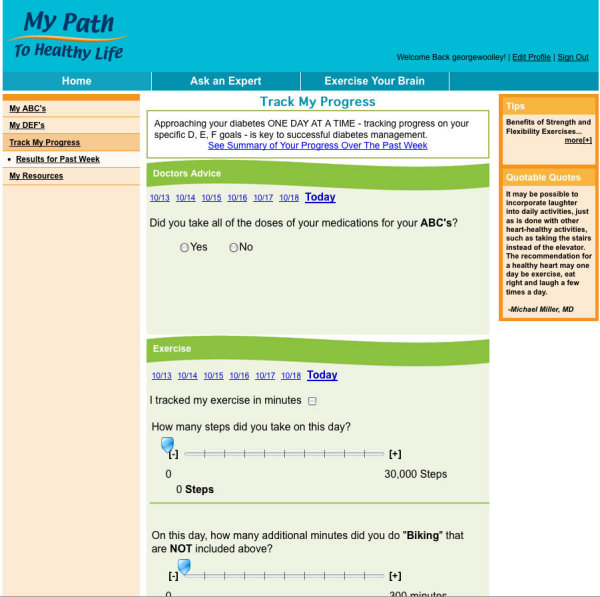
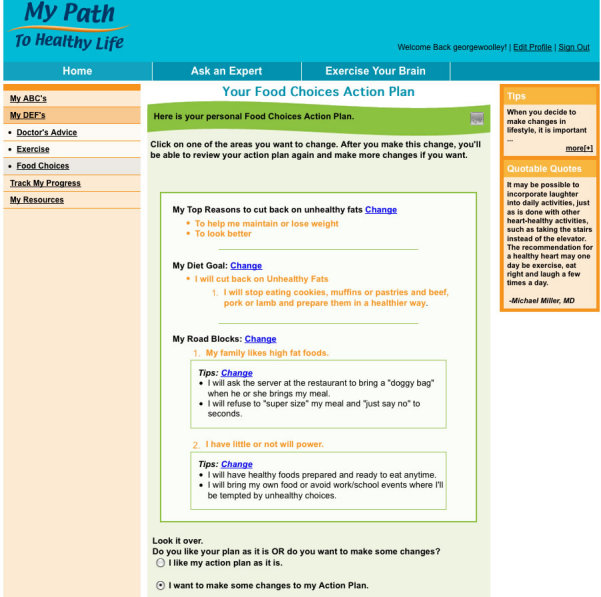
BACKGROUND: Increased access to the Internet and the availability of efficacious eHealth interventions offer great promise for assisting adults with diabetes to change and maintain health behaviors. A key concern is whether levels of engagement in Internet programs are sufficient to promote and sustain behavior change. OBJECTIVE: This paper used automated data from an ongoing Internet-based diabetes self-management intervention study to calculate various indices of website engagement. The multimedia website involved goal setting, action planning, and self-monitoring as well as offering features such as "Ask an Expert" to enhance healthy eating, physical activity, and medication adherence. We also investigated participant characteristics associated with website engagement and the relationship between website use and 4-month behavioral and health outcomes. METHODS: We report on participants in a randomized controlled trial (RCT) who were randomized to receive (1) the website alone (n = 137) or (2) the website plus human support (n = 133) that included additional phone calls and group meetings. The website was available in English and Spanish and included features to enhance engagement and user experience. A number of engagement variables were calculated for each participant including number of log-ins, number of website components visited at least twice, number of days entering self-monitoring data, number of visits to the "Action Plan" section, and time on the website. Key outcomes included exercise, healthy eating, and medication adherence as well as body mass index (BMI) and biological variables related to cardiovascular disease risk. RESULTS: Of the 270 intervention participants, the average age was 60, the average BMI was 34.9 kg/m², 130 (48%) were female, and 62 (23%) self-reported Latino ethnicity. The number of participant visits to the website over 4 months ranged from 1 to 119 (mean 28 visits, median 18). Usage decreased from 70% of participants visiting at least weekly during the first 6 weeks to 47% during weeks 7 to 16. There were no significant differences between website only and website plus support conditions on most of the engagement variables. In total, 75% of participants entered self-monitoring data at least once per week. Exercise action plan pages were visited more often than medication taking and healthy eating pages (mean of 4.3 visits vs 2.8 and 2.0 respectively, P < .001). Spearman nonparametric correlations indicated few significant associations between patient characteristics and summary website engagement variables, and key factors such as ethnicity, baseline computer use, age, health literacy, and education were not related to use. Partial correlations indicated that engagement, especially in self-monitoring, was most consistently related to improvement in healthy eating (r = .20, P = .04) and reduction of dietary fat (r = -.31, P = .001). There was also a significant correlation between self-monitoring and improvement in exercise (r = .20, P = .033) but not with medication taking. CONCLUSIONS: Participants visited the website fairly often and used all of the theoretically important sections, but engagement decreased over 4 months. Usage rates and patterns were similar for a wide range of participants, which has encouraging implications for the potential reach of online interventions. TRIAL REGISTRATION: NCT00987285; http://clinicaltrials.gov/show/NCT00987285 (Archived by WebCite at http://www.webcitation.org/5vpe4RHTV).
Overview
The claims and statistics of this paper haven’t been checked yet.
Run the check — free, no account needed. It reads the open-access text and checks the sources it cites.
Integrity signals
Registry
Cites
Statistics
Figures
Verification
Claims the paper makes
The claims and statistics of this paper haven’t been checked yet.
Run the check — free, no account needed. It reads the open-access text and checks the sources it cites.
Claims other papers make about this one
Each is checked against this paper’s own text: does it say what the citing paper says it does?
The source backs part of the claim, not all of it — or backs it for a different population, condition or comparison.
In the citing paper
“The application was equipped with neither “push” factors nor an advanced decision support system providing feedback based on accumulated data and other personal profiles, which are advocated for long-term usage, according to relevant studies [62-65].”
From Long-Term Engagement With a Mobile Self-Management System for People With Type 2 Diabetes (2013) · cites this paper as [64]
Experimental — accuracy not yet measuredThe source backs part of the claim, not all of it — or backs it for a different population, condition or comparison.
In the citing paper
“others have found no association between adherence and age, gender, or education level [80,81].”
From Web-Based Interventions for Behavior Change and Self-Management: Potential, Pitfalls, and Progress (2012) · cites this paper as [80]
Experimental — accuracy not yet measuredIn the citing paper
“Log data analyses in eHealth research have mainly focused on descriptive statistics, such as the number of logins, time spent, and the frequency of use of the different elements by all users as a group [18-20].”
From Opening the Black Box of Electronic Health: Collecting, Analyzing, and Interpreting Log Data (2017) · cites this paper as [18]
In the citing paper
“The application was equipped with neither “push” factors nor an advanced decision support system providing feedback based on accumulated data and other personal profiles, which are advocated for long-term usage, according to relevant studies [62-65].”
From Long-Term Engagement With a Mobile Self-Management System for People With Type 2 Diabetes (2013) · cites this paper as [64]
In the citing paper
“For example, in a trial of a Web-based intervention for diabetes self-management, use of a self-monitoring feature was associated with improvements in healthy eating, reductions in dietary fat, and increased exercise, but not with medication compliance [8].”
From Breaking open the black box: isolating the most potent features of a web and mobile phone-based intervention for depression, anxiety, and stress (2015) · cites this paper as [8]
In the citing paper
“Attempts to focus more directly on interactive technological elements of an intervention that may facilitate engagement have reported positive correlations between interactive feature inclusion and outcomes [21-24].”
From Analyzing Engagement in a Web-Based Intervention Platform Through Visualizing Log-Data (2014) · cites this paper as [23]
In the citing paper
“Of the 15 studies that mention adapting the design of the intervention to increase adherence, 8 studies do so without any theoretical basis or reference [64-71]”
From Persuasive System Design Does Matter: a Systematic Review of Adherence to Web-based Interventions (2012) · cites this paper as [70]
Self-check
Percentages, sums and reported differences re-computed from the paper’s own numbers.
The self-check needs the paper’s full text.
Citations
Cites
Self-efficacy: Toward a unifying theory of behavioral change
Bandura, A. (1977) · Psychological Review · doi:10.1037/0033-295x.84.2.191 · Cited by 43,925
Self-efficacy: the exercise of control
(1997) · Choice Reviews Online · doi:10.5860/choice.35-1826 · Cited by 24,451
Self-efficacy: Toward a unifying theory of behavioral change
Bandura, A. (1978) · Advances in Behaviour Research and Therapy · doi:10.1016/0146-6402(78)90002-4 · Cited by 10,586
Hibbard, J. H., Stockard, J., Mahoney, E. R., & Tusler, M. (2004) · Health Services Research · doi:10.1111/j.1475-6773.2004.00269.x · Cited by 2,748 · cited 1×
“Interventions The interventions were guided by a behavioral systems approach to diabetes self- management [20-23] that applies validated behavior change principles at patient, health care provider, and social-environmental levels.”
Eysenbach, G. (2005) · Journal of Medical Internet Research · doi:10.2196/jmir.7.1.e11 · Cited by 2,524
Tunis (2003) · doi:10.1001/jama.290.12.1624 · Cited by 1,724
CHAMPS Physical Activity Questionnaire for Older Adults: outcomes for interventions
Stewart, A. L., Mills, K. M., King, A. C., Haskell, W. L., Gillis, D., & Ritter, P. L. (2001) · Medicine & Science in Sports & Exercise · doi:10.1097/00005768-200107000-00010 · Cited by 1,274
The UKPDS risk engine: a model for the risk of coronary heart disease in Type II diabetes (UKPDS 56)
STEVENS, R. J., KOTHARI, V., ADLER, A. I., & STRATTON, I. M. (2001) · Clinical Science · doi:10.1042/cs20000335 · Cited by 1,084
Tate, D. F., Jackvony, E. H., & Wing, R. R. (2003) · JAMA · doi:10.1001/jama.289.14.1833 · Cited by 666
Multiple behavioral risk factor interventions in primary care
Goldstein, M. G., Whitlock, E. P., & DePue, J. (2004) · American Journal of Preventive Medicine · doi:10.1016/j.amepre.2004.04.023 · Cited by 467
Research works printed but not linked: 5
- Boren, SA, 2006, AMIA Annu Symp Proc, 2006, 51
- Lorig, K, 2000, Living a healthy life with chronic conditions
- Thompson, FE, 1998, Eur J Clin Nutr, 52, S63
- Srimanunthiphol, J, 2000, Hawaii Med J, 59, 295
- 10.1111/j.1525-1497.2004.30425.x · DOI · Paper page
Cited by
Sorted by citations
Persuasive System Design Does Matter: a Systematic Review of Adherence to Web-based Interventions
Kelders, S. M., Kok, R. N., Ossebaard, H. C., & Van Gemert-Pijnen, J. E. (2012) · Journal of Medical Internet Research · doi:10.2196/jmir.2104 · Cited by 1,308
Perski, O., Blandford, A., West, R., & Michie, S. (2017) · Translational Behavioral Medicine · doi:10.1007/s13142-016-0453-1 · Cited by 1,193
When Is Diabetes Distress Clinically Meaningful?
Fisher, L., Hessler, D. M., Polonsky, W. H., & Mullan, J. (2012) · Diabetes Care · doi:10.2337/dc11-1572 · Cited by 648
“, walk fast or briskly, swim, ride a bicycle) assessed caloric expenditures per week in moderate-intensity physical activity activities, capped at a value of 6,000 calories (19).”
BackgroundShort, C. E., DeSmet, A., Woods, C., Williams, S. L., Maher, C., Middelweerd, A., Müller, A. M., Wark, P. A., Vandelanotte, C., Poppe, L., et al. (2018) · Journal of Medical Internet Research · doi:10.2196/jmir.9397 · Cited by 400
Web 2.0 chronic disease self-management for older adults: a systematic review
Stellefson, M., Chaney, B., Barry, A. E., Chavarria, E., Tennant, B., Walsh-Childers, K., Sriram, P. S., & Zagora, J. (2013) · Journal of Medical Internet Research · doi:10.2196/jmir.2439 · Cited by 315
Metadata
- Authors
- Glasgow, R. E., Christiansen, S. M., Kurz, D., King, D. K., Woolley, T., Faber, A. J., Estabrooks, P. A., Strycker, L., Toobert, D., & Dickman, J.
- Affiliations
- Kaiser Permanente (US)
- InterVision Media (United States) (US)
- Virginia Tech (US)
- Oregon Research Institute (US)
- Corresponding author
- Glasgow, Russell E
- Venue
- Journal of Medical Internet Research
- Publisher
- JMIR Publications Inc.
- Published
- 2011-01-25
- Volume
- 13
- Issue
- 1
- Pages
- e9
- ISSN
- 1438-8871 (ISSN-L)
- PMC
- PMC3221359
- OpenAlex
- W1999611855
- Cited by
- 219
- References
- 35
- Citations by year
- 2026: 3 · 2025: 6 · 2024: 8 · 2023: 8 · 2022: 10 · 2021: 11 · 2020: 19 · 2019: 10 · 2018: 21 · 2017: 15 · 2016: 23 · 2015: 17 · 2014: 24 · 2013: 24 · 2012: 14
- FWCI
- 39.25
- Type
- journal article
- Language
- en
- Open access
- gold
- doi.org
- Licence
- cc-by
- Locations
- Journal of Medical Internet Research (publishedVersion, cc-by)
- Europe PMC (PubMed Central) (publishedVersion, cc-by)
- PubMed Central (publishedVersion, cc-by)
- PubMed (publishedVersion)
- DOAJ (DOAJ: Directory of Open Access Journals) (submittedVersion, cc-by-sa)
- VTechWorks (Virginia Tech) (submittedVersion, cc-by)
- Funders
- National Institute of Diabetes and Digestive and Kidney Diseases (R01DK035524)
- Topics
- Health Sciences › Health Professions › General Health Professions › Mobile Health and mHealth Applications
- Health Sciences › Medicine › Endocrinology, Diabetes and Metabolism › Diabetes Management and Education
- Social Sciences › Psychology › Applied Psychology › Digital Mental Health Interventions
- Keywords
- diabetes self-management, digital health interventions, website engagement, usage patterns, self-monitoring, goal setting, action planning, medication adherence, physical activity, healthy eating, human support, body mass index, Hispanic patients, health literacy, computer use, Spanish-language websites, behavior maintenance
- MeSH terms
- Diabetes Mellitus, Diet, Female, Humans, Male, Middle Aged, Motor Activity, Self Care, Social Support, Time Factors, Blood Glucose Self-Monitoring, Health Behavior, Body Mass Index, Internet
About these checks
Registry, retraction, Cites and statistics results are computed, not judged, with one exception: a printed reference that no index lists is read once by a model before it counts as a citation error. Claims are extracted by a model and kept only when their quote appears verbatim in the text; each cited source is then checked, with a model’s help, for whether it says what the claim relies on. Those verdicts can be wrong — read the claim’s quote and the cited source before relying on one.
Statistics and arithmetic are recomputed, not judged.
Confidence bands are shown only for fields calibrated on our annotated test set. None is calibrated yet, so no band is shown.
What counts as a claim ›How we measure confidence ›How we check this ›
Are you an author, or do you see a problem with this page? Request a review
