

The DOI matches its Crossref record; 30 of the 30 references it cites were found in a registry or an index.
Smartphone Apps for Schizophrenia: A Systematic Review
Open accessAbstract
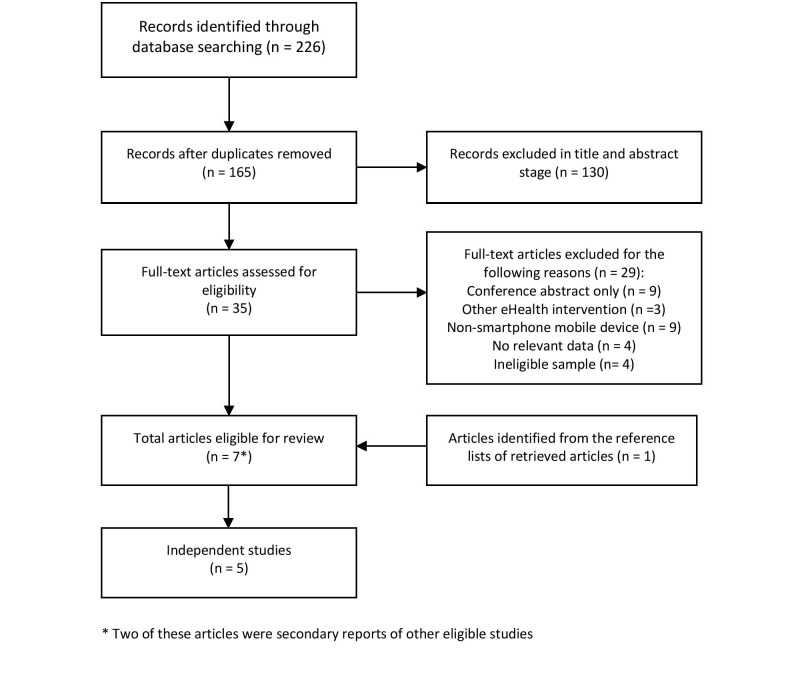
BACKGROUND: There is increasing interest in using mobile technologies such as smartphones for improving the care of patients with schizophrenia. However, less is known about the current clinical evidence for the feasibility and effectiveness of smartphone apps in this population. OBJECTIVE: To review the published literature of smartphone apps applied for the care of patients with schizophrenia and other psychotic disorders. METHODS: An electronic database search of Ovid MEDLINE, the Cochrane Central Register of Controlled Trials, Health Technology Assessment Database, Allied and Complementary Medicine, Health and Psychosocial Instruments, PsycINFO, and Embase was conducted on May 24, 2015. All eligible studies were systematically reviewed, and proportional meta-analyses were applied to pooled data on recruitment, retention, and adherence to examine the overall feasibility of smartphone interventions for schizophrenia. RESULTS: Our search produced 226 results from which 7 eligible articles were identified, reporting on 5 studies of smartphone apps for patients with schizophrenia. All examined feasibility, and one assessed the preliminary efficacy of a smartphone intervention for schizophrenia. Study lengths varied between 6 and 130 days. Overall retention was 92% (95% CI 82-98%). Participants consistently used the smartphone apps on more than 85% of days during the study period, averaging 3.95 interactions per person per day. Furthermore, participants responded to 71.9% of automated prompts (95% CI 65.7-77.8%). Participants reported a range of potential benefits from the various interventions, and user experience was largely positive. CONCLUSIONS: Although small, the current published literature demonstrates strong evidence for the feasibility of using smartphones to enhance the care of people with schizophrenia. High rates of engagement and satisfaction with a broad range of apps suggest the nascent potential of this mobile technology. However, there remains limited data on the efficacy of such interventions.
Overview
The claims and statistics of this paper haven’t been checked yet.
Run the check — free, no account needed. It reads the open-access text and checks the sources it cites.
Integrity signals
Registry
Cites
Statistics
Figures
Verification
Claims the paper makes
The claims and statistics of this paper haven’t been checked yet.
Run the check — free, no account needed. It reads the open-access text and checks the sources it cites.
Claims other papers make about this one
Each is checked against this paper’s own text: does it say what the citing paper says it does?
The source backs part of the claim, not all of it — or backs it for a different population, condition or comparison.
In the citing paper
“It also states that people at risk for a psychotic episode and those who just experienced their first psychotic episode were most likely to use the app.”
From Mobile intervention for individuals with psychosis, dual disorders, and their common comorbidities: A literature review (2019) · cites this paper as [93]
Experimental — accuracy not yet measuredThe source backs part of the claim, not all of it — or backs it for a different population, condition or comparison.
In the citing paper
“a literature review by Firth and Torous (93) identified five applications, evaluated in seven separate articles—those apps were primarily designed to promote self-management of the disease.”
From Mobile intervention for individuals with psychosis, dual disorders, and their common comorbidities: A literature review (2019) · cites this paper as [93]
Experimental — accuracy not yet measuredThe cited source says what the claim attributes to it.
In the citing paper
“The authors report that the majority of applications were very well received by participants, with an estimated average use of 85% of the days in which the studies were conducted, 3.95 times per day.”
From Mobile intervention for individuals with psychosis, dual disorders, and their common comorbidities: A literature review (2019) · cites this paper as [93]
In the citing paper
“Research on DMHTs for severe mental illness, such as bipolar and psychotic disorders, has shown feasibility, although efficacy data remain more limited (33, 34).”
From Banbury forum consensus statement on the path forward for digital mental health treatment (2021) · cites this paper as [33]
Self-check
Percentages, sums and reported differences re-computed from the paper’s own numbers.
The self-check needs the paper’s full text.
Citations
Cites
Meta-analysis in clinical trials
DerSimonian, R., & Laird, N. (1986) · Controlled Clinical Trials · doi:10.1016/0197-2456(86)90046-2 · Cited by 39,552
Hamine, S., Gerth-Guyette, E., Faulx, D., Green, B. B., & Ginsburg, A. S. (2015) · Journal of Medical Internet Research · doi:10.2196/jmir.3951 · Cited by 1,149 · cited 1×
“These rates of adherence and engagement appear similar, and actually slightly higher, compared with mHealth interventions for other chronic conditions such as diabetes, cardiovascular diseases, and lung diseases [31].”
ResultA Smartphone Application to Support Recovery From Alcoholism: A Randomized Clinical Trial
Gustafson, D. H., McTavish, F. M., Chih, M.-Y., Atwood, A. K., Johnson, R. A., Boyle, M. G., Levy, M. S., Driscoll, H., Chisholm, S. M., Dillenburg, L., et al. (2014) · JAMA Psychiatry · doi:10.1001/jamapsychiatry.2013.4642 · Cited by 692
Design of an mHealth app for the self-management of adolescent type 1 diabetes: a pilot study
Cafazzo, J. A., Casselman, M., Hamming, N., Katzman, D. K., & Palmert, M. R. (2012) · Journal of Medical Internet Research · doi:10.2196/jmir.2058 · Cited by 676
A systematic review and meta-analysis of exercise interventions in schizophrenia patients
Firth, J., Cotter, J., Elliott, R., French, P., & Yung, A. R. (2015) · Psychological Medicine · doi:10.1017/s0033291714003110 · Cited by 600
Self-citationFeasibility, Acceptability, and Preliminary Efficacy of a Smartphone Intervention for Schizophrenia
Ben-Zeev, D., Brenner, C. J., Begale, M., Duffecy, J., Mohr, D. C., & Mueser, K. T. (2014) · Schizophrenia Bulletin · doi:10.1093/schbul/sbu033 · Cited by 493
Jain, S. H., Powers, B. W., Hawkins, J. B., & Brownstein, J. S. (2015) · Nature Biotechnology · doi:10.1038/nbt.3223 · Cited by 425
Firth, J., Cotter, J., Torous, J., Bucci, S., Firth, J. A., & Yung, A. R. (2016) · Schizophrenia Bulletin · doi:10.1093/schbul/sbv132 · Cited by 351
Self-citationKirwan, M., Vandelanotte, C., Fenning, A., & Duncan, M. J. (2013) · Journal of Medical Internet Research · doi:10.2196/jmir.2588 · Cited by 343
Binder, M. D., van Winkel, R., Eyck, D. V., Hanssens, L., Wampers, M., Scheen, A. J., & Peuskens, J. (2006) · Schizophrenia Research · doi:10.1016/j.schres.2005.12.855 · Cited by 314
Research works printed but not linked: 2
- AaronSChapter One: A Portrait of Smartphone Ownership2015412015-07-08Washington, DCPewResearchCenterhttp://www.pewinternet.org/2015/04/01/chapter-one-a-portrait-of-smartphone-ownership/6ZsC8HUFA
- 2005, StatsDirect Statistical Software
Cited by
Sorted by citations
Items 201–268 of 268
Pilot study of smartphone-based health outcome tracking (OurBrainBank) for glioblastoma patients
Ellen, J., Boele, F. W., Hellman, B., Duprey, K., Nayak, L., & Morris, J. L. (2021) · Neuro-Oncology Practice · doi:10.1093/nop/npab044 · Cited by 4
Utilizing Technology to Prevent Distracted Walking
Marrapu, A. (2024) · IEEE Integrated STEM Education Conference (ISEC) · doi:10.1109/isec61299.2024.10664842 · Cited by 4
Zhang, X., Liu, B., Zang, D., Li, Y., Xiao, S., & Yu, Y. (2022) · Patient Preference and Adherence · doi:10.2147/ppa.s338936 · Cited by 4
Heydarian, S., Shakiba, A., & Kalhori, S. R. N. (2023) · Journal of Healthcare Informatics Research · doi:10.1007/s41666-023-00134-5 · Cited by 3
Bailey, R., Bartlett, Y. K., Hassan, L., Armitage, C. J., Stockton-Powdrell, C., Machin, M., Lewis, S. W., & Epton, T. (2022) · International Journal of Social Psychiatry · doi:10.1177/00207640221102733 · Cited by 3
da Costa, M. P., & Groups, P. P. A. (2022) · JMIR Formative Research · doi:10.2196/35086 · Cited by 3
Measuring Mental Health at Workplaces Using Machine Learning Techniques
Mittal, M., Usharani, B., Harish, & Manish, M. (2022) · Lecture notes on data engineering and communications technologies · doi:10.1007/978-981-19-1724-0_8 · Cited by 3
The Promise of Digital Health Interventions for Addressing Loneliness in Serious Mental Illness
Gandhi, A., Mote, J., & Fulford, D. (2023) · Current Treatment Options in Psychiatry · doi:10.1007/s40501-023-00289-3 · Cited by 5
Sood, M., Chawla, N., Shukla, T., Patel, R., Singh, P., Mohan, M., Singh, S. P., & Chadda, R. (2021) · World Social Psychiatry · doi:10.4103/wsp.wsp_67_21 · Cited by 3
Bucci, S., Zhang, X.-L., Basilio, D. D., Richardson, C., Berry, N., Berry, K., Edge, D., & Haddock, G. (2025) · BMC Psychiatry · doi:10.1186/s12888-025-07071-0 · Cited by 3
Assistive technology and schizophrenia
Devlin, H., Nolan, C., & Turner, N. (2019) · Irish Journal of Occupational Therapy · doi:10.1108/ijot-12-2018-0024 · Cited by 3
mSexHealth: An Overview of Mobile Sexual Health Applications
Jurin, T., Šoštarić, M., Jokić‐Begić, N., & Korajlija, A. L. (2022) · Journal of Sex & Marital Therapy · doi:10.1080/0092623x.2022.2079576 · Cited by 3
Assessing Social Functioning Across the Life Course of Psychosis
Stain, H. J., & Bjørnestad, J. R. (2019) · Elsevier eBooks · doi:10.1016/b978-0-12-815012-2.00009-2 · Cited by 3
Datta, R., Vishwanath, R., & Shenoy, S. (2022) · The Egyptian Journal of Neurology Psychiatry and Neurosurgery · doi:10.1186/s41983-022-00574-7 · Cited by 5
Kellett, S., Easton, K., Cooper, M., Millings, A., Simmonds‐Buckley, M., & Parry, G. D. (2021) · JMIR Mental Health · doi:10.2196/27159 · Cited by 3
Banbury Forum Consensus Statement on the Path Forward for Digital Mental Health Treatment
Mohr, D. C., Azocar, F., Bertagnolli, A., Choudhury, T., Chrisp, P., Frank, R. G., Harbin, H. T., Histon, T., Kaysen, D. L., Nebeker, C., et al. (2025) · FOCUS The Journal of Lifelong Learning in Psychiatry · doi:10.1176/appi.focus.25023021 · Cited by 2
Self-citationRisks of digitalization in mental health care
Volpe, U., Ramalho, R., & Gäebel, W. (2025) · Neuropsychiatrie · doi:10.1007/s40211-025-00551-5 · Cited by 2
Shared Decision Making in Mental Health: International Perspectives on Implementation
Ramon, S., Zisman‐Ilani, Y., Quirk, A., & Zisman-Ilani (2022) · Frontiers research topics · doi:10.3389/978-2-88974-217-2 · Cited by 2
Dong, D., Mu, T., Xu, J.-Y., Dai, J.-N., Zhou, Z.-N., Zhang, Q.-Z., & Shen, C. (2022) · Frontiers in Psychology · doi:10.3389/fpsyg.2022.931802 · Cited by 5
Caponnetto, P., Signorelli, M. S., Tiralongo, J., Rodolico, A., Concerto, C., Petralia, A., & Inguscio, L. (2023) · Health Psychology Research · doi:10.52965/001c.89721 · Cited by 2
Behandlungsassistenz durch elektronische Medien in der Schizophrenieversorgung
Surmann, M., & Lencer, R. (2017) · Zeitschrift für Psychiatrie Psychologie und Psychotherapie · doi:10.1024/1661-4747/a000308 · Cited by 2
Halverson, T. F., Browne, J., Thomas, S. M., Palenski, P. E., & Vilardaga, R. (2022) · Schizophrenia Research Cognition · doi:10.1016/j.scog.2022.100236 · Cited by 2
Magwood, O., Saad, A., Ranger, D., Volpini, K., Rukikamirera, F., Haridas, R., Sayfi, S., Alexander, J., Tan, Y., Petkovic, J., et al. (2022) · Campbell Systematic Reviews · doi:10.1002/cl2.1222 · Cited by 1
Digital Patient Experience: Umbrella Systematic Review (Preprint)Preprint
Wang, T., Giunti, G., Melles, M., & Goossens, R. (2022) · doi:10.2196/preprints.37952 · Cited by 2
Factor mixture analysis of paranoia in young people
Preti, A., Massidda, D., Cella, M., Raballo, A., Scanu, R., Tronci, D., Gabbrielli, M., Muratore, T., Carta, M. G., & Петретто, Д. Р. (2018) · Social Psychiatry and Psychiatric Epidemiology · doi:10.1007/s00127-018-1642-7 · Cited by 5
Hoşgelen, E. I., Akdede, B. B., & Alptekın, K. (2024) · Turkish Journal of Psychiatry · doi:10.5080/u27385 · Cited by 1
Improving telemedicine: evaluating emotional recognition for better patient-consultant interaction
Alshaer, A. (2025) · Journal of Umm Al-Qura University for Engineering and Architecture · doi:10.1007/s43995-025-00101-8 · Cited by 1
Andrade, P., Sanfins, N., & Azevedo, J. C. (2025) · International Journal of Environmental Research and Public Health · doi:10.3390/ijerph22071024 · Cited by 2
Smartphone intervention apps for schizophrenia: A review of the academic literature and app stores
Xia, W., Hau, C., Burns, J., Ryan, S., Firth, J., Linardon, J., & Torous, J. B. (2025) · Schizophrenia Research · doi:10.1016/j.schres.2025.09.007 · Cited by 1
Self-citationXia, W., Hau, C., Firth, J., Kimhy, D., & Torous, J. B. (2025) · FOCUS The Journal of Lifelong Learning in Psychiatry · doi:10.1176/appi.focus.20250014 · Cited by 1
Self-citationLu, M., Dong, J., Chen, Y., Feng, Y., Huang, H., Zhang, S., & Zhou, Y. (2025) · International Journal of Mental Health Nursing · doi:10.1111/inm.70152 · Cited by 1
Devices, Mobile Health and Digital Phenotyping
Volpe, U., Elkholy, H. A., Gargot, T., da Costa, M. P., & Orsolini, L. (2023) · Springer eBooks · doi:10.1007/978-3-030-42825-9_151-1 · Cited by 1
Cremaschi, M., Avis, G. R., Zhao, A. Q., Guarnieri, E., Panzeri, A., & Spoto, A. (2025) · Computers in Human Behavior Reports · doi:10.1016/j.chbr.2025.100586 · Cited by 1
eHealth tools for assessing psychomotor activity in schizophrenia: a systematic review
Molina, R., Porras‐Segovia, A., Ruiz, M., & Baca‐García, E. (2020) · Brazilian Journal of Psychiatry · doi:10.1590/1516-4446-2019-0867 · Cited by 1
Bregenzer, A., & Jiménez, P. (2018) · Springer Reference Wirtschaft · doi:10.1007/978-3-658-17975-5_30-1 · Cited by 1
Bregenzer, A., & Jiménez, P. (2021) · Springer eBooks · doi:10.1007/978-3-658-17782-9_30 · Cited by 1
Will the Proteus sensor enhance adherence to aripiprazole or other antipsychotics?
Masand, P. S., Han, C., & Pae, C. (2017) · Expert Review of Neurotherapeutics · doi:10.1080/14737175.2017.1287566 · Cited by 1
Smartphone apps for type 2 diabetes self-management and medication adherence : a multi-method study
Huang, Z. (2020) · DR-NTU (Nanyang Technological University) · doi:10.32657/10356/137883 · Cited by 1
Milton, A. C., Ozols, I., Cassidy, T., Jordan, D., Brown, E., Arnautovska, U., Cook, J., Phung, D., Lloyd‐Evans, B., Johnson, S., et al. (2023) · The University of Queensland · doi:10.14264/1b2b547 · Cited by 1
Lau, N., Kola, L., Zhao, X., Asafo, S. M., Attah, D. A., & Ben‐Zeev, D. (2025) · Wiley eBooks · doi:10.1002/9781394179909.ch14 · Cited by 2
Digital Heath Interventions in Mental Health
Stanimirovic, A. (2018) · Advances in psychology, mental health, and behavioral studies (APMHBS) book series · doi:10.4018/978-1-5225-7513-9.ch009
Technological Strategies to Address Psychiatric Nonadherence
Sengupta, S., & Adragna, M. S. (2019) · Springer eBooks · doi:10.1007/978-3-030-12665-0_14
Bell, I. (2019) · Minerva Access (University of Melbourne)
Integrating Technology Into Mental Health Care Delivery
Riboni, F. V., & Pagnini, F. (2020) · Elsevier eBooks · doi:10.1016/b978-0-12-818697-8.00012-1
Bregenzer, A., & Jiménez, P. (2020) · Springer Reference Wirtschaft · doi:10.1007/978-3-658-17975-5_30-2
Roncero, C., Remón-Gallo, D., Casado‐Espada, N. M., Aguilar, L., Gamonal-Limcaoco, S., Gallego, M. T., Bonaechea, B. B., Montejo, A. L., & Buch, B. (2020) · doi:10.2196/preprints.22224
Mobile Health to Support Ageing in Place
Rocha, N. P., Santos, M., Cerqueira, M., & Queirós, A. (2022) · IGI Global eBooks · doi:10.4018/978-1-6684-5295-0.ch049
Williams, A., Fossey, E. M., Farhall, J., Foley, F., & Thomas, N. (2018) · doi:10.2196/preprints.9934.a
Bibliography: Emerging Therapies in Psychiatry
(2018) · FOCUS The Journal of Lifelong Learning in Psychiatry · doi:10.1176/appi.focus.16305
Digital Heath Interventions in Mental Health
Stanimirovic, A. (2021) · IGI Global eBooks · doi:10.4018/978-1-7998-8544-3.ch019
Roncero, C., Remón-Gallo, D., Casado‐Espada, N. M., Aguilar, L., Gamonal-Limcaoco, S., Gallego, M. T., Bonaechea, B. B., Montejo, A. L., & Buch, B. (2020) · JMIR Formative Research · doi:10.2196/22224
Levy, L. S., & Lowe, K. B. (2023) · Elsevier eBooks · doi:10.1016/b978-0-323-91497-0.00155-7
Infectious Disease-Related Applications
Isa, R., Nordin, M. F., Othman, R., & Mohadis, H. M. (2023) · International Journal on Perceptive and Cognitive Computing · doi:10.31436/ijpcc.v9i2.402
Raftopoulou, A.-V. K., & Dritsas, I. (2023) · Creative Education · doi:10.4236/ce.2023.1413171
Jongeneel, M. J. (2024) · doi:10.5463/thesis.667
Devices, Mobile Health, and Digital Phenotyping
Volpe, U., Elkholy, H. A., Gargot, T., da Costa, M. P., & Orsolini, L. (2024) · Springer eBooks · doi:10.1007/978-3-030-51366-5_151
The Digitalisation of Reinforcement Learning and Token Economy in e-Health
Guarnieri, E., & Cremaschi, M. (2024) · Communications in computer and information science · doi:10.1007/978-3-031-67351-1_29
Seppälä, J., Grasa, E., Alonso-Solís, A., Roldán, A., Haapea, M., Isohanni, M. K., Miettunen, J., Mendivelso, J. C., Almazán, C., Rubinstein, K., et al. (2025) · JMIR Human Factors · doi:10.2196/67659 · Cited by 1
Ortega, S., Alvarado, R., Guayaquil, D. P. S., Pluas-Borja, J., & Faytong‐Haro, M. (2025) · JMIR Human Factors · doi:10.2196/58943
Foley, G., Cassiano, M. S., & Ricciardelli, R. (2025) · Digital Health · doi:10.1177/20552076251384142
Evaluation of medical education mobile apps with MARS and MARuL in a TPACK informed model
Rezaei, M. S., Owrangi, S., & Jafari, S. (2025) · Scientific Reports · doi:10.1038/s41598-025-31973-4
Ghosh, R. C., Singh, G. B., & Sharma, N. (2025) · Advances in computational intelligence and robotics book series · doi:10.4018/979-8-3693-9521-9.ch011
Mangelsdorf, S. N., Cagliarini, D., Nelson, B., McEnery, C., Whiting, J., Chinnery, G. L., Valentine, L., Lee, Y. Y., Mihalopoulos, C., Liu, V., et al. (2025) · BMJ Open · doi:10.1136/bmjopen-2025-102132
Mobile apps for psychotic disorders: a systematic review protocol
Ananthakrishnan, A., Sharma, A., Anderson, D., Shankar, R., & Meinert, E. (2026) · Systematic Reviews · doi:10.1186/s13643-025-02943-8
Yosep, I., Hikmat, R., Mardhiyah, A., & Kurniawan, K. (2026) · International Journal of Africa Nursing Sciences · doi:10.1016/j.ijans.2026.101026
Dalloul, N., Kandala, S., Moran, E. K., & Barch, D. M. (2026) · Schizophrenia Research · doi:10.1016/j.schres.2026.02.016
El-Saboni, Y., Awwal, S., Mishra, R., Sharma, N., Gaur, A., & Fleming, L. T. (2026) · JMIR Medical Informatics · doi:10.2196/89189
Hiller, S., Prietzel, K., Shehata, M., Sikorová, S. N., Bakštein, E., Urbanová, K., Leone, G., Emde, L., Jais, D., Lorenzen, T., et al. (2026) · npj Digital Medicine · doi:10.1038/s41746-026-03435-2
Metadata
- Authors
- Firth, J., & Torous, J.
- Affiliations
- University of Manchester (GB)
- Brigham and Women's Hospital (US)
- Corresponding author
- Torous, John
- Venue
- JMIR mHealth and uHealth
- Publisher
- JMIR Publications Inc.
- Published
- 2015-11-06
- Volume
- 3
- Issue
- 4
- Pages
- e102
- ISSN
- 2291-5222 (ISSN-L)
- PMC
- PMC4704940
- OpenAlex
- W2116293971
- Cited by
- 268
- References
- 30
- Citations by year
- 2026: 4 · 2025: 22 · 2024: 18 · 2023: 19 · 2022: 28 · 2021: 30 · 2020: 42 · 2019: 31 · 2018: 38 · 2017: 21 · 2016: 14 · 2015: 1
- FWCI
- 3.43
- Type
- journal article
- Language
- en
- Open access
- gold
- doi.org
- Licence
- cc-by
- Locations
- JMIR mhealth and uhealth (publishedVersion, cc-by)
- PubMed Central (publishedVersion, cc-by)
- PubMed (publishedVersion)
- Research Explorer (The University of Manchester) (publishedVersion, other-oa)
- DOAJ (DOAJ: Directory of Open Access Journals) (submittedVersion, cc-by-sa)
- Topics
- Social Sciences › Psychology › Applied Psychology › Digital Mental Health Interventions
- Health Sciences › Health Professions › General Health Professions › Mobile Health and mHealth Applications
- Health Sciences › Medicine › Psychiatry and Mental health › Schizophrenia research and treatment
- Keywords
- mobile application, schizophrenia, psychosis, mobile health, feasibility, participant retention, app adherence, user engagement, user satisfaction, digital mental health interventions
About these checks
Registry, retraction, Cites and statistics results are computed, not judged, with one exception: a printed reference that no index lists is read once by a model before it counts as a citation error. Claims are extracted by a model and kept only when their quote appears verbatim in the text; each cited source is then checked, with a model’s help, for whether it says what the claim relies on. Those verdicts can be wrong — read the claim’s quote and the cited source before relying on one.
Statistics and arithmetic are recomputed, not judged.
Confidence bands are shown only for fields calibrated on our annotated test set. None is calibrated yet, so no band is shown.
What counts as a claim ›How we measure confidence ›How we check this ›
Are you an author, or do you see a problem with this page? Request a review
