

The DOI matches its Crossref record; 30 of the 30 references it cites were found in a registry or an index.
Smartphone Apps for Schizophrenia: A Systematic Review
Open accessAbstract
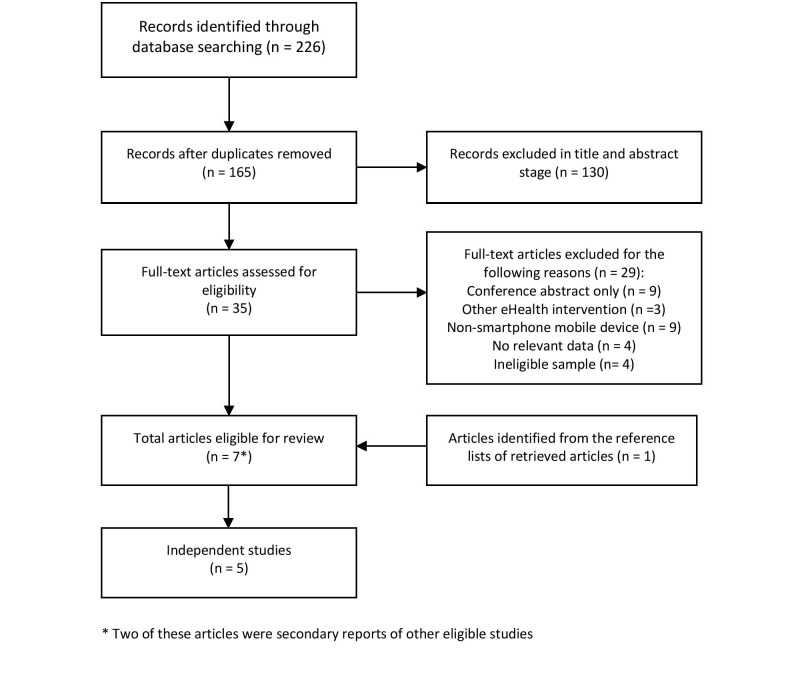
BACKGROUND: There is increasing interest in using mobile technologies such as smartphones for improving the care of patients with schizophrenia. However, less is known about the current clinical evidence for the feasibility and effectiveness of smartphone apps in this population. OBJECTIVE: To review the published literature of smartphone apps applied for the care of patients with schizophrenia and other psychotic disorders. METHODS: An electronic database search of Ovid MEDLINE, the Cochrane Central Register of Controlled Trials, Health Technology Assessment Database, Allied and Complementary Medicine, Health and Psychosocial Instruments, PsycINFO, and Embase was conducted on May 24, 2015. All eligible studies were systematically reviewed, and proportional meta-analyses were applied to pooled data on recruitment, retention, and adherence to examine the overall feasibility of smartphone interventions for schizophrenia. RESULTS: Our search produced 226 results from which 7 eligible articles were identified, reporting on 5 studies of smartphone apps for patients with schizophrenia. All examined feasibility, and one assessed the preliminary efficacy of a smartphone intervention for schizophrenia. Study lengths varied between 6 and 130 days. Overall retention was 92% (95% CI 82-98%). Participants consistently used the smartphone apps on more than 85% of days during the study period, averaging 3.95 interactions per person per day. Furthermore, participants responded to 71.9% of automated prompts (95% CI 65.7-77.8%). Participants reported a range of potential benefits from the various interventions, and user experience was largely positive. CONCLUSIONS: Although small, the current published literature demonstrates strong evidence for the feasibility of using smartphones to enhance the care of people with schizophrenia. High rates of engagement and satisfaction with a broad range of apps suggest the nascent potential of this mobile technology. However, there remains limited data on the efficacy of such interventions.
Overview
The claims and statistics of this paper haven’t been checked yet.
Run the check — free, no account needed. It reads the open-access text and checks the sources it cites.
Integrity signals
Registry
Cites
Statistics
Figures
Verification
Claims the paper makes
The claims and statistics of this paper haven’t been checked yet.
Run the check — free, no account needed. It reads the open-access text and checks the sources it cites.
Claims other papers make about this one
Each is checked against this paper’s own text: does it say what the citing paper says it does?
The source backs part of the claim, not all of it — or backs it for a different population, condition or comparison.
In the citing paper
“It also states that people at risk for a psychotic episode and those who just experienced their first psychotic episode were most likely to use the app.”
From Mobile intervention for individuals with psychosis, dual disorders, and their common comorbidities: A literature review (2019) · cites this paper as [93]
Experimental — accuracy not yet measuredThe source backs part of the claim, not all of it — or backs it for a different population, condition or comparison.
In the citing paper
“a literature review by Firth and Torous (93) identified five applications, evaluated in seven separate articles—those apps were primarily designed to promote self-management of the disease.”
From Mobile intervention for individuals with psychosis, dual disorders, and their common comorbidities: A literature review (2019) · cites this paper as [93]
Experimental — accuracy not yet measuredThe cited source says what the claim attributes to it.
In the citing paper
“The authors report that the majority of applications were very well received by participants, with an estimated average use of 85% of the days in which the studies were conducted, 3.95 times per day.”
From Mobile intervention for individuals with psychosis, dual disorders, and their common comorbidities: A literature review (2019) · cites this paper as [93]
In the citing paper
“Research on DMHTs for severe mental illness, such as bipolar and psychotic disorders, has shown feasibility, although efficacy data remain more limited (33, 34).”
From Banbury forum consensus statement on the path forward for digital mental health treatment (2021) · cites this paper as [33]
Self-check
Percentages, sums and reported differences re-computed from the paper’s own numbers.
The self-check needs the paper’s full text.
Citations
Cites
Meta-analysis in clinical trials
DerSimonian, R., & Laird, N. (1986) · Controlled Clinical Trials · doi:10.1016/0197-2456(86)90046-2 · Cited by 39,552
Hamine, S., Gerth-Guyette, E., Faulx, D., Green, B. B., & Ginsburg, A. S. (2015) · Journal of Medical Internet Research · doi:10.2196/jmir.3951 · Cited by 1,149 · cited 1×
“These rates of adherence and engagement appear similar, and actually slightly higher, compared with mHealth interventions for other chronic conditions such as diabetes, cardiovascular diseases, and lung diseases [31].”
ResultA Smartphone Application to Support Recovery From Alcoholism: A Randomized Clinical Trial
Gustafson, D. H., McTavish, F. M., Chih, M.-Y., Atwood, A. K., Johnson, R. A., Boyle, M. G., Levy, M. S., Driscoll, H., Chisholm, S. M., Dillenburg, L., et al. (2014) · JAMA Psychiatry · doi:10.1001/jamapsychiatry.2013.4642 · Cited by 692
Design of an mHealth app for the self-management of adolescent type 1 diabetes: a pilot study
Cafazzo, J. A., Casselman, M., Hamming, N., Katzman, D. K., & Palmert, M. R. (2012) · Journal of Medical Internet Research · doi:10.2196/jmir.2058 · Cited by 676
A systematic review and meta-analysis of exercise interventions in schizophrenia patients
Firth, J., Cotter, J., Elliott, R., French, P., & Yung, A. R. (2015) · Psychological Medicine · doi:10.1017/s0033291714003110 · Cited by 600
Self-citationFeasibility, Acceptability, and Preliminary Efficacy of a Smartphone Intervention for Schizophrenia
Ben-Zeev, D., Brenner, C. J., Begale, M., Duffecy, J., Mohr, D. C., & Mueser, K. T. (2014) · Schizophrenia Bulletin · doi:10.1093/schbul/sbu033 · Cited by 493
Jain, S. H., Powers, B. W., Hawkins, J. B., & Brownstein, J. S. (2015) · Nature Biotechnology · doi:10.1038/nbt.3223 · Cited by 425
Firth, J., Cotter, J., Torous, J., Bucci, S., Firth, J. A., & Yung, A. R. (2016) · Schizophrenia Bulletin · doi:10.1093/schbul/sbv132 · Cited by 351
Self-citationKirwan, M., Vandelanotte, C., Fenning, A., & Duncan, M. J. (2013) · Journal of Medical Internet Research · doi:10.2196/jmir.2588 · Cited by 343
Binder, M. D., van Winkel, R., Eyck, D. V., Hanssens, L., Wampers, M., Scheen, A. J., & Peuskens, J. (2006) · Schizophrenia Research · doi:10.1016/j.schres.2005.12.855 · Cited by 314
Research works printed but not linked: 2
- AaronSChapter One: A Portrait of Smartphone Ownership2015412015-07-08Washington, DCPewResearchCenterhttp://www.pewinternet.org/2015/04/01/chapter-one-a-portrait-of-smartphone-ownership/6ZsC8HUFA
- 2005, StatsDirect Statistical Software
Cited by
Sorted by citations
Items 101–200 of 268
Thomas, N., Farhall, J., Foley, F., Rossell, S. L., Castle, D. J., Ladd, E., Meyer, D., Mihalopoulos, C., Leitan, N., Nunan, C., et al. (2016) · BMC Psychiatry · doi:10.1186/s12888-016-1024-1 · Cited by 35
Ha, S. W., & Kim, J. (2020) · International Journal of Human-Computer Interaction · doi:10.1080/10447318.2020.1750792 · Cited by 32
Serrano‐Ripoll, M. J., Ricci‐Cabello, I., Jiménez, R., Zamanillo‐Campos, R., Yañez‐Juan, A. M., Bennasar‐Veny, M., Sitges, C., Gervilla, E., Leiva, A., García‐Campayo, J., et al. (2021) · Journal of Advanced Nursing · doi:10.1111/jan.14813 · Cited by 28
Williams, A., Farhall, J., Fossey, E. M., & Thomas, N. (2019) · BMC Psychiatry · doi:10.1186/s12888-019-2153-0 · Cited by 36
Blease, C., Torous, J. B., Kharko, A., DesRoches, C. M., Harcourt, K., O’Neill, S. F., Salmi, L., Wachenheim, D., & Hägglund, M. (2021) · JMIR Mental Health · doi:10.2196/27397 · Cited by 31
Self-citationAccessibility and availability of smartphone apps for schizophrenia
Kwon, S., Firth, J., Joshi, D., & Torous, J. B. (2022) · Schizophrenia · doi:10.1038/s41537-022-00313-0 · Cited by 32
Self-citationIngestible sensors, data, and pharmaceuticals: Subjectivity in the era of digital mental health
Flore, J. (2020) · New Media & Society · doi:10.1177/1461444820931024 · Cited by 31
Bell, I., Fielding-Smith, S. F., Hayward, M., Rossell, S. L., Lim, M. H., Farhall, J., & Thomas, N. (2018) · Trials · doi:10.1186/s13063-018-2607-6 · Cited by 35
Shared Decision-Making and Self-Directed Care
Salyers, M. P., & Zisman‐Ilani, Y. (2019) · Springer eBooks · doi:10.1007/978-3-030-11908-9_8 · Cited by 27
Aji, M., Gordon, C. J., Stratton, E., Calvo, R. A., Bartlett, D. J., Grunstein, R. R., & Glozier, N. (2021) · Journal of Medical Internet Research · doi:10.2196/24607 · Cited by 29
Arnautovska, U., Trott, M., Vitangcol, K. J., Milton, A. C., Brown, E., Warren, N., Leucht, S., Firth, J., & Siskind, D. J. (2024) · Schizophrenia Bulletin · doi:10.1093/schbul/sbae143 · Cited by 27
Self-citationKrzystanek, M., Krysta, K., Borkowski, M., Skałacka, K., Przybyło, J., Pałasz, A., Mucić, D., Martyniak, E., & Waszkiewicz, N. (2020) · Journal of Clinical Medicine · doi:10.3390/jcm9113681 · Cited by 27
Villani, M., & Kovess–Masféty, V. (2017) · JMIR Mental Health · doi:10.2196/mental.5946 · Cited by 27
Mueller, N. E., Panch, T., Macias, C., Cohen, B. M., Ongur, D., & Baker, J. T. (2018) · JMIR Mental Health · doi:10.2196/10092 · Cited by 26
Mobile App Tools for Identifying and Managing Mental Health Disorders in Primary Care
Magee, J. C., Adut, S., Brazill, K., & Warnick, S. (2018) · Current Treatment Options in Psychiatry · doi:10.1007/s40501-018-0154-0 · Cited by 25
Social Media and Social Functioning in Psychosis: A Systematic Review
Bjørnestad, J. R., Hegelstad, W. T. V., Berg, H., Davidson, L., Joa, I., Johannessen, J. O., Melle, I. S., Stain, H. J., & Pallesen, S. (2019) · Journal of Medical Internet Research · doi:10.2196/13957 · Cited by 36
Aschbrenner, K. A., Naslund, J. A., Gorin, A. A., Mueser, K. T., Scherer, E. A., Viron, M., Kinney, A., & Bartels, S. J. (2018) · Contemporary Clinical Trials · doi:10.1016/j.cct.2018.10.005 · Cited by 26
Smelror, R. E., Bless, J. J., Hugdahl, K., & Agartz, I. (2019) · JMIR Formative Research · doi:10.2196/13882 · Cited by 25
Merkouris, S., Hawker, C. O., Rodda, S. N., Youssef, G. J., & Dowling, N. A. (2020) · International Gambling Studies · doi:10.1080/14459795.2020.1749293 · Cited by 24
Thomas, N., Bless, J. J., Alderson‐Day, B., Bell, I., Cella, M., Craig, T., Delespaul, P., Hugdahl, K., Laloyaux, J., Larøi, F., et al. (2018) · Schizophrenia Bulletin · doi:10.1093/schbul/sby103 · Cited by 25
Lincke, L., Ulbrich, L., Reis, O., Wandinger, E., Brähler, E., Dück, A., & Kölch, M. (2022) · Frontiers in Psychiatry · doi:10.3389/fpsyt.2022.889555 · Cited by 24
Hidalgo-Mazzei, D., Nikolova, V. L., Kitchen, S., & Young, A. H. (2019) · Digital Psychiatry · doi:10.1080/2575517x.2019.1616476 · Cited by 23
Smartphones for Smarter Care? Self-Management in Schizophrenia
Sandoval, L. R., Torous, J. B., & Keshavan, M. S. (2017) · American Journal of Psychiatry · doi:10.1176/appi.ajp.2017.16090990 · Cited by 23
Self-citationA feasibility study of a mobile app to treat insomnia
Aji, M., Glozier, N., Bartlett, D. J., Peters, D., Calvo, R. A., Zheng, Y., Grunstein, R. R., & Gordon, C. J. (2020) · Translational Behavioral Medicine · doi:10.1093/tbm/ibaa019 · Cited by 22
Taylor, K. M., Bradley, J., & Cella, M. (2022) · Psychology and Psychotherapy Theory Research and Practice · doi:10.1111/papt.12395 · Cited by 22
Digital Technology to Enhance Clinical Care of Early Psychosis
Bell, I., & Álvarez‐Jiménez, M. (2019) · Current Treatment Options in Psychiatry · doi:10.1007/s40501-019-00182-y · Cited by 27
Dragovic, M., Davison, S., Morgan, V. A., Chiu, V. W., Richards, N., Vatskalis, T., Atkinson, A., & Waters, F. (2020) · Advances in Mental Health · doi:10.1080/18387357.2018.1557014 · Cited by 20
McClelland, G. T., & Fitzgerald, M. (2018) · Health Education Journal · doi:10.1177/0017896918773790 · Cited by 22
Language Analytics for Assessment of Mental Health Status and Functional Competency
Voleti, R., Woolridge, S. M., Liss, J., Milanovic, M., Stegmann, G., Hahn, S., Harvey, P. D., Patterson, T. L., Bowie, C. R., & Berisha, V. (2023) · Schizophrenia Bulletin · doi:10.1093/schbul/sbac176 · Cited by 22
Sawyer, C. S., Hassan, L., Sainsbury, J., Carney, R., Bucci, S., Burgess, H., Lovell, K., Torous, J. B., & Firth, J. (2023) · Early Intervention in Psychiatry · doi:10.1111/eip.13441 · Cited by 21
Self-citationReilly, T. J., Mechelli, A., McGuire, P. K., Fusar‐Poli, P., & Uhlhaas, P. J. (2019) · JMIR Mental Health · doi:10.2196/14581 · Cited by 22
Yu, Y., Li, Y., Li, T., Xi, S., Xiao, X., Xiao, S., & Tebes, J. K. (2020) · Journal of Medical Internet Research · doi:10.2196/18663 · Cited by 21
Shvetz, C., Gu, F., Drodge, J., Torous, J. B., & Guimond, S. (2021) · Schizophrenia · doi:10.1038/s41537-021-00194-9 · Cited by 20
Self-citationKim, S. K., Lee, M., Jeong, H. C., & Jang, Y. M. (2022) · Japan Journal of Nursing Science · doi:10.1111/jjns.12476 · Cited by 23
Luther, L., Buck, B., Fischer, M. W., Johnson-Kwochka, A. V., Coffin, G., & Salyers, M. P. (2020) · Journal of Technology in Behavioral Science · doi:10.1007/s41347-020-00162-7 · Cited by 18
López-Moríñigo, J.-D., Barrigón, M. L., Porras‐Segovia, A., Ruiz-Ruano, V. G., Martínez, A. S.-E., Escobedo-Aedo, P. J., Sánchez-Alonso, S., Iturralde, L. M., Lorenzo, L. M., Artés-Rodrı́guez, A., et al. (2021) · Journal of Medical Internet Research · doi:10.2196/26548 · Cited by 19
Hunter, P. V., Delbaere, M., O’Connell, M. E., Cammer, A. L., Seaton, J., Friedrich, T. E., & Fick, F. (2017) · BMC Geriatrics · doi:10.1186/s12877-017-0515-3 · Cited by 17
Warwick-India-Canada (WIC) global mental health group: rationale, design and protocol
Singh, S. P., Mohan, M., Iyer, S. N., Meyer, C., Currie, G., Shah, J. L., Madan, J. J., Birchwood, M. J., Sood, M., Ramachandran, P., et al. (2021) · BMJ Open · doi:10.1136/bmjopen-2020-046362 · Cited by 17
Internet addiction is associated with psychological distress in highly schizotypal students
Fekih‐Romdhane, F., Away, R., Jahrami, H., & Cheour, M. (2022) · Early Intervention in Psychiatry · doi:10.1111/eip.13362 · Cited by 18
Texting on a Smartphone While Walking Affects Gait Parameters
Sajewicz, J., & Dziuba-Słonina, A. (2023) · International Journal of Environmental Research and Public Health · doi:10.3390/ijerph20054590 · Cited by 17
Ribba, B., Peck, R., Hutchinson, L. G., Bousnina, I., & Motti, D. (2023) · Clinical Pharmacology & Therapeutics · doi:10.1002/cpt.2989 · Cited by 18
Milton, A. C., Ozols, I., Cassidy, T., Jordan, D., Brown, E., Arnautovska, U., Cook, J., Phung, D., Lloyd‐Evans, B., Johnson, S., et al. (2024) · JMIR Formative Research · doi:10.2196/49110 · Cited by 19
Lobban, F. A., Appelbe, D. E., Appleton, V., Billsborough, J., Fisher, N. R., Foster, S., Gill, B., Glentworth, D., Harrop, C. E., Johnson, S., et al. (2020) · BMC Health Services Research · doi:10.1186/s12913-020-5002-4 · Cited by 18
da Costa, M. P. (2020) · European Psychiatry · doi:10.1192/j.eurpsy.2020.53 · Cited by 15
Williams, A., Fossey, E. M., Farhall, J., Foley, F., & Thomas, N. (2021) · JMIR Mental Health · doi:10.2196/25998 · Cited by 18
Sedgwick, O., Hardy, A., Greer, B., Newbery, K., & Cella, M. (2021) · Journal of Clinical Psychology · doi:10.1002/jclp.23193 · Cited by 15
Fernández-Sotos, P., Fernández‐Caballero, A., González, P., Aparicio, A. I., Martínez‐Gras, I., Torío, I., Dompablo, M., Fernandez, L. G., Santos, J. L., & Rodríguez–Jiménez, R. (2018) · Journal of Medical Internet Research · doi:10.2196/11824 · Cited by 16
Mou, D. (2016) · mHealth · doi:10.21037/mhealth.2016.08.03 · Cited by 14
Holmberg, C., Gremyr, A., Karlsson, V., & Asztély, K. (2022) · The European Journal of Psychiatry · doi:10.1016/j.ejpsy.2022.04.005 · Cited by 14
Alonso-Solís, A., Rubinstein, K., Corripio, I., Jääskeläinen, E., Seppälä, A., Vella, V. A., Mendivelso, J. C., Caspi, A., Isohanni, M. K., Unoka, Z., et al. (2018) · BMJ Open · doi:10.1136/bmjopen-2017-021346 · Cited by 14
How would patients with psychosis like to be in contact with a volunteer: Face-to-face or digitally?
da Costa, M. P., Chevalier, A., Farreny, A., Cassidy, M., Leverton, M., Toner, S. K., & Priebe, S. (2019) · PLoS ONE · doi:10.1371/journal.pone.0216929 · Cited by 15
Arnautovska, U., Milton, A. C., Trott, M., Soole, R., & Siskind, D. J. (2024) · Current Opinion in Psychiatry · doi:10.1097/yco.0000000000000957 · Cited by 13
Buck, B., Chander, A., Tauscher, J. S., Nguyen, T., Monroe‐DeVita, M., & Ben‐Zeev, D. (2021) · Journal of Technology in Behavioral Science · doi:10.1007/s41347-021-00223-5 · Cited by 14
Mobile Health to Support Ageing in Place
Rocha, N. P., Santos, M., Cerqueira, M., & Queirós, A. (2019) · International Journal of E-Health and Medical Communications · doi:10.4018/ijehmc.2019070101 · Cited by 14
Gómez-Lumbreras, A., Hurwitz, J. T., Liang, X., Schippers, S., Phillip, K., Bhattacharjee, S., Waters, H. C., & Malone, D. C. (2024) · Journal of Managed Care & Specialty Pharmacy · doi:10.18553/jmcp.2024.30.4.313 · Cited by 12
Dudley, R. E. J., Dodgson, G., Common, S., Ogundimu, E. O., Liley, J., O'Grady, L., Watson, F., Gibbs, C., Arnott, B., Fernyhough, C., et al. (2024) · Journal of Psychiatric Research · doi:10.1016/j.jpsychires.2024.04.031 · Cited by 11
Austin, S. F., Frøsig, A. J., Buus, N., Lincoln, T. M., von Malachowski, A., Schlier, B., Frost, M. M., & Simonsen, E. H. (2021) · Qualitative Health Research · doi:10.1177/1049732320986556 · Cited by 13
Stakeholders’ views on volunteering in mental health: an international focus group study
da Costa, M. P., Conneely, M., da Silva, F. M., & Toner, S. K. (2022) · BMJ Open · doi:10.1136/bmjopen-2021-052185 · Cited by 12
Han, M., Lee, K., Kim, M., Heo, Y., & Choi, H. (2022) · Journal of Psychosocial Nursing and Mental Health Services · doi:10.3928/02793695-20220706-01 · Cited by 12
Batalas, N., Rot, M. A. H., Khan, V.-J., & Markopoulos, P. (2018) · Proceedings of the ACM on Human-Computer Interaction · doi:10.1145/3179428 · Cited by 12
Traber‐Walker, N., Gerstenberg, M., Metzler, S., Joris, M. R., Karr, M., Studer, N., Logoz, M. Z., Roth, A., Wulf Rössler, A., Walitza, S., et al. (2019) · Frontiers in Psychiatry · doi:10.3389/fpsyt.2019.00384 · Cited by 12
Polillo, A., Voineskos, A. N., Foussias, G., Kidd, S. A., Sav, A., Hawley, S., Soklaridis, S., Stergiopoulos, V., & Kozloff, N. (2021) · JMIR Mental Health · doi:10.2196/24567 · Cited by 12
Berkhout, S., & Zaheer, J. (2021) · Catalyst Feminism Theory Technoscience · doi:10.28968/cftt.v7i1.34101 · Cited by 12
Hau, C., Xia, W., Ryan, S., Firth, J., Linardon, J., & Torous, J. B. (2025) · Schizophrenia Research · doi:10.1016/j.schres.2025.05.019 · Cited by 13
Self-citationUnderstanding Self-Tracked Data from Bounded Situational Contexts
Ng, A., Walker, A. M., Wakschlag, L. S., Alshurafa, N. I., & Reddy, M. C. (2022) · Designing Interactive Systems Conference · doi:10.1145/3532106.3533498 · Cited by 14
Roncero, C., Remón-Gallo, D., Casado‐Espada, N. M., Aguilar, L., Gamonal-Limcaoco, S., Gallego, M. T., Bonaechea, B. B., Montejo, A. L., & Buch-Vicente, B. (2022) · Frontiers in Psychiatry · doi:10.3389/fpsyt.2022.981346 · Cited by 15
Kellett, S., Easton, K., Cooper, M., Millings, A., Simmonds‐Buckley, M., & Parry, G. D. (2020) · JMIR Mental Health · doi:10.2196/19888 · Cited by 10
Grasa, E., Seppälä, J., Alonso-Solís, A., Haapea, M., Isohanni, M. K., Miettunen, J., Mendivelso, J. C., Almazán, C., Rubinstein, K., Caspi, A., et al. (2023) · JMIR Formative Research · doi:10.2196/46179 · Cited by 10
Funnell, E. L., Spadaro, B., Martin-Key, N. A., Benáček, J., & Bahn, S. (2024) · JMIR Formative Research · doi:10.2196/48881 · Cited by 13
Fulford, D., Correll, C. U., Harvey, P. D., & Cohen, A. S. (2025) · Schizophrenia Bulletin · doi:10.1093/schbul/sbaf134 · Cited by 11
Orsolini, L., Appignanesi, C., Pompili, S., & Volpe, U. (2022) · International Review of Psychiatry · doi:10.1080/09540261.2022.2118521 · Cited by 12
Shin, H. D., Zaheer, J., Torous, J. B., & Strudwick, G. (2023) · JMIR Research Protocols · doi:10.2196/50643 · Cited by 9
Self-citationD’Arcey, J., Torous, J. B., Asuncion, T.-R., Tackaberry-Giddens, L., Zahid, A., Ishak, M., Foussias, G., & Kidd, S. A. (2024) · JMIR Mental Health · doi:10.2196/57150 · Cited by 10
Self-citationSeeman, M. V. (2016) · Journal of Obesity Management · doi:10.14302/issn.2574-450x.jom-16-1039 · Cited by 10
Digitale Technologien zur Verbesserung der psychischen Gesundheit
Fuhr, D. C., Wolf‐Ostermann, K., Hoel, V., & Zeeb, H. (2024) · Bundesgesundheitsblatt - Gesundheitsforschung - Gesundheitsschutz · doi:10.1007/s00103-024-03842-4 · Cited by 12
Tatar, O., Abdel‐Baki, A., Dyachenko, A., Bakouni, H., Bahremand, A., Tibbo, P. G., Crockford, D. N., Roy, M., Copeland, J., Fischer, B., et al. (2023) · Psychiatry Research · doi:10.1016/j.psychres.2023.115276 · Cited by 15
New strategies of physical activity assessment in cystic fibrosis: a pilot study
Savi, D., Graziano, L., Giordani, B., Schiavetto, S., Vito, C. D., Migliara, G., Simmonds, N. J., Palange, P., & Elborn, J. S. (2020) · BMC Pulmonary Medicine · doi:10.1186/s12890-020-01313-5 · Cited by 9
Internet Access for Patients on Psychiatric Units.
Morris, N. P. (2018) · PubMed · doi:10.29158/jaapl.003760-18 · Cited by 9
Patients’ perspectives about the design of a mobile application for psychotic disorders
Simões de Almeida, R., Sousa, T., Marques, A., & Queirós, C. (2018) · Psychology, Community & Health · doi:10.5964/pch.v7i1.192 · Cited by 8
Wang, T., Giunti, G., Goossens, R., & Melles, M. (2023) · Journal of Medical Internet Research · doi:10.2196/46308 · Cited by 8
Characteristics and Outcomes of mHealth Interventions in Psychosis: Systematic Mapping Review
Loh, P. Y., Martinengo, L., Heaukulani, C., Tan, X., Hng, M., Cheah, Y. Y., Morris, R. J. T., Car, L. T., & Lee, J. (2024) · Journal of Medical Internet Research · doi:10.2196/55924 · Cited by 8
Kidd, S. A., McKenzie, K. J., Wang, W., Agrawal, S., & Voineskos, A. N. (2020) · JMIR Research Protocols · doi:10.2196/24736 · Cited by 8
The Therapeutic Use of Digital Technologies in Psychosis
Bell, I., Lim, M. H., & Thomas, N. (2019) · Elsevier eBooks · doi:10.1016/b978-0-12-815012-2.00027-4 · Cited by 8
Herpertz, J., Richter, M. F., Barkhau, C., Storck, M., Blitz, R., Steinmann, L. A., Goltermann, J., Dannlowski, U., Baune, B. T., Varghese, J., et al. (2022) · Psychiatry Research · doi:10.1016/j.psychres.2022.114773 · Cited by 9
Stakeholder identified research priorities for early intervention in psychosis
Renwick, L., McWilliams, C., Schaff, O., Russell, L., Ramsdale, S., & Morris, R. (2022) · Health Expectations · doi:10.1111/hex.13604 · Cited by 7
Kidd, S. A., D’Arcey, J., Tackaberry-Giddens, L., Asuncion, T.-R., Agrawal, S., Chen, S., Wang, W., McKenzie, K. J., Zhou, W., Luo, S., et al. (2024) · Schizophrenia Research · doi:10.1016/j.schres.2024.11.011 · Cited by 7
Mobile health in the specific management of first-episode psychosis: a systematic literature review
Maechling, C., Yrondi, A., & Cambon, A. (2023) · Frontiers in Psychiatry · doi:10.3389/fpsyt.2023.1137644 · Cited by 9
Rubeis, G., & Ketteler, D. (2020) · PPmP - Psychotherapie · Psychosomatik · Medizinische Psychologie · doi:10.1055/a-1104-5459 · Cited by 7
Suicide means, timing, intent and behavior characteristics of the suicides with schizophrenia
Lyu, J., & Zhang, J. (2021) · Psychiatry Research · doi:10.1016/j.psychres.2021.114267 · Cited by 6
Hiller, S., Emde, L., Jais, D., Sikorová, S., Bakštein, E., Španiel, F., Urbanová, K., Hahn, E. W., Zierhut, M. M., Fürstenau, D., et al. (2025) · European Archives of Psychiatry and Clinical Neuroscience · doi:10.1007/s00406-025-02089-7 · Cited by 6
Dalloul, N., van Huijgevoort, C., Belmont, J., & Barch, D. M. (2025) · Neuroscience & Biobehavioral Reviews · doi:10.1016/j.neubiorev.2025.106385 · Cited by 8
Digitally Enhanced Psychological Assessment and Treatment of Paranoia: A Systematic Review
Bird, M., O'Neill, E., & Riches, S. (2024) · Clinical Psychology & Psychotherapy · doi:10.1002/cpp.3019 · Cited by 6
Terp, M., Bjørnes, C. D., Jørgensen, R., Mainz, J., & Laursen, B. S. (2017) · Open Journal of Nursing · doi:10.4236/ojn.2017.77056 · Cited by 6
Alan, H. (2024) · Behaviour and Information Technology · doi:10.1080/0144929x.2024.2303626 · Cited by 10
Volunteering via Smart-Phone for People With Psychosis—Protocol of a Feasibility Trial
da Costa, M. P., & Groups, P. P. A. (2021) · Frontiers in Psychiatry · doi:10.3389/fpsyt.2021.742202 · Cited by 5
Mental health mobile app use to manage psychological difficulties: an umbrella review
Badesha, K., Wilde, S., & Dawson, D. L. (2022) · Mental Health Review Journal · doi:10.1108/mhrj-02-2021-0014 · Cited by 8
mHealth and Physical Activity Interventions Among People With Mental Illness
Carney, R., & Firth, J. (2018) · Elsevier eBooks · doi:10.1016/b978-0-12-812605-9.00012-5 · Cited by 5
Self-citationPinheiro, M., Serra, M., & Azevedo, N. P. (2019) · JMIR Mental Health · doi:10.2196/15064 · Cited by 5
Schnitzer, K., Cather, C., Zvonar, V., Dechert, A., Plummer, R., Lowman, K., Pachas, G., Potter, K., & Evins, A. E. (2021) · Journal of Participatory Medicine · doi:10.2196/21934 · Cited by 4
Polillo, A., Foussias, G., Wong, A. H. C., Ampofo, A., Stergiopoulos, V., Anderson, K. K., Bromley, S., D’Arcey, J., de Oliveira, C., Duda, L., et al. (2020) · BMJ Open · doi:10.1136/bmjopen-2020-042751 · Cited by 4
Metadata
- Authors
- Firth, J., & Torous, J.
- Affiliations
- University of Manchester (GB)
- Brigham and Women's Hospital (US)
- Corresponding author
- Torous, John
- Venue
- JMIR mHealth and uHealth
- Publisher
- JMIR Publications Inc.
- Published
- 2015-11-06
- Volume
- 3
- Issue
- 4
- Pages
- e102
- ISSN
- 2291-5222 (ISSN-L)
- PMC
- PMC4704940
- OpenAlex
- W2116293971
- Cited by
- 268
- References
- 30
- Citations by year
- 2026: 4 · 2025: 22 · 2024: 18 · 2023: 19 · 2022: 28 · 2021: 30 · 2020: 42 · 2019: 31 · 2018: 38 · 2017: 21 · 2016: 14 · 2015: 1
- FWCI
- 3.43
- Type
- journal article
- Language
- en
- Open access
- gold
- doi.org
- Licence
- cc-by
- Locations
- JMIR mhealth and uhealth (publishedVersion, cc-by)
- PubMed Central (publishedVersion, cc-by)
- PubMed (publishedVersion)
- Research Explorer (The University of Manchester) (publishedVersion, other-oa)
- DOAJ (DOAJ: Directory of Open Access Journals) (submittedVersion, cc-by-sa)
- Topics
- Social Sciences › Psychology › Applied Psychology › Digital Mental Health Interventions
- Health Sciences › Health Professions › General Health Professions › Mobile Health and mHealth Applications
- Health Sciences › Medicine › Psychiatry and Mental health › Schizophrenia research and treatment
- Keywords
- mobile application, schizophrenia, psychosis, mobile health, feasibility, participant retention, app adherence, user engagement, user satisfaction, digital mental health interventions
About these checks
Registry, retraction, Cites and statistics results are computed, not judged, with one exception: a printed reference that no index lists is read once by a model before it counts as a citation error. Claims are extracted by a model and kept only when their quote appears verbatim in the text; each cited source is then checked, with a model’s help, for whether it says what the claim relies on. Those verdicts can be wrong — read the claim’s quote and the cited source before relying on one.
Statistics and arithmetic are recomputed, not judged.
Confidence bands are shown only for fields calibrated on our annotated test set. None is calibrated yet, so no band is shown.
What counts as a claim ›How we measure confidence ›How we check this ›
Are you an author, or do you see a problem with this page? Request a review
