

The DOI matches its Crossref record; 30 of the 30 references it cites were found in a registry or an index.
Smartphone Apps for Schizophrenia: A Systematic Review
Open accessAbstract
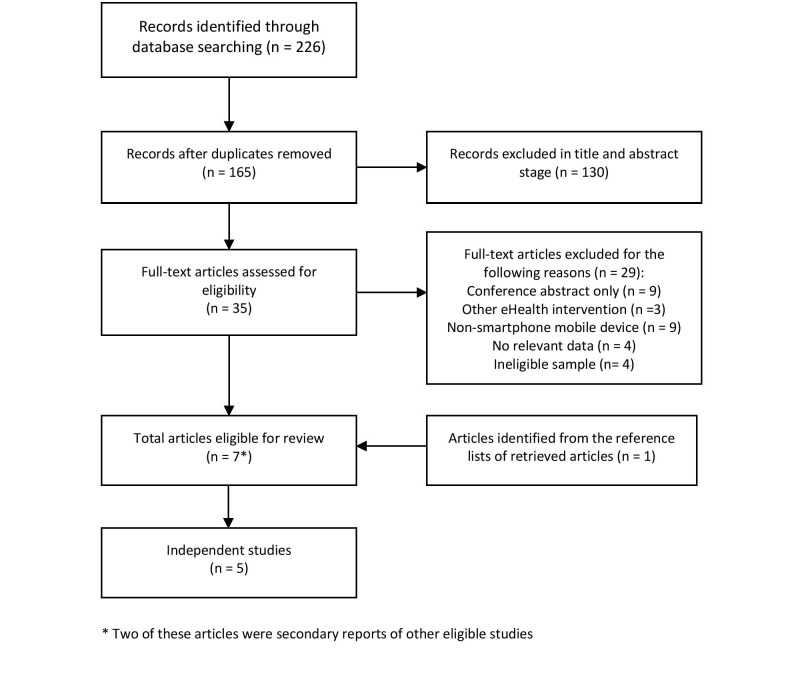
BACKGROUND: There is increasing interest in using mobile technologies such as smartphones for improving the care of patients with schizophrenia. However, less is known about the current clinical evidence for the feasibility and effectiveness of smartphone apps in this population. OBJECTIVE: To review the published literature of smartphone apps applied for the care of patients with schizophrenia and other psychotic disorders. METHODS: An electronic database search of Ovid MEDLINE, the Cochrane Central Register of Controlled Trials, Health Technology Assessment Database, Allied and Complementary Medicine, Health and Psychosocial Instruments, PsycINFO, and Embase was conducted on May 24, 2015. All eligible studies were systematically reviewed, and proportional meta-analyses were applied to pooled data on recruitment, retention, and adherence to examine the overall feasibility of smartphone interventions for schizophrenia. RESULTS: Our search produced 226 results from which 7 eligible articles were identified, reporting on 5 studies of smartphone apps for patients with schizophrenia. All examined feasibility, and one assessed the preliminary efficacy of a smartphone intervention for schizophrenia. Study lengths varied between 6 and 130 days. Overall retention was 92% (95% CI 82-98%). Participants consistently used the smartphone apps on more than 85% of days during the study period, averaging 3.95 interactions per person per day. Furthermore, participants responded to 71.9% of automated prompts (95% CI 65.7-77.8%). Participants reported a range of potential benefits from the various interventions, and user experience was largely positive. CONCLUSIONS: Although small, the current published literature demonstrates strong evidence for the feasibility of using smartphones to enhance the care of people with schizophrenia. High rates of engagement and satisfaction with a broad range of apps suggest the nascent potential of this mobile technology. However, there remains limited data on the efficacy of such interventions.
Overview
The claims and statistics of this paper haven’t been checked yet.
Run the check — free, no account needed. It reads the open-access text and checks the sources it cites.
Integrity signals
Registry
Cites
Statistics
Figures
Verification
Claims the paper makes
The claims and statistics of this paper haven’t been checked yet.
Run the check — free, no account needed. It reads the open-access text and checks the sources it cites.
Claims other papers make about this one
Each is checked against this paper’s own text: does it say what the citing paper says it does?
The source backs part of the claim, not all of it — or backs it for a different population, condition or comparison.
In the citing paper
“It also states that people at risk for a psychotic episode and those who just experienced their first psychotic episode were most likely to use the app.”
From Mobile intervention for individuals with psychosis, dual disorders, and their common comorbidities: A literature review (2019) · cites this paper as [93]
Experimental — accuracy not yet measuredThe source backs part of the claim, not all of it — or backs it for a different population, condition or comparison.
In the citing paper
“a literature review by Firth and Torous (93) identified five applications, evaluated in seven separate articles—those apps were primarily designed to promote self-management of the disease.”
From Mobile intervention for individuals with psychosis, dual disorders, and their common comorbidities: A literature review (2019) · cites this paper as [93]
Experimental — accuracy not yet measuredThe cited source says what the claim attributes to it.
In the citing paper
“The authors report that the majority of applications were very well received by participants, with an estimated average use of 85% of the days in which the studies were conducted, 3.95 times per day.”
From Mobile intervention for individuals with psychosis, dual disorders, and their common comorbidities: A literature review (2019) · cites this paper as [93]
In the citing paper
“Research on DMHTs for severe mental illness, such as bipolar and psychotic disorders, has shown feasibility, although efficacy data remain more limited (33, 34).”
From Banbury forum consensus statement on the path forward for digital mental health treatment (2021) · cites this paper as [33]
Self-check
Percentages, sums and reported differences re-computed from the paper’s own numbers.
The self-check needs the paper’s full text.
Citations
Cites
Meta-analysis in clinical trials
DerSimonian, R., & Laird, N. (1986) · Controlled Clinical Trials · doi:10.1016/0197-2456(86)90046-2 · Cited by 39,552
Hamine, S., Gerth-Guyette, E., Faulx, D., Green, B. B., & Ginsburg, A. S. (2015) · Journal of Medical Internet Research · doi:10.2196/jmir.3951 · Cited by 1,149 · cited 1×
“These rates of adherence and engagement appear similar, and actually slightly higher, compared with mHealth interventions for other chronic conditions such as diabetes, cardiovascular diseases, and lung diseases [31].”
ResultA Smartphone Application to Support Recovery From Alcoholism: A Randomized Clinical Trial
Gustafson, D. H., McTavish, F. M., Chih, M.-Y., Atwood, A. K., Johnson, R. A., Boyle, M. G., Levy, M. S., Driscoll, H., Chisholm, S. M., Dillenburg, L., et al. (2014) · JAMA Psychiatry · doi:10.1001/jamapsychiatry.2013.4642 · Cited by 692
Design of an mHealth app for the self-management of adolescent type 1 diabetes: a pilot study
Cafazzo, J. A., Casselman, M., Hamming, N., Katzman, D. K., & Palmert, M. R. (2012) · Journal of Medical Internet Research · doi:10.2196/jmir.2058 · Cited by 676
A systematic review and meta-analysis of exercise interventions in schizophrenia patients
Firth, J., Cotter, J., Elliott, R., French, P., & Yung, A. R. (2015) · Psychological Medicine · doi:10.1017/s0033291714003110 · Cited by 600
Self-citationFeasibility, Acceptability, and Preliminary Efficacy of a Smartphone Intervention for Schizophrenia
Ben-Zeev, D., Brenner, C. J., Begale, M., Duffecy, J., Mohr, D. C., & Mueser, K. T. (2014) · Schizophrenia Bulletin · doi:10.1093/schbul/sbu033 · Cited by 493
Jain, S. H., Powers, B. W., Hawkins, J. B., & Brownstein, J. S. (2015) · Nature Biotechnology · doi:10.1038/nbt.3223 · Cited by 425
Firth, J., Cotter, J., Torous, J., Bucci, S., Firth, J. A., & Yung, A. R. (2016) · Schizophrenia Bulletin · doi:10.1093/schbul/sbv132 · Cited by 351
Self-citationKirwan, M., Vandelanotte, C., Fenning, A., & Duncan, M. J. (2013) · Journal of Medical Internet Research · doi:10.2196/jmir.2588 · Cited by 343
Binder, M. D., van Winkel, R., Eyck, D. V., Hanssens, L., Wampers, M., Scheen, A. J., & Peuskens, J. (2006) · Schizophrenia Research · doi:10.1016/j.schres.2005.12.855 · Cited by 314
Research works printed but not linked: 2
- AaronSChapter One: A Portrait of Smartphone Ownership2015412015-07-08Washington, DCPewResearchCenterhttp://www.pewinternet.org/2015/04/01/chapter-one-a-portrait-of-smartphone-ownership/6ZsC8HUFA
- 2005, StatsDirect Statistical Software
Cited by
Sorted by citations
Correll, C. U., & Schooler, N. R. (2020) · Neuropsychiatric Disease and Treatment · doi:10.2147/ndt.s225643 · Cited by 911
Firth, J., Torous, J., Nicholas, J., Carney, R., Rosenbaum, S., & Sarris, J. (2017) · Journal of Affective Disorders · doi:10.1016/j.jad.2017.04.046 · Cited by 675
Self-citationOECD (2021) · OECD Health Policy Studies · doi:10.1787/4ed890f6-en · Cited by 407
The COVID-19 Global Pandemic: Implications for People With Schizophrenia and Related Disorders
Kozloff, N., Mulsant, B. H., Stergiopoulos, V., & Voineskos, A. N. (2020) · Schizophrenia Bulletin · doi:10.1093/schbul/sbaa051 · Cited by 381
Chandrashekar, P. (2018) · mHealth · doi:10.21037/mhealth.2018.03.02 · Cited by 359
Torous, J., Linardon, J., Goldberg, S. B., Sun, S., Bell, I., Nicholas, J., Hassan, L., Hua, Y., Milton, A., & Firth, J. (2025) · World Psychiatry · doi:10.1002/wps.21299 · Cited by 323
Self-citationThe impact of post-adoption beliefs on the continued use of health apps
Cho, J. (2015) · International Journal of Medical Informatics · doi:10.1016/j.ijmedinf.2015.12.016 · Cited by 277
Creber, R. M., Maurer, M. S., Turchioe, M. R., Hiraldo, G., Hickey, K. T., & Iribarren, S. (2016) · JMIR mhealth and uhealth · doi:10.2196/mhealth.5882 · Cited by 255
Berry, N., Lobban, F., Emsley, R., & Bucci, S. (2016) · Journal of Medical Internet Research · doi:10.2196/jmir.5250 · Cited by 230
Actissist: Proof-of-Concept Trial of a Theory-Driven Digital Intervention for Psychosis
Bucci, S., Barrowclough, C., Ainsworth, J., Machin, M., Morris, R., Berry, K., Emsley, R., Lewis, S., Edge, D., Buchan, I., et al. (2018) · Schizophrenia Bulletin · doi:10.1093/schbul/sby032 · Cited by 196
The digital placebo effect: mobile mental health meets clinical psychiatry
Torous, J., & Firth, J. (2016) · The Lancet Psychiatry · doi:10.1016/s2215-0366(15)00565-9 · Cited by 200
Self-citationFiol-deRoque, M. A., Serrano-Ripoll, M. J., Jiménez, R., Zamanillo‐Campos, R., Yáñez, A. M., Bennasar‐Veny, M., Leiva, A., Gervilla, E., Buades, E. G., Garcı́a-Toro, M., et al. (2021) · JMIR mhealth and uhealth · doi:10.2196/27039 · Cited by 203
Bell, I. H., Lim, M. H., Rossell, S. L., & Thomas, N. (2017) · Psychiatric Services · doi:10.1176/appi.ps.201600523 · Cited by 189
Ben‐Zeev, D., Brian, R., Wang, R., Wang, W., Campbell, A. T., Aung, M. H., Merrill, M., Tseng, V. W.-S., Choudhury, T., Hauser, M., et al. (2017) · Psychiatric Rehabilitation Journal · doi:10.1037/prj0000243 · Cited by 185
Hollis, C., Sampson, S., Simons, L., Davies, E. B., Churchill, R., Betton, V., Butler, D., Chapman, K., Easton, K., Gronlund, T. A., et al. (2018) · The Lancet Psychiatry · doi:10.1016/s2215-0366(18)30296-7 · Cited by 186
Scaling evidence-based treatments through digital mental health.
Schueller, S. M., & Torous, J. B. (2020) · American Psychologist · doi:10.1037/amp0000654 · Cited by 191
Self-citationPerspectives on the COVID-19 Pandemic and Individuals With Serious Mental Illness
Shinn, A. K., & Viron, M. (2020) · The Journal of Clinical Psychiatry · doi:10.4088/jcp.20com13412 · Cited by 174
Berry, N., Lobban, F., & Bucci, S. (2019) · BMC Psychiatry · doi:10.1186/s12888-018-1979-1 · Cited by 170
Batra, S., Baker, R., Wang, T., Forma, F., DiBiasi, F., & Peters-Strickland, T. (2017) · Medical Devices: Evidence and Research · doi:10.2147/mder.s144158 · Cited by 169
Bauer, M., Glenn, T., Geddes, J., Gitlin, M., Grof, P., Kessing, L. V., Monteith, S., Faurholt-Jepsen, M., Severus, E., & Whybrow, P. C. (2020) · International Journal of Bipolar Disorders · doi:10.1186/s40345-019-0164-x · Cited by 163
Digital Technology Use Among Individuals with Schizophrenia: Results of an Online Survey
Gay, K., Torous, J., Joseph, A., Pandya, A., & Duckworth, K. (2016) · JMIR Mental Health · doi:10.2196/mental.5379 · Cited by 161
Self-citationDigital Therapeutics: An Integral Component of Digital Innovation in Drug Development
Sverdlov, O., van Dam, J., Hannesdottir, K., & Thornton‐Wells, T. (2018) · Clinical Pharmacology & Therapeutics · doi:10.1002/cpt.1036 · Cited by 147
Digital Technologies for Emotion-Regulation Assessment and Intervention: A Conceptual Review
Bettis, A. H., Burke, T. A., Nesi, J. L., & Liu, R. T. (2021) · Clinical Psychological Science · doi:10.1177/21677026211011982 · Cited by 174
Höchsmann, C., Knaier, R., Eymann, J., Hintermann, J., Infanger, D., & Schmidt‐Trucksäss, A. (2018) · Scandinavian Journal of Medicine and Science in Sports · doi:10.1111/sms.13074 · Cited by 134
Smartphone apps for the treatment of mental health conditions: status and considerations
Huckvale, K., Nicholas, J., Torous, J. B., & Larsen, M. E. (2020) · Current Opinion in Psychology · doi:10.1016/j.copsyc.2020.04.008 · Cited by 148
Self-citationBen-Zeev, D., Scherer, E. A., Gottlieb, J. D., Rotondi, A. J., Brunette, M. F., Achtyes, E. D., Mueser, K. T., Gingerich, S., Brenner, C. J., Begale, M., et al. (2016) · JMIR Mental Health · doi:10.2196/mental.6348 · Cited by 137
Bucci, S., Berry, N., Morris, R., Berry, K., Haddock, G., Lewis, S., & Edge, D. (2019) · Frontiers in Psychiatry · doi:10.3389/fpsyt.2019.00344 · Cited by 124
Schlosser, D., Campellone, T., Kim, D., Truong, B., Vergani, S., Ward, C., & Vinogradov, S. (2016) · JMIR Research Protocols · doi:10.2196/resprot.5450 · Cited by 103
Cognitive-Behavioral Therapy in the Digital Age: Presidential Address
Wilhelm, S., Weingarden, H. M., Ladis, I., Braddick, V., Shin, J. Y., & Jacobson, N. C. (2019) · Behavior Therapy · doi:10.1016/j.beth.2019.08.001 · Cited by 128
Blease, C., Locher, C., Leon-Carlyle, M., & Doraiswamy, M. (2020) · DIGITAL HEALTH · doi:10.1177/2055207620968355 · Cited by 121
Banbury forum consensus statement on the path forward for digital mental health treatment
Mohr, D. C., Azocar, F., Bertagnolli, A., Choudhury, T., Chrisp, P., Frank, R., Harbin, H., Histon, T., Kaysen, D., Nebeker, C., et al. (2021) · Psychiatric Services · doi:10.1176/appi.ps.202000561 · Cited by 115
Self-citationOld-fashioned technology in the era of “bling”: is there a future for text messaging in health care?
Willcox, J. C., Dobson, R., & Whittaker, R. (2019) · Journal of Medical Internet Research · doi:10.2196/16630 · Cited by 95
Rincon, E., Monteiro-Guerra, F., Rivera-Romero, O., Dorronzoro-Zubiete, E., Sanchez-Bocanegra, C. L., & Gabarron, E. (2017) · JMIR mHealth and uHealth · doi:10.2196/mhealth.8741 · Cited by 108
Usability Evaluations of Mobile Mental Health Technologies: Systematic Review
İnal, Y., Wake, J. D., Guribye, F., & Nordgreen, T. (2019) · Journal of Medical Internet Research · doi:10.2196/15337 · Cited by 111
A Review on the Mobile Applications Developed for COVID-19: An Exploratory Analysis
Islam, M. N., Islam, I., Munim, K. M., & Islam, A. K. M. N. (2020) · IEEE Access · doi:10.1109/access.2020.3015102 · Cited by 105
HOFFMAN, L., WISNIEWSKI, H., HAYS, R., HENSON, P., VAIDYAM, A., HENDEL, V., KESHAVAN, M., & TOROUS, J. (2020) · Journal of Psychiatric Practice · doi:10.1097/pra.0000000000000450 · Cited by 97
Self-citationMental health apps in a college setting: openness, usage, and attitudes.
Kern, A., Hong, V., Song, J., Lipson, S., & Eisenberg, D. (2018) · mHealth · doi:10.21037/mhealth.2018.06.01 · Cited by 96
Firth, J., Stubbs, B., Vancampfort, D., Schuch, F. B., Rosenbaum, S., Ward, P. B., Firth, J. A., Sarris, J. J., & Yung, A. R. (2017) · Schizophrenia Bulletin · doi:10.1093/schbul/sbx149 · Cited by 93
Self-citationHidalgo‐Mazzei, D., Reinares, M., Mateu, A., Nikolova, V. L., Bonnín, C. D. M., Samalin, L., García-Estela, A., Pérez, V., Young, A. H., Strejilevich, S., et al. (2018) · Journal of Affective Disorders · doi:10.1016/j.jad.2018.08.048 · Cited by 92
Biagianti, B., Quraishi, S. H., & Schlosser, D. A. (2018) · Psychiatric Services · doi:10.1176/appi.ps.201700283 · Cited by 90
“Although the principles of online social networks can still be harnessed in a therapeutic context to facilitate peer-to-peer interactions, only a few digital interventions (DIs) developed for individualswith psychosis (43,44) have incorporated social media technology.”
BackgroundWasil, A. R., Gillespie, S., Patel, R., Petre, A., Venturo-Conerly, K. E., Shingleton, R. M., Weisz, J. R., & DeRubeis, R. J. (2020) · Journal of Consulting and Clinical Psychology · doi:10.1037/ccp0000604 · Cited by 86
Digital Technologies in Psychiatry: Present and Future
Hirschtritt, M. E., & Insel, T. R. (2018) · FOCUS The Journal of Lifelong Learning in Psychiatry · doi:10.1176/appi.focus.20180001 · Cited by 86
Porras-Segovia, A., Molina-Madueño, R. M., Berrouiguet, S., López-Castroman, J., Barrigón, M. L., Pérez-Rodríguez, M. S., Marco, J. H., Díaz-Oliván, I., de León, S., Courtet, P., et al. (2020) · Journal of Affective Disorders · doi:10.1016/j.jad.2020.05.067 · Cited by 85
Co-producing digital mental health interventions: A systematic review
Brotherdale, R., Berry, K., Branitsky, A., & Bucci, S. (2024) · Digital Health · doi:10.1177/20552076241239172 · Cited by 87
E-mental health: Promising advancements in policy, research, and practice
Lal, S. (2019) · Healthcare Management Forum · doi:10.1177/0840470418818583 · Cited by 83
Sinha Deb, K., Tuli, A., Sood, M., Chadda, R., Verma, R., Kumar, S., Ganesh, R., & Singh, P. (2018) · PLOS ONE · doi:10.1371/journal.pone.0203353 · Cited by 79
Xu, D. R., Xiao, S., He, H., Caine, E. D., Gloyd, S. S., Simoni, J. M., Hughes, J. P., Nie, J., Lin, M., He, W., et al. (2019) · PLoS Medicine · doi:10.1371/journal.pmed.1002785 · Cited by 85
Williams, A., Fossey, E., Farhall, J., Foley, F., & Thomas, N. (2018) · JMIR Mental Health · doi:10.2196/mental.9934 · Cited by 76
Kumar, D., Tully, L. M., Iosif, A., Zakskorn, L. N., Nye, K. E., Zia, A., & Niendam, T. A. (2018) · JMIR Mental Health · doi:10.2196/mental.8551 · Cited by 72
Hardy, A., Wojdecka, A. B., West, J., Matthews, E., Golby, C., Ward, T., Lopez, N. D., Freeman, D. H., Waller, H., Kuipers, E., et al. (2018) · JMIR Mental Health · doi:10.2196/11222 · Cited by 72
Depp, C. A., Perivoliotis, D., Holden, J. L., Dorr, J., & Granholm, E. L. (2018) · Schizophrenia Bulletin · doi:10.1093/schbul/sby135 · Cited by 72
Digital Technologies in the Treatment of Anxiety: Recent Innovations and Future Directions
Firth, J., Torous, J., Carney, R., Newby, J., Cosco, T. D., Christensen, H., & Sarris, J. (2018) · Current Psychiatry Reports · doi:10.1007/s11920-018-0910-2 · Cited by 70
Self-citationA health app developer’s guide to law and policy: a multi-sector policy analysis
Parker, L., Karliychuk, T., Gillies, D., Mintzes, B., Raven, M., & Grundy, Q. (2017) · BMC Medical Informatics and Decision Making · doi:10.1186/s12911-017-0535-0 · Cited by 71
Bell, I., Rossell, S. L., Farhall, J., Hayward, M., Lim, M. H., Fielding-Smith, S. F., & Thomas, N. (2019) · Schizophrenia Research · doi:10.1016/j.schres.2019.10.026 · Cited by 70
Hanssen, E., Balvert, S. C. E., Oorschot, M., Borkelmans, K. W. H., van Os, J., Delespaul, P., & Fett, A.-K. J. (2019) · Psychiatry Research · doi:10.1016/j.psychres.2019.112695 · Cited by 76
Use of Smartphones, Computers and Social Media Among People with SMI: Opportunity for Intervention
Brunette, M. F., Achtyes, E., Pratt, S., Stilwell, K., Opperman, M., Guarino, S., & Kay-Lambkin, F. (2019) · Community Mental Health Journal · doi:10.1007/s10597-019-00431-7 · Cited by 67
Psychiatry in the Digital Age: A Blessing or a Curse?
Roth, C. B., Papassotiropoulos, A., Brühl, A. B., Lang, U. E., & Huber, C. G. (2021) · International Journal of Environmental Research and Public Health · doi:10.3390/ijerph18168302 · Cited by 76
Alyami, M. M., Giri, B., Alyami, H., & Sundram, F. (2017) · Evidence-Based Mental Health · doi:10.1136/eb-2017-102664 · Cited by 69
Heidel, A., & Hagist, C. (2020) · JMIR mhealth and uhealth · doi:10.2196/16444 · Cited by 72
Digital mental health in China: a systematic review
Zhang, X., Lewis, S. W., Firth, J., Xu, C., & Bucci, S. (2021) · Psychological Medicine · doi:10.1017/s0033291721003731 · Cited by 62
Self-citationMobile Mental Health: Navigating New Rules and Regulations for Digital Tools
Armontrout, J. A., Torous, J. B., Fisher, M., Drogin, E. Y., & Gutheil, T. G. (2016) · Current Psychiatry Reports · doi:10.1007/s11920-016-0726-x · Cited by 61
Self-citationBiagianti, B., Hidalgo‐Mazzei, D., & Meyer, N. (2017) · Evidence-Based Mental Health · doi:10.1136/eb-2017-102765 · Cited by 60
Understanding Mental Ill-health as Psychosocial Disability: Implications for Assistive Technology
Ringland, K. E., Nicholas, J., Kornfield, R., Lattie, E. G., Mohr, D. C., & Reddy, M. (2019) · Proceedings of the 21st International ACM SIGACCESS Conference on Computers and Accessibility · doi:10.1145/3308561.3353785 · Cited by 60
Methodology and Reporting of Mobile Health and Smartphone Application Studies for Schizophrenia
Torous, J. B., Firth, J., Mueller, N. E., Onnela, J.-P. “., & Baker, J. T. (2017) · Harvard Review of Psychiatry · doi:10.1097/hrp.0000000000000133 · Cited by 59
Self-citationAndalibi, N., & Flood, M. K. (2021) · JMIR Mental Health · doi:10.2196/21819 · Cited by 66
Exploring the Role of YouTube in Disseminating Psychoeducation
Lam, N. H., Tsiang, J. T.-H., & Woo, B. K. P. (2017) · Academic Psychiatry · doi:10.1007/s40596-017-0835-9 · Cited by 55
mHealth for schizophrenia spectrum disorders management: A systematic review
Chivilgina, O., Wangmo, T., Elger, B. S., Heinrich, T. W., & Jotterand, F. (2020) · International Journal of Social Psychiatry · doi:10.1177/0020764020933287 · Cited by 58
Digital Patient Experience: Umbrella Systematic Review
Wang, T., Giunti, G., Melles, M., & Goossens, R. (2022) · Journal of Medical Internet Research · doi:10.2196/37952 · Cited by 57
Editorial: Lifestyle Psychiatry
Firth, J., Ward, P. B., & Stubbs, B. (2019) · Frontiers in Psychiatry · doi:10.3389/fpsyt.2019.00597 · Cited by 54
Self-citationThe role of social media in schizophrenia: evaluating risks, benefits, and potential
Torous, J., & Keshavan, M. (2016) · Current Opinion in Psychiatry · doi:10.1097/yco.0000000000000246 · Cited by 51
Self-citationBlease, C., Kharko, A., Annoni, M., Gaab, J., & Locher, C. (2021) · Frontiers in Public Health · doi:10.3389/fpubh.2021.623088 · Cited by 58
D’Arcey, J., Collaton, J., Kozloff, N., Voineskos, A. N., Kidd, S. A., & Foussias, G. (2020) · JMIR Mental Health · doi:10.2196/16993 · Cited by 50
Goreis, A., Felnhofer, A., Kafka, J. X., Probst, T., & Kothgassner, O. D. (2020) · Frontiers in Neuroscience · doi:10.3389/fnins.2020.00003 · Cited by 53
Krzystanek, M., Borkowski, M., Skałacka, K., & Krysta, K. (2018) · Schizophrenia Research · doi:10.1016/j.schres.2018.08.016 · Cited by 49
Mental Health Apps in Psychiatric Treatment: A Patient Perspective on Real World Technology Usage
Chiauzzi, E., & Newell, A. (2019) · JMIR Mental Health · doi:10.2196/12292 · Cited by 46
Using behavioral rhythms and multi-task learning to predict fine-grained symptoms of schizophrenia
Tseng, V. W.-S., Sano, A., Ben-Zeev, D., Brian, R., Campbell, A. T., Hauser, M., Kane, J. M., Scherer, E. A., Wang, R., Wang, W., et al. (2020) · Scientific Reports · doi:10.1038/s41598-020-71689-1 · Cited by 44
Almuqrin, A., Hammoud, R., Terbagou, I., Tognin, S., & Mechelli, A. (2025) · BMJ Open · doi:10.1136/bmjopen-2024-093932 · Cited by 52
Kim, S., Lee, G., Yu, H., Jung, E. K., Lee, J., Kim, S., Kim, J., Shin, I., & Yoon, J. (2017) · Early Intervention in Psychiatry · doi:10.1111/eip.12418 · Cited by 45
Considering the therapeutic alliance in digital mental health interventions
Henson, P., Peck, P., & Torous, J. (2019) · Harvard Review of Psychiatry · doi:10.1097/hrp.0000000000000224 · Cited by 43
Self-citationSteare, T., O’Hanlon, P., Eskinazi, M., Osborn, D., Lloyd‐Evans, B., Jones, R., Rostill, H., Amani, S., & Johnson, S. (2020) · BMJ Open · doi:10.1136/bmjopen-2019-034927 · Cited by 41
Williams, L. M., Carpenter, W. T., Carretta, C. M., Papanastasiou, E., & Vaidyanathan, U. (2023) · CNS Spectrums · doi:10.1017/s1092852923002420 · Cited by 49
Kolovson, S., Pratap, A., Duffy, J., Allred, R., Munson, S. A., & Areán, P. A. (2020) · International Conference on Pervasive Computing Technologies for Healthcare · doi:10.1145/3421937.3422025 · Cited by 40
Vitger, T., Korsbek, L., Austin, S. F., Petersen, L., Nordentoft, M., & Hjorthøj, C. R. (2021) · Frontiers in Psychiatry · doi:10.3389/fpsyt.2021.691251 · Cited by 42
Achtyes, E. D., Ben-Zeev, D., Luo, Z., Mayle, H., Burke, B., Rotondi, A. J., Gottlieb, J. D., Brunette, M. F., Mueser, K. T., Gingerich, S., et al. (2019) · Schizophrenia Research · doi:10.1016/j.schres.2018.11.026 · Cited by 35
Kozelka, E. E., Acquilano, S. C., Al‐Abdulmunem, M., Guarino, S., Elwyn, G. J., Drake, R. E., & Carpenter-Song, E. A. (2023) · SSM - Mental Health · doi:10.1016/j.ssmmh.2023.100241 · Cited by 50
Tomorrow's world: current developments in the therapeutic use of technology for psychosis
O'Hanlon, P., Aref-Adib, G., Fonseca, A., Lloyd‐Evans, B., Osborn, D., & Johnson, S. (2016) · BJPsych Advances · doi:10.1192/apt.bp.115.014654 · Cited by 41
Biagianti, B., Schlosser, D. A., Nahum, M., Woolley, J. D., & Vinogradov, S. (2016) · JMIR Mental Health · doi:10.2196/mental.6671 · Cited by 41
Terp, M., Jørgensen, R., Laursen, B. S., Mainz, J., & Bjørnes, C. D. (2018) · JMIR Mental Health · doi:10.2196/10157 · Cited by 41
Ilagan, G. S., Iliakis, E. A., Wilks, C. R., Vahia, I. V., & Choi-Kain, L. W. (2020) · Borderline Personality Disorder and Emotion Dysregulation · doi:10.1186/s40479-020-00127-5 · Cited by 42
Granholm, E. L., Holden, J. L., Dwyer, K., Mikhael, T., Link, P. C., & Depp, C. A. (2020) · JMIR Mental Health · doi:10.2196/24406 · Cited by 40
mHealth Interventions for Self-Harm: Scoping Review
Cliffe, B., Tingley, J., Greenhalgh, I., & Stallard, P. N. (2021) · Journal of Medical Internet Research · doi:10.2196/25140 · Cited by 44
Parker, L. M., Bero, L. A., Gillies, D. M., Raven, M. K., & Grundy, Q. (2018) · International Journal of Health Policy and Management · doi:10.15171/ijhpm.2018.117 · Cited by 37
Bell, I. H., Fielding-Smith, S. F., Hayward, M., Rossell, S. L., Lim, M. H., Farhall, J., & Thomas, N. (2018) · Internet Interventions · doi:10.1016/j.invent.2018.11.001 · Cited by 36
Rai, M., Vigod, S. N., & Hensel, J. M. (2016) · JMIR Mental Health · doi:10.2196/mental.6068 · Cited by 38
Breitborde, N. J. K., Moe, A. M., Ered, A., Ellman, L. M., & Bell, E. K. (2017) · Psychology Research and Behavior Management · doi:10.2147/prbm.s111593 · Cited by 36
Biagianti, B., Fisher, M., Howard, L., Rowlands, A., Vinogradov, S., & Woolley, J. D. (2017) · Schizophrenia Research Cognition · doi:10.1016/j.scog.2017.07.003 · Cited by 36
Ghaemi, S. N., Sverdlov, O., van Dam, J., Campellone, T. R., & Gerwien, R. W. (2021) · JMIR Formative Research · doi:10.2196/29154 · Cited by 36
Pennou, A., Lecomte, T., Potvin, S., & Khazaal, Y. (2019) · Frontiers in Psychiatry · doi:10.3389/fpsyt.2019.00302 · Cited by 34
Real-World Technology Use Among People With Mental Illnesses: Qualitative Study
Carpenter-Song, E. A., Noel, V. A., Acquilano, S. C., & Drake, R. E. (2018) · JMIR Mental Health · doi:10.2196/10652 · Cited by 34
Arnautovska, U., Kesby, J. P., Korman, N., Rebar, A. L., Chapman, J., Warren, N., Rossell, S. L., Dark, F. L., & Siskind, D. J. (2022) · Neuropsychiatric Disease and Treatment · doi:10.2147/ndt.s393775 · Cited by 38
Metadata
- Authors
- Firth, J., & Torous, J.
- Affiliations
- University of Manchester (GB)
- Brigham and Women's Hospital (US)
- Corresponding author
- Torous, John
- Venue
- JMIR mHealth and uHealth
- Publisher
- JMIR Publications Inc.
- Published
- 2015-11-06
- Volume
- 3
- Issue
- 4
- Pages
- e102
- ISSN
- 2291-5222 (ISSN-L)
- PMC
- PMC4704940
- OpenAlex
- W2116293971
- Cited by
- 268
- References
- 30
- Citations by year
- 2026: 4 · 2025: 22 · 2024: 18 · 2023: 19 · 2022: 28 · 2021: 30 · 2020: 42 · 2019: 31 · 2018: 38 · 2017: 21 · 2016: 14 · 2015: 1
- FWCI
- 3.43
- Type
- journal article
- Language
- en
- Open access
- gold
- doi.org
- Licence
- cc-by
- Locations
- JMIR mhealth and uhealth (publishedVersion, cc-by)
- PubMed Central (publishedVersion, cc-by)
- PubMed (publishedVersion)
- Research Explorer (The University of Manchester) (publishedVersion, other-oa)
- DOAJ (DOAJ: Directory of Open Access Journals) (submittedVersion, cc-by-sa)
- Topics
- Social Sciences › Psychology › Applied Psychology › Digital Mental Health Interventions
- Health Sciences › Health Professions › General Health Professions › Mobile Health and mHealth Applications
- Health Sciences › Medicine › Psychiatry and Mental health › Schizophrenia research and treatment
- Keywords
- mobile application, schizophrenia, psychosis, mobile health, feasibility, participant retention, app adherence, user engagement, user satisfaction, digital mental health interventions
About these checks
Registry, retraction, Cites and statistics results are computed, not judged, with one exception: a printed reference that no index lists is read once by a model before it counts as a citation error. Claims are extracted by a model and kept only when their quote appears verbatim in the text; each cited source is then checked, with a model’s help, for whether it says what the claim relies on. Those verdicts can be wrong — read the claim’s quote and the cited source before relying on one.
Statistics and arithmetic are recomputed, not judged.
Confidence bands are shown only for fields calibrated on our annotated test set. None is calibrated yet, so no band is shown.
What counts as a claim ›How we measure confidence ›How we check this ›
Are you an author, or do you see a problem with this page? Request a review
