

The DOI matches its Crossref record; 31 of the 31 references it cites were found in a registry or an index.
Evaluating the Validity of Current Mainstream Wearable Devices in Fitness Tracking Under Various Physical Activities: Comparative Study
Open accessPublished version of a preprint
Abstract
BACKGROUND: Wearable devices have attracted much attention from the market in recent years for their fitness monitoring and other health-related metrics; however, the accuracy of fitness tracking results still plays a major role in health promotion. OBJECTIVE: The aim of this study was to evaluate the accuracy of a host of latest wearable devices in measuring fitness-related indicators under various seminatural activities. METHODS: A total of 44 healthy subjects were recruited, and each subject was asked to simultaneously wear 6 devices (Apple Watch 2, Samsung Gear S3, Jawbone Up3, Fitbit Surge, Huawei Talk Band B3, and Xiaomi Mi Band 2) and 2 smartphone apps (Dongdong and Ledongli) to measure five major health indicators (heart rate, number of steps, distance, energy consumption, and sleep duration) under various activity states (resting, walking, running, cycling, and sleeping), which were then compared with the gold standard (manual measurements of the heart rate, number of steps, distance, and sleep, and energy consumption through oxygen consumption) and calculated to determine their respective mean absolute percentage errors (MAPEs). RESULTS: Wearable devices had a rather high measurement accuracy with respect to heart rate, number of steps, distance, and sleep duration, with a MAPE of approximately 0.10, whereas poor measurement accuracy was observed for energy consumption (calories), indicated by a MAPE of up to 0.44. The measurements varied for the same indicator measured by different fitness trackers. The variation in measurement of the number of steps was the highest (Apple Watch 2: 0.42; Dongdong: 0.01), whereas it was the lowest for heart rate (Samsung Gear S3: 0.34; Xiaomi Mi Band 2: 0.12). Measurements differed insignificantly for the same indicator measured under different states of activity; the MAPE of distance and energy measurements were in the range of 0.08 to 0.17 and 0.41 to 0.48, respectively. Overall, the Samsung Gear S3 performed the best for the measurement of heart rate under the resting state (MAPE of 0.04), whereas Dongdong performed the best for the measurement of the number of steps under the walking state (MAPE of 0.01). Fitbit Surge performed the best for distance measurement under the cycling state (MAPE of 0.04), and Huawei Talk Band B3 performed the best for energy consumption measurement under the walking state (MAPE of 0.17). CONCLUSIONS: At present, mainstream devices are able to reliably measure heart rate, number of steps, distance, and sleep duration, which can be used as effective health evaluation indicators, but the measurement accuracy of energy consumption is still inadequate. Fitness trackers of different brands vary with regard to measurement of indicators and are all affected by the activity state, which indicates that manufacturers of fitness trackers need to improve their algorithms for different activity states.
Overview
The claims and statistics of this paper haven’t been checked yet.
Run the check — free, no account needed. It reads the open-access text and checks the sources it cites.
Integrity signals
Registry
Cites
Statistics
Figures
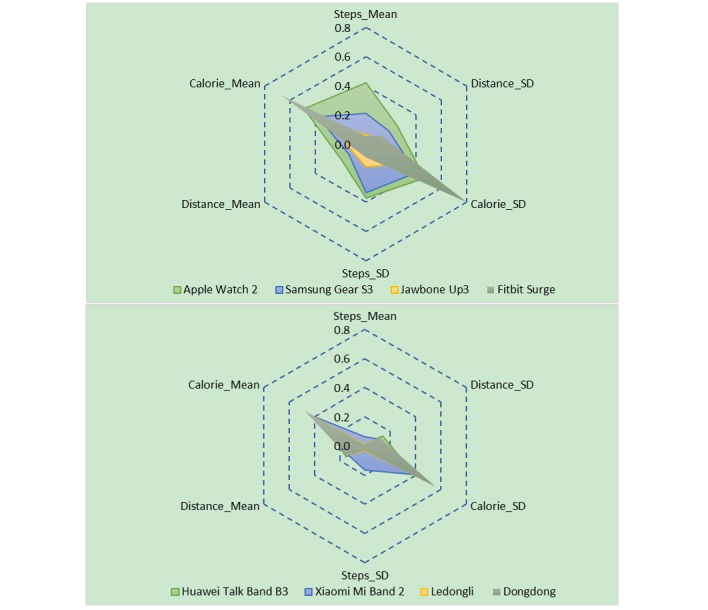
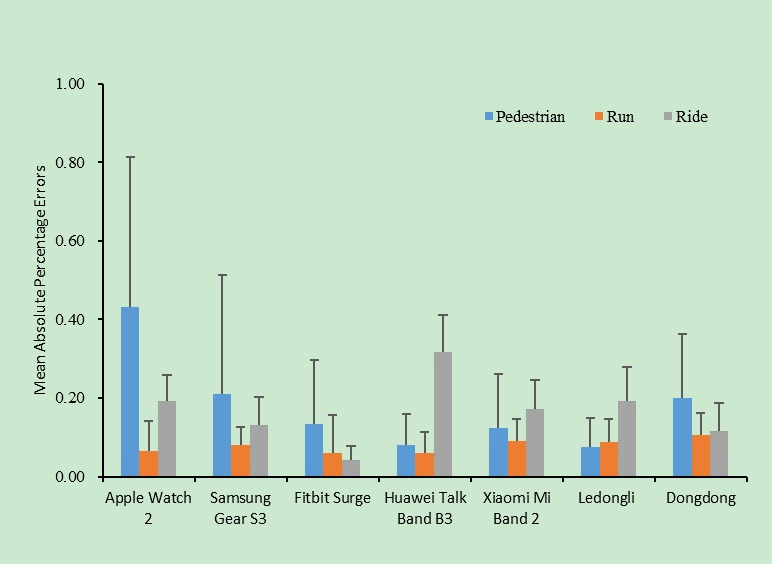
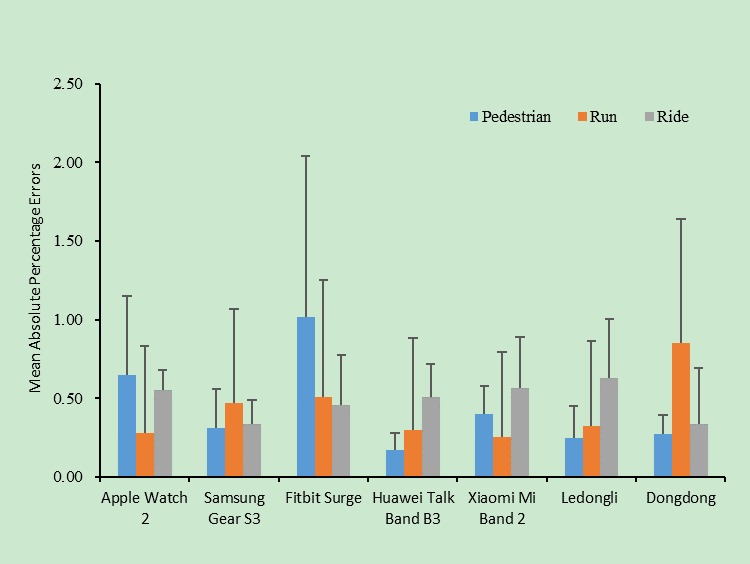
Verification
Claims the paper makes
The claims and statistics of this paper haven’t been checked yet.
Run the check — free, no account needed. It reads the open-access text and checks the sources it cites.
Claims other papers make about this one
Each is checked against this paper’s own text: does it say what the citing paper says it does?
The source backs part of the claim, not all of it — or backs it for a different population, condition or comparison.
In the citing paper
“Wearable and mobile sensor technologies can be useful tools in precision nutrition research and practice”
From Wearable Technology to Quantify the Nutritional Intake of Adults: Validation Study (2020) · cites this paper as [15]
Experimental — accuracy not yet measuredIn the citing paper
“a second study found that the accuracy of HR measurement was highest during running51”
From Guidelines for wrist-worn consumer wearable assessment of heart rate in biobehavioral research (2020) · cites this paper as [51]
Self-check
Percentages, sums and reported differences re-computed from the paper’s own numbers.
The self-check needs the paper’s full text.
Citations
Cites
‘Small Changes' to Diet and Physical Activity Behaviors for Weight Management
Hills, A. P., Byrne, N. M., Lindstrom, R. C., & Hill, J. O. (2013) · Obesity Facts · doi:10.1159/000345030 · Cited by 9,526
Using Pedometers to Increase Physical Activity and Improve Health: A Systematic Review
Bravata, D. M., Smith-Spangler, C., Sundaram, V., Gienger, A. L., Lin, N., Lewis, R., Stave, C. D., Olkin, I., & Sirard, J. R. (2007) · JAMA · doi:10.1001/jama.298.19.2296 · Cited by 2,064
Systematic review of the validity and reliability of consumer-wearable activity trackers
Evenson, K. R., Goto, M. M., & Furberg, R. D. (2015) · International Journal of Behavioral Nutrition and Physical Activity · doi:10.1186/s12966-015-0314-1 · Cited by 1,232
Sullivan, A. N., & Lachman, M. E. (2017) · Frontiers in Public Health · doi:10.3389/fpubh.2016.00289 · Cited by 458
Validity of Consumer-Based Physical Activity Monitors
LEE, J.-M., KIM, Y., & WELK, G. J. (2014) · Medicine & Science in Sports & Exercise · doi:10.1249/mss.0000000000000287 · Cited by 401 · cited 2×
“Lee et al [34] asked 60 subjects to simultaneously wear eight types of wearable devices in a natural state of life for 69 min and used the Oxycon mobile 5.0 as the gold standard of energy consumption measurement and found that, except for the Basis Band (MAPE=0.23), the majority of the devices had good accuracy, maint…”
MethodInfluentialValidation of the Fitbit One activity monitor device during treadmill walking
Takacs, J., Pollock, C. L., Guenther, J. R., Bahar, M., Napier, C., & Hunt, M. A. (2013) · Journal of science and medicine in sport · doi:10.1016/j.jsams.2013.10.241 · Cited by 336
Movement toward a novel activity monitoring device
Montgomery-Downs, H. E., Insana, S. P., & Bond, J. A. (2012) · Sleep and Breathing · doi:10.1007/s11325-011-0585-y · Cited by 301
Stahl, S. E., An, H.-S., Dinkel, D. M., Noble, J. M., & Lee, J.-M. (2016) · BMJ Open Sport & Exercise Medicine · doi:10.1136/bmjsem-2015-000106 · Cited by 276
Feasibility and Effectiveness of Using Wearable Activity Trackers in Youth: A Systematic Review
Ridgers, N. D., McNarry, M. A., & Mackintosh, K. A. (2016) · JMIR mhealth and uhealth · doi:10.2196/mhealth.6540 · Cited by 245
Dooley, E. E., Golaszewski, N. M., & Bartholomew, J. B. (2017) · JMIR mHealth and uHealth · doi:10.2196/mhealth.7043 · Cited by 242
Research works printed but not linked: 3
- 2010, Global Recommendations on Physical Activity for Health
- 10.1093/jamia/ocx006 · DOI
- Jo, E, 2016, J Sports Sci Med, 15, 540
Cited by
Sorted by citations
Items 301–310 of 310
Chen, Y., Xu, K., Zhao, Y., Gu, Z., Zhang, S., Chen, G., & Dai, J. (2026) · Frontiers in Public Health · doi:10.3389/fpubh.2026.1833198
Heart Rate Circadian Oscillations as Digital Biomarkers of Cardiometabolic Health DeterminantsPreprint
Colitta, A., Bruno, S., Benedetti, D., Hoxhaj, D., Sanabria, F. C., Pede, C. D., Torresi, F. B., Frumento, P., Gargani, L., Fabbrini, M., et al. (2026) · medRxiv · doi:10.64898/2026.06.07.26355124
Demographic and Socioeconomic Factors Associated with Fitbit Ownership in the NIH All of Us Cohort
Carrier, B., & Navalta, J. W. (2026) · International Journal of Environmental Research and Public Health · doi:10.3390/ijerph23070839
Flexible nap scheduling for cognitive recovery in young adults after acute sleep restriction
Huang, W., Yang, Y., Zhang, X., & Tang, J. (2026) · Sleep research. · doi:10.1002/slp2.70044
Hogue, T., Khoury, A., Njeim, P., Aswad, N., Youssef, L., Birtulescu, S., Faust, A., & Hajj‐Boutros, G. (2026) · Frontiers in Digital Health · doi:10.3389/fdgth.2026.1820224
Zaitsev, A. A., Kovalev, A. A., & Gnatyuk, V. I. (2026) · Almanac Institute of special education · doi:10.66435/almanac.ise.1.03
Exercise and physical activity changes during the menstrual cycle in users of the Flo app
Cunningham, A. C., Rauff, E. L., Hewings-Martin, Y., Wickham, A. P., Xu, Y., & Zhaunova, L. (2026) · Women s Health · doi:10.1177/17455057261473456
Ryu, H., Kim, S., & Park, A. (2026) · Chaos Solitons & Fractals · doi:10.1016/j.chaos.2026.119183
Muhammad, M., Oguntala, G., & Yinusa, A. (2026) · Nano Biomedicine and Engineering · doi:10.1016/j.nbe.2026.100079
Costa, S. N., Scheidt, I. V., Ulbrich, A. Z., de Mattos, F., & Bento, P. C. B. (2026) · Sport Sciences for Health · doi:10.1007/s11332-026-01959-4
Metadata
- Authors
- Xie, J., Wen, D., Liang, L., Jia, Y., Gao, L., & Lei, J.
- Affiliations
- Peking University (CN)
- Guangdong Medical College (CN)
- Jilin University (CN)
- Corresponding author
- Lei, Jianbo
- Venue
- JMIR mHealth and uHealth
- Publisher
- JMIR Publications Inc.
- Published
- 2018-04-12
- Volume
- 6
- Issue
- 4
- Pages
- e94
- ISSN
- 2291-5222 (ISSN-L)
- PMC
- PMC5920198
- OpenAlex
- W2798041585
- Cited by
- 310
- References
- 31
- Citations by year
- 2026: 17 · 2025: 31 · 2024: 38 · 2023: 36 · 2022: 35 · 2021: 63 · 2020: 55 · 2019: 27 · 2018: 8
- FWCI
- 19.13
- Type
- journal article
- Language
- en
- Open access
- gold
- doi.org
- Licence
- cc-by
- Locations
- JMIR mhealth and uhealth (publishedVersion, cc-by)
- Europe PMC (PubMed Central) (publishedVersion, cc-by)
- PubMed Central (publishedVersion, cc-by)
- PubMed (publishedVersion)
- DOAJ (DOAJ: Directory of Open Access Journals) (submittedVersion, cc-by-sa)
- Topics
- Physical Sciences › Computer Science › Computer Vision and Pattern Recognition › Context-Aware Activity Recognition Systems
- Health Sciences › Medicine › Public Health, Environmental and Occupational Health › Physical Activity and Health
- Health Sciences › Health Professions › General Health Professions › Mobile Health and mHealth Applications
- Keywords
- wearable activity trackers, heart rate monitoring, step counting, distance measurement, energy expenditure estimation, Apple Watch, mean absolute percentage error, oxygen consumption, mobile health apps
About these checks
Registry, retraction, Cites and statistics results are computed, not judged, with one exception: a printed reference that no index lists is read once by a model before it counts as a citation error. Claims are extracted by a model and kept only when their quote appears verbatim in the text; each cited source is then checked, with a model’s help, for whether it says what the claim relies on. Those verdicts can be wrong — read the claim’s quote and the cited source before relying on one.
Statistics and arithmetic are recomputed, not judged.
Confidence bands are shown only for fields calibrated on our annotated test set. None is calibrated yet, so no band is shown.
What counts as a claim ›How we measure confidence ›How we check this ›
Are you an author, or do you see a problem with this page? Request a review
