

Efficient magic state factories with a catalyzed | C C Z ⟩ to 2 | T ⟩ transformation
Open accessThe DOI matches its Crossref record; 30 of the 30 references it cites were found in a registry or an index.
Abstract
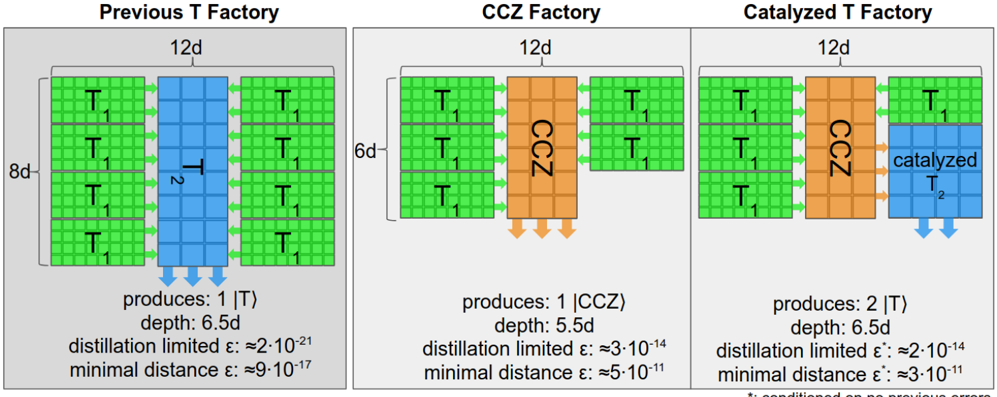
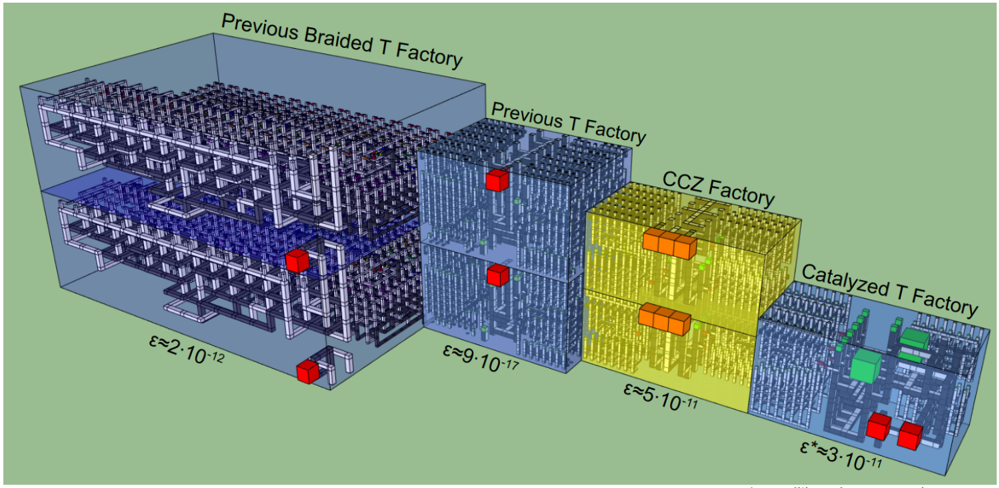
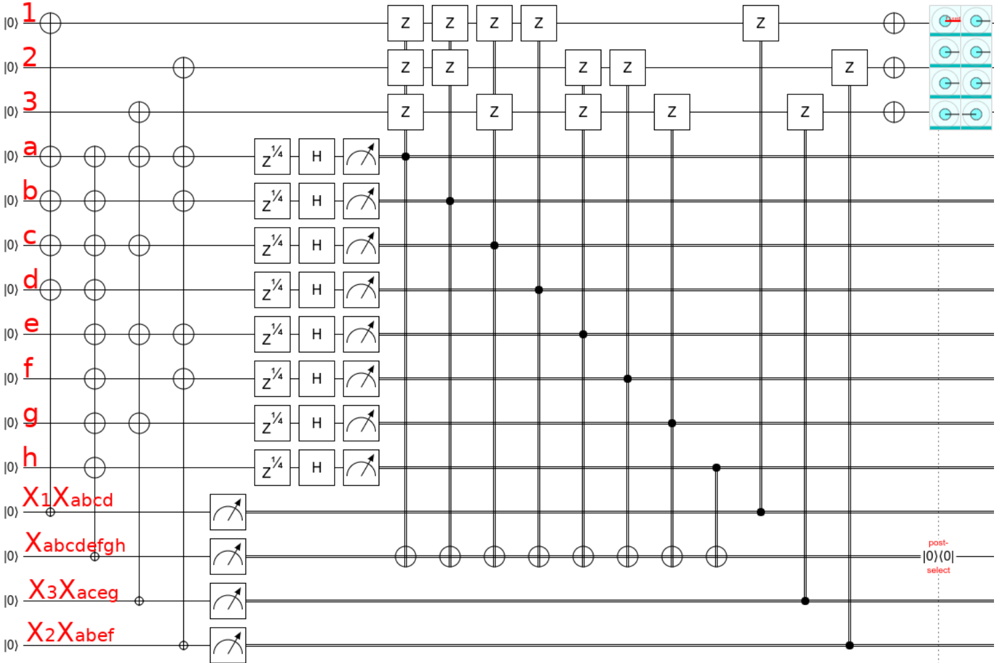
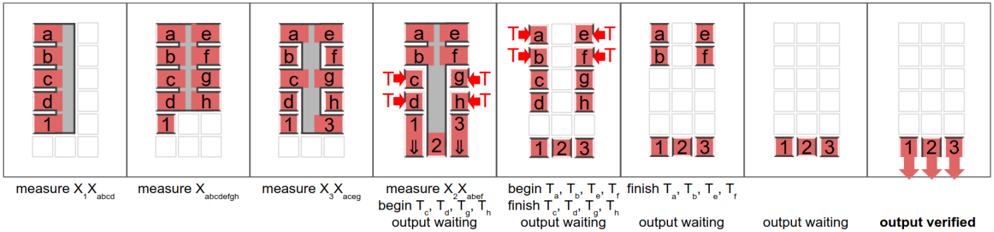
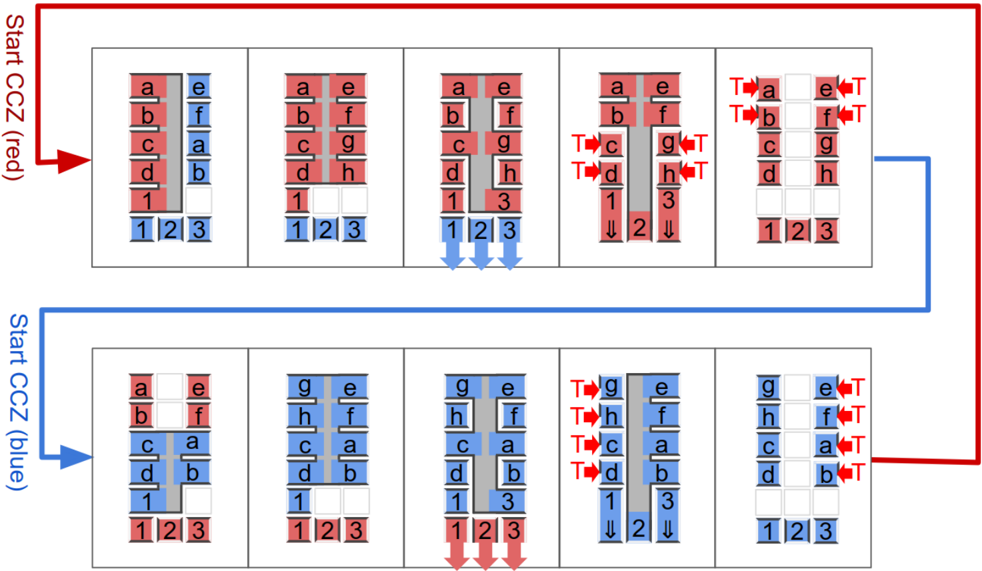
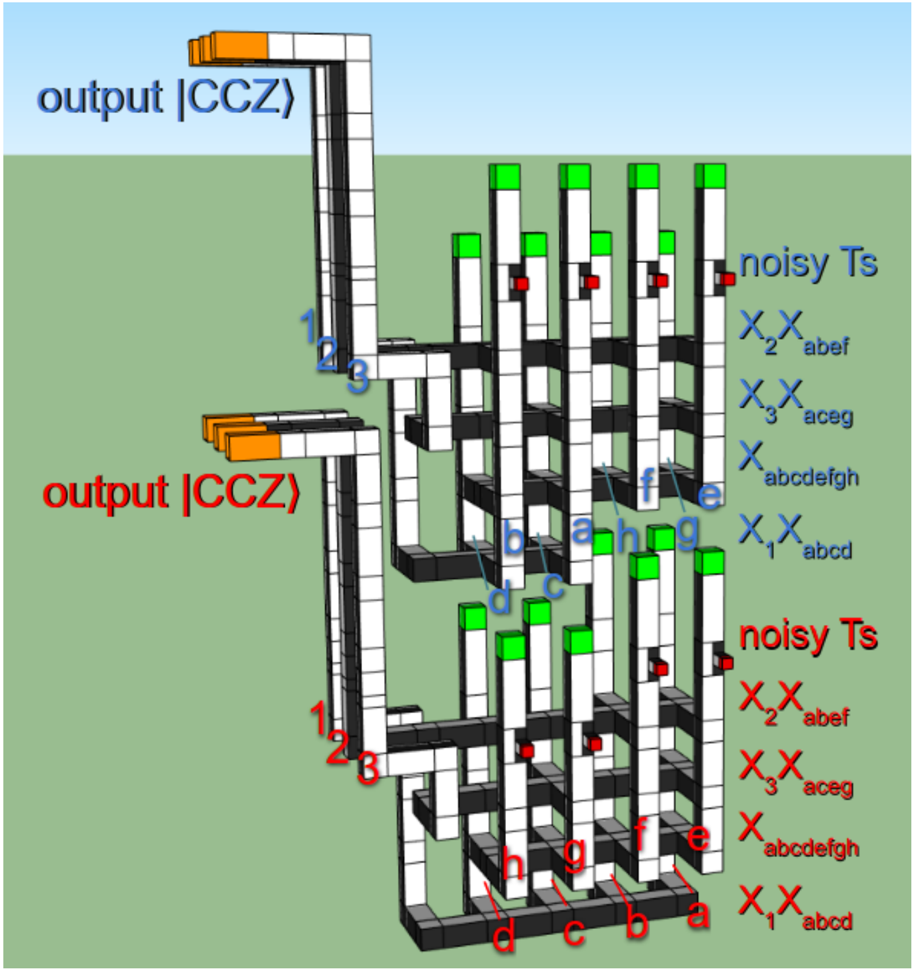
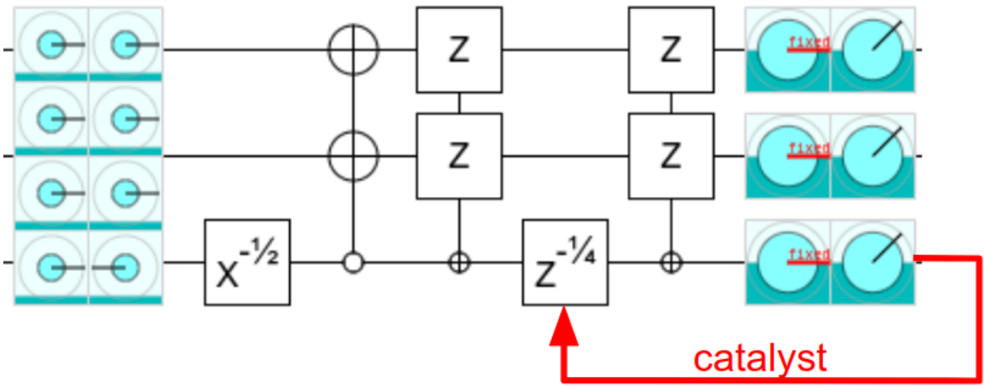
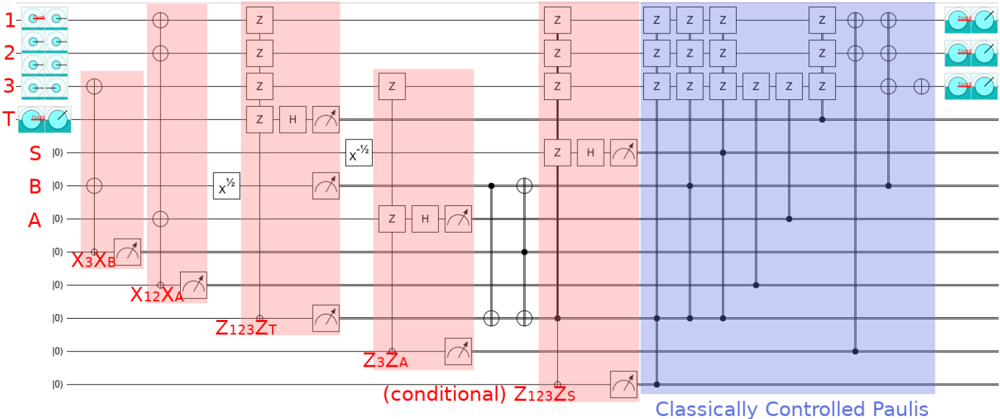
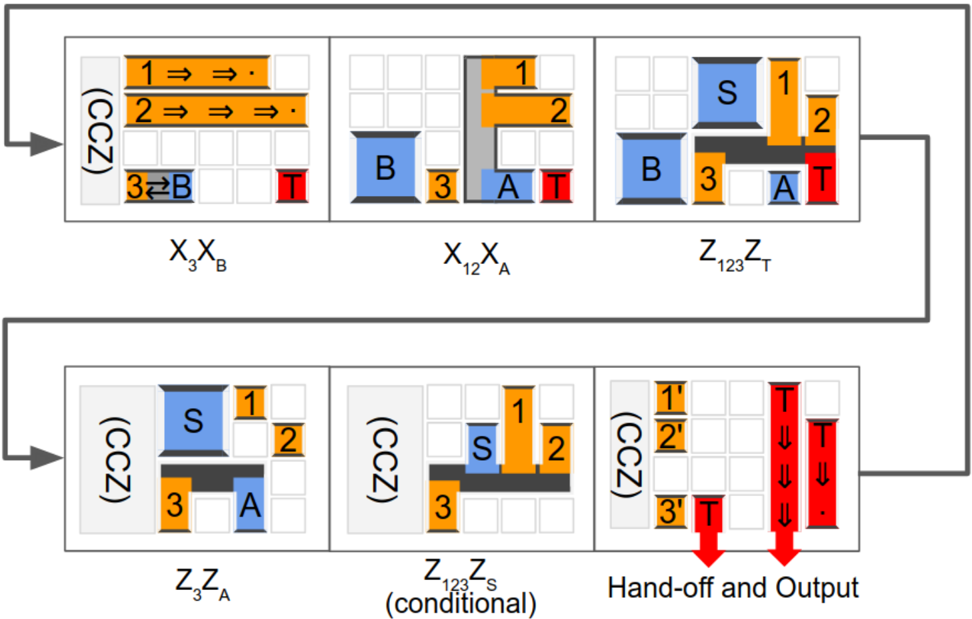
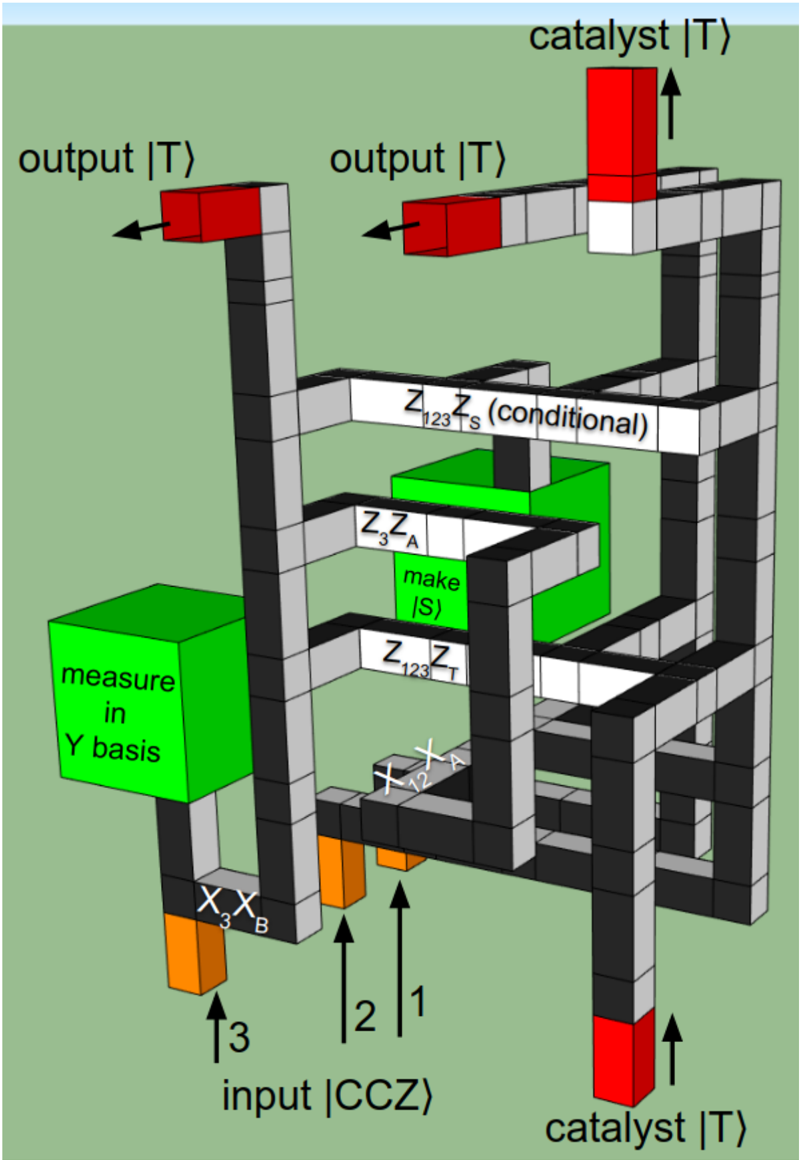
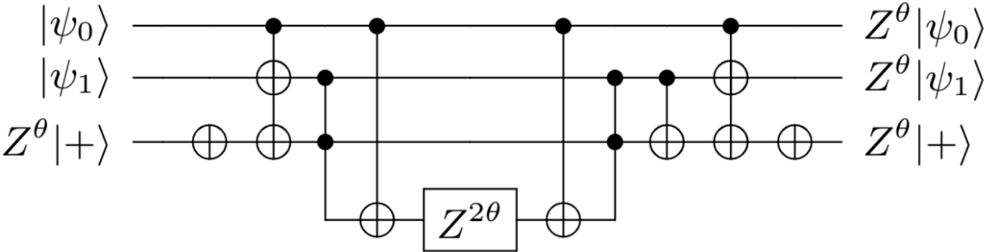
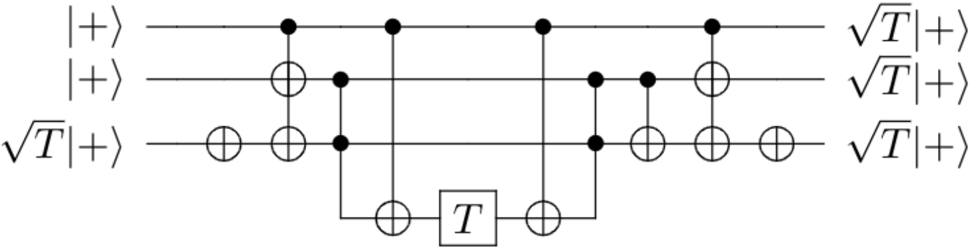
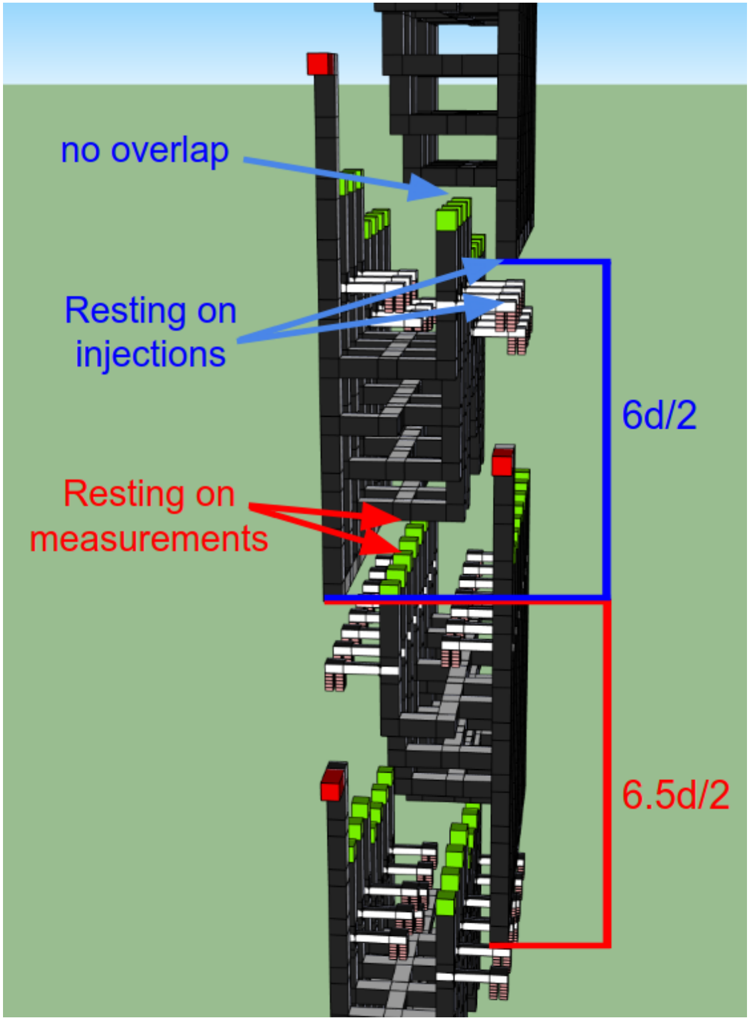
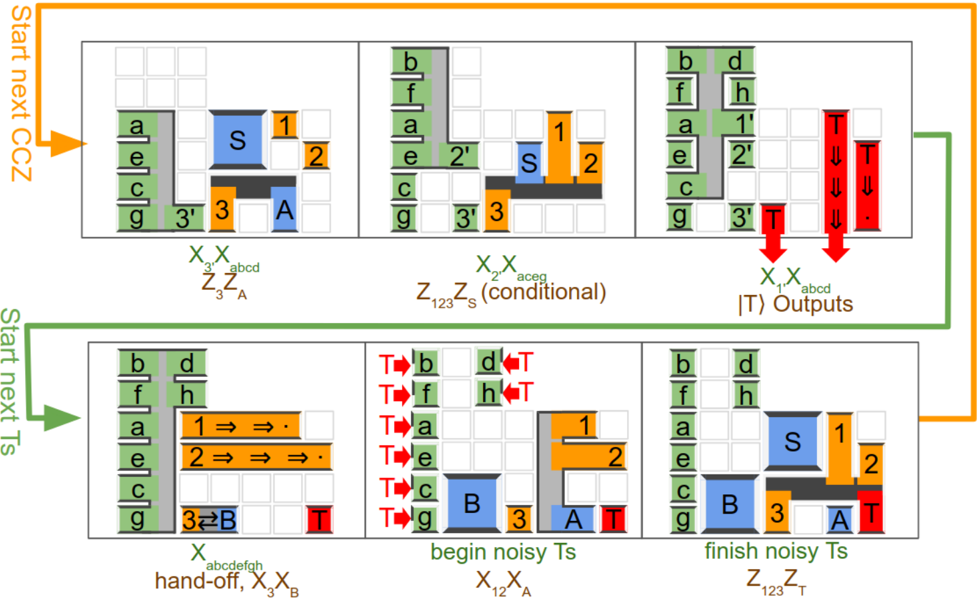
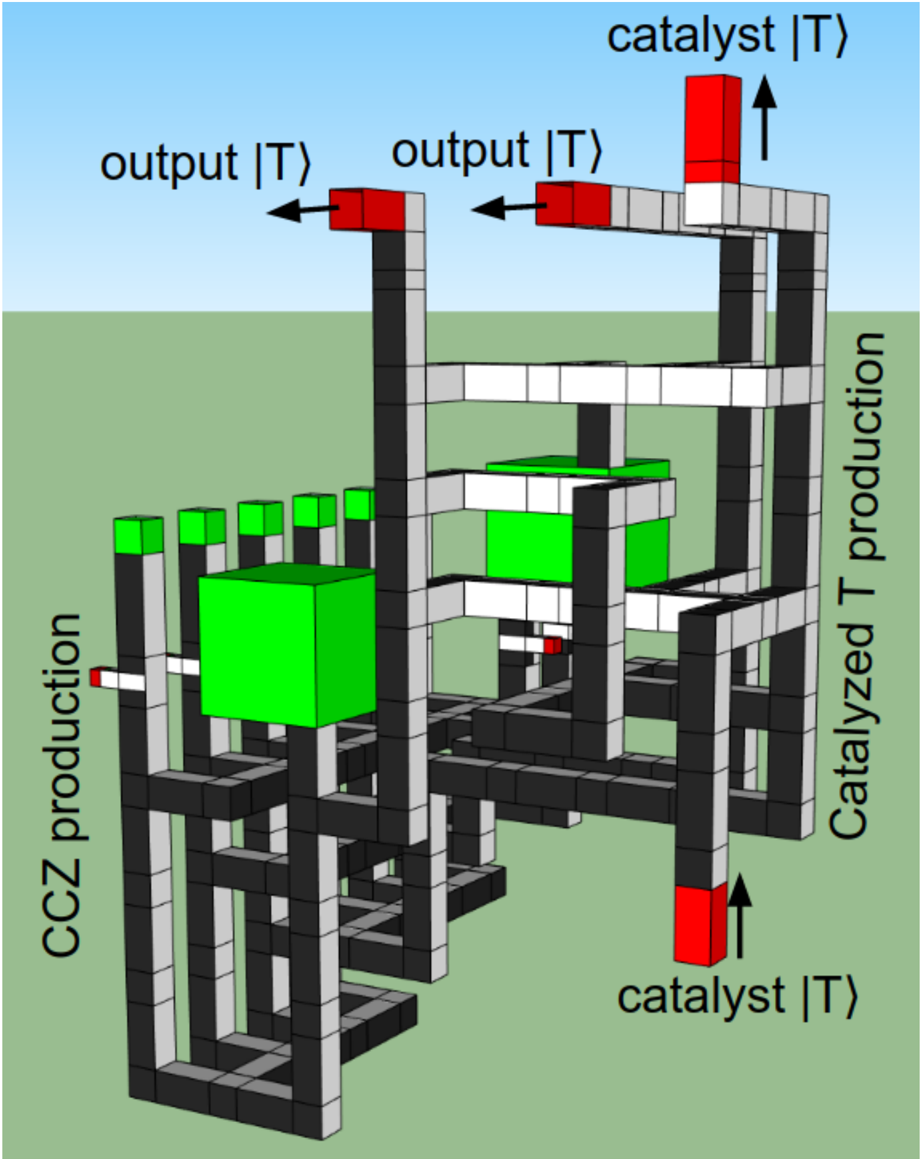
We present magic state factory constructions for producing | C C Z ⟩ states and | T ⟩ states. For the | C C Z ⟩ factory we apply the surface code lattice surgery construction techniques described in \cite{fowler2018} to the fault-tolerant Toffoli \cite{jones2013, eastin2013distilling}. The resulting factory has a footprint of 12 d × 6 d (where d is the code distance) and produces one | C C Z ⟩ every 5.5 d surface code cycles. Our | T ⟩ state factory uses the | C C Z ⟩ factory's output and a catalyst | T ⟩ state to exactly transform one | C C Z ⟩ state into two | T ⟩ states. It has a footprint 25 % smaller than the factory in \cite{fowler2018} but outputs | T ⟩ states twice as quickly. We show how to generalize the catalyzed transformation to arbitrary phase angles, and note that the case θ = 22.5 ∘ produces a particularly efficient circuit for producing | T ⟩ states. Compared to using the 12 d × 8 d × 6.5 d | T ⟩ factory of \cite{fowler2018}, our | C C Z ⟩ factory can quintuple the speed of algorithms that are dominated by the cost of applying Toffoli gates, including Shor's algorithm \cite{shor1994} and the chemistry algorithm of Babbush et al. \cite{babbush2018}. Assuming a physical gate error rate of 10 − 3 , our CCZ factory can produce ∼ 10 10 states on average before an error occurs. This is sufficient for classically intractable instantiations of the chemistry algorithm, but for more demanding algorithms such as Shor's algorithm the mean number of states until failure can be increased to ∼ 10 12 by increasing the factory footprint ∼ 20 % .
Overview
The claims and statistics of this paper haven’t been checked yet.
Free: it reads the open-access text and checks the first 5 claims that cite a source we can check. Create a free account to check every claim.
Integrity signals
Registry
Cites
Statistics
Figures
Verification
Claims the paper makes
The claims and statistics of this paper haven’t been checked yet.
Free: it reads the open-access text and checks the first 5 claims that cite a source we can check. Create a free account to check every claim.
Self-check
Percentages, sums and reported differences re-computed from the paper’s own numbers.
The self-check needs the paper’s full text.
Citations
Cites
Algorithms for quantum computation: discrete logarithms and factoring
Shor, P. W. (2002) · Proceedings 35th Annual Symposium on Foundations of Computer Science · doi:10.1109/sfcs.1994.365700 · Cited by 8,713 · cited 1×
“ates. Compared to using the 12d×8d×6.5d|Tifactory of [15], our |CCZi factory can quintuple the speed of algorithms that are dominated by the cost of applying Toffoli gates, including Shor’s algorithm [31] and the chemistry algorithm of Babbush et al. [1]. Assuming a physical gate error rate of 10−3, our CCZ factory ca…”
MethodSurface codes: Towards practical large-scale quantum computation
Fowler, A. G., Mariantoni, M., Martinis, J. M., & Cleland, A. N. (2012) · Physical Review A · doi:10.1103/physreva.86.032324 · Cited by 3,059 · cited 1×
“…based on the surface code (a likely component of future error corrected quantum computers due to the surface code’s comparatively high threshold and planar connectivity requirements [3, 11, 29, 30, 13]), the cost of a quantum algorithm is well approximated by the number of non-Clifford operations.”
BackgroundSelf-citationGottesman, D., & Chuang, I. L. (1999) · Nature · doi:10.1038/46503 · Cited by 1,860 · cited 1×
“Contrast with gate teleportation [18], which consumes a previously prepared Z|+〉 state in order to perform one Z operation, with a 50% chance of requiring a fixup Z−2θ operation.”
MethodDennis, E., Kitaev, A., Landahl, A., & Preskill, J. (2002) · Journal of Mathematical Physics · doi:10.1063/1.1499754 · Cited by 1,768 · cited 1×
“…based on the surface code (a likely component of future error corrected quantum computers due to the surface code’s comparatively high threshold and planar connectivity requirements [3, 11, 29, 30, 13]), the cost of a quantum algorithm is well approximated by the number of non-Clifford operations.”
BackgroundUniversal quantum computation with ideal Clifford gates and noisy ancillas
Bravyi, S., & Kitaev, A. (2005) · Physical Review A · doi:10.1103/physreva.71.022316 · Cited by 1,525 · cited 2×
“com distillation [5], and the cost of state distillation is large.”
BackgroundMethodClassical and Quantum Computation
Kitaev, A., Shen, A., & Vyalyi, M. (2002) · Graduate Studies in Mathematics · doi:10.1090/gsm/047 · Cited by 1,387
Fault-Tolerant Quantum Computation with High Threshold in Two Dimensions
Raussendorf, R., & Harrington, J. (2007) · Physical Review Letters · doi:10.1103/physrevlett.98.190504 · Cited by 812 · cited 1×
“rected quantum computers due to the surface code’s comparatively high threshold and planar connectivity requirements [3, 11, 29, 30, 13]), the cost of a quantum algorithm is well approximated by the number of non-Clifford operations.”
MethodTopological fault-tolerance in cluster state quantum computation
Raussendorf, R., Harrington, J., & Goyal, K. (2007) · New Journal of Physics · doi:10.1088/1367-2630/9/6/199 · Cited by 617
Surface code quantum computing by lattice surgery
Horsman, D., Fowler, A. G., Devitt, S., & Meter, R. V. (2012) · New Journal of Physics · doi:10.1088/1367-2630/14/12/123011 · Cited by 598 · cited 3×
“Over the past decade, thanks to techniques such as block codes [4, 16], bridge compression [14], and many others [19, 8, 9, 25], the cost of magic state distillation has steadily decreased.”
BackgroundMethodSelf-citationA Game of Surface Codes: Large-Scale Quantum Computing with Lattice Surgery
Litinski, D. (2019) · Quantum · doi:10.22331/q-2019-03-05-128 · Cited by 408 · cited 3×
“Over the past decade, thanks to techniques such as block codes [4, 16], bridge compression [14], and many others [19, 8, 9, 25], the cost of magic state distillation has steadily decreased.”
Background
Research works printed but not linked: 2
- 10. Niel de Beaudrap and Dominic Horsman. The zx calculus is a language for surface code lattice surgery. arXiv preprint arXiv:1704.08670, 2017. URL https://arxiv.org/abs/1704.08670. · arXiv
- 27. Yunseong Nam, Yuan Su, and Dmitri Maslov. Approximate quantum fourier transform with o(n log(n)) t gates. arXiv preprint arXiv:1803.04933, 2018. URL https://arxiv.org/abs/1803.04933. · arXiv
Cited by
Items 101–200 of 217
Quantum Algorithms and Oracles with the Scalable ZX-calculus
Carette, T., D'Anello, Y., & Perdrix, S. (2021) · Electronic Proceedings in Theoretical Computer Science · doi:10.4204/eptcs.343.10 · Cited by 17
“Among others we can cite the optimisation of quantum circuits [24, 15, 3] and the design of fault tolerant quantum computation [5, 16, 21, 4].”
MethodSpin-networks in the ZX-calculusPreprint
East, R. D. P., Martin-Dussaud, P., & van de Wetering, J. (2021) · arXiv (Cornell University) · doi:10.48550/arxiv.2111.03114 · Cited by 17
Low-overhead quantum computing with the color code
Thomsen, F., Kesselring, M. S., Bartlett, S. D., & Brown, B. J. (2024) · Physical Review Research · doi:10.1103/physrevresearch.6.043125 · Cited by 15
FTCircuitBench: A Benchmark Suite for Fault-Tolerant Quantum Compilation and Architecture
Harkness, A., Kan, S., Liu, C., Wang, M., Martyn, J. M., Xu, S., Chamaki, D., Decker, E., Mao, Y., Zuluaga, L. F., et al. (2026) · ACM Transactions on Quantum Computing · doi:10.1145/3858421 · Cited by 16
The T-Complexity Costs of Error Correction for Control Flow in Quantum Computation
Yuan, C., & Carbin, M. (2024) · Proceedings of the ACM on Programming Languages · doi:10.1145/3656397 · Cited by 19
“On the surface code, realizing the T gate incurs an area-latency cost of about 10 2 times that of Clifford gates such as CNOT [Gidney and Fowler 2019] and 10 10 times that of a NAND gate in classical transistors [Babbush et al. 2021].”
BackgroundInfluentialGavriel, J., Herr, D., Shaw, A., Bremner, M. J., Paler, A., & Devitt, S. J. (2023) · Physical Review Research · doi:10.1103/physrevresearch.5.033019 · Cited by 17
Towards solving industrial integer linear programs with decoded quantum interferometry
Sabater, F., Harzli, O. E., Besjes, G.-J., Erdmann, M., Klepsch, J., Hiltrop, J., Bobier, J.-F., Cao, Y., & Riofrío, C. A. (2026) · Quantum Science and Technology · doi:10.1088/2058-9565/ae65d8 · Cited by 16
“This decoding-centric paradigm thus offers a rigorous and complementary path in the search for quantum advantage in optimization—one that sidesteps known variational barriers while capitalizing on quantum Fourier structure where it is provably effective.”
Catalytic z -rotations in constant T -depth
Kim, I. H. (2026) · Quantum · doi:10.22331/q-2026-08-13-2191 · Cited by 16
Quantum Computing for Climate Change Detection, Climate Modeling, and Climate Digital TwinPreprint
Otgonbaatar, S., Nurmi, O., Johansson, M. P., Mäkelä, J., kocman, T., Gawron, P., Puchała, Z., Mielzcarek, J., Miroszewski, A., & Dumitru, C. O. (2023) · doi:10.36227/techrxiv.24478663.v1 · Cited by 17
Patel, S., Brahmachari, A. S., Cantin, J. T., Wang, L., & Izmaylov, A. F. (2025) · Journal of Chemical Theory and Computation · doi:10.1021/acs.jctc.4c01390 · Cited by 18
Unitary-invariant method for witnessing nonstabilizerness in quantum processors
Wagner, R., Peres, F. C. R., Cruzeiro, E. Z., & Galvão, E. F. (2025) · Journal of Physics A Mathematical and Theoretical · doi:10.1088/1751-8121/ade9ff · Cited by 20
Efficient Simulation of Logical Magic State Preparation Protocols
Surti, S., Daguerre, L., & Kim, I. H. (2026) · PRX Quantum · doi:10.1103/fby6-xjbm · Cited by 27
“VII for more details. fault-tolerant quantum computing architectures, it is commonly assumed that preparing magic states is significantly more costly than Clifford gates [8– 19].”
A robust phase of continuous transversal gates in quantum stabilizer codesPreprint
Huang, E., Rozon, P.-G., Dua, A., Gopalakrishnan, S., & Gullans, M. J. (2025) · arXiv (Cornell University) · doi:10.48550/arxiv.2510.01319 · Cited by 13
The prospects of Monte Carlo antibody loop modelling on a fault-tolerant quantum computer
Allcock, J., Vangone, A., Meyder, A., Adaszewski, S., Strahm, M., Hsieh, C.-Y., & Zhang, S. (2022) · Frontiers in Drug Discovery · doi:10.3389/fddsv.2022.908870 · Cited by 12
“Using the state-of-the-art |CCZ〉 distillation factory of (Gidney and Fowler, 2019), and assuming first generation large-scale FTQC have physical error rates of 10–4 (see (Sevilla and Riedel, 2020) for forecast timelines of quantum computing technology) and a surface code cycle time of 1μs4, a…”
BackgroundFlexible layout of surface code computations using AutoCCZ states
Gidney, C., & Fowler, A. G. (2019) · arXiv · doi:10.48550/arxiv.1905.08916 · Cited by 12
“Figure 9: The CCZ factory from [11], after adjusting the level 1 distance to 17 and the level 2 distance to d = 27, has a footprint that fits inside a 15× 8 rectangular patch of distance d = 27 logical qubits.”
BackgroundMethodInfluentialSelf-citationQuantum block lookahead adders and the wait for magic statesPreprint
Gidney, C. (2020) · arXiv (Cornell University) · doi:10.48550/arxiv.2012.01624 · Cited by 12
“For example in [10] a factory covers hundreds of thousands of physical qubits (although new techniques are reducing the cost [13]).”
BackgroundSelf-citationA Graphical #SAT Algorithm for Formulae with Small Clause Density
Laakkonen, T., Meichanetzidis, K., & van de Wetering, J. (2024) · Electronic Proceedings in Theoretical Computer Science · doi:10.4204/eptcs.406.7 · Cited by 12
“It has seen use in a variety of areas like optimising quantum computations [5, 21, 24, 33, 36], more effectively classically simulating quantum computations [37, 38], and several others like [16, 28, 49]; see [51] for a review.”
BackgroundFrom quantum-enhanced to quantum-inspired Monte Carlo
Christmann, J., Ivashkov, P., Chiurco, M., & Mazzola, G. (2025) · Physical Review A · doi:10.1103/physreva.111.042615 · Cited by 14
Well-tempered ZX and ZH Calculi
de Beaudrap, N. (2021) · Electronic Proceedings in Theoretical Computer Science · doi:10.4204/eptcs.340.2 · Cited by 11
Clifford Gate Optimisation and T Gate Scheduling: Using Queueing Models for Topological Assemblies
Paler, A., & Basmadjian, R. (2019) · IEEE/ACM International Symposium on Nanoscale Architectures (NANOARCH) · doi:10.1109/nanoarch47378.2019.181305 · Cited by 11
Dündar‐Coecke, S., Puca, C., Yeh, L., Waseem, M. H., Pothos, E. M., Cervoni, T., Pfaendler, S. M.-L., Wang-Maścianica, V., Sigrist, P., Tomassini, F., et al. (2025) · arXiv (Cornell University) · doi:10.48550/arxiv.2504.01013 · Cited by 13
Efficient Benchmarking of Logical Magic State
Lee, S.-U., Yuan, M., Chen, S., Tsubouchi, K., & Jiang, L. (2026) · Physical Review Letters · doi:10.1103/fwjt-mw2c · Cited by 13
“While directly preparing high-fidelity magic states within QEC codes is challenging, magic state distillation provides a practical solution by consuming multiple noisy copies to produce higher-fidelity ones [11–13].”
Many-Body Quantum Catalysts for Transforming Between Phases of Matter
Stephen, D. T., Nandkishore, R., & Zhang, J.-H. (2025) · PRX Quantum · doi:10.1103/prxquantum.6.020353 · Cited by 10
Picturing Counting Reductions with the ZH-Calculus
Laakkonen, T., Meichanetzidis, K., & van de Wetering, J. (2023) · Electronic Proceedings in Theoretical Computer Science · doi:10.4204/eptcs.384.6 · Cited by 10
Magic state cultivation: growing T states as cheap as CNOT gates
Gidney, C., Shutty, N., & Jones, C. (2024) · arXiv · doi:10.48550/arxiv.2409.17595 · Cited by 9
“The main inefficiency of magic state distillation is the fact that it’s performed with logical operations [Fow+12; GF19a; Lit19].”
BackgroundSelf-citationWeakly fault-tolerant computation in a quantum error-detecting code
Gerhard, C., & Brun, T. A. (2026) · Physical Review A · doi:10.1103/7pv5-46nd · Cited by 9
“New meth-ods have been introduced in the past few years to reduce the cost of this procedure [10–13], but magic state distillation still considerably magnifies the size of the logical versions of quantum circuits.”
Unlocking early fault-tolerant quantum computing with mitigated magic dilution
Luthra, S., Moylett, A. E., Browne, D. E., & Campbell, E. T. (2025) · Quantum Science and Technology · doi:10.1088/2058-9565/ae0aef · Cited by 14
Magic state distillation and cost analysis in fault-tolerant universal quantum computation
Liu, Y., Ma, Z., Luo, L., Du, C., Fei, Y., Wang, H., Duan, Q., & Yang, J. (2023) · Quantum Science and Technology · doi:10.1088/2058-9565/ace6ca · Cited by 11
Randomized semi-quantum matrix processing
Tosta, A., Silva, T. D. L., Camilo, G., & Aolita, L. (2024) · npj Quantum Information · doi:10.1038/s41534-024-00883-0 · Cited by 14
Averaging gate approximation error and performance of Unitary Coupled Cluster ansatz in Pre-FTQC Era
Kuroiwa, K., & Nakagawa, Y. O. (2025) · Quantum · doi:10.22331/q-2025-07-21-1800 · Cited by 10
““(X , ( x, y, z ))” denotes three dimensional coordinates x, y, z of atom X in units of Å.”
Paler, A. (2019) · arXiv (Cornell University) · doi:10.48550/arxiv.1902.02417 · Cited by 13
“[27]), such that preparing and resource estimating scqc is a job that has to be repeated.”
BackgroundMundada, P., Khindanov, A., Wang, Y., Edmunds, C., Coote, P., Biercuk, M. J., Baum, Y., & Hush, M. (2026) · New Journal of Physics · doi:10.1088/1367-2630/aeb71b · Cited by 8
Exploring AES Encryption Implementation Through Quantum Computing Techniques
Gorine, A., & Suhaib, M. (2024) · American Journal of Computer Science and Technology · doi:10.11648/j.ajcst.20240704.12 · Cited by 9
Finite Verification of Infinite Families of Diagram Equations
Miller-Bakewell, H. (2020) · Electronic Proceedings in Theoretical Computer Science · doi:10.4204/eptcs.318.3 · Cited by 8
Iteratively decoded magic state distillationPreprint
Wan, K. H. (2024) · arXiv (Cornell University) · doi:10.48550/arxiv.2410.17992 · Cited by 8
Constant-Rate Entanglement Distillation for Fast Quantum Interconnects
Pattison, C. A., Baranes, G., Ataides, J. P. B., Lukin, M. D., & Zhou, H. (2025) · Proceedings - International Symposium on Computer Architecture/Proceedings · doi:10.1145/3695053.3731069 · Cited by 20
Karmakar, T., Lewalle, P., Zhang, Y., & Whaley, K. B. (2026) · Physical Review A · doi:10.1103/cnxj-m1wn · Cited by 8
On the Practicality of Quantum Sieving Algorithms for the Shortest Vector Problem
Doriguello, J. F., Giapitzakis, G., Luongo, A., & Morolia, A. (2026) · Lecture notes in computer science · doi:10.1007/978-3-032-22695-2_1 · Cited by 8
Cost-optimal single-qubit gate synthesis in the Clifford hierarchy
Mooney, G. J., Hill, C. D., & Hollenberg, L. C. L. (2021) · Quantum · doi:10.22331/q-2021-02-15-396 · Cited by 16
“1, which was introduced in [23] and presented in more detail in [22].”
BackgroundMethodInfluentialQuantum Computing for Climate Change Detection, Climate Modeling, and Climate Digital TwinPreprint
Otgonbaatar, S., Nurmi, O., Johansson, M. P., Mäkelä, J., kocman, T., Gawron, P., Puchała, Z., Mielzcarek, J., Miroszewski, A., & Dumitru, C. O. (2023) · TechRxiv · doi:10.36227/techrxiv.24478663 · Cited by 8
A manufacturable surface code architecture for spin qubits with fast transversal logicPreprint
Chadwick, J. D., Yang, W., Viszlai, J., & Chong, F. T. (2025) · arXiv (Cornell University) · doi:10.48550/arxiv.2512.07131 · Cited by 7
“2) 8T-to-CCZ factory: The 8T-to-CCZ factory [92], [93] (Figure 14b) is an alternative magic state preparation method that outputs a | CCZ ⟩ state, which can be used to perform a Toffoli gate.”
Accelerating Fault-Tolerant Quantum Computation with Good Quantum Low-Density Parity-Check Codes
Zhang, G., Zhu, Y., & Li, Y. (2026) · PRX Quantum · doi:10.1103/3fj5-gn1h · Cited by 9
Controller-decoder system requirements derived by implementing Shor's algorithm with surface code
Kurman, Y., Ella, L., Halay, N., Wertheim, O., & Cohen, Y. (2026) · Quantum · doi:10.22331/q-2026-07-22-2170 · Cited by 8
Time versus Hardware: Reducing Qubit Counts with a (Surface Code) Data BusPreprint
Herr, D., Paler, A., Devitt, S. J., & Nori, F. (2019) · arXiv (Cornell University) · doi:10.48550/arxiv.1902.08117 · Cited by 7
“We compare the qubit counts with the most up-to-date results from [19].”
BackgroundMethodInfluentialQuantum Circuit Pre-Synthesis: Learning Local Edits to Reduce $T$-countPreprint
Bosco, D. L., Cincio, Ł., Serra, G., & Cerezo, M. (2026) · arXiv (Cornell University) · doi:10.48550/arxiv.2601.19738 · Cited by 7
“This naïve examples shows that equivalent circuit representations can yield vastly different T -counts (i.e., number of T -gates), a central metric in fault-tolerant synthesis [12].”
Takeuchi, Y. (2024) · Physical Review Letters · doi:10.1103/physrevlett.133.050601 · Cited by 5
Fault-tolerant quantum computation without distillation on a 2D device
Scruby, T. R., Nemoto, K., & Cai, Z. (2025) · npj Quantum Information · doi:10.1038/s41534-025-01133-7 · Cited by 8
Low-depth phase oracle using a parallel piecewise circuit
Sun, Z., Boyd, G., Cai, Z., Jnane, H., Koczor, B., Meister, R., Minko, R., Pring, B., Benjamin, S. C., & Stamatopoulos, N. (2025) · Physical Review A · doi:10.1103/m32k-7nq2 · Cited by 7
“R z (2 i a ), i.e. a set of single-qubit rotations performed in parallel.”
Applications and resource estimates for open system simulation on a quantum computerPreprint
Mozgunov, E., Marshall, J., & Anand, N. (2024) · arXiv (Cornell University) · doi:10.48550/arxiv.2406.06281 · Cited by 5
Quantum Theory from Principles, Quantum Software from DiagramsPreprint
van de Wetering, J. (2021) · arXiv (Cornell University) · doi:10.48550/arxiv.2101.03608 · Cited by 4
“Recent work in optimising the design and layout of magic state distillation factories has greatly improved the resource cost of implementing T gates in the surface code [84, 144].”
BackgroundCatalysing Completeness and UniversalityPreprint
Kissinger, A., Ross, N. J., & van de Wetering, J. (2024) · arXiv (Cornell University) · doi:10.48550/arxiv.2404.09915 · Cited by 4
Threshold for Fault-tolerant Quantum Advantage with the Quantum Approximate Optimization Algorithm
Omanakuttan, S., He, Z., Zhang, Z., Hao, T., Babakhani, A., Boulebnane, S., Chakrabarti, S., Herman, D., Sullivan, J., Perlin, M. A., et al. (2025) · arXiv · doi:10.48550/arxiv.2504.01897 · Cited by 3
“…example, by finding more gate-efficient or parallelizable implementations in a Clifford+ T gate set [69], or by finding more efficient implementations in a different gate set [61, 70] that is compatible with the surface code architecture—may therefore yield substantial speedups for QAOA+AA.”
Prospects for NMR spectral prediction on fault-tolerant quantum computers
Elenewski, J. E., Camara, C. M., & Kalev, A. (2026) · Physical Review Research · doi:10.1103/km66-ltpl · Cited by 3
“…factories, which can deliver | T ⟩ states by generating of an intermediate | CCZ ⟩ = CCZ | + ⟩ ⊗ 3 and performing a catalytic | CCZ ⟩ → 2 T ⟩ conversion [109, 110]. entry point | In brief, the is an injection of T –states at code distance d 0 = ⌊ d 1 / 2 using well–established methods [111].”
Approximate encoded permutations and piecewise quantum adders
Gidney, C. (2019) · arXiv · doi:10.48550/arxiv.1905.08488 · Cited by 3
“We assume that the CCZ factory from [6] is used, with 50% overhead for routing and Clifford work such as CZ fixups to the gate teleportation, and that the code distance of the computation is 31.”
MethodSelf-citationMagic state distillation without measurements and post-selection
Heußen, S. (2025) · APL Quantum · doi:10.1063/5.0280551 · Cited by 5
Boundaries of acceptable defectiveness: redefining surface code robustness under heterogeneous noise
Palmer, J. S., & Smith, K. N. (2026) · npj Unconventional Computing · doi:10.1038/s44335-026-00084-2 · Cited by 3
Zhang, J., Tian-hao, W. E. I., Zhuang, X., Chen, Z., Kong, W., Wu, Y.-C., & Guo, G. (2026) · Physical Review Letters · doi:10.1103/mjsj-hxyj · Cited by 3
Optimized Compilation of Logical Clifford Circuits
Popov, A., Meyer, N., Scherer, D. D., & Dietl, G. K. E. (2026) · IEEE International Conference on Quantum Control, Computing and Learning (qCCL) · doi:10.1109/qccl70331.2026.11668561 · Cited by 3
“For leading approaches such as the surface code, gate-by-gate compilation inflates resource requirements because logical gates require repeated stabilizer measurement rounds and code-deformation primitives (e.g., lattice surgery), introducing routing, ancillas, and synchronization barriers [5], [6].”
An Evaluation of Computational Complexity of Shor’s Algorithm on Surface Codes for Factorization
Oonishi, K., & Kunihiro, N. (2026) · IEEE Access · doi:10.1109/access.2026.3665887 · Cited by 3
“In this section, we present the method for evaluating the computational cost of magic state distillation, which utilizes multiple low-fidelity | A ⟩ = | 0 ⟩ + exp (π i / 4 ) | 1 ⟩ states to generate high-fidelity | A ⟩ states [7] or | CCZ ⟩ states [19].”
InfluentialNonlocal nonstabilizerness generation and information scrambling in noisy Clifford circuits
Dallas, E., & Zanardi, P. (2026) · Physical Review A · doi:10.1103/xkhn-d7yv · Cited by 4
High schoolers excel at Oxford quantum course using pictorial mathematics
Coecke, B., Kissinger, A., Gogioso, S., Dündar‐Coecke, S., Puca, C., Yeh, L., Waseem, M., Pothos, E. M., Pfaendler, S. M.-L., Wang-Maścianica, V., et al. (2026) · Journal of Physics Conference Series · doi:10.1088/1742-6596/3189/1/012008 · Cited by 3
“…simulating quantum processes on a classical (super)computer [47, 67, 13, 61, 10, 48], producing effective techniques to manage and correct errors in quantum computations [33, 51, 45, 43, 46, 5, 59, 68, 39, 8, 7, 9, 57], and designing interpretable classical and quantum AI systems [52, 41, 49, 28].”
Non-stabilizerness and entanglement from cat-state injection
Peres, F. C. R., Wagner, R., & Galvão, E. F. (2024) · New Journal of Physics · doi:10.1088/1367-2630/ad1b80 · Cited by 4
QB Ground State Energy Estimation BenchmarkPreprint
Bellonzi, N., Cantin, J. T., Jangrouei, M. R., Kunitsa, A. A., Necaise, J., Nguyen, N., Penuel, J., Radin, M. D., Fontalvo, J. R., Sundareswara, R., et al. (2025) · arXiv (Cornell University) · doi:10.48550/arxiv.2508.10873 · Cited by 4
“These models use the Qualtran physical costing module [22] assuming four catalyzed AutoCCZ factories for magic state distillation [92] but make different assumptions about the hardware.”
Space and time cost of continuous rotations in surface codes
Sun, Z., & Koczor, B. (2026) · Quantum Science and Technology · doi:10.1088/2058-9565/ae636b · Cited by 2
“The in-circuit catalyst tower is composed of the ‘generalised phase catalysis circuit’ introduced in [10].”
Lau, M.-T., Yang, H.-C., Chen, H.-Y., & Huang, C.-Y. R. (2025) · IEEE International Conference on Quantum Computing and Engineering (QCE) · doi:10.1109/qce65121.2025.00060 · Cited by 3
Huang, X., Niu, L., Chen, J., Li, L., Hayat, K., & Liu, W. (2024) · Critical Reviews in Environmental Science and Technology · doi:10.1080/10643389.2024.2365907 · Cited by 3
String Diagrams for Defect-Based Surface Code Computing
Kupper, M., Horsman, D. C., Heunen, C., & de Beaudrap, N. (2025) · Electronic Proceedings in Theoretical Computer Science · doi:10.4204/eptcs.426.6 · Cited by 3
“Lattice surgery has lower resource requirements in general than defect-based surface codes (e.g. [23]).”
Classical Coding Approaches to Quantum ApplicationsPreprint
Rengaswamy, N. (2020) · arXiv (Cornell University) · doi:10.48550/arxiv.2004.06834 · Cited by 3
Quantum computing enhanced computational catalysis (Molecular integrals)
Von Burg, V., Low, G. H., Häner, T., Steiger, D. S., Reiher, M., Roetteler, M., & Troyer, M. (2021) · Figshare · doi:10.5281/zenodo.4769112 · Cited by 3
Orchestrating multi-level magic state distillation: a dynamic pipeline architecturePreprint
Wang, J., & Murali, P. (2025) · arXiv (Cornell University) · doi:10.48550/arxiv.2509.24402 · Cited by 2
Finite-Dimensional ZX-Calculus for Loop Quantum GravityPreprint
Priestley, B. (2025) · arXiv (Cornell University) · doi:10.48550/arxiv.2511.15966 · Cited by 3
Harvest: Resource-Aware Quantum Compilation for Magic State ProtocolsPreprint
Pflieger, J., Świerkowska, A., Giortamis, E., & Bhatotia, P. (2026) · arXiv (Cornell University) · doi:10.48550/arxiv.2608.03315 · Cited by 3
“Distillation protocols reduce this cost, including 15-to-1 [11], 10-to-2 [50], Bravyi-Haah [12], and catalyzed | CCZ ⟩ factories [26].”
Apel, H., Caesura, A., Harvey, C., Heavey, S., Kan, A., Lemieux, J., Levy, R., Pallister, S., Peetz, J., Pol, W., et al. (2026) · arXiv (Cornell University) · doi:10.48550/arxiv.2609.05316 · Cited by 3
Kim, J., Cho, J., Jeong, H., Min, D., Choi, J., Hong, J., & Kim, J. (2025) · IEEE/ACM International Symposium on Microarchitecture (MICRO) · doi:10.1145/3725843.3756026 · Cited by 1
Replacement-type quantum gates
Ginzel, F., Kazemi, J., Torggler, V., & Lechner, W. (2026) · Physical Review A · doi:10.1103/frwk-cb6n · Cited by 1
“It is expected that several hundreds to thousands of raw magic states are required for preparing one high-quality magic state [8, 41, 42].”
Fault-tolerant universal quantum computation via surface code conversion
Dongxiao, Q., Zhenli, W., & Longxiang, C. (2026) · Acta Physica Sinica · doi:10.7498/aps.75.20251344 · Cited by 1
The Hitchhiker’s Guide to the Surface Code
Zhang, F., & Chen, J. (2026) · Entropy · doi:10.3390/e28020251 · Cited by 2
“When there are multiple levels of distillation, a simple optimization, used in [33], is to reduce the surface code distance for lower levels, since it is unnecessary to suppress topological errors to be much lower than injection/distillation errors at these levels.”
Accelerating Computation in Quantum LDPC Code
Cho, J., Jeong, H., Kim, J., Choi, J., Hong, J., & Kim, J. (2026) · International Conference on Architectural Support for Programming Languages and Operating Systems (ASPLOS) · doi:10.1145/3779212.3790122 · Cited by 1
Beyond symbolic algebra with quantum picturalism
Dündar‐Coecke, S., Yeh, L., Pothos, E., Waseem, M. H., & Coecke, B. (2026) · Frontiers in Cognition · doi:10.3389/fcogn.2026.1790789 · Cited by 1
Assessing the Requirements for Industry Relevant Quantum Computation
Krol, A. M., Erdmann, M., Munro, E., Luckow, A., & Al-Ars, Z. (2024) · IEEE International Conference on Quantum Computing and Engineering (QCE) · doi:10.1109/qce60285.2024.10280 · Cited by 2
Graphical Calculi and their Conjecture SynthesisPreprint
Miller-Bakewell, H. (2020) · arXiv (Cornell University) · doi:10.48550/arxiv.2010.03914 · Cited by 1
Characterization and implementation of robust quantum information processing
Fernandez, D. (2020) · Cronfa (Swansea University) · doi:10.23889/suthesis.56913 · Cited by 1
Estimating the Power of a Quantum ComputerPreprint
Rodenburg, B. (2025) · arXiv (Cornell University) · doi:10.48550/arxiv.2502.00113 · Cited by 1
Continuous-angle logical rotations in the Steane codePreprint
Huang, E., Zhu, D., Ippoliti, M., Monroe, C., & Gullans, M. J. (2026) · arXiv (Cornell University) · doi:10.48550/arxiv.2608.20676 · Cited by 1
Yu, Q., & Liu, K. (2026) · arXiv (Cornell University) · doi:10.48550/arxiv.2608.23159 · Cited by 1
Chancellor, N. (2017) · Durham Research Online (Durham University) · doi:10.15128/r1bn999672k · Cited by 1
Dataset for "Unlocking early fault-tolerant quantum computing with mitigated magic dilution"
Luthra, S., Moylett, A. E., Browne, D. E., & Campbell, E. T. (2025) · Zenodo (CERN European Organization for Nuclear Research) · doi:10.5281/zenodo.15427988 · Cited by 1
Costa, P. C. S., Morales, M. E. S., An, D., & Sanders, Y. R. (2025) · Physical Review A · doi:10.1103/hm1z-z9p2
Large-Scale Topological Quantum Computing with and without Majorana Fermions
Litinski, D. (2019) · Refubium (Universitätsbibliothek der Freien Universität Berlin) · doi:10.17169/refubium-4064
RSA Quantum Cryptanalysis: A Thorough Exploration of n–Bit Attacks and Emerging Factoring Techniques
Wardhani, R. W., Putranto, D. S. C., & Kim, H. (2025) · Lecture notes in computer science · doi:10.1007/978-981-96-5566-3_11
Realizing 4-input Functions with the Minimum Toffoli Gate Count
Yamashita, S., Horiyama, T., Yasuda, N., & Nakao, T. (2025) · IEEE International Symposium on Multiple-Valued Logic (ISMVL) · doi:10.1109/ismvl64713.2025.00030
Castillo, J. C. R. (2025) · Revista Interdisciplinaria e Intercultural de Educación y Ciencia · doi:10.65213/31059910.v1i1.7
Detailed Implementation of Quantum Toom-Cook Multiplication Circuits and Resource Estimation
Cao, Y., Rivas, M., Guo, S., Küçükçolak, A., & Ma, A. (2025) · IEEE International Conference on Quantum Computing and Engineering (QCE) · doi:10.1109/qce65121.2025.10377
Space‐Efficient Logical Qubit Architecture with a Bus for Magic State Consumption
Kang, Y., Chung, Y., & Heo, J. (2025) · Advanced Quantum Technologies · doi:10.1002/qute.202500505
Quantum phase estimation with optimal confidence interval using three control qubits
Kristjuhan, K., & Berry, D. W. (2026) · Quantum · doi:10.22331/q-2026-08-19-2193 · Cited by 2
“DWB is also supported by Australian Research Council Discovery Projects DP210101367 and DP220101602.”
The Amplitude Dynamics of Impulsive QueuesPreprint
Gao, R., & Pender, J. J. (2026) · arXiv (Cornell University) · doi:10.48550/arxiv.2603.15398
“However, each correction cycle consumes time and computational resources, introduces additional measurement and gate operations, and may disrupt other parts of the computation as discussed in [9].”
Physique formelle de spin diagrammatique
East, R. D. P. (2022) · theses.fr (ABES) · doi:10.70675/6ef7448czffafz4a97z9e90z961cf9e751ae · Cited by 2
Régent, F.-M. L. (2024) · theses.fr (ABES) · doi:10.70675/3ff480a7zcc19z4b1ez9fbfz19648b9991de
Optimization of fault-tolerant quantum computing by the ZX-calculus
Vandaele, V. (2025) · theses.fr (ABES) · doi:10.70675/f2c979ddzb4bfz49eezb516z14b5cf1ea51d · Cited by 1
Multi-Level Quantum Error Correction in Scalable Quantum Computing Architectures
Kuc, S. G., & Barański, M. (2023) · Journal of Applied Automation Technologies · doi:10.64972/jaat.2023v1.288p10e:134-147
“By connecting smaller quantum units via photonic links or shuttling operations, modular systems seek to address chip-size and connectivity constraints; however, inter-module noise increases the correction requirements [19].”
Metadata
- Authors
- Gidney, C., & Fowler, A. G.
- Affiliations
- Google (United States) (US)
- ORCID
- Fowler, Austin G.
- Venue
- Quantum
- Published
- 2019-04-30
- Volume
- 3
- Pages
- 135
- ISSN
- 2521-327X (ISSN-L)
- OpenAlex
- W2952708034
- Cited by
- 152
- References
- 24
- Citations by year
- 2026: 23 · 2025: 33 · 2024: 22 · 2023: 13 · 2022: 15 · 2021: 16 · 2020: 18 · 2019: 11
- FWCI
- 6.96
- Type
- journal article
- Language
- en
- Open access
- gold
- doi.org
- Locations
- Quantum (publishedVersion, cc-by)
- arXiv (Cornell University) (submittedVersion)
- DOAJ (DOAJ: Directory of Open Access Journals) (submittedVersion, cc-by-sa)
- arXiv (Cornell University) (cc-by)
- Topics
- Physical Sciences › Computer Science › Artificial Intelligence › Quantum Computing Algorithms and Architecture
- Physical Sciences › Physics and Astronomy › Atomic and Molecular Physics, and Optics › Quantum Information and Cryptography
- Physical Sciences › Physics and Astronomy › Atomic and Molecular Physics, and Optics › Quantum many-body systems
- Keywords
- Toffoli gate, surface code, lattice surgery, fault-tolerant quantum computing, quantum chemistry algorithms, Shor's algorithm
About these checks
Registry, retraction, Cites and statistics results are computed, not judged, with one exception: a printed reference that no index lists is read once by a model before it counts as a citation error. Claims are extracted by a model and kept only when their quote appears verbatim in the text; each cited source is then checked, with a model’s help, for whether it says what the claim relies on. Those verdicts can be wrong — read the claim’s quote and the cited source before relying on one.
Statistics and arithmetic are recomputed, not judged.
Confidence bands are shown only for fields calibrated on our annotated test set. None is calibrated yet, so no band is shown.
What counts as a claim ›How we measure confidence ›How we check this ›
Are you an author, or do you see a problem with this page? Request a review
Data sources
Bibliographic data: Semantic Scholar, OpenAlex, Crossref.
Contains information from the Semantic Scholar Academic Graph Datasets, made available under the ODC Attribution License (ODC-BY 1.0).
Semantic Scholar’s data is described in: Kinney, R., et al. (2023). The Semantic Scholar Open Data Platform. arXiv:2301.10140.
