

Efficient magic state factories with a catalyzed | C C Z ⟩ to 2 | T ⟩ transformation
Open accessThe DOI matches its Crossref record; 30 of the 30 references it cites were found in a registry or an index.
Abstract
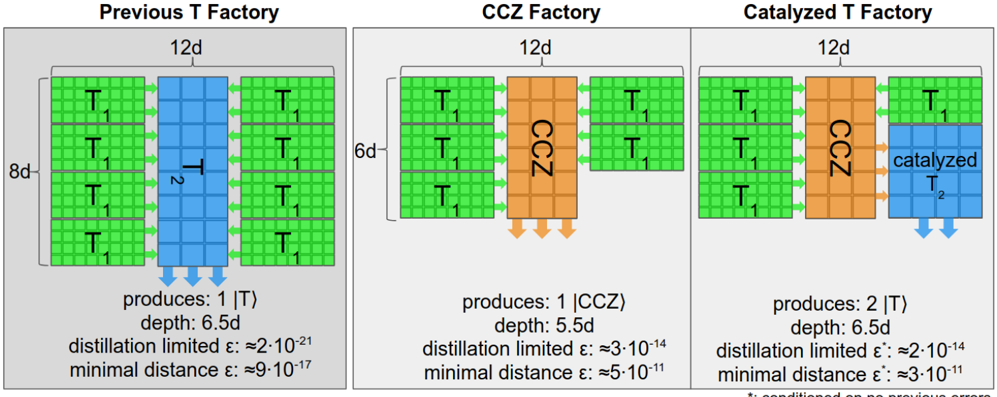
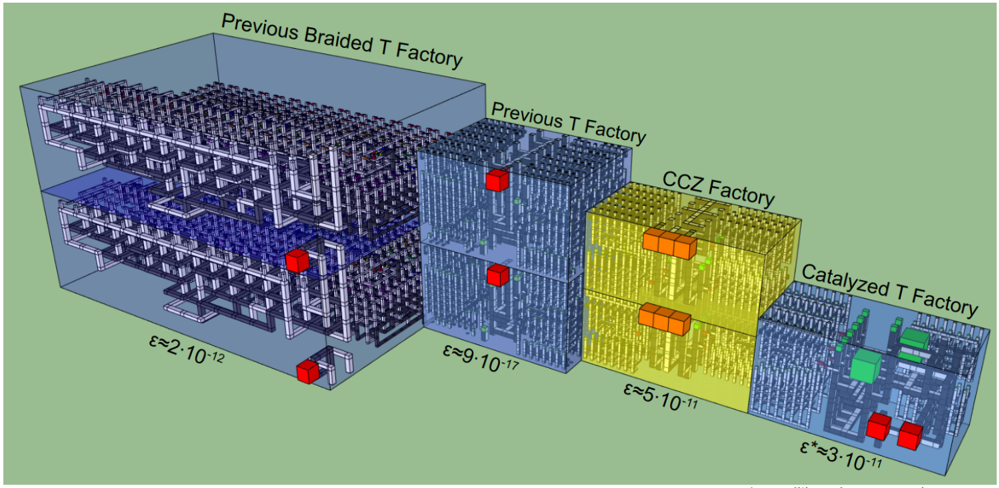
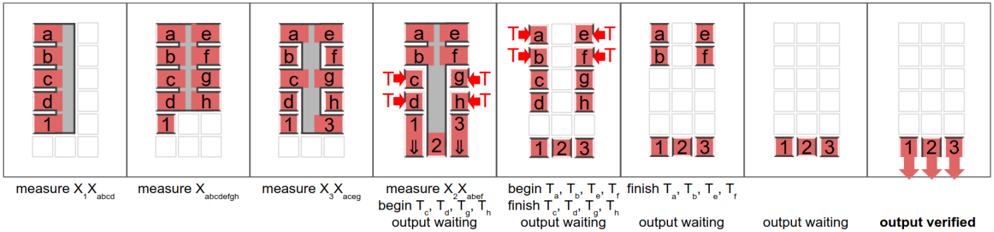
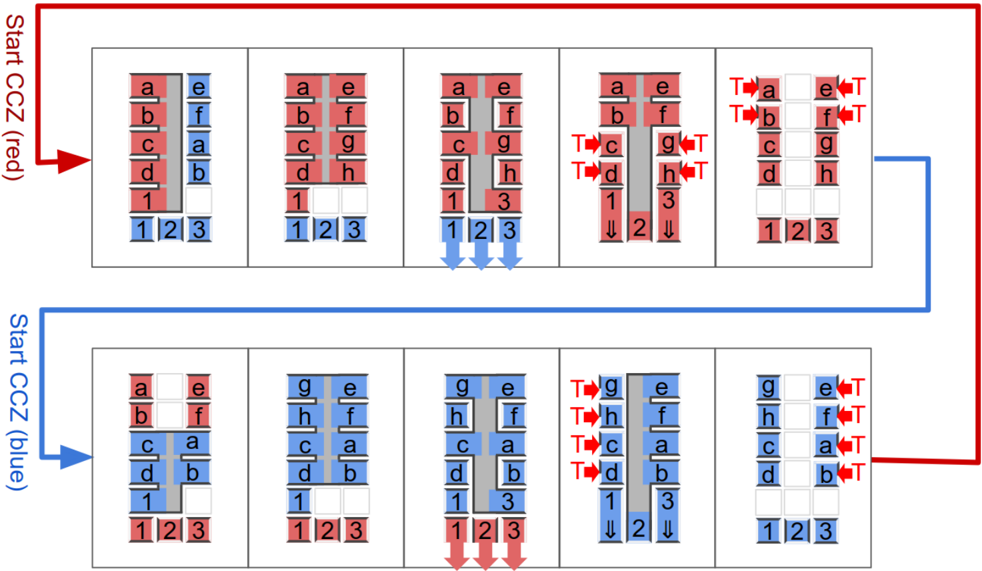
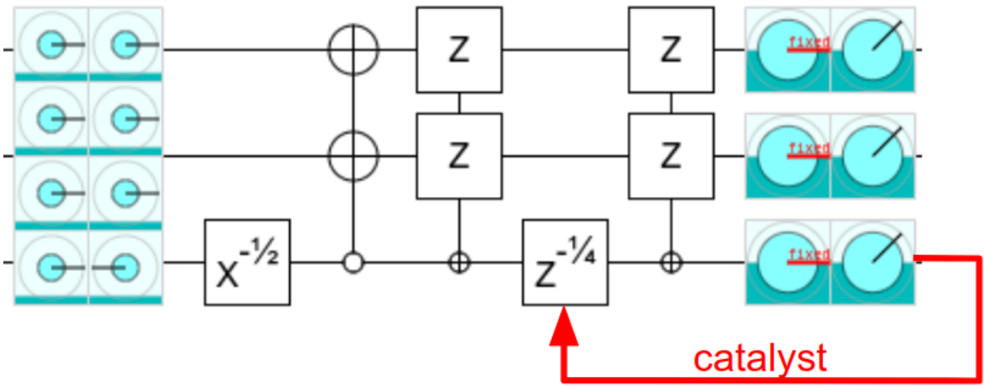
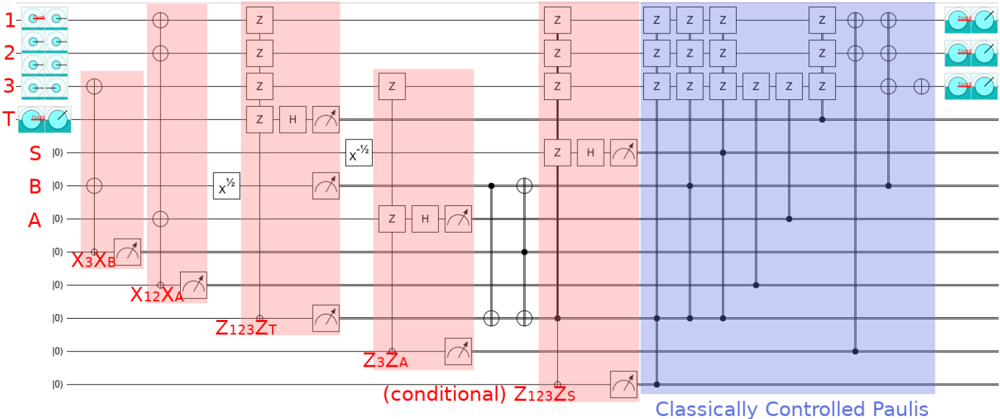
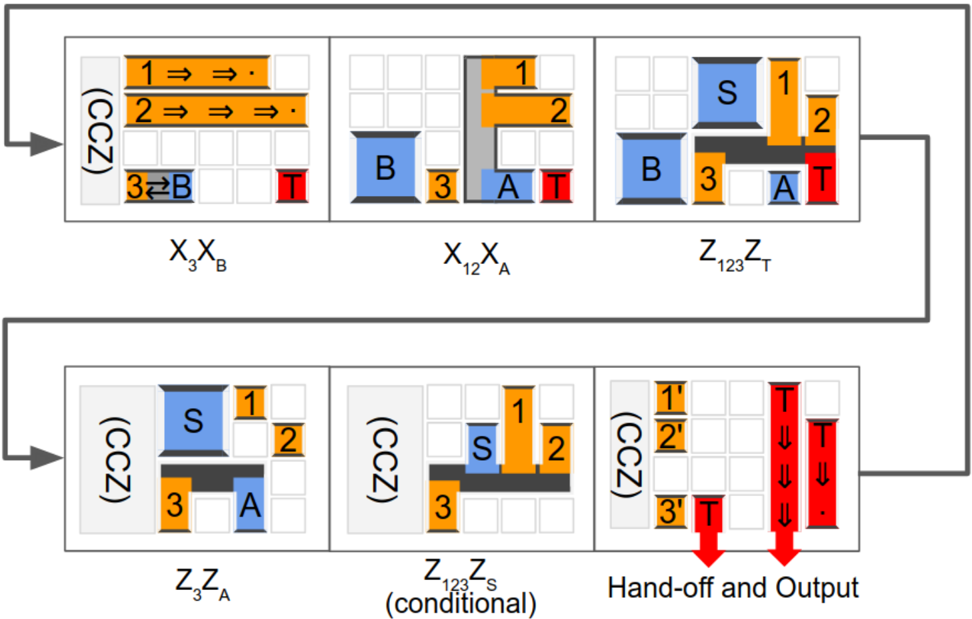
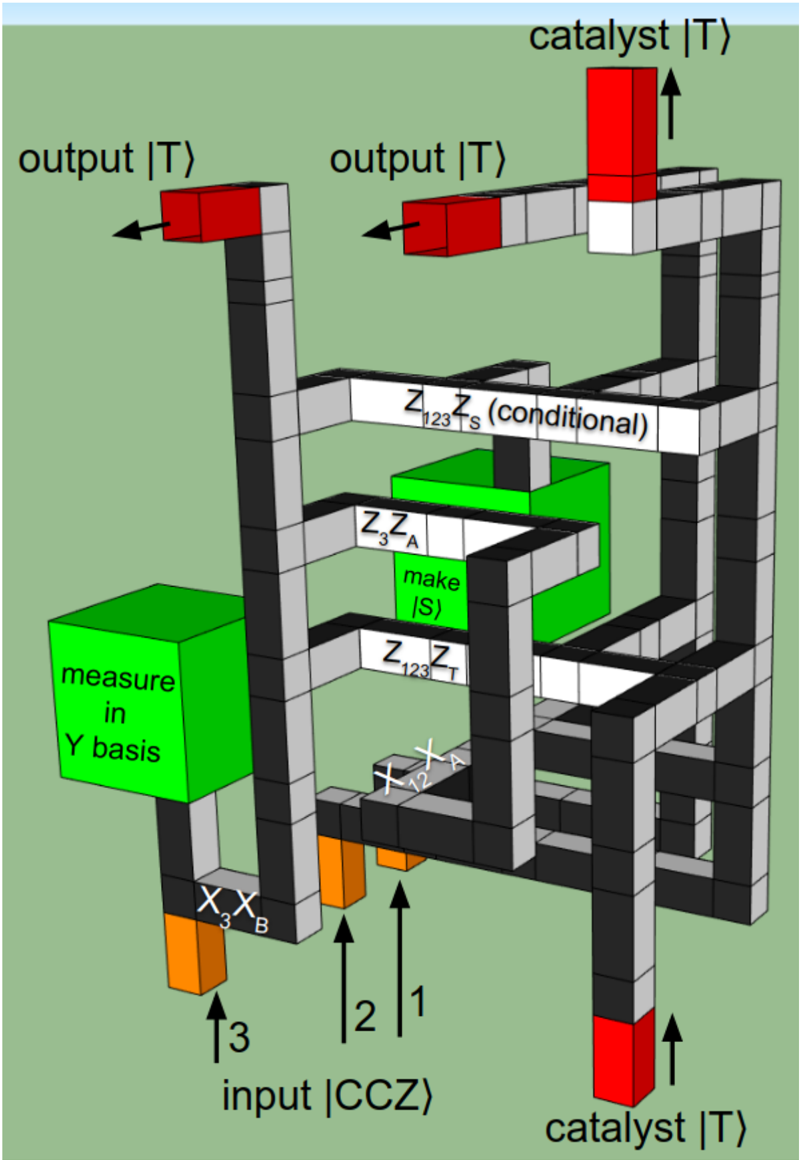
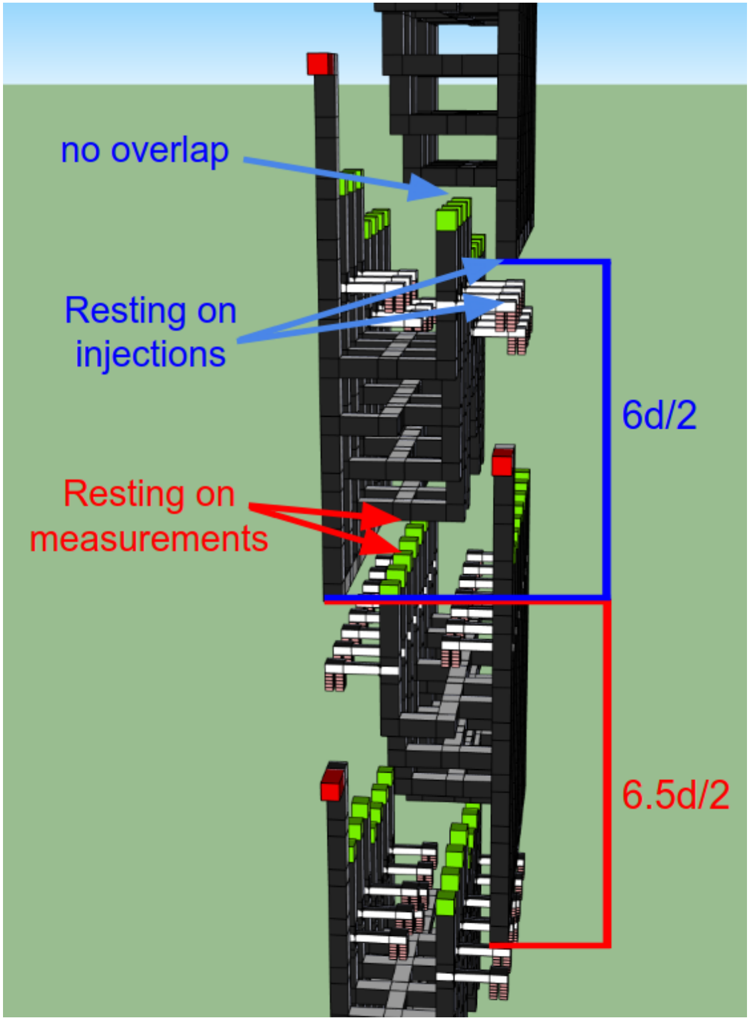
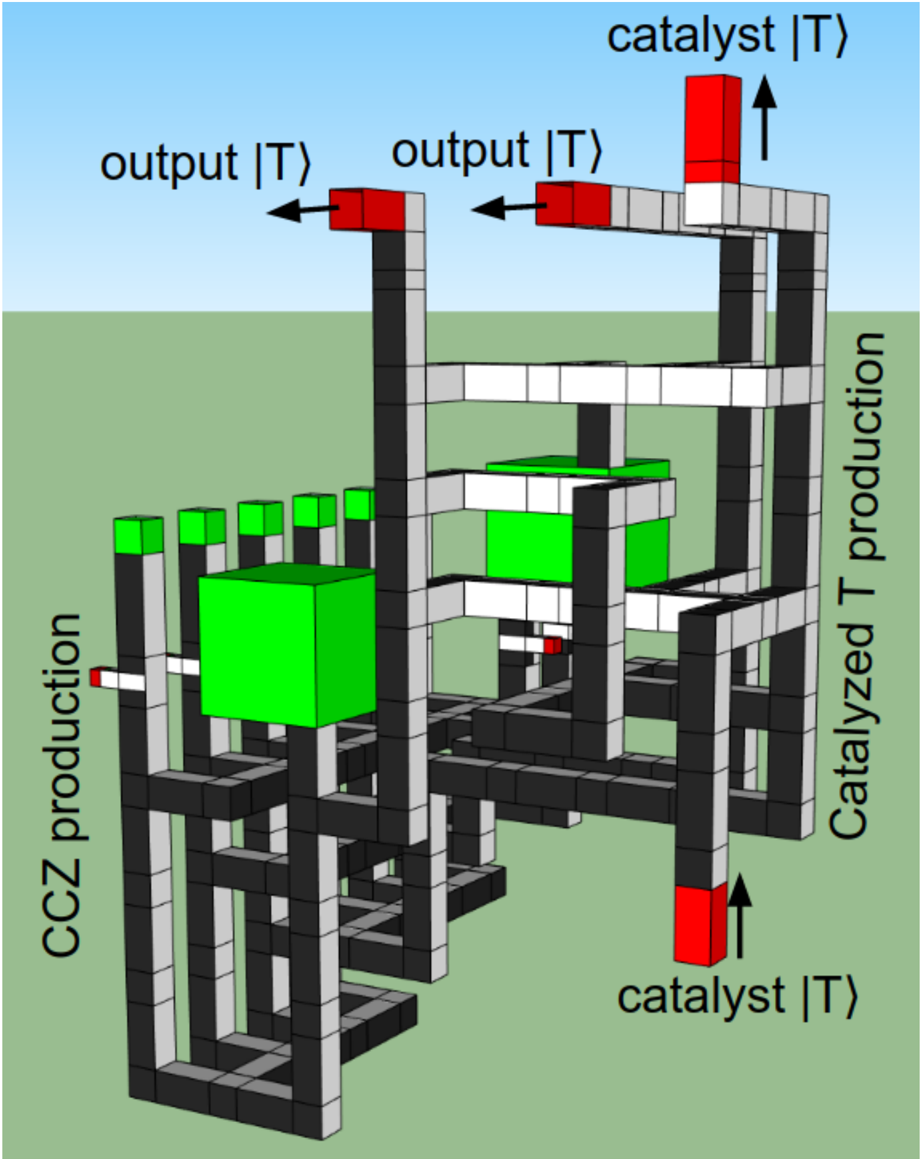
We present magic state factory constructions for producing | C C Z ⟩ states and | T ⟩ states. For the | C C Z ⟩ factory we apply the surface code lattice surgery construction techniques described in \cite{fowler2018} to the fault-tolerant Toffoli \cite{jones2013, eastin2013distilling}. The resulting factory has a footprint of 12 d × 6 d (where d is the code distance) and produces one | C C Z ⟩ every 5.5 d surface code cycles. Our | T ⟩ state factory uses the | C C Z ⟩ factory's output and a catalyst | T ⟩ state to exactly transform one | C C Z ⟩ state into two | T ⟩ states. It has a footprint 25 % smaller than the factory in \cite{fowler2018} but outputs | T ⟩ states twice as quickly. We show how to generalize the catalyzed transformation to arbitrary phase angles, and note that the case θ = 22.5 ∘ produces a particularly efficient circuit for producing | T ⟩ states. Compared to using the 12 d × 8 d × 6.5 d | T ⟩ factory of \cite{fowler2018}, our | C C Z ⟩ factory can quintuple the speed of algorithms that are dominated by the cost of applying Toffoli gates, including Shor's algorithm \cite{shor1994} and the chemistry algorithm of Babbush et al. \cite{babbush2018}. Assuming a physical gate error rate of 10 − 3 , our CCZ factory can produce ∼ 10 10 states on average before an error occurs. This is sufficient for classically intractable instantiations of the chemistry algorithm, but for more demanding algorithms such as Shor's algorithm the mean number of states until failure can be increased to ∼ 10 12 by increasing the factory footprint ∼ 20 % .
Overview
The claims and statistics of this paper haven’t been checked yet.
Free: it reads the open-access text and checks the first 5 claims that cite a source we can check. Create a free account to check every claim.
Integrity signals
Registry
Cites
Statistics
Figures
Verification
Claims the paper makes
The claims and statistics of this paper haven’t been checked yet.
Free: it reads the open-access text and checks the first 5 claims that cite a source we can check. Create a free account to check every claim.
Self-check
Percentages, sums and reported differences re-computed from the paper’s own numbers.
The self-check needs the paper’s full text.
Citations
Cites
Algorithms for quantum computation: discrete logarithms and factoring
Shor, P. W. (2002) · Proceedings 35th Annual Symposium on Foundations of Computer Science · doi:10.1109/sfcs.1994.365700 · Cited by 8,713 · cited 1×
“ates. Compared to using the 12d×8d×6.5d|Tifactory of [15], our |CCZi factory can quintuple the speed of algorithms that are dominated by the cost of applying Toffoli gates, including Shor’s algorithm [31] and the chemistry algorithm of Babbush et al. [1]. Assuming a physical gate error rate of 10−3, our CCZ factory ca…”
MethodSurface codes: Towards practical large-scale quantum computation
Fowler, A. G., Mariantoni, M., Martinis, J. M., & Cleland, A. N. (2012) · Physical Review A · doi:10.1103/physreva.86.032324 · Cited by 3,059 · cited 1×
“…based on the surface code (a likely component of future error corrected quantum computers due to the surface code’s comparatively high threshold and planar connectivity requirements [3, 11, 29, 30, 13]), the cost of a quantum algorithm is well approximated by the number of non-Clifford operations.”
BackgroundSelf-citationGottesman, D., & Chuang, I. L. (1999) · Nature · doi:10.1038/46503 · Cited by 1,860 · cited 1×
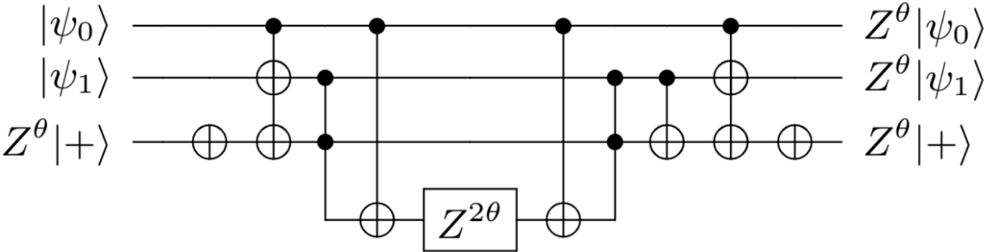
“Contrast with gate teleportation [18], which consumes a previously prepared Z|+〉 state in order to perform one Z operation, with a 50% chance of requiring a fixup Z−2θ operation.”
MethodDennis, E., Kitaev, A., Landahl, A., & Preskill, J. (2002) · Journal of Mathematical Physics · doi:10.1063/1.1499754 · Cited by 1,768 · cited 1×
“…based on the surface code (a likely component of future error corrected quantum computers due to the surface code’s comparatively high threshold and planar connectivity requirements [3, 11, 29, 30, 13]), the cost of a quantum algorithm is well approximated by the number of non-Clifford operations.”
BackgroundUniversal quantum computation with ideal Clifford gates and noisy ancillas
Bravyi, S., & Kitaev, A. (2005) · Physical Review A · doi:10.1103/physreva.71.022316 · Cited by 1,525 · cited 2×
“com distillation [5], and the cost of state distillation is large.”
BackgroundMethodClassical and Quantum Computation
Kitaev, A., Shen, A., & Vyalyi, M. (2002) · Graduate Studies in Mathematics · doi:10.1090/gsm/047 · Cited by 1,387
Fault-Tolerant Quantum Computation with High Threshold in Two Dimensions
Raussendorf, R., & Harrington, J. (2007) · Physical Review Letters · doi:10.1103/physrevlett.98.190504 · Cited by 812 · cited 1×
“rected quantum computers due to the surface code’s comparatively high threshold and planar connectivity requirements [3, 11, 29, 30, 13]), the cost of a quantum algorithm is well approximated by the number of non-Clifford operations.”
MethodTopological fault-tolerance in cluster state quantum computation
Raussendorf, R., Harrington, J., & Goyal, K. (2007) · New Journal of Physics · doi:10.1088/1367-2630/9/6/199 · Cited by 617
Surface code quantum computing by lattice surgery
Horsman, D., Fowler, A. G., Devitt, S., & Meter, R. V. (2012) · New Journal of Physics · doi:10.1088/1367-2630/14/12/123011 · Cited by 598 · cited 3×
“Over the past decade, thanks to techniques such as block codes [4, 16], bridge compression [14], and many others [19, 8, 9, 25], the cost of magic state distillation has steadily decreased.”
BackgroundMethodSelf-citationA Game of Surface Codes: Large-Scale Quantum Computing with Lattice Surgery
Litinski, D. (2019) · Quantum · doi:10.22331/q-2019-03-05-128 · Cited by 408 · cited 3×
“Over the past decade, thanks to techniques such as block codes [4, 16], bridge compression [14], and many others [19, 8, 9, 25], the cost of magic state distillation has steadily decreased.”
BackgroundQuantum codes on a lattice with boundary
Bravyi, S. B., & Kitaev, A. Y. (1998) · arXiv · doi:10.48550/arxiv.quant-ph/9811052 · Cited by 394 · cited 1×
“rected quantum computers due to the surface code’s comparatively high threshold and planar connectivity requirements [3, 11, 29, 30, 13]), the cost of a quantum algorithm is well approximated by the number of non-Clifford operations.”
MethodEncoding Electronic Spectra in Quantum Circuits with Linear T Complexity
Babbush, R., Gidney, C., Berry, D. W., Wiebe, N., McClean, J., Paler, A., Fowler, A., & Neven, H. (2018) · Physical Review X · doi:10.1103/physrevx.8.041015 · Cited by 383 · cited 4×
“Assuming that such a reworking is possible for [1], the runtimes at classically intractable sizes would be reduced from ∼ 10 hours (see table VII of [1]) to ∼ 2 hours.”
BackgroundMethodInfluentialSelf-citationEntanglement-Assisted Local Manipulation of Pure Quantum States
Jonathan, D., & Plenio, M. B. (1999) · Physical Review Letters · doi:10.1103/physrevlett.83.3566 · Cited by 351
Magic-state distillation with low overhead
Bravyi, S., & Haah, J. (2012) · Physical Review A · doi:10.1103/physreva.86.052329 · Cited by 341
Halving the cost of quantum addition
Gidney, C. (2018) · Quantum · doi:10.22331/q-2018-06-18-74 · Cited by 279
Self-citationLow-overhead constructions for the fault-tolerant Toffoli gate
Jones, C. (2013) · Physical Review A · doi:10.1103/physreva.87.022328 · Cited by 204
Efficient Synthesis of Universal Repeat-Until-Success Quantum Circuits
Bocharov, A., Roetteler, M., & Svore, K. M. (2015) · Physical Review Letters · doi:10.1103/physrevlett.114.080502 · Cited by 142
Poking Holes and Cutting Corners to Achieve Clifford Gates with the Surface Code
Brown, B. J., Laubscher, K., Kesselring, M. S., & Wootton, J. R. (2017) · Physical Review X · doi:10.1103/physrevx.7.021029 · Cited by 121 · cited 1×
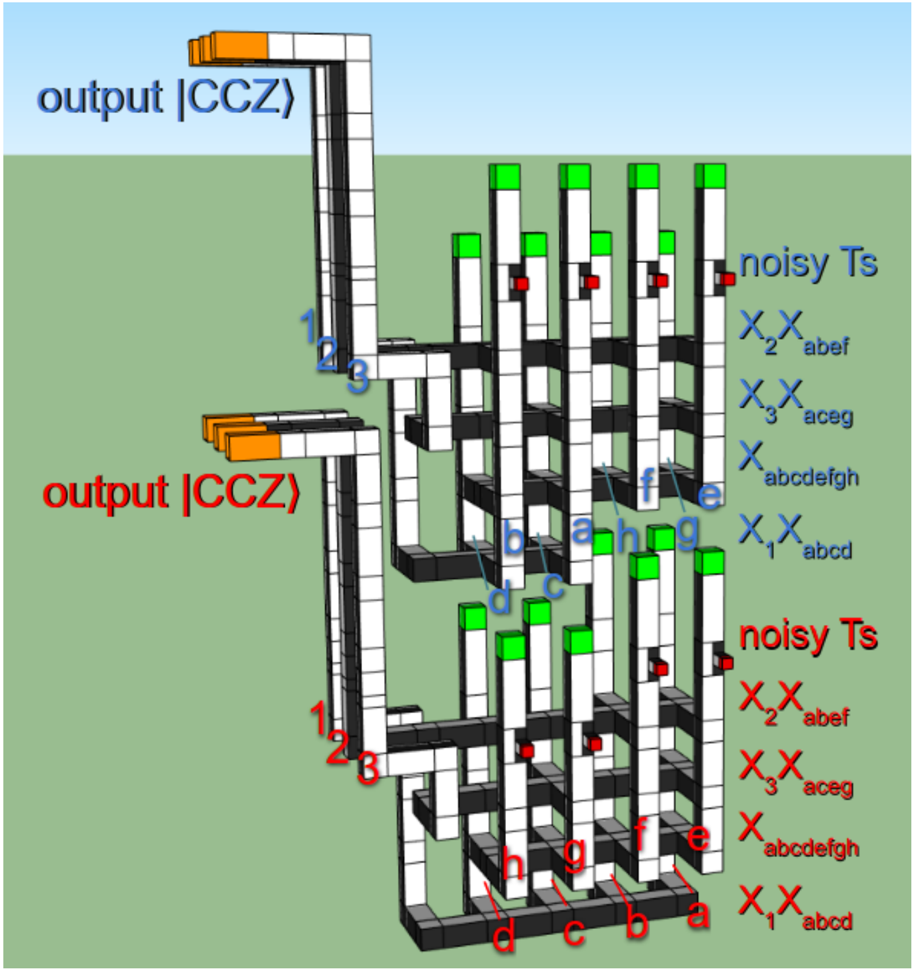
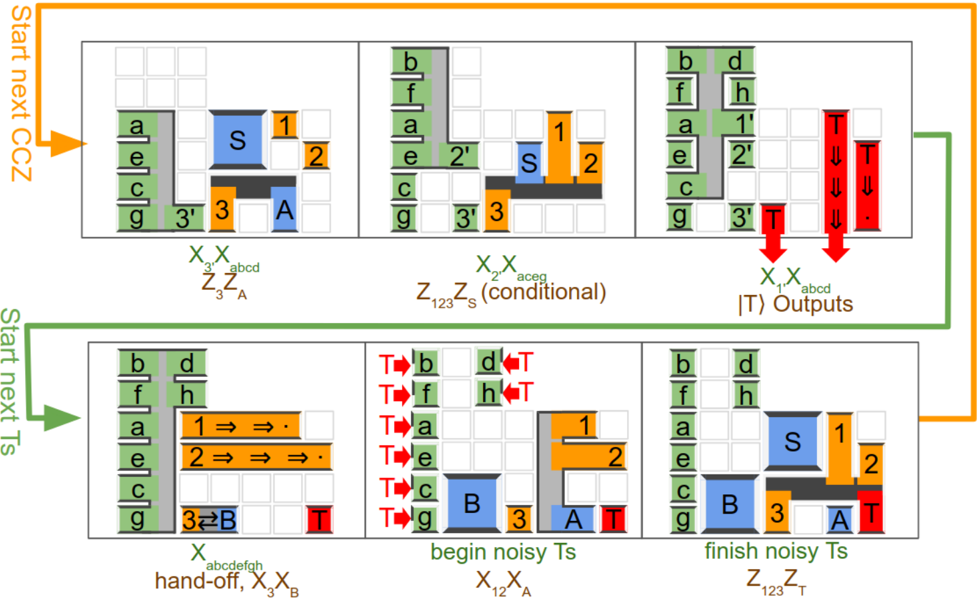
“The green boxes atop the columns are performing either an X or Y basis measurement at half code distance, as described in [15], by including or omitting an S gate performed using twists [6].”
MethodSurface code implementation of block code state distillation
Fowler, A. G., Devitt, S. J., & Jones, C. (2013) · Scientific Reports · doi:10.1038/srep01939 · Cited by 99 · cited 1×
“Over the past decade, thanks to techniques such as block codes [4, 16], bridge compression [14], and many others [19, 8, 9, 25], the cost of magic state distillation has steadily decreased.”
BackgroundSelf-citationCampbell, E. T., & Howard, M. (2017) · Physical Review A · doi:10.1103/physreva.95.022316 · Cited by 91 · cited 2×
“Over the past decade, thanks to techniques such as block codes [4, 16], bridge compression [14], and many others [19, 8, 9, 25], the cost of magic state distillation has steadily decreased.”
BackgroundA magic state’s fidelity can be superior to the operations that created it
Li, Y. (2015) · New Journal of Physics · doi:10.1088/1367-2630/17/2/023037 · Cited by 88 · cited 3×
“The distillation limited error rates assume a physical gate error rate of 10−3, that the injection technique of [24] can create level 0 |T 〉 states with approximately that level of error, and that the code distance is large enough for the dominant source of error in the outputs to be distillation error.”
BackgroundMethodInfluentialCatalysis and activation of magic states in fault-tolerant architectures
Campbell, E. T. (2011) · Physical Review A · doi:10.1103/physreva.83.032317 · Cited by 78 · cited 1×
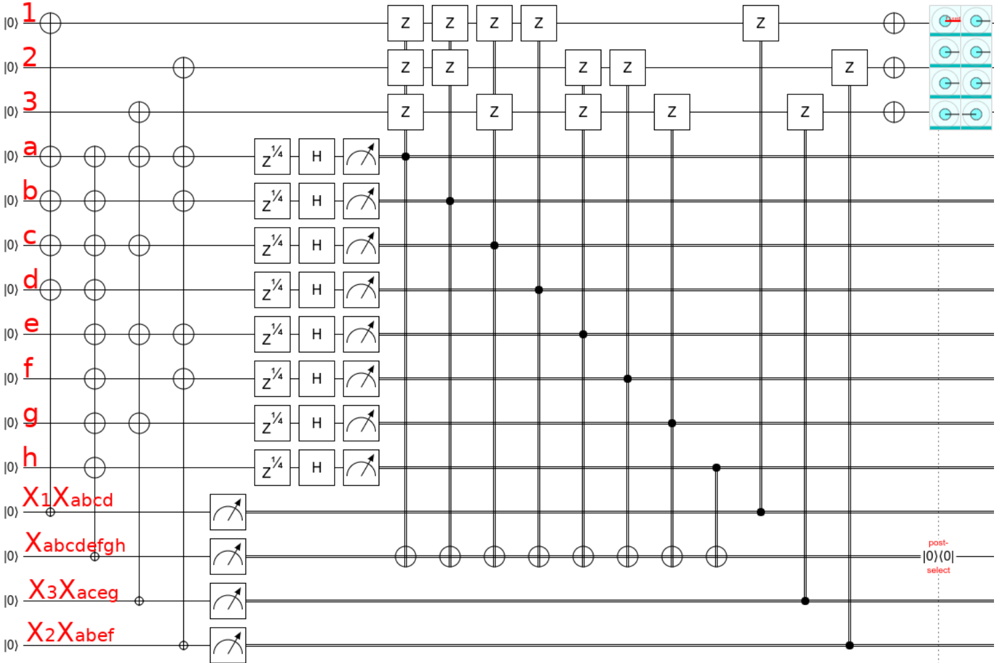
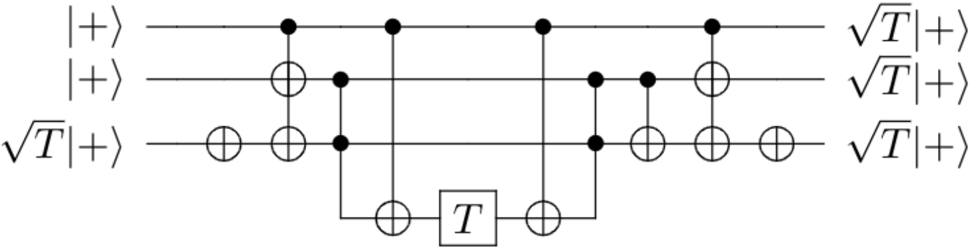
“n to be possible, but is not consumed by the transformation. Thus, in keeping with terminology for ancillary states that enable LOCC communication tasks without being consumed [20], and previous work [7], we refer to the third |Tias a catalyst. We refer to the circuit as a whole as the |Ti-catalyzed |CCZi→2|Tifactory,…”
Fast versions of Shor's quantum factoring algorithm
Zalka, C. (1998) · arXiv · doi:10.48550/arxiv.quant-ph/9806084 · Cited by 73
Low overhead quantum computation using lattice surgery
Fowler, A. G., & Gidney, C. (2018) · arXiv · doi:10.48550/arxiv.1808.06709 · Cited by 69 · cited 10×
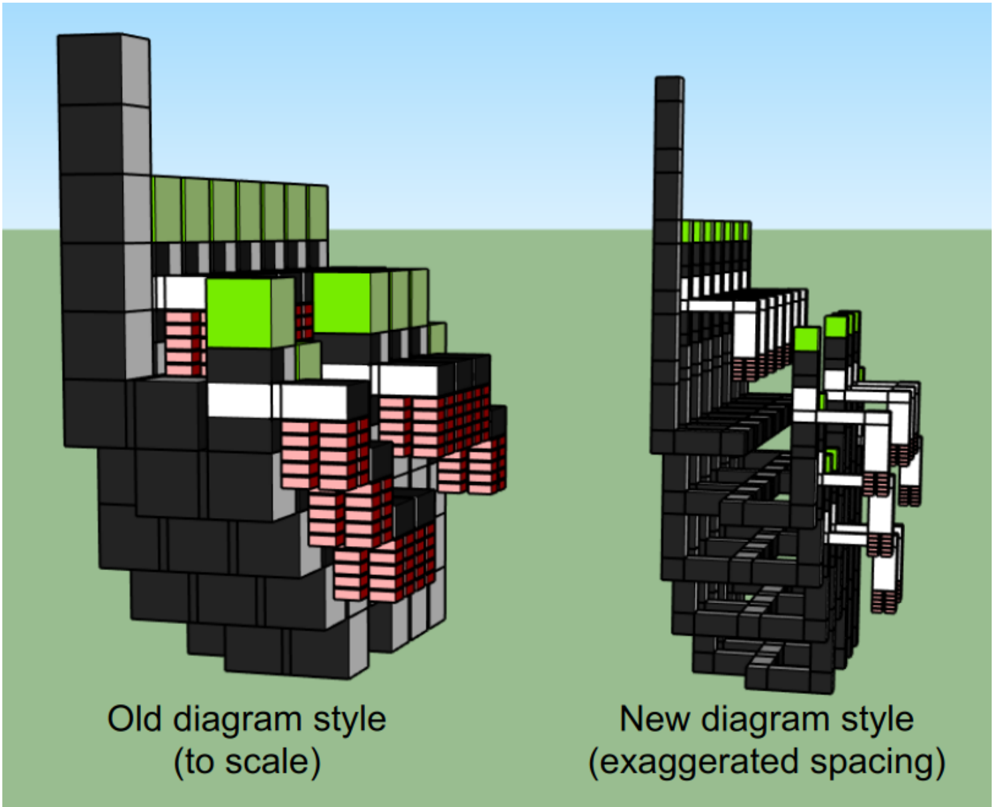
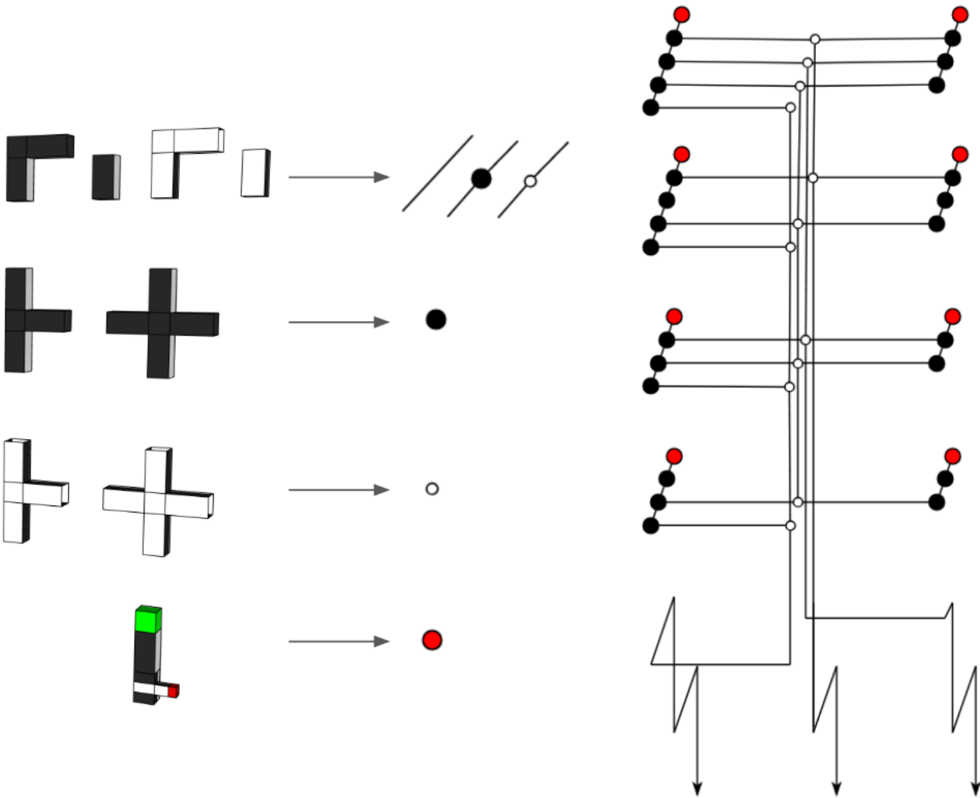
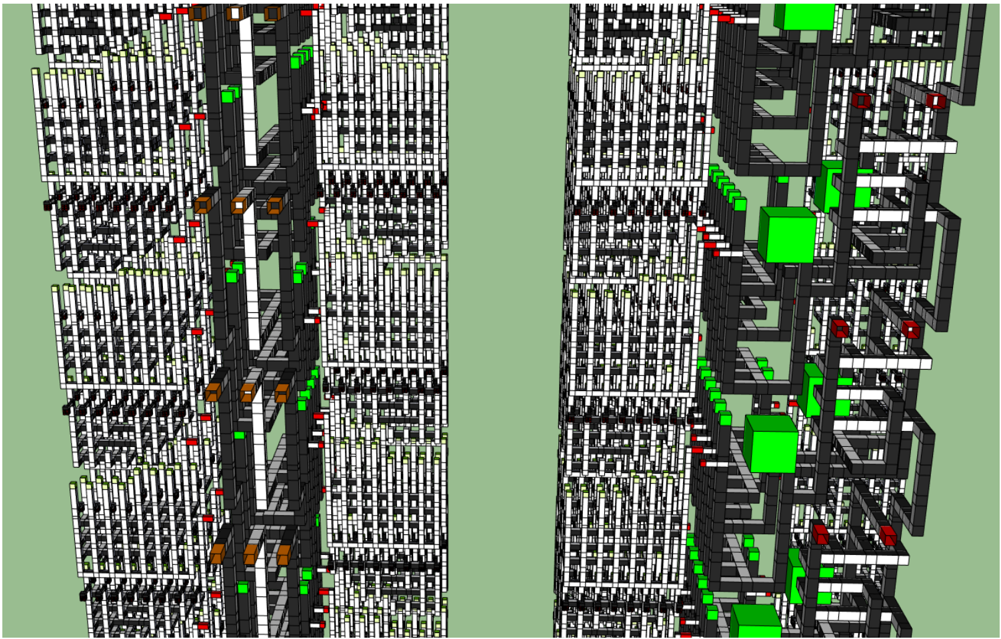
“Figure 4: Comparison of the to-scale diagram style from [15] with the exaggerated-spacing diagram style used by this paper.”
BackgroundMethodInfluentialSelf-citationLandahl, A. J., & Cesare, C. (2013) · arXiv (Cornell University) · doi:10.48550/arxiv.1302.3240 · Cited by 59 · cited 1×
“This is significantly more efficient than previous techniques we were able to find and adapt to the task of producing | √ T 〉 states [23, 2, 26, 22, 17, 27], assuming a physical gate error rate of 10−3 and a target error rate of 10−10.”
MethodA bridge to lower overhead quantum computation
Fowler, A. G., & Devitt, S. J. (2012) · arXiv (Cornell University) · doi:10.48550/arxiv.1209.0510 · Cited by 57 · cited 2×
“Over the past decade, thanks to techniques such as block codes [4, 16], bridge compression [14], and many others [19, 8, 9, 25], the cost of magic state distillation has steadily decreased.”
BackgroundSelf-citationDistilling one-qubit magic states into Toffoli states
Eastin, B. (2013) · Physical Review A · doi:10.1103/physreva.87.032321 · Cited by 50 · cited 3×
“In Section 2, we explain how to construct an efficient |CCZ〉 factory by applying the techniques of [15] to the construction of [21, 12].”
MethodMagic state parity-checker with pre-distilled components
Campbell, E. T., & Howard, M. (2018) · Quantum · doi:10.22331/q-2018-03-14-56 · Cited by 24
Paterson, M. B., & Stinson, D. R. (2010) · The Electronic Journal of Combinatorics · doi:10.37236/358 · Cited by 9 · cited 1×
“For other examples of correlation be-tween errors being beneficial, we recommend reviewing hat guessing games [28].”
MethodResource comparison of two surface code implementations of small angle Z rotationsPreprint
Mishra, P., & Fowler, A. G. (2014) · arXiv (Cornell University) · doi:10.48550/arxiv.1406.4948 · Cited by 6 · cited 2×
“As another example, according to table III of [26], direct synthesis of √ T state uses ≈ 25 times more volume than direct synthesis of | T i states (though this ratio improves as the physical gate error rate improves).”
BackgroundMethodSelf-citation
Research works printed but not linked: 2
- 10. Niel de Beaudrap and Dominic Horsman. The zx calculus is a language for surface code lattice surgery. arXiv preprint arXiv:1704.08670, 2017. URL https://arxiv.org/abs/1704.08670. · arXiv
- 27. Yunseong Nam, Yuan Su, and Dmitri Maslov. Approximate quantum fourier transform with o(n log(n)) t gates. arXiv preprint arXiv:1803.04933, 2018. URL https://arxiv.org/abs/1803.04933. · arXiv
Cited by
Quantum computational chemistry
McArdle, S., Endo, S., Aspuru-Guzik, A., Benjamin, S. C., & Yuan, X. (2020) · Reviews of Modern Physics · doi:10.1103/revmodphys.92.015003 · Cited by 1,621
How to factor 2048 bit RSA integers in 8 hours using 20 million noisy qubits
Gidney, C., & Ekerå, M. (2021) · Quantum · doi:10.22331/q-2021-04-15-433 · Cited by 830
“According to the spreadsheet included in [36], using a level 1 code distance 17 and a level 2 code distance of 27, this corresponds to a total distillation error of 6.”
BackgroundMethodInfluentialSelf-citationStim: a fast stabilizer circuit simulator
Gidney, C. (2021) · Quantum · doi:10.22331/q-2021-07-06-497 · Cited by 415
Self-citationA Game of Surface Codes: Large-Scale Quantum Computing with Lattice Surgery
Litinski, D. (2019) · Quantum · doi:10.22331/q-2019-03-05-128 · Cited by 408
“[12, 38]), using smaller patches and fewer code cycles.”
MethodQuantum computing enhanced computational catalysis
von Burg, V., Low, G. H., Häner, T., Steiger, D. S., Reiher, M., Roetteler, M., & Troyer, M. (2021) · Physical Review Research · doi:10.1103/physrevresearch.3.033055 · Cited by 252
Metadata
- Authors
- Gidney, C., & Fowler, A. G.
- Affiliations
- Google (United States) (US)
- ORCID
- Fowler, Austin G.
- Venue
- Quantum
- Published
- 2019-04-30
- Volume
- 3
- Pages
- 135
- ISSN
- 2521-327X (ISSN-L)
- OpenAlex
- W2952708034
- Cited by
- 152
- References
- 24
- Citations by year
- 2026: 23 · 2025: 33 · 2024: 22 · 2023: 13 · 2022: 15 · 2021: 16 · 2020: 18 · 2019: 11
- FWCI
- 6.96
- Type
- journal article
- Language
- en
- Open access
- gold
- doi.org
- Locations
- Quantum (publishedVersion, cc-by)
- arXiv (Cornell University) (submittedVersion)
- DOAJ (DOAJ: Directory of Open Access Journals) (submittedVersion, cc-by-sa)
- arXiv (Cornell University) (cc-by)
- Topics
- Physical Sciences › Computer Science › Artificial Intelligence › Quantum Computing Algorithms and Architecture
- Physical Sciences › Physics and Astronomy › Atomic and Molecular Physics, and Optics › Quantum Information and Cryptography
- Physical Sciences › Physics and Astronomy › Atomic and Molecular Physics, and Optics › Quantum many-body systems
- Keywords
- Toffoli gate, surface code, lattice surgery, fault-tolerant quantum computing, quantum chemistry algorithms, Shor's algorithm
About these checks
Registry, retraction, Cites and statistics results are computed, not judged, with one exception: a printed reference that no index lists is read once by a model before it counts as a citation error. Claims are extracted by a model and kept only when their quote appears verbatim in the text; each cited source is then checked, with a model’s help, for whether it says what the claim relies on. Those verdicts can be wrong — read the claim’s quote and the cited source before relying on one.
Statistics and arithmetic are recomputed, not judged.
Confidence bands are shown only for fields calibrated on our annotated test set. None is calibrated yet, so no band is shown.
What counts as a claim ›How we measure confidence ›How we check this ›
Are you an author, or do you see a problem with this page? Request a review
Data sources
Bibliographic data: Semantic Scholar, OpenAlex, Crossref.
Contains information from the Semantic Scholar Academic Graph Datasets, made available under the ODC Attribution License (ODC-BY 1.0).
Semantic Scholar’s data is described in: Kinney, R., et al. (2023). The Semantic Scholar Open Data Platform. arXiv:2301.10140.
