

Efficient magic state factories with a catalyzed | C C Z ⟩ to 2 | T ⟩ transformation
Open accessThe DOI matches its Crossref record; 30 of the 30 references it cites were found in a registry or an index.
Abstract
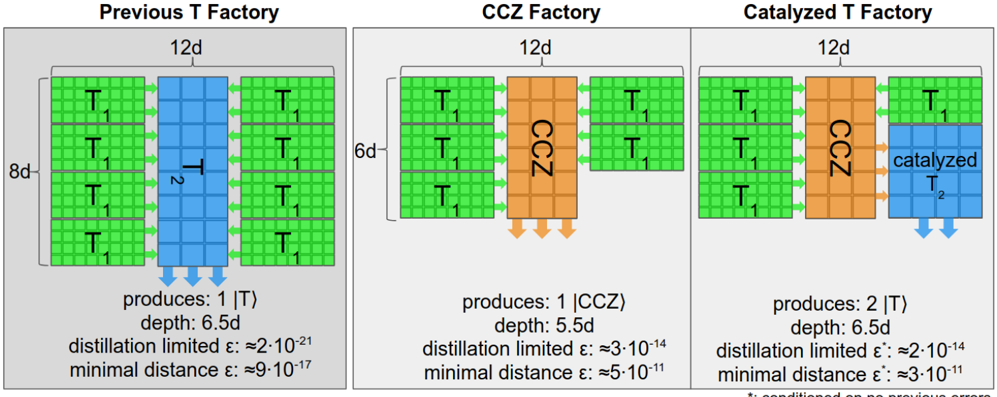
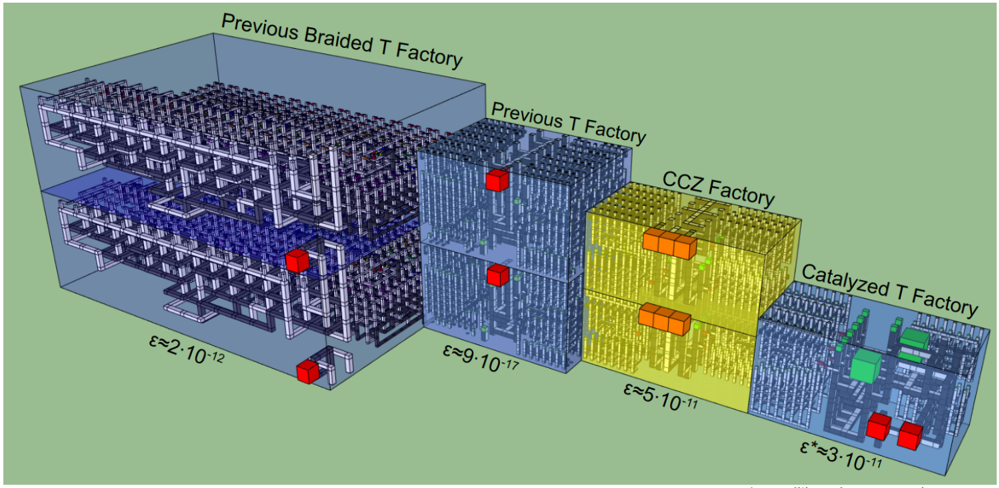
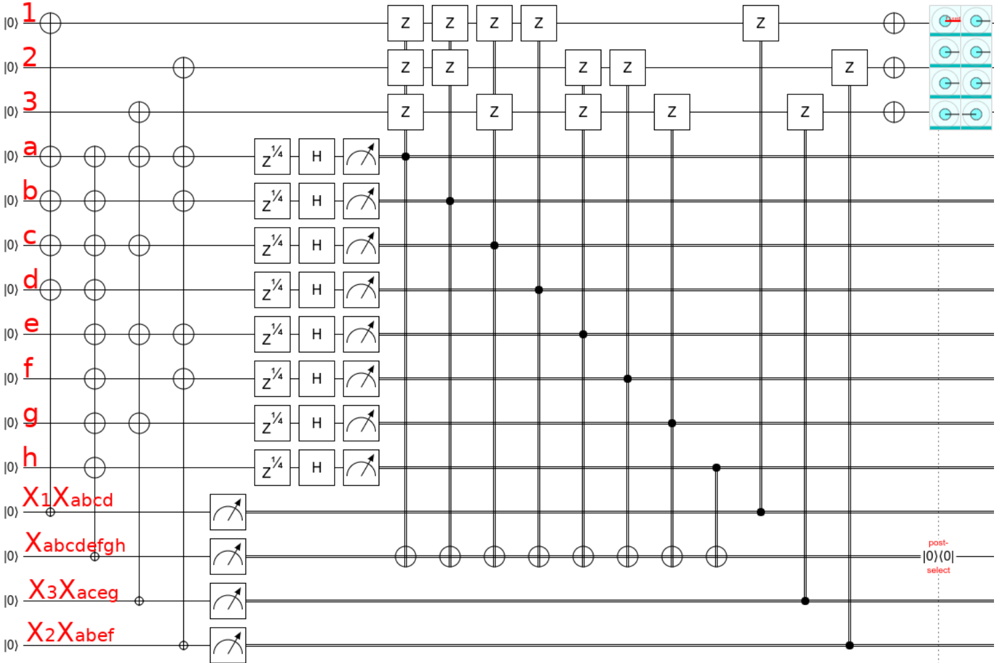
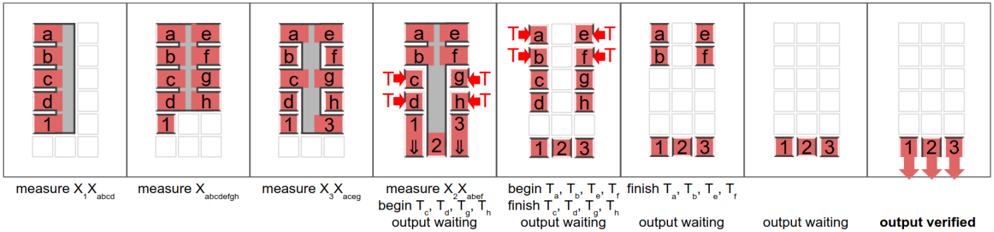
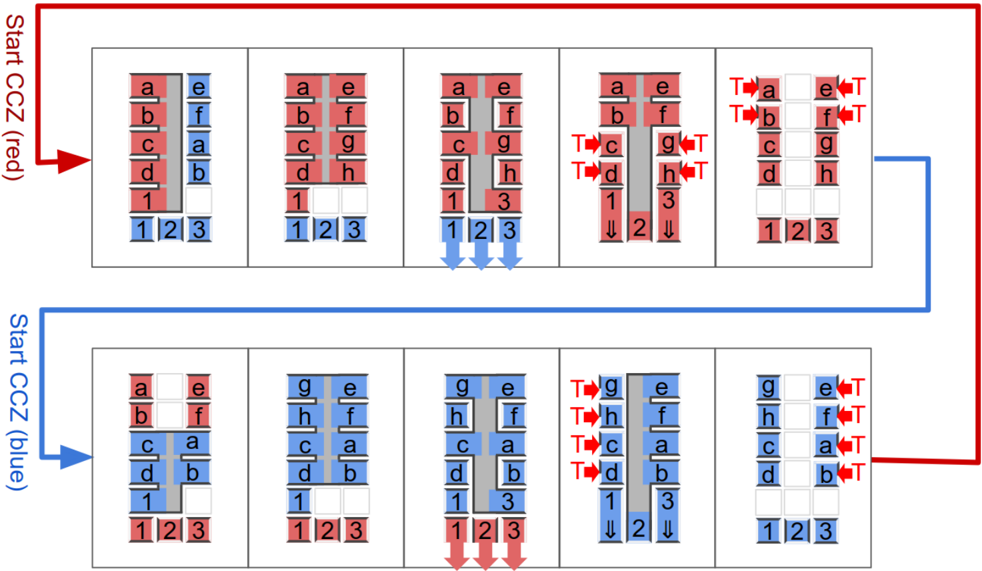
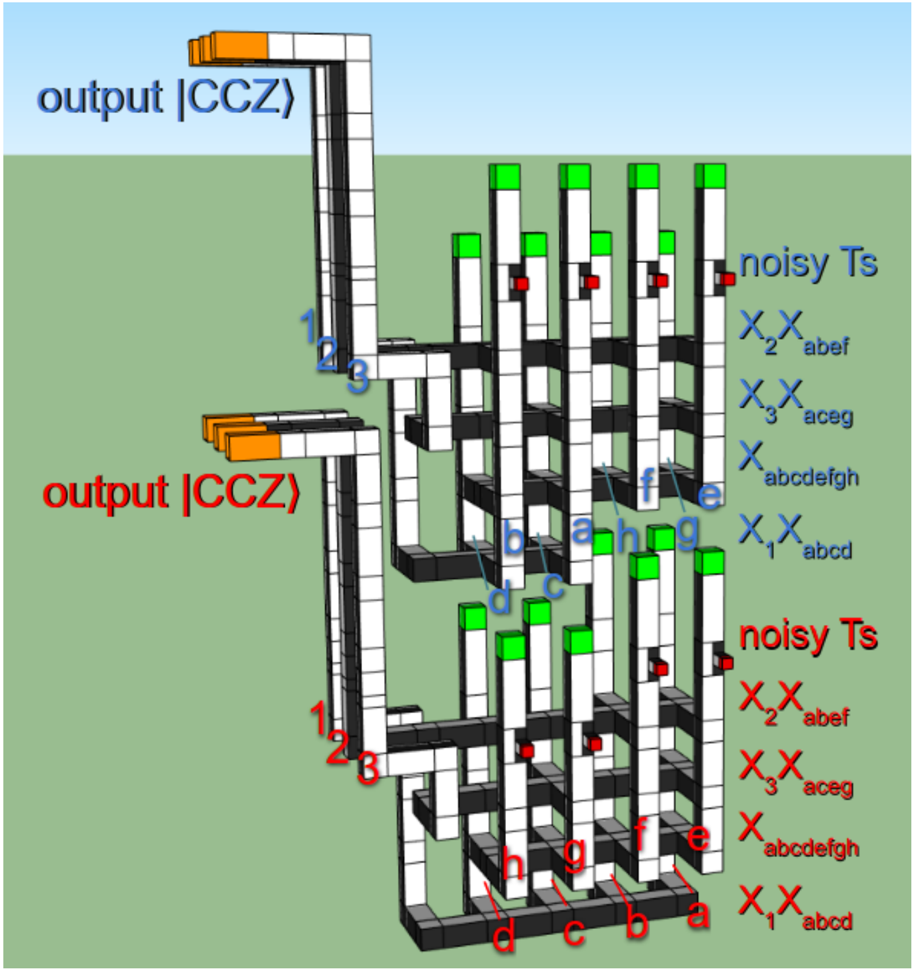
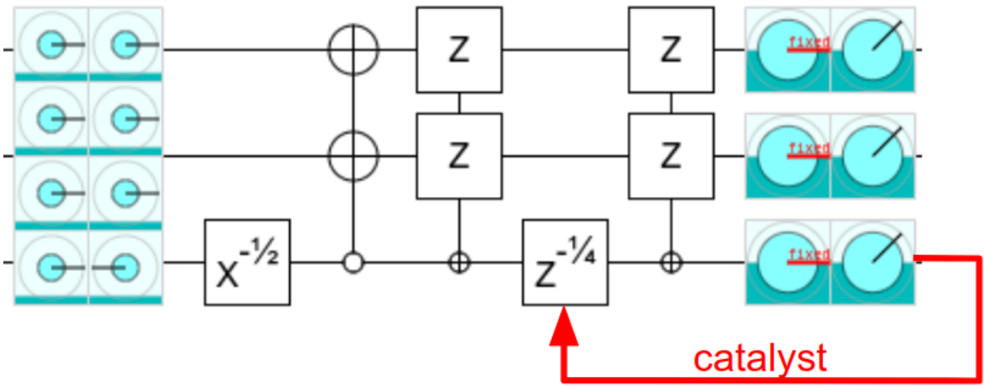
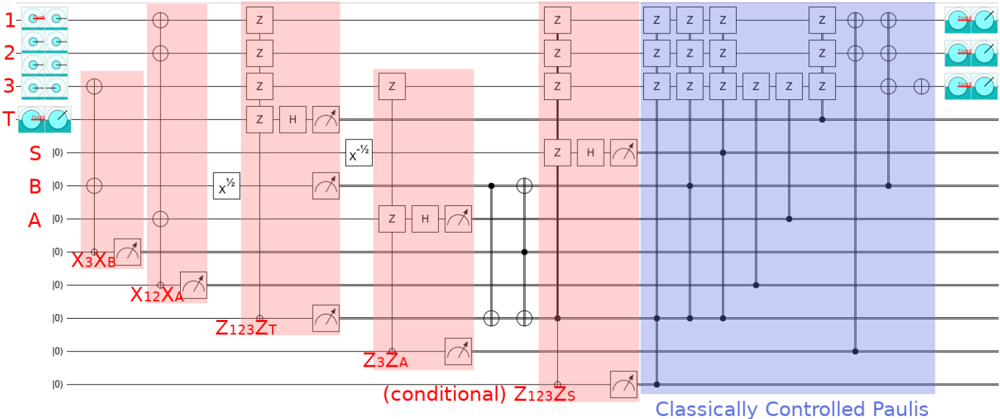
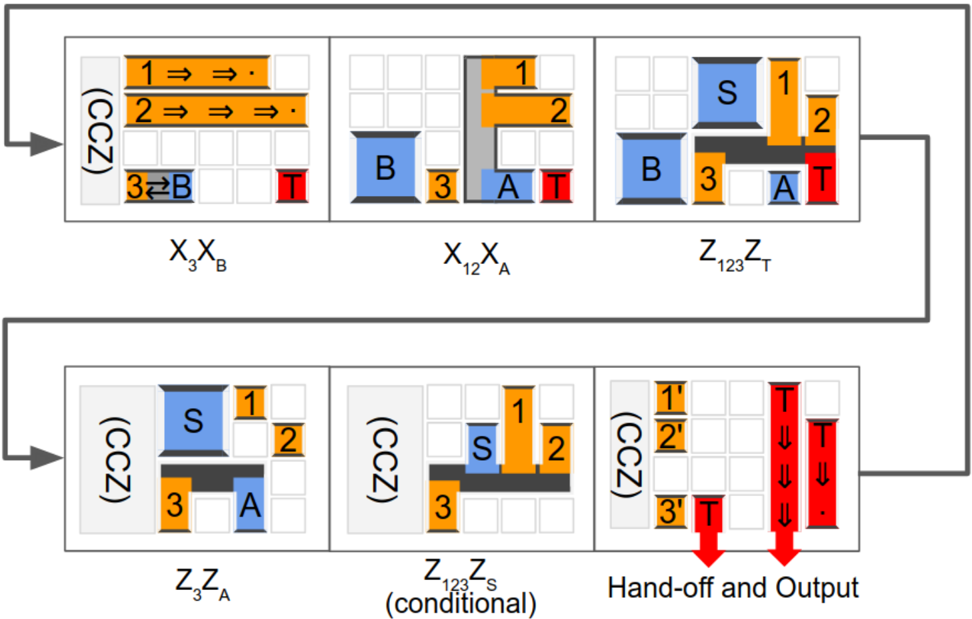
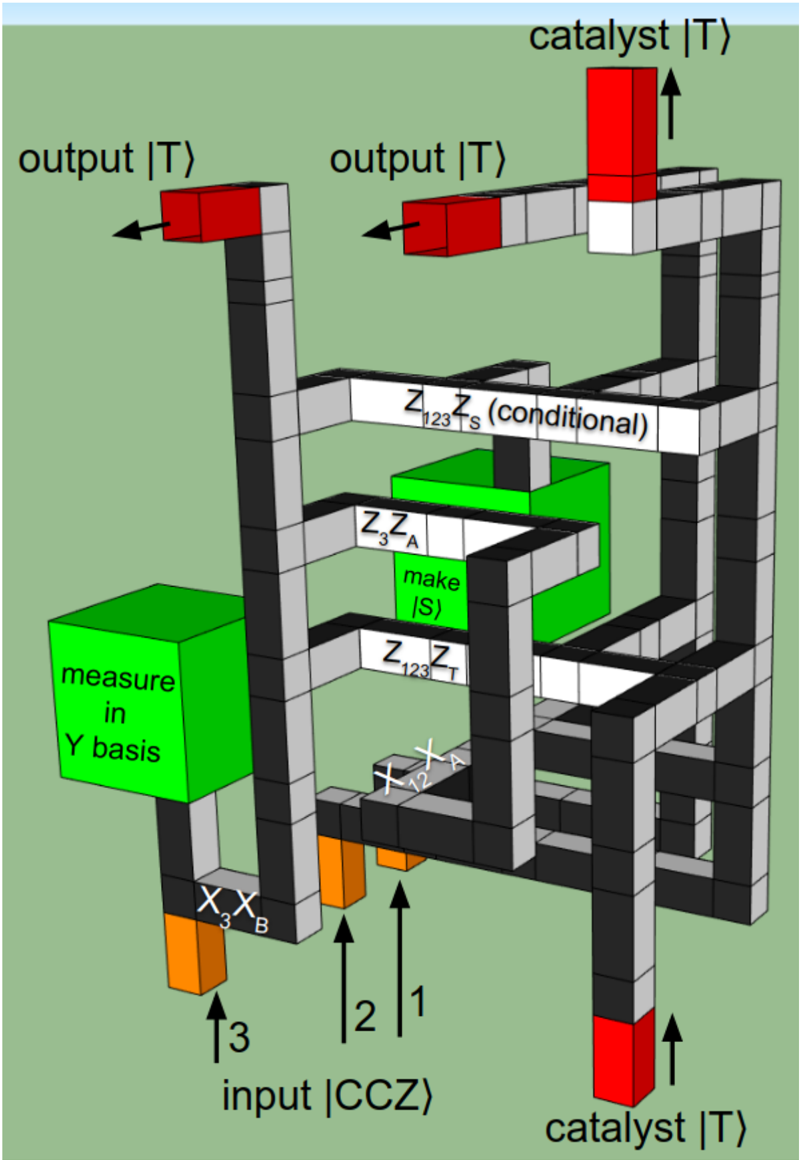
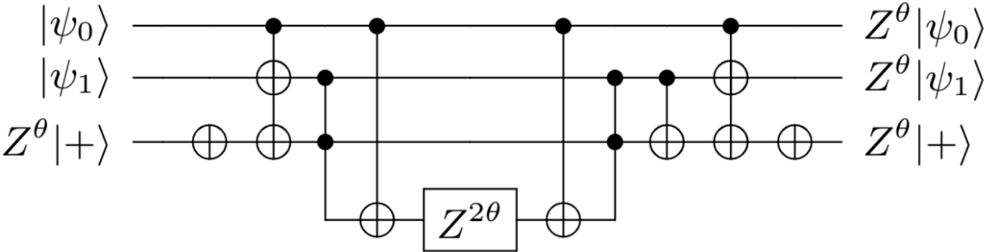
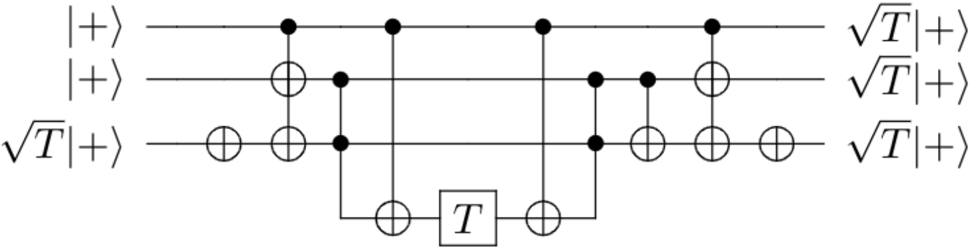
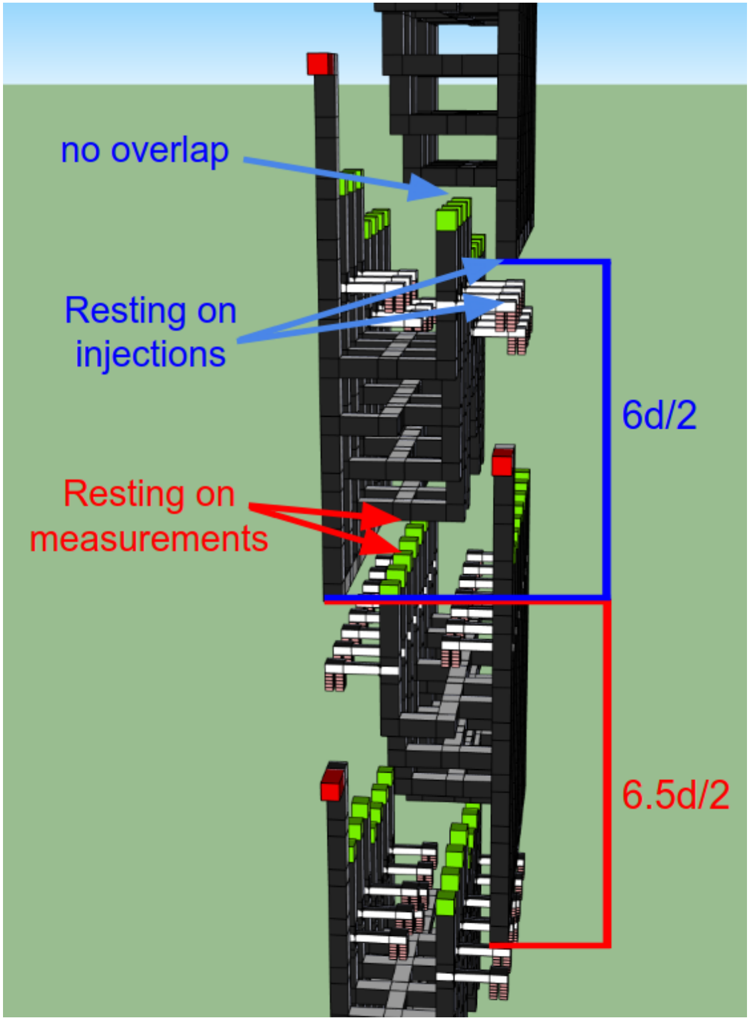
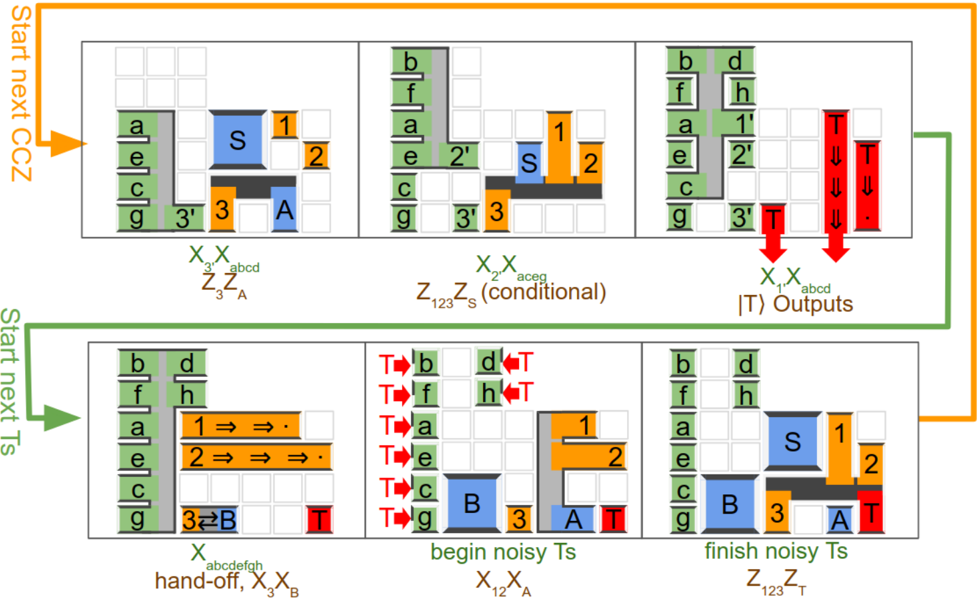
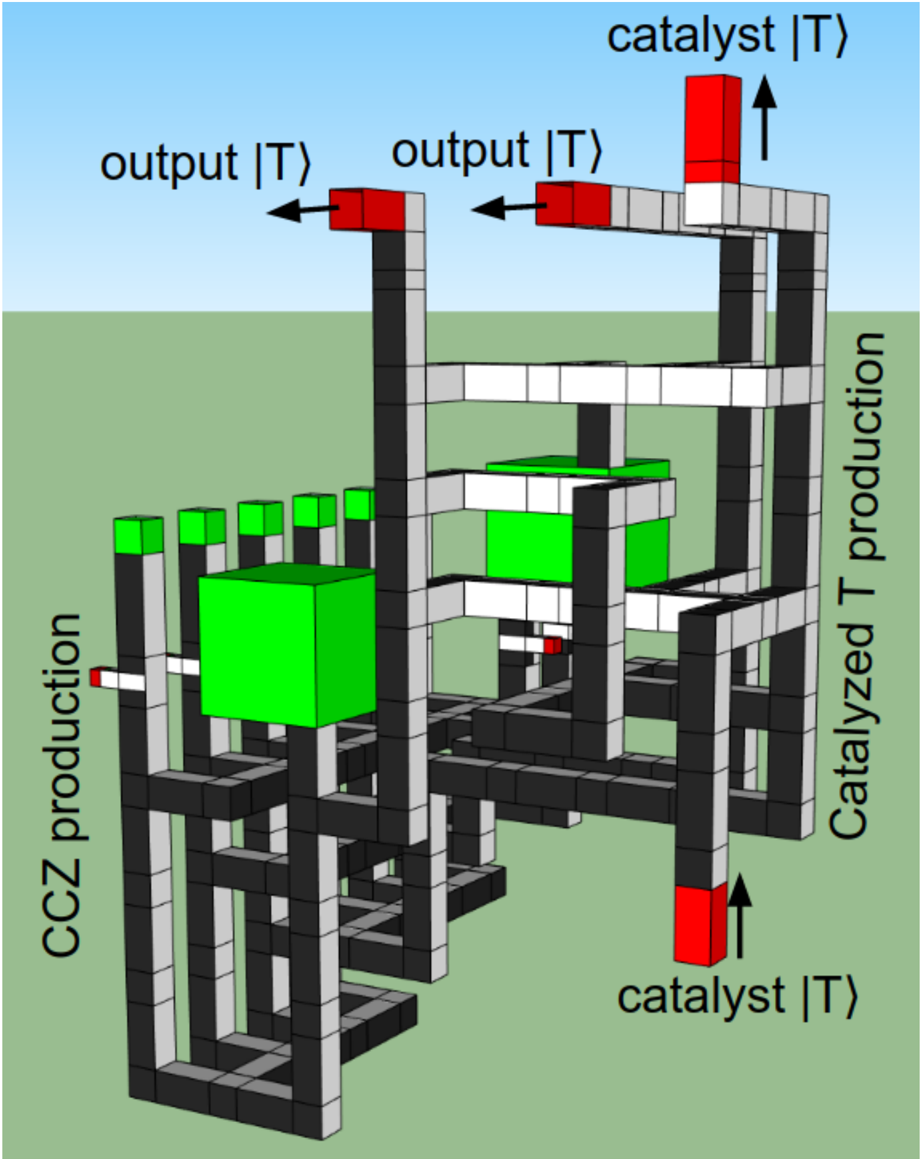
We present magic state factory constructions for producing | C C Z ⟩ states and | T ⟩ states. For the | C C Z ⟩ factory we apply the surface code lattice surgery construction techniques described in \cite{fowler2018} to the fault-tolerant Toffoli \cite{jones2013, eastin2013distilling}. The resulting factory has a footprint of 12 d × 6 d (where d is the code distance) and produces one | C C Z ⟩ every 5.5 d surface code cycles. Our | T ⟩ state factory uses the | C C Z ⟩ factory's output and a catalyst | T ⟩ state to exactly transform one | C C Z ⟩ state into two | T ⟩ states. It has a footprint 25 % smaller than the factory in \cite{fowler2018} but outputs | T ⟩ states twice as quickly. We show how to generalize the catalyzed transformation to arbitrary phase angles, and note that the case θ = 22.5 ∘ produces a particularly efficient circuit for producing | T ⟩ states. Compared to using the 12 d × 8 d × 6.5 d | T ⟩ factory of \cite{fowler2018}, our | C C Z ⟩ factory can quintuple the speed of algorithms that are dominated by the cost of applying Toffoli gates, including Shor's algorithm \cite{shor1994} and the chemistry algorithm of Babbush et al. \cite{babbush2018}. Assuming a physical gate error rate of 10 − 3 , our CCZ factory can produce ∼ 10 10 states on average before an error occurs. This is sufficient for classically intractable instantiations of the chemistry algorithm, but for more demanding algorithms such as Shor's algorithm the mean number of states until failure can be increased to ∼ 10 12 by increasing the factory footprint ∼ 20 % .
Overview
The claims and statistics of this paper haven’t been checked yet.
Free: it reads the open-access text and checks the first 5 claims that cite a source we can check. Create a free account to check every claim.
Integrity signals
Registry
Cites
Statistics
Figures
Verification
Claims the paper makes
The claims and statistics of this paper haven’t been checked yet.
Free: it reads the open-access text and checks the first 5 claims that cite a source we can check. Create a free account to check every claim.
Self-check
Percentages, sums and reported differences re-computed from the paper’s own numbers.
The self-check needs the paper’s full text.
Citations
Cites
Algorithms for quantum computation: discrete logarithms and factoring
Shor, P. W. (2002) · Proceedings 35th Annual Symposium on Foundations of Computer Science · doi:10.1109/sfcs.1994.365700 · Cited by 8,713 · cited 1×
“ates. Compared to using the 12d×8d×6.5d|Tifactory of [15], our |CCZi factory can quintuple the speed of algorithms that are dominated by the cost of applying Toffoli gates, including Shor’s algorithm [31] and the chemistry algorithm of Babbush et al. [1]. Assuming a physical gate error rate of 10−3, our CCZ factory ca…”
MethodSurface codes: Towards practical large-scale quantum computation
Fowler, A. G., Mariantoni, M., Martinis, J. M., & Cleland, A. N. (2012) · Physical Review A · doi:10.1103/physreva.86.032324 · Cited by 3,059 · cited 1×
“…based on the surface code (a likely component of future error corrected quantum computers due to the surface code’s comparatively high threshold and planar connectivity requirements [3, 11, 29, 30, 13]), the cost of a quantum algorithm is well approximated by the number of non-Clifford operations.”
BackgroundSelf-citationGottesman, D., & Chuang, I. L. (1999) · Nature · doi:10.1038/46503 · Cited by 1,860 · cited 1×
“Contrast with gate teleportation [18], which consumes a previously prepared Z|+〉 state in order to perform one Z operation, with a 50% chance of requiring a fixup Z−2θ operation.”
MethodDennis, E., Kitaev, A., Landahl, A., & Preskill, J. (2002) · Journal of Mathematical Physics · doi:10.1063/1.1499754 · Cited by 1,768 · cited 1×
“…based on the surface code (a likely component of future error corrected quantum computers due to the surface code’s comparatively high threshold and planar connectivity requirements [3, 11, 29, 30, 13]), the cost of a quantum algorithm is well approximated by the number of non-Clifford operations.”
BackgroundUniversal quantum computation with ideal Clifford gates and noisy ancillas
Bravyi, S., & Kitaev, A. (2005) · Physical Review A · doi:10.1103/physreva.71.022316 · Cited by 1,525 · cited 2×
“com distillation [5], and the cost of state distillation is large.”
BackgroundMethodClassical and Quantum Computation
Kitaev, A., Shen, A., & Vyalyi, M. (2002) · Graduate Studies in Mathematics · doi:10.1090/gsm/047 · Cited by 1,387
Fault-Tolerant Quantum Computation with High Threshold in Two Dimensions
Raussendorf, R., & Harrington, J. (2007) · Physical Review Letters · doi:10.1103/physrevlett.98.190504 · Cited by 812 · cited 1×
“rected quantum computers due to the surface code’s comparatively high threshold and planar connectivity requirements [3, 11, 29, 30, 13]), the cost of a quantum algorithm is well approximated by the number of non-Clifford operations.”
MethodTopological fault-tolerance in cluster state quantum computation
Raussendorf, R., Harrington, J., & Goyal, K. (2007) · New Journal of Physics · doi:10.1088/1367-2630/9/6/199 · Cited by 617
Surface code quantum computing by lattice surgery
Horsman, D., Fowler, A. G., Devitt, S., & Meter, R. V. (2012) · New Journal of Physics · doi:10.1088/1367-2630/14/12/123011 · Cited by 598 · cited 3×
“Over the past decade, thanks to techniques such as block codes [4, 16], bridge compression [14], and many others [19, 8, 9, 25], the cost of magic state distillation has steadily decreased.”
BackgroundMethodSelf-citationA Game of Surface Codes: Large-Scale Quantum Computing with Lattice Surgery
Litinski, D. (2019) · Quantum · doi:10.22331/q-2019-03-05-128 · Cited by 408 · cited 3×
“Over the past decade, thanks to techniques such as block codes [4, 16], bridge compression [14], and many others [19, 8, 9, 25], the cost of magic state distillation has steadily decreased.”
Background
Research works printed but not linked: 2
- 10. Niel de Beaudrap and Dominic Horsman. The zx calculus is a language for surface code lattice surgery. arXiv preprint arXiv:1704.08670, 2017. URL https://arxiv.org/abs/1704.08670. · arXiv
- 27. Yunseong Nam, Yuan Su, and Dmitri Maslov. Approximate quantum fourier transform with o(n log(n)) t gates. arXiv preprint arXiv:1803.04933, 2018. URL https://arxiv.org/abs/1803.04933. · arXiv
Cited by
Quantum computational chemistry
McArdle, S., Endo, S., Aspuru-Guzik, A., Benjamin, S. C., & Yuan, X. (2020) · Reviews of Modern Physics · doi:10.1103/revmodphys.92.015003 · Cited by 1,621
How to factor 2048 bit RSA integers in 8 hours using 20 million noisy qubits
Gidney, C., & Ekerå, M. (2021) · Quantum · doi:10.22331/q-2021-04-15-433 · Cited by 830
“According to the spreadsheet included in [36], using a level 1 code distance 17 and a level 2 code distance of 27, this corresponds to a total distillation error of 6.”
BackgroundMethodInfluentialSelf-citationStim: a fast stabilizer circuit simulator
Gidney, C. (2021) · Quantum · doi:10.22331/q-2021-07-06-497 · Cited by 415
Self-citationA Game of Surface Codes: Large-Scale Quantum Computing with Lattice Surgery
Litinski, D. (2019) · Quantum · doi:10.22331/q-2019-03-05-128 · Cited by 408
“[12, 38]), using smaller patches and fewer code cycles.”
MethodQuantum computing enhanced computational catalysis
von Burg, V., Low, G. H., Häner, T., Steiger, D. S., Reiher, M., Roetteler, M., & Troyer, M. (2021) · Physical Review Research · doi:10.1103/physrevresearch.3.033055 · Cited by 252
Even More Efficient Quantum Computations of Chemistry Through Tensor Hypercontraction
Lee, J., Berry, D. W., Gidney, C., Huggins, W. J., McClean, J. R., Wiebe, N., & Babbush, R. (2021) · PRX Quantum · doi:10.1103/prxquantum.2.030305 · Cited by 304
Self-citationBuilding a Fault-Tolerant Quantum Computer Using Concatenated Cat Codes
Chamberland, C., Noh, K., Arrangoiz-Arriola, P., Campbell, E. T., Hann, C. T., Iverson, J., Putterman, H., Bohdanowicz, T. C., Flammia, S. T., Keller, A., et al. (2022) · PRX Quantum · doi:10.1103/prxquantum.3.010329 · Cited by 281
Quantum computing enhanced computational catalysis
von Burg, V., Low, G. H., Häner, T., Steiger, D. S., Reiher, M., Roetteler, M., & Troyer, M. (2020) · arXiv · doi:10.48550/arxiv.2007.14460 · Cited by 258
A game of surface codes: Large-scale quantum computing with lattice surgery
Litinski, D. (2019) · Refubium (Universitätsbibliothek der Freien Universität Berlin) · doi:10.17169/refubium-4067 · Cited by 252
Qubitization of Arbitrary Basis Quantum Chemistry Leveraging Sparsity and Low Rank Factorization
Berry, D. W., Gidney, C., Motta, M., McClean, J. R., & Babbush, R. (2019) · Quantum · doi:10.22331/q-2019-12-02-208 · Cited by 222
Self-citationMagic State Distillation: Not as Costly as You Think
Litinski, D. (2019) · Quantum · doi:10.22331/q-2019-12-02-205 · Cited by 220
Tour de gross: A modular quantum computer based on bivariate bicycle codesPreprint
Yoder, T. J., Schoute, E., Rall, P., Pritchett, E., Gambetta, J., Cross, A. W., Carroll, M. S., & Beverland, M. E. (2025) · arXiv (Cornell University) · doi:10.48550/arxiv.2506.03094 · Cited by 254
Lower bounds on the non-Clifford resources for quantum computations
Beverland, M., Campbell, E., Howard, M., & Kliuchnikov, V. (2020) · Quantum Science and Technology · doi:10.1088/2058-9565/ab8963 · Cited by 140
“For W3, we have that the state |W3〉 is Clifford equivalent to |CCZ〉 and so |CCZ〉 =⇒ |T〉⊗2, which is the catalysis protocol observed by Gidney and Fowler [23].”
BackgroundMethodKivlichan, I. D., Gidney, C., Berry, D. W., Wiebe, N., McClean, J., Sun, W., Jiang, Z., Rubin, N., Fowler, A., Aspuru-Guzik, A., et al. (2020) · Quantum · doi:10.22331/q-2020-07-16-296 · Cited by 173
“When generating T states, superscript a indicates that a single round of 15-1 distillation was used, superscript b indicates 15-1 followed by CCZ state generation and catalyzation was used [80].”
BackgroundMethodInfluentialSelf-citationSuzuki, Y., Endo, S., Fujii, K., & Tokunaga, Y. (2022) · PRX Quantum · doi:10.1103/prxquantum.3.010345 · Cited by 125
“We can choose CCZ-gate as a magic state instead of a T -gate [64].”
MethodDisentangling Hype from Practicality: On Realistically Achieving Quantum Advantage
Hoefler, T., Häner, T., & Troyer, M. (2023) · Communications of the ACM · doi:10.1145/3571725 · Cited by 227
Focus beyond Quadratic Speedups for Error-Corrected Quantum Advantage
Babbush, R., McClean, J. R., Newman, M., Gidney, C., Boixo, S., & Neven, H. (2021) · PRX Quantum · doi:10.1103/prxquantum.2.010103 · Cited by 148
“(a) A surface code Toffoli factory for distilling Toffoli gates (which act as the NAND gate when the target bit is on) requires a space-time volume greater than 10 qubit seconds under reasonable assumptions on the capabilities of an error-corrected superconducting qubit platform [13].”
BackgroundMethodInfluentialSelf-citationElfving, V. E., Broer, B. W., Webber, M., Gavartin, J. L., Halls, M. D., Lorton, K. P., & Bochevarov, A. D. (2020) · arXiv (Cornell University) · doi:10.48550/arxiv.2009.12472 · Cited by 51
Compilation of Fault-Tolerant Quantum Heuristics for Combinatorial Optimization
Sanders, Y. R., Berry, D. W., Costa, P. C. S., Tessler, L. W., Wiebe, N., Gidney, C., Neven, H., & Babbush, R. (2020) · PRX Quantum · doi:10.1103/prxquantum.1.020312 · Cited by 103
Self-citationExperimental demonstration of logical magic state distillation
Rodriguez, P. S., Robinson, J. M., Jepsen, N., He, Z., Duckering, C., Zhao, C., Wu, K.-H., Campo, J., Bagnall, K. R., Kwon, M., et al. (2025) · Nature · doi:10.1038/s41586-025-09367-3 · Cited by 246
Goings, J. J., White, A., Lee, J., Tautermann, C. S., Degroote, M., Gidney, C., Shiozaki, T., Babbush, R., & Rubin, N. C. (2022) · Proceedings of the National Academy of Sciences · doi:10.1073/pnas.2203533119 · Cited by 127
“For time complexity we focus on the number of Toffoli gates that are the rate-limiting gate operation within the surface code error correction protocol (58).”
Self-citationFault-tolerant quantum simulations of chemistry in first quantization
Su, Y., Berry, D. W., Wiebe, N., Rubin, N., & Babbush, R. (2021) · PRX Quantum · doi:10.1103/prxquantum.2.040332 · Cited by 123
Kim, I. H., Liu, Y.-H., Pallister, S., Pol, W., Roberts, S., & Lee, E. (2022) · Physical Review Research · doi:10.1103/physrevresearch.4.023019 · Cited by 96
Universal Quantum Computing with Twist-Free and Temporally Encoded Lattice Surgery
Chamberland, C., & Campbell, E. T. (2022) · PRX Quantum · doi:10.1103/prxquantum.3.010331 · Cited by 80
Quantum State Preparation without Coherent Arithmetic
McArdle, S., Gilyén, A., & Berta, M. (2026) · Physical Review Letters · doi:10.1103/ntvs-c48s · Cited by 105
Fault-tolerant magic state preparation with flag qubits
Chamberland, C., & Cross, A. W. (2019) · Quantum · doi:10.22331/q-2019-05-20-143 · Cited by 83
Quantum circuit optimization with AlphaTensor
Ruiz, F. J. R., Laakkonen, T., Bausch, J., Balog, M., Barekatain, M., Heras, F. J. H., Novikov, A., Fitzpatrick, N., Romera‐Paredes, B., van de Wetering, J., et al. (2025) · Nature Machine Intelligence · doi:10.1038/s42256-025-01001-1 · Cited by 132
Constant-overhead magic state distillation
Wills, A., Hsieh, M.-H., & Yamasaki, H. (2025) · Nature Physics · doi:10.1038/s41567-025-03026-0 · Cited by 120
“…constant-overhead magic state distillation in the same sense as Theorem I.1 (possibly with different constant factors) for the | T ⟩ gate by using known protocols to convert between | CCZ ⟩ states and | T ⟩ states 31–34 At a high level, there are two ingredients that allow us to prove Theorem I.1.”
The ZX calculus is a language for surface code lattice surgery
de Beaudrap, N., & Horsman, D. (2020) · Quantum · doi:10.22331/q-2020-01-09-218 · Cited by 83
Early fault-tolerant simulations of the Hubbard model
Campbell, E. T. (2022) · Quantum Science and Technology · doi:10.1088/2058-9565/ac3110 · Cited by 81
“Each of these individual plaquettes commute so,”
Graphical structures for design and verification of quantum error correction
Chancellor, N., Kissinger, A., Zohren, S., Roffe, J., & Horsman, D. C. (2023) · Quantum Science and Technology · doi:10.1088/2058-9565/acf157 · Cited by 86
“It is also now being used in a number of places in the technology ecosystem, both by academic and industrial parties, including for compilation by Quantinuum (formerly Cambridge Quantum Computing) [39], and for surface codes by PsiQuantum [40] and Google [41].”
MethodA fault-tolerant non-Clifford gate for the surface code in two dimensions
Brown, B. J. (2020) · Science Advances · doi:10.1126/sciadv.aay4929 · Cited by 77
Simulating key properties of lithium-ion batteries with a fault-tolerant quantum computer
Delgado, A., Casares, P. A. M., dos Reis, R., Zini, M. S., Campos, R., Hernández, N. C., Voigt, A.-C., Lowe, A., Jahangiri, S., Martin-Delgado, M. A., et al. (2022) · Physical Review A · doi:10.1103/physreva.106.032428 · Cited by 92
Fold-transversal surface code cultivation
Sahay, K., Tsai, P.-K., Chang, K., Su, Q. D., Smith, T. B., Singh, S., & Puri, S. (2026) · PRX Quantum · doi:10.1103/gpvl-lg4c · Cited by 92
“First, injection is modified to use an S gate instead of a T gate [10, 28].”
Challenges of variational quantum optimization with measurement shot noise
Scriva, G., Astrakhantsev, N., Pilati, S., & Mazzola, G. (2024) · Physical Review A · doi:10.1103/physreva.109.032408 · Cited by 83
“1 ms (10 kHz) in the fault-tolerant regime [44].”
BackgroundZX-calculus for the working quantum computer scientist
van de Wetering, J. (2020) · arXiv · doi:10.48550/arxiv.2012.13966 · Cited by 68
“Many of the recent works focus on specific applications such as MBQC [13, 82], quantum circuit optimisation [42, 46, 57, 83] and as a tool for reasoning about surface code quantum computing [44, 47, 64, 69, 72].”
BackgroundMethodCatalysis in quantum information theory
Lipka-Bartosik, P., Wilming, H., & Ng, N. H. Y. (2024) · Reviews of Modern Physics · doi:10.1103/revmodphys.96.025005 · Cited by 105
Choi, H., Pant, M., Guha, S., & Englund, D. R. (2019) · npj Quantum Information · doi:10.1038/s41534-019-0215-2 · Cited by 81
Fault-tolerant weighted union-find decoding on the toric code
Huang, S., Newman, M., & Brown, K. R. (2020) · Physical Review A · doi:10.1103/physreva.102.012419 · Cited by 58
Fast and Parallelizable Logical Computation with Homological Product Codes
Xu, Q., Zhou, H., Zheng, G., Bluvstein, D., Ataides, J. P. B., Lukin, M. D., & Jiang, L. (2025) · Physical Review X · doi:10.1103/physrevx.15.021065 · Cited by 93
“As shown in Fig.4(a), we consider the “8-to-CCZ” distillation circuit that converts 8 noisy ∣ T ⟩ states into one less noisy ∣ CCZ ⟩ state [48, 50, 54].”
BackgroundThe impact of hardware specifications on reaching quantum advantage in the fault tolerant regime
Webber, M., Elfving, V., Weidt, S., & Hensinger, W. K. (2022) · AVS Quantum Science · doi:10.1116/5.0073075 · Cited by 40
“These trends utilize AutoCCZ factories to trade space for time to reach the desired run time and assume that a CCZ state can be efficiently traded for 2 T gates ([58]).”
BackgroundMethodShorter quantum circuits via single-qubit gate approximation
Kliuchnikov, V., Lauter, K., Minko, R., Paetznick, A., & Petit, C. (2023) · Quantum · doi:10.22331/q-2023-12-18-1208 · Cited by 106
Opening the Black Box inside Grover’s Algorithm
Stoudenmire, E. M., & Waintal, X. (2024) · Physical Review X · doi:10.1103/physrevx.14.041029 · Cited by 74
Error rates and resource overheads of repetition cat qubits
Guillaud, J., & Mirrahimi, M. (2021) · Physical Review A · doi:10.1103/physreva.103.042413 · Cited by 55
Inplace Access to the Surface Code Y Basis
Gidney, C. (2024) · Quantum · doi:10.22331/q-2024-04-08-1310 · Cited by 97
“The cost of Y basis measurement is surprisingly relevant to the overall cost of surface code computations because, in many magic state factory designs [FG18; GF19; Lit18], distilling a magic state involves hundreds of Y basis measurements.”
BackgroundSelf-citationPreparing Bethe Ansatz Eigenstates on a Quantum Computer
Dyke, J. S. V., Barron, G. S., Mayhall, N. J., Barnes, E., & Economou, S. E. (2021) · PRX Quantum · doi:10.1103/prxquantum.2.040329 · Cited by 60
Practical Quantum Advantage on Partially Fault-Tolerant Quantum Computer
Toshio, R., Akahoshi, Y., Fujisaki, J., Oshima, H., Sato, S., & Fujii, K. (2025) · Physical Review X · doi:10.1103/physrevx.15.021057 · Cited by 76
Fault-tolerant one-bit addition with the smallest interesting color code
Wang, Y., Simsek, S., Gatterman, T. M., Gerber, J. A., Gilmore, K., Gresh, D., Hewitt, N., Horst, C. V., Matheny, M., Mengle, T., et al. (2024) · Science Advances · doi:10.1126/sciadv.ado9024 · Cited by 64
Efficient Magic State Cultivation on R P 2
Chen, Z.-H., Chen, M.-C., Lu, C., & Pan, J.-W. (2026) · PRX Quantum · doi:10.1103/9kys-3whh · Cited by 65
Quantum computing for chemistry and physics applications from a Monte Carlo perspective
Mazzola, G. (2024) · The Journal of Chemical Physics · doi:10.1063/5.0173591 · Cited by 64
“32 Often, in literature, one hears about T -depth as a proxy for the complexity of an algorithm.”
BackgroundTan, D. B., Niu, M. Y., & Gidney, C. (2024) · Proceedings - International Symposium on Computer Architecture/Proceedings · doi:10.1109/isca59077.2024.00032 · Cited by 67
“[20] considered the interplay of T -factories with | CCZ (cid”
BackgroundSelf-citationQuantum Computing is Scalable on a Planar Array of Qubits with Fabrication Defects
Strikis, A., Benjamin, S. C., & Brown, B. J. (2023) · Physical Review Applied · doi:10.1103/physrevapplied.19.064081 · Cited by 57
Logical qubits with erasure conversion using metastable neutral atoms
Zhang, B., Liu, G., Bornet, G., Horvath, S. P., Peng, P., Ma, S., Huang, S., Puri, S., & Thompson, J. D. (2026) · Nature Physics · doi:10.1038/s41567-026-03309-0 · Cited by 57
“At the same time, advances in the design of quantum error-correcting codes and fault-tolerant circuits 9–11 and quantum algorithms 12–14 have reduced the apparent computational cost of running large-scale algorithms for real-world applications.”
Phase Estimation with Partially Randomized Time Evolution
Günther, J., Witteveen, F., Schmidhuber, A., Miller, M., Christandl, M., & Harrow, A. W. (2026) · PRX Quantum · doi:10.1103/ynxb-p2xq · Cited by 44
“…regime where λ R is a large fraction of λ will not lead to significant speedup over the fully randomized method (so it does not help much that the Trotter error is smaller), and when λ R is reasonably small, the Trotter error of the fully deterministic product formula is a very good approximation.”
Circuit Extraction for ZX-Diagrams Can Be #P-Hard
de Beaudrap, N., Kissinger, A., & van de Wetering, J. (2022) · DROPS (Schloss Dagstuhl – Leibniz Center for Informatics) · doi:10.4230/lipics.icalp.2022.119 · Cited by 45
Vasmer, M., & Kubica, A. (2022) · PRX Quantum · doi:10.1103/prxquantum.3.030319 · Cited by 39
XQsim: modeling cross-technology control processors for 10+K qubit quantum computers
Byun, I., Kim, J., Min, D., Nagaoka, I., Fukumitsu, K., Ishikawa, I., Tanimoto, T., Tanaka, M., Inoue, K., & Kim, J. (2022) · Proceedings - International Symposium on Computer Architecture/Proceedings · doi:10.1145/3470496.3527417 · Cited by 46
“10% [20] 15 [20] QECOOL [69] Physical quantum gate latency Single-qubit gate Two-qubit gate Measurement 14ns [9] 26ns [9] 600ns [9] Refrigeration and wiring 4K power budget 4K area budget 300K-4K cable”
BackgroundFault-Tolerant Postselection for Low-Overhead Magic State Preparation
Bombín, H., Pant, M., Roberts, S., & Seetharam, K. (2024) · PRX Quantum · doi:10.1103/prxquantum.5.010302 · Cited by 70
Cleaner magic states with hook injectionPreprint
Gidney, C. (2023) · arXiv (Cornell University) · doi:10.48550/arxiv.2302.12292 · Cited by 41
Self-citationLogical Clifford Synthesis for Stabilizer Codes
Rengaswamy, N., Calderbank, R., Kadhe, S., & Pfister, H. D. (2020) · IEEE Transactions on Quantum Engineering · doi:10.1109/tqe.2020.3023419 · Cited by 45
“Since these are the primitive operations in trapped-ion systems [41], codes that support a transversal T = diag(1, exp( ıπ 4 )) gate, such as the tri-orthogonal codes mentioned earlier, could be directly used for computation rather than being dedicated for expensive magic state distillation [10], [42]–[44].”
BackgroundPauli Fusion: a Computational Model to Realise Quantum Transformations from ZX Terms
de Beaudrap, N., Duncan, R., Horsman, D., & Perdrix, S. (2020) · Electronic Proceedings in Theoretical Computer Science · doi:10.4204/eptcs.318.6 · Cited by 41
Fault-Tolerant One-Bit Addition with the Smallest Interesting Colour Code
Wang, Y., Simsek, S., Gatterman, T. M., Gerber, J. A., Gilmore, K., Gresh, D., Hewitt, N., Horst, C. V., Matheny, M., Mengle, T., et al. (2023) · arXiv · doi:10.48550/arxiv.2309.09893 · Cited by 32
Quantum simulations of chemistry in first quantization with any basis set
Georges, T. N., Bothe, M., Sünderhauf, C., Berntson, B. K., Izsák, R., & Ivanov, A. V. (2025) · npj Quantum Information · doi:10.1038/s41534-025-00987-1 · Cited by 50
Effective Compression of Quantum Braided Circuits Aided by ZX-Calculus
Hanks, M., Estarellas, M. P., Munro, W. J., & Nemoto, K. (2020) · Physical Review X · doi:10.1103/physrevx.10.041030 · Cited by 43
“[52] Craig Gidney and Austin G Fowler.”
BackgroundMethodInfluentialMagic Tricycles: Efficient Magic-State Generation with Finite Block-Length Quantum LDPC Codes
Menon, V., Ataides, J. P. B., Mehta, R., Gu, A., Tan, D. B., & Lukin, M. D. (2026) · Physical Review X · doi:10.1103/ghhp-cytl · Cited by 45
Unifying the Clifford hierarchy via symmetric matrices over rings
Rengaswamy, N., Calderbank, R., & Pfister, H. D. (2019) · Physical Review A · doi:10.1103/physreva.100.022304 · Cited by 38
“When Paulis are propagated through non-Clifford elements, we lose the Pauli frame, and hence this extension will not be straightforward, but we think research in this direction might produce alternatives to (expensive) magic state distillation [14, 17] for realizing non-Clifford logical unitaries.”
BackgroundTranspiler-Architecture Co-Design to Curb Clifford Costs in Fault-Tolerant Quantum Computing
Wang, M., Liu, C., Stein, S., Ding, Y., Das, P., Nair, P. J., & Li, A. (2026) · Proceedings - International Symposium on Computer Architecture/Proceedings · doi:10.1109/isca66397.2026.00072 · Cited by 29
Resource Analysis of Low-Overhead Transversal Architectures for Reconfigurable Atom Arrays
Zhou, H., Duckering, C., Zhao, C., Bluvstein, D., Cain, M., Kubica, A., Wang, S.-T., & Lukin, M. D. (2025) · Proceedings - International Symposium on Computer Architecture/Proceedings · doi:10.1145/3695053.3731039 · Cited by 75
“The top half of the circuit has a similar structure to the adder circuit, and can be implemented in a similar fashion.”
Generating logical magic states with the aid of non-Abelian topological order
Huang, S.-J., & Chen, Y. (2026) · npj Quantum Information · doi:10.1038/s41534-026-01315-x · Cited by 28
Fast quantum interconnects via constant-rate entanglement distillationPreprint
Pattison, C. A., Baranes, G., Ataides, J. P. B., Lukin, M. D., & Zhou, H. (2024) · arXiv (Cornell University) · doi:10.48550/arxiv.2408.15936 · Cited by 28
An iterative transversal CNOT decoderPreprint
Wan, K. H., Webber, M., Fowler, A. G., & Hensinger, W. K. (2024) · arXiv (Cornell University) · doi:10.48550/arxiv.2407.20976 · Cited by 26
Self-citationResource analysis of quantum computing with noisy qubits for Shor’s factoring algorithms
Ha, J., Lee, J., & Heo, J. (2022) · Quantum Information Processing · doi:10.1007/s11128-021-03398-1 · Cited by 28
Codesign of quantum error-correcting codes and modular chiplets in the presence of defects
Lin, S. F., Viszlai, J., Smith, K. N., Ravi, G. S., Yuan, C., Chong, F. T., & Brown, B. J. (2024) · International Conference on Architectural Support for Programming Languages and Operating Systems (ASPLOS) · doi:10.1145/3620665.3640362 · Cited by 44
Practical blueprint for low-depth photonic quantum computing with quantum dots
Chan, M. L., Capatos, A. A., Lodahl, P., Sørensen, A. S., & Paesani, S. (2026) · npj Quantum Information · doi:10.1038/s41534-026-01258-3 · Cited by 31
Error Mitigation and Circuit Division for Early Fault-Tolerant Quantum Phase Estimation
Dutkiewicz, A., Polla, S., Scheurer, M., Gogolin, C., Huggins, W. J., & O’Brien, T. E. (2025) · PRX Quantum · doi:10.1103/mlmy-yskj · Cited by 34
High-fidelity magic-state preparation with a biased-noise architecture
Singh, S., Darmawan, A. S., Brown, B. J., & Puri, S. (2022) · Physical Review A · doi:10.1103/physreva.105.052410 · Cited by 34
Coecke, B., Horsman, D. C., Kissinger, A., & Wang, Q. (2021) · Theoretical Computer Science · doi:10.1016/j.tcs.2021.07.024 · Cited by 28
Shor's Algorithm Using Efficient Approximate Quantum Fourier Transform
Oonishi, K., & Kunihiro, N. (2023) · IEEE Transactions on Quantum Engineering · doi:10.1109/tqe.2023.3319044 · Cited by 24
Completeness of the ZH-calculus
Backens, M., Kissinger, A., Miller-Bakewell, H., van de Wetering, J., & Wolffs, S. (2023) · Compositionality · doi:10.32408/compositionality-5-5 · Cited by 27
SZX-calculus: Scalable Graphical Quantum ReasoningPreprint
Carette, T., Horsman, D. C., & Perdrix, S. (2019) · DROPS (Schloss Dagstuhl – Leibniz Center for Informatics) · doi:10.48550/arxiv.1905.00041 · Cited by 41
Feasibility of accelerating homogeneous catalyst discovery with fault-tolerant quantum computersPreprint
Bellonzi, N., Kunitsa, A. A., Cantin, J. T., Campos-Gonzalez-Angulo, J. A., Radin, M. D., Zhou, Y., Johnson, P. D., Martínez-Martínez, L. Á., Jangrouei, M. R., Brahmachari, A. S., et al. (2024) · arXiv (Cornell University) · doi:10.48550/arxiv.2406.06335 · Cited by 24
“However, it may be more meaningful to consider a Toffoli gate as roughly equivalent to two T gates in terms of physical cost because an AutoCCZ factory can be used to implement two T gates for the cost of a single Toffoli [101].”
MethodMartínez-Martínez, L. Á., Yen, T.-C., & Izmaylov, A. F. (2023) · Quantum · doi:10.22331/q-2023-08-16-1086 · Cited by 27
Universal limitations on implementing resourceful unitary evolutions
Takagi, R., & Tajima, H. (2020) · Physical Review A · doi:10.1103/physreva.101.022315 · Cited by 21
Sampling, rates, and reaction currents through reverse stochastic quantization on quantum computers
Mazzola, G. (2021) · Physical Review A · doi:10.1103/physreva.104.022431 · Cited by 25
Option pricing under stochastic volatility on a quantum computer
Wang, G., & Kan, A. (2024) · Quantum · doi:10.22331/q-2024-10-23-1504 · Cited by 25
Marti-Dafcik, D., Burton, H. G. A., & Tew, D. P. (2025) · Physical Review Research · doi:10.1103/physrevresearch.7.013191 · Cited by 27
Graphical CSS Code Transformation Using ZX Calculus
Huang, J., Li, S. M., Yeh, L., Kissinger, A., Mosca, M., & Vasmer, M. (2023) · Electronic Proceedings in Theoretical Computer Science · doi:10.4204/eptcs.384.1 · Cited by 26
“Beyond these, ZX-calculus has been applied to verify QECC [23, 26], represent Clifford encoders [38], as well as study various QECC such as tripartite coherent parity check codes [12, 13] and surface codes [27, 28, 29, 54].”
MethodOonishi, K., Tanaka, T., Uno, S., Satoh, T., Meter, R. V., & Kunihiro, N. (2021) · IEEE Transactions on Quantum Engineering · doi:10.1109/tqe.2021.3136195 · Cited by 24
“operation, and its optimization is an ongoing topic of research [14].”
BackgroundAKLT-States as ZX-Diagrams: Diagrammatic Reasoning for Quantum States
East, R. D. P., van de Wetering, J., Chancellor, N., & Grushin, A. G. (2022) · PRX Quantum · doi:10.1103/prxquantum.3.010302 · Cited by 29
Compositionality as We See It, Everywhere Around Us
Coecke, B. (2023) · Springer eBooks · doi:10.1007/978-3-031-12986-5_12 · Cited by 24
Extending the reach of quantum computing for materials science with machine learning potentials
Schuhmacher, J., Mazzola, G., Tacchino, F., Dmitriyeva, O., Bui, T., Huang, S., & Tavernelli, I. (2022) · AIP Advances · doi:10.1063/5.0099469 · Cited by 19
Quantum Computing for Genomics: Conceptual Challenges and Practical Perspectives
Maurizio, A., & Mazzola, G. (2025) · PRX Life · doi:10.1103/h49j-bsc6 · Cited by 23
“[36, 39, 43, 44] The typical quantum gate frequency will depend on the architecture and error correction code implemented in the future, but estimates suggest around 10 kHz[43].”
Quantum computing and neuroscience for 6G/7G networks: Survey
Glisic, S., & Lorenzo, B. (2024) · Intelligent Systems with Applications · doi:10.1016/j.iswa.2024.200346 · Cited by 19
Leveraging Zero-Level Distillation to Generate High-Fidelity Magic States
Hirano, Y., Itogawa, T., & Fujii, K. (2024) · IEEE International Conference on Quantum Computing and Engineering (QCE) · doi:10.1109/qce60285.2024.00104 · Cited by 29
“Using the surface code error rate approximation [9], [12] p L ( d ) := 0 .”
TE-PAI: exact time evolution by sampling random circuits
Kiumi, C., & Koczor, B. (2025) · Quantum Science and Technology · doi:10.1088/2058-9565/ae1160 · Cited by 31
“[54, 56].”
Compilation of a simple chemistry application to quantum error correction primitives
Blunt, N. S., Gehér, G. P., & Moylett, A. E. (2024) · Physical Review Research · doi:10.1103/physrevresearch.6.013325 · Cited by 20
“This is even more prominent when moving Clifford gates through the circuit, where of the 2,744 physical qubits required at error rate 10 − 4 , 2,288 are for preparing and storing | T ⟩ states.”
BackgroundCode switching revisited: Low-overhead magic state preparation using color codes
Daguerre, L., & Kim, I. H. (2025) · Physical Review Research · doi:10.1103/physrevresearch.7.023080 · Cited by 40
Ivanov, A. V., Patterson, A. D., Bothe, M., Sünderhauf, C., Berntson, B. K., Mortensen, J. J., Kuisma, M. J., Campbell, E. T., & Izsák, R. (2025) · Journal of Chemical Theory and Computation · doi:10.1021/acs.jctc.5c00551 · Cited by 18
Unfolded distillation: very low-cost magic state preparation for biased-noise qubits
Ruiz, D., Guillaud, J., Vuillot, C., & Mirrahimi, M. (2026) · npj Quantum Information · doi:10.1038/s41534-026-01197-z · Cited by 20
Scalable Decoding Protocols for Fast Transversal Logic in the Surface Code
Turner, M. L., Campbell, E. T., Crawford, O., Gillespie, N. I., & Camps, J. (2026) · PRX Quantum · doi:10.1103/nx6p-hjqy · Cited by 28
Metadata
- Authors
- Gidney, C., & Fowler, A. G.
- Affiliations
- Google (United States) (US)
- ORCID
- Fowler, Austin G.
- Venue
- Quantum
- Published
- 2019-04-30
- Volume
- 3
- Pages
- 135
- ISSN
- 2521-327X (ISSN-L)
- OpenAlex
- W2952708034
- Cited by
- 152
- References
- 24
- Citations by year
- 2026: 23 · 2025: 33 · 2024: 22 · 2023: 13 · 2022: 15 · 2021: 16 · 2020: 18 · 2019: 11
- FWCI
- 6.96
- Type
- journal article
- Language
- en
- Open access
- gold
- doi.org
- Locations
- Quantum (publishedVersion, cc-by)
- arXiv (Cornell University) (submittedVersion)
- DOAJ (DOAJ: Directory of Open Access Journals) (submittedVersion, cc-by-sa)
- arXiv (Cornell University) (cc-by)
- Topics
- Physical Sciences › Computer Science › Artificial Intelligence › Quantum Computing Algorithms and Architecture
- Physical Sciences › Physics and Astronomy › Atomic and Molecular Physics, and Optics › Quantum Information and Cryptography
- Physical Sciences › Physics and Astronomy › Atomic and Molecular Physics, and Optics › Quantum many-body systems
- Keywords
- Toffoli gate, surface code, lattice surgery, fault-tolerant quantum computing, quantum chemistry algorithms, Shor's algorithm
About these checks
Registry, retraction, Cites and statistics results are computed, not judged, with one exception: a printed reference that no index lists is read once by a model before it counts as a citation error. Claims are extracted by a model and kept only when their quote appears verbatim in the text; each cited source is then checked, with a model’s help, for whether it says what the claim relies on. Those verdicts can be wrong — read the claim’s quote and the cited source before relying on one.
Statistics and arithmetic are recomputed, not judged.
Confidence bands are shown only for fields calibrated on our annotated test set. None is calibrated yet, so no band is shown.
What counts as a claim ›How we measure confidence ›How we check this ›
Are you an author, or do you see a problem with this page? Request a review
Data sources
Bibliographic data: Semantic Scholar, OpenAlex, Crossref.
Contains information from the Semantic Scholar Academic Graph Datasets, made available under the ODC Attribution License (ODC-BY 1.0).
Semantic Scholar’s data is described in: Kinney, R., et al. (2023). The Semantic Scholar Open Data Platform. arXiv:2301.10140.
