

The DOI matches its Crossref record; 34 of the 34 references it cites were found in a registry or an index.
Surface code quantum computing by lattice surgery
Open accessAbstract
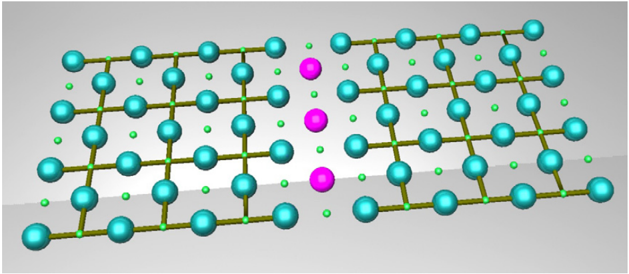
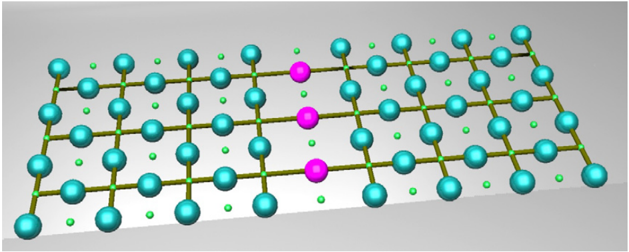
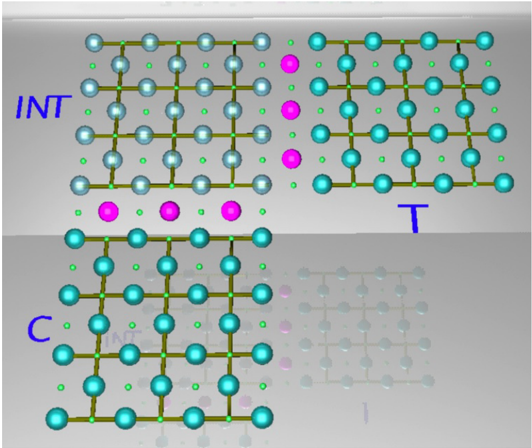
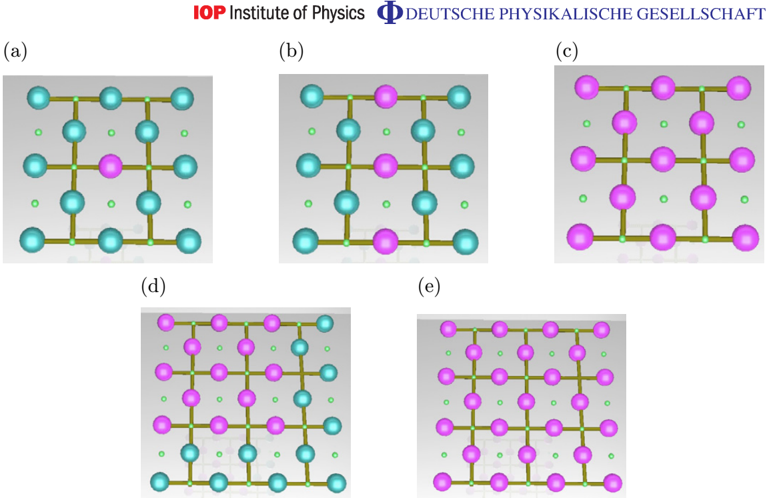
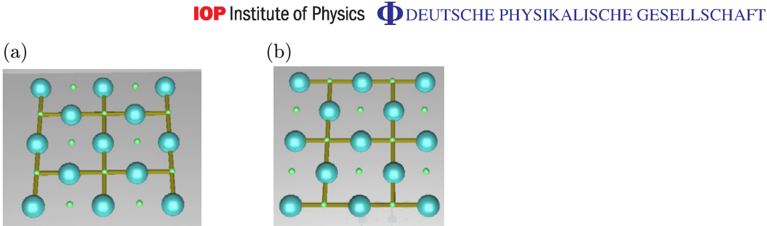
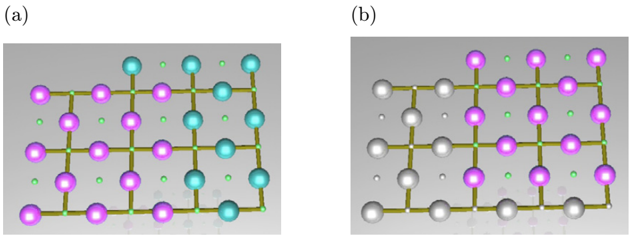
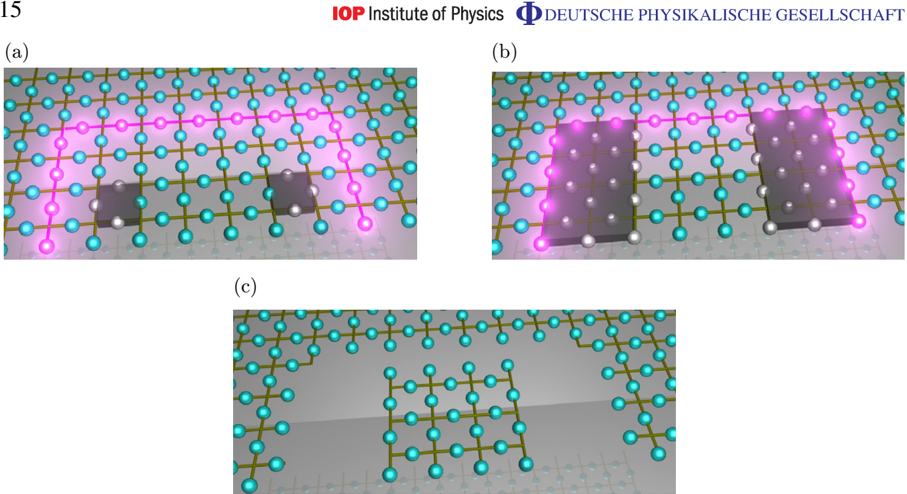
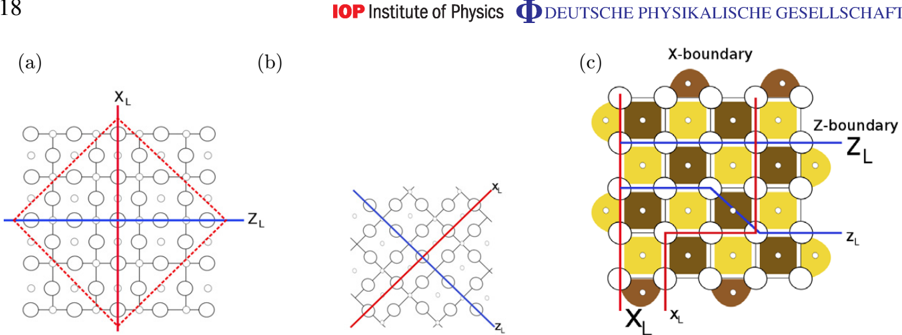
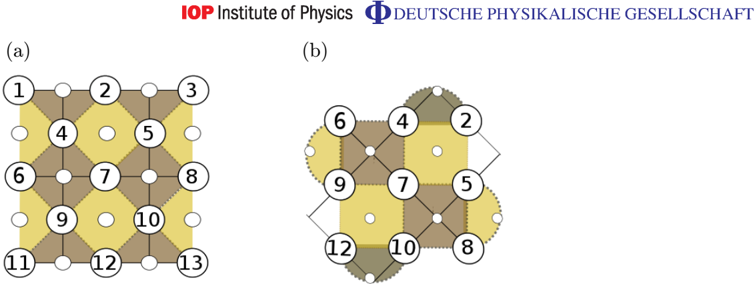
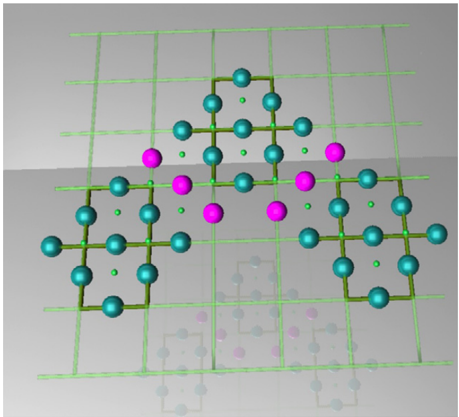
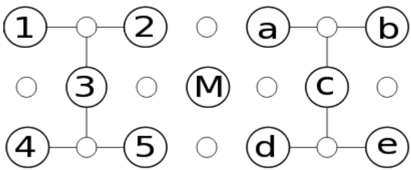
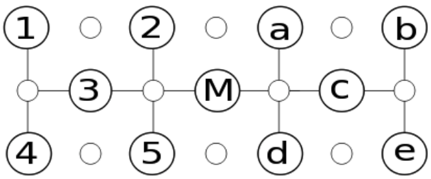
In recent years, surface codes have become a leading method for quantum error correction in theoretical large-scale computational and communications architecture designs. Their comparatively high fault-tolerant thresholds and their natural two-dimensional nearest-neighbour (2DNN) structure make them an obvious choice for large scale designs in experimentally realistic systems. While fundamentally based on the toric code of Kitaev, there are many variants, two of which are the planar- and defect-based codes. Planar codes require fewer qubits to implement (for the same strength of error correction), but are restricted to encoding a single qubit of information. Interactions between encoded qubits are achieved via transversal operations, thus destroying the inherent 2DNN nature of the code. In this paper we introduce a new technique enabling the coupling of two planar codes without transversal operations, maintaining the 2DNN of the encoded computer. Our lattice surgery technique comprises splitting and merging planar code surfaces, and enables us to perform universal quantum computation (including magic state injection) while removing the need for braided logic in a strictly 2DNN design, and hence reduces the overall qubit resources for logic operations. Those resources are further reduced by the use of a rotated lattice for the planar encoding. We show how lattice surgery allows us to distribute encoded GHZ states in a more direct (and overhead friendly) manner, and how a demonstration of an encoded CNOT between two distance-3 logical states is possible with 53 physical qubits, half of that required in any other known construction in 2D.
Overview
The claims and statistics of this paper haven’t been checked yet.
Free: it reads the open-access text and checks the first 5 claims that cite a source we can check. Create a free account to check every claim.
Integrity signals
Registry
Cites
Statistics
Figures





Verification
Claims the paper makes
The claims and statistics of this paper haven’t been checked yet.
Free: it reads the open-access text and checks the first 5 claims that cite a source we can check. Create a free account to check every claim.
Claims other papers make about this one
Each is checked against this paper’s own text: does it say what the citing paper says it does?
The cited source says what the claim attributes to it.
In the citing paper
“Lattice surgery22,39,43,56 enables the efficient realization of multi-qubit fault-tolerant operations, such as the CNOT gate, with only nearest-neighbour interactions.”
From Scaling and logic in the colour code on a superconducting quantum processor (2025) · cites this paper as [22]
The cited source says what the claim attributes to it.
In the citing paper
“Finally, we teleport logical states between colour codes using lattice surgery22.”
From Scaling and logic in the colour code on a superconducting quantum processor (2025) · cites this paper as [22]
Self-check
Percentages, sums and reported differences re-computed from the paper’s own numbers.
The self-check needs the paper’s full text.
Citations
Cites
Fault-tolerant quantum computation by anyons
Kitaev, A. Y. (2003) · Annals of Physics · doi:10.1016/s0003-4916(02)00018-0 · Cited by 7,238 · cited 2×
“Surface codes were first introduced by Kitaev [9] in the context of anyonic quantum computing.”
Edmonds, J. (1965) · Canadian Journal of Mathematics · doi:10.4153/cjm-1965-045-4 · Cited by 2,428 · cited 1×
“[19, 20, 21].”
Dennis, E., Kitaev, A., Landahl, A., & Preskill, J. (2002) · Journal of Mathematical Physics · doi:10.1063/1.1499754 · Cited by 1,768 · cited 1×
“The general procedure was given for the planar code in [2], and a worked example for general surface codes in [4, section VI(C)].”
MethodMaximum matching and a polyhedron with 0,1-vertices
Edmonds, J. (1965) · Journal of Research of the National Bureau of Standards Section B Mathematics and Mathematical Physics · doi:10.6028/jres.069b.013 · Cited by 1,712 · cited 1×
“A pattern of chains of corrective operations highly likely to maintain the correct logical state can be inferred using Edmonds’ minimum weight perfect matching algorithm [21, 22, 23].”
MethodUniversal quantum computation with ideal Clifford gates and noisy ancillas
Bravyi, S., & Kitaev, A. (2005) · Physical Review A · doi:10.1103/physreva.71.022316 · Cited by 1,525 · cited 1×
“This allows for both state preparation and also arbitrary single-qubit rotations, in accordance with standard techniques [29].”
ResultPreskill, J. (1998) · Proceedings of the Royal Society of London. Series A: Mathematical, Physical and Engineering Sciences · doi:10.1098/rspa.1998.0167 · Cited by 994 · cited 1×
“As long as physical errors are below the threshold value, increasing the number of physical qubits can exponentially suppress error on the logical qubits [1].”
BackgroundFault-Tolerant Quantum Computation with High Threshold in Two Dimensions
Raussendorf, R., & Harrington, J. (2007) · Physical Review Letters · doi:10.1103/physrevlett.98.190504 · Cited by 812 · cited 2×
“By contrast, in the defect-based code there are no transversal operations, and the CNOT is performed by braiding defects: extending a defect by measuring out qubits in a line, and passing this extended defect around the second logical qubit defect [3].”
BackgroundMethodTopological fault-tolerance in cluster state quantum computation
Raussendorf, R., Harrington, J., & Goyal, K. (2007) · New Journal of Physics · doi:10.1088/1367-2630/9/6/199 · Cited by 617
High-threshold universal quantum computation on the surface code
Fowler, A. G., Stephens, A. M., & Groszkowski, P. (2009) · Physical Review A · doi:10.1103/physreva.80.052312 · Cited by 486 · cited 1×
“The price of maintaining NN interactions is over three times the number of physical qubits per logical qubit [3, 4].”
BackgroundSelf-citationBlossom V: a new implementation of a minimum cost perfect matching algorithm
Kolmogorov, V. (2009) · Mathematical Programming Computation · doi:10.1007/s12532-009-0002-8 · Cited by 414
Research works printed but not linked: 1
- Bravyi, 2001, Quantum Comp. Comput., 2, 43
Cited by
Quantum error correction for quantum memories
Terhal, B. M. (2015) · Reviews of Modern Physics · doi:10.1103/revmodphys.87.307 · Cited by 1,354
“This rotation þ chopping, while leaving the distance unchanged, can be done for arbitrary-sized lattices (Horsman et al. , 2012). with the check operators, their minimum weight is L .”
InfluentialLogical quantum processor based on reconfigurable atom arrays
Bluvstein, D., Evered, S. J., Geim, A. A., Li, S. H., Zhou, H., Manovitz, T., Ebadi, S., Cain, M., Kalinowski, M., Hangleiter, D., et al. (2024) · Nature · doi:10.1038/s41586-023-06927-3 · Cited by 1,119
“Logic operations are implemented by changing stabilizer measurement patterns, enabling realization of techniques such as braiding 24 and lattice surgery 89 .”
MethodSuppressing quantum errors by scaling a surface code logical qubit
Google Quantum, A. I., Acharya, R., Aleiner, I., Allen, R., Andersen, T. I., Ansmann, M., Arute, F., Arya, K., Asfaw, A., Atalaya, J., et al. (2023) · Nature · doi:10.1038/s41586-022-05434-1 · Cited by 1,103
“Most surface code logical gates can be implemented by maintaining logical memory and executing different sequences of measurements on the code boundary [37, 38].”
Self-citationHow to factor 2048 bit RSA integers in 8 hours using 20 million noisy qubits
Gidney, C., & Ekerå, M. (2021) · Quantum · doi:10.22331/q-2021-04-15-433 · Cited by 830
“We assume distance-d logical qubits are stored using square patches of 2(d+1) physical qubits (see Figure 8) and are operated on via lattice surgery [12, 29] (see Figure 9).”
Realizing repeated quantum error correction in a distance-three surface code
Krinner, S., Lacroix, N., Remm, A., Di Paolo, A., Genois, E., Leroux, C., Hellings, C., Lazar, S., Swiadek, F., Herrmann, J., et al. (2022) · Nature · doi:10.1038/s41586-022-04566-8 · Cited by 686
“The number of required cycles scales in general with d in planar architectures and in architectures allowing for transversal execution of logical two-qubit gates [5, 6, 23, 52, 53].”
BackgroundInfluential
Metadata
- Authors
- Horsman, D., Fowler, A. G., Devitt, S., & Meter, R. V.
- Affiliations
- The University of Melbourne (AU)
- National Institute of Informatics (JP)
- Keio University (JP)
- Venue
- New Journal of Physics
- Publisher
- IOP Publishing
- Published
- 2012-12-01
- Volume
- 14
- Issue
- 12
- Pages
- 123011
- ISSN
- 1367-2630 (ISSN-L)
- OpenAlex
- W1985315536
- Cited by
- 598
- References
- 30
- Citations by year
- 2026: 79 · 2025: 144 · 2024: 82 · 2023: 61 · 2022: 53 · 2021: 30 · 2020: 31 · 2019: 24 · 2018: 25 · 2017: 35 · 2016: 12 · 2015: 12 · 2014: 4 · 2013: 6
- FWCI
- 6.93
- Type
- journal article
- Language
- en
- Open access
- gold
- doi.org
- Licence
- cc-by-nc-sa
- creativecommons.org/licenses/by-nc-sa/3.0/ (vor, 6 d)
- iopscience.iop.org/info/page/text-and-data-mining (tdm, 6 d)
- Locations
- New Journal of Physics (publishedVersion, cc-by-nc-sa)
- arXiv (Cornell University) (publishedVersion)
- DOAJ (DOAJ: Directory of Open Access Journals) (submittedVersion)
- arXiv (Cornell University)
- Funders
- National Security Agency (W911NF-08-1-0527)
- Ministry of Education, Culture, Sports, Science and Technology
- Japan Society for the Promotion of Science
- Centre of Excellence for Quantum Computation and Communication Technology, Australian Research Council (CE110001027)
- Army Research Office (W911NF-08-1, W911NF-08-1- 0527, W911NF)
- Topics
- Physical Sciences › Computer Science › Artificial Intelligence › Quantum Computing Algorithms and Architecture
- Physical Sciences › Physics and Astronomy › Atomic and Molecular Physics, and Optics › Quantum Information and Cryptography
- Physical Sciences › Physics and Astronomy › Atomic and Molecular Physics, and Optics › Quantum many-body systems
- Keywords
- surface code, lattice surgery, toric code, quantum error correction, fault-tolerant quantum computing
About these checks
Registry, retraction, Cites and statistics results are computed, not judged, with one exception: a printed reference that no index lists is read once by a model before it counts as a citation error. Claims are extracted by a model and kept only when their quote appears verbatim in the text; each cited source is then checked, with a model’s help, for whether it says what the claim relies on. Those verdicts can be wrong — read the claim’s quote and the cited source before relying on one.
Statistics and arithmetic are recomputed, not judged.
Confidence bands are shown only for fields calibrated on our annotated test set. None is calibrated yet, so no band is shown.
What counts as a claim ›How we measure confidence ›How we check this ›
Are you an author, or do you see a problem with this page? Request a review
How to cite
Cite CoChat for the checks on this page, and the paper for its own findings.
- This page
- CoChat. (2026). Citation check: Surface code quantum computing by lattice surgery. https://app.cochat.ai/papers/10.1088/1367-2630/14/12/123011
- The paper
- Horsman, D., Fowler, A. G., Devitt, S., & Meter, R. V. (2012). Surface code quantum computing by lattice surgery. New Journal of Physics. https://doi.org/10.1088/1367-2630/14/12/123011
Data sources
Bibliographic data: Semantic Scholar, OpenAlex, Crossref.
Contains information from the Semantic Scholar Academic Graph Datasets, made available under the ODC Attribution License (ODC-BY 1.0).
Semantic Scholar’s data is described in: Kinney, R., et al. (2023). The Semantic Scholar Open Data Platform. arXiv:2301.10140.
