

Hamiltonian Simulation by Qubitization
Open accessThe DOI matches its Crossref record; 50 of the 50 references it cites were found in a registry or an index.
Abstract
We present the problem of approximating the time-evolution operatore−iH^tto errorϵ, where the HamiltonianH^=(⟨G|⊗I^)U^(|G⟩⊗I^)is the projection of a unitary oracleU^onto the state|G⟩created by another unitary oracle. Our algorithm solves this with a query complexityO(t+log(1/ϵ))to both oracles that is optimal with respect to all parameters in both the asymptotic and non-asymptotic regime, and also with low overhead, using at most two additional ancilla qubits. This approach to Hamiltonian simulation subsumes important prior art considering Hamiltonians which ared-sparse or a linear combination of unitaries, leading to significant improvements in space and gate complexity, such as a quadratic speed-up for precision simulations. It also motivates useful new instances, such as whereH^is a density matrix. A key technical result is `qubitization', which uses the controlled version of these oracles to embed anyH^in an invariantSU(2)subspace. A large class of operator functions ofH^can then be computed with optimal query complexity, of whiche−iH^tis a special case.
Overview
The claims and statistics of this paper haven’t been checked yet.
Free: it reads the open-access text and checks the first 5 claims that cite a source we can check. Create a free account to check every claim.
Integrity signals
Registry
Cites
Statistics
Figures
Verification
Claims the paper makes
The claims and statistics of this paper haven’t been checked yet.
Free: it reads the open-access text and checks the first 5 claims that cite a source we can check. Create a free account to check every claim.
Claims other papers make about this one
Each is checked against this paper’s own text: does it say what the citing paper says it does?
In the citing paper
“There are many other Hamiltonian simulation methods, an example of a powerful and sophisticated method being qubitization [166] and quantum signal processing [167], which have the provably optimal asymptotic scaling, although it is unclear whether this will translate to better practical applications.”
From The prospects of quantum computing in computational molecular biology (2021) · cites this paper as [166]
Self-check
Percentages, sums and reported differences re-computed from the paper’s own numbers.
The self-check needs the paper’s full text.
Citations
Cites
A fast quantum mechanical algorithm for database search
Grover, L. K. (1996) · Proceedings of the twenty-eighth annual ACM symposium on Theory of computing - STOC '96 · doi:10.1145/237814.237866 · Cited by 8,830 · cited 1×
“After all, (cid:104) G | ˆ S ˆ U ˆ S ˆ U | G (cid:105) = ˆ I implies that ˆ S ˆ U is a reflection when controlled by input state | G (cid:105) , and it is well-known that a Grover iterate [25, 45] is the product of two reflection about start and target subspaces.”
BackgroundQuantum Algorithm for Linear Systems of Equations
Harrow, A. W., Hassidim, A., & Lloyd, S. (2009) · Physical Review Letters · doi:10.1103/physrevlett.103.150502 · Cited by 3,325 · cited 1×
“ralized by Aharonov and Ta-Shma [3] to sparse Hamiltonians. Celebrated achievements over the years [20,8,32,10,33] have each ignited a urry of activity in diverse applications from quantum algorithms [26,19,21,15] to quantum chemistry [46,44,40,41,4,29,39]. In this dawning era of the small quantum computer [5,23], the…”
BackgroundLloyd, S. (1996) · Science · doi:10.1126/science.273.5278.1073 · Cited by 3,088 · cited 2×
“The first explicit quantum algorithms were discovered by Lloyd [31] for local interactions, and then generalized by Aharonov and Ta-Shma [3] to sparse Hamiltonians.”
Method(1964) · doi:10.1115/1.3625776 · Cited by 1,796
Superconducting quantum circuits at the surface code threshold for fault tolerance
Barends, R., Kelly, J., Megrant, A., Veitia, A., Sank, D., Jeffrey, E., White, T. C., Mutus, J., Fowler, A. G., Campbell, B., et al. (2014) · Nature · doi:10.1038/nature13171 · Cited by 1,733
Quantum principal component analysis
Lloyd, S., Mohseni, M., & Rebentrost, P. (2014) · Nature Physics · doi:10.1038/nphys3029 · Cited by 1,385 · cited 2×
“Celebrated achievements over the years [20, 8, 32, 10, 33] have each ignited a flurry of activity in diverse applications from quantum algorithms [26, 19, 21, 15] to quantum chemistry [46, 44, 40, 41, 4, 29, 39].”
BackgroundMethodA computer program for designing optimum FIR linear phase digital filters
McClellan, J., Parks, T., & Rabiner, L. (1973) · IEEE Transactions on Audio and Electroacoustics · doi:10.1109/tau.1973.1162525 · Cited by 1,139 · cited 1×
“We present a systematic framework that furnishes the optimal complexity and a concrete procedure for almost any f and show how an exact connection is made between query complexity and the theory of best function approximations with polynomials [33, 36].”
MethodScalable Quantum Simulation of Molecular Energies
O’Malley, P. J. J., Babbush, R., Kivlichan, I. D., Romero, J., McClean, J. R., Barends, R., Kelly, J., Roushan, P., Tranter, A., Ding, N., et al. (2016) · Physical Review X · doi:10.1103/physrevx.6.031007 · Cited by 1,059 · cited 1×
“Celebrated achievements over the years [3–7] have each ignited a flurry of activity in diverse applications from quantum algorithms [8–11] to quantum chemistry [12–18].”
BackgroundExponential algorithmic speedup by a quantum walk
Childs, A. M., Cleve, R., Deotto, E., Farhi, E., Gutmann, S., & Spielman, D. A. (2003) · Proceedings of the thirty-fifth annual ACM symposium on Theory of computing · doi:10.1145/780542.780552 · Cited by 825
Demonstration of a small programmable quantum computer with atomic qubits
Debnath, S., Linke, N. M., Figgatt, C., Landsman, K. A., Wright, K., & Monroe, C. (2016) · Nature · doi:10.1038/nature18648 · Cited by 777 · cited 1×
“In this dawning era of the small quantum computer [5, 23], the relevance and necessity of space and gate efficient procedures for practical Hamiltonian simulation has intensified.”
BackgroundOptimal Hamiltonian Simulation by Quantum Signal Processing
Low, G. H., & Chuang, I. L. (2017) · Physical Review Letters · doi:10.1103/physrevlett.118.010501 · Cited by 769 · cited 7×
“Similar to previous approaches [6, 7], we approximate e−iλt with the JacobiAnger expansion e cos (z)t = ∑∞ k=−∞ i Jk(t)e [38], where Jk(t) are Bessel function of the first kind.”
BackgroundMethodResultInfluentialSelf-citationElucidating reaction mechanisms on quantum computers
Reiher, M., Wiebe, N., Svore, K. M., Wecker, D., & Troyer, M. (2017) · Proceedings of the National Academy of Sciences · doi:10.1073/pnas.1619152114 · Cited by 745 · cited 1×
“Celebrated achievements over the years [20, 8, 32, 10, 33] have each ignited a flurry of activity in diverse applications from quantum algorithms [26, 19, 21, 15] to quantum chemistry [46, 44, 40, 41, 4, 29, 39].”
BackgroundSimulating Hamiltonian Dynamics with a Truncated Taylor Series
Berry, D. W., Childs, A. M., Cleve, R., Kothari, R., & Somma, R. D. (2015) · Physical Review Letters · doi:10.1103/physrevlett.114.090502 · Cited by 742 · cited 4×
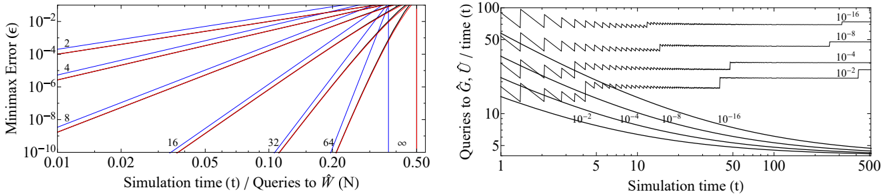
“o be qubitized, thus incurring a factor 2 additional cost from quering U^ and U^yeach over the asymptotic limit of 2 queries per unit of simulation time in Fig.1(Left). Similarly, the BCCKS algorithm [9] incurs a factor 3 additional cost from querying U^ twice and U^yin their use of oblivious amplitude amplication. As…”
BackgroundInfluentialChilds, A. M., Kothari, R., & Somma, R. D. (2017) · SIAM Journal on Computing · doi:10.1137/16m1087072 · Cited by 646 · cited 4×
“Problem BCCKS [6] d-sparse [7] Evolution by ρ QPE QLSP [9] Gibbs [10] Ĥ Hamiltonian Hamiltonian Density matrix Unitary Matrix Hamiltonian Û Selects Ûj Isometry T̂ SWAP Any Any Any Ĝ Ûj coefficients Identity Purified ρ Any Any Any Solution e−iĤt e−iĤt e−iρ̂t Decision Ĥ−1 e−βĤ”
BackgroundInfluential(2004) · doi:10.1109/focs.2004.53 · Cited by 599
Toward the first quantum simulation with quantum speedup
Childs, A. M., Maslov, D., Nam, Y., Ross, N. J., & Su, Y. (2018) · Proceedings of the National Academy of Sciences · doi:10.1073/pnas.1801723115 · Cited by 551 · cited 1×
“Numerical Quantum signal processing: The numerical algorithm for decomposing target polynomials of degree Q into phases was originally claimed to be polynomial time [37], but only when counting arbitrary-precision arithmetical operations, and appeared to be ill-conditioned in case studies [49].”
MethodGilyén, A., Su, Y., Low, G. H., & Wiebe, N. (2019) · Proceedings of the 51st Annual ACM SIGACT Symposium on Theory of Computing · doi:10.1145/3313276.3316366 · Cited by 542 · cited 1×
“Singular value transformations: The standard-form encoding, qubitization, and quantum signal processing of Hermitian or normal matrices has been extended to perform polynomial transformations on the singular value of arbitrary matrices [43].”
BackgroundSelf-citationApproximation of Functions: Theory and Numerical Methods
Meinardus, G. (1967) · Springer Tracts in Natural Philosophy · doi:10.1007/978-3-642-85643-3 · Cited by 493 · cited 3×
“The fact that Chebyshev polynomials are the best polynomial basis for L∞ function approximation on an finite interval [33] suggests that the any target operator f [Ĥ] = A[Ĥ] + iB[Ĥ] could be approximated with a judicious choice of controls on the ancilla register.”
BackgroundMethodOn the Relationship Between Continuous- and Discrete-Time Quantum Walk
Childs, A. M. (2010) · Communications in Mathematical Physics · doi:10.1007/s00220-009-0930-1 · Cited by 411
Hamiltonian simulation using linear combinations of unitary operations
Childs, A. M., & Wiebe, N. (2012) · Quantum Information and Computation · doi:10.26421/qic12.11-12-1 · Cited by 392
Hamiltonian Simulation with Nearly Optimal Dependence on all Parameters
Berry, D. W., Childs, A. M., & Kothari, R. (2015) · 2015 IEEE 56th Annual Symposium on Foundations of Computer Science · doi:10.1109/focs.2015.54 · Cited by 372 · cited 7×
“2A slightly tighter lower bound is Ω(q) queries, where q = min {q ∈ Z+ : < | sin(|τ |/q)|q = O((τ/q)q)} [6, 21].”
BackgroundMethodInfluentialExponential improvement in precision for simulating sparse Hamiltonians
Berry, D. W., Childs, A. M., Cleve, R., Kothari, R., & Somma, R. D. (2014) · Proceedings of the forty-sixth annual ACM symposium on Theory of computing · doi:10.1145/2591796.2591854 · Cited by 324 · cited 4×
“See Cor. 7, 8, 9 for applications.”
BackgroundInfluentialAdiabatic quantum state generation and statistical zero knowledge
Aharonov, D., & Ta-Shma, A. (2003) · Proceedings of the thirty-fifth annual ACM symposium on Theory of computing · doi:10.1145/780542.780546 · Cited by 322 · cited 1×
“The first explicit quantum algorithms were discovered by Lloyd [31] for local interactions, and then generalized by Aharonov and Ta-Shma [3] to sparse Hamiltonians.”
MethodGate-count estimates for performing quantum chemistry on small quantum computers
Wecker, D., Bauer, B., Clark, B. K., Hastings, M. B., & Troyer, M. (2014) · Physical Review A · doi:10.1103/physreva.90.022305 · Cited by 296 · cited 1×
“Celebrated achievements over the years [3–7] have each ignited a flurry of activity in diverse applications from quantum algorithms [8–11] to quantum chemistry [12–18].”
BackgroundFixed-Point Quantum Search with an Optimal Number of Queries
Yoder, T. J., Low, G. H., & Chuang, I. L. (2014) · Physical Review Letters · doi:10.1103/physrevlett.113.210501 · Cited by 223 · cited 2×
“ecovers Eq.4. 7 In hindsight, these results are manifest. After all, hGjS^U^S^U^jGi= I^ implies that S^U^ is a re ection when controlled by input state jGi, and it is well-known that a Grover iterate [25,45] is the product of two re ection about start and target subspaces. Nevertheless, the suciency of these condition…”
BackgroundMethodSelf-citationHamiltonian Simulation by Uniform Spectral AmplificationPreprint
Low, G. H., & Chuang, I. L. (2017) · arXiv (Cornell University) · doi:10.48550/arxiv.1707.05391 · Cited by 185 · cited 1×
“More refined simulation algorithms can exploit prior knowledge of geometric locality [44, 45], Hamiltonian induced one-norm [46], spectral norm [47], and separation of energy scales [48].”
BackgroundSelf-citationProduct Decomposition of Periodic Functions in Quantum Signal Processing
Haah, J. (2019) · Quantum · doi:10.22331/q-2019-10-07-190 · Cited by 183 · cited 1×
“A more thorough analysis [50] proved that the algorithm had a runtime of O(Q3 polylog(Q/ )) with finite-precision arithmetic, provided that some subtleties were carefully managed to control this ill-conditioned behavior.”
Nearly Optimal Lattice Simulation by Product Formulas
Childs, A. M., & Su, Y. (2019) · Physical Review Letters · doi:10.1103/physrevlett.123.050503 · Cited by 181
Methodology of Resonant Equiangular Composite Quantum Gates
Low, G. H., Yoder, T. J., & Chuang, I. L. (2016) · Physical Review X · doi:10.1103/physrevx.6.041067 · Cited by 159 · cited 2×
“Furthermore, a table of select phases ~ φ computed using the algorithm in [37] can be found in Table 3.”
MethodSelf-citationThe Trotter step size required for accurate quantum simulation of quantum chemistry
Poulin, D., Hastings, M. B., Wecker, D., Wiebe, N., Doberty, A. C., & Troyer, M. (2015) · Quantum Information and Computation · doi:10.26421/qic15.5-6-1 · Cited by 159 · cited 1×
“Celebrated achievements over the years [3–7] have each ignited a flurry of activity in diverse applications from quantum algorithms [8–11] to quantum chemistry [12–18].”
BackgroundQuantum Speed-Ups for Solving Semidefinite Programs
Brandao, F. G. S. L., & Svore, K. M. (2017) · 2017 IEEE 58th Annual Symposium on Foundations of Computer Science (FOCS) · doi:10.1109/focs.2017.45 · Cited by 142 · cited 2×
“Celebrated achievements over the years [3–7] have each ignited a flurry of activity in diverse applications from quantum algorithms [8–11] to quantum chemistry [12–18].”
BackgroundExponentially more precise quantum simulation of fermions in second quantization
Babbush, R., Berry, D. W., Kivlichan, I. D., Wei, A. Y., Love, P. J., & Aspuru-Guzik, A. (2016) · New Journal of Physics · doi:10.1088/1367-2630/18/3/033032 · Cited by 135
Chakraborty, S., Gilyén, A., & Jeffery, S. (2019) · Schloss Dagstuhl – Leibniz-Zentrum für Informatik · doi:10.4230/lipics.icalp.2019.33 · Cited by 127 · cited 1×
“4After the original preprint release of this manuscript, standard-form encoding has been replaced in the community by ‘block-encoding’ [29], which is a more informative description.”
Black-box Hamiltonian simulation and unitary implementation
Childs, A. M., & Berry, D. W. (2012) · Quantum Information and Computation · doi:10.26421/qic12.1-2-4 · Cited by 101
Spectra of Quantized Walks and a $\sqrt{δε}$ rulePreprint
Szegedy, M. (2004) · arXiv (Cornell University) · doi:10.48550/arxiv.quant-ph/0401053 · Cited by 86
Hamiltonian simulation with optimal sample complexity
Kimmel, S., Lin, C. Y.-Y., Low, G. H., Ozols, M., & Yoder, T. J. (2017) · npj Quantum Information · doi:10.1038/s41534-017-0013-7 · Cited by 85 · cited 1×
“…the ancilla of some output from a quantum circuit ˆ G , we instead keep this ancilla, leading to an unconditional quadratic improvement in time scaling, and an exponential improvement in error scaling over the sample-based Lloyd, Mohseni, and Rebentrost (LMR) model [32, 28], as summarized in Table.”
MethodSelf-citationQuantum algorithms for Gibbs sampling and hitting-time estimation
Chowdhury and, A. N., & Somma, R. D. (2017) · Quantum Information and Computation · doi:10.26421/qic17.1-2-3 · Cited by 76 · cited 2×
“Problem BCCKS [6] d-sparse [7] Evolution by ρ QPE QLSP [9] Gibbs [10] Ĥ Hamiltonian Hamiltonian Density matrix Unitary Matrix Hamiltonian Û Selects Ûj Isometry T̂ SWAP Any Any Any Ĝ Ûj coefficients Identity Purified ρ Any Any Any Solution e−iĤt e−iĤt e−iρ̂t Decision Ĥ−1 e−βĤ”
BackgroundQuantum Algorithm for Simulating Real Time Evolution of Lattice Hamiltonians
Haah, J., Hastings, M., Kothari, R., & Low, G. H. (2018) · 2018 IEEE 59th Annual Symposium on Foundations of Computer Science (FOCS) · doi:10.1109/focs.2018.00041 · Cited by 65
Self-citationBounding the costs of quantum simulation of many-body physics in real space
Kivlichan, I. D., Wiebe, N., Babbush, R., & Aspuru-Guzik, A. (2017) · Journal of Physics A: Mathematical and Theoretical · doi:10.1088/1751-8121/aa77b8 · Cited by 63 · cited 1×
“Celebrated achievements over the years [20, 8, 32, 10, 33] have each ignited a flurry of activity in diverse applications from quantum algorithms [26, 19, 21, 15] to quantum chemistry [46, 44, 40, 41, 4, 29, 39].”
BackgroundLimitations on the simulation of non-sparse Hamiltonians
Childs, A. M., & Kothari, R. (2010) · Quantum Information and Computation · doi:10.26421/qic10.7-8-7 · Cited by 58
Hamiltonian Simulation in the Interaction Picture
Low, G. H., & Wiebe, N. (2018) · arXiv (Cornell University) · doi:10.48550/arxiv.1805.00675 · Cited by 51 · cited 1×
“More refined simulation algorithms can exploit prior knowledge of geometric locality [44, 45], Hamiltonian induced one-norm [46], spectral norm [47], and separation of energy scales [48].”
BackgroundSelf-citationIntroduction to Quantum Algorithms for Physics and Chemistry
Yung, M., Whitfield, J. D., Boixo, S., Tempel, D. G., & Aspuru‐Guzik, A. (2014) · Advances in Chemical Physics · doi:10.1002/9781118742631.ch03 · Cited by 50 · cited 1×
“Celebrated achievements over the years [20, 8, 32, 10, 33] have each ignited a flurry of activity in diverse applications from quantum algorithms [26, 19, 21, 15] to quantum chemistry [46, 44, 40, 41, 4, 29, 39].”
BackgroundSomma, R. D., & Boixo, S. (2013) · SIAM Journal on Computing · doi:10.1137/120871997 · Cited by 43 · cited 1×
“Similar structures are of foundational importance to many quantum algorithms – the gap ∆ of eigenvalues λ = 1 − ∆ of Ĥ is amplified to cos−1 (λ) = O( √ ∆) in the phase of the iterate, which resembles spectral gap amplification [30], the quantization of stochastic matrices [31], as well as Szegedy’s [26] and Childs’ [2…”
BackgroundA Trotter-Suzuki approximation for Lie groups with applications to Hamiltonian simulation
Somma, R. D. (2016) · Journal of Mathematical Physics · doi:10.1063/1.4952761 · Cited by 41 · cited 1×
“Furthermore, it is easy to construct pathological ˆ H with small norms, but nevertheless decompose by naive methods into components with large spectral norms [42].”
BackgroundChebyshev digital FIR filter design
Karam, L. J., & McClellan, J. H. (1999) · Signal Processing · doi:10.1016/s0165-1684(98)00244-8 · Cited by 40 · cited 1×
“, Q/2, and is plotted for the upper bound 4t 2qq! (blue), truncation ∑∞ k=q 2|Jk[t]| (black), and best possible [51] (red), for Q = 2, 4, 8, 16, 32, 64,∞ queries to the controlled iterate Ŵ , where q = 1+Q/2.”
BackgroundCorrected quantum walk for optimal Hamiltonian simulation
Berry, D. W., & Novo, L. (2016) · Quantum Information and Computation · doi:10.26421/qic16.15-16-3 · Cited by 36 · cited 1×
“It is unclear whether our methodology could be applied to other formulations of Hamiltonian simulation, in contrast to alternatives that seem more flexible [27].”
MethodHamiltonian simulation with nearly optimal dependence on spectral norm
Low, G. H. (2019) · Proceedings of the 51st Annual ACM SIGACT Symposium on Theory of Computing · doi:10.1145/3313276.3316386 · Cited by 23 · cited 1×
“More refined simulation algorithms can exploit prior knowledge of geometric locality [44, 45], Hamiltonian induced one-norm [46], spectral norm [47], and separation of energy scales [48].”
BackgroundSelf-citationQuantum Imaging by Coherent Enhancement
Low, G. H., Yoder, T. J., & Chuang, I. L. (2015) · Physical Review Letters · doi:10.1103/physrevlett.114.100801 · Cited by 20 · cited 1×
“ting any arbitrary target function of the signal exactly matches fundamental bounds lower in polynomial and Fourier approximation theory [37], we expect this to have numerous application in metrology [34] and other quantum algorithms [45]. 7 Acknowledgements G.H.Low and I.L.Chuang thank Robin Kothari, Yuan Su, and And…”
BackgroundSelf-citationBoyd, J. P. (2006) · Applied Numerical Mathematics · doi:10.1016/j.apnum.2005.11.010 · Cited by 20 · cited 1×
“The rapid converge by truncation arises as eit sin (θ) is an entire analytic function [14].”
BackgroundAn ancilla-based quantum simulation framework for non-unitary matrices
Daskin, A., & Kais, S. (2016) · Quantum Information Processing · doi:10.1007/s11128-016-1452-3 · Cited by 19 · cited 1×
“In prior art [22], this was approximated using phase estimation.”
Method
Research works printed but not linked: 2
- R. Kothari, Efficient algorithms in quantum query complexity, Ph.D. thesis, University of Waterloo (2014).
- M. Abramowitz, I. A. Stegun, and Others, "Handbook of mathematical functions," Applied mathematics series 55, 62 (1966).
Cited by
Quantum computational chemistry
McArdle, S., Endo, S., Aspuru-Guzik, A., Benjamin, S. C., & Yuan, X. (2020) · Reviews of Modern Physics · doi:10.1103/revmodphys.92.015003 · Cited by 1,621
Quantum Chemistry in the Age of Quantum Computing
Cao, Y., Romero, J., Olson, J. P., Degroote, M., Johnson, P. D., Kieferová, M., Kivlichan, I. D., Menke, T., Peropadre, B., Sawaya, N. P. D., et al. (2019) · Chemical Reviews · doi:10.1021/acs.chemrev.8b00803 · Cited by 1,560
Machine learning & artificial intelligence in the quantum domain: a review of recent progress
Dunjko, V., & Briegel, H. J. (2018) · Reports on Progress in Physics · doi:10.1088/1361-6633/aab406 · Cited by 1,055
The Variational Quantum Eigensolver: A review of methods and best practices
Tilly, J., Chen, H., Cao, S., Picozzi, D., Setia, K., Li, Y., Grant, E., Wossnig, L., Rungger, I., Booth, G. H., et al. (2022) · Physics Reports · doi:10.1016/j.physrep.2022.08.003 · Cited by 1,031
Quantum Algorithms for Quantum Chemistry and Quantum Materials Science
Bauer, B., Bravyi, S., Motta, M., & Chan, G. K.-L. (2020) · Chemical Reviews · doi:10.1021/acs.chemrev.9b00829 · Cited by 848
Metadata
- Authors
- Low, G. H., & Chuang, I. L.
- Affiliations
- Massachusetts Institute of Technology (US)
- Venue
- Quantum
- Published
- 2019-07-12
- Volume
- 3
- Pages
- 163
- ISSN
- 2521-327X (ISSN-L)
- OpenAlex
- W2535738892
- Cited by
- 854
- References
- 46
- Citations by year
- 2026: 120 · 2025: 216 · 2024: 160 · 2023: 137 · 2022: 92 · 2021: 70 · 2020: 43 · 2019: 15
- FWCI
- 25.21
- Type
- journal article
- Language
- en
- Open access
- gold
- doi.org
- Locations
- Quantum (publishedVersion, cc-by)
- arXiv (Cornell University) (acceptedVersion)
- DOAJ (DOAJ: Directory of Open Access Journals) (submittedVersion)
- arXiv (Cornell University) (cc-by)
- Topics
- Physical Sciences › Computer Science › Artificial Intelligence › Quantum Computing Algorithms and Architecture
- Physical Sciences › Physics and Astronomy › Atomic and Molecular Physics, and Optics › Quantum many-body systems
- Physical Sciences › Physics and Astronomy › Atomic and Molecular Physics, and Optics › Quantum Mechanics and Applications
- Keywords
- Hamiltonian simulation, qubitization, evolution operator, query complexity, sparse Hamiltonians, linear combination of unitaries, ancilla qubits, operator functions, quantum algorithms
About these checks
Registry, retraction, Cites and statistics results are computed, not judged, with one exception: a printed reference that no index lists is read once by a model before it counts as a citation error. Claims are extracted by a model and kept only when their quote appears verbatim in the text; each cited source is then checked, with a model’s help, for whether it says what the claim relies on. Those verdicts can be wrong — read the claim’s quote and the cited source before relying on one.
Statistics and arithmetic are recomputed, not judged.
Confidence bands are shown only for fields calibrated on our annotated test set. None is calibrated yet, so no band is shown.
What counts as a claim ›How we measure confidence ›How we check this ›
Are you an author, or do you see a problem with this page? Request a review
Data sources
Bibliographic data: Semantic Scholar, OpenAlex, Crossref.
Contains information from the Semantic Scholar Academic Graph Datasets, made available under the ODC Attribution License (ODC-BY 1.0).
Semantic Scholar’s data is described in: Kinney, R., et al. (2023). The Semantic Scholar Open Data Platform. arXiv:2301.10140.
